Introduction
Ramadan is a Holy Islamic religious month. It is the ninth month of the Hijra calendar, during which Muslims are expected to fast from sunrise to sundown for the entire month. During Ramadan, the population of Makkah (Mecca), Saudi Arabia increases precipitously, with recent statistics from the Ministry of Hajj (Makkah, Saudi Arabia) showing that approximately 7.6 million Umrah (religious visitation) visas were issued in the lead up to Ramadan in 2019. 1 These pilgrims spend their visit in the Holy Mosque of Makkah, which has a capacity of up to four million, where they perform religious rituals and attend prayers.
Saudi Arabia hosts around six million Umrah visitors each year, with this number expected to reach 30 million annually by 2030. Reference Yezli, Yassin, Awam, Attar, Al-Jahdali and Umrah2 Most research and surge capacity planning in Makkah are focused on the mass gathering during Hajj (Figure 1), despite the number of pilgrims performing Umrah being significantly higher than during Hajj. Reference Yezli, Yassin, Awam, Attar, Al-Jahdali and Umrah2 King Abdul-Aziz Hospital (KAAH; Makkah, Saudi Arabia) is a 300-bed referral hospital and trauma center located in Makkah. It operates a 39-bed emergency department (ED) throughout the year and a 20-bed intensive care unit (ICU). During Hajj, the ED flexes up to 47 beds and the ICU up to 40 beds.
PubMed Search Results for Yearly Publications Related to the Hajj and Umrah.
Note: Generated using the search terms “Hajj” or “Umrah” or “Umra.”

The World Health Organization (WHO; Geneva, Switzerland) defines a mass gathering as a planned or spontaneous event where the number of people attending could strain the planning and response resources of the community or country hosting the event. The Olympic Games, Hajj, and other major sporting, religious, and cultural events are all examples of a mass gathering. 3 The health care sector should identify methods to increase resource availability during these gatherings.
Mass gatherings, including Ramadan, increase the risk of high-casualty events, including infectious disease outbreaks, natural disasters, terrorist attacks, and accidental injuries which can place immense pressure on health care system resources. Reference Kok, Blyth and Dwyer4 This state of patient surge can last through and sometimes beyond the demobilization of the mass gathering. The influx of patients requires hospitals to create surge capacity, defined as an increase in the ability to triage and treat large numbers of patients. Surge capacity has four components, often referred to as the “4S’s”: Staff, Stuff, Space, and Systems. Reference Ciottone5 In order to create surge capacity in Makkah, it is important to determine the impact of Ramadan on health care facilities in order to predict resource needs.
The goal of this study is to define the impact of the Ramadan mass gathering in comparison to Hajj and the rest of the year on KAAH using recent trends in resource utilization with a focus on ED visits, hospital admissions, and mortality so as to better plan future resource needs for hospitals involved in the medical response to events on this scale.
Methods
This study is a retrospective chart review of electronic medical records. It compares ED visits and hospital admissions during Ramadan with those during Hajj and with non-Hajj/non-Ramadan months during the years 1438-1440 in the Hijra calendar, which corresponds to the years 2016-2019 on the Gregorian calendar. The Hijra calendar is a twelve-month calendar based on the lunar cycle used for determining religious dates throughout the Islamic world. The Hijra calendar is used in this study because Hajj and Ramadan are determined by their placement on this calendar, as opposed to the Gregorian calendar, on which both religious celebrations move each year. Primary outcomes measured were the number of ED visits per month, hospital admission per month, and ICU admissions per month. Secondary outcomes were mortality (in ED and in-hospital); number of surgeries performed by specialty; and number of admissions to the cardiac, orthopedic, and general surgery wards. Inclusion criteria were all patients who presented to the ED during the study time period. There were no exclusion criteria. This study was approved by both the Institutional Review Board of Beth Israel Deaconess Medical Center (Boston, Massachusetts USA; Protocol # 2020D000075) and the Makkah Research Center (KAMC; Makkah, Saudi Arabia; H-02-K-076-0919-194).
Data Collection
Data were collected from the hospital Quality Improvement/Quality Assurance (QI/QA) evaluation program. This database automatically collects data from the electronic medical records of all ED visits and hospital admissions in an unidentifiable, abstracted format. There is no manual data entry into the database. No protected health information (ie, patient name, date of birth, or governmental identification numbers) was collected from the QI/QA system. All charts were associated with a randomly generated identification number for the study. Information collected from the database included disposition for each patient, whether a surgical procedure was performed, and whether the patient died prior to discharge for those who were admitted.
Data Analysis
All charts were collected and collated to determine total numbers of ED visits, total hospital admissions, specialty ward admissions, and ICU admissions by month. These designations come directly from the QI/QA database, and this was done by simple counting of charts that met each criterion by researchers. Data were analyzed in Excel spreadsheets (Microsoft Corporation; Redmond, Washington USA). Sub-groups by triage category (acute versus non-acute), ward of admission, and mortality were collected from these totals. A mean number of patients for each category was calculated for the ten months excluding Ramadan and Hajj, reported with 95% confidence intervals (CI). As the QI/QA database collects the chart of every hospital visit, the data collected represents 100% of each category, so no other power calculation was performed based on sample size.
Results
During the study period (three years of the Hijra calendar – Moharram, 1438 through Dul-Hijjah, 1440), a total of 566,050 patients visited the ED at KAAH. This time period correlates with October 2, 2016 through August 30, 2019 on the Gregorian calendar. There were 205,974 visits in 1438 (October 2, 2016 - September 20, 2017); 206,610 visits in 1439 (September 21, 2017- September 10, 2018); and 133,466 in 1440 (September 11, 2018 - August 30, 2019). The average month had 14,856.5 (95% CI, 1400-15800) ED visits in 1438; 14,971.9 (95% CI, 13200-16700) in 1439; and 10,716.0 (95% CI, 9650-11800) in 1440. There were 68,433 total ED visits during the three Ramadan months, with 27,216 (183.0% monthly average) in 1438; 26,173 (174.8% monthly average) in 1439; and 15,044 (140.3% monthly average) in 1440 (Table 1). This represented more than 12.5% of ED visits during the three-year period.
Average ED Visits per Month Compared to During Ramadan Across Years

Total Admissions by Service per Year and During Ramadan

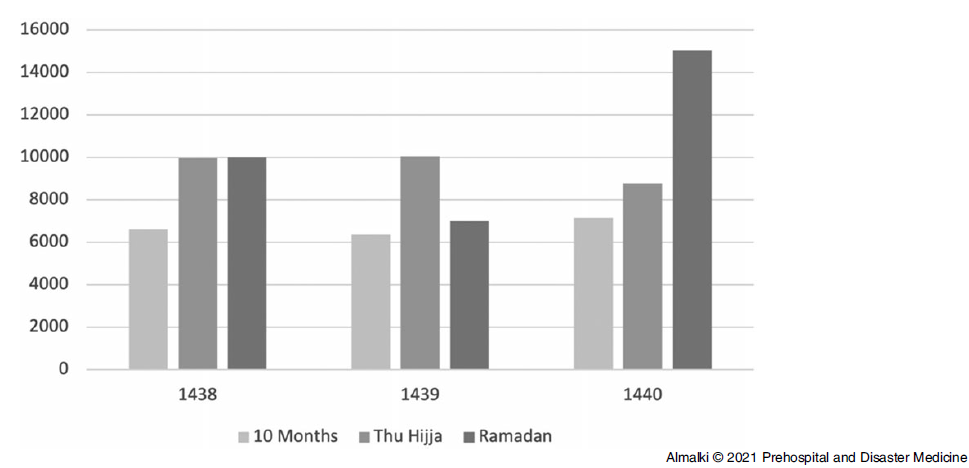
During Ramadan, there were 32,021 total acute visits based on the Canadian Triage System over the three years. There were 9,995 in 1438; 7,002 in 1439, respectively; and 15,024 in 1440 (Figure 2).
Monthly ED Visits Classified as “Acute” by the Canadian Triage System.
Abbreviation: ED, emergency department.

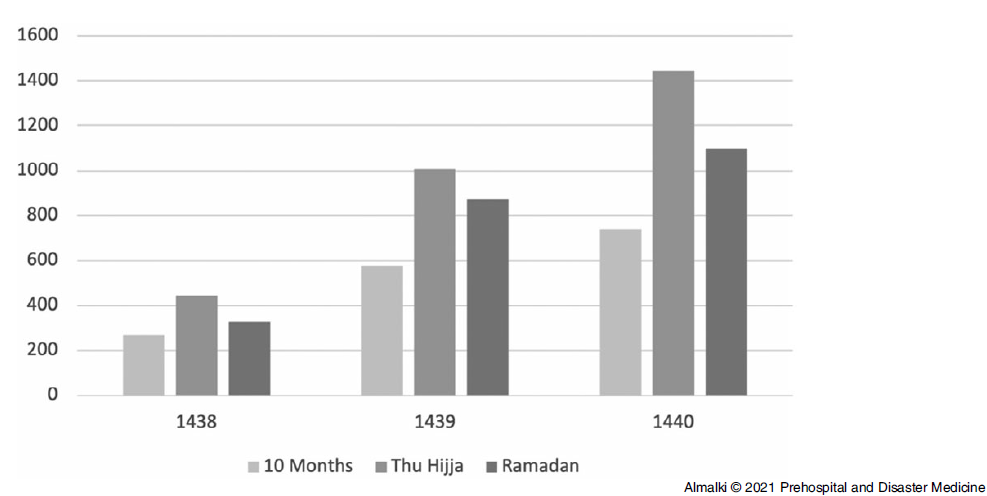
There were 21,045 total admissions, including ICU admissions, during the study period (3,464 in 1438; 7,640 in 1439; and 9,941 in 1440). During Ramadan, in the three years there were 2,293 total patients admitted, representing 10.8% of yearly admissions (326 in 1438; 860 in 1439; and 1,097 in 1440). The average month saw 289 admissions in 1438; 636 admissions in 1439; and 828 admissions in 1440 (Figure 3).
Total Number of Ward Admissions.

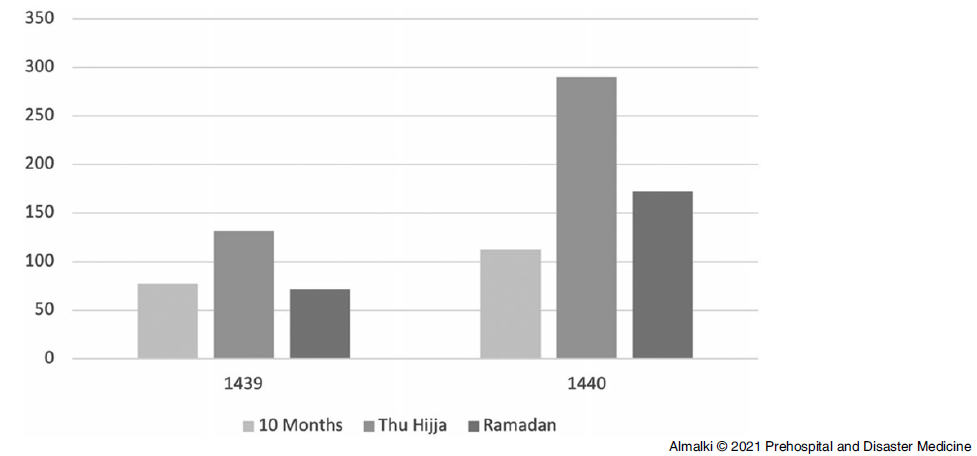
A consistent effect of Ramadan on ICU admissions compared with other months was not observed. In 1439, there were a total of 971 admissions, for an average of 77.4 per month. During Ramadan of that year, 72 patients were admitted to the ICU. In 1440, there were 1,590 total ICU admissions, an average of 112.8 per month. During Ramadan of 1440, there were 172 ICU admissions. The ICU admission totals for 1438 were missing due to the retrospective nature of the data collection from the QI/QA database, which did not maintain these numbers for 1438 (Figure 4).
Total Number of Intensive Care Unit Admissions.

When excluding Ramadan and Hajj from the monthly average, there were significant differences in admission rates to specific services between Ramadan and other months of the same year. This included admissions to orthopedic surgery, general surgery, and the cardiac ward. For general surgery, the 10-month average of admissions was 108.5 (95% CI, 96.3-121.0). For orthopedic surgery, it was 84.9 (95% CI, 74.7-95.1) in 1439 and 98.2 (95% CI, 98.3-107.0) in 1440. For the cardiac ward, it was 21.2 (95% CI, 15.8-26.6) in 1439 and 26.7 (95% CI, 21.4-32.0) in 1440. During Ramadan, general surgery averaged 224 admissions (206% monthly average). Orthopedic surgery admitted 120 each year. The cardiac ward admitted 39 patients in Ramadan of 1439 and 30 in 1440.
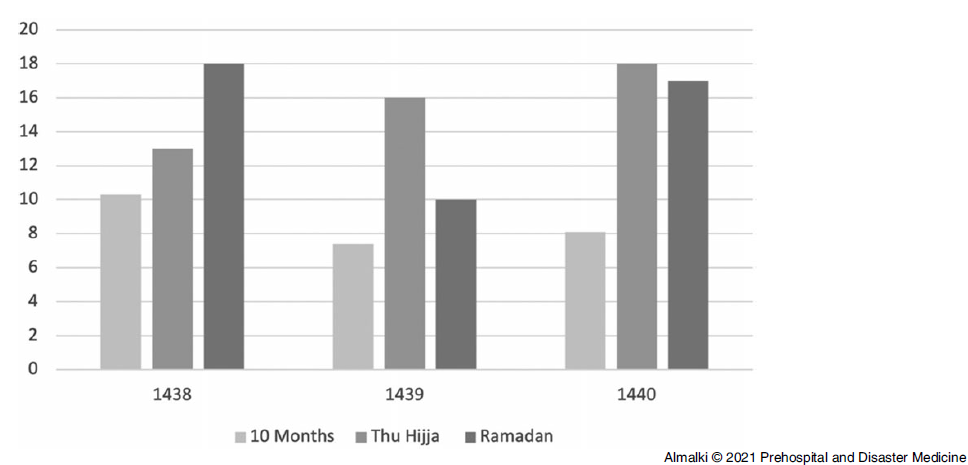
There was a change in ED mortality during Ramadan compared to all other months when Hajj was excluded. The 10-month average of ED deaths was 8.6 (95% CI, 7.08-10.10) per month. Ramadan averaged 15.00 deaths per year over the course of the month, while Hajj averaged 15.67. In-patient mortality was comparable between Ramadan and other months, excluding Hajj (Figure 5).
Mortalities in the ED.

Discussion
As one of the most holy celebrations in Islam, Ramadan is associated with a significant transient increase in the population of Makkah. Mass-gathering medicine is a specialized field which deals with these large influxes of population to a single area, such as pilgrims in Makkah during Ramadan. Several factors influence the health care response to mass gatherings, including the size of the gathering, duration of the event, diversity of the population, and the baseline medical facilities of the region. Reference Shujaa and Alhamid6
The increase in Makkah’s population during Ramadan is comparable in many ways to that during Hajj, during which there is a major increase in medical resources. These include mobile temporary facilities, including 25 additional hospitals opened with an increase of 4,427 in bed capacity (500 critical care and 550 emergency care) and 141 out-patient health centers established in the region with an additional 20,000 medical personnel. Reference Shujaa and Alhamid6
It was found that there was a trend of increasing ED visits from the seventh month in the Hijra calendar (Rajab) which peaked during Ramadan (ninth month in the Hijra calendar) each year. This trend is due to the issuance of Umrah visas during Rajab, gradually increasing to a maximum number for Ramadan. These are known as the Umrah months, and many pilgrims come early in Rajab and stay until the end of Ramadan. In Hajj rituals, pilgrims spend roughly seven days in Makkah moving between several locations such as Arafat and Mina, but in Ramadan, they are more stationary in Makkah around the Holy Mosque.
Much of the drop in total ED visits in 1440 was likely due to the opening of a separate hospital which accepted the non-acute visits via a triage policy initiated in Rajab, two months prior to Ramadan. This hospital functions all year round and is not specific to Ramadan.
There was a demonstrated increase in ED mortality during Ramadan without increase in mortality among admitted patients. This could be due to higher acuity pilgrims coming to the ED during Ramadan. Previous studies have shown that 43% of pilgrims are 56 years of age or older, two-thirds are from countries with suboptimal disease surveillance systems or travel health services, and 50% have pre-existing chronic disease. Reference Ebrahim and Memish7 Possible explanations include increased patient hand-offs by staff during Ramadan from a 25% decrease in work hours due to fasting, decreased cognitive function of staff due to fasting, or increased wait-times of patients due to surge without additional staff. Reference Petersen, Brennan, O’Neil, Cook and Lee8–Reference Qasrawi, Pandi-Perumal and BaHammam10
Emergency preparedness for mass gatherings is in large part dependent upon the creation of surge capacity. This surge capacity requires the availability of resources, as well as a coherent plan for their allocation. Reference Hick, Christian and Sprung11 The medical system must have a clear plan to increase staff (both medical and support staff) to deal with increases in patient presentations. It must also develop a plan to provide enough space and material resources to care for the increased patient population inherent in a mass gathering. These material resources range from high-cost equipment, such as additional ventilators, to lower cost materials, such as bandages and linens. A hospital must plan for an increased demand for these resources, requiring adequate supply chains and careful planning prior to the mass gathering. Reference Paras, Butler, Maguire and Scarfone12
The medical system of Makkah, led by the Ministry of Health (Riyadh, Saudi Arabia) and the Ministry of Hajj, have extensive experience providing increased resources for the Hajj mass gathering. Reference Shujaa and Alhamid6 Despite the influx of patients inherent in the Ramadan mass gathering, there are currently no additional resources devoted to the medical system during this time. However, the experience of KAAH demonstrates the strain placed on the medical system by this lack of resources and shows a trend towards increased ED mortality. Careful planning and allocation of resources for the medical response to Ramadan could potentially decrease patient morbidity and mortality.
Limitations
The primary limitation of this study is that it is a single center study over a three-year time period only. Further research that includes additional local and regional centers should be considered for more robust statistical analysis. Additionally, the expected increase in the number of pilgrims during Ramadan over the coming decade limits the ability to predict exact resource needs based on this study, though it should highlight the need to increase resource allocation. Finally, given the nature of the QI/QA database used for data collection, there is missing granularity in the data which could provide additional information in regards to specific resources (ie, ventilators or surgical equipment) which may need to be stockpiled.
Conclusion
The month of Ramadan should be considered a mass-gathering event and managed similarly to Hajj. To achieve the goal of improved patient outcomes, a national preparedness strategy for Ramadan mass gatherings should include the provision of additional resources and personnel.
Conflicts of interest/funding
none