Introduction
Profound demographic changes affecting the age distribution of societies are a global phenomenon, and with the population ageing that we are witnessing today is unprecedented in the whole of human history (United Nations, 2009). Commonly, in Western societies the social stereotype of ageing is a negative phenomenon (Levy, Reference Levy2009), and Spain is not an exception to this. Surprisingly, when older people are asked about ageing, their experience is often seen in a more positive light, in which growth, development, and positive changes are still possible and commonplace (Vaillant, Reference Vaillant2002; Laidlaw et al., Reference Laidlaw, Power and Schmidt2007). The majority of older people experience ageing as just another stage of life, where loss and change is a universal experience accepted as part of a longer lifespan (Boerner and Jopp, Reference Boerner and Jopp2007). Consistent with this is the phenomenon of ageing paradox, where older people typically report high levels of life satisfaction at the stage of life most associated with cognitive and physical decline (Carstensen and Löckenhoff, Reference Carstensen and Löckenhoff2003). Recent research suggests that older people do not necessarily, nor universally, experience ageing as a negative event in life, as longitudinal data demonstrate that many older people experience ageing as a relatively benign experience with the result that they develop enhanced well being and greater emotional stability across the lifespan (Carstensen et al., Reference Carstensen2011).
Ageing is a process rather than a state and is uniquely a personal experience so that an individual's attitude toward the ageing process may affect the quality of later years as well as long-term health-related outcomes (Levy et al., Reference Levy, Slade and Kasl2002; Harrison et al., Reference Harrison, Blozis and Stuifbergen2008), including mortality (Levy and Myers, Reference Levy and Myers2005). Social support may act as a buffer between stressful situations and mental health outcomes (Cohen and Wills, Reference Cohen and Wills1985), and physical health outcomes and functional limitations (Fong et al., Reference Fong, Finlayson and Peacock2006; Harrison et al., Reference Harrison, Blozis and Stuifbergen2008). In addition, perceptions of ageing may also be influenced by how fast functions decline (Harrison et al., Reference Harrison, Blozis and Stuifbergen2008). Nevertheless, studies of how social support might impact attitudes toward ageing are scarce (Harrison et al., Reference Harrison, Blozis and Stuifbergen2008). As such when trying to understand the experience of ageing, older people are the only section of society qualified to comment upon this. Thus, older people have the most intimate knowledge of adaptation to the ageing process, and therefore Attitudes to Ageing Questionnaire (AAQ) that can capture personal experiences of ageing in the context of more general attributes about attitudes to ageing is an important assessment tool (Laidlaw et al., Reference Laidlaw, Power and Schmidt2007).
Until now, with the development of the AAQ (Laidlaw et al., Reference Laidlaw, Power and Schmidt2007) there have been very few measures that explicitly assess the individual experience of ageing in a more contemporary and broad manner. Prior to the development of the AAQ, researchers commonly used a subscale of the Philadelphia Geriatric Morale Scale (PGCMS; Lawton, Reference Lawton1975) to index attitudes to ageing. The PGCMS was designed to provide a measure of morale or psychological well being in social studies in the field of gerontology. The PGCMS subscale, Attitude toward own ageing, consists of five items that capture a very restricted snapshot of the experience of ageing. While it has been used in a variety of gerontological studies in a number of countries, including Spain (Stock et al., Reference Stock, Okun and Gómez Benito1994), it is nevertheless inadequate as a general tool to flexibly and comprehensively measure attitudes to ageing (Laidlaw et al., Reference Laidlaw, Power and Schmidt2007).
The AAQ has been developed using the methodology for scale development collated by the World Health Organisation Quality of Life Group (The WHOQOL Group, 1998a; 1998b) in the context of the development of an adaptation of the WHOQOL measures for use with older adults (Power et al., Reference Power, Quinn and Schmidt2005). It was based on an intense theoretical debate among international experts, as well as in focus groups carried out with older adults to confirm or adjust the instrument items. Barcelona was one of the centers used in the original focus groups for development of the AAQ.
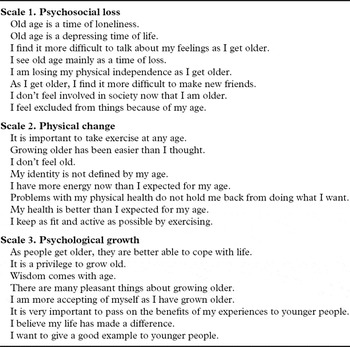
The AAQ assesses the subjective perception of ageing, focussing primarily on three different aspects of ageing. The first subscale focuses on psychosocial losses relevant to older adults in which the perceived negative experiences of ageing are collected together in a single composite scale. This subscale functions as a proxy for negative attitudes to ageing where old age is seen primarily as a negative experience involving psychological and social loss. The second subscale (physical change) has a more mixed physical functioning focus with items related primarily to health, exercise, and the experience of ageing itself. The third subscale (psychological growth) has an explicitly positive focus and could be summarized as “Wisdom” or “Growth,” as it recognises a lifespan development perspective on ageing as viewed by the individual. Thus, the three-domain structure of the AAQ reflects both positive and negative aspects of ageing The subjective perspective of ageing is important in the AAQ, as it allows researchers a way of measuring attitudes toward ageing from the perspective of the older people themselves, as this provides researchers with a unique insight into the experience of ageing (Chachamovich et al., Reference Chachamovich, Fleck, Laidlaw and Power2008). The AAQ utilizes two different answer formats to provide an experimental and general approach to understanding an individual's attitudes. Thus, section one comprises personal experiential questions such as “growing older has been easier than I thought,” and section two comprises more general attitudes, such as “wisdom comes with age.” This feature adds to the potential usefulness of this tool, as it was designed to be used by researchers, clinicians, and policy makers (Laidlaw et al., Reference Laidlaw, Power and Schmidt2007).
The AAQ demonstrates good psychometric performance, acceptable Cronbach's alpha coefficients, good test–retest reliability, discriminant validity, and concurrent validity (Laidlaw et al., Reference Laidlaw, Power and Schmidt2007). Our objective was to assess the reliability and validity of the Spanish version of the AAQ.
Methods
Participants
A convenience sample of 242 Spanish older people was recruited from community centers, primary care centers, and family associations (including caregivers of patients with severe mental disorders, such as schizophrenia, and caregivers of patients with dementia). One of the authors (RLC) contacted centers, provided information to staff, and explained the purpose of the study. At each site, a staff member (primary care physician, social worker) invited participants to take part in the study and obtained written informed consent. Participants were included if they were at least 60 years of age and able to read and write. Persons with severe visual or hearing impairment, memory problems, or cognitive impairment were excluded. Participants completed measures at each participating center. All information was self-reported. This study was a part of a larger project, the WHOQOL-OLD, which aimed to develop a cross-cultural specific module to appraise quality of life (QoL) in older people to supplement the existing WHOQOL questionnaire (The WHOQOL Group, 1998a; 1998b). The project was financed by the European Commission Fifth Framework Programme (QLRT-2000-00320; Power et al., Reference Power, Quinn and Schmidt2005).
Procedures and measures
Attitudes to Ageing Questionnaire (AAQ)
The AAQ assesses the subjective perception of ageing; it contains three subscales (psychological growth, physical change, and psychosocial loss) of eight items each (Table 1). Each item is scored on a five-point scale, with scores ranging from 8 to 40. The total scores on the physical change and psychological growth domain of the AAQ are summated to give an indication of the attitudes to ageing with higher scores indicating a more positive appraisal of ageing. Total scores on the psychosocial loss domain can be summated to give an indication of the attitudes to ageing with higher scores (stronger endorsement of items in this domain) indicating a more negative appraisal of ageing (Laidlaw et al., Reference Laidlaw, Power and Schmidt2007).

WHOQOL-BREF
The WHOQOL-BREF is a generic QoL questionnaire comprising 26 items; 24 items cover four domains (physical, psychological, social relationships, and environment) and two global questions about overall QoL and satisfaction with health. The items have a 5-point Likert response scale; scores range from 4 to 20, with higher scores representing higher QoL, and a time base relating to the previous two weeks (The WHOQOL Group, 1998b).
WHOQOL-OLD
The WHOQOL-OLD is a QoL module specific for older people that can be used in addition to the generic WHOQOL-BREF. It consists of 24 items rated on a five-point Likert response scale covering six facets: sensory abilities; autonomy; past, present, and future activities; social participation; death and dying; and intimacy. Scores range from 4 to 20, with higher scores representing higher QoL. The time frame for assessment is the past two weeks (Power et al., Reference Power, Quinn and Schmidt2005). The Spanish version was used (Lucas-Carrasco et al., Reference Lucas-Carrasco, Laidlaw and Power2011).
Short Form Health Survey (SF-12)
SF-12 is a measure of health status developed for the Medical Outcomes Study (MOS) containing 12 items summarized as two scores: physical (PCS-12) and mental (MCS-12). Time reference for assessment is the preceding four weeks (Ware et al., Reference Ware, Kosinski, Turner-Bowker, Gandek and Keller2002).
Geriatric Depression Scale (GDS-30)
The GDS is a 30-item self-reported questionnaire that measures depressive symptoms in older people with answers reported on a simple yes/no format. The time frame for the measure is the past week. High scores indicate more severe depression with a cut-off score of 10–19 indicating mild depression, and 20–30 indicating severe depression (Yesavage et al., Reference Yesavage1983).
In addition, socio-demographic information was obtained using a semi-structured interview format developed for use in all the centers (for details see Laidlaw et al., Reference Laidlaw, Power and Schmidt2007) that recruited participants into the development study for the AAQ.
Analysis
Acceptability, reliability, and validity were assessed using standard psychometric methods. To assess acceptability, we examined floor and ceiling effects and missing data for summary scores. Floor and ceiling effects were present if high percentages of respondents achieved the lowest or the highest possible score (Streiner and Norman, Reference Streiner, Norman, Streiner and Norman1995). Internal consistency reliability was assessed using Cronbach's alpha (≥0.70; Cohen, Reference Cohen1988). We used exploratory factor analysis to examine the factor structure and verify support for scales from the original measure. The Kaiser–Meyer–Olkin statistic (KMO) and the Bartlett test of sphericity were used to test if there was underlying structure to the data; KMO > 0.5 was required, as well as a significant Bartlett test. We used principal components as the extraction method and used factor loadings ≥0.40 as a criterion to define a “salient” factor loading (Nunnally and Bernstein, Reference Nunnally and Bernstein1994). The Varimax rotation procedure was applied to place items with their appropriate factor.
To assess convergent validity, we examined the association of the AAQ with age, the WHOQOL-BREF domains, WHOQOL-OLD, SF-12 components, and GDS-30. Pearson correlation analyses were performed to explore related factors: we considered a correlation of <0.3 to be small, 0.3–0.5 moderate, and ≥0.5 large (Cohen, Reference Cohen1988). A p-value of <0.05 was regarded as statistically significant.
To assess discriminant validity, we examined the association of the AAQ subscales with socio-demographic variables: gender and education (primary school and lower vs. higher than primary school). Finally, to assess “contrasting” group differences, we compared the AAQ for subgroups of participants defined on the basis of significant depressive symptoms measured with GDS-30 (GDS-30 < 11 vs. GDS-30 ≥ 11), number of self-reported chronic health conditions (<4 vs. ≥4), and groups of participants (from primary care and community centers vs. caregivers). Based on previous research, we did not expect to find associations with socio-demographic variables. We expected non-depressed participants with a lower number of chronic health conditions (i.e., <4), those from primary care and community centers to score higher on the AAQ psychological growth and physical change subscales and lower on the psychosocial loss subscale. Thus, we expected healthy non-depressed participants to endorse more positive attitudes to ageing compared with depressed participants, or those with higher number of chronic health conditions, or those who are caregivers. T-tests were performed to examine group differences with a two-tailed p-value of <0.05 regarded as statistically significant. All statistical calculations were performed with SPSS for Windows v19.0 (SPSS v19.0 for Windows; SPSS, Inc., Chicago, IL).
Results
Sample characteristics
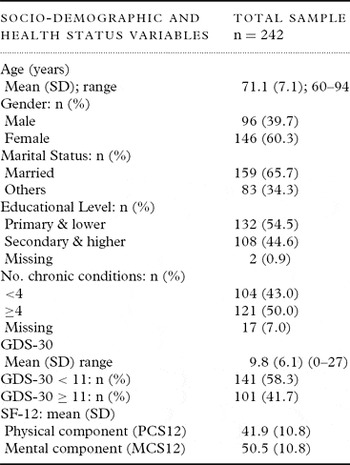
Nearly 70% of the participants were from primary care centers and community centers; the remaining 29.8% were caregivers. Table 2 shows participant characteristics.
Participant characteristics

SD: Standard Deviation; GDS-30: Geriatric Depression Scale 30-item version; SF-12: Short Form Health Survey.
Psychometric properties of the AAQ
Acceptability. There were no floor/ceiling effects. Percentage of missing information was low.
Reliability. Internal consistency measured by Cronbach's alpha was 0.59 for psychological growth, 0.73 for physical change, and 0.70 for psychosocial loss (Table 3).
Descriptive statistics, acceptability, and reliability parameters of the AAQ subscales

SD: Standard Deviation; α: Chronbach's alpha coefficient.
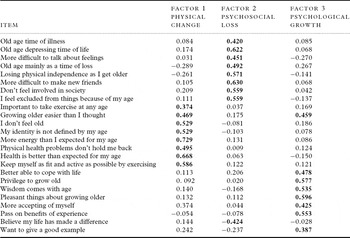
Factor structure. The KMO was greater than 0.5 (KMO = 0.703) and the Bartlett test of sphericity was significant (p < 0.05), indicating an underlying structure in the scale. Table 4 presents the factor solution for the Spanish version of AAQ. After principal components factor extraction and the Varimax rotation, the solution indicated a model with three factors that accounted for 34% of the variance. Visual inspection of the Scree Plot also strongly supported the three-factor solution. Results using principal axis factoring were basically unchanged. All items, except two (Important to take exercise at any age, and Want to give a good example), loaded ≥0.40 on any factor, one item (Growing older easier than I thought) loaded ≥0.40 on two factors, and one item (Believe my life has made a difference) loaded on another factor.
Rotated factor matrix of the Spanish AAQ

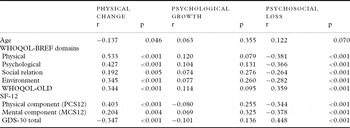
Convergent validity. A statistically significant negative correlation was found between the AAQ physical change and age subscales (r = −0.137, p = 0.046). As expected, moderate correlations were found between the AAQ physical change and psychosocial loss subscales with the physical and psychological WHOQOL-BREF domains, the WHOQOL-OLD, the total GDS, and the PCS-12 (Table 5).
Convergent validity Association of the AAQ with other measures using Pearson's correlations

GDS-30: Geriatric Depression Scale 30-item version; SF-12: Short Form Health Survey; r: Pearson's correlation coefficient; p: p-value.
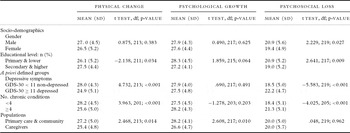
Discriminant validity showed that men scored significantly higher on the psychosocial loss subscale compared with females (t (219) = 2.229, p = 0.027, two-tailed). Participants with higher educational level scored significantly higher on the physical change (t (211) = –2.138, p = 0.034 two-tailed) and lower on the psychosocial loss subscales (t (217) = 2.641, p = 0.009 two-tailed) (Table 6).
Discriminant validity of the AAQ

SD: Standard Deviation; GDS-30: Geriatric Depression Scale-30 items.
A priori defined groups. Participants with lower depressive symptoms (GDS-30 < 11) compared with those with higher symptoms (GDS-30 ≥ 11) scored significantly higher on the physical change and lower on the psychosocial loss subscales. A similar result was found between participants self-reporting lower number of chronic conditions (<4) compared with participants reporting greater number of chronic conditions (≥4). Compared with caregivers, participants from primary care centers and community centers scored significantly higher on the physical change and psychological growth subscales (Table 6).
Discussion
Our aim was to study the psychometric properties of the Spanish version of the AAQ among Spanish elderly adults. The Spanish version of the AAQ showed satisfactory psychometric properties (acceptability, internal consistency, construct, and convergent and discriminant validity). The AAQ was designed to assess attitudes toward ageing across cultures. All subscales had lower reliabilities than those reported in the international study (Laidlaw et al., Reference Laidlaw, Power and Schmidt2007) where each domain reported very similar Person Separation Index (PSI) scores (the item response theory (IRT) equivalent of Cronbach's alphas). In the current study, the psychological growth subscale demonstrates the lowest reliability. Deleting the item Believe my life has made a difference increases reliability to 0.62, though this remains lower than the acceptable level. This apparent breakdown in reliability is difficult to explain given that the larger original data sample (Laidlaw et al., Reference Laidlaw, Power and Schmidt2007) reports no problems with reliability. It is possible that some of the conceptual ideas contained in the psychological growth domain may be more sensitive to the difference in the participant sample recruited here. Thus, in the current sample there is more variability because of the mix of caregivers and non-caregivers. As a consequence, we have inherited a larger degree of heterogeneity in our sample in terms of an individual attribution toward the experience of ageing. For example, becoming a dementia caregiver is a major life event involving both negative (Pinquart and Sorensen, Reference Pinquart and Sorensen2011) and positive aspects (Cohen et al., Reference Cohen, Colantonio and Vernich2002) and it is highly likely that the reduction in reliability on the AAQ domain of psychological growth is a consequence of this. Given the challenges and variability in providing caregiving, items like wisdom accruing and becoming more accepting of oneself may become polarized between caregiving and non-caregiving. Two recommendations flow from this issue: First, in future research participants should be more homogenous in terms of current life experiences, and second, a study exploring the impact of caregiving on attitudes to ageing is urgently recommended.
Three factors emerged that correspond to the identical factor structure as found in the international study. These three factors were psychosocial loss, physical change, and psychological growth/wisdom. All items, except two, loaded ≥0.40 on any factor, though these two items loaded more than 0.35.
In terms of discriminant validity, regarding associations between the AAQ and socio-demographic variables, level of education showed significant differences in two AAQ subscales and gender in one subscale. In the current study, participants with more chronic medical conditions, significant depressive symptoms, and caregivers also had more negative attitudes toward ageing (lower AAQ scores). These findings are consistent with previous reports about negative images of poor physical health and its association with negative attitudes toward ageing (Harrison et al., Reference Harrison, Blozis and Stuifbergen2008; Bryant et al., Reference Bryant, Bei, Gilson, Komiti, Jackson and Judd2012), which in turn has detrimental effects on future health outcomes (Levy et al., Reference Levy, Slade and Kasl2002). Social support may act as a buffer between stressful situations and physical and mental health outcomes in the case of caregivers (O'Connor and McCabe, Reference O'Connor and McCabe2011).
In Spain, a recent survey indicated that caregivers of older people are mostly female (82.6%), and nearly one-third are of 60 years and older. However, health and social care services are limited to satisfy adequately their needs. In addition, Spanish caregivers of persons with dementia (mostly spouses and daughters) talking about their experiences of caregiving reported not being listened to by their primary care physicians when noticing early stage symptoms of dementia such as forgetfulness, irritability, confusion, disorientation, or lack of initiative (Lucas-Carrasco and Monteserín, Reference Lucas-Carrasco and Monteserín2007). These early symptoms of dementia may be dismissed as “normal” experiences of ageing. This may suggest that healthcare providers endorse a negative attitude to ageing that may result in people not experiencing help at a time when it is needed. Perhaps, as the AAQ research enterprise develops, attitudes of healthcare providers may become the subject of scrutiny.
In a recent study looking at QoL in caregivers providing care to recipients with four different illnesses, mood proved to be a significant predictor for QoL (O'Connor and McCabe, Reference O'Connor and McCabe2011). Likewise in this current study, mood is hypothesized to have an important impact on AAQ scores. Levy (Reference Levy2003) states that ageist attitudes internalized during childhood become negative age-stereotypes that are reinforced by an attentional bias to negative information about ageing, and eventually these beliefs become negative self-stereotypes. Thus, as individuals age, internalized age stereotypes operating outside the individual's conscious awareness become activated by congruent negative experiences attributed to ageing (the stress is only relevant as it is congruent with diathesis).
Older people may be prone to attribute negative events in later life as a consequence of ageing, resulting in an enhanced psychological vulnerability in later life for those who endorse negative beliefs about age (Levy, Reference Levy2009). In other words, negative events are attributed to the ageing process and this plausible explanatory construct reinforces an individual's negative appraisals congruent with a negative self-stereotype of ageing so that the older person misattribute symptoms of depression (sleep disturbance, anhedonia, hopelessness about the future, etc) as being merely the negative consequences of ageing and thus fails to seek help for a treatable illness. Consistent with this idea is the evidence that depressed older people who attribute depression to ageing are less likely to seek treatment for it (Sarkisian et al., Reference Sarkisian, Lee-Henderson and Mangione2003).
Improving mood results in an improvement in attitudes to ageing (Chachamovich et al., Reference Chachamovich, Fleck, Laidlaw and Power2008). Therefore, the difficulty may be that others (social and healthcare professionals inexperienced in working with older people) may also unwittingly endorse negative stereotypical beliefs (e.g., Burroughs et al., Reference Burroughs, Lovell, Morley, Baldwin, Burns and Chew-Graham2006) and the older person is not empowered to challenge their negative attributions.
This information is important for professionals because interventions targeted to improve social support in persons with depression, functional, and social limitations have been proved beneficial (Fong et al., Reference Fong, Finlayson and Peacock2006; Harrison et al., Reference Harrison, Blozis and Stuifbergen2008). Until now models of negative attributions about ageing have been limited by the lack of appropriate tools. The AAQ allows for the above hypothesis to be further explored in clinical settings and with clinical populations (i.e., depressed) and special populations (i.e., caregivers).
Limitations of the study
First and most importantly, a convenience sample was recruited in this study and therefore it is difficult to say with any precision how representative these results are for a wider population. Nonetheless the same factor structure was achieved in comparison to that reported for the international sample. While all participants were community-dwelling and free from cognitive impairment, a large subset of the sample reported here were caregivers. There is no report of the AAQ being used with caregivers before; however, as they were merely asked to complete the AAQ using standard instructions, they approached this task free from any external consideration of being a caregiver and as such there ought to be no reliability issues. It would be interesting to follow up this issue further and examine the impact that caring for another person dying from a disease associated with old age has upon one’ attitudes to ageing.
While questions are always raised about samples recruited opportunistically, basic socio-demographic characteristics, such as gender and educational level, did not differ from those reported on the Catalan health survey (Enquesta de Salut de Catalunya (ESCA), 2002). Second, we did not include participants living in care facilities. Third, we did not assess cognitive status of participants, as no individuals with cognitive impairment would have met inclusion criteria, hence the sample is free from impairment. Fourth, we did not collect information on the stability of the measure (test–retest). Fifth, the cross-sectional nature prevents the determination of causality.
In conclusion, it is expected that the AAQ will have high utility for professionals working with older people in distress. The AAQ can be useful as a direct measure of an individual's attitude to ageing. As studies have demonstrated that most of the older people endorse positive attitudes to ageing (Laidlaw et al., Reference Laidlaw, Power and Schmidt2007; Bryant et al., Reference Bryant, Bei, Gilson, Komiti, Jackson and Judd2012), the healthcare practitioner may wish to assess whether there is evidence for negative misattributions of the cause of their problems to ageing. Negative attitudes to ageing appear to be mood–state-dependent (Chachamovich et al., Reference Chachamovich, Fleck, Laidlaw and Power2008; Bryant et al., Reference Bryant, Bei, Gilson, Komiti, Jackson and Judd2012) rather than a fixed unchangeable appraisal. This would suggest that practitioners might wish to assess mood-state at the same time as they assess attitudes.
Conflict of interest
None. All authors declare that they have no conflict of interest.
Description of authors’ roles
Dr. Lucas-Carrasco had full access to the data and was responsible for carrying out the data analysis; she and Dr. Laidlaw interpreted the results and prepared the draft manuscript. Profs. Power and Gómez-Benito reviewed results and contributed to the drafting of the final manuscript by commenting on earlier versions.
Acknowledgments
We thank all the centers, and specially the persons who participated in the study. The study was funded by the European Commission Fifth Framework, QLRT-2000-00320, and was carried out under the auspices of the WHOQOL Group. The funding agency did not have any role in the analysis of the data or in the preparation of the manuscript. The study was approved by the Ethics Committee at the Autonomous University of Barcelona.