Implications
Obtaining well-developed rabbit females that produce a large number of healthy, marketable litters per mating over multiple parities is still one of the main priorities for rabbit production. This objective not only involves the use of adequate management programmes during reproduction but also appropriate management of nutrition during pre- and post-pubertal growth to ensure better development of future reproductive females. The correct design of rearing programmes that take into account the young rabbit female's requirements and priorities, while ensuring both adequate pubertal development and future reproductive performance, is a pressing need.
Introduction
The negative effects of underfeeding on pubertal maturation have long been known in numerous species (Frisch, Reference Frisch1984). However, overfeeding during rearing period has also been related with lower reproductive performance in dairy heifers (Sejrsen et al., Reference Sejrsen, Hubert, Tucker and Akers1982), pullets (Whitehead, Reference Whitehead1988) and gilts (Klindt et al., Reference Klindt, Yen and Christenson1999). Young rabbit females fed ad libitum until first parturition usually suffer similar problems to those mentioned for other species (Maertens, Reference Maertens1992).
For this reason, in the last decade, some works assessed the possible impacts of different management and feeding plans for the rearing period on female development and reproduction: feed restriction (Rommers et al., Reference Rommers, Meijerhof, Noorhuizen and Kemp2004), BW at weaning or at the first artificial insemination (AI; Rommers et al., Reference Rommers, Kemp, Meijerhof and Noordhuizen2001a, Reference Rommers, Meijerhof, Noordhuizen and Kemp2001b and Reference Rommers, Meijerhof, Noorhuizen and Kemp2002) or the use of fibrous diets (Xiccato et al., Reference Xiccato, Bernardini, Castellini, Dalle Zotte, Queaque and Trocino1999; Pascual et al., Reference Pascual, Cervera and Fernández-Carmona2002; Quevedo et al., Reference Quevedo, Cervera, Blas, Baselga, Costa and Pascual2005). However, some of these works have shown an antagonism between proper development and improvement of reproductive response. The earlier the introduction of the restriction programme and the lower the energy supply, the higher the voluntary feed intake of primiparous does with improved milk yield or reduced body reserves mobilisation during first lactation (Nizza et al., Reference Nizza, Di Meo and Esposito1997; Xiccato et al., Reference Xiccato, Bernardini, Castellini, Dalle Zotte, Queaque and Trocino1999; Pascual et al., Reference Pascual, Cervera and Fernández-Carmona2002), but the later or the lower their pubertal maturation (Pascual et al., Reference Pascual, Cervera and Fernández-Carmona2002; Rommers et al., Reference Rommers, Meijerhof, Noorhuizen and Kemp2004).
On the basis of this previous information, in this work, we evaluated the effects on nulliparous rabbit does development of a diet for reproductive rabbit does provided during the rearing period and first pregnancy both ad libitum and restricted, compared with three different feeding programmes based on the use of a low-energy, high-fibre diet designed for young rabbit females and provided: (i) until first parturition, (ii) until 2 weeks before first mating and (iii) until first parturition applying the C diet from 16 to 20 weeks of age.
Material and methods
The experimental procedure was approved by the animal welfare ethics committee of the Universitat Politècnica de València (UPV) and carried out following the European Union (2003) recommendations on care and protection of animals used for experimental purposes and the advice for applied nutrition research in rabbits according to the European Group on Rabbit Nutrition (Fernández-Carmona et al., Reference Fernández-Carmona, Blas, Pascual, Maertens, Gidenne, Xiccato and García2005).
Diets
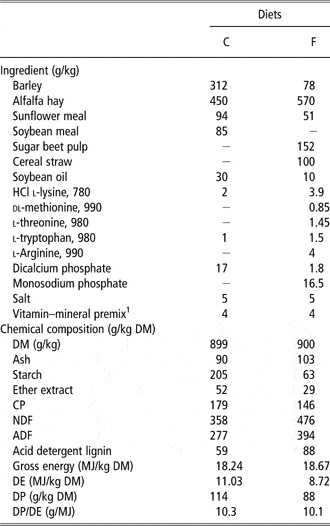
Ingredients and chemical composition of the experimental pelleted diets used in this trial are summarised in Table 1. A control diet (C), similar to a commercial diet for reproductive rabbit does (11.0 MJ digestible energy (DE) and 114 g digestible protein (DP)/kg dry matter (DM)), was formulated following main recommendations of De Blas and Mateos (Reference De Blas and Mateos2010). In addition, a low-energy, high-fibre diet (F) was also formulated (8.7 MJ DE and 88 g DP/kg DM), including some minor ingredients and supplements to partially correct obvious deficiencies in amino acids and minerals.
Ingredients and chemical composition of experimental diets

DM = dry matter; DE = digestible energy; DP = digestible protein.
1Per kg of feed: vitamin A, 8375 IU; vitamin D3, 750 IU; vitamin E, 20 mg; vitamin K3, 1 mg; vitamin B1, 1 mg; vitamin B2, 2 mg; vitamin B6, 1 mg; nicotinic acid, 20 mg; choline chloride, 250 mg; Mg, 290 mg; Mn, 20 mg; Zn, 60 mg; I, 1.25 mg; Fe, 26 mg; Cu, 10 mg; Co, 0.7; butyl hydroxylanysole + ethoxiquin, 4 mg.
Apparent digestibility coefficients of energy and CP were determined for each diet, using a total of 30 three-way crossbred rabbits, aged 42 days with an average BW of 1.32 (s.d. 0.07) kg, according to Perez et al. (Reference Perez, Lebas, Gidenne, Maertens, Xiccato, Parigi-Bini, Dalle Zotte, Cossu, Carazzolo, Villamide, Carabaño, Fraga, Ramos, Cervera, Blas, Fernández-Carmona, Falcao e Cunha and Bengala Freire1995).
Chemical analyses of diets and faeces were performed following the Association of Official Analytical Chemist (AOAC, 1999) methods for DM, ash, ether extract, CP and crude fibre (934.01, 942.05, 920.39, 976.06 and 978.10, respectively). Ether extract was determined after acid hydrolysis. NDF, ADF and ADL were analysed sequentially (Van Soest et al., Reference Van Soest, Robertson and Lewis1991) using a thermo-stable amylase (Thermamyl L120, Novo Nordisk, Gentofte, Denmark) pre-treatment and expressed exclusive of residual ash. Gross energy was determined by adiabatic bomb calorimetry (Gallenkamp Autobomb, Loughborough, UK) following the recommendation of the European Group on Rabbit Nutrition (EGRAN, 2001).
Animals and experimental procedure
A total of 190 young rabbit does (line A from UPV, selected over 36 generations for litter size at weaning) were used from 9 weeks of age to first parturition. The animals were housed in a traditional building under controlled environmental conditions, with light alternating on a cycle of 16 h light and 8 h dark. The experiment was carried out from January to June 2007.
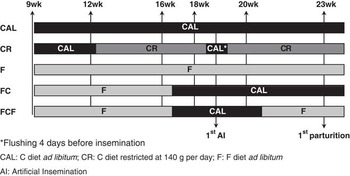
Until 9 weeks of age, young rabbit females were caged collectively, receiving the same commercial diet ad libitum (185 g crude fibre and 175 g CP/kg DM), and subsequently housed in individual cages with access to one of the experimental diets. Combining two diets and three different feeding schemes, five feeding programmes were formed (Figure 1). At 9 weeks of age, animals were randomly assigned to one of the experimental diets (C (n = 91) and F (n = 99)) to allow the ulterior definition of the experimental groups, considering the early culling of females to provide enough stock for each group. The number of animals at the end of the period controlled for each experimental group is shown in Table 2. The CAL group included females that received the C diet ad libitum until first parturition. The CR group included females that received the C diet ad libitum until 12 weeks of age and then 140 g/day until first parturition, with a 7-day flushing period (C diet ad libitum) around AI. The F group included females that received the F diet ad libitum until first parturition. The FC group included females that received F diet ad libitum until 16 weeks of age, and then received C diet ad libitum until first parturition. FCF group included females that received F diet ad libitum until 16 weeks of age, then received the C diet ad libitum until 11 days of pregnancy and finally the F diet ad libitum until first parturition.
Diagram of the different feeding programmes carried out during rearing and first pregnancy for the five experimental groups (CAL, CR, F, FC and FCF; abbreviations as in Table 2).

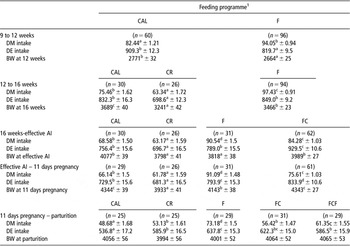
Daily DM (g DM/kg metabolic weight (BW0.75)) and DE (kJ DE/kg BW0.75) intake, and BW (g) of young rabbit does during rearing and first pregnancy (mean ± s.e.)

DM = dry matter; DE = digestible energy; AI = artificial insemination.
1Feeding programme: CAL group received the C diet ad libitum until first parturition; CR group received the C diet ad libitum until 12 weeks and then, 140 g/day until first partum; F group received the F diet ad libitum until first partum; FC and FCF group received F diet ad libitum until 16 weeks and then, FC group received the C diet ad libitum until first partum and FCF group the C diet ad libitum until 20 weeks and then the F diet ad libitum until first partum.
a,b,c,dMeans within a row not sharing any superscript are significantly different at P < 0.05.
n = number of observations at the end of the period.
Although animals from different experimental groups were kept on the same feeding programme, data were analysed and presented as a whole (CAL and CR until 12 weeks of age, F, FC and FCF until 16 weeks of age and then FC and FCF until 11 days of pregnancy).
Does were artificially inseminated at the end of the 18th week of age. As of this date, successive AIs were carried out every 21 days, as necessary, and data were only used for effective AIs. The average AI to get pregnant was 1.18 and maximum successive AIs allowed were 3. Average and maximum ages at first positive AI were 18.6 and 27 weeks, respectively. Average and maximum ages at first parturition were 23.6 and 32 weeks, respectively. AI was done using polyspermic semen, supplying GnRH hormone by intramuscular injection. Pregnancy was tested by manual palpation at 11 days post AI. After the 28th day of pregnancy, maternal cages were provided with a nest equipped for the litter. Non-pregnant animals were not included in the data assay.
The traits measured for all does were BW and food intake at 9, 12 and 16 weeks of age, at effective AI, at 11 days of pregnancy and at parturition, as well as perirenal fat thickness (PFT) by ultrasounds at 9 and 12 weeks of age, at effective AI, at 11 days of pregnancy and at parturition. Total and live litter size and weight at parturition were also recorded. From the same 12 rabbit does per group, blood samples were collected at 9 and 12 weeks of age, at effective AI and at parturition. On sampling day, feeders were closed at 0700 h and blood samples were taken from the central ear artery into EDTA-containing tubes from 1100 to 1300 h. Blood samples were centrifuged immediately after sampling (3000 × g, 4°C and 10 min) and plasma was stored at −20°C before being assayed for insulin, glucose, non-esterified fatty acids (NEFA), leptin, cortisol and tri-iodothyroxine (T3) concentrations. Controls at 9, 12 and 16 weeks of age and 11 days of pregnancy were carried out on Mondays, and those at AI on Friday.
Ultrasound measurements
The PFT of does was measured by ultrasound to evaluate body condition, as described by Pascual et al. (Reference Pascual, Castella, Cervera, Blas and Fernández-Carmona2000 and Reference Pascual, Blanco, Piquer, Quevedo and Cervera2004). Images were obtained with an ultrasound unit (JustVision 200 ‘SSA–320A’ real-time machine; Toshiba, Tokyo, Japan) equipped with image analyser software to determine distances. Estimated body energy content (EBE; MJ/kg) was determined at AI and at parturition from BW and PFT data as described by Pascual et al. (Reference Pascual, Blanco, Piquer, Quevedo and Cervera2004).
Hormone and metabolite assays
Plasma insulin concentrations were determined by the double antibody/PEG technique using porcine insulin radioimmunoassay (RIA) kit (Linco Research Inc., St Charles, MO, USA). The antiserum was guinea pig anti-porcine insulin, whereas both labelled antigen and standards used purified recombinant human insulin. Leptin concentrations were determined by double antibody RIA using the multi-species leptin kit (Linco Research Inc.) as previously reported (Brecchia et al., Reference Brecchia, Bonanno, Galeati, Federici, Maranesi, Gobbetti, Zerani and Boiti2006). Total T3 was assayed by RIA according to the procedure provided by the manufacturer (Immunotech, Marseille, France). The assay sensitivity was 0.13 ng/ml, and the major analogues of T3 did not interfere with the assay. Plasma cortisol was assayed by RIA, using the CORT kit (ICN Biomedicals Inc., Costa Mesa, CA, USA). CORT assay sensitivity was 0.15 ng/ml. Dilution and recovery tests done on insulin, leptin, T3 and corticosterone using five different samples of rabbit plasma showed linearity.
Glucose was analysed by the glucose oxidase method using the Glucose Infinity kit from Sigma (Sigma Diagnostic Inc., St Louis, MO, USA). NEFA concentrations were analysed using enzymatic colorimetric assay from Wako (Wako Chemicals GmbH, Neuss, Germany) as previously reported (Brecchia et al., Reference Brecchia, Bonanno, Galeati, Federici, Maranesi, Gobbetti, Zerani and Boiti2006).
Statistical analysis
The model used to analyse performance, hormonal and metabolic data of young rabbit does during rearing and first gestation was a mixed model (PROC MIXED by Statistical Analysis System, SAS, 2002), in a repeated measure design that took into account the variation between animals and the covariation within them. Covariance structures were objectively compared using the most severe criteria (Schwarz Bayesian criterion), as suggested by Littell et al. (Reference Littell, Henry and Ammerman1998). The model included the feeding programme (CAL, CR, F, FC and FCF), the control day (9 and 12 weeks of age, effective AI, 11 days of pregnancy and parturition; data for week 16 was also included for consumption and BW) and their interaction as fixed effects. Random terms in the model included a permanent effect of each animal (p) and the error term (e), both assumed to have an average of zero and variance σ 2p and σ 2e, respectively.
Different contrasts were computed to test the significance of the differences between treatments, although animals of different experimental groups received the same feeding programme at 12 weeks [(CAL + CR)/2 v. (F + FC + FCF)/3], at 16 weeks [CAL v. CR v. (F + FC + FCF)/3], at effective AI and 11 days of pregnancy (CAL v. CR v. F v. (FC + FCF)/2) and at parturition (CAL v. CR v. F v. FC v. FCF).
To analyse the litter data at first parturition, a fixed effects model (PROC GLM of SAS, 2002) was used that included only the feeding programme (CAL, CR, F, FC and FCF). Data concerning mortality of females during the rearing and first pregnancy were analysed according to a non-parametric procedure (PROC NPAR1WAY of SAS, 2002), using a chi-square test for mean separation.
Results
Animal performance
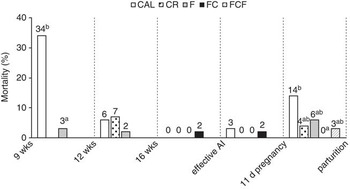
As it can be seen in Figure 2, a high mortality rate was observed for the animals receiving ad libitum C diet (34%) between 9 and 12 weeks of age compared with those fed F diet (3%; P < 0.05), probably because of an outbreak of epizootic rabbit enteropathy (ERE). Considering the age of the animals and the short period where ERE was detected, no treatment with antimicrobials was carried out to control the disease for a better comparison of the feeding programmes. Mortality was low and similar in groups under different feeding programmes from 12 weeks of age to 11 days of pregnancy. However, the CAL group again presented a significantly higher mortality rate (14%; P < 0.05) compared with the other groups (on average 3%) during the last 3 weeks of pregnancy.
Percentage of does dead during the rearing and first pregnancy (from 9 weeks of age to first parturition) with the different feeding programmes (abbreviations as in Table 2). Bars within a period not sharing any superscript are significantly different at P < 0.05. AI = Artificial Insemination.

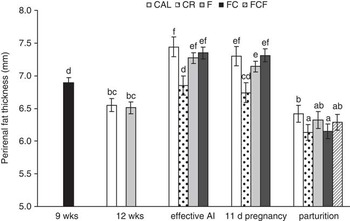
Daily intake, BW and PFT of young rabbit does during rearing and pregnancy are presented in Table 2 and Figure 3. The BW and PFT at 9 weeks of age were 1.97 ± 0.03 (s.e.) kg and 6.9 ± 0.1 mm, respectively. Females fed ad libitum C diet (CAL) showed significantly higher DE and DP intakes between 9 and 12 weeks of age (+89 kJ and +11 g/day, respectively; P < 0.05) and BW at week 12 (+0.11 kg; P < 0.05) than those fed the F diet. From 12 to 16 weeks, DE and DP intakes were similar for the CAL and F females (on average 841 kJ and 86 g/day, respectively), but significantly lower for those restricted (CR; 699 kJ and 72 g/day; P < 0.05). Thus, BW at week 16 was significantly higher for the CAL than for the F group (3.69 and 3.47 kg, respectively; P < 0.05) and was higher for both groups than for the CR group (3.24 kg; P < 0.05).
Perirenal fat thickness evolution of young rabbit does during rearing and first pregnancy (9 weeks of age to first parturition) with the different feeding programmes (abbreviations as in Table 2). Data at 9 weeks of age are presented as a whole. Bars not sharing any superscript are significantly different at P < 0.05. AI = Artificial Insemination.

From 16 weeks of age to 11 days of pregnancy, DE and DP intakes of the F group were even higher (on average 792 kJ and 80 g/day, respectively) than that observed for the CAL group (742 kJ and 76 g/day; P < 0.05) and were higher for both groups than for CR group (690 kJ and 71 g/kg per day; P < 0.05). In fact, F females going on to ad libitum C diet at 16 weeks of age (FC) showed the highest intake values (on average 883 kJ and 91 g/day; P < 0.05). In consequence, CAL and FC females at 11 days of pregnancy presented higher BW and PFT values (4.34 kg and 7.3 mm, respectively) than CR females (3.93 and 6.7 mm; P < 0.05), with F females showing medium values (4.14 kg and 7.1 mm).
The type of feeding programme did not affect the fertility rate of young females at first AI (85.2%, 84.0%, 89.7% and 85.0% for CAL, CR, F and FC females, respectively).
During the last 3 weeks of pregnancy, F and FC females presented higher DE and DP intakes (on average 630 kJ and 65 g/day, respectively) than CR and FCF females (on average 586 kJ and 60 g/day; P < 0.05), with CAL females showing the lowest intake values (537 kJ and 55 g/day; P < 0.05). Thus, differences in BW between feeding programmes disappeared at parturition (Table 2), whereas only CAL females presented a greater PFT than CR and FC females (6.4 v. 6.1 mm, respectively; P < 0.05).
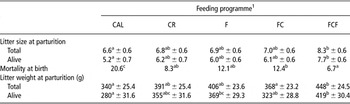
Table 3 shows the effect of the feeding programme adopted during doe rearing on litter traits at the first parturition. The lower number of kits born could be caused by the use of pure genetic lines, which have been frequently described as more sensible to the environment. In comparison to the CAL group, FCF females had larger (7.7 v. 5.2 kits; P < 0.05) and heavier live born litters (419 v. 280 g; P < 0.05), with CR, F and FC females showing medium values (on average 6.1 kits and 349 g). The small number of kits born alive at first parturition to CAL females was because of their lower number of total kits born (6.6 v. 8.3 kits; P < 0.05) and the greater mortality of their litters at birth (20.6% v. 6.7%; P < 0.05) compared with FCF females.
Litter size and weight at first parturition (mean ± s.e.)

1Feeding programme: CAL group received the C diet ad libitum until first partum; CR group received the C diet ad libitum until 12 weeks and then, 140 g/day until first partum; F group received the F diet ad libitum until first partum; FC and FCF group received F diet ad libitum until 16 weeks and then, FC group received the C diet ad libitum until first partum and FCF group the C diet ad libitum until 20 weeks and then the F diet ad libitum until first partum.
a,bMeans within a row not sharing any superscript are significantly different at P < 0.05.
Metabolic and hormonal parameters
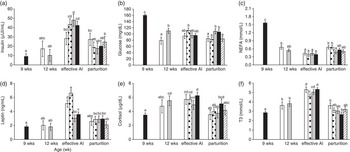
The plasma profiles of insulin, glucose, NEFA, leptin, cortisol and T3 during rearing and first pregnancy in the different feeding programmes are shown in Figure 4. An increase in circulating insulin concentrations was observed with advancing age in all the groups, although it decreased at parturition (Figure 4a). CAL group animals presented lower mean plasma insulin concentration than F females at effective AI (−19.5 μUI/ml; P < 0.05).
Evolution of blood plasma (a) insulin, (b) glucose, (c) non-esterified fatty acids (NEFA), (d) leptin, (e) cortisol and (f) tri-iodothyroxine (T3) concentrations in young rabbit does during rearing and first pregnancy (9 weeks of age to first parturition) with the different feeding programmes ( CAL
 CR
 F
 FC
 FCF; abbreviations as in Table 2). Data at 9 weeks of age are presented as a whole. Bars not sharing any superscript are significantly different at P < 0.05.

Both glucose and NEFA plasma concentrations showed the highest values at 9 weeks of age and dropped thereafter. Glucose concentration in plasma was opposite to insulin, being lower for CAL (−31.4 mg/dl; P < 0.05) than for F females at 12 weeks of age (Figure 4b). At parturition day, glucose was lower in CAL, CR and FCF than in F and FC females (on average −20.7 mg/dl; P < 0.05). Although NEFA levels were similar for all the groups at effective AI (Figure 4c), females receiving the C diet (CAL, CR and FC) presented the highest NEFA values in plasma at parturition, only being significantly higher in CAL and CR compared with F females (on average +0.18 mmol/l; P < 0.05).
Leptin levels were similar for all groups at 12 weeks of age and at partum day (Figure 4d). An increase in plasma leptin concentration was observed at 18 weeks, especially in CR females (6.6 ng/ml; P < 0.05), where plasma had higher leptin levels than in CAL (5.1 ng/ml) and both F and FC females (on average 3.3 ng/ml; P < 0.05). Plasma cortisol increased from 9 weeks of age to effective AI, although it decreased at parturition (Figure 4e). No significant differences between feeding programmes on cortisol in plasma were observed throughout the experiment. Plasma concentrations of T3 at 12 weeks of age were similar for all the groups (Figure 4f). Females given C diet ad libitum at effective AI (CAL and FC) had higher levels of plasma T3 than CR females (on average 0.75 mmol/l; P < 0.05). However, CAL females showed higher T3 levels than FC females at parturition (−0.96 mmol/l; P < 0.05).
Discussion
No previous work evaluating the use of rearing diets described the high mortality rate observed in this work from 9 to 12 weeks of age when young females were fed the control diet. This fact seems to be related to ERE incidence when no medicated diets were used. Under these conditions, insufficient level or inadequate quality of dietary fibre can increase the risk of digestive disorders in young rabbits (Gidenne, Reference Gidenne1997; Gidenne and García, Reference Gidenne and García2006). In this work, although higher soluble fibre was expected for the F diet (from alfalfa and beet pulp), both diets were designed to meet fibre recommendations to prevent digestive problems from 9 to 12 weeks of age (ADL>50, ADF>190 and NDF–ADF>80 g/kg). However, a recent review (Blas and Gidenne, Reference Blas and Gidenne2010) highlighted that, even if requirements proposed to prevent digestive disorders are met, replacing starch with insoluble or soluble fibre reduces mortality rate, especially in the context of ERE, probably because of favourable changes induced in the caecal environment (Martínez-Vallespín et al., Reference Martínez-Vallespín, Martínez-Paredes, Ródenas, Cervera, Pascual and Blas2011).
Young rabbit female needs from 9 to 12 weeks of age (∼1.52 MJ/day, considering their mean live weight and daily gain; Xiccato and Trocino, Reference Xiccato and Trocino2010) were met with both C and F diets (1.74 and 1.54 MJ/day, respectively). Although the lower DE intake led females receiving the F diet to reach 12 weeks of age with a smaller BW, as in a previous work (Pascual et al., Reference Pascual, Cervera and Fernández-Carmona2002), the main metabolic and hormonal parameters here examined were not greatly affected. Rebollar et al. (Reference Rebollar, Pereda, Schwarz, Millán, Lorenzo and Nicodemus2011) also found similar concentrations of leptin (2.8 ng/ml) and NEFA (0.22 mmol/l) in the blood of young females at 11 weeks of age when comparing ad libitum supply of control and fibre-rich diets. However, when higher feed restriction is asserted (even below animal needs 1.03 MJ/day; Rommers et al., Reference Rommers, Meijerhof, Noorhuizen and Kemp2004), the blood levels of glucose, leptin, insulin and T3 of young females (from 6 to 12 weeks of age) were clearly reduced.
As a consequence of feed intake restriction from 12 weeks of age to effective AI, CR females reached effective AI age with a delay in their development, showing lower BW and PFT than those fed ad libitum. These results agree with those reported in previous works where feed restriction reduced BW, as well as body fat and protein content of young rabbit females at first AI (Rommers et al., Reference Rommers, Meijerhof, Noordhuizen and Kemp2001b and Reference Rommers, Meijerhof, Noorhuizen and Kemp2004), and even caused a delay in the effectiveness of this AI (Rebollar et al., Reference Rebollar, Pereda, Schwarz, Millán, Lorenzo and Nicodemus2011). In this work, CR females presented a slight reduction of T3 blood levels at effective AI together with an unexpected higher concentration of leptin compared with those with free access to the control diet. Several studies have shown that fasting reduces leptin, mainly synthesised and secreted by adipocytes, circulating in blood at levels proportional to body fat stores in humans (Weigle et al., Reference Weigle, Duell, Connor, Steiner, Soules and Kuijper1997), gilts (Barb et al., Reference Barb, Barrett, Kraeling and Rampacek2001), ruminants (Chilliard et al., Reference Chilliard, Ferlay, Faulconnier, Bonnet, Rouel and Bocquier2000) and also in rabbits (Rommers et al., Reference Rommers, Meijerhof, Noorhuizen and Kemp2004; Brecchia et al., Reference Brecchia, Bonanno, Galeati, Federici, Maranesi, Gobbetti, Zerani and Boiti2006; Rebollar et al., Reference Rebollar, Pereda, Schwarz, Millán, Lorenzo and Nicodemus2011). However, the mechanisms whereby feeding restriction affects circulating leptin levels are still unclear, and different responses were observed depending on type and length of fasting and blood sampling protocols. In this respect, Brecchia et al. (Reference Brecchia, Bonanno, Galeati, Federici, Maranesi, Gobbetti, Zerani and Boiti2006) described higher leptin levels in the plasma of 48-h fasted does than in 24-h fasted does. In any case, it might be considered that CR females were subject to a 4-day flushing period before AI, where animals had free access to the C diet, which could have conditioned the plasma metabolic profile for these days.
In contrast, females with free access to the F diet were able to compensate for the lower nutritive dietary concentration with a greater feed intake from 12 weeks of age to effective AI. Thus, they achieved DE and DP intakes similar to those of rabbits receiving the C diet ad libitum and, consequently, reduced their gaps in BW and PFT at effective AI. In fact, these differences disappeared when females of the F group had free access to the C diet as of 16 weeks of age. Pascual et al. (Reference Pascual, Cervera and Fernández-Carmona2002) described how young rabbit females fed with a low-energy diet (8 MJ DE/kg DM) from 10 weeks of age had a greater DE intake than those fed with a restriction of 150 g/day of a standard diet (11 MJ DE/kg DM) during late rearing. The greater feed intake, however, did not compensate earlier differences in BW and these rabbits achieved first AI 10 days later. However, a later introduction of a very low-energy diet at 13 weeks of age (7.3 MJ DE/kg DM; Quevedo et al., Reference Quevedo, Cervera, Blas, Baselga, Costa and Pascual2005) or the use of moderate-energy diets (9.5 MJ DE/kg DM; Xiccato et al., Reference Xiccato, Bernardini, Castellini, Dalle Zotte, Queaque and Trocino1999) enabled young rabbit females to achieve first mating at an adequate age and BW.
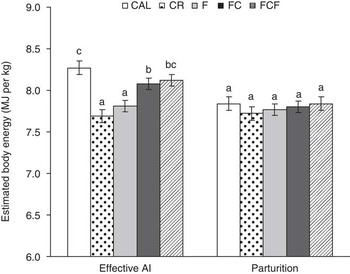
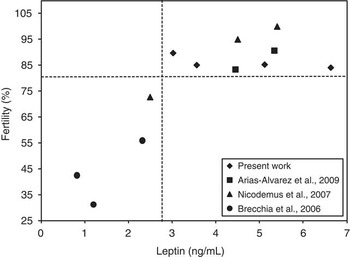
In this sense, although the use of a low-energy diet during the rearing period led females to reach first mating with lower energy body reserves (Figure 5) and lower blood leptin levels than those fed a conventional diet for reproductive does, no consequence on fertility at first AI was reported. It is well known that nutrient restriction may delay the onset of puberty, leading to the hypothesis that a critical soma must be achieved before puberty can occur (Frisch, Reference Frisch1980). Furthermore, although fertility rate is affected by many factors, Arias-Álvarez et al. (Reference Arias-Álvarez, García-García, Rebollar, Nicodemus, Revuelta, Millán and Lorenzo2009) recently proposed that reaching the permissive leptin threshold should be necessary for pubertal reproductive activity, and may be associated with inhibition of reproduction if the critical soma is insufficient to trigger gestation (Moschos et al., Reference Moschos, Chan and Mantzoros2002). In fact, when the relationship between fertility and blood leptin levels of young rabbit females around first insemination is drawn (Figure 6), the hypothesis of a leptin threshold for initiation of puberty and reproductive success that is not improved by additional provision of this hormone seems to be confirmed. Consequently, these results could reveal that in terms of ad libitum feeding during rearing, both feed restriction and earlier use of a low-energy diet (8.7 MJ/kg DM) could lead females to achieve the critical BW and fat mass at first AI to ensure reproduction, in spite of their lower fatness and leptin content in blood.
Estimated energy content of young rabbit does at effective artificial insemination (AI) and parturition days with the different feeding programmes (abbreviations as in Table 2). Bars not sharing any superscript are significantly different at P < 0.05.

Relationship between leptin levels in the blood of young rabbit does at first mating (16 to 18 weeks of age) and the fertility observed during the first reproductive cycle. Data obtained from the present results and three previous works of the literature.

After the first AI, although young females receiving the C diet ad libitum maintained a greater consumption than those restricted until 11 days of pregnancy, the fatness accumulated by CAL females throughout rearing allowed them to reduce their feed intake as pregnancy progressed, allowing CR females to diminish the differences in BW, PFT and EBE observed up to this point with the CAL group during late pregnancy. In a previous work (Rommers et al., Reference Rommers, Meijerhof, Noorhuizen and Kemp2004), where development between young females fed ad libitum and early restricted diets (restriction: from 5 to 10 weeks of age; recovery: 10 to 17.5 weeks of age) was compared, although compensatory growth of the restricted group was also observed during pregnancy, the early differences achieved in BW of females were maintained throughout the three reproductive cycles controlled by the authors. In gilts, where feed restriction of young females has been studied extensively, most works (Sørensen et al., Reference Sørensen, Danielsen and Busk1998; Klindt et al., Reference Klindt, Yen and Christenson1999 and Reference Klindt, Yen and Christenson2001b) show that moderate feed restriction during the rearing period helps females avoid excessive fatness, whereas more intense restriction (earlier and/or stronger) leads to smaller development and sometimes even to lower reproductive performance. Therefore, these results seem to confirm the effectiveness of moderate restrictive feeding in preventing excessive fatness in young females, although the starting age and restriction level should be controlled to avoid an inadequate pre-pubertal body development.
A practical alternative to restriction could be the use of fibrous diets. Several works found in the literature showed that the use of fibrous diets during rearing led nulliparous rabbit females to a greater DE intake after first mating, independently of their previous growth rate during development. Even so, when very low-energy fibrous diets are used (<8.5 MJ DE/kg DM), females are not able to compensate the previous developmental delay (Pascual et al., Reference Pascual, Cervera and Fernández-Carmona2002; Quevedo et al., Reference Quevedo, Cervera, Blas, Baselga, Costa and Pascual2005). However, when females have the chance of receiving a low-energy fibrous diet (∼9 MJ DE/kg DM), they reach the first parturition with a development and BW similar to those of rabbit does fed ad libitum a diet for reproductive does (>10.5 MJ DE/kg DM), but with a lower fatness (Xiccato et al., Reference Xiccato, Bernardini, Castellini, Dalle Zotte, Queaque and Trocino1999; Rebollar et al., Reference Rebollar, Pereda, Schwarz, Millán, Lorenzo and Nicodemus2011). In this work, and independently of the fibrous feeding systems used (F, FC or FCF), females reached first parturition in an intermediate developmental situation to that observed in females fed the C diet ad libitum or restricted. Similar results were also obtained by Rebollar et al. (Reference Rebollar, Pereda, Schwarz, Millán, Lorenzo and Nicodemus2011), where the use of a fibrous diet (9.4 MJ DE/kg DM) from 11 weeks of age to first parturition led young rabbit females to reach the end of first pregnancy with body energy and protein content halfway between ad libitum and restricted administration of a control diet (11.6 MJ DE/kg DM). The use of a fibrous diet with 8.5 to 9.5 MJ DE/kg DM should therefore allow young rabbit females to reach first parturition in an adequate state of development, avoiding excessive fatness without the need for feeding restriction.
In fact, the possible negative effects of excessive fatness could be the reason for the problems detected around first parturition in the CAL group. Compared with the other feeding systems evaluated here, females fed the C diet ad libitum during rearing showed the lowest DE intake and the highest body energy mobilisation recorded during late pregnancy. In fact, the plasma of these females at partum day was characterised by higher NEFA and lower glucose levels. The aforementioned profile is frequently related to pregnancy toxaemia risk (Martenink and Herdt, Reference Martenink and Herdt1988; Bezille, Reference Bezille1995; Rosell, Reference Rosell2000), and could explain the higher mortality in late pregnancy for the females of this group and the smaller size of their litters at first birth caused by both lower total litter size and higher mortality at birth. Rommers et al. (Reference Rommers, Meijerhof, Noorhuizen and Kemp2002) also observed that heavier young females at first AI (more than 4 kg BW) had a higher percentage of stillborn at first parturition (13.4%) than smaller females (5%). In gilts, Klindt et al. (Reference Klindt, Yen and Christenson2001a and Reference Klindt, Yen and Christenson2001b) related an excessive energy intake during rearing with a lower number of corpora lutea and live embryos per gilt, and also observed a tendency towards the reduction of litter size at first birth (−0.8 piglets born) and the increase of gilts removed until this time (+13%). In this sense, the highest prolificacy and the lowest mortality at birth were recorded for females given the F diet with a flushing of 4 weeks with the C diet applied around first mating. In a recent revision, Theau-Clement (Reference Theau-Clement2007) concluded that feed flushing after nutritive restriction could improve the reproduction performance, at least at the beginning of the reproductive career.
From the results of this work, it could be concluded that the ad libitum use of diets formulated to cover the needs of lactating rabbit does for the whole rearing period could lead young rabbit females to present a higher risk of early death and smaller litter size at first parturition. As an alternative, either feed restriction or earlier use of an adequate fibrous diet could lead females to achieve the critical BW and fat mass at first AI to ensure reproduction. However, under these feeding programmes for young females, the starting age and nutritive level of the fibrous diet should be controlled to avoid an inadequate pre-pubertal development. In fact, the introduction of a flushing around first AI when fibrous diets were used led to avoid possible retardation of young females’ development and to the best reproductive results at the first parturition.
Acknowledgement
The authors thank the Spanish Ministry of Education and Science (Project AGL2006-07596) for the economic support to conduct this study.