The object that is the main focus of this paper came to my attention as a result of the BBC4 television series Heritage! The Battle for Britain’s Past. The first programme – ‘From Old Bones to Precious Stones’, broadcast in March 2013 – featured a section on the role of John Lubbock, the first Lord Avebury, in promoting interest in the prehistoric past. Curator Marie-Louise Kerr, of Bromley Museum Service, was shown describing items from the Avebury Collection in her museum.Footnote 1 One of these caught my eye immediately. It was an intricately decorated carved stone ball, which to my knowledge had never previously been studied or even listed.Footnote 2 Such balls are a well-known element of Scottish material culture, dating from the late Neolithic period of British prehistory, around 4,600 or more years ago, and this Aberdeenshire example, although incomplete, very clearly constituted an important addition to the known corpus of carved stone balls, particularly because of its distinctive decorative scheme. The Lubbock / Avebury connection also makes this ball and its modern biography of interest in a history-of-collections context.
JOHN LUBBOCK, LORD AVEBURY, AND THE AVEBURY COLLECTION
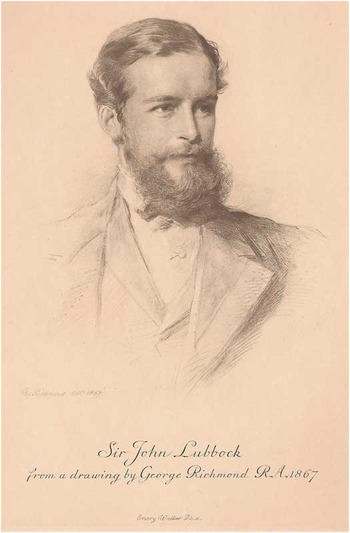
John Lubbock (1834–1913), who became Sir John Lubbock from 1865 (fig 1) and Lord Avebury from 1900,Footnote 3 has been the subject of several recent publications exploring various aspects of the life and work of this larger-than-life Victorian / Edwardian polymath.Footnote 4 Archaeologically, he is well known for at least three main reasons: for his very popular book Pre-Historic Times,Footnote 5 in which famously he introduced the Palaeolithic and Neolithic subdivisions of the Stone Age;Footnote 6 for his part in the preservation of Silbury Hill and Avebury henge;Footnote 7 and for promoting the cause that led to the first Ancient Monuments Act of 1882.Footnote 8
Sir John Lubbock in 1867, aged 33, then at the height of his collecting phase. Illustration: photograph by Emery Walker of the drawing by George Richmond (Hutchinson Reference Hutchinson1914, frontispiece)

Lubbock’s home, at Nine Elms, Orpington, in Kent, was adjacent to Down House, the home of Charles Darwin, who had a major influence on Lubbock’s intellectual and scientific career and probably stimulated his initial interest in collecting. Although his collection was not on the same scale as those of others of his contemporaries, such as his friends Sir John Evans and A H L F Pitt Rivers,Footnote 9 and his collecting was not pursued in the relentless fashion of another friend, Sir Augustus Wollaston Franks,Footnote 10 nevertheless, by a combination of active and passive acquisition, Lubbock built up a significant collection of both archaeological and ethnographic artefacts.Footnote 11 His collecting activities have in particular been studied by Janet Owen, who, in a series of publications,Footnote 12 has thrown considerable light on Lubbock’s personal collection, which he accumulated mainly during the period 1863–72.
At Lubbock’s death in 1913 his collection passed as part of his estate to his eldest son, the second Lord Avebury, who – largely because of the interest shown by Sir Charles Hercules Read of the British Museum – donated some 356 items from it to that institution in 1916.Footnote 13 The remainder stayed with the family until 1947, when the third Lord Avebury donated it to the Orpington Historical Society, which was campaigning for a local museum. The latter finally came to fruition in the mid-1960s with the opening of the Bromley Museum at the Priory, Orpington, to which the Avebury Collection was passedFootnote 14 along with Lubbock’s two handwritten catalogues (now known as the Avebury Catalogues (hereafter AC) volumes 1 and 2).Footnote 15
Like his contemporaries, and those friends such as Evans, Franks and Sir Joseph Prestwich,Footnote 16 with whom he pursued his archaeological, ethnological and geological interests, Lubbock travelled widely and frequently.Footnote 17 His visits to Scotland have not been researched in detail, but Owen has provided a useful summary list of many of them.Footnote 18 Most well known is that in 1863 when Lubbock studied shell-middens on the Moray coast.Footnote 19 In 1867, after attending the Dundee meeting of the British Association for the Advancement of Science, he toured in Scotland, including visits to Orkney and Shetland.Footnote 20 On this trip his inspection of the ‘parallel roads’ at Glenroy in the Highlands led to a geological paper on the topic.Footnote 21 He was in Scotland again in 1875 (see below), in 1878 when he lectured in Glasgow, in 1883 when on holiday in the Hadrian’s Wall area, in 1884 when awarded an honorary degree at Edinburgh University and in 1885 when staying with Sir Charles Lyell’s son, who presented Lubbock with a flint handaxe from St-Acheul, France, which his father had collected.Footnote 22 It is also clear that Lubbock had visited the National Museum of Antiquities in Edinburgh,Footnote 23 and that he had been in contact with Joseph Anderson, the man who was to become the keeper of the Edinburgh museum and who had passed artefacts to him for his collection.Footnote 24 At least one actual meeting with Joseph Anderson in Edinburgh is recorded, in November 1889.Footnote 25 Lubbock was in Scotland again in 1896 and 1901, and in 1908 he was elected Rector of the University of St Andrews and was there to give his Rectorial Address.Footnote 26
Apart from the carved stone ball, the other Scottish artefacts extant in the Avebury Collection at Bromley Museum are mainly Caithness Iron Age items presented to Lubbock in 1864 by Joseph Anderson. They comprise a hammerstone (Bromley Museum 84.44.7) from ‘a shell mound at Keiss’, a hammerstone (68.14.1) and fragmentary stone disc (68.14.3) from ‘a shell mound at Stirkoke’ and a spindle whorl (68.14.2) from ‘a Picts House’ at Latheron.Footnote 27 These are items listed by Lubbock as his numbers AC vol. 1 285, 286, 287 and 288, respectively. This same donation, as recorded in the catalogue, includes item AC vol. 1 289, ‘Worked stone – Bickle [sic] Hills Picts House N.[?] Caithness’, which is not in the Bromley collections or is there but no longer individually identifiable.Footnote 28 The same applies to another presentation from Anderson in 1864 listed in AC vol. 1 as: ‘265. Bone pin and flint flake. The pin from a Picts House at Old Stirkoke nr Wick; the flake from a shellmound attached to a Picts House at Keiss’.
Also listed in AC vol. 1 are: ‘Arrow from Scotland’ (267), given to Lubbock by Charles Darwin, which was probably a flint arrowhead from Aberdeenshire given to Darwin by Colonel Erskine;Footnote 29 ‘Stone axe found by Dr Gordon on the sea shore near Burghhead [sic]’ (298); ‘Stone axe found by C. Magnian Esq in the Annan, Dumfries’ (698);Footnote 30 ‘Stone flakes from an Ancient dwelling at Skaill, Orkney’ (554); and ‘Stone flakes made by us at Skaill, Orkney’ (555). The Skaill items are dated 16 September 1867 and derive from Lubbock’s tour of Scotland in that year. They probably indicate examples of so-called Skaill knives collected by Lubbock at, or near, Skara Brae,Footnote 31 on the Bay of Skaill. This was known as an important archaeological site since its exposure by a storm in the middle of the nineteenth century,Footnote 32 though first authoritatively reported on in 1867,Footnote 33 the same year as Lubbock’s visit. And ‘the flakes made by us’ seem to denote an early instance of experimental archaeology whereby he and his companion, Archibald Hamilton, replicated these artefacts using local beach cobbles.Footnote 34 There is a further Avebury Collection item from ‘Skaill’ in the Bromley Museum, a pebble hammerstone (68.37.3), which has no reference or number in the Avebury Catalogue but probably should belong with the AC 554 entry. The ‘Dr Gordon’ who donated the Neolithic axehead from near Burghead, on the Moray coast, was the same Dr Gordon of Birnie, near Elgin, with whom Lubbock visited the local shell-mounds in 1863.Footnote 35 The February 1869 entry for the Dumfriesshire Neolithic stone axehead makes clear that this was found in the River Annan, though without any more precise indication of the location.
Joseph Anderson’s donations are of particular interest. Caithness was Anderson’s stamping ground before he became Keeper of the National Museum of Antiquities in Edinburgh in 1869 and these donations pre-date his move south. In Caithness, where Anderson was editor of the Wick-based John O’Groats Journal, he undertook various archaeological investigations, including at Old Stirkoke broch.Footnote 36 The fragmentary stone disc from Stirkoke (‘287. flat disk’ in AC) could be the one that Anderson mentions finding.Footnote 37 Latheron is a parish to the south of Wick under which Anderson’s inventory lists eight brochs;Footnote 38 these include Dunbeath, which Anderson had himself reported on,Footnote 39 so this location is perhaps the most likely origin of the spindle whorl. Keiss, where there are several brochs, is not listed by Anderson in either his 1874 or 1883 publications, but was the location of Samuel Laing’s contemporary investigations,Footnote 40 and is the spot from where item 289 probably derived.
Anderson was a key figure in the development and understanding of archaeology in Scotland during his long period as Keeper of the National Museum of Antiquities (1869–1913), as well as being highly instrumental in the formation of the museum’s collections.Footnote 41 It would be interesting to know more about his contacts and relations with Lubbock before and after moving to Edinburgh and whether this extended to include others from Lubbock’s wide circle of Darwinist antiquaries.Footnote 42 He would certainly have had some contact with Sir John Evans, who was elected a Fellow of the Society of Antiquaries of Scotland in 1868 and an Honorary Member in 1874 (the same year as Lubbock and J J A Worsaae), and who subsequently made many donations to the Society’s museum and library. It would seem, however, that Anderson did not see eye to eye with Samuel Laing,Footnote 43 Thomas Huxley’s collaborator in interpreting the results of Laing’s Caithness fieldwork.Footnote 44 Anderson published some of his own Caithness work in the Memoirs of the Anthropological Society of London, the journal of the society that supported his work.Footnote 45 This society was established by James Hunt and fellow anti-Darwinists as a breakaway from the Ethnological Society, of which Lubbock and Darwinist colleagues, including Huxley, were the driving force.Footnote 46
Anderson travelled extensively in Europe, visiting museums, but his reports of these trips give no indication of contact with antiquaries in the countries he visited.Footnote 47 He was recognised as an Honorary Member of the Royal Irish Academy, the Royal Society of Northern Antiquaries in Copenhagen and of the Society of Antiquaries of Stockholm,Footnote 48 and had specific contacts in Scandinavian countries.Footnote 49 He definitely made one trip in 1872 when he saw museum collections in Copenhagen, Stockholm and Christiania / Oslo,Footnote 50 but was certainly no match for John Evans in the frequency of his Scandinavian visits and contacts,Footnote 51 and a very poor relation in terms of pan-European travel when compared to his counterpart at the British Museum, A W Franks,Footnote 52 with whom Anderson’s relations were on occasion somewhat frosty.Footnote 53
Thus, how far Anderson really was part of a ‘network of eminent European archaeologists’ is unclear.Footnote 54 Accounts of archaeological developments in Britain have yet to explore and document in detail the existence and significance of contacts and networks involving individuals and groups / societies throughout Britain and Ireland during the later Victorian and Edwardian periods. Rowley-Conwy has expressed the view that the ‘archaeological communities of London, Edinburgh, and Dublin maintained their separateness throughout the nineteenth century’,Footnote 55 but the ‘Lubbock circle’ would be a fruitful starting point for investigating how far and with whom any ‘networks of connections’Footnote 56 or ‘invisible college or community of interest’Footnote 57 may have extended at this time.
Lubbock was elected a Fellow of the Society of Antiquaries of Scotland in 1867 and became an Honorary Member of the Society in 1874. Apart from the gift of two of his publications to the Society’s library, his only artefact donation to the Society’s museum was in 1867 and comprised ‘Two flint implements found in a cave at Thetford’.Footnote 58 As the small number of Scottish items in his collection shows, Lubbock either had no particular interest in Scottish antiquities or had no regular links with individuals who might supply them. Apart from Dr Gordon, mentioned earlier, individuals based in Scotland appear absent from his ‘national network’.Footnote 59 It is anyway likely that after 1869 Lubbock would have faced stiff opposition from Joseph Anderson at the National Museum of Antiquities in Edinburgh over acquiring Scottish antiquities of any significance.
The carved stone ball: description
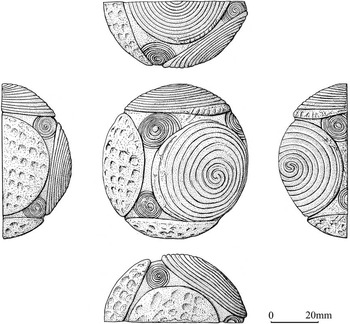
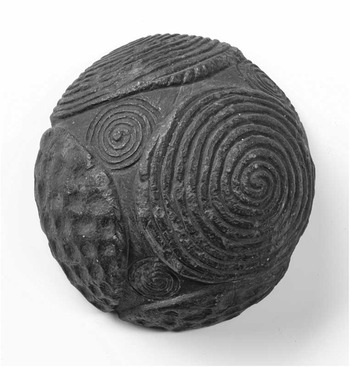
This artefact can be described as comprising approximately half of a Neolithic decorated carved stone ball (figs 2–5). In its present state the flat ‘break’ surface is largely even, suggesting a clean initial break, but it is obvious that this surface has been deliberately modified by grinding and smoothing, if not actual polishing, at some point in the object’s history. The ball weighs 164gm and the maximum surviving diameter is 66mm, the maximum thickness / height being 28mm. The colour is a uniform very dark grey (eg Munsell soil colour 7.5 YR 3/0) and the stone is an unidentified fine-grained igneous rock, possibly serpentine.
The Keith Hall carved stone ball: the maximum diameter of the ball is 66mm and the maximum thickness / height is 28mm. Drawing: Marion O’Neil

The Keith Hall ball: decorated surface. Photograph: Neil McLean, © Trustees of the National Museums of Scotland

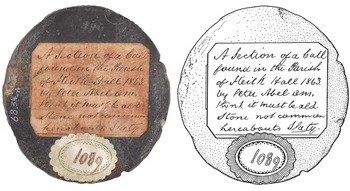
The Keith Hall ball: break surface with labels. Left: photograph: Neil McLean, © Trustees of the National Museums of Scotland. Right: drawing: Marion O’Neil

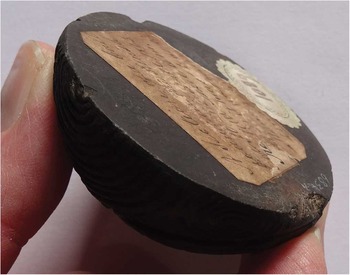
The Keith Hall ball: side view to show the flat, smoothed break surface. Photograph: Alan Saville

The remaining outer surface of the ball has one complete circular projection, or knob, and the truncated portions of a further three knobs. These knobs are not prominent, standing only c 2mm proud of the smooth interstitial background. The outer surface is extensively decorated, both on the knobs and on the interstitial spaces. When complete the original ball would have had six knobs and is classifiable as an example of Marshall’s type 9a/6K.Footnote 60 The surface of the complete knob (maximum diameter 45mm) is entirely covered with incised spiral decoration, in the form of a single spiral with up to ten concentric grooves. One of the truncated knobs (maximum surviving diameter 45mm) has the same type of incised spiral decoration, in this case with up to twelve concentric grooves. The grooves and ridges vary slightly in width and in precise concentricity. They are slightly finer, narrower, closer-set and more regular in appearance on the truncated knob, being often c 1mm or less in width, whereas they are often c 1.5mm or more on the complete knob. The ridges between the grooves are unmodified except for the outermost ridge on the truncated knob, which has a sequence of near-parallel transverse incisions. In three cases these incisions have run over onto the interstitial space. It is unclear whether this represents intentional decoration. There are some similar transverse incisions at one point on the outer two ridges of the complete knob, but they are somewhat obscured by minor damage. This and minor damage elsewhere on the decorated surfaces appear for the most part to be ancient, and to result from surface contact which has dented, compressed or depleted the ridges in places. At one point on the complete knob there is a small but more severe area of damage, which has removed a portion of two of the outermost grooves; this area is fresher looking and may be more recent, perhaps resulting from a blow or from the object being dropped. Perhaps related to this event is an adjacent area of damage on the break surface that also appears fresher and less ancient.
The other two truncated knobs (maximum surviving diameters 43mm and 41mm) both have all-over decoration in the form of rows or a grid of small shallow pits. The larger of the two surviving knob portions retains c thirty-three pits, the other c fourteen pits, with surface abrasion partially obscuring the pitting in some places. The pits are irregularly sub-circular, ranging in maximum diameter from c 3.5mm to c 5.5mm.
In the interstices between the knobs are small incised spirals on the smooth, plain background. Two of these are complete; the larger is c 17mm in diameter, with up to six concentric grooves; the smaller is c 12mm in diameter with up to five concentric grooves. The larger, which is very well preserved, has its outermost groove interrupted where it meets two of the adjacent knobs, but this groove is complete where it narrowly skirts the third adjacent knob. The smaller interstitial spiral is damaged by an impact, but its outermost groove appears similarly to skirt one adjacent knob but be interrupted where it meets the other two.
Of the two incomplete interstitial spirals, one is large – c 19mm in diameter – with up to six concentric grooves, whilst the other survives very partially in the form of just two concentric grooves and a maximum diameter of 10mm. The outermost groove of the larger incomplete spiral is interrupted where it meets one adjacent knob, and skirts the other. The outermost groove of the vestigial spiral abuts the outermost ridge of the one adjacent knob.
The flat break surface is slightly chipped by damage at two points on the circumference (fig 5). The more extensive of these (to the left of the label as illustrated in fig 4) is relatively recent, but probably pre-dates the adjacent application of the Bromley Museum registration number. The small chip to the right of the label is also relatively recent and also post-dates the smoothing of the break surface. The rectangular label has an unstuck, slightly sunken area near its centre, masking an underlying irregular depression in the break surface of the stone, the detail of which cannot be assessed.
The rectangular paper label (44×35mm, with chamfered corners), originally white or cream but now discoloured, has a handwritten inscription in black ink (fig 4), which reads as follows:
A Section of a ball
found in the Parish
of Keith-Hall 1863.
by Peter Abel om[?].
I think it must be old.
Stone not common
hereabouts. Slaty.
Underlying this label is an earlier, smaller, rectangular paper label, c 18mm in its smaller dimension, which is visible where its left edge protrudes from beneath the subsequent label. The loss of a small triangular chip from the left side of the uppermost label reveals that there is also a handwritten ink inscription on the earlier label, but the area exposed is too small to decipher any of the text.
With one edge overlying the bottom edge of the larger rectangular paper label is a subsequent oval label (26×19mm), white with peripheral decoration in green inside its scalloped border. This label has the handwritten number 1089 in black ink. The same number has been written in black ink directly on the surface of the stone above the rectangular label, but is now very faded. To the left of the label, written in white ink on the surface of the stone, is the number 68.34.7. This is the Bromley Museum registration number, whilst 1089 is Lubbock’s own catalogue number.
THE CARVED STONE BALL: BIOGRAPHY / PROVENANCE
The label on the ball records that it was found in 1863 in ‘Keith-Hall’ parish. This is the parish of Keith Hall and Kinkell, in central Aberdeenshire, and Keith Hall itself is a country house in that parish near the town of Inverurie (NGR nj788212). Marshall lists another carved stone ball – a plain four-knobbed example – as being from Keith Hall,Footnote 61 and the area is within the heartland of the overall distribution of carved stone balls.Footnote 62
Peter Abel is described as the finder.Footnote 63 This is almost certainly the Peter Abel (1812–76) recorded in the census returns in 1841 as an agricultural labourer on a farm seven miles north of Inverurie; in 1851 as a day labourer living in Inverurie; and in 1861 as a farmer renting 60 acres and living in a property (Old Mill / Burnhead) on the estate of the Earl of Kintore, in the parish of Keith Hall and Kinkell, where he lived until he died and was buried in Oldmeldrum kirkyard.Footnote 64 The presumption can be made that Peter Abel picked up the ball from a field surface somewhere in the vicinity of his residence, most probably perhaps on his own rented farmland, although the scanty available evidence dictates that the parish attribution must remain the basic indication of provenance.
The ball was acquired by Lubbock and the acquisition recorded in his handwritten catalogue (AC vol. 2; fig 6) as: ‘1089. Section of a stone ball found in the Parish of Keith Hall nr Inverurie, N.B. [North Britain] in 1863 by Mr Peter Abel. Pres. by Mr G. Taylor May [1875]’. It is likely that this information was copied from the pre-existing label, which the label marked with Lubbock’s catalogue number overlies, and that it was on the ball when he acquired it. Of the two names associated with the ball prior to Lubbock’s acquisition, the label could have been written by Abel or Taylor, although in view of the observation about ‘Stone not common hereabouts’ this might depend on whether or not Taylor was a local man. Nevertheless, the comment ‘Slaty’ is odd, since the stone is not in the least slate-like in character, nor is the dark grey colour particularly slate-like.
Lubbock’s own handwritten entry for the Keith Hall ball in the Avebury Catalogue vol. 2. Photograph: scanned image reproduced courtesy of Bromley Museum Service

Lubbock is known to have visited Scotland in May 1875, the year of the entry in the catalogue, and it is conceivable he was presented with the ball as a gift for his collection by Mr Taylor in person. Unfortunately it has not yet been possible to discover anything definite about this Mr Taylor or how he acquired the ball.Footnote 65 The concise entry in Lubbock’s diary for 29 May 1875 simply reads: ‘Have been down [sic] to Scotland to see some of the Scottish monuments’.Footnote 66 It was not at all unusual for Lubbock to receive gifts for his collection, often entirely unsolicited, so there is no reason to assume that he necessarily had any contact or relationship with Mr Taylor other than in this transaction. There may well have been correspondence; if so, this does not seem to have found its way into the archive and the Lubbock / Avebury papers in the British Library appear to throw no further light on the matter.
The ball remained in the Lubbock / Avebury Collection until it passed, along with the residue of the collection, to the Orpington Historical Society in 1947, and then to the Bromley Museum in 1965. A misreading of Lubbock’s handwriting in his catalogue has led to the ball being registered previously at Bromley Museum as from Keith Hall, Inverness, rather than Inverurie.
DISCUSSION
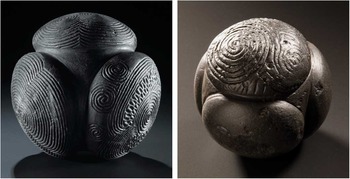
This Keith Hall ball joins a select group within the known corpus of carved stone balls that have extensive surface decoration, and an even more select group with incised spirals. Marshall lists fourteen balls in her type 9a with spirals, but they are extremely varied in type, in the quality, extent and positioning of their decoration, and in the character of the motifs employed – both the spirals themselves and any associated motifs.Footnote 67 The quality of the spiral decoration on the Keith Hall ball is high; it is one of the most carefully and skilfully executed, falling between the decorative apogee represented by the exceptional incised work on the Towie ball and the somewhat less regularly formed incisions of the ‘Elgin’ ball (fig 7).Footnote 68
Left: the Towie ball (NMS X.AS 10). Photograph: NMS, © Trustees of the National Museums of Scotland. Right: the ‘Elgin’ ball (NMS X.AS 217). Photograph: NMS, © Trustees of the National Museums of Scotland

Marshall makes the point that on none of the recorded spiral-decorated balls are all the knobs decorated.Footnote 69 It is not possible to know in the case of the Keith Hall ball if either of the completely absent knobs bore decoration, but the unusual presence of the small spirals in each of the extant interstitial spaces may offer a hint that decoration did extend further. Interstitial spirals are not common, but other cases are known,Footnote 70 and the Towie ball has comparable small spirals around the edge of one of its knobs.Footnote 71 No other balls appear to have quite the same kind of pitting decoration, either in the form of the individual pits or in the arrangement of them, though there are a few examples on which a kind of pitting occurs on the knobs,Footnote 72 or in the interstitial space.Footnote 73 The Towie ball has a combination of spirals and a version of pitting on one of its knobs.Footnote 74 In detail the nature, combination and placing of the decorative elements on the Keith Hall ball are unique, but this is to be expected since no two examples of decorated balls have so far been found to match precisely.
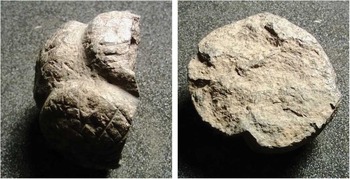
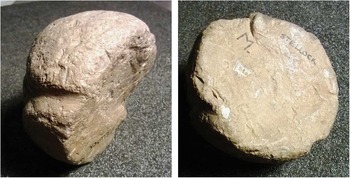
It is interesting to note how few fragmentary, as opposed to surface-damaged, balls have been recorded. Marshall refers to twenty-nine chipped or broken examples,Footnote 75 but there are only some seven examples of what are approximately half balls in her list. Of those in the National Museum of Scotland collection examined by the present author, the break surfaces range from uneven to nearly flat, and this can obviously be influenced by such factors as the type of stone and the degree of post-depositional weathering (figs 8–9). None of the examples seen is nearly as smooth as the flat surface on the Keith Hall ball, the finish of which has definitely been enhanced. The polishing of the break surface must pre-date the application of the labels (fig 4) and is most likely to post-date the 1863 finding of the ball, though this cannot be proven. The intention may have been to facilitate use of the half-ball as a paperweight, for which it would be admirably suited (fig 5).
Broken ball from Nochnarie, Strathmiglo, Fife (NMS X.AS 166; Anon 1909, 73; Marshall Reference Marshall1977, 71). Photographs: Alan Saville

Broken ball from Stelloch (or Stellock), near Monreith, Dumfries and Galloway (NMS X.AS 73; Anon 1889, 146; Marshall Reference Marshall1977, 64; Maxwell Reference Maxwell1889, 212). Photographs: Alan Saville

The parish of Keith Hall and Kinkell, as already mentioned, is in the heartland of the distribution of carved stone balls of all types; nine balls are listed by Marshall as being, variously, from Keith Hall, Kinkell, Inverurie, the Inverurie district or near Inverurie, two of which are decorated, but not with spirals.Footnote 76 However, Towie is only c 35km to the south west of Keith Hall and other spiral-decorated balls cluster in the general area, suggesting the possibility of some sort of local significance or tradition for this design element.Footnote 77
The dating and cultural attribution of carved stone balls are still largely reliant on art-historical parallels for some of the elements on decorated examples – particularly in the case of spiral decoration – and on the contexted archaeological association of balls at the late Neolithic Grooved Ware site of Skara Brae, Orkney.Footnote 78 The latter association has now been reinforced by recent Orcadian finds of carved stone balls at the Grooved Ware sites of Links of Noltland and Ness of Brodgar,Footnote 79 which also strengthens the suggested date bracket of c 3100–2600 cal bc for their occurrence.Footnote 80 There are no reliable archaeological contexts, dated or otherwise, for any of the balls from the Aberdeenshire heartland of their distribution, but they are assumed, by analogy with Orkney, to be associated culturally and chronologically with the producers and users of Grooved Ware pottery. This association has been accepted despite the historical absence of finds of Grooved Ware from Aberdeenshire,Footnote 81 a situation only changed recently as a result of a few new ceramic discoveries, two of which, fortuitously, were made in the parish of Kintore, adjacent to Inverurie and Keith Hall and Kinkell parish.Footnote 82 Almost none of the reported associations of balls with cist burials in various parts of Scotland is sufficiently documented for full credence, though their number does invite speculation.Footnote 83 This is encouraged by recent reconsideration of the 1898 discovery of a type 4a (plain six-knobbed) carved stone ball along with a Beaker vessel in a short cist at Bruachaig, Kinlochewe, Wester Ross,Footnote 84 where the association appears rather more secure and raises tantalising possibilities about, for example, cultural interaction between Beaker and Grooved Ware users.
In the context of Lubbock’s collecting and archaeological interests, the Keith Hall ball was a relatively late arrival. The third edition of Pre-Historic Times had been published in 1872, and the most significant and direct use of items from his own collection in the text and illustrations had already occurred in the second edition of 1869. In no edition is there any reference to carved stone balls as a type, although Lubbock, along with his fellow antiquaries, was well aware of their existence – for example from the publications of Wilson and Evans.Footnote 85 There is little doubt that Lubbock knew of the Towie ball, probably from the original note and illustration in the Proceedings of the Society of Antiquaries of Scotland,Footnote 86 and certainly from the many subsequent references and reproductions of it and other balls, including the ‘Elgin’ ball.Footnote 87 It is surprising, therefore, that the obvious similarity, quality and rarity of the Keith Hall ball seems to have elicited from him no manifest interest. The same might be said of Sir Charles Hercules Read, who failed to acquire this outstanding object for the British Museum amongst the 356 items that did go to the Museum in 1916.Footnote 88 Read may simply have been unaware of the ball’s existence – we have little in the way of detail about the way the archaeological items in Lubbock’s collection were curated, stored and displayed at his home, although there does seem to have been some British Museum involvement in arranging the collection under Read’s predecessor as keeper, A W Franks.Footnote 89
In conclusion we can be thankful that, despite the anonymity of the ball following its discovery in 1863, the ball has survived as part of the Avebury Collection and can now be appreciated for its true worth and significance.
Acknowledgements
I am particularly indebted to Marie-Louse Kerr at Bromley Museum for her ready and enthusiastic assistance in providing information about the Avebury Collection and for facilitating the temporary loan of the Keith Hall ball to National Museums Scotland for it to be studied. Subsequently Lucy Romeril at Bromley Museum kindly provided further information. I am grateful to Janet Owen for her interest in this paper, to Trevor Cowie, Annette Carruthers and C Stephen Briggs for reading the paper in draft and for their helpful comments, and to the latter for providing a cutting from the John O’Groats Journal. Marion O’Neil undertook the drawing of the ball, and Craig Angus and Neil McLean provided photographs. Craig Angus kindly prepared the illustrations for publication. The British Library provided access to the Lubbock / Avebury papers.
ABBREVIATIONS AND BIBLIOGRAPHYAbbreviations
Abbreviations
- BL
British Library, London
- NGR
National Grid Reference
- NMS
National Museums Scotland, Edinburgh