In Tigrinya, one of Ethiopia’s local languages, physical disability is called akal gudat – literally, ‘damage of the body’. The implication is that disability concerns only the body’s condition, in opposition to the social model that casts disability as ‘a negative social response to a perceived impairment’ (Shuttleworth and Kasnitz Reference Shuttleworth and Kasnitz2004: 141). In the federal state of Tigray, a significant portion of the population lives with akal gudat, due in part to the violent struggle against the Derg regime and the war against Eritrea causing disabilities. However, the lack of rehabilitative and medical services, such as vaccination campaigns, as well as poor access to medical resources, contributed to the prevalence of disability as well. In my research,Footnote 1 it appeared that among disabled peopleFootnote 2 it was more important to actively participate in social life than to become ‘obsessed’ with the rehabilitation of the body. Therefore, in this article I focus attention on how disabled people I met during my fieldwork relate to the mobility devices they use, such as crutches, wheelchairs and prostheses, and how they use them in everyday life.
The relationship between disabled people and mobility, conceived as a cultural experience of devices in daily life and of prosthesis in practice, can be an excellent window on disability. It highlights, in fact, the phenomenological, embodied and ‘enfleshed’ experience of disability and it reclaims the importance of the body, which ‘disappeared’ in some versions of the social model of disability (see Hughes and Paterson Reference Hughes and Paterson1997). I think that the body should be at the core of the study of physical disability, but only if we consider the body not as merely biological, but – as Scheper-Hughes and Lock (Reference Scheper-Hughes and Lock1987) argue – as a mindful body that is at the same time biological, social and political.
In this article, I argue that mobility devices should not only be seen as ‘useful’ technologies for disabled people; they should also be seen in their intrinsic ambiguity, technologies are also biopolitical devices. They should be analysed in their practical and ethical relations with the social actors who use them in everyday life; at the same time, we should examine how and why processes of appropriation, negotiation and resistance, connected to the wider socio-political context, take place. The theoretical approach adopted is inspired by critical disability studies as represented by the volume Foucault and the Government of Disability, edited by Shelley Tremain (Reference Tremain2005). What is argued is that biopolitics must be conceived as government of bodies (Foucault Reference Foucault1978) and the socio-political nature of mobility devices as a form of biopolitics. Devices and prostheses will be investigated not only as material objects of the culture of rehabilitation, which is itself a ‘dispositif’ or composite apparatus of discursive and practical elements. They will be connected to wider political issues and to the topics of ‘embodiment’ (Csordas Reference Csordas1994) and ‘stateness’ (Pizza and Johannessen Reference Pizza, Johannessen, Pizza and Johannessen2009), the close relationship between intimacy and power:
An approach along these lines would lead us to insights of ways in which the state enters our bodies as well as how bodies create and recreate the state: in the course of everyday practice, in the central institutions of state bureaucracy, and in sites that are marginal and apparently removed from bureaucratic state procedures. (Pizza and Johannessen Reference Pizza, Johannessen, Pizza and Johannessen2009: 19)
The use of devices addresses the ‘normalizing’ expectations of the able society, expectations embodied by disabled people, and it has to be connected to the disciplining of an ‘ungovernable body’ (Agamben Reference Agamben2005). Although, in Ethiopia, disability is a complex issue at the centre of multiple dimensions that give it different meanings, such as that of the Orthodox Church tewahedo and of so-called ‘traditional’ medicine, in this article I focus primarily on how the ‘ungovernable’ body of people with disabilities is linked to the political question of development, at the core of the wider political project of the Tigray People’s Liberation Front (TPLF).Footnote 3
Beginning with the case of my friend RahelFootnote 4 and through the stories of other informants, I highlight the relation between people and devices in everyday life that is ‘the primary arena in which people learn something about the state’ (Sharma and Gupta Reference Sharma, Gupta, Sharma and Gupta2006: 11). I show how disabled people embody the artefacts of the rehabilitative dispositif and/or how they resist or negotiate with them. I consider the ‘rehabilitative culture’ as technology, conceived as a set of knowledge and practices, and also as a biopolitical device.
Devices and everyday life
Rahel was affected by polio when she was two years old, and although she was cured, she will live with the effects of the illness for the rest of her life. To move around she uses a crutch, a brace for her leg and orthopaedic shoes. The use of those devices is very important for her – to the point where she developed a special relation with them and she gave a name to her crutch. I realized this one day in April 2015 when we were having a cup of Ethiopian coffee in her house. At one point I drew her. As soon as I showed her the drawing, the first thing she said was ‘You forgot Awetasc’, and she pointed at her crutch.
Awetasc in the local language means something that allows you to go out; in particular, it is used to refer to a boy or a girl who takes you out for a date or out of a situation or a problem. In Rahel’s case, her crutch became her life companion; it was like a human. Tools have an impact only if deployed intentionally by their users and they have similarities to the ‘gift’, as Ingold suggests: ‘both tool and gift mediate an active, purposive engagement between persons and their environments’ (Reference Ingold2000: 319). For Rahel, that crutch is not a crutch, a tool made of iron and plastic; it is someone, and not something, that takes her out. Rahel’s case is quite unique and personal; however, it made me think about the relationship between a person and different devices, especially when she pointed out my error in representing her, revealing my cultural idea of a ‘normal’ body and forgetting that that device was totally embedded in her daily habits. As other researchers have stated (Papadimitriou Reference Papadimitriou2008), the devices used by people with disabilities become real extensions of the body, external organs.
Disability forces a person to rethink and re-embody the techniques of the body (Mauss Reference Mauss and Mauss1965) in order to re-establish their ‘self-identity in relation to the person’s new bodily state’ (Seymour Reference Seymour1998: 99), as Rahel’s case shows. Therefore, the body needs to conform to the different available devices, in order to make a person able to move around. This process is not easy or ‘natural’. In fact, there are centres where it is possible to receive training lasting at least fifteen days in order to become familiar with different devices. In other studies, this process is known as ‘adjustment’ and ‘coping’ (Murray Reference Murray2010: 81–2).
It was interesting to see how Rahel needed mobility devices in the public space, but in the domestic space she released herself from them, preferring to walk ‘badly’ rather than utilize the crutch and the brace that irritated her leg, especially when it was very hot. Some informants who used wheelchairs likewise left them in certain circumstances in favour of simpler techniques. They preferred to grasp wooden blocks – the ones utilized by the shu shiner – to protect their hands while pulling themselves along the ground, dragging their legs. Moving in that way was much more comfortable than rolling the wheelchair in a city such as Mekelle, where the pavements are very high.
Some people attempted not to rely on any devices and to find their own body balance, if they were in the physical condition to do so. This was the case for Hyiab, who has been lame since she was fourteen years old as a consequence of an attack by an evil spirit (ganien) when she was on her way back to the countryside on the first day of the month. She underlines the date because she says that, since then, every first day of the month she feels pain in her leg. Her story tells of different attempts to treat her condition, which started with her leg becoming too dark and swollen. After she attended the Red Cross, they referred her to a public hospital where, even after an X-ray, she did not receive a diagnosis. She spent six months going in and out of the hospital and at last health professionals suggested amputation, but she categorically refused. She went to a may chelot (holy water) to find some relief and continued with biomedical treatments such as massage and physiotherapy. She is convinced that during the treatments they misplaced her sinew and that is why she is still lame.
Hyiab decided not to undergo amputation and not to be dependent on any external device. She adopted a way of walking that is not the ‘normal’ one; in fact, she is called hankash (lame) and known in the neighbourhood where she lives alone by her way of walking:
When I came to live in Mekelle, the sister of my father intentionally broke the stick I used to walk with. I asked her how I could walk without it and she replied that I should walk by my own leg in a zigzag. So with a zigzag way I walked and thank God now I can walk without a stick.Footnote 5
Hyiab’s aunt took an aggressive approach, damaging her niece’s device, but Hyiab does not refer to this episode as a form of domestic violence. Upon her arrival in the city, the aunt aimed to avoid any bad reaction from the community: first, the stick is something good for the village, not for the urban space; second, it is something immediately visible that can reveal an ‘impaired body’; third, being independent is an important goal. The destruction of the stick can be seen as a spur to the assumption of a ‘modern’ urban identity. This idea of independence is still embodied in Hyiab; she lives alone, walks alone, and is part of the Association of Women for Disability and Development.
In the field, I was amazed by the employment of devices I would define as ‘unusual’ or, for lack of a better term, not ‘socially recognized’. Many informants explained that, at a young age, since they did not have devices that could help them to learn the culturally normal and accepted ‘techniques of the body’ (Mauss Reference Mauss1979), they employed subversive ways to move and different body postures. ‘Crawling like a snake’ was an expression often used by my informants to describe the techniques of mobility employed by them when they were young.
I was introduced to ‘subversive techniques of the body’ early in my fieldwork. During the first ten days in Mekelle, I stayed in a hotel in one of the main squares of the town: Atsé Yohannes. From the terrace every morning I saw a rather old man passing by; I met him more than once in the adjacent streets and I realized he was begging. The man had had both legs amputated and he used to turn on the road, crawling on his stumps with the help of his arms. There was less traffic than in the capital city, since in Mekelle there are few private cars aside from the jeeps belonging to local NGOs; but, such as it was, the traffic stopped. The man presented an image of pain and poverty. However, a few days later I saw the same man with a wheelchair that had probably been donated to him by a humanitarian organization. The technique of the body that the wheelchair required was much more difficult for him than moving in the way he had been used to since he was young. At the same time, the spectacularization of a physical impairment can be seen as an income generator in relation to his begging. As I explain in the next section, both begging and using ‘subversive techniques of the body’ that can evoke worlds of poverty and suffering are things that the Ethiopian government fights against. The contradistinction between ‘modernity’ and ‘backwardness’ is the rhetoric at the core of political and social intervention in the Ethiopian developmental state. As the social workers at the governmental offices stated many times in our conversations, their point of view was that the main problem of the disabled people is their difficulty in securing an income. In this discourse, disabled people are associated with an ‘unproductive’ social body that is not able to contribute to the economic growth of the country. The policy interventions aim at avoiding any form of dependency, such as begging, and underline the expectations of productivity and the association between the ideas of an ‘able’ body and a ‘productive’ citizen, as the following words of an office worker in one of the Woreda of Labour and Social Affairs (WOLSA) stated: ‘We are working, step by step, on the eradication of dependency and the expectations of governmental aid without doing anything only because they are elderly or disabled.’Footnote 6
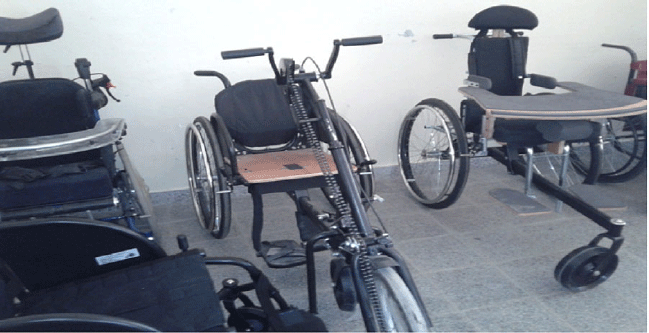
During my fieldwork I often saw the amount of effort people had to expend to move their wheelchairs on the unpaved road. The situation was even worse during road repairs. One wheelchair user, a young mother I met at the Association of Women for Disability and Development, was forced to stay at home until the road works in front of her house were completed. Nor are people in wheelchairs able to take public transport, as there is no way to fit a wheelchair into the small buses full of people and animals. The variety of wheelchairs (see Figure 1) meant for use in the urban space cannot compensate for the lack of infrastructure. As also reported in urban Ecuador, ‘since built environments have been constructed for particular users, analysis can reveal cultural assumptions about spatial governance. For instance, steps and curbs are non-neutral methods of directing pedestrian traffic that constitute known barriers for people who use wheelchairs’ (Rattray Reference Rattray2013: 27).
Different kinds of wheelchairs available at the MOPC.

In addition to the infrastructural barriers, wheelchairs are problematic because of their – real or supposed – negative associations. Getachew, the manager of the community-based rehabilitation programme in rural areas, said that these devices were so strongly connected to disability that some people he met in the villages would not touch them for fear of ‘infection’. In his narration, which related to his work in the villages of Tigray, Getachew stated: ‘Devices are immediately associated with disability and touching them is like invoking disability, better to stay away.’Footnote 7
As Andrea Caprara affirms: ‘Contagion can be thought of as a cross-category that goes through and bonds together socio-cultural aspects of the community and shows the difference between conceptual models of body and sickness, similarity and contiguity’ (Caprara Reference Caprara1996: 103, my translation). In fact, lived experiences in Tigray are shaped by different horizons of meaning that coexist in harmony and contradiction in the same setting and games of power between the hegemonic biomedical tradition tied to ideals of development and ‘modernity’ and the local forms of knowledge and health practices that play out in the lives of disabled people.
Ethiopia has a plural health system (Wondwosen Reference Wondwosen2006; Schirripa Reference Schirripa2010), in the sense of a ‘field’ in Bourdieu’s terminology and as ‘medicoscapes’ (Hörbst et al. Reference Hörbst, Gerrets and Schirripa2017: 17). The history of biomedicine in Ethiopia is not the result of the colonial experience, as in many African countries; rather, it is more related to choices made by the national government. Since biomedicine was brought to Ethiopia by Menelik II, known as ‘the father of modernization’ (Bishaw Reference Bishaw1991; Kassaye et al. Reference Kassaye, Ambebir, Getachew and Mussema2006), the government has always given legal, rational and de facto political legitimacy to biomedicine. Even though Ethiopia signed the Alma-Ata Declaration in 1978, which recognizes the importance of ‘traditional’ medicine, the government gave priority to the biomedical tradition. In fact, in Tigray, there are different therapeutic resources and different explanations of illness; the health-seeking behaviours of patients (see Massa Reference Massa and Schirripa2010; De Silva Reference De Silva2012) confirm the use of all these resources. I refer to this set of local medical theories and practices as ‘traditional’, contextualizing this choice in the light of debates on ‘tradition’ and taking for granted that this notion is just dialogic and reveals the power of the biomedical tradition in comparison to others.
Sickness in Tigray is attributed to natural and supernatural attacks by ganien, zar, buda and ide seb Footnote 8 (Vecchiato Reference Vecchiato, Kloos and Zein1993; Reference Vecchiato1994; Messing Reference Messing1958; Young Reference Young1975; Reference Young2000 [1975]) that can compromise health and even take the form of possession. Usually debterà healers, those who reach the highest level of religious education, have the ability to summon and fight evil spirits. Evil spirits move through the blood of the affected person and their presence leaves a sign in it. Healers speak about ‘spoiled blood’ as a symptom of illness and as a sign of the passage of these supernatural figures that can be passed on to others and transmitted from parents to children. This accords with the idea of contiguity and contagion. In the specific case of disability, some aleka Footnote 9 healers and people refer to this kind of transmission, especially from mother to son, or to acquisition via contact.
During one of my visits to a may chelot in Mekelle, an aleka healer told me that the baby on the wheelchair, who was there washing with his mother, received the spirit from her during childbirth and that this was the reason for the child’s impairment.Footnote 10 However, the mother attributed the child’s bodily condition to another reason. She thought that her son had passed across spoiled water that had been used by a healer to free an old man from an evil spirit. In a further interview the same aleka healer explained his claim:
Parents worship some spirits, like zar, and they worship them with clothes, a coffee ceremony or slaughtering a goat or a hen. In these cases, evil spirits keep in touch with the parents who worship them and mingle with their blood. So when a child is born from these parents, the evil spirit reigns in the child. In the science it is called polio, right? But it is not polio; it is the result of worshipping spirits.Footnote 11
This ethnographic background allows us to understand the initial words of Getachew and how the categories of transmission and contagion via contact may be used in the signification of disability. However, I do not want to give too much emphasis to the ‘medical’ aspects of disability, because I am firmly convinced that disability should be neither medicalized nor anthropo-medicalized. This kind of discourse influences the perception of disabled people’s conditions and their approach to mobility devices because these ideas are part of the socio-cultural context, but other issues play a more important role in their life stories. Only in the rhetoric of development actors (such as NGO and government workers) was there an emphasis on these topics, with the aim of ‘traditionalizing’ the community’s view of disability (De Silva Reference De Silva2020a). It is well known that there is a profound difference between people’s ‘attitudes’ and their real practices, as shown in the work of Benedicte Ingstad (Reference Ingstad, Ingstad and Whyte1995a; Reference Ingstad, Ingstad and Whyte1995b). Moreover, these ideas are mentioned by professionals who work on disability, who tend to characterize their society as ‘backward’ (see Ingstad Reference Ingstad, Ingstad and Whyte1995b on community-based rehabilitation in Botswana). The lives of disabled people and their choices in relation to mobility devices are influenced by many contradictory factors, but the devices are at stake in this contradistinction between ‘tradition and backwardness’ and ‘modernity and development’. This is the way in which the social body and the personal body, government agendas and intimate experiences are closely bound together.
Rehabilitative culture and development
In Tigray, the main rehabilitation institution is the Mekelle Ortho-Physiotherapy Centre (MOPC). The MOPC was established in 1992 and mainly provides ortho-prosthetic services. It has two departments. The first handles prostheses: here there are consultation rooms, a large space for training people in how to use artificial limbs, a room for different kinds of devices (crutches, wheelchairs, etc.) and a lab where the prostheses are made. These use polypropylene provided by the International Committee of the Red Cross (ICRC), a plastic material that is characterized by high durability, flexibility and a resistance to impact and a wide range of temperatures. The second department is for physiotherapy and occupational therapy. The centre was established with donations from many stakeholders: the Ethiopian Bureau of Labour and Social Affairs, the ICRC and Doctors with Africa CUAMM (an Italian NGO). However, the main administrator is the Tigray Disabled Veterans Association (TDVA).
The TDVA provides the budget for buildings, materials and transport. Services are provided free of charge with a card from one’s kebele that shows one’s inability to pay for rehabilitation. Even prostheses are free as they come from donations; however, maintenance and repairs are not free. The ICRC provides food and covers the expenses of patients’ stay in the centre while they complete their training with the prostheses. The centre was established as a local NGO administered by the TDVA, but due to its limited resources it finances its activities through international donations, making it dependent on external aid with no security or continuity. Many people received devices as donations from NGOs but with no continuity.
The main role of the TDVA indicates that the MOPC primarily provided a service for disabled veterans; only later was this extended to others with the ‘globalization’ of the issue of disability. The difference between war-disabled and non-war-disabled people was marked (De Silva Reference De Silva2019; Reference De Silva2020b): the former have good welfare provision, while the latter are mostly considered by government and the local administration as ‘vulnerable’ citizens.
It is important to explain how, in Tigray, the moral economies of the post-war and developmental state are strongly interwoven and how people involved directly in the fight against the Derg regime are considered ‘grade A’ citizens. Ideally, the struggle for development is the direct heir of the struggle for liberation in the political project of the TPLF:
The official memory of the liberation struggle is re-elaborated, in order to amplify its social dimension, considered ‘a revolution within the revolution’ and to allow ‘the fight against poverty’ taking the baton from ‘the fight against the Derg’. Those who do not adhere and comply with official development policies and guidelines, exactly as in the times of the civil war, are considered as traitors. The discourse about economic development and the fight against poverty become therefore a vector of access or exclusion from the resources controlled by the state. (Fantini Reference Fantini2013: 5)
The difference is even related to the presentation of oneself. Veterans seem to be proud to show the signs of disability on their body, even in the case of amputations or limited physical functionalities.
Some veterans I met in the MOPC were not very happy with my curiosity about their lives; at the same time, during my fieldwork, it was not possible for me to carry out research at the TDVA. The man I met the first time I went to the TDVA refused to recognize the ‘research permit’ provided by my Italian university and the University of Mekelle because it related to ‘research on disability’, not veterans. This strengthened my conviction that there was a significant distinction between disabled veterans and other disabled people. Once, an ex-soldier who was in the MOPC in order to fix his artificial limb was very upset about one of my questions:
VdS: Which were the problems you experienced in your life?
Soldier: Problem? What problem? I don’t have problems. They gave me the right treatment and after the cure, the government even gave me a house … I never had problems. The government supported us.Footnote 12
This assertion is very important, because in some way it ‘decolonizes’ disability from the universality of a ‘personal tragedy theory and narrative’ (see Oliver Reference Oliver1990; Martins Reference Martins, Campbell, Fontes, Hemingway, Soorenian and Till2008) – to which I return later – and demonstrates how personal perceptions of self and of devices are bound up with socio-political environments, expectations and recognition.
The signs on the veterans’ bodies are proof of their participation in the struggle for national liberation and for the development of the country; most of them use the rhetoric that the loss of a part of the body has its counterpart in the integrity of the state. In the case of non-war-disabled people, the loss seems to have no social counterpart. A disabled body is considered an ‘un-abled’ body and is associated with a reduced ability both for independent living and to work for poverty eradication and development.
The employment of devices related to the expectations of normalization and ‘normification’ (Goffman Reference Goffman1963) is closely related to this concept of personal and political bodies and development in different ways. In the case of disabled veterans, the use of devices seems to be compensation and reward for their contribution to the democratization of the state. For the non-veteran disabled, instead, it is related to the idea of fixing a body to make it more productive in the economic sense and to avoid recourse to ‘backward’ tools (such as wooden sticks) and ‘subversive techniques of the body’ associated with the spectacularization of the bodily impairment for begging and a poor suffering universe.
As stated previously, Ethiopia is making a great effort in developing the country, placing the health sector at the centre of development actions:
The huge effort in the economic and structural transformation of the Ethiopian state through ‘developmentalist capitalism’, where the project of development and the reinforcement of the central power merge, reaches its apex with the ambitious project of the Growth and Transformation Plan of 2010. (Villanucci Reference Villanucci2014b: 126, my translation)
Proclaimed by Meles Zenawi, the Growth and Transformation Plan is based on the huge involvement of society at a grass-roots level, starting from rural areas, through programmes such as the Women’s Development Army (Villanucci and Fantini Reference Villanucci and Fantini2016).
The informants interviewed attempted to recover from their disabilities by relying on various resources: biomedical institutions, traditional healers, may chellot and woggesha (bonesetters). Two bonesetters, both old women, whom I met during my research described carefully their treatment of broken bones and the paralysis of limbs. These practices are seen as ‘backward’, and incision and maghuma (blood sucking) in particular are discouraged because they involve blood and the danger of contagious diseases such as HIV.
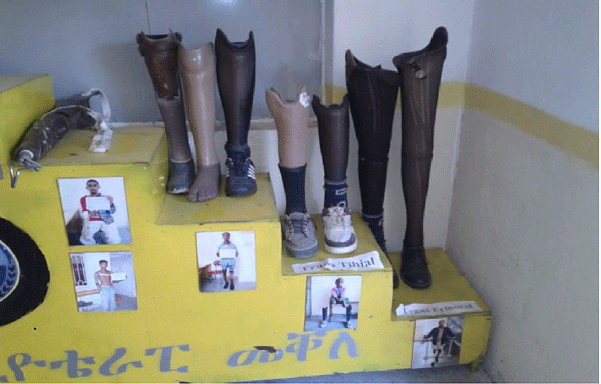
The Ethiopian developmental state wishes to distance itself from ‘unscientific’ therapeutic practices just as it would like to eliminate the multiplicity of mobility techniques: the use of sticks; the wooden blocks for protecting one’s hands while pulling oneself along the ground; the subversive techniques of the body that allow mobility without ‘high-tech’ devices. All these things represent poverty and backwardness. The MOPC is the ideal alternative with its modern, ‘high-tech’ devices. It exhibits pictures of patients using these devices (see Figure 2) as ‘models’ for the community. These pictures are not only displayed on posters that explain the different kinds of devices; they are also an awareness tool. People portrayed in the pictures are examples for society and they put their faces and their private information (such as name and date of birth) at the service of the community, raising awareness about the use of prosthetic and mobility devices.
Artificial limbs and pictures of the users with their names and dates of birth.

In the local context, the practice of electing model citizens is very common:
The creation of model citizens is considered an indispensable goal on the path towards development and towards ‘modernity’ and emancipation from the state of ‘backwardness’ in the country. Based on official discourses, the practical demonstration of improvement in the life conditions of some people, engendering a spirit of emulation and competition in their neighbours, triggers a virtuous cycle for mass change. (Villanucci Reference Villanucci2014b: 129, my translation)
People using mobility devices provided by the biomedical rehabilitation institutions are shown to be an example of ‘modernity’. They are a version of the model citizen, responsible for themselves. Individual development is a step forward in the development of the state and a ‘fixed’ body counters the lack of infrastructure. The use of prostheses and other devices is seen as proof of development. In general, the culture of rehabilitation is related to socio-political issues and responds to what Sumi Colligan calls ‘the moral imperative to fix’ (Reference Colligan, Smith and Hutchinson2004). As Laura Mauldin (Reference Mauldin2014) wrote, quoting Colligan, it is easier to concentrate on fixing a body than on building an environment able to ensure social justice.
Narratives of loss
Many ‘natural’Footnote 13 disabled people I met at the MOPC were amputees who had been fitted for artificial limbs, known as bambula. Footnote 14 The frequent use of amputation is a symptom of the lack of access to cancer care, and unfortunately is common in Ethiopia as well as in other parts of Africa (Livingston Reference Livingston2012). They told me that, although these prostheses were very helpful for them for managing their daily activities, they also restricted participation in a social life. They noted many difficulties in working out a balanceFootnote 15 between the body and the prosthesis.
This is the story of Netsanet, whom I met at the MOPC. She was a thirty-seven-year-old woman and had an amputated leg due to cancer. She lived alone with her daughter, and she was a housewife with no regular income. She had no land and told me that, in order to earn some money, she made gibabo (a typical woven basket used for injera). Netsanet started to feel pain in her leg some years before our meeting, and she reported that the first symptom she recognized was a kind of wound. This wound stayed with her for seven years and during this period she tried different traditional medicines: ‘I spent seven years just limping and using this traditional medicine or that!’Footnote 16 In the meantime, she used to walk with a stick. She said that later this wound ‘changed into another disease’. She went to a Catholic clinic, and they referred her to Mekelle hospital, where she received the diagnosis of cancer. She was advised that it was necessary to amputate her leg.
I went through the surgery in a happy mood because in one way I had to save my life. I said to myself, ‘If I’m lucky I will survive,’ and on the other hand I said to myself, ‘What is important is my relief from pain regardless of my death during surgery.’ If you are saved from death then all you have to say is thanks to St Michael and St Gabriel,Footnote 17 but regardless, the living is bad. Let alone without one part of the body, life is unfulfilled; even with all parts of the body it is hard! So now my life has a lot of pitfalls! What kind of living can you call such a kind of living? I’m spending my time playing with my eyes [alone and doing nothing] … My life is now from the toilet to the house. To live with all the parts of the body and to live with one of these missing, it is not the same.
When I asked her about her social life and if and how the artificial leg had changed anything in her daily life, she replied:
I don’t always socialize. Where do I go? I can’t walk! I always stay at home locked up. I will be a trouble if I go to another person’s house because I either sit in a tall seat or a very short one. Psychologically I don’t feel like going to other people, and anyway I can do some activities at home. But in my mind, I think: ‘I was fitted into an artificial leg, then why should I go to others?’ I just simply sit at home telling myself: ‘What will I do if I go there? I can’t run to be in a meeting on time.’ You know, a lot of meetingsFootnote 18 are held at kebele but I can’t go, and I don’t want to go because if I go there my leg starts to get numb and when it is sunny I feel pain. I simply stay at home and sweep the floor, thanking God that I was fitted into the artificial leg.
Netsanet thinks that the artificial limb will help her in regaining physical functions, but at the same time she thinks that this rehabilitative aid will not lead to social rehabilitation. In fact, she is unhappy with her situation, but this feeling proceeds from encounters with ‘able-bodied’ society that create frustration and shame, confirming disability as a relational process. Her sense of ‘loss’ is not only physical but concerns the loss of possibility of social movement. It is the result – as French states – of disabling expectations: ‘disabled people are subject to many disabling expectations, for example, to be “independent”, “normal”, to “adjust” and “accept” their situation. It is these expectations that can cause unhappiness, rarely the impairment itself’ (French Reference French and French1994: 3).
The predominant narrativeFootnote 19 of my informants was one of loss – the physical loss of a limb or a corporeal function, and the loss of social mobility. This is the consequence of a tragic view that non-disabled society and development expectations impose on ‘natural’ disabled people with an ‘order of discourse’ creating effects of ‘truth’ (Foucault Reference Foucault1971), a view that in some ways oppresses them and shapes the discourse on disability. The concept of personal tragedy narratives as culture grand narrative (Martins Reference Martins, Campbell, Fontes, Hemingway, Soorenian and Till2008) develops from the ‘personal tragedy theory’ postulated by Oliver (Reference Oliver1990). This concept represents the grammar and semantics on which most disabled people draw to describe their experience of disability; but, as first Oliver and then Martins showed, it is the result of a dominant culture that wants to link the condition of disability to the universe of misfortune, tragedy, disgrace and inability (Martins Reference Martins, Campbell, Fontes, Hemingway, Soorenian and Till2008).
The narratives of those informants who acquired an impairment later in life underline how disability has been a watershed between a ‘normal’ existence shaped by participation in the social life of the community and broader possibility of choice, and therefore by a larger capability Footnote 20 (Sen Reference Sen, Nussbaum and Sen1993), and an existence marked by a ‘reduction’ of physical activities and of social position. Shiferaw, another patient I knew at the MOPC, was there with his wife to receive his first artificial leg. Six months before, he had undergone amputation due to disease. When his leg started to swell, he went first to a hospital in Mekelle, but he did not find a solution. After that he went to a may chelot for washing but his suffering did not disappear, so he went back to the biomedical institution. In Ayder hospital, where he received a diagnosis of cancer, he was advised to undergo amputation immediately to avoid the spread of the cancer. At first, he refused, then he agreed to surgery. Shiferaw had a commercial activity – a billiard hall in the centre of Mekelle – but after the amputation he did not go back to work and he stopped renting the premises.
I lost my concentration very much. I have never been in gatherings with people till now because it touches my mind. I move by covering my face because I get frustrated, and I feel bad about it. I have been implanted with an artificial leg to move around but not to gather with people. It frustrates me. My closest people always come to visit me, but I never go to social gatherings because I feel bad about it. I mean … when I walk like this, I feel bad very much.Footnote 21
Prostheses in practice
As in the case of Shiferaw, the sense of loss is material, physical and psychological, and the relation with a prosthesis is not easy or smooth. I met Shiferaw some days after our first meeting. He was in training, trying to adjust his body to the new apparatus and to adjust his life to his new condition. When he was released by the MOPC, I lost track of him. I do not know if he ever returned to his business. The concept of prosthesis has been used in anthropology mostly as ‘metaphor’ (Nelson Reference Nelson2001). In this approach, prosthesis does not emerge as a subject of analysis itself and remains out of the embodied experience; it is no longer a matter of practice (Mol Reference Mol2002). In contrast, Kurzman (Reference Kurzman2001) draws attention to the prosthesis as subject of study, connecting prosthesis and technologies to phenomenological experience.
Following Kurzman’s approach, in this section I give greater attention to the materiality and to the phenomenological and embodied experience of the mobility devices and prostheses used by disabled people. In my case, prostheses are conceived both as ‘phenomenologically lived artifact’ (Sobchack Reference Sobchack2004: 206) and ‘a cultural trope and a material condition that indelibly affect[s] people’s lives’ (Deutsch and Nussbaum Reference Deutsch and Nussbaum2000: 1–2). Disabled people interviewed during my fieldwork expressed different feelings and perceptions about artificial limbs. Artificial limbs cannot be embodied easily; it takes time for the person to pass from the idea of ‘an apparatus that is not my leg’ to an acceptance of ‘my leg’ (Sobchack Reference Sobchack2004: 195).
When I asked Netsanet, whom I introduced above, about her embodiment of the artificial limb and if it was hard or not, she answered:
Of course, it is hard! What can we do about it? But since we want to walk, we consider it as our normal leg, thanking God and these people for providing us with such. But in general why shouldn’t it be hard, when you are carrying an apparatus which isn’t your own leg? … I don’t know why but I had a lot of hardship to fit into and to train with an artificial leg.Footnote 22
For Netsanet, as for others, adjusting to the device meant that compensating for their loss was a complicated matter.
Some people looked at the artificial limbs as a ‘reintegration’ of the body and they underlined how they felt better than with other kinds of mobility devices such as crutches. Fitsum was a patient with an amputated leg due to an accident at work; I met him in the MOPC during his training to walk properly with his new bambula:
[The] artificial leg helps me very much. For one thing: there is a mental change in the mental condition when you use a crutch and on the other hand when you walk with an artificial leg. When I walk with an artificial leg, it is OK; I don’t feel so much embarrassment when relatives look at me. They started seeing you as such, so you also feel such a way.Footnote 23
In this case, the artificial leg was seen by the informant as a way to rebuild a ‘complete’ body, while the crutch was seen as an evident and external symbol of inability that provoked embarrassment, also perhaps due to the notions of infectious devices or devices that will bring bad luck. The topic of the transparency of the prosthesis is often discussed: ‘in a social context, artificial limbs are ideally invisible in order to facilitate mimicry of nonamputees and passing as able-bodied’ (Kurzman Reference Kurzman2001: 379).
The importance of the cosmetic aspects of prostheses was argued many times during my fieldwork. The first time I went to the MOPC, Abraham, the physiotherapist who helped me during the research and was a gatekeeper in my meetings with the patients, showed me all the devices and artificial limbs available. He explained that material for the artificial limbs has different shades of colour to adapt properly to the skin colour of the patients. To make me understand the importance of this point, he told me the story of a woman, a patient of the centre, who refused the leg they prepared for her because the colour was not the same as the rest of her body. To expand on the topic, he showed me two types of artificial hands: the first one looked like a doll’s hand and was aesthetic but not functional; the second one was metallic with a mechanism that allowed opposability of the thumb so the user could grasp objects. Abraham told me that, in his experience, most of the patients preferred the aesthetic hand rather than the functional one. Some of the informants in my field experience refused to utilize prostheses and mobility devices. In the urban environment, they were not very useful; nor did they add more abilities than those the disabled people already enjoyed. The cosmetic aspect was more important.
As emerges from the different experiences of the disabled people, it is possible to affirm that the devices have a dual nature, as Christina Papadimitriou states in her study of the use of wheelchairs by adults affected by spinal cord injury (SCI): ‘[The wheelchair] is often perceived as a symbol of limitation or incapacity, yet at the same time it is a part of the normalization process for persons after SCI (or other disabilities)’ (Papadimitriou Reference Papadimitriou2008: 692). She adopts the term en-wheeled to specify the mechanical and practical process of rehabilitation implicit in the use of the wheelchair as well as to recognize this process of adjustment as more existential than operational – en-wheeled refers to the incorporation of the device in the body technique and also as a way to be in the world. In this ethnographic section, I have shed light on the different ways in which people face and negotiate what could be called their deviced bodies.
Concluding remarks
Inclining towards a theory of embodiment for which the ‘body is not an object to be studied in relation to culture, but is to be considered as the subject of culture, or in other words as the existential ground of culture’ (Csordas Reference Csordas1990: 5), and towards an idea of disability as a ‘realignment of body, person and society’ (Bendelow and Williams Reference Bendelow and Williams1995: 156), I have analysed the relation between disabled people and mobility devices in the specific setting of an urban context in Ethiopia. My approach takes for granted the fact that technologies are not neutral, and that they are linked to an idea of competence embedded in the social and political environment in which subjects using them live. That is why institutions and the state are involved in this re-embodiment process of persons/citizens.
Of course, devices are ‘helpful’ for people living with physical disability in Mekelle, but the evidence shows us the following points. The relation between persons and devices is very personal: in some cases, including Rahel’s, they are ‘naturalized’; in others, as for Netsanet, they remain something ‘out of the body’. In either case, they require a process of adjustment and negotiation. In fact, if the rehabilitative device is presented as unitary, unique, neutral and universal – just like biomedicine (Martinez Hernaez Reference Martinez Hernaez2000) – then the analysis of practice shows that the ‘reality multiplies’ (Mol Reference Mol2002: 5).
If the use of mobility devices is not supported by development of a barrier-free city and accessible means of transport, some people remain ‘out of place’ (Rattray Reference Rattray2013: 41). Urban contexts such as that of Mekelle worsen the accessibility problem – architectural, spatial, as well as socio-political. In a rural context open to the possibility of physical movement and broader involvement in social life for disabled people, such as rural Botswana, ‘the contribution someone can make to the household and community is more important for how he or she is evaluated as a person than the actual physical appearance’ (Ingstad Reference Ingstad, Ingstad and Whyte1995b: 182). The urban context, with a disruption of family ties and an enlargement of the ties of community/citizenship, demands that an individual be an active member not only of a family or a neighbourhood, but of the broader national family – to be a citizen, an active citizen. The conditions of the urban context make more complex the goals that an individual/citizen should achieve and at the same time make more complex the ways of achieving such goals for a disabled person due to the extension of living space and the increase in social expectations.
The culture of rehabilitation is spreading as a symbol of Ethiopia’s development, but in daily life people with disabilities use tactics (de Certeau Reference de Certeau1980) of resistance and negotiation in dealing with rehabilitation culture and devices, ‘decolonizing disability’ (Block et al. Reference Block, Kasnitz, Nishida and Pollard2016: 360) and their bodies. They do this by refusing the dominant biomedical culture, which seems to be focused on a standardization of bodily practices and ways to be and to walk in the world, instead of accepting diversity and personal adaptations to mobility and personal ‘subversive techniques of the body’. In Tigray, as I have shown in this article, the use of high-tech technologies is connected to an eradication of ‘backward’ practices and conceptions about disability.
Even if they are provisional, such concluding remarks suggest that an anthropological approach to the study of technology and disability is urgent in the international science-scape for at least three reasons. First, the transcultural comparative approach is able to deconstruct taken-for-granted conceptions about the social use of technology for disability. Second, the plurality of technology’s uses is not merely about cultural differences; it calls for a political anthropology of daily bodily habits. Third, ethnography is now considered as a sharable and committed critical methodology, a new way of participating in the daily life of the persons and citizens with whom we work.
Virginia De Silva is Research Fellow at the University of Perugia. She holds a PhD in History, Anthropology and Religion (Sapienza University of Rome). Her thesis focused on disability in Tigray.