


Introduction
Anxiety disorders are among the most common psychiatric disorders in children and adolescents (Beesdo, Knappe and Pine, Reference Beesdo, Knappe and Pine2009; Merikangas et al., Reference Merikangas, He, Burstein, Swanson, Avenevoli and Cui2010). Epidemiological studies describe prevalence rates ranging from 2 to 4% for current or 3-month pediatric anxiety disorders, and 6 to 12-month prevalence rates vary between 10 and 20% (Costello, Egger and Angold, Reference Costello, Egger and Angold2005). In addition to significant negative impact on social and emotional development of children (Kessler et al., Reference Kessler, Berglund, Demler, Jin, Merikangas and Walters2005), anxiety disorders tend to follow a chronic and fluctuating course in adulthood (Merikangas et al., Reference Merikangas, He, Burstein, Swanson, Avenevoli and Cui2010). Therefore early identification and effective treatment can reduce the impact of disease on social and academic functioning (Kendall, Khanna, Edson, Cummings and Harris, Reference Kendall, Khanna, Edson, Cummings and Harris2011; Klein, Reference Klein2009) and on development of psychiatric disorders in adulthood (Connolly, Bernstein and Issues, Reference Connolly, Bernstein and Issues2007).
Anxiety disorder treatment has been the focus of several studies with important advances in the last 20 years (March, Reference March2011). Selective Serotonin Reuptake Inhibitors (SSRIs) and Cognitive-Behavioral Therapy (CBT) are both considered first line treatments for anxiety disorders (Rynn et al., Reference Rynn, Puliafico, Heleniak, Rikhi, Ghalib and Vidair2011; Walkup et al., Reference Walkup, Albano, Piacentini, Birmaher, Compton and Sherrill2008). A recent review of controlled trials showed a remission rate of around 56% for CBT using conservative intention-to-treat criteria versus 28.2% for controls (James, Soler and Weatherall, Reference James, Soler and Weatherall2007). However, the majority of studies were conducted in specific research centers in high income countries (Connolly et al., Reference Connolly, Bernstein and Issues2007).
Although first line options are easily accessible around the world, in low and middle income countries (LaMICs) such as Brazil, CBT is usually limited to research centers and specialized care. We believe that the small number of qualified therapists and the lack of CBT protocols designed for these specific populations may contribute to its underutilization. Dissemination of effective techniques is an important new research field and adequate protocols are a starting point for this (Kendall et al., Reference Kendall, Khanna, Edson, Cummings and Harris2011; McLean and Foa, Reference McLean and Foa2011).
CBT protocols have been developed in Brazil and shown to be effective with adults with anxiety disorders in the short (Heldt et al., Reference Heldt, Manfro, Kipper, Blaya, Maltz and Isolan2003; Cordioli et al., Reference Cordioli, Heldt, Braga, Margis, Sousa and Tonello2003) and longer term (Braga, Manfro, Niederauer and Cordioli, Reference Braga, Manfro, Niederauer and Cordioli2010; Heldt et al., Reference Heldt, Kipper, Blaya, Salum, Hirakata and Otto2011). However, CBT programmes for youth with anxiety disorders have not been tested in Brazil and there is a notable lack of qualified health professionals capable of conducting CBT with children and adolescents
The CBT group programme used in this study was based on a recognized CBT protocol for anxious children: the Coping Cat program (Kendall and Hedtke, Reference Kendall and Hedtke2006a,Reference Kendall and Hedtkeb). This study is not a cross-cultural adaptation of a manual, but rather it uses previously validated CBT techniques to develop a feasible protocol adapted to Brazilian socioeconomic and cultural reality, focusing on anxiety, with evidence of similar responses to treatment for separation anxiety disorder (SeAD), social anxiety disorder (SoAD), panic disorder (PD), and generalized anxiety disorder (GAD) in youths. Our objective is to evaluate the effectiveness of group CBT protocol for youths with anxiety disorders identified in a community sample in LaMICs.
Method
This is an open clinical trial designed to evaluate the effectiveness of group CBT for anxiety disorders in youth and was undertaken from 2009 to 2010. The study was approved by the Research and Ethics Committee of Hospital de Clínicas de Porto Alegre (n° 08–450). Primary caretakers and youths signed written informed consents to participate.
Participants
This study is part of a community cross-section study that screened a total of 2457 subjects from 10 to 17-years-old for anxiety disorders in the community with the Screen for Child and Adolescents Related Emotional Disorders (Isolan, Salum, Osowski, Amaro and Manfro, Reference Isolan, Salum, Osowski, Amaro and Manfro2011). A sub-sample of 242 subjects were further evaluated with the Schedule for Affective Disorders and Schizophrenia for School-Age Children-Present and Lifetime Version (K-SADS-PL) (Kaufman et al., Reference Kaufman, Birmaher, Brent, Rao, Flynn and Moreci1997), performed by independent child and adolescent psychiatrists or psychiatric residents receiving supervision (Salum et al., Reference Salum, Isolan, Bosa, Tocchetto, Teche and Schuch2011). From those a total of 138 (5.6%) were diagnosed with at least one anxiety disorder.
In order to participate in the CBT trial, youths had to be between 10 to 13 years old, not receiving psychotherapy or psychopharmacological treatment at the time of recruitment, and be available to participate in group CBT for 14 weeks. The exclusion criteria include: severe comorbidities that demanded immediate treatment, main diagnosis of PTSD, OCD, psychotic disorders or pervasive developmental disorder, and mental retardation or cognitive dysfunction.
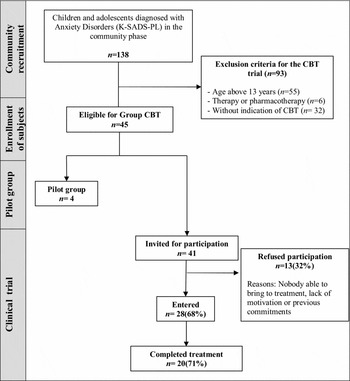
Forty-five subjects met inclusion criteria; 4 participated in a pilot group, with the remaining 41 being invited to participate in the main trial. Of these, 28 consented to take part in the research (see Figure 1).
Flow chart of the study

Intervention
The intervention was based on a recognized CBT protocol for anxious children, the Coping Cat program - Cognitive-Behavioral Therapy for Anxious Children: therapist manual for group treatment (Kendall and Hedtke, Reference Kendall and Hedtke2006a), and The Coping Cat Workbook (Kendall and Hedtke, Reference Kendall and Hedtke2006b).
The intervention consisted of 14 weekly 90 minute sessions. Two more concurrent sessions with parents, one in the seventh and another at the last session of treatment, were included. CBT was conducted by two clinical psychologists, supervised by researchers with more than 10 years of experience in group CBT. Before starting the open trial we undertook a pilot group (n = 4) to assess suitability for a Brazilian population and the time required to deliver the programme.
The group intervention aimed to: increase recognition and analysis of distorted thinking patterns that contribute to anxiety symptoms; develop coping strategies to deal with anxiety-provoking situations; recognize signs of anxiety as a signal to use the coping strategies and to decrease or eliminate avoidance that maintains anxiety (Kendall et al., Reference Kendall, Flannery-Schroeder, Panichelli-Mindel, Southam-Gerow, Henin and Warman1997; Kendall and Hedtke, Reference Kendall and Hedtke2006a,Reference Kendall and Hedtkeb).
Study procedures
After the pilot CBT group was completed, 41 youths were invited to participate in the trial and were assessed by child and adolescent psychiatrists and through self-report questionnaires described below. These evaluations were conducted at three different time points: before starting treatment (baseline), in the middle (session 7), and at the end of treatment (session 14).
Primary outcomes
The Clinical Global Impression (CGI) rating scale was used as the primary dichotomous outcome. CGI is a clinician rating scale of severity that ranges from 1 (normal) to 7 (extremely ill), with lower scores indicating greater improvement, as compared with baseline (Guy, Reference Guy1976). Remission rates were defined by a CGI ≤ 2 in the previous month.
The Pediatric Anxiety Rating Scale (PARS) was used as the primary continuous outcome. With this scale, the clinician uses a checklist of questions regarding the symptoms of anxiety during the past week to elicit responses from parents and youths aged between 6–17 years. After completing this checklist, the clinician rates five general items: the severity of the child's distress due to anxiety, the frequency of anxiety, the degree to which the child avoided anxiety-provoking situations, and the degree to which the anxiety limited the child's participation in typical daily activities both at home and in other environments, such as school. Total scores on this scale range from 0 to 30, with scores above 13 indicating clinically meaningful anxiety. Symptoms were confirmed through integration of both youth and parent information, rated by the evaluator (The Research Units on Pediatric Psychopharmacology Anxiety Study Group, 2002).
Secondary outcomes
The Screen for Child Anxiety Related Emotional Disorders (SCARED; Birmaher et al., Reference Birmaher, Khetarpal, Brent, Cully, Balach and Kaufman1997) is a child and parent self-report measure with 41 items that assess DSM-IV symptoms of SeAD, GAD, SoAD, PD, and school phobia. The two versions are for the child (SCARED-C) and parents (SCARED-P) respectively. The total score and each of the five factors of the SCARED Brazilian-Portuguese version showed good internal consistency, test-retest and construct validity (Isolan et al., Reference Isolan, Salum, Osowski, Amaro and Manfro2011).
The Children's Global Assessment Scale (CGAS) provides a global impairment measure and functioning over the previous month. The scale ranges from 1 (lowest) to 100 (highest) and scores of 60 or lower are considered to indicate a need for treatment (Shaffer et al., Reference Shaffer, Gould, Brasic, Ambrosini, Fisher and Bird1983).
The Children's Depression Inventory (CDI) is a 27-item self-report measure assessing cognitive and somatic symptoms associated with depression in people aged from 7 to 17 years old (Golfeto and D'Oliveira, Reference Golfeto and D'Oliveira2004). Items are rated on a 3-point scale, ranging from 0 to 2, reflecting the degree of particular depressive symptoms over the past 2 weeks. With the sum of the scores of all items, we obtained a total score from 0 to 54.
Youth Quality of Life Instrument-Research Version (YQOL-R) is a self-report questionnaire of 49 perceptual items used to perform a multidimensional assessment of the generic quality of life (QoL) (Edwards, Huebner, Connell and Patrick, Reference Edwards, Huebner, Connell and Patrick2002; Patrick, Edwards and Topolski, Reference Patrick, Edwards and Topolski2002). A conceptual model was used to organize QoL items for each domain and their associated facets, in an 11-point scale with anchors of 0 (Not at all) and 10 (A great deal or completely). The YQOL-R is considered a youth-centered questionnaire, focuses on positive aspects of health and perceptions, and allows cross-cultural comparisons.
The SNAP-IV was the version used in a Multimodality Treatment Study, which includes 26 items corresponding to Attention Deficit Disorder Hyperactivity (ADHD), and symptoms of Oppositional Defiant Disorder (ODD). The 4-point response is scored from 0–3, subscale scores for the ADHD and ODD are calculated by summing the scores on the items in the specific subset (e.g. Inattention) and dividing by the number of items in the subset (Serra-Pinheiro, Mattos and Angélica, Reference Serra-Pinheiro, Mattos and Angélica2008).
Statistical analysis
Data were described as count and percent (%), mean and standard deviations (SD). A Generalized Estimating Equations (GEE) model was performed taking into consideration the individual and therapy group levels testing time effect in the repeated measures at baseline, mid-point and endpoint evaluations. An unstructured correlation matrix was used as a robust estimator. Sequential Bonferroni adjustment for multiple comparisons was used to compare time points. All comparisons were adjusted for age and gender. These tests were complemented by presentation of within-group effect sizes (Cohen's d = M1 – M2 / √ SD21 + SD22 − 2 × r × SD1 × SD2). Tests were two-tailed, with a significance level of .05 and performed with SPSS 17.0.
Results
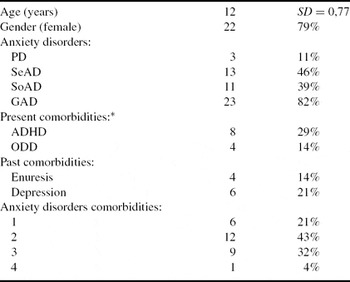
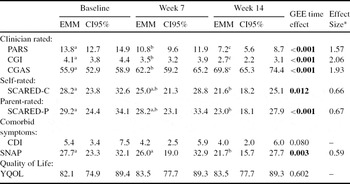
A total of 28 (68%) patients were included in one of the four groups, with demographic characteristics and diagnosis being summarized in Table 1. Twenty patients (71%) completed the intervention with 9 (45%) meeting criteria for remission (CGI ≤ 2). All clinician, self-rated and parent-rated scales showed an improvement over time, with a moderate to large effect (Cohen's d ranging from = 0.59 to 2.09). In addition, there was a significant improvement in symptoms of externalizing disorders, but not in depressive symptoms over time. No significant change was found in QoL scores (see Table 2).
Descriptive sample characteristics (n = 28)

Notes: Data are presented as n (%) and mean and Standard Deviation (SD)
Abbreviations: ADHD = Attention Deficit/Hyperactivity Disorder; ODD = Oppositional Defiant Disorder; PD = Panic Disorder; SeAD = Separation Anxiety Disorder; SoAD = Social Anxiety Disorder; GAD = Generalized Anxiety Disorders.
* Relative frequency superior to 10%
Estimated marginal means of each outcome over the course of treatment

Notes: Different letters (a,b,c) indicate statistical significant results at 0.05 level of significant in sequential Bonferroni multiple comparison adjustment.
*Effect size (Cohen's formula) between baseline and the 14 week assessment.
Abbreviations: EEM, Estimated Marginal Means; CI95%, 95% Confidence Interval; GEE, Generalized Estimating Equations; PARS, Pediatric Anxiety Rating Scale; CGI, Clinical Global Impressions; CGAS, Children's Global Assessment Scale; SCARED-C, Screen for Child Anxiety Related Disorders - Child Version; SCARED-P, Screen for Child Anxiety Related Disorders - Parent Version; CDI, Childhood Depression Inventory; YQOL, Youth Quality of Life Instrument.
Discussion
This study was a first attempt to clinically test a CBT protocol for anxiety disorders in Brazilian youth (Kendall et al., Reference Kendall, Flannery-Schroeder, Panichelli-Mindel, Southam-Gerow, Henin and Warman1997; Kendall and Hedtke, Reference Kendall and Hedtke2006a,Reference Kendall and Hedtkeb). Our findings suggest that group CBT is an effective intervention for youth with anxiety disorders in a LaMIC.
Interestingly, CBT produced substantial treatment effects for anxiety symptoms measured by PARS and SCARED, although it did not result in a significant decrease in depressive symptoms nor an improvement in quality of life. There is evidence that depression is frequently a consequence of high levels of anxiety and something that starts in childhood (Merikangas et al., Reference Merikangas, He, Burstein, Swanson, Avenevoli and Cui2010; Roza, Hofstra, Van Der Ende and Verhulst, Reference Roza, Hofstra, Van Der Ende and Verhulst2003). The mean age of our sample is around 12 years old and the mean of depressive symptoms was low, as verified by CDI, suggesting that perhaps we did not have enough power to show mild differences in depression scores (Kendall, Safford, Flannery-Schroeder and Webb, Reference Kendall, Safford, Flannery-Schroeder and Webb2004).
Another interesting result was the significant decrease in externalizing symptoms measured by the SNAP-IV after the treatment. With regard to this finding, around 30% of the sample had ADHD comorbidity (Kendall, Brady and Verduin, Reference Kendall, Brady and Verduin2001). Furthermore, improvement of anxiety symptoms may have contributed to the positive effects on externalizing symptoms (Beidas, Benjamin, Puleo, Edmunds and Kendall, Reference Beidas, Benjamin, Puleo, Edmunds and Kendall2010).
In terms of intervention delivery our experience suggests that the presence of a co-therapist in all sessions was essential. In terms of time, no session exceeded 90 minutes, with group size being limited to six due to individual problems of participants (shyness, anxiety). According to family report, the two sessions designed for family members were very important in understanding the disorder, learning how to deal with the child's anxiety and cooperating with the child's homework.
Our study has limitations that should be taken into consideration. The lack of a control group, the absence of a follow-up and the small sample size limit the generalization of our findings. Similarly, only 50% of those who were eligible actually completed the treatment. In spite of this, the effect size of interventions greatly encourages further research. The youths suffered from different kinds of anxiety disorders and, as the sample was too small, it remains unclear whether or not a specific anxiety disorder demonstrated a better response to group CBT. On the other hand, this was a sample directly selected from the community and not a treatment-seeking one. Given the high prevalence and substantial morbidity associated with anxiety disorders in childhood and adolescence, dissemination of CBT from research to clinical practice should be a priority (Beidas et al., Reference Beidas, Benjamin, Puleo, Edmunds and Kendall2010; Kendall et al., Reference Kendall, Khanna, Edson, Cummings and Harris2011; March, Reference March2011; McLean and Foa, Reference McLean and Foa2011). However, an important barrier is the lack of CBT practitioners adequately trained in empirically supported treatments (Kendall et al., Reference Kendall, Khanna, Edson, Cummings and Harris2011). The use of a group CBT protocol aided the ability of clinicians to provide an effective manual driven treatment. Further, randomized controlled trials are needed to confirm our findings with an appropriate follow-up to evaluate whether gains are maintained over time.
Acknowledgements
Financing was project linked from Universal Edict - CNPq 2007 (Number: 483032/2007-7), FIPE-HCPA and CAPES-Prof.



Comments
No Comments have been published for this article.