Introduction
Attention-deficit/hyperactivity disorder (ADHD) encompasses symptoms, including inattention, hyperactivity and impulsivity, and is a common neurodevelopmental disorder in childhood (Feldman & Reiff, Reference Feldman and Reiff2014; Thapar & Cooper, Reference Thapar and Cooper2016). Previous systematic reviews and metaregression analyses have revealed that the prevalence of ADHD worldwide ranges from 5.3 to 7.2% (Polanczyk et al. Reference Polanczyk, de Lima, Horta, Biederman and Rohde2007; Thomas et al. Reference Thomas, Sanders, Doust, Beller and Glasziou2015), and that these rates were not affected by geographical location or year of the study (Polanczyk et al. Reference Polanczyk, Willcutt, Salum, Kieling and Rohde2014). A community study in Taiwan reported that ADHD affects approximately 7.5% of school-aged children (Gau et al. Reference Gau, Chong, Chen and Cheng2005). Various psychosocial interventions, such as behavioural, cognitive behavioural and parenting skills training strategies, represent evidence-based approaches for managing ADHD (Evans et al. Reference Evans, Owens and Bunford2014; Chan et al. Reference Chan, Fogler and Hammerness2016). Nevertheless, pharmacotherapy has been consistently used as the primary and most effective therapeutic option for ADHD (Findling, Reference Findling2008; Vaughan et al. Reference Vaughan, March and Kratochvil2012). Although various studies have provided robust evidence with regards to the epidemiology and effectiveness of ADHD pharmacotherapy, public controversy related to the potential overdiagnosis and overmedication of children with ADHD remains (Sciutto & Eisenberg, Reference Sciutto and Eisenberg2007; Partridge et al. Reference Partridge, Lucke and Hall2012; Rapoport, Reference Rapoport2013).
The conception of overdiagnosis of ADHD typically refers to that too many children are diagnosed with ADHD when they do not really have it (false positives) (Sciutto & Eisenberg, Reference Sciutto and Eisenberg2007). In a survey of public attitude towards the diagnosis and treatment of ADHD, 78.3% of respondents thought that ADHD has been overdiagnosed (Partridge et al. Reference Partridge, Lucke and Hall2014). A recent article questioned whether immaturity leads to a misdiagnosis of ADHD, and whether overdiagnosis may be harmful for the children (Coon et al. Reference Coon, Quinonez, Moyer and Schroeder2014). Another study suggested that clinicians do not adhere strictly to diagnostic manuals, and that ADHD is routinely overdiagnosed (Bruchmuller et al. Reference Bruchmuller, Margraf and Schneider2012). In epidemiological studies, the rates of being diagnosed with ADHD increased across different geographical areas, such as the United States (USA) (Garfield et al. Reference Garfield, Dorsey, Zhu, Huskamp, Conti, Dusetzina, Higashi, Perrin, Kornfield and Alexander2012; Getahun et al. Reference Getahun, Jacobsen, Fassett, Chen, Demissie and Rhoads2013; Visser et al. Reference Visser, Danielson, Bitsko, Holbrook, Kogan, Ghandour, Perou and Blumberg2014), the United Kingdom (UK) (Holden et al. Reference Holden, Jenkins-Jones, Poole, Morgan, Coghill and Currie2013), Denmark (Mohr Jensen & Steinhausen, Reference Mohr Jensen and Steinhausen2015), Western Australia (Atladottir et al. Reference Atladottir, Gyllenberg, Langridge, Sandin, Hansen, Leonard, Gissler, Reichenberg, Schendel, Bourke, Hultman, Grice, Buxbaum and Parner2015), Korea (Hong et al. Reference Hong, Kwack, Joung, Lee, Kim, Sohn, Chung, Yang, Bhang, Hwang, Choi, Oh, Lee and Bahn2014) and also in Taiwan (Chien et al. Reference Chien, Lin, Chou and Chou2012; Huang et al. Reference Huang, Chu, Cheng and Weng2014). However, previous studies in Taiwan have used claims data before 2005, and it is unclear how the rate of a diagnosis of ADHD has changed in recent years. Investigating the current rates of ADHD diagnosis among the general population is essential for determining whether identification of ADHD is consistent with the prevalence rate of ADHD estimated using a standardised interview (Gau et al. Reference Gau, Chong, Chen and Cheng2005).
The empirical definition of overmedication is either when medications are prescribed unnecessarily, when they are continued although not measurably respond, or when they are more of risk than a benefit (Safer, Reference Safer2000). Public concern that youths with ADHD have been overmedicated has continued for decades (Rapoport, Reference Rapoport2013). Criticisms with regards the overmedication of ADHD are generally based on two perspectives: drastic increases in prescriptions of ADHD medications, and the high proportion of ADHD patients receiving drug therapy (Safer, Reference Safer2000). Rapid increases have been reported in the prescription of ADHD medications in a number of countries (Safer et al. Reference Safer, Zito and Fine1996; Hodgkins et al. Reference Hodgkins, Sasane and Meijer2011; Treceno et al. Reference Treceno, Martin Arias, Sainz, Salado, Garcia Ortega, Velasco, Jimeno, Escudero, Velasco and Carvajal2012; Oner et al. Reference Oner, Yilmaz, Karada, Vural, Vural, Akbulat, Gursoz, Turkcapar and Kerman2014; Ponizovsky et al. Reference Ponizovsky, Marom and Fitoussi2014; Stuhec et al. Reference Stuhec, Locatelli and Svab2015) including Taiwan, where the prevalence rates of ADHD and the use of medications in children diagnosed with ADHD have increased from 1997 to 2005 (Chien et al. Reference Chien, Lin, Chou and Chou2012). Two studies conducted in the USA reported that 8–10% of school-aged students receive ADHD medications, and that this exceeded the expected rate of ADHD (LeFever et al. Reference LeFever, Dawson and Morrow1999; Rowland et al. Reference Rowland, Umbach, Stallone, Naftel, Bohlig and Sandler2002). In addition, a national survey in the USA indicated that the pharmacotherapy was used as treatment for ADHD in 93–96% of medical visits (Garfield et al. Reference Garfield, Dorsey, Zhu, Huskamp, Conti, Dusetzina, Higashi, Perrin, Kornfield and Alexander2012). These studies suggest that ADHD is potentially overmedicated in children in the USA. However, little is known about the trends in prescriptions of ADHD medications in Taiwan after 2005, and whether ADHD is overmedicated in Taiwan warrants investigation.
Reimbursement data are ideal to explore the nationwide utilisation of medical services. Therefore, we used national population-based data from 2000 to 2011 to analyse trends in the diagnosis rate of ADHD and the proportion of patients receiving medications. We looked into the possibility of overdiagnosis and overmedication for ADHD by comparing the results of the present study with those of the epidemiological study on the prevalence rate of ADHD in Taiwan and the previous studies in other countries.
Methods
Data source
The Institutional Review Board of Chang Gung Memorial Hospital approved this study. Data were obtained from the National Health Insurance Research Database of Taiwan (NHIRD-TW), an ambulatory claims database. Initiated in Taiwan in 1995, the National Health Insurance (NHI) programme is a compulsory universal health insurance programme, with the Bureau of NHI as the sole payer of healthcare services. The Bureau of NHI has contracted 93% of all healthcare providers in Taiwan, and at least 96% of insured people have benefitted from healthcare services provided by one of the contracted hospitals or clinics at least once since 1995. These medical care institutions are required to electronically submit monthly medical expense-related claims documents, including the patients’ demographic data, the medical institution visited, diagnostic codes, dates of any prescriptions, drugs prescribed and all claimed medical expenses. The database of this programme contains registration files and original claim data for reimbursement. Large computerised databases derived from this system are maintained by the National Health Research Institutes, Taiwan, and are provided as NHIRD-TW to scientists in Taiwan for research purposes. The NHIRD-TW has previously been validated to be an effective resource for population-based research (Wu et al. Reference Wu, Lai, Gau, Wang and Tsai2014).
Definition of ADHD and ADHD diagnosis rates
We recruited all youths (age ≤18 years) from the NHIRD-TW who were diagnosed with ADHD from January 2000 to December 2011. In order to minimise possible cases of misdiagnosis, ADHD was defined as at least two NHIRD-TW claims records with the International Classification of Diseases, 9th Revision, Clinical Modification (ICD-9-CM) code 314.X. Our study sample included 145 018 patients with ADHD (mean age at a diagnosis of ADHD: 7.7 ± 3.1 years; 21.4% females).
Cases of ADHD were determined annually as those with at least one NHIRD-TW claims record with a diagnosis of ADHD within the specific year (from 2000 to 2011). The annual ADHD diagnosis (prevalence) rates (per 100 000) were then determined by dividing the annual number of ADHD cases by the total population during each year. Data on the general population in Taiwan was obtained from the Executive Yuan, Taiwan (Directorate-General of Budget Accounting and Statistics, 2015). The distribution of the total population in each age group is listed in the Supplementary Table.
Definition of ADHD medication
ADHD medications were defined according to the Anatomical Therapeutic Chemical classification system. According to the Food and Drug Administration of Taiwan, only three drugs were licensed to treat ADHD prior to 2011: immediate-release methylphenidate (IR-MPH), osmotic controlled-release formulation of methylphenidate (OROS-MPH) and atomoxetine (ATX). All prescriptions for these three medications were recorded in an ambulatory care claim, pharmacy claim or hospital care claim.
The annual number of cases who received ADHD medication was defined as the number of youths with ADHD with at least one record of pharmacotherapy (IR-MPH, OROS-MPH or ATX) in each year. The proportion of ADHD youths receiving medications was determined by dividing the annual number of cases who received ADHD medications by the total number of ADHD patients in the entire study sample each year. We also calculated the annual prevalence rates of the use of ADHD medications among the whole population (per 100 000) by dividing the annual number of cases who used ADHD medications by the total population each year.
Statistical analysis
The Statistical Package for Social Sciences (SPSS) version 20.0 (SPSS Inc., Chicago, IL, USA) was used for all statistical analyses. A two-tailed p value of <0.05 was taken to indicate statistical significance.
In order to investigate the potential effect of age on the rates of a diagnosis of ADHD and the use of medication, we categorised the age of the patients into the following three groups: (1) preschoolers (≤6 years); (2) school-aged children (7–12 years); and (3) adolescents (13–18 years). A general linear model was used to evaluate trends with regard to the annual number of cases of ADHD, annual ADHD diagnosis rates, those receiving pharmacotherapy, annual proportion of those treated with medications and annual prevalence rates of using ADHD medications.
To assess the rates of a diagnosis of ADHD and the use of medications between years, age groups and gender, the ratios of prevalence rates and 95% confidence intervals (CI) were also calculated. A generalised estimating equations (GEE) model with the maximum-likelihood estimation method and auto-regression covariance matrix was used to examine differences in the prevalence of ADHD and medication use between years, age groups and gender. Autoregressive covariance matrix of GEE model is usually applied for longitudinal data analysis (Liang & Zeger, Reference Liang and Zeger1986).
Results
ADHD diagnosis rates
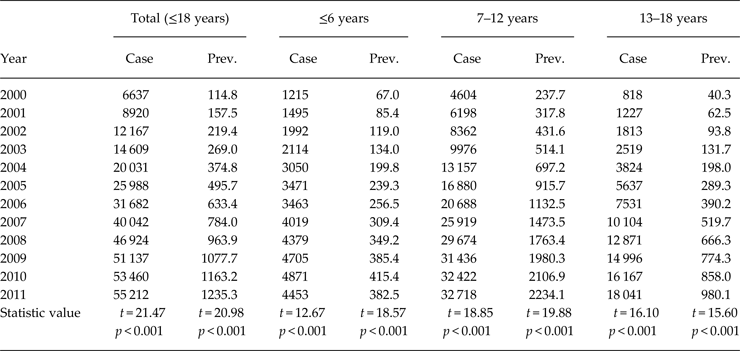
The annual ADHD diagnosis rate among the study cohort increased from 0.11% in 2000 to 1.24% in 2011 (10.8-fold increase, t = 20.98, p < 0.001) (Table 1). For the preschool children (age ≤6 years), the annual ADHD diagnosis rate increased from 0.07% in 2000 to 0.38% in 2011 (5.7-fold increase, t = 18.57, p < 0.001), compared with 0.24% in 2000 to 2.23% in 2011 (9.4-fold increase, t = 19.88, p < 0.001) in the school-aged children (7–12 years) and 0.04% in 2000 to 0.98% in 2011 (24.3-fold increase, t = 15.60, p < 0.001) in the adolescents (13–18 years).
Distribution of patients with a diagnosis of ADHD and annual prevalence rates from 2000 to 2011 in Taiwan

Note: Prev. (per 100 000): The annual prevalence rates of ADHD, in which the denominator is the total nationwide population and the numerator is the annual number of cases with a diagnosis of ADHD.
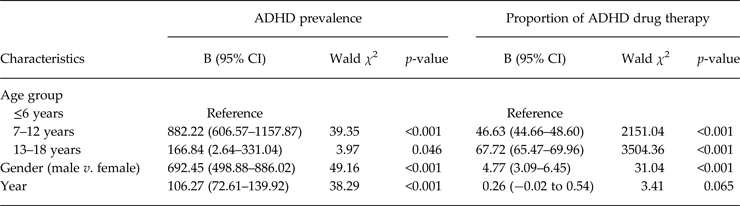
Figure 1 shows the annual ADHD diagnosis rates among the general population (per 100 000) stratified by age and gender from 2000 to 2011. The rates significantly increased in all age groups and in both genders during the study period. Compared with the ADHD diagnosis rates in the preschoolers (Table 3), the diagnosis rates in the school-aged children (ratio of prevalence rates = 4.36, Wald χ 2 = 39.35, p < 0.001) and adolescents (ratio of prevalence rates = 1.42, Wald χ 2 = 3.97, p = 0.046) were significantly higher during the study period. The prevalence in males was significantly higher than in females (ratio of prevalence rates = 4.09, Wald χ 2 = 49.16, p < 0.001).
Annual prevalence of ADHD stratified by age and gender in Taiwan between 2000 and 2011. The Y-axis represents the prevalence of ADHD (per 100 000) in each year between 2000 and 2011. The ADHD prevalence rates significantly increased in all age groups and in both genders during the study period.

Patients treated with ADHD medication
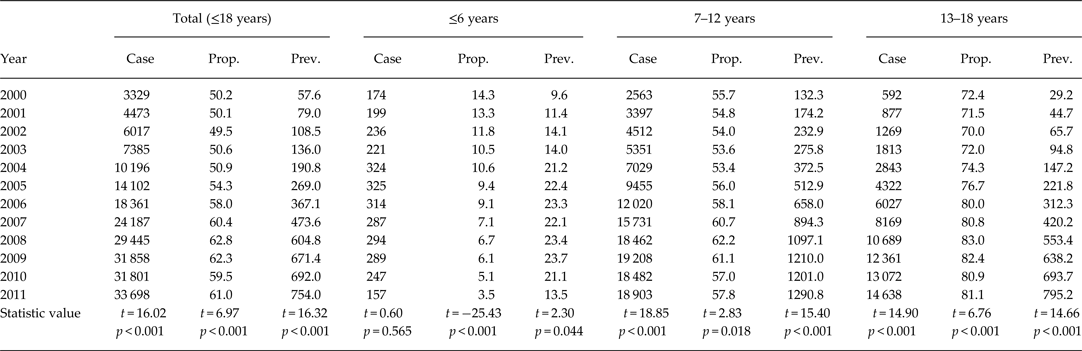
Among all patients with ADHD (Table 2), the proportion of those receiving ADHD medication increased from 50.2% in 2000 to 61.0% in 2011 (t = 16.02, p < 0.001). Among the preschoolers with ADHD, the proportion receiving ADHD medication significantly decreased from 14.3% in 2000 to 3.5% in 2011 (t = −25.43, p < 0.001), compared with an increase from 55.7% in 2000 to 57.8% in 2011 (t = 2.83, p = 0.018) in the school-aged children, and an increase from 72.4% in 2000 to 81.1% in 2011 (t = 6.76, p < 0.001) in the adolescents.
Distribution of youths with ADHD who received medications from 2000 to 2011 in Taiwan

Note: Prop.: The proportion of youths with ADHD who received medication, in which the denominator is the annual number of ADHD patients and the numerator is the annual number of ADHD case who used ADHD medications. Prev. (per 100 000): The annual prevalence rates of ADHD medication use among the national population, in which the denominator is the total population and the numerator is the annual number of cases who used ADHD medications.
Among the total population under 18 years of age in Taiwan (Table 2), the prevalence of ADHD medication use increased from 0.06% in 2000 to 0.75% in 2011 (13.1-fold increase, t = 16.32, p < 0.001). For preschool children, the annual prevalence of ADHD medication use increased from 0.009% in 2000 to 0.013% in 2011 (1.4-fold increase, t = 2.30, p = 0.044), compared with an increase from 0.13% in 2000 to 1.29% in 2011 (9.8-fold increase, t = 15.40, p < 0.001) in school-aged children and an increase from 0.03% in 2000 to 0.80% in 2011 (27.2-fold increase, t = 14.66, p < 0.001) in adolescents.
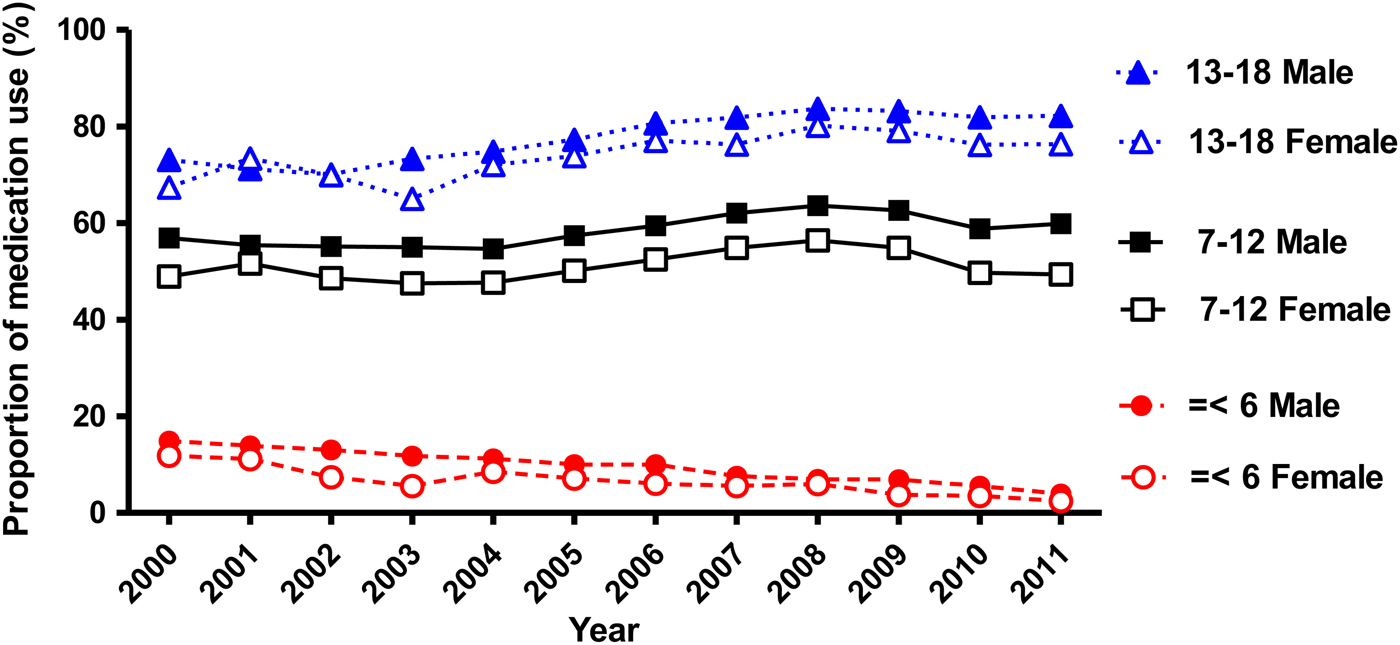
Figure 2 shows the proportions of medication use among the patients with ADHD in each age group and gender from 2000 to 2011. The proportion of ADHD medication use significantly increased in the school-aged children and adolescents, however it significantly decreased in the preschool children in both genders. Compared with the preschool patients (Table 3), the medication use in the school-aged children (ratio of prevalence rates = 7.54, Wald χ 2 = 2151.04, p < 0.001) and adolescents (ratio of prevalence rates = 10.28, Wald χ 2 = 3504.36, p < 0.001) was significantly higher during the study period. In addition, significantly more male ADHD patients received ADHD medications the female ADHD patients (ratio of prevalence rates = 1.16, Wald χ 2 = 31.43, p < 0.001).
Proportion of medication use among the patients with ADHD in each age group and gender in Taiwan between 2000 and 2011. The Y-axis represents the proportion (%) of those receiving drug therapy among the patients with ADHD in each year between 2000 and 2011. The proportion of ADHD drugs use significantly increased in the patients aged 7–12 years and in those aged 13–18 years. The proportion of ADHD medication use significantly decreased in the patients under 6 years of age in both genders.

Generalised estimating equation models for the effects of age, gender and time on prevalence of ADHD and proportion of ADHD medication use from 2000 to 2011 in Taiwan

Note: Year was set as a continuous variable (range from 2000 to 2011).
Discussion
The results of this study indicate that the number of youths being diagnosed with ADHD has increased over tenfold from 2000 to 2011. However, the prevalence rate of a diagnosis of ADHD was only 1.24% in 2011, which is still far lower than the prevalence rate reported in a previous community study using face-to-face interviews. Among the youths with ADHD, the proportion of those receiving ADHD medication increased from 50.2 to 61.0% during the study period. The likelihood of receiving ADHD medication was positively correlated with the patients’ age and gender. These findings do not support the overdiagnosis or overmedication of ADHD in youths in Taiwan.
Prevalence of ADHD and whether it is overdiagnosed
Similar to our findings, many time-trend surveys using diagnostic reports based on medical records have indicated that the prevalence of ADHD has increased worldwide (Chien et al. Reference Chien, Lin, Chou and Chou2012; Garfield et al. Reference Garfield, Dorsey, Zhu, Huskamp, Conti, Dusetzina, Higashi, Perrin, Kornfield and Alexander2012; Getahun et al. Reference Getahun, Jacobsen, Fassett, Chen, Demissie and Rhoads2013; Holden et al. Reference Holden, Jenkins-Jones, Poole, Morgan, Coghill and Currie2013; Hong et al. Reference Hong, Kwack, Joung, Lee, Kim, Sohn, Chung, Yang, Bhang, Hwang, Choi, Oh, Lee and Bahn2014; Huang et al. Reference Huang, Chu, Cheng and Weng2014; Visser et al. Reference Visser, Danielson, Bitsko, Holbrook, Kogan, Ghandour, Perou and Blumberg2014; Atladottir et al. Reference Atladottir, Gyllenberg, Langridge, Sandin, Hansen, Leonard, Gissler, Reichenberg, Schendel, Bourke, Hultman, Grice, Buxbaum and Parner2015; Mohr Jensen & Steinhausen, Reference Mohr Jensen and Steinhausen2015). However, individuals with diagnostic records of ADHD only represent those who sought medical care, but not all patients with ADHD in the general population. Meta-analyses of epidemiological studies have reported that the prevalence of ADHD worldwide is between 5.3 and 7.2% (Polanczyk et al. Reference Polanczyk, de Lima, Horta, Biederman and Rohde2007; Thomas et al. Reference Thomas, Sanders, Doust, Beller and Glasziou2015), and these rates were not affected by the changes of diagnostic criteria from different versions of the Diagnostic and Statistical Manual of Mental Disorders, or geographical and chronological variations (Polanczyk et al. Reference Polanczyk, Willcutt, Salum, Kieling and Rohde2014). This implies that the prevalence rates of ADHD, determined by face-to-face assessments of community youths, had not changed significantly over time. Therefore, the ascending trend of numbers of patients being diagnosed with ADHD may only reflect the increase in patients seeking medical care, but should not be viewed as an increase of youths with ADHD (Safer, Reference Safer2015).
The most reliable estimate of the prevalence of ADHD in Taiwan reported that ADHD affects 7.5% of school-aged children (Gau et al. Reference Gau, Chong, Chen and Cheng2005). Our results revealed that the proportion of patients with a diagnosis of ADHD increased from 0.11% in 2000 to 1.24% in 2011, which is far lower than the reported prevalence rate of 7.5%. We suggest this finding is not consistent with a public opinion about overdiagnosis of ADHD in Taiwan. Moreover, we speculate that a large number of patients who meet the criterions for ADHD do not seek medical care. In our survey, the number of individuals with a diagnosis of ADHD significantly increased over time and consistently across different age groups and in both genders. This implies that the increasing trend in the diagnosis of ADHD according to the medical records from the NHIRD-TW is due to increasing awareness about ADHD and increased access to psychiatric services.
We found that the prevalence of ADHD in males was approximately four times higher than in females. Gender differences in the prevalence of ADHD are well established (ratios of boys to girls range from 2 : 1 to 9 : 1) (Rucklidge, Reference Rucklidge2010; Nussbaum, Reference Nussbaum2012), and our national survey revealed compatible findings. With regards to the influence of age on the rates of a diagnosis of ADHD, we found that the rate was highest among school-aged children (7–12 years), followed by adolescents (13–18 years) and preschool children (age ≤6 years). These results are comparable with previous epidemiological studies, which revealed that the symptoms of ADHD are most prominent in school-aged children and that most require medical care (Holden et al. Reference Holden, Jenkins-Jones, Poole, Morgan, Coghill and Currie2013; Huang et al. Reference Huang, Chu, Cheng and Weng2014). A possible explanation for this may be that the confirmation of a diagnosis of ADHD can be difficult in patients of a preschool age. The symptoms of ADHD decrease in around 50% of patients at puberty or in early adulthood (Cherkasova et al. Reference Cherkasova, Sulla, Dalena, Ponde and Hechtman2013), and the likelihood of seeking medical care decreases with decreases in clinical manifestations.
Use of ADHD medication and whether youths are overmedicated in Taiwan
Significant increases in the number of patients receiving medications for ADHD have been reported in several countries in recent years (Safer et al. Reference Safer, Zito and Fine1996; Hodgkins et al. Reference Hodgkins, Sasane and Meijer2011; Chien et al. Reference Chien, Lin, Chou and Chou2012; Treceno et al. Reference Treceno, Martin Arias, Sainz, Salado, Garcia Ortega, Velasco, Jimeno, Escudero, Velasco and Carvajal2012; Oner et al. Reference Oner, Yilmaz, Karada, Vural, Vural, Akbulat, Gursoz, Turkcapar and Kerman2014; Ponizovsky et al. Reference Ponizovsky, Marom and Fitoussi2014; Visser et al. Reference Visser, Danielson, Bitsko, Holbrook, Kogan, Ghandour, Perou and Blumberg2014; Stuhec et al. Reference Stuhec, Locatelli and Svab2015), which is consistent with our findings. However, the higher number of patients receiving ADHD medication is naturally related to the higher number of patients diagnosed with ADHD. We found that the proportion of youths with a diagnosis of ADHD receiving medications (any prescription of IR-MPH, OROS-MPH or ATX for at least one dose) increased from 49.5 to 62.8% during the study period. This finding indicates that approximately 40–50% of patients were not prescribed with any medications during their medical visits in this study. Despite public controversy regarding the potential overmedication for ADHD has continued for decades, there are currently no guidelines to determine whether or not patients with ADHD are overmedicated. Empirically, the overuse or inappropriate use of ADHD medications is defined as when they are less effective than alternative interventions, when continued although not measurably useful, or when they are more of risk than a benefit (Safer, Reference Safer2000). Because the clinical information about patients’ symptom severity and outcomes were unavailable in the NHIRD-TW, the appropriateness of the use of medications cannot be directly judged through the results of the current study.
Alternatively, we could compare the prevalence rates of ADHD medication use with those reported in other countries. Barbaresi et al. (Reference Barbaresi, Katusic, Colligan, Pankratz, Weaver, Weber, Mrazek and Jacobsen2002) reported a prevalence rate of treatment with stimulants of 86.5% for children with a definite diagnosis of ADHD in the USA. Moreover, a national survey in the USA indicated that the proportion of visits in which pharmacotherapy was used as treatment ranged from 93 to 96% (Garfield et al. Reference Garfield, Dorsey, Zhu, Huskamp, Conti, Dusetzina, Higashi, Perrin, Kornfield and Alexander2012). In a Danish cohort (Dalsgaard et al. Reference Dalsgaard, Nielsen and Simonsen2013), 61% of ADHD patients were treated with ADHD medications, corresponding to a 0.82% prevalence rate of treatment in the total population. In a national survey in the UK (McCarthy et al. Reference McCarthy, Wilton, Murray, Hodgkins, Asherson and Wong2012), the prevalence of ADHD medication usage ranged from 0.48 to 0.92% among children aged 6–12 years. A study using the Medicaid database in the USA reported that the prevalence of ADHD drug use increased from 2.52% in 1995 to 4.63% in 2004 (Winterstein et al. Reference Winterstein, Gerhard, Shuster, Zito, Johnson, Liu and Saidi2008). Taken together, the prevalence of ADHD drug prescription seems to be higher in the USA than which in the European countries, and the prevalence of prescriptions for ADHD medications in Taiwan is not higher than that reported in other international studies. It is noteworthy that since pharmacotherapy has been suggested as the first-line treatment for ADHD (Barbaresi et al. Reference Barbaresi, Katusic, Colligan, Weaver and Jacobsen2007; Vaughan et al. Reference Vaughan, March and Kratochvil2012; Chan et al. Reference Chan, Fogler and Hammerness2016), the high rates of ADHD drug prescription (even as high as 100%) do not necessarily represent that ADHD youths are overmedicated. A future study which consists of comprehensive clinical information of a representative ADHD sample (e.g., severity of ADHD symptoms, treatment effects, adverse effects and patient outcomes) is warranted to determine the legitimate of the use of ADHD medications.
We found that the patients’ age significantly influenced the prescription rate of ADHD medication. The preschool patients had the lowest rate (under 15%), compared with 70–80% of the adolescent patients. It has been reported that parents of preschoolers with ADHD usually seek options other than pharmacotherapy first (e.g., psychosocial or rehabilitation treatment) (Lien et al. Reference Lien, Yeh, Soong, Jeng, Huang and Chen2015). In contrast, older patients may have greater functional impairments and therefore a higher likelihood of being prescribed with medication (Morrow et al. Reference Morrow, Garland, Wright, Maclure, Taylor and Dormuth2012). Patients who respond well to medication may maintain such therapy as they grow (Chen et al. Reference Chen, Yeh, Chen, Chang, Wu and Lin2011). With regards to differences in gender, significantly more males received medications than females. Boys with ADHD may exhibit more externalised behavioural problems and have a higher probability of being prescribed with medication and then to maintain this therapy (Visser et al. Reference Visser, Lesesne and Perou2007; Garbe et al. Reference Garbe, Mikolajczyk, Banaschewski, Petermann, Petermann, Kraut and Langner2012), which is consistent with the findings in the current study.
Limitations
This study has several limitations. First, the diagnoses of ADHD were identified on the basis of ICD codes only, and were not validated using face-to-face diagnostic instruments. Although ADHD was defined by at least two NHIRD-TW claims records with ADHD, the possibility of misdiagnosis still exists. Without standardised, multidimensional assessments for the national population, the actual false positive rate or false negative rate of a diagnosis of ADHD is unknown (Sciutto & Eisenberg, Reference Sciutto and Eisenberg2007). Second, the specific drug distribution, duration of drug treatment, gap in prescriptions (e.g., drug holiday) and drug adherence were not analysed in this study. In addition, ADHD medications prescribed for indications other than ADHD were not analysed. Third, some clinical data such as socioeconomic status, residential area, clinical manifestations and patient outcomes were not provided in the claims data. It is unclear how the prevalence rates of ADHD diagnosis or medication treatment were influenced by the aforementioned factors. Consequently, we could not determine whether or not the prescribed ADHD medications were appropriate. Last, data on therapy other than medication (i.e., behavioural or occupational therapy) were not available in this study. In addition, the reasons underlying the decision of whether or not to prescribe pharmacotherapy were not available from the claims data.
Conclusions
In conclusion, this population-based study shows that the number of youths being diagnosed with ADHD who attended medical services and who received medications increased from 2000 to 2011 in Taiwan. However, the proportion of youths with a diagnosis of ADHD among the total population was still lower than the prevalence rate of ADHD reported in previous community-based research in Taiwan. In addition, approximate 40–50% of youths with ADHD did not receive medications. These findings are not consistent with a systematic public opinion on overdiagnosis or overmedication of ADHD in Taiwan. We suggest that our findings may help to increase public awareness that a large number of children with ADHD in Taiwan are not currently identified or treated.
Supplementary material
The supplementary material for this article can be found at https://doi.org/10.1017/S2045796016000500
Acknowledgements
The authors thank Mr Keng-Hao Chang and Mr Yao-cheng Lyu for retrieving data from the NHIRD-TW. This study is based in part on data from the NHIRD-TW provided by the National Health Insurance Administration, Ministry of Health and Welfare and managed by the National Health Research Institutes (registration number: NHIRD-102-088). The interpretations and conclusions contained herein do not represent those of the National Health Insurance Administration, Ministry of Health and Welfare or National Health Research Institutes.
Financial Support
This study was sponsored by the Chang Gung Memorial Hospital Research Project (Grant numbers CMRPG8D0581, CMRPG2D0422, CRRPG2B0114 and CLRPG2C0024).
Conflict of Interest
None.
Availability of data and materials
Data are available from the NHIRD published by Taiwan National Health Insurance Bureau. Due to legal restrictions imposed by the Government of Taiwan in relation to the ‘Personal Information Protection Act’, data cannot be made publicly available. Requests for data can be sent as a formal proposal to the NHIRD (http://nhird.nhri.org.tw).