INTRODUCTION
People make political decisions in different ways. Some look at new evidence, stick to traditional choices, adopt the preferences of others, think hard, or think not much at all. This much we know. However, when people hear from elites about the positions they take, does it matter whether the elites elaborate on the decision-making process by which they came to their position? Do people then use this process information to evaluate the source and her message? We argue that people will use decision-making process cues (or simply “process cues”) as heuristics in order to assess their trust of the source and to decide whether to adopt a source's opinion as their own. However, while process cues function like at least some heuristics, they are also in a class by themselves, as we will discuss further.
Moreover, we believe that significant message recipient considerations must be included in the analysis. Some people are not motivated to pursue or process political information by dint of the structure and content of their social interactions (Djupe Reference Djupe2008; Djupe and Neiheisel Reference Djupe and Neiheisel2008a; Djupe, Sokhey, and Calfano Reference Djupe, Sokhey and Calfano2008; Druckman and Nelson Reference Druckman and Nelson2003). We posit that those in agreeable and insular social networks see less need for extensive information gathering and will be more resistant to elite influence.
In this article, we focus our attention on the trust and persuasion generated by a particular elite source (clergy) and their specialized decision-making process. After working through the applicable literature concerning the message source and recipient, we describe our survey experiment involving arguments concerning environmental racism. Because elites almost never communicate in a vacuum, especially in the context of a newspaper article, we pair a clergy's statements concerning environmental racism with another non-political elite's (an academic). The resulting combination of elite argument, process cues, and recipient characteristics should provide us with a nuanced portrait of the potential for clergy influence and the effects of process cues.
MESSAGE SOURCE CONSIDERATIONS
The importance of elite cues on public opinion has a long history of consideration, of course, and is based on the notion that Americans regularly deal with non-political concerns that require the significant use of their cognitive resources (Lippmann Reference Lippmann1925). Clearly, elite cues play an important role in the public's decision-making process (Brady and Sniderman Reference Brady and Sniderman1985; Popkin Reference Popkin1991); yet only a small range of forces that might affect the efficacy of elite communication has been studied.
Thus far, the social psychology literature shows that cues can function as heuristics, which are simple decision rules that enable probability judgments. Reliance on heuristics helps to explain how most Americans, who are generally disinterested in politics and unsophisticated in their understanding of the subject (Converse Reference Converse and Apter1964), can perform most of their citizenly duties reasonably well (Chaiken and Stangor Reference Chaiken and Stangor1987; Downs Reference Downs1957; Lupia Reference Lupia1994; but see Kuklinski and Hurley Reference Kuklinski and Hurley1994; Lau and Redlawsk Reference Lau Richard and Redlawsk2001).
Since political elites constitute a group of better-informed actors often representing institutional power, prestige, and expertise, it is logical for their cues to be influential (Carmines and Kuklinski Reference Carmines, Kuklinski, Ferejohn and Kuklinski1990; Darmofal Reference Darmofal2005; Downs Reference Downs1957; Kuklinski and Hurley Reference Kuklinski and Hurley1994; Lupia and McCubbins Reference Lupia and McCubbins1998; Page and Shapiro Reference Page and Shapiro1992; Popkin Reference Popkin1991; Zaller Reference Zaller1992). Sharing similarities with the interest group endorsement and ideology heuristics, elite cues may act as influential decision rules for particular groups, especially if group members are conditioned to look to specific elites for guidance (Druckman Reference Druckman2001; Kinder and Sanders Reference Kinder and Sanders1996; Nelson, Oxley, and Clawson Reference Nelson, Oxley and Clawson1997). A canonical case would be clergy. Given the nature of their office and close relation to their congregations, what clergy say, and their reasons for saying it, should be especially trusted and influential.
Beyond the now traditional understanding that people will trust cues from elites for whom they have some sense of personal affinity and whom they see as knowledgeable, we argue that people will be more likely to adopt cues from elites who demonstrate a preferred method of decision making. That “process cues” are important should come as no surprise to social scientists who are skeptical of arguments advanced unless they are accompanied by a detailed discussion of a highly specialized decision-making process (social scientific research methods). However, some would argue that the decision-making process, known in other fields as reason giving, is not important to specialists but is embedded in social relations at a fundamental level: “Giving of reasons…connects people with each other” (Tilly Reference Tilly2006, 10), and it reflects one's basic humanity, showing a degree of autonomy and agency (Cheng and Johnstone Reference Cheng and Johnstone2002). Reason giving is a natural part of speech; people give reasons for what they do even in the most unnatural of social interactions, such as the survey interview, where reasons are not required or even desired (Cheng and Johnstone Reference Cheng and Johnstone2002).
Reason giving is also of fundamental normative importance if, as one scholar has argued, “the offering of reasons for political choice is the central act of public deliberation” (Ettema Reference Ettema2006), which accords with the centrality of reasons underlying debate in deliberative encounters (see e.g., Mendelberg and Oleske Reference Mendelberg and Oleske2000). Moreover, Tilly established why reason giving is a useful social scientific metric for our work: “[T]he credibility of reasons always depends on the relation between speaker and audience, in part because giving of reasons always says something about the relation itself” (2006, 158).
Reliance on the elite process cues will be arguably most noticeable among groups for whom elites play a key role in discharging vital institutional and ritualistic functions. These cues will also be critical for a group that adheres to a distinctive decision-making process. Though minimal-condition groups may encourage in-group/out-group biases, they are probably insufficiently organized to support elite cue effects. Thus, most of the extant research on elite cues pertains to political leaders. However, if process cues are appealing to particular groups, then an investigation of elites in well-defined, non-political groups is particularly attractive. That is, it is analytically helpful to examine groups that are more likely to have distinctive, or at least preferred, decision-making processes, the employ of which would make the employer immediate recognizable as one of the group. In this way, process cues can be a key indicator of in-group status, in the same way that labels (e.g., Conover Reference Conover1988; Rahn Reference Rahn1993) or even encoded religious messages can (Calfano and Djupe forthcoming). Therefore, process cues are compatible with other elite persuasive rhetorical strategies, such as priming and framing, providing a moderating force akin to credibility, trustworthiness, or in-group status.
American evangelicals are a particularly useful group example for the study of process cues (Djupe and Gwiasda Reference Djupe and Gwiasda2008). Until recently, evangelicals were underrepresented in political institutions. Despite their growing level of elite influence (Lindsay Reference Lindsay2007), evangelicals maintain some level of boundaries with the world (Finke and Stark Reference Finke and Stark1992; Fowler et al. Reference Fowler, Hertzke, Olson and den Dulk2004; Smith Reference Smith1998), and, stereotypically, engage in a distinctive decision-making process. Evangelicals emphasize a process for reaching decisions that involves intense, personal reflection, both on the Bible and with God through prayer. Only through this process do evangelicals trust that a decision, either their own or one made by others, is a valid one.Footnote 1 There are an enormous number of books written by clergy and other religious elites exhorting evangelicals to employ this sort of decision process in one form or another. Importantly, other groups, religious or not, would not recognize this process as their own, though they may not understand it to be evangelical per se.
If social psychology has not explored a wide range of factors affecting elite influence, the religion and politics literature is severely underdeveloped in exploring what makes religious elites, like clergy, more or less persuasive; indeed, it has barely begun to evaluate even whether clergy are persuasive at all (but see Djupe and Gilbert forthcoming; Smith Reference Smith2008). This omission is particularly curious given that clergy stand in front of at least a third of the United States population in any given week. Moreover, the extensive research on the political behavior of clergy at least implicitly assumes that what clergy do and say is amplified through their audience (Crawford and Olson Reference Crawford and Olson2001; Djupe and Gilbert Reference Djupe and Gilbert2003; Djupe and Neiheisel Reference Djupe and Neiheisel2008b; Djupe and Olson Reference Djupe and Olson2007; Guth et al. Reference Guth, Green, Smidt, Kellstedt and Poloma1997; Olson Reference Olson2000). However, there are at least fleeting bits of evidence to support the notion that clergy influence varies based on a wide variety of indicators, including, at least, personal charm, value congruence with the congregation, congregational motivation, and the broader context that may turn people's attentions toward the church.
In addition to the expected application of what has transpired in social psychological work, we particularly encourage the development and exploration of concerns native to religion and politics. Though there are many possible mechanisms that are worth testing, including clergy credibility, trustworthiness, perceived efficacy (Djupe and Gilbert forthcoming; see also Djupe and Gilbert Reference Djupe and Gilbert2008), and moral authority, one of the most deceptively simple and appealing is revelation of their decision-making process for an argument. Clergy sermons are concerned as much with message as justification for that message. The decision-making processes clergy employ to justify adoption of a message may be unique,Footnote 2 and may vary considerably from pulpit to pulpit, week to week, or even message to message. This degree of potential variance begs for attention and we begin this overdue exploration here.
MESSAGE RECIPIENT CONSIDERATIONS
A complete understanding mandates the integration of the recipient side of elite cue giving as well. A long line of research has found that a person's social relations affect whether and how they pursue political information (Berelson, Lazarsfeld, and McPhee Reference Berelson, Lazarsfeld and McPhee1954; Verba Reference Verba1961). A much shorter line has investigated how social relations affect information seeking concerning interest groups, specifically (Djupe Reference Djupe2008; Djupe and Neiheisel Reference Djupe and Neiheisel2008a; Djupe, Sokhey, and Calfano Reference Djupe, Sokhey and Calfano2008). Two important components of those relations include (1) the extent to which agreeable information is available (network disagreement) and (2) the degree of exposure of the network to the community (network insularity) (Granovetter Reference Granovetter1973). The network may affect whether individuals are exposed to political information (structure — insularity) and their motivation to pursue it (content — disagreement). Granovetter (Reference Granovetter1973) advanced the notion that instead of thinking of the kind of information networks transmitted, we should consider the structure of relations within them, primarily in terms of their strength of ties. Insular networks have strong ties between members of the network, and are more closed to external information, both from influencing and from being influenced by that information (Huckfeldt et al. Reference Huckfeldt, Beck, Dalton and Levine1995). Disagreeable networks, on the other hand, affect information seeking through motivation — disagreement boosts an individual's motivation to find information that would sustain their views (Huckfeldt, Johnson, and Sprague Reference Huckfeldt, Johnson and Sprague2004).
Several studies have found evidence supporting the combined effect of these two factors on the reception of information from the broader environment. Djupe and Neiheisel (Reference Djupe and Neiheisel2008a) find that Republican primary voters, even evangelical Republican primary voters, are less likely to base their votes on conservative Christian interest group evaluations when they are in agreeable and insular networks. Djupe (Reference Djupe2008) find that insular, agreeable networks undermine information seeking about interest groups and hence opinions about them — the relationships hold even among evangelicals' opinions about Christian conservative interest groups. The leap to substitute clergy for interest group is not a great one.
DEPENDENT VARIABLES
While the heuristics literature uses persuasion measures to gauge influence, more useful indicators of elite cue influence may be found in levels of public trust and attitude ambivalence, especially since trust has been an important, if not fully understood, bonding mechanism between elites and the masses (Brehm and Rahn Reference Brehm and Rahn1998; Verba and Nie Reference Verba and Nie1972). While trust and its effects on group cohesion and policy agreement with elites has been studied from the bottom up (see e.g., Hill and Matsubayashi Reference Hill and Matsubayashi2005), the options available to elites in building trust with particular groups from the top down has been largely unexplored. Concomitantly, ambivalence, higher levels of which indicate the consideration of multiple and competing arguments on an issue, provides a useful indication of how subject trust in elite cues may manifest in public deliberation.
We test for how subjects respond to competing process cues from academics and clergy on the issue of environmental racism, which is a policy area without much scholarly attention regarding elite influence. Citizens will use process information regardless of whether they agree with the direction of the argument the source is providing, comparing how they make decisions to how the source reports doing so. Thus, we expect that the presence of a process cue in an elite's statement on environmental racism will affect public trust in the elite, resulting in augmented trust from those for whom the process is normative. We also expect that process cues will yield more ambivalence for those who do not recognize a particular decision-making process, even when they agree with the argument that results from it.
DATA AND DESIGN
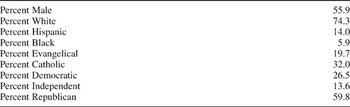
We assess the effects of both process and source cues through an experimental design embedded in a survey administered to 456 undergraduates enrolled in various Texas A&M University introductory political science courses in June 2007. Compared to the American public (see Table 1), students at Texas A&M University are more conservative than Americans, more male, roughly the same proportion white as the population, more Catholic, and a bit less likely to be evangelical Christians. Importantly, many students in this sample are religious and display considerable religiosity compared to many student samples. While the sample is not perfectly representative of the United States, it is diverse, and individual subjects likely respond to stimuli in roughly the same way as average Americans, especially once appropriate controls are applied (Lucas Reference Lucas2003). Moreover, we focus on contingent effects so that only how particular types of individuals react, not how the sample responds, is generalizable (Brewer and Gross Reference Brewer and Gross2005; Kam, Wilking, and Zechmeister Reference Kam, Wilking and Zechmeister2007).
Descriptive statistics for the student sample

N = 456.
On an exam day, which maximizes attendance and the diversity of student ability represented, surveys were administered to all members of several introductory classes. The paper survey consisted of a number of questions, with a short, recent news article attributed to the St. Louis Post Dispatch inserted after 1 page of questions (out of 3). Manipulations of that text constitute the experimental stimuli for this study (see the Appendix for the full article text and all variable coding). The article concerned environmental racism in a fictitious St. Louis neighborhood — a poor, largely Black, polluted neighborhood with rampant health problems among its inhabitants. Two experts, a local clergyman and an academic from a fictitious University of Missouri branch located in the community, were quoted in the article. The choice of a clergyperson is natural given the question, but perhaps the choice of an academic is not obvious. The inclusion of an academic presents several advantages given the use of a clergyperson. In general, using the second elite is more realistic since elites almost never communicate in a vacuum, especially in newspaper articles where multiple sources are generally quoted. Moreover, effects due to clergy process in a competitive environment should be more robust and trustworthy. In particular, academics are perhaps closer in type to clergypersons than are elected officials — the academic we employ lives in the community, has not been popularly elected, and also has a distinctive decision-making process. Moreover, the student population should be relatively torn between academic and religious sources.
We implemented a 2 × 2 × 2 design, randomly varying blame attribution between the two elites, whether the clergyperson offers process cues, and whether the academic offers process cues. The clergyperson and academic elite pair variously attributed blame: the clergyperson either suggests environmental pollution is the cause of the health problems or pinpoints the inhabitants' unhealthy lifestyle choices as the cause, while the academic simply takes the opposite position. The source providing the attributions was randomized so that half of the subjects read about the clergyperson blaming unhealthy lifestyle choices. Presenting the elite arguments in pairs was necessary to control for any effects coming from the direction of the argument.
Given the possible difference in effects between source cue types, we independently varied the presence of the decision-making process attached to the clergy and academic. The process information attached to the clergy stance was particularly evangelical: “After intense reflection and prayer over Scripture that led to a revelation with the power of an ‘altar call … ’” For the academic, the decision-making process involved his being “the lead researcher on a multi-year study of the effects of pollution on health employing rigorous statistical methods.” With this design, we can assess whether clergy or academics generate more trust and ambivalence conditional on their particular stance and the existence and balance of process cues.
TRUST RESULTS
The dependent variable is generated from the following questions: “Please use a scale from 0 to 10, where 0 means you do not trust the arguments at all and 10 means you trust them completely… How much do you trust (Reverend Vaughn's/Professor Serwin's) comments?” The sample mean trust of the professor was slightly, but significantly, higher than for the reverend — 5.6 versus 4.9. The first dependent variable is simply the trust response for the reverend. The second dependent variable is the difference between the reverend and professor's scores (thus ranging from −10 to 10), where a positive number indicates more trust for the reverend than the professor. Stimuli may affect subject trust in each source independently, but they may also be interrelated, which is why we test both.
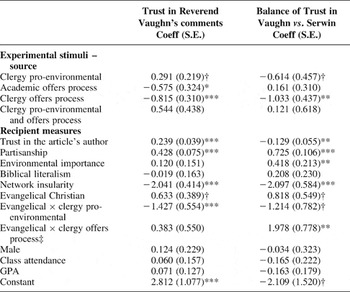
Table 2 presents ordinary least squares (OLS) regression results of trust placed in the reverend, as well as the balance of trust in the reverend versus the professor. The positive and marginally significant coefficient for the “clergy pro-environmental” indicator suggests that when the clergyperson expresses the view that pollution caused health problems in the community and the academic attributed health problems to irresponsible behavior, trust in the clergy was higher than when the sources switched views. However, the balance of trust in the two sources was more equal and less polarized in this pattern than when the reverend blamed personal responsibility. This may merely suggest that the reverend is trusted most when he sides with the majority on this type of issue (as there is widespread support for the government cracking down on industrial pollution). However, since trust for both elites elevate in this condition, there may be a general expectation that clergy and academics will argue in this way, at least on this issue.
Estimates of the determinants of trust in Reverend Vaughn's comments and the balance of trust in Vaughn vs. Serwin

N = 455, adj R 2 = 0.193, SEE = 2.309, F = 8.748***
*** p < 0.01,** p < 0.05,* p < 0.10 (two-tailed tests),† p < 0.10 (one-tailed test)
‡ Note: The estimated effect of this variable was acquired in a separate model in which it replaced the “evangelical x clergy pro-environmental” interaction term. We merely report this result for space considerations.
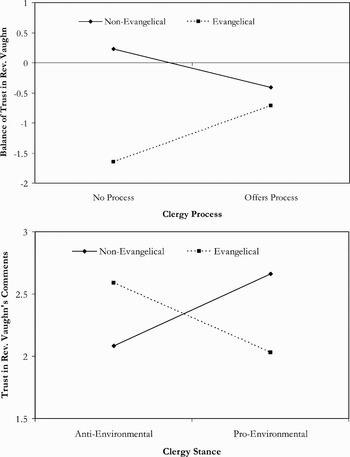
Of particular interest are the process cue results. The negative and significant sign for the “academic offers process” and “clergy offers process” treatments show that trust in the reverend fares poorly when process cues are employed. Process information from clergy also affects the balance of trust between the two sources — clergy process cues bring the two scores more in balance instead of polarizing them. The direction of the arguments and process cues do not interact to affect trust in the reverend. However, process cues should be particularly important for the group that finds them normative. It may not be surprising to find that the interaction between evangelicals and the clergyperson employing process cues is significant; the results are displayed graphically in the top panel of Figure 1. There, we see that process cues do indeed bolster trust in the reverend for evangelicals, while trust among non-evangelicals abates in the face of clergy process cues.
The Conditional Effect of Clergy Stance For Evangelicals and Non-Evangelicals On Trust in Rev. Vaughn's Comments and Balance of Trust.

That the process cue conditions are significant in both models point to the capabilities of the citizenry in using abstract information to assess source credibility. Just how process cues might be used by citizens is not immediately obvious, but these subjects rely on process systematically even when they are presented with two easier guides — the source's identity (professor or clergy) and argument direction.
Furthermore, this is a case where observation and study (the professor's process) might be more credible than personal reflection (the clergy's), and subjects downgrade their trust in the clergy's comments when the clergy's process cues are present. Of course, in a case where the question is almost purely value driven instead of reliant on empirical data (as might be the case with abortion or gay rights), personal reflection (the clergy's process) might yield movement more consensual to the views expressed. In some ways, this may represent a new twist on Carmines and Stimson's (Reference Carmines and Stimson1980) “easy vs. hard” issue distinction in that the public looks to elites for evidence of rigorous analytical consideration of more complex policy concerns, and is leery of leaders who do not embrace this more positivistic approach. Essentially, the effectiveness of elite cues may indeed be predicated on the public's sense that the one making the statements has some degree of issue expertise (Lupia and McCubbins Reference Lupia and McCubbins1998).
The results regarding attributes of the message recipient also reinforce the validity of the experimental effects. Of greatest interest are the effects on members of the groups most likely to look favorably on cues from the reverend. Republicans and evangelical Christians, independently, trust the clergyperson more and are more polarized in their trust patterns in favor of the reverend. While this would suggest the specific appeal of clergy as elites to these groups, evangelicals are significantly less likely to trust the reverend when he advances the pro-environmental view (see the bottom panel of Fig. 1). Perhaps they do not expect this position to be articulated by a reverend and, thus, trust in a clergyperson may be motivated more by sociological considerations than theological orthodoxy. That is, when presented with both kinds of information, evangelicals elevate issue consonance over group ties, though a stronger test would be the more natural one in which controversial stances come from one's own clergyperson. There is a further twist on group effects in the models, however.
While there is the expectation that public opinion tends to spiral in insular and agreeable networks (Sunstein Reference Sunstein2002), our results ratify something closer to Berelson, Lazarsfeld, and McPhee's (Reference Berelson, Lazarsfeld and McPhee1954) general notion and Mutz's (Reference Mutz2002) specific formulation. They argue that more disagreement in the network decreases polarization and draws down intensity. Thus, those in disagreeable networks tend toward attitudinal indifference, holding all else constant (Huckfeldt, Morehouse, and Osborn Reference Huckfeldt, Mendez and Osborn2004). In the trust models, the degree of insularity in a social network decreases trust in the reverend and reduces the polarization of trust. Put another way, those in networks that are more closed to the community due to the strength of their social ties are more skeptical (first model) and indifferent (second model) to these two elites. Thus, even if social insularity may promote attitudinal polarization, it does not seem to encourage subjects to take cues from elites that might further encourage that process (see Djupe Reference Djupe2008). One counter hypothesis is that insularity might augment reception from an in-group elite, but the interaction of, for instance, evangelicals with network insularity was insignificant (for trust p = 0.321 and for the balance of trust p = 0.227 — results not shown).
Finally, subjects were asked if they trust the article's author, which boosts trust in the reverend, but also reduces polarization in trust of the sources (it serves to balance them). It is important to remember that the stimuli are mediated, and subjects may have independent views of the medium that reflect on the contents (Chong and Druckman Reference Chong and Druckman2007; Darke and Ritchie Reference Darke and Ritchie2007). Clearly, they do, and that view carries through to the sources employed by a journalist.
AMBIVALENCE RESULTS
Historically, scholars executed the evaluation of personal political attitudes by using a bi-polar, unidimensional like/dislike differentiation. While these attitudes were considered inversely related, more recent scholarship has found that the relationship between like and dislike may be more nuanced, even independent of each other. Specifically, Cacioppo, Gardner, and Bernston (Reference Cacioppo, Gardner and Bernston1997) suggest that a change in positive attitude toward a stimulus need not affect one's negative evaluation and vice versa. If the two poles move independently, then ambivalence is not the same as indifference. The latter is the product of low levels of evaluation; ambivalence, on the other hand, reflects the high activation of evaluative processes. We take these lessons to heart in the analysis to follow.
Our empirical examination of the persuasive effect of the stimuli is contained in Table 3. The dependent variables include the Griffin measure of ambivalence (e.g., Thompson, Zanna, and Griffin Reference Thompson, Zanna, Griffin, Petty and Krosnick1995) and its components. The first looks at similarity in the number of positive and negative arguments held for and against a position — attitude polarization. The second averages the sum of the positive and negative arguments — attitude intensity. Without both components, the measure would confuse indifference (when the person might not hold any arguments) and ambivalence (when the person holds equal numbers of considerations) (Thompson, Zanna, and Griffin Reference Thompson, Zanna, Griffin, Petty and Krosnick1995). Thus, the third dependent variable represents the full ambivalence measure, which is characterized by the following formula, where P and N are the number of positive and negative arguments concerning an attitude object:

The persuasive effects of process cues on government pursuing corporate pollution

*** p < 0.01, **p < 0.05, *p < 0.10 (two-tailed tests), †p < 0.10 (one-tailed test).
To generate the number of considerations a person might have concerning government pursuit of corporate pollution, we began by asking:
We'd like to ask your thoughts about some issues confronting the nation today. For each statement, think of the positive arguments to support it as well as the negative arguments against it. Using a scale from 0–10, where 0 means there are no positive or negative arguments and 10 means there are very many, where would you place yourself?
We then presented subjects with the policy statement, “The government should devote more attention and resources to stop businesses from polluting” and asked them about “positive arguments in support” and “negative arguments opposed,” each ranging from 0 to 10.
This approach to gathering the number of positive and negative arguments supporting an attitude differs in some respects from other attempts. In particular, one of the more common modes in political science research involves open-ended questions about likes and dislikes concerning parties and candidates used in the American National Election Studies (Feldman and Zaller Reference Feldman and Zaller1992; Chong Reference Chong1993). Other approaches to measuring ambivalence included Hochschild's (Reference Hochschild1981; see also Brewer and Gross Reference Brewer and Gross2005) use of intensive interview techniques in place of objective positive and negative indicators, while Priester and Petty (Reference Priester and Petty1996) and Tourangeau et al. (Reference Tourangeau, Rasinski, Bradburn and D'Andrade1989) asked respondents whether they had positive and negative feelings about an object directly. While these alternative approaches have merit, independent survey items measuring a subject's positive and negative evaluations are particularly efficient and useful (Gwiasda Reference Gwiasda2005).
Table 3 presents OLS regression estimates of the three dependent variables relating to ambivalence — the first column contains polarization, the second intensity, and the third presents the Griffin measure estimation results. We begin with the recipient results, which provide interesting observations about what affects ambivalence. The importance of the environment to the respondent affects argument polarization, but has no effect on intensity. These results are generally in-line with Krosnick et al.'s (Reference Krosnick, Holbrook and Visser2000) findings, where argument intensity was not significantly affected for those with already strong environmental positions. In terms of the network variables, recall that those in networks that are more insular are less exposed to external initiation of discussion and tend to face less disagreement (Huckfeldt et al. Reference Huckfeldt, Beck, Dalton and Levine1995). In part, people in insular networks should have fewer defenses to dissonant information and should readily adopt more considerations. Thus, those in insular networks might initially have more ambivalent political attitudes, other things being equal, and that is what we find in these models. Network insularity exerts a strong and significant downward pressure on polarization and promotes ambivalence with an effect that is about two times stronger than the effect of disagreement. It appears that network insularity may be an underappreciated variable in structuring exposure to elite influence.
The “clergy pro-environment” indicator controls for the particular argument attributed to a source. Its significant and positive coefficient clearly indicates a more potent effect of clergy advancing the argument about environmental pollution and health problems and the academic identifying individual responsibility as the culprit, rather than the reverse. With this pattern of argumentation, the subjects' balance of arguments becomes more polarized (first column) and they become less ambivalent (third column) regarding government pursuit of corporate pollution. A natural complement to less ambivalence is less intensity — an imbalance in considerations naturally means fewer arguments held overall and the intensity score drops. It is important to note that there is no particular direction (more or less positive) in which most subjects move when confronted with this pattern of argumentation.
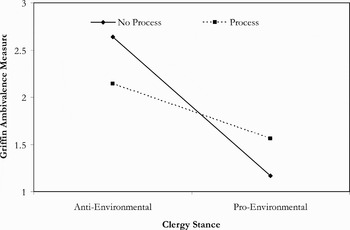
While the “clergy offers process” condition (second IV) does not affect any of the ambivalence components, an imbalance in process information does (represented by the “one side offers process” indicator). If just one source, either clergy or academic, is paired with its process cue, subjects hold more polarized arguments and are less ambivalent. An imbalance in process cues does not affect argument intensity. Moreover, there are interactive effects of clergy process cues and the clergy's stance (when clergy present the pollution-health relationship), the results of which can be seen graphically in Figure 2. Note the general pattern that when clergy present the environment-health link (we have labeled this the “pro-environment” stance since it entails more government action to address pollution), subject ambivalence decreases. The results are essentially the same for the polarization estimates, of course. However, that reduction is moderated by clergy attaching process cues. That is, subjects exhibit relatively more attitudinal ambivalence when they learn that clergy engaged in intense personal reflection and prayer — their specific process mode — to arrive at their conclusion. Put another way, subjects respond particularly strongly when a moral leader, such as a clergyperson, informs them of a poor community being exploited as a receptacle for industrial pollution. Their response to that figure is diminished, however, when the argument is rooted in a style of decision making particularly suited to conservative religious people.
The interactive effects of clergy stance and process cues on ambivalence.

Two explanations readily present themselves. First, this type of process may be seen as ill-suited to address the complexity inherent in environmental policy concerns. Clergy using this particular process may simply be seen as lacking the level of specific knowledge the public would like to see in those whose cues they accept on this issue. Second, only a particular group may recognize the decision-making process of our clergyperson and we chose the process style to mimic a typically evangelical style. We explore this second hypothesis below and throughout the remainder of this article.
Concerning how specific groups respond to the cues, evangelicals are not more or less ambivalent, but those with more literal views of the Bible are. In some ways, this might be a curious finding since a generation of scholarship has investigated the “Lynn White hypothesis” (White Reference White1967), which proposed that a Judeo-Christian worldview was the foremost barrier to an environmental consciousness and sustainable future. Subsequent research has confirmed this idea to a point. It has been conservative Christians (rather than all Jews and Christians) with an emphasis on evangelism and personal spirituality over worldly action that have resisted pro-environmental values and activism (e.g., Eckberg and Blocker Reference Eckberg and Blocker1989; Reference Eckberg and Blocker1996; Guth et al. Reference Guth, Kellstedt, Smidt and Green1993; Reference Guth, Green, Kellstedt and Smidt1995). Conservative Christians, variously measured, downplay the importance of environmental issues, have less information about environmental issues, and generally are more opposed to environmental protection measures than others, though the relationships are quite complex (see Sherkat and Ellison Reference Sherkat and Ellison2007). One might expect that literalists would hold less intense opinions on environmental protection considering they hold the environment to be less important, and, therefore, do not seek out much information about it. Their ability to hold a broad range of arguments about environmental protection would, therefore, be compromised. However, literalists do not hold more or less intense opinions in the results in the second column of Table 3. Perhaps, then, we are witnessing a move toward true ambivalence on the environment among a new generation of conservative Christians, as a recent Pew Forum on Religion and Public Life (2007) survey noted.
Several facets of these results, as well as the particular process cue that the reverend employed, suggest that evangelical Christians might respond differently. Of course, we composed the clergy decision-making process cue with evangelicals in mind, which was modeled on the public statements of Reverend Rich Cizik, the Vice-President for Governmental Affairs for the National Association of Evangelicals (Djupe and Gwiasda Reference Djupe and Gwiasda2008). Reverend Cizik was the driving force behind the NAE's controversial statement in 2004 encouraging more environmental protection, among other policy goals (Goodstein Reference Goodstein2005; National Association Evangelicals (NAE) 2004). He emphasized a uniquely evangelical decision making process that focused on intense, private prayer, and personal reflection.
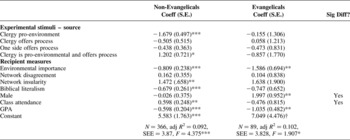
We test for the possibility that evangelicals might respond to this particular process cue in Table 4. There, we assess the same model used in Table 3, now separately for evangelical versus non-evangelical subjects. A systematic interaction term test helps us to judge if evangelicals, in fact, do respond differently. The short answer, following the insignificant evangelical dummy variable in the models in Table 3, is no. Using the industry standard for judging difference,Footnote 3 we find no difference in how evangelicals' ambivalence levels react to the experimental stimuli. Only two control variables — gender and class attendance — have different slopes for evangelicals.
Ambivalence estimates for evangelicals and others

*** p < 0.01, **p < 0.05, *p < 0.10 (two-tailed tests), †p < 0.10 (one-tailed test)
Note: “Sig Diff?” corresponds to a variation of the Chow test, where interaction terms of evangelical and every other independent variable are included in one model using the entire sample. Significant interaction terms (p < 0.10) are indicated by “Yes”.
Null findings are less than satisfactory; however, they may help to narrow the range of reasonable interpretations. Above, we suggested that there are several ways to view the clergy process stimuli, including as personal reflection. Since evangelicals' respond in roughly the same way as non-evangelicals, then perhaps the cue can be understood primarily as a sign of personal reflection instead of a particular religious practice. These subjects may have been able to see through the religious aspects to understand the decision-making process revealed as an ill-suited means of dealing with this problem (hence the moderating effect of clergy process cues when the reverend was pro-environmental). At the same time, evangelicals do trust more clergy providing process cues as we have defined them, but that gateway to persuasion seems stuck since evangelicals' ambivalence levels do not differ from others'.
DISCUSSION AND CONCLUSION
Elites almost never speak in a vacuum. Thus, we paired a reverend with a professor and varied the valence of their arguments. The latter choice proved to have been foresighted because one set of arguments was more persuasive than the other. We randomly added process information that would likely be associated with the type of source — intense reflection through prayer for the clergy and rigorous statistical methods for the professor. Future research might randomly assign process types to sources to see if the unexpected use of a process (e.g., clergy using social science research) induces greater credibility. Regardless, the evidence indicates that people do use process cues to assess trust in the source as well as inform their attitudes. Future work remains to elaborate the types of processes that elites provide, the process preferences of citizens, as well as the intriguing possibility that preferred processes exist for different usages.
We had three primary motivations for pursuing this research. First, decision-making process information often accompanies elite policy arguments; the effects of elite process cues on individuals have not been studied to this point (though see Djupe and Gwiasda Reference Djupe and Gwiasda2008). It appears that subjects do utilize process information, when available, which seems to run counter to a basic assumption that voters have a limited capacity to acquire and use politically-relevant information. In fact, the application of process information is so abstract that its use hints at cognitive processing at the systematic level/central route, beyond the normal level at which heuristics are employed — the heuristic (e.g., Chaiken Reference Chaiken1980) or peripheral route (Petty and Cacciopo Reference Petty, Cacioppo and Berkowitz1986).
Second, we assessed the effect of message recipient characteristics to look for, especially, social conditions that affect the possibility of elite influence. What we found confirms findings from other contexts — the structure of social relations affects the degree to which individuals are accessible to and are motivated to learn from elites (Djupe Reference Djupe2008; Djupe and Neiheisel Reference Djupe and Neiheisel2008a; Djupe, Sokhey, and Calfano Reference Djupe, Sokhey and Calfano2008). Because social network variables are included in an experimental setting in which access obviously is not an issue, they clearly point to motivational effects. Thus, those in more insular networks are less motivated to learn from these elites — they trust them less and learn less from them. This is an especially important finding since insular networks are often thought to be a danger to democracy by promoting extreme opinions. If elites have a hard time accessing and directing those opinions, then they would pose a bit less of a threat.
Third, we were interested in elaborating how religious influence works, hence our focus on comments made by a clergyperson. Despite a long line of research on the political speech of clergy (e.g., Djupe and Gilbert Reference Djupe and Gilbert2003; Guth et al. Reference Guth, Green, Smidt, Kellstedt and Poloma1997; Welch et al. Reference Welch, Leege, Wald, Kellstedt, Leege and Kellstedt1993), we know very little about how clergy are persuasive, or if indeed they are at all (see Djupe and Gilbert forthcoming; Smith Reference Smith2008). Are clergy persuasive because they are figures of authority standing in front of a group who choose to be in attendance? Because they are particularly good public speakers? Because they reference shared values? Because they draw from a revered text? We chose to test one appealing possibility — that clergy back their arguments with a decision-making process cue that is recognized by an in-group. Just as social scientists might embrace an unfamiliar relationship when produced by a decision-making process they trust (i.e., by social science research methods), evangelicals might trust and adopt the arguments of clergy employing a familiar strategy for reaching a decision and non-evangelicals might not.
Clearly, one pattern of elite argumentation was more effective in affecting trust and ambivalence than the other. In particular, the pattern of clergy making the environmental-health link and the professor arguing for individual responsibility was more effective than the reverse. The opposite is more persuasive for evangelical trust patterns. Moreover, evangelicals respond to clergy providing process cues with increased trust, as we would expect. Beyond trust, though, we now have two instances in which evangelicals do not respond to process cues as most would think they would (see Djupe and Gwiasda (Reference Djupe and Gwiasda2008) for the other example, which uses a national probability sample).
There are plentiful cues to prime evangelicals to think of the problem with religion in mind, but they react similarly to non-evangelicals nonetheless. Several possibilities to explain this are available. First, it may be that the process cue is not strong enough, though many examples can be found in the media of evangelical elites using similar or even more abstract appeals (see Calfano and Djupe forthcoming). Second, it is possible, even likely, that people respond to their own clergy embedded in their social networks in church and resist internalizing information from a new source from outside a well-known haunt. Third, some research has found that those demonstrating more religious commitment are actually more resistant to elite and socially-supplied information (see Djupe and Gilbert forthcoming). If that is the case, then evangelicals should post more individualistic distinctions except when in high accountability situations, such as in church. That is, evangelicals might simply not be open to new information without extra assurances that it can be trusted, which squares with common definitions of evangelicalism that include some barrier with the world.
Thus, this pattern informs our understanding of religious influence on attitudes by telling us what it is not. Evangelicals may resemble the rest of the population in responding to elites — they do not evaluate an elite's policy views more highly simply because of ecclesiastical title or an appeal to religious process. Instead, evangelicals, and the public in general, may positively respond to elite policy positions for other reasons, including a sense that members of the elite are being honest and thoughtful in sharing their perspectives on an issue, irrespective of reference to faith. The sample used here did not appreciate the decision process our clergyman employed, and evangelicals specifically seemed immune to its appeal.
In an indirect way at least, these findings challenge the dispositional assumptions of the symbolic politics literature (see Sears et al. Reference Sears, Lau, Tyler and Allen1980; Kinder and Sears Reference Kinder and Sears1981; Sears and Funk Reference Sears, Funk and Mansbridge1990), that behavior is shaped by entrenched habits, including following respected elites in shaping one's policy views. That evangelicals were not prone to follow clergy process cues suggests that discourse may be far more important components of the cognitive activities of religious subjects than is conventional wisdom. This may also explain why the literature has had a hard time establishing a clear linkage between clergy influence and parishioner behavior. Of course, a null finding for clergy process in this one instance is not the same as determining definitively its non-existence.
Much remains to be tested on this subject. For instance, in parsing out when subjects may be more or less likely to rely on elite process, future research may wish to explore emotion and other affective elements in shaping subject deliberation (see Marcus, Neuman, and MacKuen Reference Marcus, Russell Neuman and MacKuen2000). This is especially true concerning feelings of threat. While environmental racism may be a policy issue of unique concern to those it directly affects, one could argue that the evangelical findings in this experiment were, in part, the result of a lack of perceived personal threat by subjects.
For now, our results offer comment on how religious voices are challenged to engage in public debate. Particularistic arguments couched in religious justifications are not necessarily welcome, even by groups that would seem amenable to elite cues on the subject. We cannot say definitively that preferred judgment styles can be associated with different policy problems, but the evidence seems to point in that direction. The public largely appears to want a debate held on common ground.
APPENDIX: STIMULI AND VARIABLE CODING
Experimental Stimuli
The source cue is bolded, the directional argument is underlined, and the process cue is italicized. The source making the directional argument and the inclusion of the process cue for each source were randomly distributed.
May 24, 2007
ST. LOUIS POST-DISPATCH
“Trudging on the Toxic Tour.”
By Heather Knight, Staff Writer
When it comes to walking tours of St. Louis, energetic tourists can many options. They can take a literary tour of the Central West End, enjoy the restaurants and varied shops of The Loop, stroll under the famous “gateway to the west” Arch on the waterfront, or meander down to the Brewery District.
But a walking tour of Hunter's Point is different. It's not centered on art, architecture or food, but is all about the pollutants and chemicals that contribute to what some consider a health crisis for this neighborhood consisting of largely poor, African-Americans. Residents of the poor, often violent part of the city are hospitalized for just about every disease – including asthma, diabetes and congestive heart failure.
Though claims of environmental racism are controversial and debatable, blame for the bleak public health of those living in the neighborhood is placed at the door of toxic waste sites. After intense reflection and prayer over Scripture that lead to a revelation with the power of an “altar call,” Reverend Walter Vaughn of Hunter's Point Community Churchagrees: “Environmental pollution is concentrated in minority neighborhoods causing a higher rate of health problems, and we need to devote greater resources to alleviate this widespread problem.”
However, others are not so quick to lay blame on corporate polluting.Professor John Serwin of the University of Missouri, located in Hunter's Point, is the lead researcher on a multi-year study of the effects of pollution on health employing rigorous statistical methods. He pushed a different priority, “People of this community need to clean up their own act. Higher rates of health problems are the result of poor diets, among other factors, and not businesses polluting.”
Dependent Variables
Balance of arguments concerning government pursuit of corporate pollution, absolute value: We began this section with the following introductory language: “We'd like to ask your thoughts about some issues confronting the nation today. For each statement, think of the positive arguments to support it as well as the negative arguments against it. Using a scale from 0–10, where 0 means there are no positive or negative arguments and 10 means there are very many, where would you place yourself?…The government should devote more attention and resources to stop businesses from polluting.” Respondents were asked to provide a number between 0 and 10 for “positive arguments in support” and for “negative arguments opposed”. For this measure, we took the absolute value of the difference; the measure ranges from 0 to 10, the mean is 3.8, and the standard deviation is 3.2.
Trust in (Reverend Vaughn, Professor Serwin, and the article's author): “Thinking about the article you just read, how reliable did you find the arguments? Please use a scale from 0 to 10, where 0 means you do not trust the arguments at all and 10 means you trust them completely…How much do you trust (Reverend Vaughn's comments — Professor Serwin's comments — the author of the article, Heather Knight?).”
Balance of trust in Vaughn versus Serwin: We took the difference in trust — Vaughn minus Serwin. The measure ranges in value from −10 to 10, the mean is −0.63, and the s.d. is 3.5.
Independent Variables
Biblical literalism “Which view comes closest to your view of the Bible?” (1) The Bible is the actual word of God and is to be taken literally, word for word; (2) The Bible is the inspired word of God but not everything in it should be taken word for word; (3) The Bible is a good book because it was written by wise people, but God had nothing to do with it; (4) The Bible was written by men so long ago that it is worth little today.
Gender: (1) Female (2) Male
Class attendance: “Thinking of a typical college course, how many of the class sessions do you attend?” (1) All – 100 percent, (2) 4 out of every 5, (3) 3 out of every 5, (4) About half or less.
GPA: “In what category does your GPA fall?” (1) 3.51–4.00, (2) 3.01–3.50, (3) 2.51–3.00, (4) <2.50.
Clergy is pro-environmental: Equals 1 if Reverend Vaughn argued that pollution was to blame for community health problems and 0 otherwise.
Clergy offers process: Equals 1 if the article indicated how Reverend Vaughn arrived at his opinion (after intense reflection and prayer) and 0 otherwise.
Academic offers process: Equals 1 if the article indicated how Professor Serwin arrived at his opinion (as lead author of a study) and 0 otherwise.
One side offers process: If just one source gave process information, but not both, then the variable is coded 1 and 0 otherwise.
Environmental importance: “We would like to get a sense of how important or not important the following issues are to you personally…environmental protection.” (1) not at all important, (2) not very important, (3) somewhat important, and (4) very important.
Evangelical: The measure equals 1 if the respondent is white, identified their religion as “Protestants,” “Other Christians,” or “Other,” and who agreed or strongly agreed that they considered themselves born again or evangelical Christian; it is 0 otherwise.
Network disagreement: Respondents were presented with the following prompt: “From time to time, people discuss government, elections, and politics. Looking back over the last few months, we would like to know about the people you talked with about these matters. These people might be relatives, spouses, friends, or acquaintances. Please think of the first three people that come to mind and answer each question for each person. We will not record the names of people you list below.” To gauge network disagreement, we asked this question about each discussant, “How often would this person disagree about politics with other people you know?” (1) rarely, (2) often, (3) very often. Responses were averaged across the network and therefore range from 1 to 3.
Network insularity: See above for the prompt for discussants, for each of whom the following question was asked: “Does this person know others you listed?” Responses were coded (0) no, (1) yes and then averaged across the network, hence ranging from 0 to 1, where values toward 1 signal an insular network.