Government officials, from politicians and military leaders to local police officers and postal workers, are beset with intensified public scrutiny. At the surface, the sources of this disdain for government appear readily explainable given the struggling economy and increasing partisanship. However, where else might these negative viewpoints of government originate? Government permeates Americans' lives, yet frequently remains unacknowledged. Given the role of government in citizens' lives one might also consider less-obvious manifestations of government, particularly those avenues for entertainment, including novels, television, and motion pictures. Narrative forms, especially film, can significantly influence perceptions and stereotypes about government (cf. Holley and Lutte Reference Holley and Lutte2000; Holzer and Slater Reference Holzer, Slater, Goodsell and Murray1995; Lichter, Lichter, and Amundson Reference Lichter, Lichter and Amundson2000; McCurdy Reference McCurdy1995). Numerous popular television shows, past and present, directly examine the work of government (for example, The West Wing and Parks and Recreation). And in film, detective John McClane in the Die Hard films and the cranky EPA inspector in Ghostbusters (1984), who challenges Dr. Egon Spengler and his fellow Ghostbusters as they endeavor to protect the citizens, represent two contrasting views of government. Even in economic downturns, Americans flock to the cinema and even more watch movies at home. With such a large audience, what images of government are being portrayed to movie-going Americans?
Here the focus is on the portrayal of government—generally and in terms of specific characters—in the top-10 box office grossing films from 2000 through 2009.Footnote 1 Although film and politics is a frequent research focus, this research expands existing work by building on more recent literature, specifically Pautz and Roselle (Reference Pautz and Roselle2010), with a new data set that examines larger samples of films in contrast to previous work. Much of the research to date focuses on small sample sizes of films or case studies that consider obscure movies. Further, a substantial portion of the scholarship focuses on specific dimensions of film, such as the portrayal of war in film (cf. Kellner Reference Kellner2009; Weber Reference Weber2006; Westwell Reference Westwell2006) or ideology of American cinema (cf. Franklin Reference Franklin2006; Neve Reference Neve1992). To address the question of how government is portrayed in film, research should focus on larger samples of film and choose a sample of films based on audience attendance to understand the movies most Americans watch. Thus, the emphasis here is on how government is portrayed in the most popular films in the United States and a grim view of government is expected.
To investigate this question, the top-10 box office grossing films in the United States from 2000 to 2009 were selected. The sample of films was limited to films that are classified as comedies, action/adventure, and dramatic films; animated and family-oriented films were excluded from study.Footnote 2 Accordingly, the 76 films in this study are among the films most likely to have been seen by the majority of cinema-going Americans. Arguably, this larger sample comprises films that have the greatest exposure to the movie-going public in the United States. In this study, 56% of civil servants (e.g., teachers, district attorneys) and 54% of members of the armed forces were portrayed positively whereas only 33% of police officers and other law enforcement officials were similarly depicted. Before exploring these findings in greater detail, a discussion is provided of views about government and existing studies regarding the treatment of narrative forms, particularly film, in public administration. After contextualizing the research, the methods and the findings from 76 films that depict more than 400 government characters are discussed; finally, the implications are reviewed.
VIEWS OF GOVERNMENT
Government, in general terms, is feeling the wrath of citizenry contending with ongoing economic challenges and partisan rancor in Washington. According to a CNN/Opinion Research Corporation Poll in September 2011, 77% of Americans only trust the government to do what is right some of the time while only 15% think government can be trusted most of the time (CNN/Opinion Research Corporation Poll 2011a). According to Gallup, 67% of Americans are dissatisfied with the size and power of the federal government (Gallup Poll 2011). These opinion polls are unsurprising as Americans continue to have negative perceptions of their government and citizens have held those beliefs for decades (cf. Nye, Zelikow, King Reference Nye, Zelikow and King1997). Goodsell (Reference Goodsell2004) states, “… Americans are taught throughout [their] lives, from hearth and home on through school and career, that government is a sea of waste, a swamp of incompetence, a mountain of unchecked power, an endless plain of mediocrity” (Goodsell Reference Goodsell2004, 3). More specifically, politicians are spoken of with great disdain and the public routinely blasts their laziness. In a CNN/Opinion Research Corporation Poll 69% said Congress has not done anything this year (CNN/Opinion Research Corporation Poll 2011b). Further, “[b]ureaucrats—with the word uttered in contempt—are alleged in all quarters to be lazy, incompetent, devious, and even dangerous” (Goodsell 3, emphasis original). These views of government along with a sluggish economy are likely to make optimism and views on the direction of the country worse. Understandably then, Americans may want to find outlets to escape these frustrations and time and time again, film proves to be one of those escape mechanisms.
ROLE OF FILM IN SOCIETY
Since the birth of the cinema in the 1890s, through the nickelodeon era, to the emergence of cinemascope, and the ubiquitous multiplex seemingly on every corner, film reaches more Americans than other forms of narrative entertainment (e.g., theatrical productions and novels) (Cook Reference Cook1996; Sklar Reference Sklar1994; Vogel Reference Vogel1998).Footnote 3 According to the Motion Picture Association of America (MPAA), 1.34 billion movie tickets were purchased in 2010 in the United States and Canada, and this number does not account for movies watched at home or in other venues, such as pay-per-view or television (MPAA 2010, 6).Footnote 4 These figures indicate that the national average of tickets sold per person is 4.1 (MPAA 2009, 6). The most frequent movie-goers are Caucasian, 18–39 year olds and are both men and women (MPAA 2010, 8). Movie-goers aged 18–24 average seven movies at the cinema each year, while 25–39 year olds average five movies a year (MPAA 2010, 10). Movies reach a large section of the American population across demographics and socioeconomic status unlike other narrative forms. Holzer and Slater (Reference Holzer, Slater, Goodsell and Murray1995) note that one of the reasons that films can have such an effect on public perceptions is due to “the vast size of the audience” (77).
FILM, GOVERNMENT, AND PERCEPTIONS
In light of Americans' views on government and the prominent role film plays as an entertainment form, consider how narrative forms, particularly film, affect perceptions. Narrative forms influence the perceptions of individuals on a host of subjects (cf. Kolker Reference Kolker1999).Footnote 5 In particular, movies can influence perceptions and behaviors about political culture, thus influencing political socialization (Franklin Reference Franklin2006, 6; Heidelberg and Schultz Reference Heidelberg, Schultz, Dale and Foy2010, 59) and government more generally (Ortega-Liston Reference Ortega-Liston2000). Although all narrative forms can affect perceptions about government, film is of particular interest for several reasons. First, as discussed, film reaches more Americans than any other form of narrative entertainment. Second, and perhaps most significantly, film arguably has the greatest impact on perceptions of all narrative forms. “The visual image is encompassing, immersing. It allows for the total suspension of disbelief …” (Holzer and Slater Reference Holzer, Slater, Goodsell and Murray1995, 77). “Of the arts, the cinematic experience is among the most psychologically persuasive” (Lee and Paddock Reference Lee and Paddock2001). Stated differently, film has the ability to completely consume its audience and occupy more senses than many other narrative forms because the senses of sight and sound are engaged when watching a film.Footnote 6
With this ability to influence perceptions, the depiction of politicians, law enforcement officials, and civil servants is of particular interest in contemporary American cinema. It is expected that fairly negative portrayals of government in film will be uncovered.
PORTRAYALS OF GOVERNMENT OFFICIALS
Depiction of Politicians
Although politicians are frequently depicted in movies (cf. Gianos Reference Gianos1998; Giglio Reference Giglio2007), their portrayals fall into two general, although not mutually exclusive, categories: larger-than-life characters or flat, uncomplicated characters. The first category pertains to characters who are over the top or unrealistic, such as overly zealous, macho presidents like Harrison Ford's character in the thriller Air Force One.Footnote 7 The second category relates to those flat character depictions, or characters that lack dimensionality and complexity (Gianos Reference Gianos1998, 169). For instance, Kevin Kline plays a presidential look-alike who stands in for the actual president of the United States, who suffered a massive heart attack while liaising with his mistress in Dave (1993). Both Kevin Kline's character and the actual president have simplistic depictions—one is an upstanding, average guy and the other is a womanizing, power-hungry leader. “Hollywood's need for simplification is irrevocably at odds with the complexities of life on Capitol Hill” (Giglio Reference Giglio2007, 143). A few further generalizations about Hollywood's portrayal of politicians can be deduced. Politicians are most often depicted in negative ways (Giglio Reference Giglio2007, 134–35). These characters are often corrupt, self-interested, overly ambitious, and greedy. Although movie-watchers may remember Jimmy Stewart's portrayal of Jefferson Smith in Mr. Smith Goes to Washington, that depiction is by far the exception as most politicians are not scripted redeeming qualities (Giglio Reference Giglio2007, 142–44).
Depiction of Law Enforcement and Military
A fundamental task for government is to provide security and order to a society, and members of the military and law enforcement personnel are most often tasked with security and order. As might be expected, depictions of these governmental actors are commonplace in American film. However, as Suid (Reference Suid2002) and Powers, Rothman, and Rothman (Reference Powers, Rothman and Rothman1996) note, military and law enforcement officials find themselves depicted in contrasting ways on the silver screen.
Historically, films exuded an unquestioned respect for the military. However, as the disillusionment over the establishment in the 1960s grew, films began to reflect these societal shifts (Powers, Rothman, and Rothman Reference Powers, Rothman and Rothman1996, 97). Rothman, Rothman, and Powers's (Reference Rothman, Rothman and Powers1990) thematic analysis of films between 1946 and 1960 found the US military was portrayed positively 44% of the time, 33% were mixed, and 23% were negative. From 1960 to 1990, 20% of the films portrayed the military positively, while the remaining 80% were split between mixed and negative depictions of the military. Suid (Reference Suid2002) echoes these varied assessments of Hollywood's portrayal of the military, particularly with recent films. For example, Black Hawk Down portrays a negative episode in America's military history, but helps renew a sense of pride and patriotism (Suid 673). War films will continue to draw large audiences for a range of reasons, from the latest special effects to Suid's conclusions about the escape that war films offer their audiences and a clear, evil enemy (Suid 6–7).
Although law enforcement characters also have a mixed portrayal in American film, the overall depiction leans more negative than the view of the military. Powers, Rothman, and Rothman (Reference Powers, Rothman and Rothman1996) examine Hollywood's portraits of law enforcement from 1946 through 1990 and deduce three different periods. According to Powers, Rothman, and Rothman, films from 1946 to 1965 convey the message that “crime doesn't pay.” Police officers enforced the laws because they were compelled to do so—morally, ethically, and professionally. The law enforcement characters in these films rarely resorted to violence (Powers, Rothman, and Rothman Reference Powers, Rothman and Rothman1996, 107). Those images of upstanding law enforcement officers changed in the 1960s; from 1966 to 1975, films portrayed police officers using “vigilante justice” to curb rampant lawlessness and disorder. Clint Eastwood's character Dirty Harry epitomizes this shift. These characters are as cold and malevolent as they combat widespread and raging crime. Films from 1976 through 1990 depict the “war on crime,” according to Powers, Rothman, and Rothman, in which police officers are portrayed in comedic roles or as renegades who can save the day. Examples of these depictions include Bruce Willis' John MacClane in Die Hard or Eddie Murphy in Beverly Hills Cop.
Depiction of Civil Servants
“Bureaucrat bashing” is commonplace in society, and as with depictions of other types of government officials, it is important to determine whether average civil servants in film reflect society's perceptions about them. Public administration provides these necessary portrayals of civil servants (cf. Kroll Reference Kroll1965; McCurdy Reference McCurdy1995; Waldo Reference Waldo1968). In his broad look at fiction, McCurdy (Reference McCurdy1995) notes that attacking the government has “… prove[n] to be a certain method for enlisting audience sympathy in the United States” (504). Besides these broad examinations, there has been some, albeit limited, study of the portrayal of civil servants in film.
Generally, civil servants appear to be negatively portrayed in American film. Holzer and Slater (Reference Holzer, Slater, Goodsell and Murray1995) found “[v]irtually all depictions [of the bureaucracy] rework stereotypes to excess … [and] the attack is ceaseless and merciless” (76). “Movies, in short, have reinforced the public's long-standing, poor image of government” (Holzer and Slater 85). Holley and Lutte (Reference Holley and Lutte2000) reach similar conclusions and further argue that Hollywood contributes to the negative perceptions about public administrators and their performance. Wielde and Schultz (Reference Wielde and Schultz2007) devise several categories of civil servants (Monstercrat, BlackHatocrat, Obsessocrat, Herocrat, Ethicrat, and Romanticrat) based on studying 40 movies dating back to the 1940s. They noted that not all films portray civil servants negatively, and the depiction of civil servants is more complicated than simply a positive or negative portrait. Other research proactively tries to find films that portray government in a favorable light. Lee and Paddock (Reference Lee and Paddock2001) sought films that depict “bureaucrat heroes” and identified 20 films based on their criteria. Note that among their 20 films, almost half are more than 30 years old and many of the films were not successful at the box office. Lee and Paddock found that most of their bureaucrat heroes wore uniforms (largely military or law enforcement) and most of the heroes defied their agencies to be heroic.
What Remains Understudied
How these three categories of government officials are portrayed presents a fairly murky view of how Hollywood treats government. One might conclude that government officials have a mixed legacy on the silver screen, and, in terms of general government depictions, conclusions are more difficult to reach. Individual characters or film genres seem to be more the focus more than a holistic look at the treatment of an institution that is varied and complex as government. Efforts to look at larger samples began with Pautz and Roselle's (Reference Pautz and Roselle2010) study that found that recent box office hits have a generally negative depiction of government despite positive portrayals of civil servants. However, their study is limited because it only considers how civil servants are portrayed without including all types of government officials, such as law enforcement, military, and politicians. Here, their research is expanded to examine more groups of government officials.
From this survey of existing work on the portrayal of government officials in film, several methodological concerns are raised. Much of the research appears to take nonrandom samples of film and this is problematic.Footnote 8 Although the desire to seek out films that portray civil servants positively can be informative, it is difficult to determine how widely those films are viewed. Therefore, caution should accompany broad conclusions about the depiction of civil servants in film if, first, the films are decades old and, second, they are somewhat obscure and not commercially successful. Also, most studies sample only a few films and do not allow for a more comprehensive view of American film and how government is portrayed. As a result, this study examines how governmental officials are portrayed in contemporary American cinema by building on Pautz and Roselle's work that endeavors to overcome some of these obstacles.Footnote 9
FILMS STUDIED AND RESEARCH DESIGN
This study follows the methods of Pautz and Roselle (Reference Pautz and Roselle2010), but with a new data set examining the top-10 grossing filmsFootnote 10 annually from 2000 through 2009. Because the interest is on the portrayal of government and the possible effects on the average movie-going American, the top-10 grossing films were selected as they represent the films in the United States most likely seen by the average American.Footnote 11 The sample was limited to films in these three genres: action/adventure, comedy, and drama.Footnote 12 Animated and family-oriented films were excluded because those films are aimed at young children, whereas the study is interested in what the movie-going, adult population sees at the local cinema. Therefore, these parameters provide a sample of 76 films to investigate.
These categories of government officials were included: politicians, law enforcement officials, members of the military, and average civil servants, such as teachers. Pautz and Roselle's (Reference Pautz and Roselle2010) coding instrument was revised substantially to assess depictions. The first part of the revised coding instrument gathered background information on the film, plot, main characters, setting, and overall depiction of government. Then the coding instrument focused on each film character who is a government official. Demographic characteristics including sex, age, ethnicity, and nationality of each government official were also gathered. The type of government official was determined by coding the agency and job duties of the official. Character attributes and actions were coded in an open-ended manner and included adjectives that were used by other characters in the film to describe the civil servants and their actions or practices. From the coders' responses to questions about each of the characters, the responses were organized into various categories.Footnote 13
Undergraduate students in a film and politics course were trained to use the coding instrument during a class sessionFootnote 14 and given a test of coding one movie to make sure they completed the coding instrument correctly. After a coder successfully completed the coding instrument (e.g., included all government characters previously identified by researchers in a film, and so forth), the coder was permitted to code films. Each coding instrument was carefully scrutinized to ensure data integrity. Intercoder reliability was adequate with slightly more than 14% of the 76 films coded by two different coders. For each movie that was coded by two coders, the researchers reviewed both coding instruments for the film to check for the same counts of characters, summaries, and assessments.
Overview of Films
First consider an overview of the 76 films studied before exploring the depictions of individual government officials. In terms of genre, 76% of the films were action/adventure movies. Sixteen percent were comedies, and the remaining 8% were dramas. Action/adventure films with their requisite superheroes (such as Batman Begins and Spider-Man) and lots of special effects (for example, Pirates of the Caribbean films and the Lord of the Rings trilogy) are frequently among the top box office grossing films each year along with comedies that appeal to audiences (such as Scary Movie and The Hangover) as are a handful of dramatic films (such as Signs and The Sixth Sense). Out of the 76 films in our sample, 69 films included government officials that were coded in this study. Stated differently, 91% of films contained at least one character who was a government official. This percentage suggests that movie-goers had a high probability of seeing government portrayed in film.
OVERALL PORTRAYALS OF GOVERNMENT
On the broadest levels, the study was interested in how the film depicts government generally, and individual government officials, more specifically. Therefore, the coding instrument asked coders to assess the depiction of government and of law enforcement/military by selecting from an assortment of descriptors: efficient, competent, good, inefficient, incompetent, and bad. Coders were allowed to select one or multiple descriptors.
Regarding government generally, most of the films had a mixed depiction of government. In 21% of the films, government was coded as inefficient while in 19% of the films, government was coded as good. Further, 17% of films portrayed government as competent while 17% showed government as incompetent. Finally, 14% of films depicted government as bad, and 12% depicted government as efficient.Footnote 15 At first, such varied responses were surprising: how could a film depict government as both inefficient and good? Take for example Pirates of the Caribbean 2: Dead Man's Chest where the general depiction of government was both good and incompetent. The royal governor and the rest of the colonial government are set on upholding the laws, but in the film the government struggles to thwart Captain Jack Sparrow and his pirate brethren. Although piracy is against the law, the film creates sympathy for the pirates and makes the audience supportive of the pirates' escape while applauding the inability of the government to keep the pirates detained. Consider another example in the film I, Robot. This movie portrays government as both efficient and bad because U.S. Robotics is very efficient, but also endeavoring to take over the world at the same time. From a narrative perspective, a mixed depiction might prove a necessity for good storytelling; from a societal viewpoint, a mixed depiction of government demonstrates the complexities of government and how Americans think about it. On the whole, 22% of the films had a positive view of government, 29% had a negative view, and 16% had a mixed view.Footnote 16
Additionally, the depictions of military and law enforcement were equally mixed. In 19% of films, military and law enforcement were depicted as efficient, and the same percentage found the aforementioned group as good. Seventeen percent of the films depicted the military and law enforcement as competent, yet 16% of the films showed them as inefficient. Only 11% of the films depicted military and law enforcement as bad. The Dark Knight helps explain the seeming contradictions in the depictions of military and law enforcement. In this film, Gotham City is struggling to contain the crime wave brought on by Joker—thus, the government appears to be both inefficient and incompetent. The villain is only stymied with the help of the hero, Batman. Yet, government, through noble characters like District Attorney Harvey Dent and Police Commissioner Gordon, is trying valiantly to stop Joker and his band of criminals. More generally, 28% of films depicted law enforcement and the military positively, 29% negatively and 9% were mixed. These mixed depictions were somewhat surprising, yet they point to the complexities of government and its work, demonstrating that assessments of government are neither simplistic nor easy. Looking at the portrayal of individual government officials offers some further insights.
PORTRAYALS OF GOVERNMENT OFFICIALS
Government Officials' Attributes
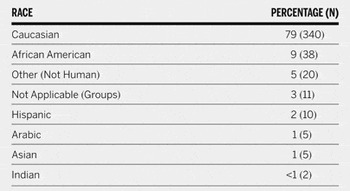
From the sample of 76 films, 431 government officials were identified and coded, providing a picture of how contemporary American cinema portrays those individuals working for the government. In terms of physical demographics, the average government worker on screen was a male Caucasian between 21 to 40 years of age. Men made up 83% of the sample, while women comprised of only 15% of characters.Footnote 17 Seventy-nine percent of the characters were Caucasian with only 9% African American. A further breakdown of race can be found in table 1.
Race of Government Officials Portrayed

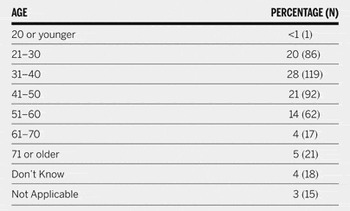
Interestingly, the government officials portrayed were overwhelmingly male and generally younger. It is not clear why more than three-quarters of government characters were male. A possible explanation might be that the nature of the films' plots lends themselves to characters often associated with men, such as military heroes or renegade police officers; nevertheless, a ready explanation remains elusive. In terms of the age of characters, the character of Rachel Dawes, played by Katie Holmes, in her role as a district attorney in Batman Begins and the rogue police officer, Del Spooner, played by Will Smith in I, Robot, exemplify younger government officials. Of all government officials coded 48% were between the ages of 21 and 40. See table 2 for a further breakdown of ages.
Age of Government Officials Portrayed

These data differed from the demographics of real-life government. According to the US Office of Personnel Management, men make up 56% of the federal, civilian work force, unlike the 83% presented by Hollywood in these films. Furthermore, the average age of a government official is 46 years old, which is older than the characters in these movies. One area that Hollywood was closer in representing reality is the depiction of demographics in regards to race. Caucasians make up 68% of the workforce, which is 11% less than Hollywood's depiction. However, African Americans make up 17% of the real civilian workforce, not the 9% Hollywood portrays.Footnote 18
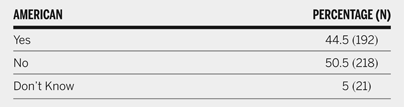
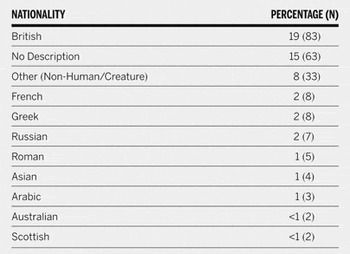
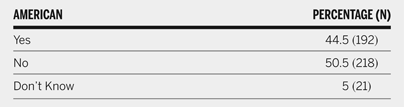
Although there is not a lot of diversity in characters' sex, race, or age, some variation exists regarding the government official's nationality. Only 45% of those coded were Americans. Those characters who were not American, 51%, were further classified into different groups, if it was possible, to distinguish the nationality of the character. British governmental officials made up 19% of the foreign government officials because of the large number of English schoolteachers in the multiple Harry Potter movies in the sample. Also included in the percentage of characters, who are not Americans, are those characters categorized as “other”—generally because the film was set in a fantasy world. Examples of fantasy characters include the Trade Federation politicians in Star Wars Episode I: The Phantom Menace or Senator Nado who was an ape in Planet of the Apes. See tables 3 and 4 for elaboration.
American Characters?
Breakdown of Non-American Characters

Accordingly, the portrait Hollywood offers audiences of government characters is one we might expect. The characters are younger, American, Caucasian, and male. As we will see in the following text, they are also attractive. These attributes are unsurprising considering the glamour Hollywood portrays on the silver screen.
Types of Government Officials
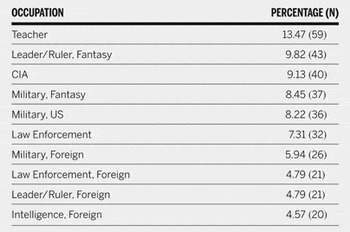
Various government occupations are portrayed through cinema. For instance, politicians include the president of the United States in The Day After Tomorrow and the leader of the galaxy in Star Wars Episode I: The Phantom Menace. Members of the armed forces are depicted through the US military's endeavors to save the planet in the War of the Worlds, foreign militaries, like those in The Passion of the Christ, and fantasy militaries in the Lord of the Rings: The Return of the King. Table 5 reports the top-10 occupations of government officials in the sample. Unexpectedly, an array of types of government characters were featured in the films, particularly schoolteachers. Given the prominence of films with plots focusing on thrilling chases and perplexing mysteries, it is understandable that a large number of military, law enforcement, and intelligence characters are found in these films given the popularity of action/adventure films.
Top Ten Occupations of Government Officials
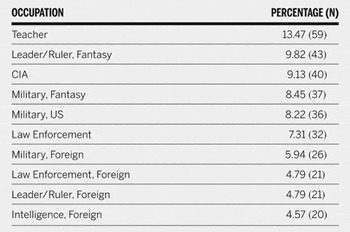
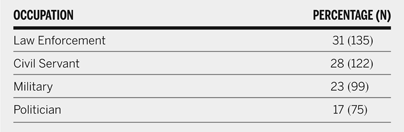
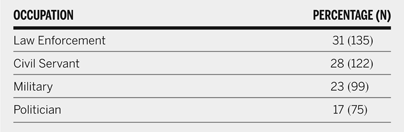
Because none of the occupations comprise a majority of the government officials, we consolidated the occupations into four categories: military, law enforcement, politician, and civil servant. Thirty-one percent—the largest group—of government officials come from law enforcement, such as police officers, federal law enforcement, and emergency rescue workers (this is further explained in table 6).
Occupations Consolidated into Four Categories
Portrayal of Government Officials in Contemporary American Cinema
As discussed, government officials were common in the 76 films in the sample. Most of those government officials, however, are minor or insignificant characters. They include, for example, the men and women who work for the CIA and chase Jason Bourne in The Bourne Ultimatum. They are also the British soldiers who pursue Captain Jack Sparrow in the Pirates of the Caribbean trilogy. These minor or insignificant characters account for 55% or 237 of the 431 government officials. Few government officials are protagonists (28%) in the films or antagonists (16%). Americans do not typically recognize the profound role of government in their lives as much of that role appears insignificant from the construction worker directing traffic during a highway building project to the faceless postal workers who ensure that mail is delivered. Moreover, much of the work of government is not the stuff of fantastic plots or nail-biting adventures, which is often the focus of films. Therefore, it was unsurprising that most government characters in films were minor characters.
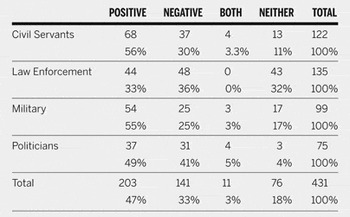
Although these governmental characters may not be the main protagonist or antagonist, many of the government officials who play a minor or insignificant role are still depicted either positively or negatively. Forty-seven percent of them have a positive depiction, 33% are depicted negatively, and 18% are neither with only 2% mixed depictions (see table 7).
Portrayal of Government Officials by Categories

As demonstrated in table 7, the depiction of civil servants is split. Of civil servants 56% are depicted positively with only 30% depicted negatively. This contradicts past research that suggests that Hollywood reinforces public's already poor opinion of government (Holzer and Slater Reference Holzer, Slater, Goodsell and Murray1995, 85). The difference here is that the focus is on the individual civil servants, and at this level, these characters seem to be portrayed in a positive light. For example, consider Abigail Chase in National Treasure: Book of Secrets who works for the Smithsonian and is portrayed as intelligent, dedicated, and even a capable treasure hunter.
Not surprisingly 54% of the military officials are depicted positively with only 25% negatively depicted. As previously discussed, existing research suggests that members of the armed forces fare well on the silver screen. Interestingly, 49% of politicians are depicted positively while 41% are depicted negatively. Queen Amidala, also known as Padma in Star Wars Episode I: The Phantom Menace, is a politician who is shown in a positive light. However, to do this, the queen is depicted as two people: a servant girl in disguise and also Queen Amidala. The servant girl, Padma, provides the positive depiction through her compassion and kindness toward young Skywalker, not Queen Amidala.
Finally, the portrayal of law enforcement provides an interesting representation because it is mixed. Of law enforcement characters, 36% are depicted negatively whereas 33% are depicted positively. This mixed depiction is consistent with past research on law enforcement in American film (cf. Powers, Rothman, and Rothman Reference Powers, Rothman and Rothman1996) because Americans have a complex relationship with law enforcement; police officers are needed and valued but not when they are finding fault with our actions. Mission Impossible II provides a scenario in which law enforcement agents for the same secret agency fight each other. The entire movie consists of law enforcement figures, and some of them try to end the world by unleashing a plague; other law enforcement characters must save the day.
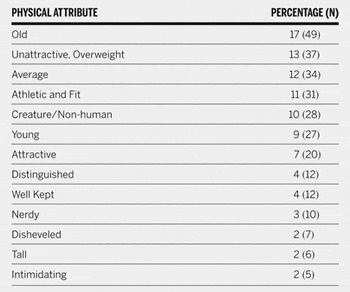
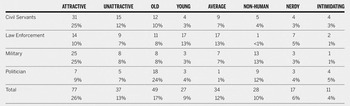
A better understanding of the government officials can be gained by exploring their physical descriptions and actions. Table 8 depicts the specific physical attributes used to describe the government officials.Footnote 19 Perhaps more interesting, table 9 shows the breakdown of the aforementioned physical attributes by broad categorization of government officials. First, out of the 122 civil servants depicted, 25% of them were depicted as attractive. For instance, Grace, a schoolteacher and also Bruce's inspiration in Bruce Almighty, fits this description. No other descriptor encapsulated more civil servants in this sample of movies. Considering that most civil servants are thought of as paper-pushing, bureaucratic automatons, it is surprising to find that civil servants in these films are physically attractive. More holistically, 28% of civil servants are young and attractive while 22% are old and unattractive. Perhaps what is most interesting with these data is that only 7% of civil servants are reportedly “average.” Given the earlier discussion of general perceptions of civil servants, this figure might be expected to be higher; yet, the attractive nature of these characters coincides with the general attractiveness of most film actors.Footnote 20 Even antagonists in film are often attractive.
Top Physical Attributes of Government Officials Portrayed

Character Physical Attributes According to Specific Government Role

Percentages calculated out of total group number; Civil Servants – 122, Law Enforcement – 135, Military – 99, Politicians – 75, Total – 292.Footnote 23
Similar depictions of law enforcement characters and members of the military were found. Out of the 135 law enforcement characters, 26% are depicted as young and average. This depiction is similar to the 28% of military officials who were portrayed in a similar manner. However, a quarter of all military officials were depicted as attractive as compared to 10% of law enforcement officials. A more attractive depiction of the military compared to law enforcement is consistent with past studies, as discussed earlier. Furthermore, most of our armed services are young with active duty members averaging ages in their late 20s.
Turning to the final category of government officials, politicians also had a mixed depiction. Of the physical attributes, the most common characteristic assigned to a politician was old (24%). This portrayal is not surprising considering, in the 112th Congress, the average age of a senator is 62 while the average age of a member of Congress is 56 (CQ Roll Call 2010). Moreover, popular sentiment thinks of the “old guys” in elected office. These findings are somewhat striking because many depictions of politicians, according to the literature, are “larger than life” and “over the top,” such as Harrison Ford's President Marshall in Air Force One. Then again, politicians often find themselves as simplistic characters in films, so the predominance of “old” as a descriptor is less surprising.
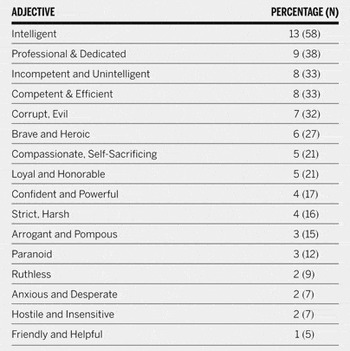
Just as physical attributes help explain how a viewer perceives a character, adjectives and descriptions of characters help viewers decipher a character's persona. Table 10 provides the adjectives most commonly used to describe characters and their actions.Footnote 21 This list represents only the most important characteristics of the character. For example, a character might be knowledgeable and dedicated; however, only the primary defining adjective is assigned to that character. For example, Assistant District Attorney Rachel Dawes from Batman Begins is an excellent example: she is knowledgeable and clever, but at the same time, she is also professional, dedicated, and inquisitive. Because the coder placed more emphasis on the dedicated characteristic, that is the label that is assigned to her.
Top Adjectives Used to Describe Government Officials

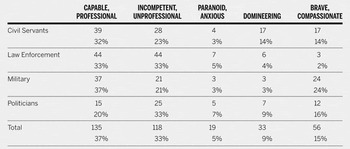
Given the array of films included in our sample, it was expected that more than a few adjectives would be needed to describe a majority of characters. However, it was surprising to find 58% of characters labeled intelligent as government and intelligence are not often two terms that are linked in society. Moreover, 38% of characters were described as professional and dedicated; the 33% of characters as incompetent and unintelligent was the expected description of government characters given the negative and cynical views of government that permeate American society. To get a better sense of the adjectives assigned to the characters, table 11 provides broad categories of the adjectives by type of government official.
Character Adjectives According to Specific Government Role

Percentages calculated out of total group number; Civil Servants – 122, Law Enforcement – 135, Military – 99, Politicians – 75, Total – 363Footnote 24.
The attributes assigned to the different government officials provide a picture of how individuals in government are portrayed. Instead of the expected “bureaucrat bashing,” 32% of 122 civil servants, were portrayed as capable professionals. For example, Dr. Grace Augustine in Avatar is a government scientist and her dedication and strength helped save the Na'vi clan. And an additional 14% are brave and compassionate. Only a quarter of civil servants were depicted as incompetent and unprofessional.
Law enforcement, however, provides a different picture. Of the 135 characters in this category, 33% are seen as capable professionals, and 33% are seen as incompetent professionals. This fascinating split in depictions is consistent with past research (cf. Rothman et al. Reference Rothman, Rothman and Powers1990). Also interesting is the lack of bravery and other heroic traits that might be expected with law enforcement officials: only 2% of the 122 law enforcement characters were found to be brave. Indeed, more civil servants (14%) and politicians (16%) were labeled brave, as compared to law enforcement. From these data readers may conclude that in these films, Hollywood's depiction of law enforcement officials is decidedly mixed; heroic, self-sacrificing police officers are far from the norm. For example, the police officers portrayed in Spider-Man and Spider-Man 2 are rescued by Peter Parker, (also known as Spiderman). One police officer even admits to a news crew that the police officers are unable to stop criminals, and they leave the job to protect and serve the public up to Spiderman.
Although law enforcement officials were not often described as brave, members of the armed services were brave. Out of the 99 military characters depicted, 24% were considered brave and 37% were classified as capable professionals. An example of the heroic action of the military is an unnamed solider in War of the Worlds who risks his life while in the feeding tank for the aliens to save the protagonist's (Tom Cruise) life. Generally, Americans are supportive of their men and women in the armed services, so a positive portrait of the military in film was expected, particularly in light of the renewed patriotism in a post-September 11 environment.
In terms of politicians, 33% of politicians were portrayed as incompetent; this percentage is both surprising and encouraging. Many would expect Hollywood to depict politicians with negativity considering the general sentiment in society about them (cf. Giglio Reference Giglio2007). For example, Vice President Becker in The Day After Tomorrow fits this depiction. He is shortsighted, stubborn, and cowardly. He realizes, too late, that he should have listened to his advisors regarding global warming, and the cost was thousands of people's lives. However, one might be surprised that this percentage is not higher given the cynicism that surrounds politicians. Indeed, 20% were portrayed as capable professionals with an additional 16% thought to be brave and compassionate.
DISCUSSION AND IMPLICATIONS
The data gathered from the 431 government officials in the 76 films in this study illuminate how recent American films portray government holistically and through individual characters. Generally, the films present a mixed view of government broadly; government, in these films, is good and inefficient, bad and competent. These conclusions might seem confusing, but they demonstrate the complexities associated with assessing government in the United States and they are in line with existing research on government's portrayal on the silver screen (cf. Pautz and Roselle Reference Pautz and Roselle2010). Although a mixed depiction of government generally exists, uncovering a more positive view of government officials as individual characters is interesting.
The individual government characters in these films range from teachers and military officials to spies and politicians. Law enforcement characters are the most common (31%) with civil servants a close second with 28%. With the exception of law enforcement characters, all other categories of government officials have a generally positive depiction. These findings are a bit striking because the overall portrayal of government is mixed and public opinion data in the United States on government is generally negative. Fifty-six percent of civil servants, 55% of military characters, and 49% of politicians are portrayed positively. Law enforcement characters are mixed with 33% portrayed positively and 36% depicted negatively. Although this research categorized the individual characters into four broad categories (civil servant, law enforcement, military, and politicians), in future studies it would be worthwhile to refine and expand these categories. For example, distinguishing between civil servants and the stereotypical bureaucrat would be helpful in drawing conclusions about the image of public administrators in film and whether they appear to be self-interested, rule-bound, and/or serving the public's interest. Now, it is difficult to ascertain why civil servants and military characters find themselves portrayed more positively than law enforcement officials; however, an explanation may lie in Americans' seemingly paradoxical view of government.
One may argue that this study may have found additional empirical support for the phenomenon Goodsell (Reference Goodsell2004) notes in his polemic on the civil service. Goodsell found that while the dominant view Americans hold of government is negative, their day-to-day interactions with government are often quite the opposite: Americans think negatively about government and its role in society; yet, the interactions Americans have with government officials—such as postal workers, public school teachers—are generally positive. In these films, the overall depictions of government are mixed and individual characters fare better than government as a whole thereby echoing Goodsell.
Questions invariably arise about the implications these depictions have on the perceptions of the movie-going public. Movie-watching Americans are exposed to a varying portrait of government in film. Holzer and Slater (Reference Holzer, Slater, Goodsell and Murray1995) find that negative images of government, including incompetence and inefficiency, in various narrative forms may “help undermine support for the public sector” (86). These insights raise questions as to whether film represents society's viewpoints or if film shapes society's perceptions. An extensive discussion of this relationship abounds (cf. Franklin Reference Franklin2006; Holzer and Slater Reference Holzer, Slater, Goodsell and Murray1995). Although it is beyond the scope of this project to assert one perspective on influence over the other, the findings do have implications for this conversation. Arguing the middle ground, that film both influences and reflects society's perceptions, may be appropriate. Films in this study have a mixed depiction of government while individual government characters fare better. Thus, moviegoers are exposed to a murky view of government, which does little to improve the view of government in the public's eyes.
Although taking the middle ground in the debate about influence, the implications of the mixed depiction of government cannot be ignored. In the United States and Canada,Footnote 22 68% of the population over the age of two watches movies, representing a 3% increase from the previous year, with the average movie watcher going to the theater six times a year (MPAA 2010). Children and young adults between the age of 12 and 17 attend the cinema on average more than seven times a year (MPAA 2010, 10). Additionally, the individuals who go to the cinema most often (at least once a month), are 18 to 39 years old. Therefore, these two groups of movie-goers are going to the cinema during a formidable time for political socialization. Accordingly, this group of citizens, who is likely gaining full-time employment, setting out on their own, and encountering the full panoply of government activities for the first time, is being bombarded with a mixed view of government at the movie theaters. What affect do these portrayals of government have on citizens? Some of those citizens are likely to be influenced, to some extent, by some of the films they watch (Heidelberg and Schultz Reference Heidelberg, Schultz, Dale and Foy2010, 61). Future projects might investigate the perceptions of cinemagoers and consider possible connections with age and other demographic characteristics.
Because government is typically not well regarded in the United States, Hollywood—at least in this study—is not helping improve the image of government (of course it is easily argued that this may not or should not be Hollywood's role either; Hollywood maintains its role is simply to entertain). However, one must be conscious of the influences on his or her political socialization and perceptions more broadly. From this limited sample, American moviegoers are being exposed to mixed images of government that might influence their political socialization and citizen engagement. However, at a minimum, this research should spark additional curiosity about the role of movies and other narrative forms, particularly television and its law enforcement shows, like Crime Scene Investigation, Law & Order, and 24, because Americans watch a considerable amount of television. These narrative forms perpetuate views about government and the directionality of that influence should be studied further. Moreover, additional research is needed to investigate these relationships, and more study should also be conducted regarding the influence of films on citizens' political engagement. Surveys might be used to determine various populations' exposure to films and what their perceptions about Hollywood's depictions might be. Additionally, this study only examines recent films, and a comparative study investigating different groups from different historical eras would also be illuminating. In the end, film is just one more influence on citizens' views of government. Additionally, a better understanding of the cinema-going audience might be useful to understand which segments of the population are exposed to these portrayals. Understanding how movies portray government continues to be important as citizens still flock to the cinema while often professing negative views of government.