Introduction
Amaranths (Amaranthaceae: Amaranthus spp.) are widely grown vegetable and grain crops in Africa, Asia, South America and Mexico (Ebert, Reference Ebert2014). Amaranths offer good drought resistance and relatively dense nutrition, which make them strong candidates for reducing malnutrition in sub-Saharan Africa (Achigan-Dako et al., Reference Achigan-Dako, Sogbohossou and Maundu2014). However, insect pests pose a significant constraint to production of amaranth crops in East Africa, where losses as high as 50% of grains and 100% of foliage have been reported recently, for example, in Kenya (Gathu, Reference Gathu2014; Kagali et al., Reference Kagali, Kioko, Osiemo, Muya and Wachera2013). A diverse complex of insect pests is associated with amaranths, but defoliating caterpillars and stem-boring weevils are considered the most damaging pests (Aderolu et al., Reference Aderolu, Omooloye and Okelana2013; Kagali et al., Reference Kagali, Kioko, Osiemo, Muya and Wachera2013). For instance, the four most abundant pests associated with amaranths in Nigeria include Spoladea (=Hymenia) recurvalis (Lepidoptera: Crambidae), Hypolixus truncatulus, Lixus truncatulus and Gastroclisus rhomboidalis (Coleoptera: Curculionidae) (Aderolu et al., Reference Aderolu, Omooloye and Okelana2013).
The development of pest management strategies for vegetable crops in East Africa is at an early stage in which information on pest species of economic importance is still being generated, as exemplified by two recent reports from Kenya (Gathu, Reference Gathu2014; Kagali et al., Reference Kagali, Kioko, Osiemo, Muya and Wachera2013). More work is needed to characterize amaranth pest complexes in other East African countries, including Tanzania, and additionally to develop appropriate integrated pest management (IPM) strategies, such as the use of pest-resistant varieties. Farmers rely on chemical pesticides to manage the pests on amaranth, but intensive pesticide use poses human and environmental health hazards (Kagali, Reference Kagali2014). For instance, it has been documented that among the leafy vegetables, amaranth can retain pesticide residues for more extended periods than other vegetables (Fan et al., Reference Fan, Zhang, Deng, Yu, Liu, Zhao and Pan2013). Hence, alternative pest management strategies are warranted to reduce the pesticide overuse or misuse in amaranth production systems. Thus, additional research is merited to identify or develop pest-resistant amaranth cultivars to increase yields while reducing pesticide reliance (Schoonhoven et al., Reference Schoonhoven, van Loon and Dicke2006).
The current study was carried out to identify significant lepidopteran and coleopteran pests that occur on amaranth in Tanzania and identify amaranth entries that are resistant to foliar feeding lepidopterans and stem-boring coleopterans.
Materials and methods
The study involved three preliminary and one advanced screening trials that were conducted in two locations Taiwan and Tanzania. Promising entries identified for resistance to insect pests in the three preliminary screening trials were evaluated in the advanced screening trial.
Source of amaranth entries
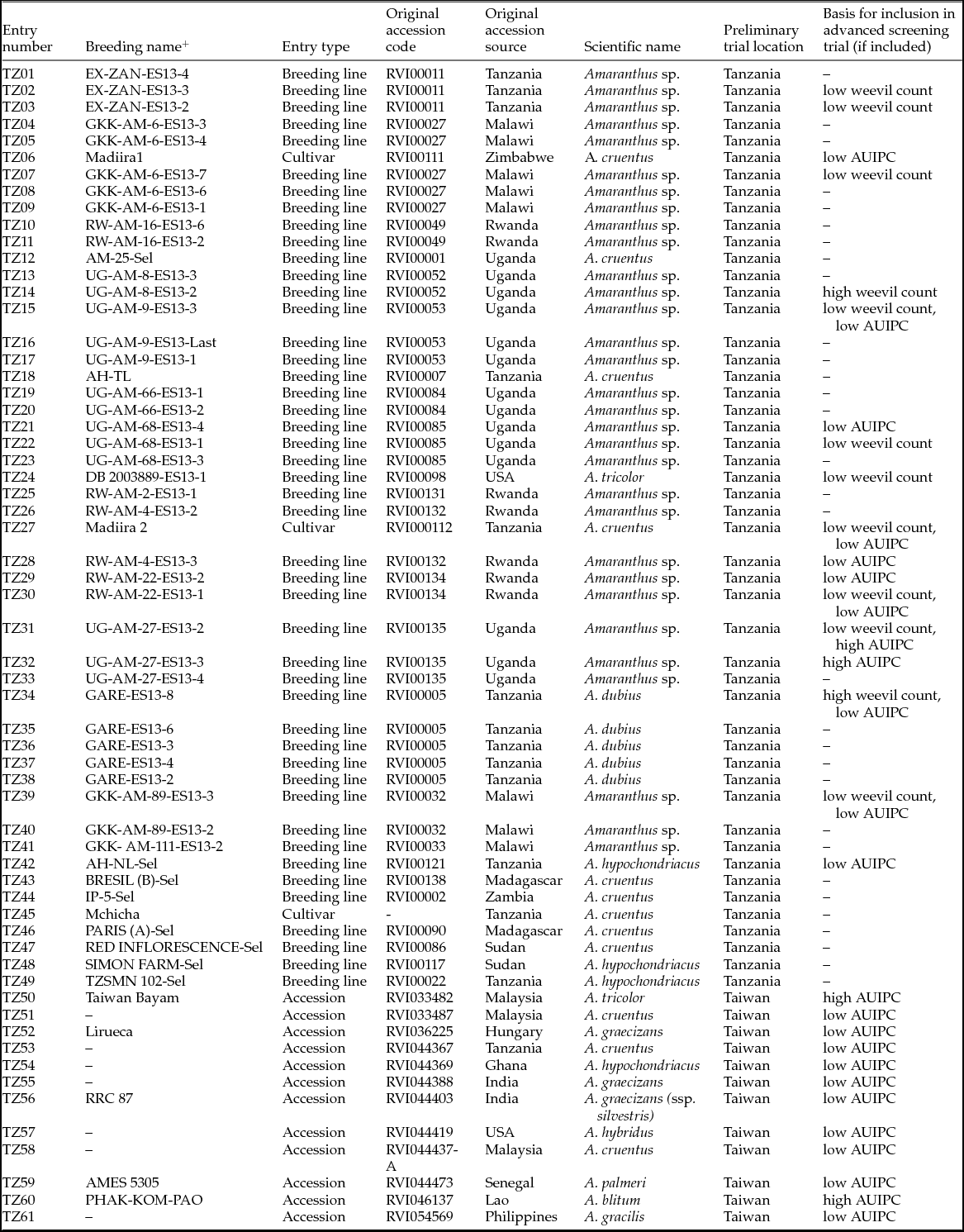
Entries of various amaranth species were obtained from the Genetic Resources and Seed Unit, World Vegetable Center (WorldVeg), Taiwan. Forty-nine breeding lines and commercial cultivars from WorldVeg, Eastern and Southern Africa, Arusha, Tanzania were also included. For purposes of this article, entries in the Taiwan trials are named after their World Vegetable Accession codes (beginning with ‘RVI’ or ‘VI’). However, entries in the Tanzania trials are assigned numbers beginning with ‘TZ’ because some accessions were represented by more than one breeding line (Table 1).
Amaranth entries evaluated in 2015 for resistance to defoliating and stem-boring insect pests in preliminary and advanced screening trials in Tanzania

+Breeding name reflects either the cultivar name or the breeding history of a line that has been developed from one of the accessions. For example, ‘EX-ZAN-ES13-n’ indicates a line that was developed by single plant selection from the original accession at the World Vegetable Centre, Eastern and Southern Africa, (Tanzania) in 2013. Contact authors for clarification of other lines.
Plant cultivation
Seedlings were raised in screenhouses in 70-cell plastic seedling trays filled with sterilized soil. Three-week-old seedlings were transplanted into field plots. The plots were furrow-irrigated either the day before transplanting or immediately after planting, and about once per week thereafter, depending upon rainfall.
Unsuccessful transplants were replaced with new transplants within one week. Excess seedlings were used to plant border plants around the perimeter of the experimental plots. The screening trials were managed following customary cultural practices, but without any pesticide application to control foliage-feeding caterpillars or other stem-boring insects. Throughout the trial, plants were exposed to natural infestation of insects.
Preliminary screening trials in Taiwan
Two preliminary screening trials were conducted in Shanhua, Taiwan (23° 07′ 04.8′′ N, 120° 17′ 42.9′′ E and 11 m asl altitude). A first trial with 121 entries was conducted from May to July 2014. A second trial evaluated 142 entries from October to December 2014. To accommodate the large number of entries, the preliminary screenings were conducted in unreplicated trials (Abang et al., Reference Abang, Srinivasan, Kekeunou, Hanna, Chagomoka, Chang and Bilong Bilong2014). Plants were spaced apart 40 cm within rows and 1 m between rows. For each entry, 10 plants were maintained. The plants were directly scored for foliage damage (percent leaf with S. recurvalis damage) at weekly intervals starting from four weeks after transplanting in the field. The plants of each entry were scored using the following rating scale: 0 = no damage; 1 = 0.1–10% damage; 2 = 10.1–20% damage; 3 = 20.1–30% damage; 4 = 30.1–40% damage and 5 = 40–100% damage.
Preliminary screening trial in Tanzania
The preliminary screening in Tanzania was conducted during the early dry and rainy seasons of 2015 (January to April) at the World Vegetable Center, Eastern and Southern Africa, Arusha, Tanzania (03° 22′ 32′′ S, 36° 48′ 23′′ E and 1290 m asl altitude). This trial involved 45 breeding lines and four commercial cultivars developed by single plant or mass selection from WorldVeg, Eastern and Southern Africa gene bank entries. Entries were planted January 29 and transplanted on February 16 in a simple lattice (two-replicate) arrangement generated with the statistical software R (v. 3.1.0) and the R package agricolae (v. 1.1) (de Mendiburu, Reference de Mendiburu2014; R Core Team, 2014). Plants were spaced 30 cm apart along ridges and 60 cm apart between ridges. Each plot consisted of 21 plants with seven plants per row (ridge). Spaces of one empty ridge or column were allowed between adjacent plots, and of two meters between lattice replicates. Plants were evaluated for leaf damage at four, six and eight weeks after sowing, and for weevil infestation (by dissecting entire plants) at 12–13 weeks after sowing.
The leaf damage assessments targeted seven plants in the middle row of each plot; adjacent rows were also sampled when middle rows offered fewer than seven healthy plants. For each plant, the total number of leaves and the number of insect-damaged leaves were recorded. Insect damage for this assessment was defined as removal of tissue at leaf margin or leaf interior, which is characteristic to insects with a chewing habit (such as webworm caterpillars); other damage symptoms (such as spontaneous leaf curling, breakage and insect-scraping) were ignored. Newly formed leaves less than 4 cm long were also omitted. Sampling was initiated when plants reached the 8-leaf stage (on average) and continued on a bi-weekly basis until all lines flowered. From each plot on each sampling date, a mean percent damage was calculated.
The stem weevil infestation was assayed after the flowering stage, once border plants evidenced late instar weevil larvae in their stems. Seven large, healthy plants were selected from each plot. Entire plants were excised at the base and then dissected: all stems, including the primary stem and the branches, were bisected to allow observation of weevil pupae, grubs or eggs. Weevil sampling was conducted in order of the plot number over a period of two weeks.
Advanced screening trial in Tanzania
The advanced screening trial was also conducted at the WorldVeg in Tanzania during the cool season (April–September) in 2015. In this trial, we screened 24 entries that incurred low insect damage in the preliminary trials, plus six entries with high insect damage for contrast. Together these represented 10 resistant and two highly susceptible entries from the preliminary Taiwan trials, plus 14 resistant and two susceptible entries from the preliminary Tanzania trial (Table 1). Entries from the Taiwan trials were selected according to foliar damage, whereas those from Tanzania were selected according to foliar damage or weevil infestation level.
The advanced trial was configured as a randomized complete block design with three replications. Plots comprised 24 plants in two adjacent rows running parallel to the irrigation ridges, with 60-cm spacing between rows and 30-cm spacing between plants within rows. Seeds were planted on April 29 and transplanted on May 22. Foliar damage and weevil infestations were assessed according to methods used in the preliminary trial in Tanzania with minor modifications. The assessment involved random selection of 10 plants per plot from the middle of each plot's two rows, assessing foliar damage at 6, 8, 12 and 14 weeks after sowing, and counting weevils, including larvae extracted from primary roots, since larvae inhabited both roots and shoots. Weevil infestation was determined by plant dissection at 19 and 20 weeks after sowing. Assessments were generally delayed in the advanced trial relative to the preliminary Tanzania trial because plants and insects developed slower during the colder conditions of the advanced screening trial.
Data analysis
To compare insect damage levels between entries within each trial, we calculated a season-long foliar damage index—area under the insect pressure curve (AUIPC)—for each plot using a formula modified from Shaner and Finney (Reference Shaner and Finney1977):
 $$\begin{equation*}
\sum\nolimits_{i = 1}^{n - 1} {\frac{{\left( {{Y_i} + {Y_{i + 1}}} \right)}}{2}\left( {{t_{i + 1}} - {t_i}} \right)}
\end{equation*}$$
n: number of assessment times
Y: leaf damage level at time t
Y was assigned a value of zero at the time of transplanting, because seedlings were initially protected from weevils and caterpillars in the screenhouses. At subsequent time points, Y was equivalent to either the damage score (for Taiwan trials) or the percent of leaves with damage (for Tanzania trials). In trials with multiple plots per entry, mean AUIPC values were calculated for each entry.
AUIPC values were then subjected to a statistical analysis to categorize entries according to their degree of insect damage (AVRDC, 1979). For each trial, we determined the mean (M) AUIPC and its standard deviation (SD). Mean and SD were used to define trial-specific thresholds for determining resistance: entries with AUIPC less than M-2SD were classified as highly resistant; between M-1SD and M-2SD as resistant; between M and M-1SD as moderately resistant; between M and M+1SD as moderately susceptible; between M+1SD and M+2SD as susceptible; and more than M+2SD as highly susceptible.
Since weevil data were collected once during the growing season, it was unnecessary to calculate season-wide AUIPC indices for these data. Rather, average number of weevils (eggs, larvae or pupae) per plant was used in place of AUIPC values in determining the resistance level of each entry to stem weevils.
Insect pest identification
Caterpillars observed on amaranth during foliar damage assessments were hand-collected and reared to adulthood on amaranth leaves in plastic cups for identification using morphological characteristics.
Weevils seen mating or feeding on amaranth during foliar damage assessments were hand-collected. Additionally, pupae collected from amaranth stems were stored in Petri dishes and allowed to emerge and then were preserved in 70% ethanol until identification. Voucher weevil specimens were deposited at the Canadian Museum of Natural History.
Results
Preliminary screening trials in Taiwan and Tanzania
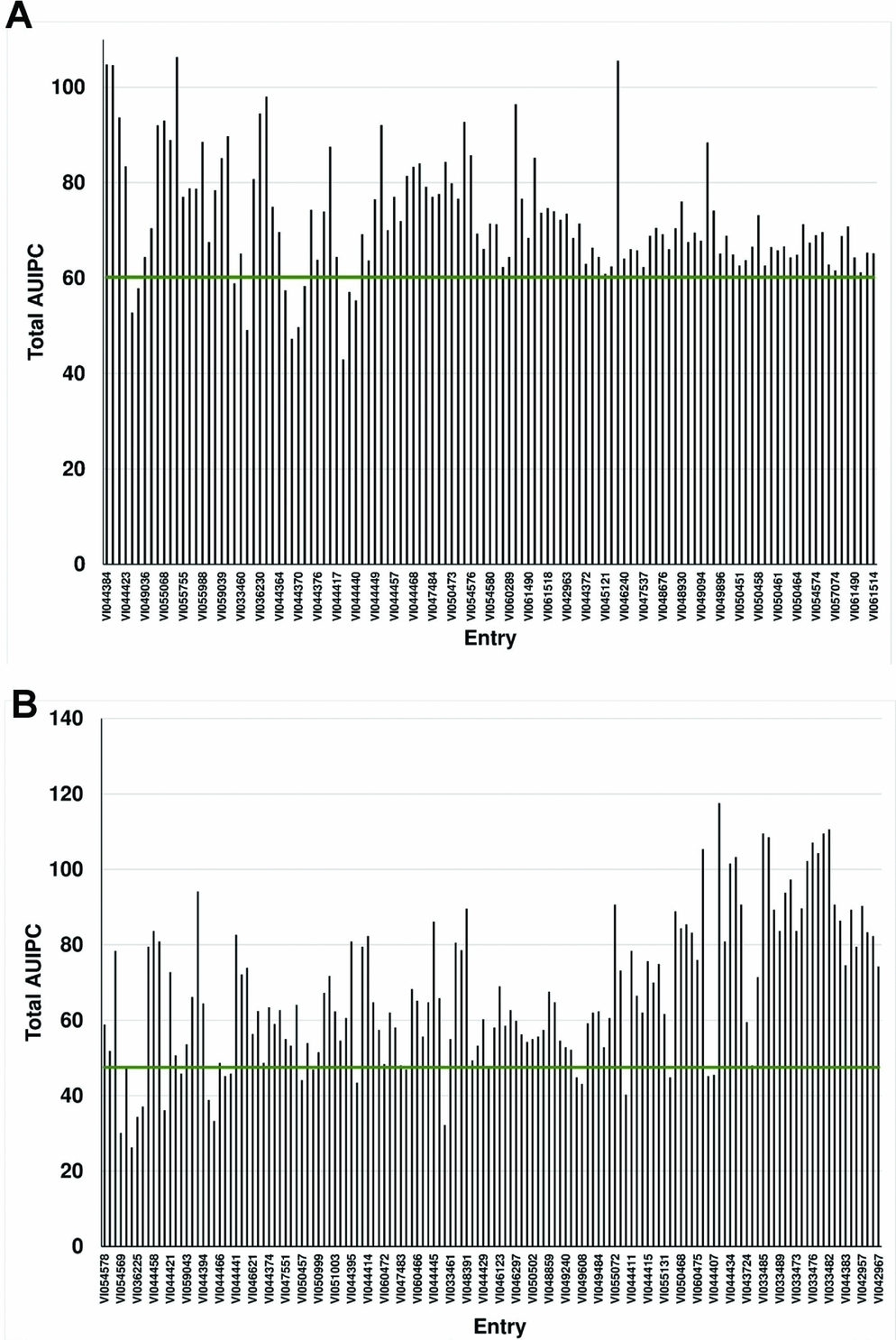
In the first preliminary screening trial in Taiwan, experiment-wide AUIPC averaged 72.41 ± 12.23 (SD). Out of the 121 entries screened in this trial, only two entries (VI044437 and VI044367) were rated as highly resistant to S. recurvalis infestation. However, based on the threshold value of 60.18 (shown in green line in Fig. 1A), nine entries were rated as resistant, and 60 other entries as moderately resistant. In the subsequent preliminary screening in Taiwan, experiment-wide AUIPC averaged 67.04 ± 19.51. Among the 142 entries, only one entry (VI044403) was rated as highly resistant. Based on the threshold value of 47.53 (shown in green line in Fig. 1B), 20 entries were rated as resistant, while 60 other entries as moderately resistant. Of the 29 resistant entries from both trials, 10 least-damaged varieties were selected for advanced screening in Tanzania. These included the three highly resistant entries and seven of the least-damaged resistant entries (VI033487, VI054569, VI036225, VI044369, VI044473, VI044388 and VI044419), all of which had AUIPC values much lower than the threshold lines in Fig. 1.
Preliminary amaranth screening trials in Taiwan. Two common garden experiments (A and B) compared foliar damage from insect pests in a combined total of 263 Amaranth entries, each represented by one replicate (plot) per entry. Data are summarized as a season-long index of insect foliar damage called Area Under Insect Pressure Curve (AUIPC, explained in Methods). AUIPC values less than the horizontal line (a threshold defined by experiment-wide mean minus one standard deviation) indicate insect resistance. Due to the large number of entries, not all entry numbers are labelled.

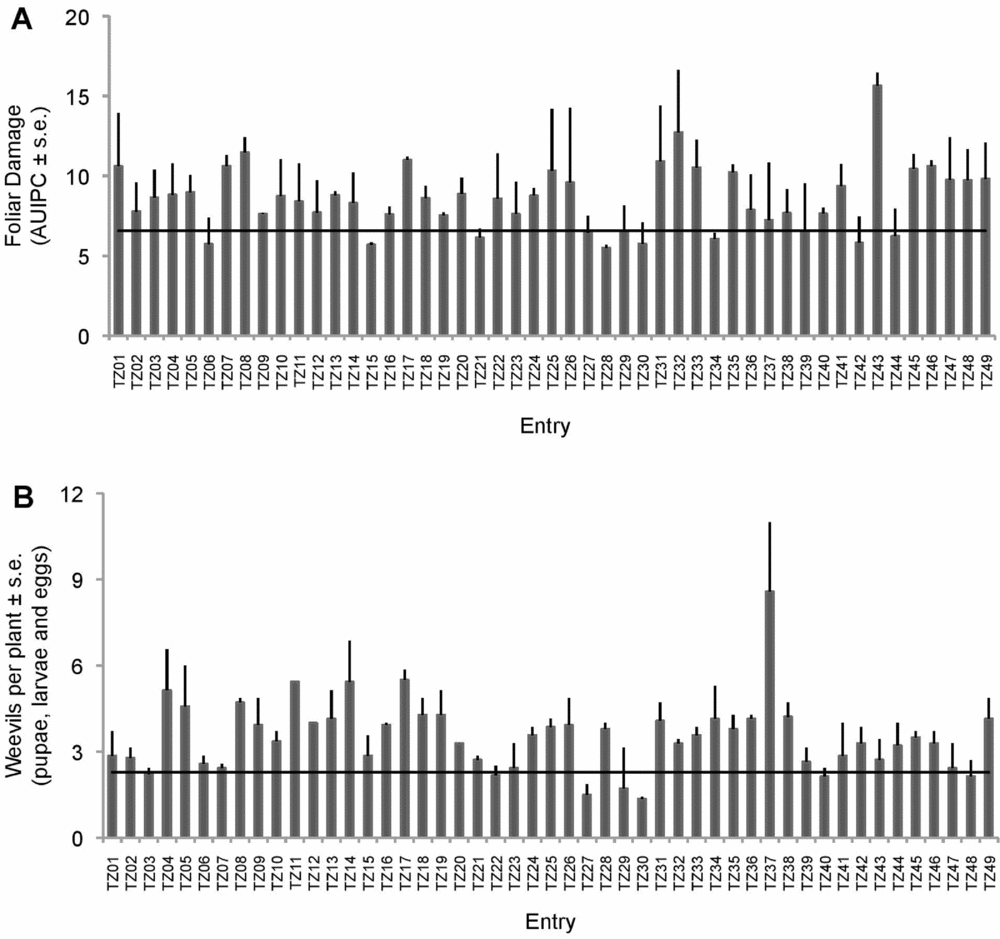
In the preliminary screening trial in Tanzania, the average AUIPC from all entries was 8.60 ± 2.10 (Fig. 2A and B). This value is substantially smaller than the mean AUIPC values from Taiwan, because Tanzanian damage scores were not transposed from percentage values (between 0 and 1) into a 1–5 number scale, as was done for Taiwan data. On average, plants were infested with three to four (3.50 ± 1.20) weevil individuals (sum of eggs, grubs and pupae). Out of the 49 entries in this trial, four were classified as resistant to both foliar pests (based on AUIPC) and stem weevils: entries TZ15, TZ27, TZ30, TZ39. Additionally, six entries were resistant only to foliar pests: TZ06, TZ21, TZ28, TZ29, TZ32 and TZ42, and five were resistant to stem weevils but not foliar pests: TZ02, TZ03, TZ07, TZ22, TZ24.
Preliminary amaranth screening trials in Tanzania. Foliar insect damage (A) and stem weevil infestation (B) were monitored in 49 amaranth entries (described in Table 1) in a common garden experiment with two replicates (plots) per entry. Data are summarized here as a season-long index of insect foliar damage called Area Under Insect Pressure Curve (AUIPC, explained in Methods). AUIPC values less than the horizontal line (a threshold defined by experiment-wide mean minus one standard deviation) indicate insect resistance.

Advanced screening trial in Tanzania
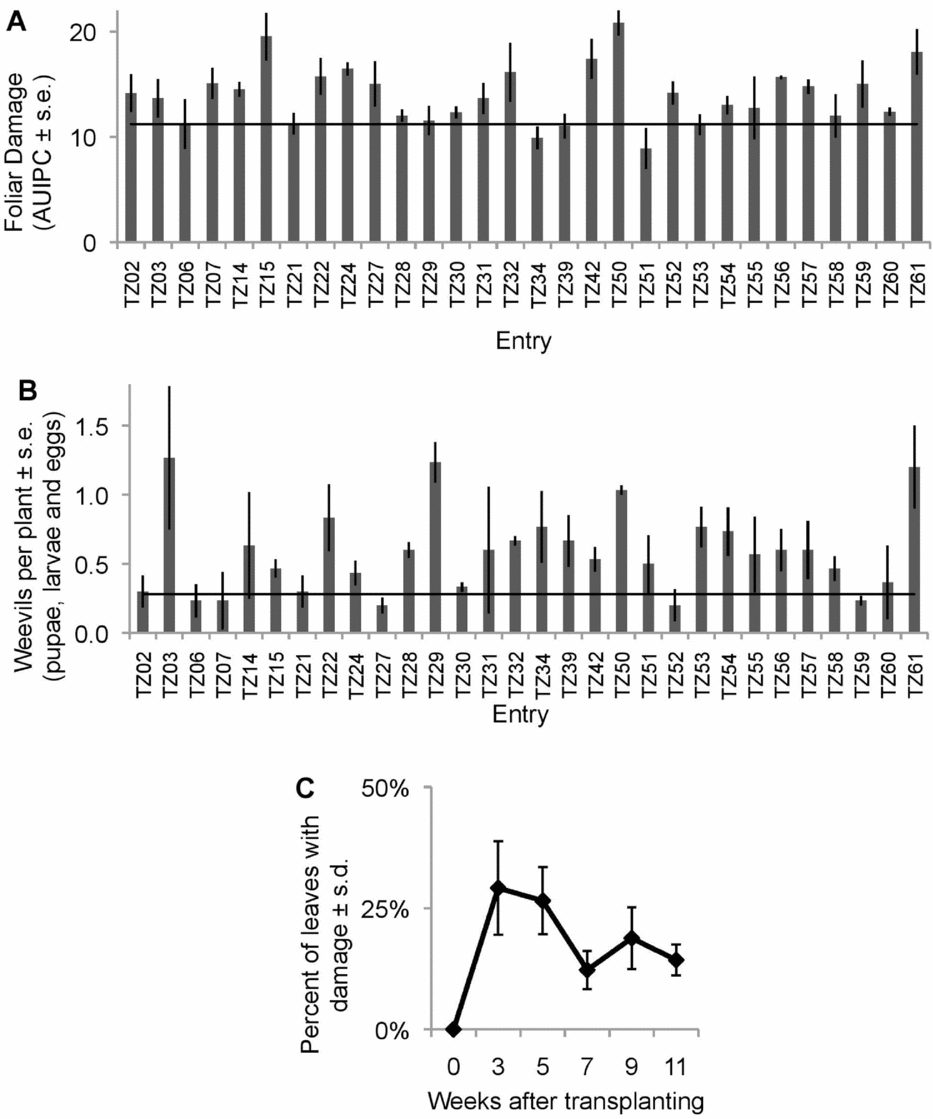
The experiment-wide AUIPC mean for foliar damage was 14.0 ± 2.8 (Fig. 3A). Experiment-wide pressure from foliar herbivores peaked three weeks after transplanting but subsequently declined (Fig. 3B). The M-1SD resistance threshold was 11.2, as indicated by the horizontal line in Fig. 3A. Only four entries—TZ34, TZ39, TZ51 and TZ53—produced AUIPC values lower than the M-1SD threshold, indicating their resistance to defoliators. Entries TZ6 (the commercial cultivar ‘Madiira 1’) and TZ21 were notably equal to the M-1SD threshold and are promising entries. Mean AUIPC for the susceptible control entries TZ31, TZ32, TZ50 and TZ60 was 15.80 ± 3.70. Among these, only entry TZ50 exceeded the M+1SD threshold of susceptibility (AUIPC>16.80), although some other entries that had appeared resistant in the preliminary trials also exceeded the susceptibility threshold, including TZ42, TZ61 and TZ15, the latter being included in this trial for potential weevil resistance.
Advanced amaranth screening trial in Tanzania. Foliar insect damage (A) and stem weevil infestation (B) were monitored in 30 amaranth entries (described in Table 1) in a common garden experiment with three replicates (plots) per entry. Entries included resistant lines plus a few susceptible lines from the preliminary trials in Taiwan and Tanzania (Fig. 1 and 3). Data are summarized as Area Under Insect Pressure Curve (AUIPC, explained in Methods). AUIPC values less than the horizontal line (a threshold defined by experiment-wide mean minus one standard deviation) indicate insect resistance. (C) The season-long foliar insect pressure curve averaged across all entries.

On average the weevil infestation level in this advanced trial ranged from zero to one (mean = 0.60 ± 0.30) pupae, larvae and eggs per plant (Fig. 3C). Mean values for five entries—TZ6, TZ7, TZ27, TZ52 and TZ59—fell below the M-1SD threshold of 0.30 weevils/plant, suggesting resistance in these entries (Fig. 3C). The average infestation for the susceptible control entries TZ14 and TZ34 was higher than the threshold as expected (0.70 ± 0.10), but they ranked as moderately susceptible rather than susceptible as in the preliminary trial. By contrast, four entries in the advanced trial (TZ3, TZ29, TZ50 and TZ61) had infestations greater than the M+1SD threshold of 0.90 weevils per plant.
Insect pest identification
Weevil grubs and pupae collected from amaranth stems during preliminary and advanced screening trials in Tanzania were identified as Hypolixus pr. haerens Boheman (Fig. 4A and B), Gasteroclisus sp. pr. rhomboidalis Boheman (Fig. 4C and D), Neocleonus sannio Herbst (Fig. 4E and F) and an unknown species in the subfamily Baridinae (Fig. 4G and H).
Amaranth weevils. (A and B) Neocleonus sannio. (C and D) Hypolixus pr. haeren. (E and F) Gasteroclisus pr. rhomboidalis. (G and H). Unknown species, subfamily Baridinae. Weevils were collected as larvae and adults from amaranths in Tanzania.

Caterpillars collected from the crop were reared to adulthood and identified as Spodoptera exigua (Noctuidae; Fig. 5A), Spodoptera littoralis (Noctuidae; Fig. 5B) and S. recurvalis (Crambidae; Fig. 5C).
Amaranth defoliators. (A) Spodoptera exigua. (B) Spodoptera littoralis. (C). Spoladea recurvalis. Moths were reared from caterpillars feeding on amaranths in Tanzania.

Discussion
Insect-resistant amaranth lines
The findings of this study reveal variation in insect resistance among Amaranthus entries of various species that breeders could use in breeding programmes to develop resistant cultivars. We identified several entries that exhibited clear resistance to the local complex of foliar pests and stem weevils. The top seven entries with low AUIPC scores in the advanced screening trial were Amaranthus cruentus (TZ06, TZ51 and TZ53), A. dubius (TZ34), and unknown Amaranthus spp. (TZ12 and TZ39). In contrast, a recent study from Edo state in Nigeria reports that A. cruentus suffered more insect pest attack than A. hybridus (Ogedegbe and Ezeh, Reference Ogedegbe and Ezeh2015), which suggests that intraspecies variation may be more critical than interspecies variation in determining insect damage susceptibility. Contrary to the foliar damage outcome, weevil infestations were lowest in two lines of A. cruentus (TZ06 and TZ27), one line of A. graecizans (TZ52), one line of A. palmeri (TZ59) and one unidentified Amaranthus sp. (TZ07). The diversity of species represented further suggests that insect resistance does not depend upon species, and instead depends on the nutritional and defensive qualities of specific genotypes.
The commercial cultivar ‘Madiira 1’ (TZ06) is notable because, in addition to showing good weevil resistance, it exhibited an AUIPC that was equivalent to the resistance threshold. The cultivar is popular for vegetable consumption by Tanzanian growers, especially in the Arusha region (JD Smith, personal communication). It stands as an excellent option to recommend to growers in appropriate climates. By contrast to entry TZ06, entry TZ50 proved susceptible to both stem weevils and foliar pests and may be experimentally useful as an all-around susceptible entry.
The nature of resistance in these low-damage lines merits further research because our assay was designed to detect overall insect resistance under natural pest conditions without necessarily indicating the mechanisms of resistance. Indeed, multiple mechanisms could underlie our findings. Because adult moths, weevils, and their natural enemies were at liberty to choose among plants, our data reflect the combined effects of Amaranth entry on herbivore behaviour (e.g., oviposition choice), on herbivore feeding success, and on natural enemy activity. These effects may arise from a number of plant traits that were unquantified in this study, including developmental phenology, colour, surface chemistry, volatile profile, mechanical properties of the leaves or the mix of chemical stimulants and deterrents within the plant. Presence or absence of stimulants is likely to feature in the stem weevil behaviour since these insects specialize in feeding on amaranths. By contrast, chemical deterrents could be expected to play a larger role in the behaviour of S. recurvalis, S. littoralis and S. exigua, since these insects are generalist feeders and do not forage exclusively for Amaranthus spp. (for alternate hosts see: Brown and Dewhurst, Reference Brown and Dewhurst1975; Greenburg et al., Reference Greenberg, Sappington, Legaspi, Liu and Sétamou2001; Hsu and Srinivasan, Reference Hsu and Srinivasan2012).
Understanding the nature of resistance through future studies will help breeders predict which entries will continue to exhibit resistance under greater pest pressure levels. In general, antixenosis (pest repellency) is less effective than antibiosis (toxicity or anti-nutrition) at preventing damage under conditions in which herbivores have little choice – for example, in monoculture Amaranth fields or when herbivore crowding forces non-selective foraging (Schoonhoven et al. Reference Schoonhoven, van Loon and Dicke2006). Consequently, antixenotic effects are less context-dependent. Context-dependent resistance might explain why some lines appeared resistant in Taiwan but not Tanzania, although it is difficult to compare pest pressure between trials since AUIPC values are affected by season length. Alternatively, one could also explain these differences by random variation in the preliminary trials in Taiwan, which were not replicated (due to the large number of entries), whereas the advanced screening trial in Tanzania accounted for randomness through greater replication. Consequently, we recommend the resistant varieties identified through the advanced trial for use in breeding and further studies on mechanisms of resistance, with those varieties exhibiting antibiosis being the most preferred for breeding.
Insect pests of amaranth in Tanzania
Prior to this study, amaranth stem weevils have been reported elsewhere in sub-Saharan Africa: in Nigeria G. rhomboidalis, H. truncatulus and L. truncatulus (Aderolu et al., Reference Aderolu, Omooloye and Okelana2013; Eluwa, Reference Eluwa1977); in South Africa H. haerens (Boheman), Gasteroclisus cf cuneiformis (Fahraeus), N. sannio (Herbst), Baris cf dodonis, Baris cf amaranthi, Baris sp., and Hypurus sp. (Louw et al., Reference Louw, Van Eeden and Weeks1995); and in Kenya Hypolixus nubilosis and Hypolixus sp. (Kagali et al., Reference Kagali, Kioko, Osiemo, Muya and Wachera2013; Mureithi et al., Reference Mureithi, Mworia, Meyhoefer, Murungi, Losenge, Akutse, Ekesi, Fiaboe and Tielkes2015). To this list our study adds a unique assemblage of weevils on amaranths in Tanzania: H. pr. haerens, G. pr. rhomboidalis, and N. sannio, as well as the unidentified Baridine sp.
On average, plants in the Tanzanian preliminary screening trial had six times more weevil individuals than plants in the advanced screening trial. The higher number suggests that the season of planting may have a significant impact on the intensity of weevil pressure, although differences in entries may have also contributed to the difference between seasons. Stem weevils cause economic losses in grain amaranths as well as vegetable cultivars grown for seed production by making plants more susceptible to lodging and to secondary fungal infections (some of which are introduced by the weevils themselves, such as pathogenic Fusarium spp. that use weevils as vectors). (Blodgett et al., Reference Blodgett, Swart and Louw1998; Reference Blodgett, Swart and Louw2004; Louw et al., Reference Louw, Swart, Honiball and Chen2002). Further work is needed to establish quantitative year-long seasonal weevil dynamics that may be exploited in an integrated pest management strategy.
Unlike the weevil damage, foliar damage from defoliators was similar between preliminary and advanced screening trials in Tanzania. We did not identify minor lepidopteran pests, but focused on those commonly observed during damage sampling: S. recurvalis, S. exigua and S. littoralis. The lepidopteran pests we found have also been noted elsewhere in sub-Saharan Africa, including Nigeria and Kenya, where S. recurvalis and Spodoptera spp. are known to affect amaranths (Kagali et al., Reference Kagali, Kioko, Osiemo, Muya and Wachera2013; Mureithi et al., Reference Mureithi, Mworia, Meyhoefer, Murungi, Losenge, Akutse, Ekesi, Fiaboe and Tielkes2015). Amaranthus spp. are considered as suitable hosts for S. exigua (Greenberg et al., Reference Greenberg, Sappington, Legaspi, Liu and Sétamou2001; Showler, Reference Showler2001) and adequate hosts for S. littoralis as well (Brown and Dewhurst, Reference Brown and Dewhurst1975). A notable absence in our pest complex is the stem-boring lepidopteran pest, Herpetogramma bipunctalis, which was reported as a major pest of amaranths in neighbouring Kenya (Kagali et al., Reference Kagali, Kioko, Osiemo, Muya and Wachera2013). The absence of the stem-boring lepidopteran pest suggests that pest complexes within the Amaranthus genus can vary widely by season or region.
More research is required on the year-long demographics of the defoliators. During both trials in Tanzania S. recurvalis was the most common adult moth to be noticed among the amaranths, which may be due to its day-active habit and recognizable wing pattern. Spodoptera exigua was the most common caterpillar in the preliminary screening trial, whereas we observed a combination of S. recurvalis, S. exigua and S. littoralis larvae in the advanced trial. The percentage of foliar damage peaked at three weeks after transplanting while plants were still small. The decline in damage scores after that probably reflects the exponential increase in leaf number that occurs as plants grow and mature, as well as possibly the reduced attractiveness of mature leaves relative to immature leaves. These results indicate that plants are at highest risk of defoliation shortly after transplanting. Consequently, IPM programmes should be designed to protect this stage of the plants in particular.
Acknowledgements
We would like to thank members of the World Vegetable Center, Eastern and Southern Africa for their assistance, including Director Thomas Dubois who offered input regarding the experimental design, and Farm Manager Omary Mwambo and Research Assistants Raphael Mallogo and Hamis Wambura who provided technical assistance throughout the field experiment. J.D.S. acknowledges the United States Institute of International Education for funding through the Fulbright Program. Additionally, we recognize the Federal Ministry for Economic Cooperation and Development (BMZ), Germany for grant 13.1432.7-001.00, which partially funded this project.