Introduction
Sunflower achenes (single-seeded fruits) are usually dormant at harvest and germinate poorly (Cseresnyes, Reference Cseresnyes1979; Corbineau et al., Reference Corbineau, Bagniol and Côme1990) over a wide range of incubation temperatures. Depending on the genotype and maternal environment (Benech-Arnold, Reference Benech-Arnold, Benech-Arnold and Sánchez2004; Bodrone et al., Reference Bodrone, Rodríguez, Arisnabarreta and Batlla2017), this initial primary dormant state can persist for several weeks or months (Brunick, Reference Brunick2007) and is a problem to the seed industry which needs non-dormant seeds to be processed and commercialized (Maiti et al., Reference Maiti, Vidyasagar, Shahapur, Ghosh and Seiler2006), particularly for counter-season markets.
According to the classification proposed by Baskin and Baskin (Reference Baskin and Baskin2004), sunflower achenes display non-deep, physiological dormancy, which can result from the embryo being dormant itself (‘embryo dormancy’) and/or from ‘coat-imposed dormancy’ (Finch-Savage and Leubner-Metzger, Reference Finch-Savage and Leubner-Metzger2006). The latter is the inhibition of germination by the structures that surround the embryo (i.e. the fruit ‘envelopes’), which include the single-layered endosperm, the seed coat (which is dead at maturity) and the pericarp (Seiler, Reference Seiler and Schneiter1997; Szemruch et al., Reference Szemruch, Renteria, Moreira, Cantamutto, Ferrari and Rondanini2014). At harvest maturity, the sunflower embryo usually presents low or intermediate levels of dormancy, whereas the achene is deeply dormant as a result of strong ‘envelope-imposed’ dormancy. Even after embryo dormancy has vanished, it may take between a few weeks and several months of dry storage for envelope-imposed dormancy to disappear completely (Corbineau et al., Reference Corbineau, Bagniol and Côme1990; Bianco et al., Reference Bianco, Garello and Le Page-Degivry1994; Domínguez et al., Reference Domínguez, Batlla, Rodríguez, Windauer, Gerbaldo and Benech-Arnold2016; Bodrone et al., Reference Bodrone, Rodríguez, Arisnabarreta and Batlla2017).
Primary dormancy of freshly harvested seeds is reduced during dry storage and this results in the widening of the temperature range for germination and also in changes in sensitivity to hormones (Bewley, Reference Bewley1997). The rate at which primary dormancy is alleviated during dry storage is controlled by temperature in many different species (Probert, Reference Probert and Fenner2000), including sunflower (Bazin et al., Reference Bazin, Batlla, Dussert, El-Maarouf-Bouteau and Bailly2011a,Reference Bazin, Langlade, Vincourt, Arribat, Balzergue, El-Maarouf Bouteau and Baillyb). Typically, warmer storage temperatures accelerate dormancy release of many species during this after-ripening (AR) period (Baskin and Baskin, Reference Baskin and Baskin1976, Reference Baskin and Baskin1986; Foley, Reference Foley1994; Allen et al., Reference Allen, Meyer and Beckstead1995; Bauer et al., Reference Bauer, Meyer and Allen1998; Steadman et al., Reference Steadman, Bignell and Ellery2003a, Reference Steadman, Crawford and Gallagherb; Chantre et al., Reference Chantre, Sabbatini and Orioli2009), although this response can be affected by seed moisture content (MC) (Bazin et al., Reference Bazin, Batlla, Dussert, El-Maarouf-Bouteau and Bailly2011a; Basbouss-Serhal et al., Reference Basbouss-Serhal, Leymarie and Bailly2016). Seed MC changes according to air relative humidity and seed properties (Ellis et al., Reference Ellis, Hong and Roberts1995). The fact that many studies investigating the effect of temperature during dry AR did not consider precisely achene water content may be the cause of some substantial differences found in the literature for sunflower. For example, Cseresnyes (Reference Cseresnyes1979) reported that storage for a short period at 0°C reduced dormancy levels compared with ambient temperature, and Seiler (Reference Seiler1998) observed that storage at 4°C partially reduced the level of dormancy of wild sunflower (Helianthus annuus) achenes compared with storage at 20°C. However, other authors observed only minor reductions of dormancy at low temperatures (Seiler, Reference Seiler1998), or no effect at all. Brunick (Reference Brunick2007) evaluated several sunflower genotypes and observed no changes in the rate of achene dormancy release after short-term storage treatments at −20, 20 and 50°C. In addition to the diversity of temperatures used in these studies, interactions between storage temperature and seed MC may also contribute to influence dormancy alleviation during dry storage, as observed for Ambrosia trifida seeds (Davis, Reference Davis1930). More recently, Bazin et al (Reference Bazin, Batlla, Dussert, El-Maarouf-Bouteau and Bailly2011a) explored this interaction in sunflower, and tested the effect of various combinations of temperature (between 15 and 30°C) and MC values on alleviation of embryo dormancy during dry AR. These authors reported a positive response to temperature for seeds with MC ≥ 0.1 g water per gram of dry weight [g water (g DW)–1] and a negative response to temperature for seeds with MC ≤ 0.05 g water (g DW)–1. Nevertheless, this study did not include achenes stored with a MC close to 0.06–0.08 g water (g DW)–1, which is typically reached after achenes equilibrate with a relative humidity of 50–60% when in contact with ambient air and temperature (Ellis et al., Reference Ellis, Hong and Roberts1995). It is with this MC that most sunflower achenes after-ripen in the seed industry. In addition, Bazin et al. (Reference Bazin, Batlla, Dussert, El-Maarouf-Bouteau and Bailly2011a) focused on embryo dormancy, and results may not apply to intact achenes in which other structures (i.e. the envelopes) contribute to dormancy and become particularly relevant after embryo dormancy is gone (Corbineau et al., Reference Corbineau, Bagniol and Côme1990; Bodrone et al., Reference Bodrone, Rodríguez, Arisnabarreta and Batlla2017).
Whatever the nature of the changes occurring in the seed during dry AR [discussed by Basbouss-Serhal et al. (Reference Basbouss-Serhal, Leymarie and Bailly2016) and Chahtane et al. (Reference Chahtane, Kim and Lopez-Molina2017)], they have a strong impact on hormone-related events upon imbibition that will define if the seed germinates or remains dormant. Studies with Arabidopsis and barley show that imbibed, dormant (freshly harvested) and non-dormant (AR) seeds exhibit differences in abscisic acid (ABA) metabolism and ABA signalling (Bewley, Reference Bewley1997; Ali-Rachedi et al., Reference Ali-Rachedi, Bouinot, Wagner, Bonnet, Sotta, Grappin and Jullien2004; Cadman et al., Reference Cadman, Toorop, Hilhorst and Finch-Savage2006; Benech-Arnold et al., Reference Benech-Arnold, Gualano, Leymarie, Côme and Corbineau2006; Barrero et al., Reference Barrero, Talbot, White, Jacobsen and Gubler2009; Yazdanpanah et al., Reference Yazdanpanah, Hanson, Hilhorst and Bentsink2017). Embryo dormancy in developing sunflower embryos involves in situ ABA synthesis by the embryo axis, and this ABA synthesis capacity is lost after dry storage (Le Page-Degivry et al., Reference Le Page-Degivry, Bianco, Barthe, Garello and Lang1996). These authors also showed that the inhibitory effect of applied ABA on germination of sunflower embryos progressively declines together with dormancy release during dry storage (Le Page-Degivry et al., Reference Le Page-Degivry, Bianco, Barthe, Garello and Lang1996). Therefore, any variations in the persistence of dormancy resulting from storage of sunflower achenes at different temperatures can be expected to involve changes in ABA metabolism and/or sensitivity to ABA that are manifested in the imbibed fruit, although other hormonal pathways might also play a role. Germination of dormant sunflower achenes can also be promoted by addition of gibberellins (GA) and ethylene (Corbineau et al., Reference Corbineau, Xia, Bailly and El-Maarouf-Bouteau2014). Le Page-Degivry et al. (Reference Le Page-Degivry, Bianco, Barthe, Garello and Lang1996) observed that responsiveness of dormant embryos to applied GA increased after treatments that reduced embryo dormancy such as drying, washing in shaking water or after long periods of dry storage. Ethylene stimulated germination of immature, dormant sunflower embryos, while chemical inhibition of ethylene biosynthesis or perception inhibited germination of non-dormant embryos (Corbineau et al., Reference Corbineau, Bagniol and Côme1990). This effect of ethylene might involve attenuation of the ABA signalling pathway and reduction of ABA levels, as occurs in Arabidopsis thaliana seeds (Finkelstein et al., Reference Finkelstein, Reeves, Ariizumi and Steber2008).
Consistent information is still lacking on the potential effects of temperature during dry storage on dormancy release of intact sunflower achenes. It remains unclear whether the effect of storage temperature is mediated through changes in embryo dormancy and/or envelope-imposed dormancy, and changes in hormone metabolism and/or sensitivity. In this context, the objectives of this paper were:
(1) To assess the effect of two contrasting storage temperatures on the pattern of dormancy release in sunflower achenes, using two commercial genotypes, and a moisture content of 0.06–0.07 g water (g DW)–1.
(2) To determine if the observed effect is related to changes in the contribution of any of the different structures (pericarp, seed coat and embryo) to achene dormancy.
(3) To investigate if the observed effect of storage temperature involves changes in ABA and GA pathways (sensitivity and metabolism), and/or changes in embryonic ABA content during dry storage.
Materials and methods
Plant material and storage treatments
Achenes from two sunflower genotypes were used to study the effect of storage temperature on dormancy release. Genotype ‘A’ is a commercial hybrid grown for oil production. Hybrid achenes were harvested from field experiments sown on three contrasting dates: early spring (22 September), mid-spring (22 October) and late spring (2 December), with four field plots on each date (for growth conditions and experimental details, see Bodrone et al., Reference Bodrone, Rodríguez, Arisnabarreta and Batlla2017). Additionally, achenes of this same hybrid were obtained from a commercial hybrid seed production field plot (sowing date unknown, probably October) and used in the experiment shown in Fig. 2B. The hybrid achenes were obtained by crossing two sunflower inbred lines following the same practices as in the process of commercial hybrid seed production. Plants heads were harvested manually when grain moisture content was lower than 11% [fresh weight (FW) basis] and threshed manually. Each head was divided concentrically into three regions and only grains from the second third were used in the experiments. These were dried at 40°C under constant air flow (between 6–10 h) until grain moisture of ca 0.06 g water (g DW)–1 was reached (% MC on a FW basis was monitored during drying with a hygrometer; final MC was determined gravimetrically and expressed on a DW basis). All the experimental and commercial plots with genotype ‘A’ were located in Fontezuela, Buenos Aires, Argentina (33° 53′ S, 60° 27′ W). Genotype ‘B’ is an inbred line widely used as a female for the production of commercial hybrids. These achenes were produced in Luján de Cuyo, Mendoza, Argentina (33° 01′ S, 68° 52′ W; sown in November) by Dow Agrosciences, and were sent to the Facultad de Agronomía de la Universidad de Buenos Aires (FAUBA) 34 days after harvest. Upon arrival at the laboratory at FAUBA, MC was determined by weighing samples before and after drying for 48 h at 80°C. Moisture content of achenes determined in this way at the beginning of storage was 0.062 ± 0.0024 g water (g DW)–1. Storage treatments began within a few days thereafter.
Fruit samples from both genotypes ‘A’ and ‘B’ were stored inside mesh nylon bags in chambers with controlled temperature set at 5 and 25°C, and in contact with ambient air humidity. Although the initial MC of achenes was 0.06 g water (g DW)–1, this value reached 0.07 g water (g DW)–1 after storage began, as expected to occur for sunflower achenes when equilibrated with an average relative humidity of the air around 50–60% (Ellis et al., Reference Ellis, Hong and Roberts1995).
Monitoring of dormancy during dry storage through germination assays
Before storage began, and then at regular intervals during storage, subsamples of both genotypes were used to perform germination trials at 11 and 25°C with achenes, seeds and/or embryos (incubation conditions are described below). We chose these temperatures for testing germination (and inferring dormancy) because: (i) they are included within the thermal range that allows germination for non-dormant sunflower achenes (approximately between 5 and 40°C) as reported by Corbineau et al. (Reference Corbineau, Bagniol and Côme1990) and Khalifa et al. (Reference Khalifa, Schneiter and Eltayeb2000); (ii) depending on the level of dormancy displayed by the seed lots or treatments being compared, differences in dormancy are detected best when incubating either at low (11–12°C) or high (25°C) incubation temperature. Both sunflower genotypes used in this study display type 2 response to temperature (dormancy is expressed more strongly at lower incubation temperatures) as defined by Baskin and Baskin (Reference Baskin and Baskin2004); therefore, dormant achenes are expected to germinate at 25°C but not at 12°C; as dormancy is released germination will increase and eventually reach a maximum value at both temperatures.
Achene, seed and embryo response to hormones after storage at 5 and 25°C
Responsiveness of achenes/seeds/embryos from genotype ‘A’ to exogenous ABA, GA and ethylene was tested on fruit samples obtained from the mid-spring sowing date (same as in Fig. 1A) and stored dry at 5 and 25°C for 60 days for ABA and GA tests (Figs 3 and 4) and 80 days for ethylene tests (Fig. 5). For genotype ‘B’ the effect of ABA and GA on germination of achenes and seeds was tested on samples from a single seed lot, at different time intervals during storage at 5 and 25°C (44, 138 and 273 days for ABA assays in Fig. 3, and 29 days for GA assays shown in Fig. 4).
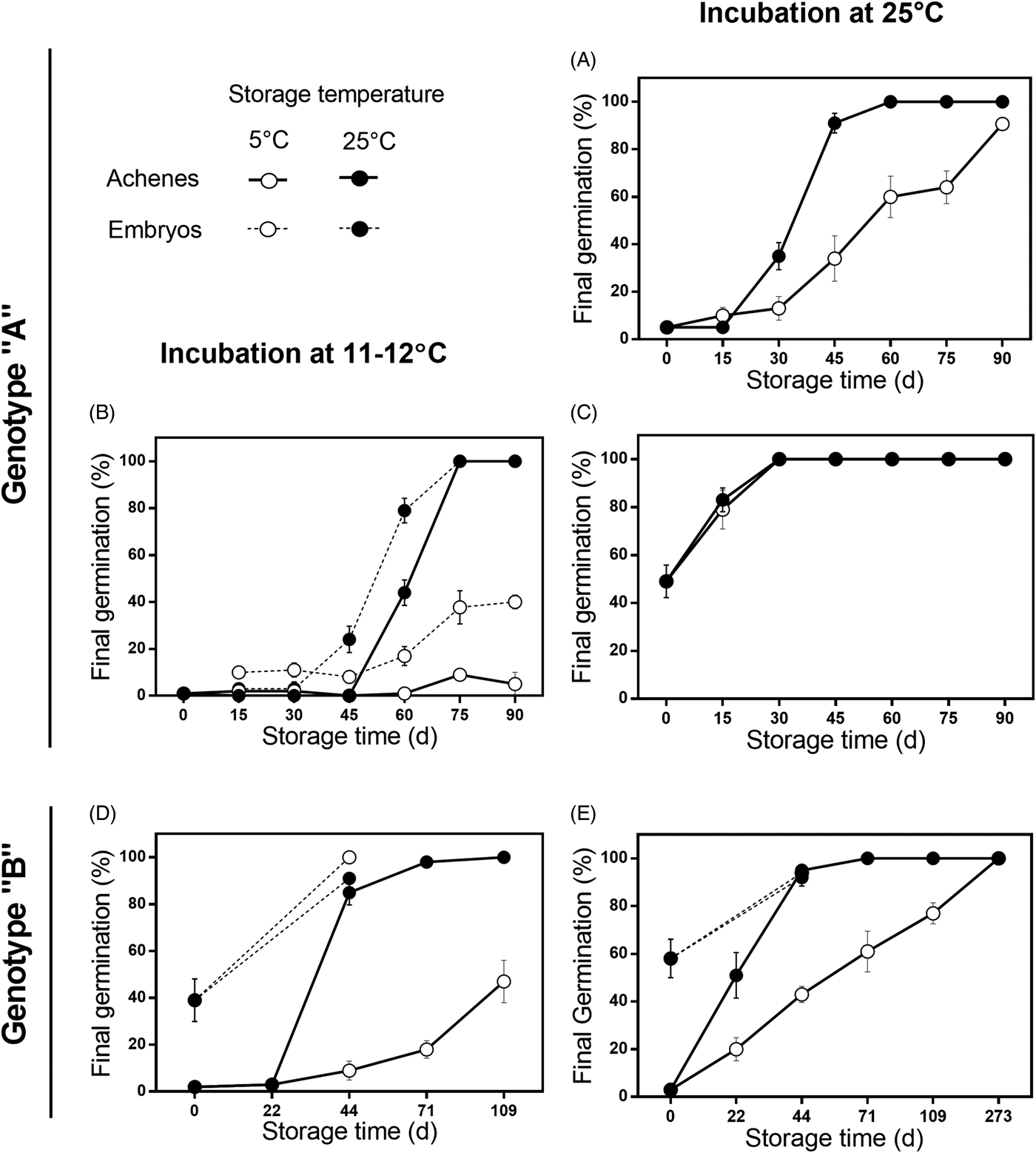
Final germination percentage of achenes (closed symbols) and isolated embryos (open symbols) of two sunflower genotypes, ‘A’ (A–C) and ‘B’ (D,E) after different storage periods at 5°C (triangles) or 25°C (circles). For genotype ‘A’, hybrid achenes were harvested from two field experiments: (A) sown in mid-spring, and (B,C) sown during late spring. Storage began immediately after drying for genotype ‘A’ or 34 days after harvest for genotype ‘B’. After different storage times, germination of achenes and embryos was tested in water at 25°C (A,C,E) for 14 days, and 11°C (B) or 12°C (D) for 20 days. Each data point is the mean of four biological repetitions (field plots for ‘A’), and pseudo-replicates (subsamples for ‘B’). Error bars represent standard error of mean.

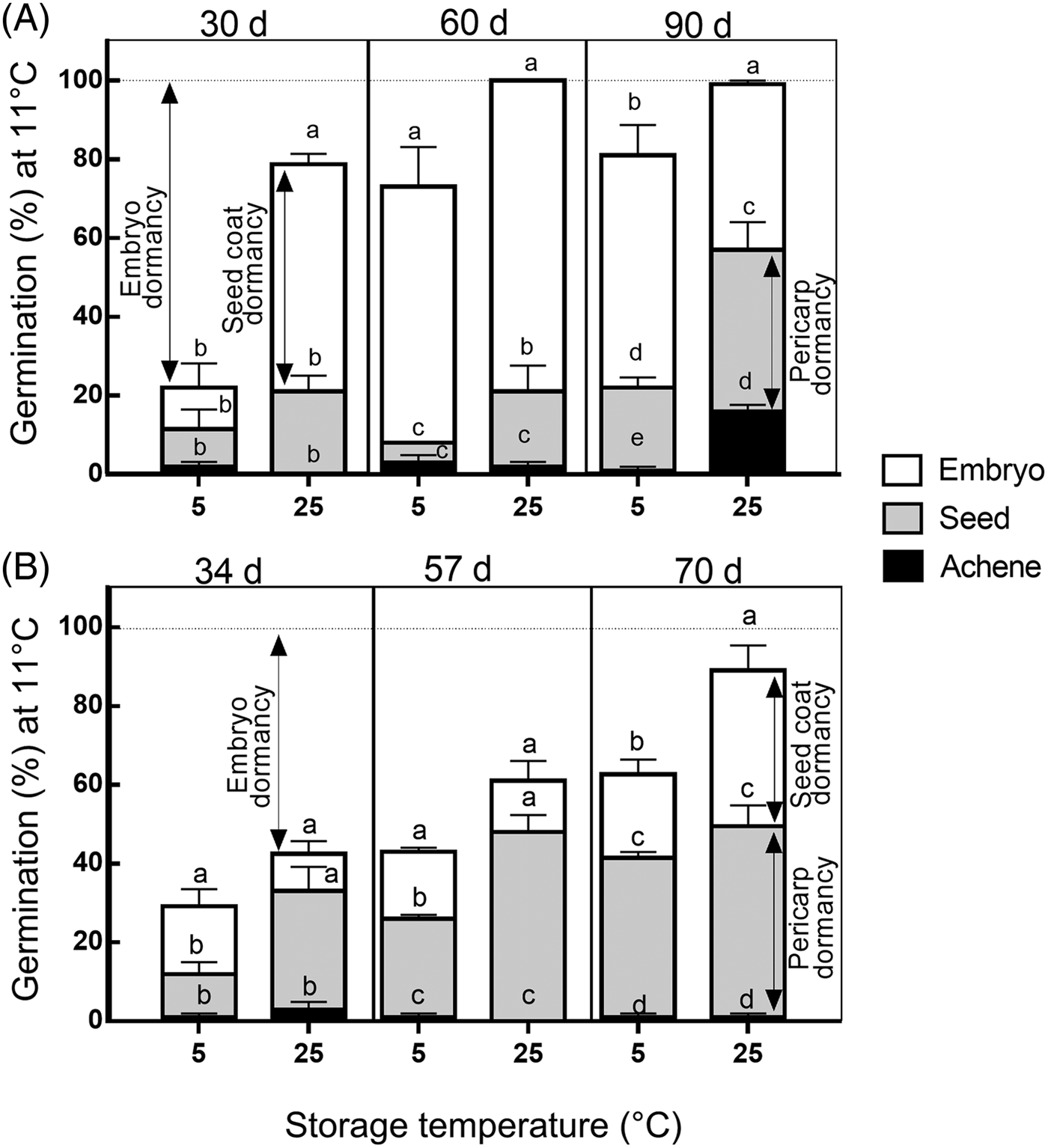
Final germination percentage of achenes, seeds and embryos from genotype ‘A’. Hybrid achenes were obtained from two different field trials: (A) experimental plots sown during mid-spring (same as in Fig. 1A), and (B) a production field. Achenes were stored dry [MC between 0.06 and 0.07 g water (g DW)–1] at 5 and 25°C and germination tests were conducted at 11°C after three different storage times (30, 60 and 90 days in A, and 34, 57 and 70 days in B). Each data point is the mean of four biological repetitions (field plots for data in A) or four pseudo-replicates (subsamples of a single seed lot, shown in B). Within each column, the contribution of the pericarp and the seed coat to dormancy is shown by the increase in germination after removal of each structure, and embryo dormancy by the absence of germination of isolated embryos (as indicated by double-headed arrows). Error bars represent standard error of mean. Analysis in A and B was performed applying generalized linear mixed models; multiple comparisons within each storage time (indicated by the numbers above each panel), with different letters indicating significant difference (P < 0.05).

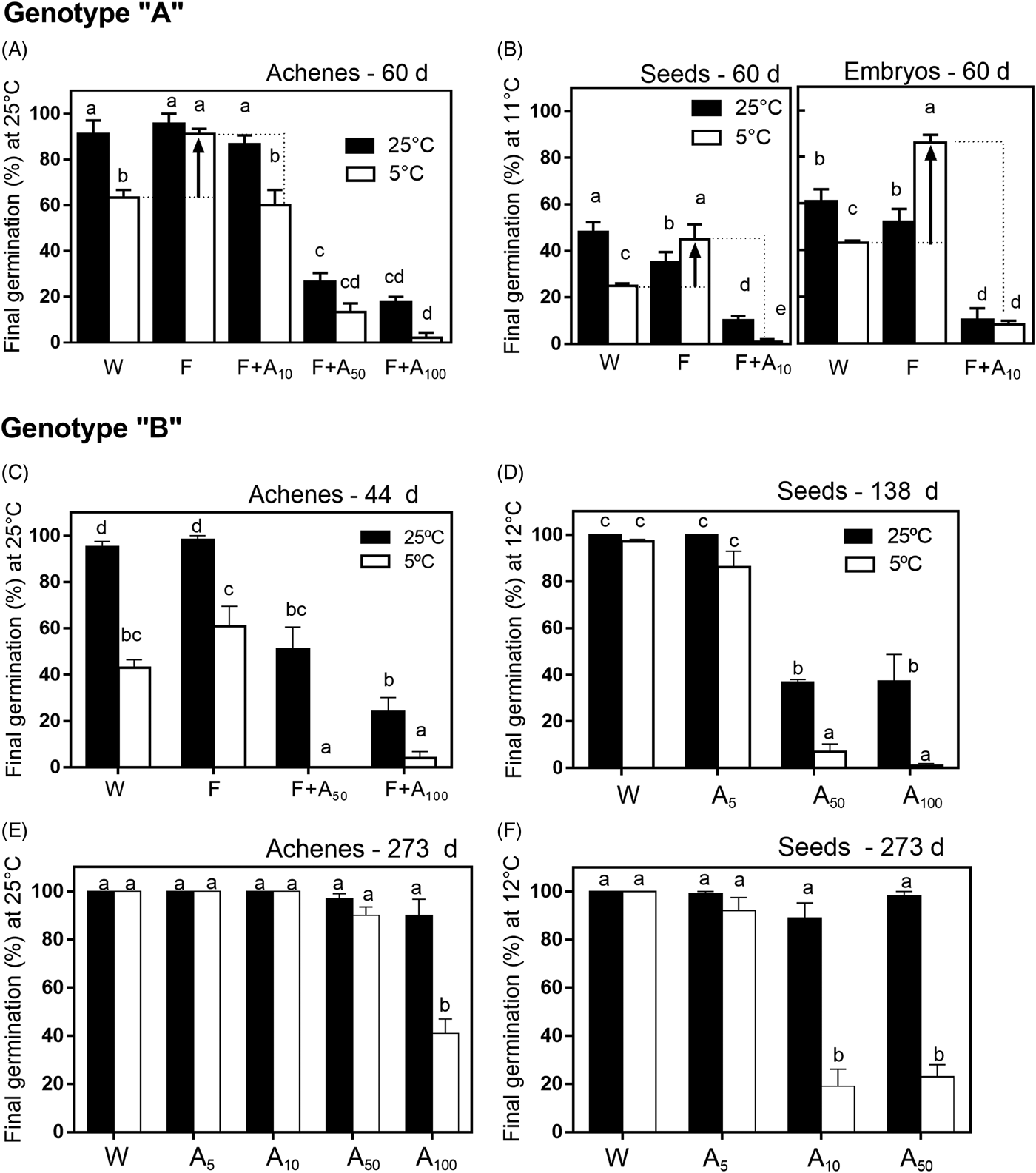
Final germination percentage obtained for achenes, seeds and embryos incubated in different combinations of water (W), 100 µM Fluridone (F) and 5, 10, 50 or 100 µM ABA (A5, A 10, A 50, A 100) for two sunflower genotypes: ‘A’ (commercial hybrid, panels A,B; sown in mid-spring, same as in Fig. 1A), and ‘B’ (inbred line; panels C–F) after storage at 5°C (white bars) and 25°C (black bars). Fruit structure (achene, seed, embryo) and storage time (days) is indicated above each panel. Storage began immediately after drying for genotype ‘A’ or 34 days after harvest for genotype ‘B’. Germination was tested at 25°C or 11–12°C depending on the dormancy level and structure. Each data point is the mean of four biological repetitions (field plots for ‘A’), and pseudo-replicates (subsamples for ‘B’). Error bars represent standard error of the mean. Different letters indicate significant differences between means (P < 0.05). Analysis in panels A and C–F was performed using ANOVA and Tukey's post hoc test for mean separation. Analysis in panel B was performed applying generalized linear mixed models.

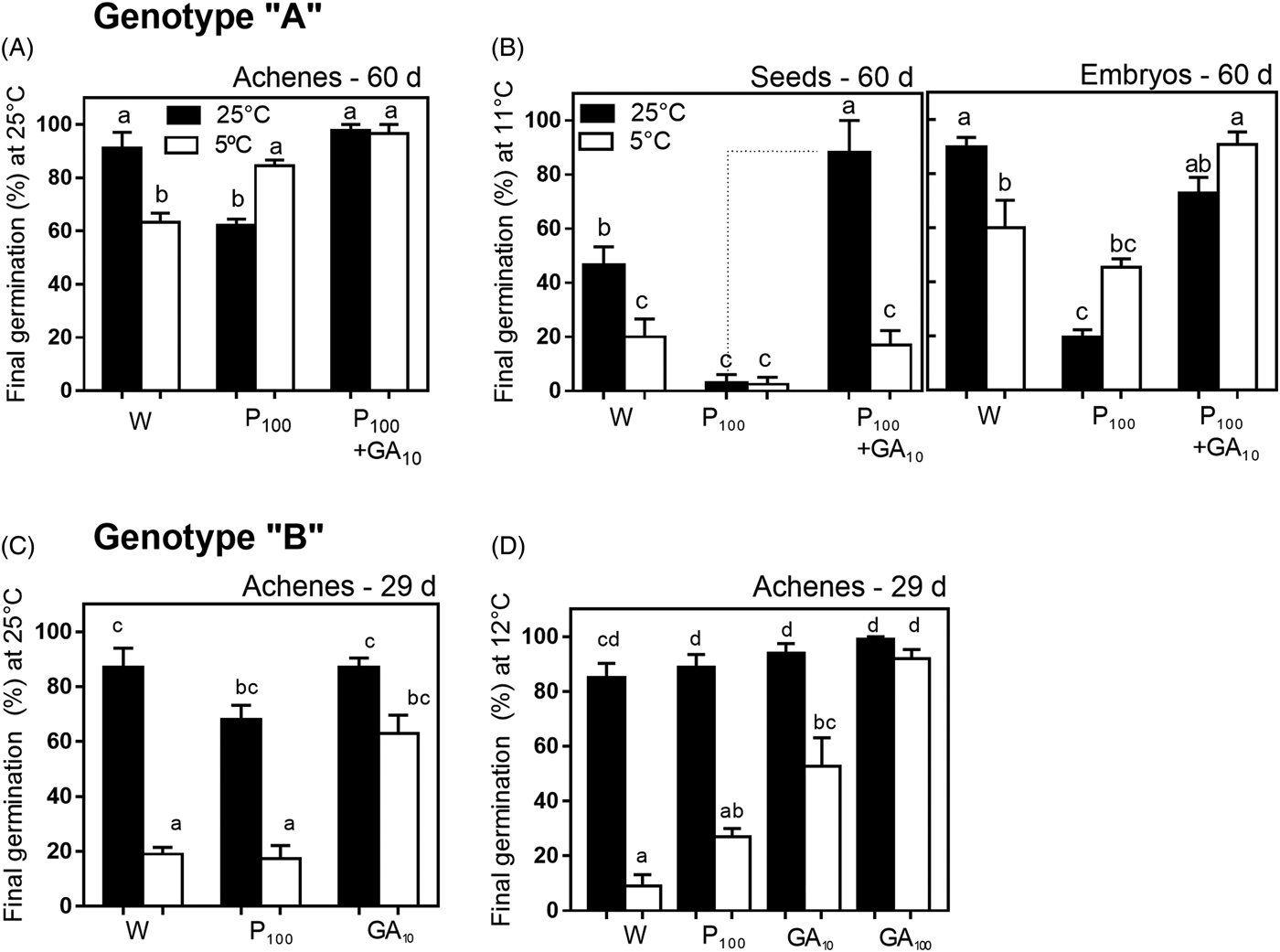
Final germination percentage obtained for achenes and embryos incubated in water (W), 100 µM paclobutrazol (P100), or 100 µM paclobutrazol + 10uM GA3 (P100+GA10) for two sunflower genotypes: ‘A’ (hybrid; sown in mid-spring, same as in Fig. 1A) and ‘B’ (inbred line). Storage at 5 and 25°C began immediately after harvest for genotype ‘A’ (60 days), while storage (29 days) in genotype ‘B’ began 34 days after harvest. Germination was tested at 25 or 11°C depending on the dormancy level and structure. Each data point is the mean of four biological repetitions (field plots for ‘A’), and pseudo-replicates (subsamples for ‘B’). Error bars represent standard error of the mean. Different letters indicate significant differences between means (P < 0.05) (ANOVA, Tukey's post hoc test for mean separation).

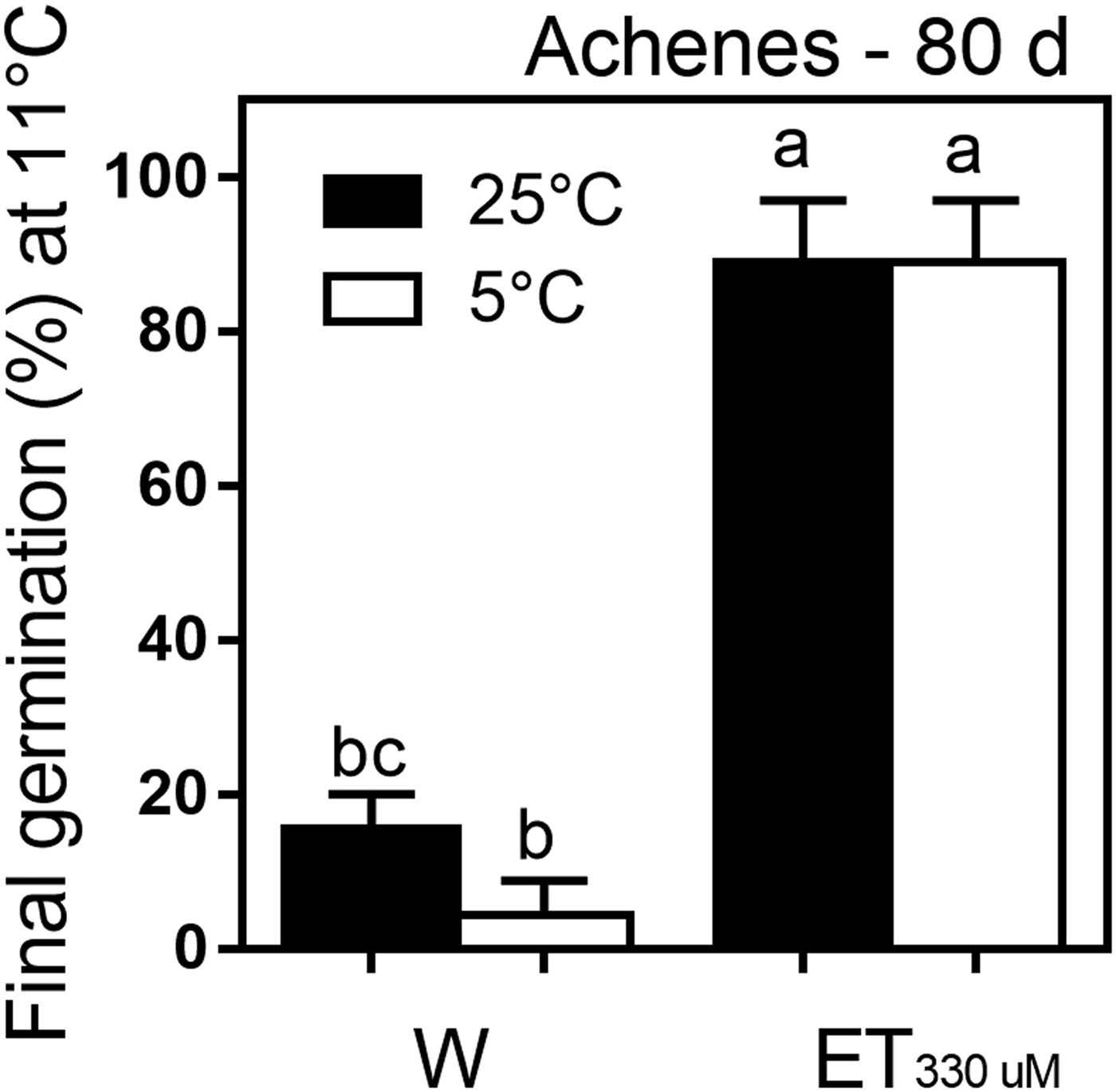
Final germination percentage obtained for achenes incubated at 11°C in water, or in 300 µM ethephon aqueous solution. Achenes from genotype ‘A’ (hybrid) had been stored dry at 5°C (white bars) and 25°C (black bars) for 80 days, and were obtained from experimental plots sown in mid-spring (same as in Fig. 1A). Error bars represent standard error of the mean (n = 4). Different letters indicate significant differences (P < 0.05).

Incubation conditions (growth regulators and manipulation of achene structures)
In each germination trial, four replicates of 25 achenes (intact achenes), seeds (without pericarp) and/or naked embryos (without seed coat and endospermic layer) were placed in 9 cm diameter plastic Petri dishes on two discs of filter paper moistened with 5 ml of distilled water, different concentrations of abscisic acid (±ABA, Sigma-Aldrich), gibberellic acid (GA3, Sigma-Aldrich) and Ethephon (Ethrel® 48 SL, Bayer; 48% ethephon) and/or ABA and GA synthesis inhibitors (Fluridone and Paclobutrazol, both by Pestanal®, Sigma-Aldrich), and incubated at 25 or 11°C for a period of 14 or 20 days, respectively. Petri dishes were sealed with plastic film to reduce evaporation during incubation, and water was added whenever necessary. In treatments where the pericarp was removed, this was done manually and avoiding damage to the embryo. To obtain isolated embryos, seeds (without the pericarp) were moistened for 2 h on filter paper (one disc of paper plus 3 ml of distilled water in a Petri dish) to facilitate separation of the seed coat together with the endospermic layer (hereafter referred to as ‘seed coat + E’) from the embryo. Achenes were considered as germinated when the radicle was visible outside the envelopes, while embryos and seeds were considered as germinated when radicle had elongated at least 3 mm and curved.
Quantification of ABA in dry and imbibed embryos
ABA content was measured in two different experiments. Experiments with genotype ‘A’ (Fig. 6) were performed with achenes belonging to the early spring sowing date and stored dry for 12 months (germination data during storage is shown in Fig. S1); achenes were sampled before (dry) and after incubation at 11°C for 15 and 24 h (before visible completion of germination of the first achene). In experiments with genotype ‘B’ (Fig. 7), ABA was quantified in embryos excised from achenes that had been stored for different periods (0, 22, 44, 105 and 138 days) at 5 and 25°C. For each ABA determination, 25 genotype ‘A’ and eight genotype ‘B’ achenes were sampled, frozen in liquid nitrogen and stored at –80°C until processing. Samples were then freeze-dried, envelopes (pericarp and seed coat + E in genotype ‘A’ and only pericarp in genotype ‘B’) were removed and dissected, and embryonic axes and cotyledons (genotype ‘A’) or entire embryos (genotype ‘B’) were powdered, weighed and stored hermetically at –30°C until quantification of ABA. ABA was quantified by radioimmunoassay (RIA), as described by Steinbach et al. (Reference Steinbach, Benech-Arnold, Kristof, Sánchez and Marcucci-Poltri1995), using the mono-clonal antibody AFR MAC 252 (Quarrie et al., Reference Quarrie, Whitford, Appleford, Wang, Cook, Henson and Loveys1988) and 3H ABA (Amersham Biosciences, UK). The average and standard error of three (genotype ‘A’) or four (genotype ‘B’) replicates, each measured in duplo, was reported. In parallel, germination was tested in water for all samples used for ABA determinations: incubation was done at 11°C for achenes and embryos from genotype ‘A’ and at 25°C for achenes from genotype ‘B’.
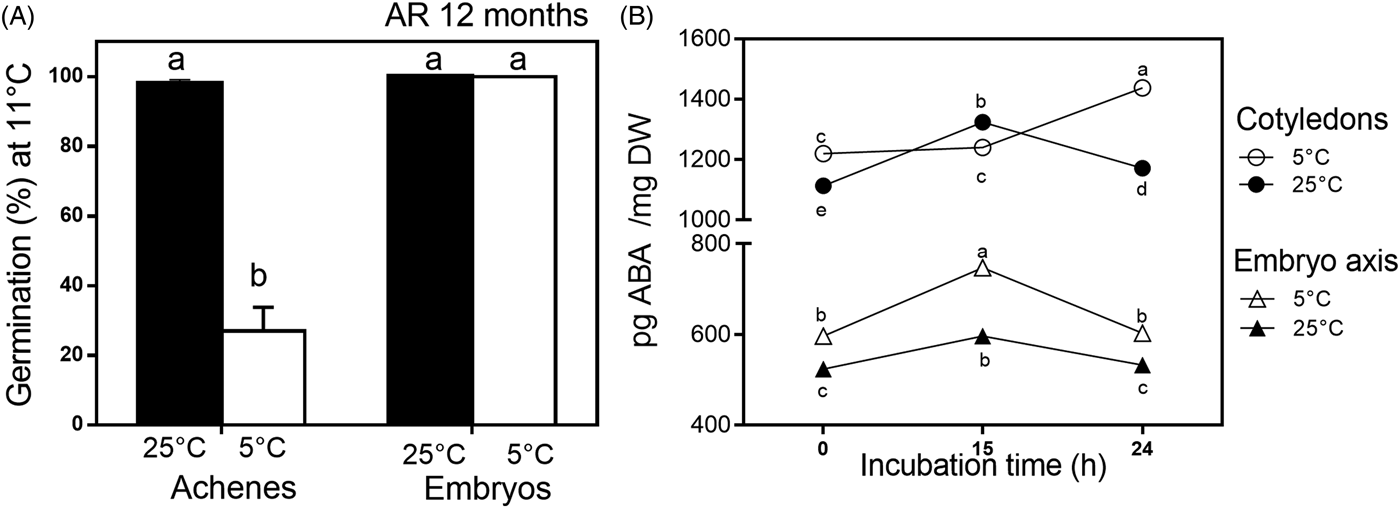
(A) Final germination percentage obtained for achenes and embryos incubated at 11°C in water. Achenes from genotype ‘A’ (hybrid) had been stored at 5°C (white bars) and 25°C (black bars) for 12 months and belonged to the early spring field experiment (same as shown in Fig. S1). (B) ABA content in cotyledons and embryo axis [pg ABA (mg DW)–1] before (time zero) and after 15 and 24 h of incubation of intact achenes in water at 11°C. ABA quantitation was done by RIA. Each data point in A and B is the mean of four biological repetitions (see ‘Materials and methods’ for details). Vertical bars represent standard error of the mean. Means were compared with Tukey's post hoc test in A, and generalized linear mixed models for repeated measures data in B. Different letters indicate significant differences between means (P < 0.05).

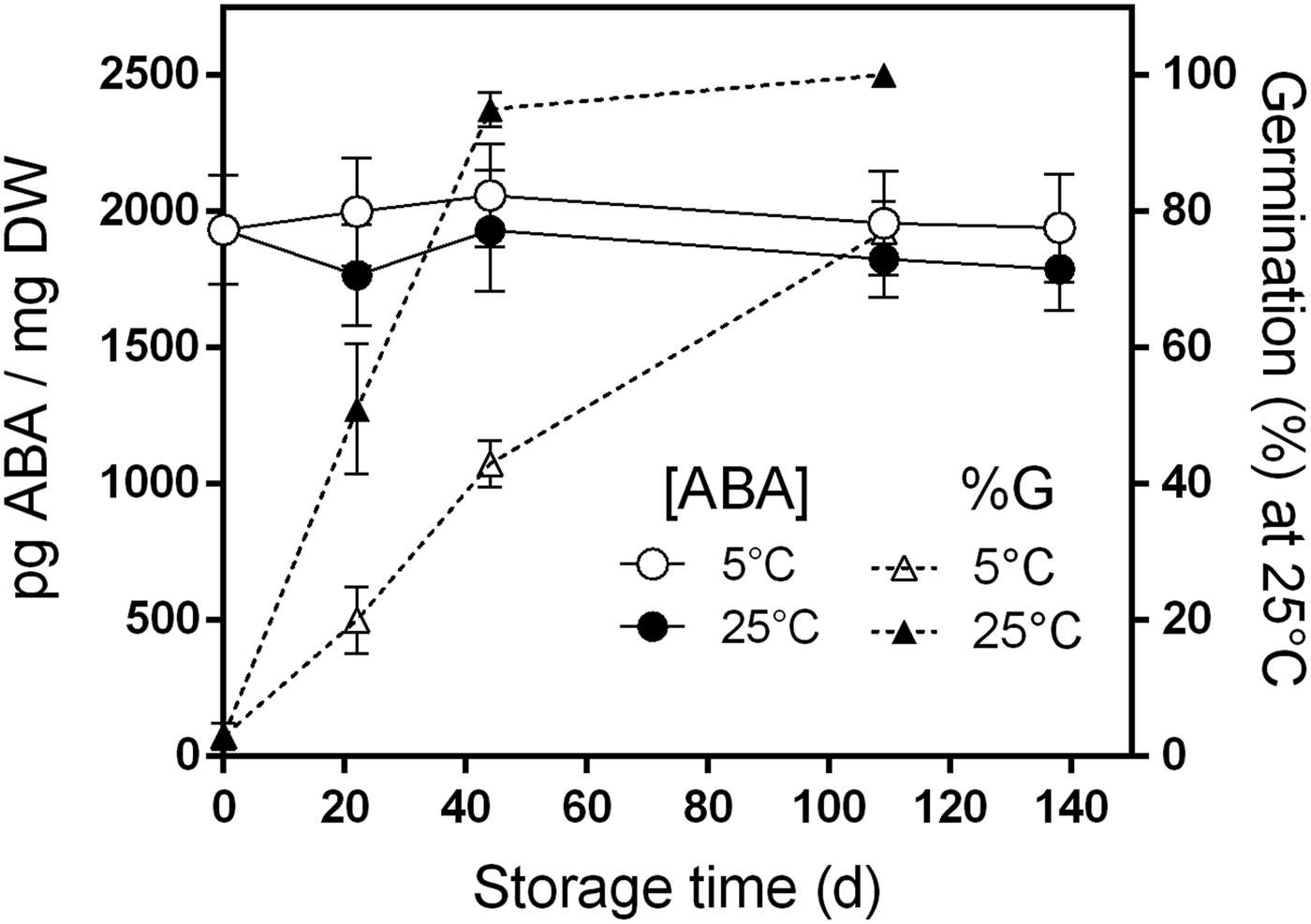
Seed ABA content (measured by RIA) and achene final germination percentage for sunflower achenes (genotype ‘B’) stored dry during different periods at 5 and 25°C. Storage treatments began 34 days after harvest. Each data point is the mean of four replicates from a single seed lot. Two-way ANOVA of ABA data showed no significant effect of storage temperature or storage time (P > 0.1), and no significant interaction between both factors.

Statistical analysis
Per cent germination data were arcsine square root-transformed, subjected to analysis of variance and Tukey's post hoc test for mean separation with a significance of 5%. Arcsine-transformed means and standard errors were back-transformed for graphic presentation. Transformed data still showing lack of homogeneity of variance were analysed by applying generalized linear mixed models. Changes in ABA content during seed incubation were analysed by applying general mixed models for repeated measures data. Statistical analysis was performed using InfoStat software (InfoStat 2010 version, InfoStat Group, FCA, National University of Córdoba, Argentina) assisted by R (R version 2.11.1, copyright 2010; The R Foundation for Statistical Computing) and GraphPad Prism 6 (GraphPad Software, San Diego, CA, USA).
Results
Dormancy release of sunflower achenes was promoted by dry storage at 25°C compared with 5°C
Higher storage temperature (i.e. 25°C) promoted dormancy loss (i.e. increased germination values) compared with storage at 5°C (Fig. 1), across several field experiments performed with a commercial hybrid (‘A’) (see also supplementary data, Fig. S1) and an inbred line (‘B’). Germination tests conducted at 10 and 25°C revealed differences in dormancy between storage treatments when applied to seed lots with varying levels of dormancy at harvest. The effect of storage temperature on dormancy release was observed when germination was tested at 25°C in some seed lots (Fig. 1A,E). In other seed lots (as shown in Fig. 1C; but also Fig. S1B), the effect of storage temperature on dormancy release was not observed when germination was tested at 25°C, but became evident at lower incubation temperatures (Fig. 1B, supplementary Fig. S1A).
Germination of intact achenes was compared with that of isolated embryos. In genotype ‘A’, warmer storage temperature reduced embryo dormancy, while in genotype ‘B’ embryos showed similar levels of embryo dormancy for both storage temperatures when tested either at 12 or 25°C after 44 days of storage (Fig. 1D,E). These results show that faster dormancy release under warm storage temperature can either be related to a reduction of embryo dormancy (as in genotype ‘A’) or to a reduced inhibitory effect imposed by the fruit envelopes as in genotype ‘B’ (compare Fig. 1B and D).
The effect of storage temperature on dormancy alleviation as related to each fruit structure (embryo, seed coat + E and pericarp) was assessed with more detail in genotype ‘A’ using achenes from two independent field experiments (Fig. 2A, mid-spring sowing, and Fig. 2B, production field in Mendoza). In both experiments, achene germination (tested at 11°C) did not exceed 20% even after 3 months of dry storage at 25°C (Fig. 2A,B). During this period, embryo germination values increased significantly, i.e. embryo dormancy decreased (supplementary Fig. S2A,B) and achene dormancy relied further on inhibition by the envelopes. Storage at 25°C promoted alleviation of embryo dormancy: embryo germination was about 80% when tested after 30 days of storage at 25°C (i.e. remaining embryo dormancy was ca 20%), while this level of embryo germination was observed a month later (i.e. after 60 days) for the 5°C-stored achenes (Fig. 2A). A similar delay was observed for the 5°C-stored achenes in the experiment shown in Fig. 2B. While dormancy by the envelopes remained high, the contribution of the seed coat + E and the pericarp differed markedly between experiments (proportion of dormancy due to the seed coat + E was higher in experiment shown in Fig. 2A; while proportion of dormancy due to the pericarp prevailed in experiment shown in Fig. 2B; see also supplementary Fig. S2). The seed coat + E/pericarp ratio changed during storage but we did not observe any pattern for both experiments or any consistent effect of storage temperature (supplementary Fig. S2C,D).
Storage at 25°C reduced achene responsiveness to fluridone and ABA compared with 5°C
Incubation with fluridone (an inhibitor of ABA synthesis) promoted germination of dormant achenes, seeds and embryos from genotype ‘A’ after a 2-month storage period at 5°C (denoted by arrows in Fig. 3A,B; germination of embryos increased from 43 to 86%). Nevertheless, fluridone had no stimulating effect on germination of seeds and embryos from achenes that had been stored at 25°C, even when tested at 11°C, a temperature at which dormancy was still expressed (Fig. 1B). Unexpectedly, fluridone promoted germination of dormant embryos stored at 5°C to a higher level (i.e. 86%) than that reached by the 25°C storage treatment (52%). This suggests that besides ABA synthesis capacity upon imbibition, other processes controlling dormancy expression are affected differently by storage temperature.
Responsiveness to ABA was tested in genotype ‘A’ in the presence of fluridone (to increase germination values of more dormant achenes/seeds/embryos from 5°C storage to similar values as less dormant from 25°C storage). Results given in Fig. 3A (achenes) and Fig. 3B (seeds and embryos) show that sensitivity to ABA was higher after storage at 5°C compared with 25°C.
In genotype ‘B’, fluridone failed to promote germination of dormant achenes from the 5°C storage treatment when tested after 44 days of dry storage (Fig. 3C). As dormant achenes were not responsive to fluridone, differential achene or seed sensitivity to ABA could not be determined between storage treatments until similar and maximum germination values were reached, e.g. as observed after 273 days for achenes (Figs 1E and 3E). In this case, achene germination (tested at 25°C) reached 100% for both storage treatments and a stronger inhibition of germination by ABA was observed in achenes (Fig. 1E; 100 µM ABA) from the 5°C storage condition. A similar result was obtained with seeds tested at 12°C after 138 and 273 days (Fig. 3D,F). It should be noted that sensitivity to ABA is enhanced at low incubation temperatures compared with 25°C (for 5°C storage, seeds were inhibited by 10 µM ABA to a lower level than achenes with 100 µM ABA; also compare embryos and achenes from genotype ‘A’ stored at 5°C imbibed in F + A10 in Fig. 3A,B).
Storage at 25°C increased responsiveness to paclobutrazol and GA
A possible effect of storage temperature on GA de novo synthesis and responsiveness to GA, was also investigated using paclobutrazol (inhibits GA biosynthesis; Rademacher, Reference Rademacher2000). In genotype ‘A’, incubation in 100 µM paclobutrazol reduced germination of achenes, seeds and embryos, but only for the 25°C storage treatment (Fig. 4A,B). This response to paclobutrazol suggests that higher germination values after storage at 25°C result from an increased capacity for GA de novo synthesis upon imbibition, although a possible increase in ABA catabolism cannot be ruled out (which may also be blocked by paclobutrazol; Rademacher, Reference Rademacher2000; Saito et al., Reference Saito, Okamoto, Shinoda, Kushiro, Koshiba and Kamiya2006). By contrast, germination of achenes and embryos from the 5°C storage was not inhibited by paclobutrazol, suggesting that GA de novo synthesis is not involved in the observed germination response in these achenes. Furthermore, and contrary to the expected changes in the ABA/GA balance that should enhance dormancy, achene germination for the 5°C storage treatment was slightly promoted by 100 µM paclobutrazol (from 60 to 80%; Fig. 4A), suggesting additional side-effects caused by this inhibitor.
For the 25°C storage treatment, incubation in 10 µM GA3 reverted inhibition by paclobutrazol in achenes, seeds and embryos (Fig. 3A,B). Although germination of embryos from achenes stored at 5°C was also promoted by applied GA3 (Fig. 4B), seeds from these storage treatments were unresponsive to paclobutrazol + GA3 (Fig. 4B, white bars). Instead, germination of seeds stored at 25°C was significantly inhibited by paclobutrazol, while 10 µM GA3 increased germination by 85% compared with the paclobutrazol-inhibited seeds (Fig. 4B).
In genotype ‘B’, incubation of achenes in paclobutrazol had no significant effect on final germination percentage for both storage treatments when tested either at 12 or 25°C (Fig. 4C,D). This suggests that GA de novo synthesis is not involved in germination of these achenes. Incubation with GA3 promoted germination of dormant achenes (Fig. 4C,D) although no differential responsiveness to GA3 could be determined between storage treatments as germination of 25°C storage was not inhibited by paclobutrazol, even when imbibed at 12°C (Fig. 4D).
Dormant achenes from genotype ‘A’ were also responsive to ethylene. Incubation with 330 µM Ethephon (0.1 ml l–1 Ethrel 48%) strongly promoted germination of dormant achenes from genotype ‘A’, and similarly for both storage temperatures (Fig. 5).
Storage temperature affected ABA levels during imbibition
A promotion of germination by fluridone was observed in dormant achenes, seeds and embryos from the 5°C storage treatment, but not for those from the 25°C storage (Fig. 3A,B). This suggests a role for de novo synthesis of ABA in the repression of germination of dormant achenes from genotype ‘A’ that had been stored at 5°C. Indeed, higher ABA levels were observed in both the embryo axis and cotyledons dissected from imbibed achenes that had been stored at 5°C (Fig. 6B). The largest differences in ABA content were observed in cotyledons after a 24 h incubation period (where ABA content values were 1437 and 1171 pg ABA (g DW)–1 for the 5 and 25°C storage treatments, respectively) and in embryonic axes after 15 h of incubation (where ABA content values were 747 and 596 pg ABA (g DW)–1 for the 5 and 25°C storage treatments, respectively).
The possibility that changes in ABA content might take place during storage at different temperatures was explored in genotype ‘B’. Results shown in Fig. 7 indicate that ABA content in the embryo did not change throughout dry storage and was not affected by temperature.
Discussion
Although the effect of storage temperature on dormancy alleviation in sunflower achenes has been explored by several groups, the variability of reported data preclude the establishment of a clear response pattern, probably due to the many sources of variation that can affect this response (e.g. moisture content, genetic diversity in sunflower, fruit structures involved in dormancy, and incubation temperature affecting dormancy expression). In this study we tested the effect of two contrasting storage temperatures on dormancy release of sunflower achenes using two commercial genotypes grown in the field. In contrast with previous works, we tested germination periodically during after-ripening and at two incubation temperatures, thus allowing us to detect potential changes in level of dormancy in response to storage treatments. Results obtained with both commercial genotypes consistently showed that dry storage at 25°C promoted dormancy alleviation compared with storage at 5°C. An important aspect of this work is that germination tests were done with intact achenes, and experimental procedures were conducted in a similar way as done by the seed industry: achenes were harvested with 0.12 g water (g DW)–1 (about 11% MC on a FW basis), then dried to ca 0.06 g water (g DW)–1 and stored in ventilated chambers with controlled temperature (5 or 25°C), where a final MC of ca 0.07 g water (g DW)–1 was reached in equilibrium with ambient humidity. These results are similar to previous reports in other species, where increasing storage temperatures between 5 and 40°C promoted dormancy release of seeds with MC values around 0.07–0.08 g water (g DW)–1 (Allen et al., Reference Allen, Meyer and Beckstead1995; Baldos et al., Reference Baldos, DeFrank, Kramer and Sakamoto2014). In sunflower, Bazin et al. (Reference Bazin, Batlla, Dussert, El-Maarouf-Bouteau and Bailly2011a) combined different values of seed MC and temperature during storage and observed a strong interaction between both variables on the alleviation of embryo dormancy. In achenes stored with MC >0.01 g water (g DW)–1, embryo dormancy release was promoted by higher temperatures (Bazin et al., Reference Bazin, Batlla, Dussert, El-Maarouf-Bouteau and Bailly2011a), and by lower temperatures when stored with MC <0.05 g water (g DW)–1. These authors suggested a threshold value of 0.1 g water (g DW)–1 between both responses (negative and positive) to temperature. Nevertheless, our results support that the positive response to temperature can occur at MC values several points below the MC threshold proposed by Bazin et al. (Reference Bazin, Batlla, Dussert, El-Maarouf-Bouteau and Bailly2011a). This agrees not only with the general pattern found in other species, but also with more recent work conducted with Arabidopsis seeds by the same group (Basbouss-Serhal et al., Reference Basbouss-Serhal, Leymarie and Bailly2016) who determined that a seed MC of 0.06 g water (g DW)–1 is a threshold value above which temperature promotes dormancy release.
After confirming for sunflower achenes that the dormancy alleviation response to storage temperature is robust under a variety of maternal environments affecting initial dormancy level at harvest (Bodrone et al., Reference Bodrone, Rodríguez, Arisnabarreta and Batlla2017), we investigated which fruit components and hormonal pathways involved in fruit dormancy are affected by storage temperature. Storage at 25°C promoted alleviation of embryo dormancy in genotype ‘A’ (Figs 1 2) and pericarp-imposed dormancy in genotype ‘B’ (Fig. 1). Interestingly, despite the different mechanism prevailing in each case, in both genotypes storage temperature affected seed/embryo sensitivity to applied ABA. Although dormancy imposed in the embryo or by the envelopes involves different structures and potentially different mechanisms, embryo sensitivity to ABA is likely to be a common factor operating in both cases. Therefore, embryo responsiveness to ABA may regulate changes in dormancy imposed by the envelopes by increasing embryo sensitivity to any potential restriction imposed by these structures. Earlier studies in sunflower by Le Page-Degivry et al. (Reference Le Page-Degivry, Bianco, Barthe, Garello and Lang1996) had already observed a decrease in sensitivity to ABA when comparing fresh, dormant achenes (which exhibit embryo dormancy) and non-dormant, after-ripened achenes. Similarly, embryo responsiveness to ABA decreased during AR of wheat grains (Schramm et al., Reference Schramm, Nelson, Kidwell and Steber2013), which, like sunflower, combine embryo and coat-imposed dormancy. Nevertheless, and according to the literature, our work shows for the first time that loss of embryo/seed sensitivity to ABA in sunflower can be affected by temperature during dry AR.
In addition to slowing down dormancy alleviation by retaining higher sensitivity to ABA for longer (as observed in both genotypes), lower storage temperature also affected ABA metabolism upon imbibition in genotype ‘A’. Results presented here support that in addition to increased embryo/seed sensitivity to ABA, a higher ABA synthesis activity (although differences in ABA catabolism cannot be disregarded) was maintained during storage at 5°C compared with storage at 25°C. Similarly, a decrease in ABA synthesis capacity by the embryo axis in AR sunflower achenes (compared with non-AR) was reported by Le Page-Degivry et al. (Reference Le Page-Degivry, Bianco, Barthe, Garello and Lang1996). A key role for ABA metabolism in the repression of germination of seeds expressing coat-imposed dormancy was demonstrated for Arabidopsis (Ali-Rachedi et al., Reference Ali-Rachedi, Bouinot, Wagner, Bonnet, Sotta, Grappin and Jullien2004), lettuce (Argyris et al., Reference Argyris, Dahal, Hayashi, Still and Bradford2008) and barley (Benech-Arnold et al., Reference Benech-Arnold, Gualano, Leymarie, Côme and Corbineau2006). Results with sunflower hybrid ‘A’ suggest that ABA synthesis (upon imbibition) can become active even after a year of dry storage (Fig. 6) at 5°C. Although after-ripened embryos germinated fully in water, some ‘residual’ embryo dormancy (evidenced by de novo ABA synthesis) persisted and was expressed differently in imbibed achenes depending on storage temperature. In contrast, presented data for sunflower inbred line ‘B’ suggests that ABA de novo synthesis is not involved in the expression of dormancy in mature achenes of this genotype. Therefore, the contribution of ABA metabolism to the expression of dormancy in imbibed after-ripened achenes depends on the genotype, and can be affected by storage temperature.
Storage temperature also produced changes in the GA pathway in genotype ‘A’, but not likely in ‘B’ (Fig. 4). Inhibition of achene and embryo germination by paclobutrazol only after storage at 25°C (but not at 5°C) suggests that post-imbibition GA synthesis capacity was increased after storage at 25°C. A greater responsiveness to GA3 was also promoted in genotype ‘A’ by storage at 25°C together with reduced achene dormancy. This is in agreement with results by Le Page-Degivry et al. (Reference Le Page-Degivry, Bianco, Barthe, Garello and Lang1996), who reported an increased sensitivity to GA of sunflower embryos after dormancy releasing treatments. Ethylene stimulated germination of dormant achenes of genotype ‘A’, although a differential sensitivity to this hormone could not be established in this study. A role for ethylene production and/or signalling in the observed changes of dormancy in response to the AR temperature remains to be tested.
The possibility that changes in embryonic ABA content took place during dry storage was also assessed. ABA levels remained unchanged during dry storage of achenes of genotype ‘B’, and were not affected by storage temperature. This is consistent with several studies that failed to establish an association between hormone levels during dry after-ripening and dormancy status in a variety of species (Bewley and Black, Reference Bewley and Black1994; Benech-Arnold, Reference Benech-Arnold, Benech-Arnold and Sánchez2004; Ceccato et al., Reference Ceccato, Bertero and Batlla2011; Kermode, Reference Kermode2005; Feurtado and Kermode, Reference Feurtado, Kermode, Bradford and Nonogaki2007; Liu et al., Reference Liu, Gao, Kanno, Jordan, Kamiya, Seo and Ayele2013).
Recently, progress has been made towards understanding the biochemical and molecular mechanisms underlying dormancy release during dry after-ripening. Reactive oxygen species (ROS) that occur spontaneously during dry storage have been proposed to play a key role in dormancy release, as reviewed by El-Maarouf-Bouteau et al. (Reference El-Maarouf-Bouteau, Meimoun, Job, Job and Bailly2013). The observed decrease in sensitivity to ABA during storage (as reported in this study, but also for wheat by Schramm et al., Reference Schramm, Nelson, Kidwell and Steber2013) may involve direct damage to proteins involved in ABA signaling, leading to inhibition of germination, or deterioration of particular transcripts coding for these signalling components. Bazin et al (Reference Bazin, Langlade, Vincourt, Arribat, Balzergue, El-Maarouf Bouteau and Bailly2011b) and Gao et al. (Reference Gao, Rampitsch., Chitnis, Humphreys, Jordan and Ayele2013) reported that targeted mRNA oxidation takes place during sunflower and wheat seed dormancy alleviation along dry after-ripening. In sunflower, Bazin et al (Reference Bazin, Langlade, Vincourt, Arribat, Balzergue, El-Maarouf Bouteau and Bailly2011b) proposed that targeted mRNA oxidation during dry after-ripening of dormant seeds could be a process that governs cell signalling towards germination in the early steps of seed imbibition. Some of these targets may be involved in ABA signalling as well as ABA metabolism and their oxidation during storage could lead to the observed reduction in sensitivity to ABA or differential ABA metabolism. Indeed, Basbouss-Serhal et al. (Reference Basbouss-Serhal, Leymarie and Bailly2016) observed that transcript levels of several ABA and GA metabolism genes in 24 h-imbibed Arabidopsis seeds changed after 7 weeks of dry storage at 20°C and 0.06 g water (g DW)–1 MC and corresponded with dormancy release and the expected changes in ABA/GA hormonal balance.
In conclusion, results presented here support that storage at 25°C, compared with 5°C, promotes dormancy release of sunflower achenes regardless of its origin (either in the embryo or imposed by the seed coat plus pericarp). How the different fruit structures work in interaction with hormonal pathways to impose dormancy in the imbibed, mature achene, still remains far from being understood. In this context, our work points to the embryo sensitivity to ABA as a decisive factor underlying the level of dormancy in the achene, and affected by mechanisms operating during AR.
Supplementary material
To view supplementary material for this article, please visit https://doi.org/10.1017/S0960258518000065
Figure S1. Final germination percentage of achenes (triangles) and isolated embryos (circles) of a commercial sunflower hybrid (genotype ‘A’) after different storage periods at 5°C (white symbols) or 25°C (black symbols). Hybrid achenes were harvested from field experiment sown in early spring (same as used in experiment shown in Fig. 6). Storage treatments began immediately after drying. After different storage times, final germination was obtained for achenes and embryos incubated in water at 11°C (A) and achenes at 25°C (B). Each data point is the mean of four biological repetitions (field plots). Error bars represent standard error of mean.
Figure S2. (A and B) Relative contribution (within the dormant fraction of the population) of each dormancy factor. Emb, embryo; SC, seed coat + endosperm; Per, pericarp. Data points were calculated with same data shown in Fig. 2. Hybrid achenes were obtained from two different field trials: experimental plots sown during mid-spring (A; same as in Fig. 1A), or (B) from a production field (see ‘Materials and methods’ for details). Fruits were stored dry (MC between 0.06 and 0.07 g water (g DW)–1) at 5 and 25°C and germination tests were conducted at 11°C after three different storage times: 30, 60 and 90 days in A, and 34, 57 and 70 days in B. Each data point is the mean of four biological repetitions (field plots, in A) or four pseudo-replicates (subsamples of a single seed lot, in B). Error bars represent standard error. Each data point is the difference between germination of achenes, seeds and embryos (as indicated in Fig. 2) and expressed as percentage within the dormant fraction of achenes (which was always above 84%; see Fig. 2). (C and D) Ratio between per cent dormancy explained by the seed coat and by the pericarp (calculations were done using data shown in A and B, respectively).
Acknowledgements
This work was supported by the Universidad de Buenos Aires (grants UBACYT no. 20020130100653BA and 20020130100874BA), and by the National Scientific and Technological Research Council (CONICET) of Argentina (PIP 11220130100738).
We would like to thank Ing. Agr. Dr. Sebastián Arisnabarreta and Ing. Agr. Luciana Pizzorno for their valuable advice during the experiments. We also wish to thank Monsanto and Dow Agrosciences for kindly providing the seed materials used in this work.