Open heart surgery on cardiopulmonary bypass is associated with cardiac injury and release of cardiac troponins I and T. Cardiac troponin I is a specific and sensitive marker for myocardial injury.Reference Bhavsar, Dhoot, Cumming, Butler-Browne, Yacoub and Barton 1 , Reference Bodor, Porterfield, Voss, Smith and Apple 2 Measurement of serum cardiac troponin I is preferable over cardiac troponin T because it has the advantage of being uninfluenced by renal failure.Reference Immer, Stocker, Seiler, Pfammatter, Printzen and Carrel 3 The post-operative cardiac troponin levels are being increasingly used to predict post-operative events and complications in children.Reference Bottio, Vida, Padalino, Gerosa and Stellin 4 – Reference Hammer, Loeff and Reichenspurner 7
At the present time, there is a trend towards performing open heart surgery at a younger age. However, it is thought that children undergoing surgical repair for congenital heart disease during the first few months of life exhibit more complications when compared with older children for a similar type of surgery. Myocardium of infants has also been thought to be more vulnerable to cardiopulmonary bypass in comparison with older children and adults.Reference Taggart, Hadjinikolas and Wong 8 , Reference Imura, Caputo, Parry, Pawade, Angelini and Suleiman 9 For this study, we evaluated the degree of myocardial injury by measurement of cardiac troponin I in infants in comparison with older children for the same lesions and during similar types of surgeries.
Materials and methods
Study design
The study was prospective and observational, involving children who underwent open heart surgeries at the New York Presbyterian Hospital. The protocol was approved by the Institutional Review Board. Informed written consent was required for enrolling.
Patients
Consecutive patients requiring elective open heart surgery under cardiopulmonary bypass for various congenital heart diseases were enrolled after obtaining written consent. The inclusion criteria included body weight 5 kilograms or greater – because of daily blood collection for the study. The exclusion criteria were any emergent surgery and presence of other systemic disease, such as diabetes or systemic lupus erythematosus or recent infections. The children were divided into two groups based on their age at surgery: either above or below 1 year. The following data were collected: demographic data, cardiac diagnoses, types of surgery performed, cardiopulmonary bypass time, cross-clamp time, post-operative parameters including blood pressure, and occurrence of cardiac arrest or death.
Surgery
The study patients underwent open heart surgery to correct their underlying congenital heart disease via sternotomy under cardiopulmonary bypass. The cardiopulmonary unit included the membrane oxygenator (Terumo, New Jersey, United States of America), roller pump (Cobe, Arvada, Colorado, United States of America), non-heparin-coated polyvinyl chloride circuit tubing (Cobe), with an arterial filter (Cobe) and hemoconcentrator (Minntech HP 400, Minnesota, United States of America). The cardiopulmonary unit was primed with an electrolyte solution with albumin, mannitol, and heparin, as well as with donor blood as needed. The flow rate was maintained at 2.2 litres per minute per square metre and the haematocrit was maintained at or greater than 25%. Myocardial protection was achieved with 15 millilitres per kilogram at 4°C of cardioplegia solution containing 5% dextrose water 500 cubic centimetres with 15 milliequivalents of sodium bicarbonate, 25 millilitres of 25% mannitol, and 15 milliequivalents of potassium chloride. Hypothermia (19.9–35.7°C) was maintained in every patient. The post-operative days were defined as follows: post-operative day 0 was the day of surgery, post-operative day 1 was 1 day after the surgery, and so forth.
Blood sampling and measurement of cardiac troponin I
Blood samples were collected using sterile technique from each patient before cardiopulmonary bypass, within 2 hours after chest closure, and early morning of each subsequent day hospitalised in the intensive care unit. The blood was centrifuged for 20 minutes and the serum separated and frozen at −70°C. Serum levels of cardiac troponin I were measured in a single batch by microparticle enzyme immunoassay with Abbott AxSYM system (Abbott laboratories, Abbott Park, Illinois, United States of America). Based on the 95 percentile, the expected values for apparently healthy individuals by this assay are serum levels of less than or equivalent to 0.4 micrograms per litre. At the cut-off value of 2.0 micrograms per litre, cardiac troponin I level is 94% sensitive and 93% specific for the diagnosis of myocardial infarction within the first 24 hours of presentation (package insert Abott AxSYM 69-3119/R3).
Statistical analysis
The Spearman rank correlations were calculated to demonstrate associations between numeric variables between subjects. The Mann–Whitney test was carried out to compare all continuous variables. The Fisher Exact test was carried out to determine the association between categorical variables. A p-value less than 0.05 was considered significant.
Results
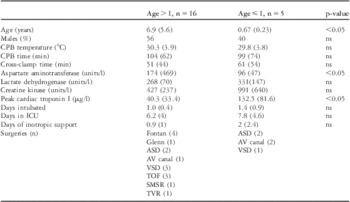
The study cohort included 21 consecutive patients requiring elective open heart surgery under cardiopulmonary bypass for various congenital heart diseases (see Table 1). All infants had cardiac surgery for acyanotic lesions. All patients enrolled completed the study; none had post-operative renal failure or a severe cardiac event requiring resuscitation, and there were no deaths. All had normal ventricular systolic function before surgery and upon discharge per echocardiogram. All patients had significant increases in the cardiac troponin I level post-operatively within 24 hours, which were almost within the normal limits by the 1st week after surgery.
Clinical and laboratory data.

ASD = atrial septal defect; AV canal = atrioventricular canal; CPB = cardiopulmonary bypass; ICU = intensive care unit; peak level (highest level of troponins on the multiple measurements after surgery) is the highest value; ns = not significant; SMSR = supra mitral stenosing ring; TOF = tetralogy of Fallot; TVR = tricuspid valve repair; VSD = ventricular septal defect
All values are in mean (standard deviation) unless specified. p-values are between the two age groups compared
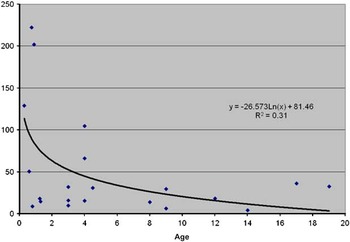
There was no significant difference in the baseline pre-operative cardiac troponin I levels between the children with cyanotic congenital heart disease (seven patients, mean 0.13 with a standard deviation of 0.16 micrograms per litre) and those with acyanotic congenital heart disease (14 patients, mean 0.2 with a standard deviation of 0.21 micrograms per litre). The enrolled children in the two age groups underwent elective surgeries that were of similar Risk Adjustment in Congenital Heart Surgery-1 risk category (category 1 to 3).Reference Jenkins, Gauvreau, Newburger, Spray, Moller and Iezzoni 10 None of the infants underwent a surgery requiring ventriculotomy or surgery for a cyanotic heart defect. The older children underwent surgeries for similar acyanotic heart defects to infants, but also had surgeries that included a ventriculotomy and surgeries for cyanotic heart defects such as tetralogy of Fallot and cavopulmonary shunts for single ventricles. Among the 21 patients, four patients, including three infants, had peak cardiac troponin I values greater than 100 micrograms per litre. The five infants had peak cardiac troponin I (micrograms per litre) levels of 222.3, 202, 129, 82.3, and 26.7 after surgeries for acyanotic heart defects. The post-operative peak cardiac troponin I levels in infants were significantly higher than those in the older children (see Table 1), and the peak cardiac troponin I correlated with age (see Fig 1).
Peak post-operative serum levels of cardiac troponin I in micrograms per litre (y-axis) by age in years.

Discussion
We found that cardiac troponin I level before surgery was similar in cyanotic children compared with the acyanotic children, similar to previous reportsReference Modi, Imura and Angelini 6 indicating that cyanosis alone may not contribute to cardiac troponin I release. In our study, the cardiac troponin I release after a variety of paediatric cardiopulmonary bypass procedures was seen to peak within the first 24 hours of the event and decline over the next several days, similar to previous reports.Reference Modi, Imura and Angelini 6 , Reference Saraiya, Sun, Jonassen, Pesce and Queagebeur 11
Recently, the trend has been towards early repair in infancy of many of the congenital heart diseases including the most complicated repairs.Reference Drinkwater and Laks 12 Investigations have shown that children had five times higher cardiac troponin T release compared with the adultsReference Taggart, Hadjinikolas and Wong 8 and that the younger age correlates significantly with higher amount of cardiac troponin I release.Reference Modi, Imura and Angelini 6 , Reference Taggart, Hadjinikolas and Hooper 13 We demonstrated similar results, and our findings in this study are strengthened by the various parameters compared between the two age groups for similar types of surgeries. All infants had similar surgeries to the older children (age greater than 1 year). However, the children in the older group also had surgeries for more complex cardiac lesions including surgery on cyanotic heart defects and surgeries with ventriculotomy that should have caused a higher release of cardiac troponin I. Despite this, we found that in infants the post-operative peak cardiac troponin I was significantly higher than the older children, although there was no significant difference in cardiopulmonary bypass time, cardiopulmonary bypass temperature, cross-clamp time, or the number of days in the intensive care unit between the two age groups.
Troponin levels have been used as a predicator of post-operative death after cardiopulmonary bypass.Reference Lasocki, Provenchere and Benessiano 14 , Reference Fellahi, Hedoire, Le Manach, Monier, Guillou and Riou 15 Cardiac troponin T has been found to correlate with the severity score of cardiac surgery in children.Reference Lipshultz, Rifai and Sallan 16 In adults, the thresholds of cardiac troponin I predicting severe cardiac event and/or death have been found to be 11.8 nanograms per litre (11.5–14.8 nanograms per litre) and an elevated cardiac troponin I above the threshold was significantly associated with a severe cardiac event and/or death (odds ratio, 4.33).Reference Fellahi, Hedoire, Le Manach, Monier, Guillou and Riou 15 In a retrospective study of children, a level of cardiac troponin T greater than 5.9 micrograms per litre on the first post-operative day was found to predict death (odds ratio, 10.7).Reference Mildh, Pettila, Sairanen and Rautiainen 17 In children, a very high post-operative cardiac troponin I release (especially at or greater than 100 micrograms per litre) has been found to be associated with mortality after cardiopulmonary bypass.Reference Bottio, Vida, Padalino, Gerosa and Stellin 4 , Reference Immer, Stocker and Seiler 5 , Reference Taggart, Hadjinikolas and Hooper 13 , Reference Montgomery, Sullivan and Buchino 18 – Reference Carmona, Manso, Vicente, Castro and Carlotti 20 In a study of 54 children who underwent cardiopulmonary bypass, only two children died, both with levels of cardiac troponin I greater than 100 micrograms per litreReference Immer, Stocker and Seiler 5 . However, in our prospective study, four patients, including three were infants, had a post-operative cardiac troponin I level greater than 100 micrograms per litre, and none had a severe cardiac event or death and demonstrated a normal ventricular systolic function before discharge. Hence, in children, a threshold level of cardiac troponin I in predicting severe cardiac event and/or death remains to be determined and the threshold may differ in the younger and the older children. Further, it appears that infant myocardium, although more vulnerable than an adult myocardiumReference Taggart, Hadjinikolas and Wong 8 with a higher release of cardiac troponin I, may also be more resilient with a recovery to normal contractility despite the excessive injury. The limitation of our study includes the small sample size of the patient population.
In conclusion, a higher cardiac troponin I is seen in infants in comparison with older children after cardiopulmonary bypass for similar surgeries. Very high cardiac troponin I levels greater than 100 micrograms per litre after surgery does not necessarily predict death or a severe cardiovascular event after cardiopulmonary bypass in the very young.
Acknowledgement
Funding resources: The project described was partially supported by Grant number 5K23HL089301-03 (PI Monesha Gupta, MD) from the National Heart, Lung, and Blood Institute. The content is solely the responsibility of the authors and does not necessarily represent the official views of the National Heart, Lung, and Blood Institute or the National Institutes of Health.