INTRODUCTION
Human activities have increasingly affected biodiversity in the Mediterranean Sea. Most of this biodiversity can be found in or near shallow shore waters, and the anthropogenic uses that threaten this biodiversity include, among other activities: land usage, which causes habitat destruction; water pollution; changes in nutrients and sedimentation; loss of coastal habitats (e.g. Airoldi & Beck, Reference Airoldi and Beck2007); fishing activities; changes in communities or habitat destruction (e.g. Coll et al., Reference Coll, Piroddi, Steenbeek, Kascher, Lasram, Aguzzi, Ballesteros, Bianchi, Corbera, Dailianis, Danovaro, Estrada, Froglia, Galil, Gasol, Gertwagen, Gil, Guilhaumon, Kesner-Reyes, Kitsos, Koukouras, Lampadariou, Laxamana, López-Fé de la Cuadra, Lotze, Martin, Mouillot, Oro, Raicevich, Rius-Barile, Saiz-Salinas, San Vicente, Somot, Templado, Turon, Vafidis, Villanueva and Voultsiadou2010); diving, which affects benthic communities (Garrabou et al., Reference Garrabou, Sala, Arcas and Zabala1998; Wielgus et al., Reference Wielgus, Chadwick-Furman, Dubinsky, Shechter and Zeitouni2002; Coma et al., Reference Coma, Pola, Ribes and Zabala2004; Linares et al., Reference Linares, Bianchimani, Torrents, Marschal, Drap and Garrabou2010); and mass mortality events related to climate change, which has already been observed in Mediterranean benthic invertebrates in the last decades (Gaino & Pronzato, Reference Gaino and Pronzato1989; Bavestrello et al., Reference Bavestrello, Bertone, Cattaneo-Vietti, Cerrano, Gaino and Zanzi1994; Cerrano et al., Reference Cerrano, Bavestrello, Bianchi, Cattaneo-vietti, Bava, Morganti, Morri, Picco, Sara, Schiaparelli, Siccardi and Sponga2000; Perez et al., Reference Perez, Garrabou, Sartoretto, Harmelin, Francour and Vacelet2000; Rodolfo Metalpa et al., Reference Rodolfo Metalpa, Bianchi, Peirano and Morri2000; Harvell et al., Reference Harvell, Mitchell, Ward, Altizer, Dobson, Ostfeld and Samuel2002; Garrabou et al., Reference Garrabou, Coma, Bensoussan, Bally, Chevaldonné, Cigliano, Diaz, Harmelin, Gambi, Kersting, Ledoux, Lejeusne, Linares, Marschal, Pérez, Ribes, Romano, Serrano, Teixido, Torrents, Zabala, Zuberer and Cerrano2009; Vezzulli et al., Reference Vezzulli, Previati, Pruzzo, Marchese, Gourne and Cerrano2010; Crisci et al., Reference Crisci, Bensoussan, Romano and Garrabou2011; Kersting et al., Reference Kersting, Bensoussan and Linares2013). These impacts and the synergies among them can greatly affect the distribution and survival of species (e.g. Coll et al., Reference Coll, Piroddi, Steenbeek, Kascher, Lasram, Aguzzi, Ballesteros, Bianchi, Corbera, Dailianis, Danovaro, Estrada, Froglia, Galil, Gasol, Gertwagen, Gil, Guilhaumon, Kesner-Reyes, Kitsos, Koukouras, Lampadariou, Laxamana, López-Fé de la Cuadra, Lotze, Martin, Mouillot, Oro, Raicevich, Rius-Barile, Saiz-Salinas, San Vicente, Somot, Templado, Turon, Vafidis, Villanueva and Voultsiadou2010, Reference Coll, Schmidt, Romanuk and Lotze2011; Micheli et al., Reference Micheli, Levin, Giakoumi, Katsanevakis, Abdulla, Coll, Fraschetti, Kark, Koutsoubas, Mackelworth, Maiorano and Possingham2013a; Serrano et al., Reference Serrano, Coma, Ribes, Weitzmann, García and Ballesteros2013). Moreover, these threats may be endangering species that play a structural role in benthic assemblages, and their alteration may further threaten rich Mediterranean biodiversity (Cebrián et al., Reference Cebrián, Uriz, Garrabou and Ballesteros2011; Kersting et al., Reference Kersting, Bensoussan and Linares2013).
The evaluation of baseline conditions is the challenge to understand the causes of environmental change (Francour et al., Reference Francour, Boudouresque, Harmelin-Vivien, Harmelin and Quignard1994). The use of historical baselines allows researchers to assess possible degradations in wild populations and to guide conservation and management initiatives for good ecosystem conditions (Sala et al., Reference Sala, Ballesteros, Dendrinos, Di Franco, Ferretti, Foley, Fraschetti, Friedlander, Garrabou, Güçlüsoy, Guidetti, Halpern, Hereu, Karamanlidis, Kizilkaya, Macpherson, Mangialajo, Mariani, Micheli, Pais, Riser, Rosenberg, Sales, Selkoe, Starr, Tomas and Zabala2012). In order to understand the effects of human impacts along the coastline, monitoring should be a routine activity (Coll et al., Reference Coll, Piroddi, Steenbeek, Kascher, Lasram, Aguzzi, Ballesteros, Bianchi, Corbera, Dailianis, Danovaro, Estrada, Froglia, Galil, Gasol, Gertwagen, Gil, Guilhaumon, Kesner-Reyes, Kitsos, Koukouras, Lampadariou, Laxamana, López-Fé de la Cuadra, Lotze, Martin, Mouillot, Oro, Raicevich, Rius-Barile, Saiz-Salinas, San Vicente, Somot, Templado, Turon, Vafidis, Villanueva and Voultsiadou2010), but a reference point is necessary.
The endemic and endangered orange coral (Astroides calycularis) is an azooxanthellate scleractinian colony coral with a carbonate calcium exoskeleton (Zibrowius, Reference Zibrowius1980) that inhabits the rocky shore from the surface to 50 m depth (Rossi, Reference Rossi1971; Ocaña et al., Reference Ocaña, Sánchez Tocino and López-González2000), but is typically found in the shallow infralittoral zone (0–15-m depth), on vertical walls, or inside caves (Rossi, Reference Rossi1971; Zibrowius, Reference Zibrowius1978; Kružic et al., Reference Kružic, Zibrowius and Pozar-Domac2002). It occupies both light and dark habitats and appears to prefer a highly hydrodynamic environment (Zibrowius, Reference Zibrowius1978; Reference Zibrowius1995; Kružic et al., Reference Kružic, Zibrowius and Pozar-Domac2002). The population density can be locally high, with colonies covering up to 90% of the sea bottom (Goffredo et al., Reference Goffredo, Caroselli, Mattioli, Pignotti and Zaccanti2011). It has a limited geographic distribution in the Mediterranean Sea, is present in Italy between the Sicilian and Messina Straits and in the Gulf of Naples, and is also present in the Iberian Peninsula, from the Strait of Gibraltar to Palos Cape (Murcia) (Zibrowius, Reference Zibrowius1980; López-González, Reference López-González1993). It can be found in Malta, Tunisia, Algeria, Morocco, Ceuta (Spain), and Melilla (Spain). Moreover, it is also present in Atlantic waters in the Espartel Cape (Morocco) and La Caleta (Cádiz, Spain). These westernmost locations (Zibrowius, Reference Zibrowius1995; Bianchi, Reference Bianchi2007) are probably attributable to currents dispersing larvae out of the Strait of Gibraltar (Ocaña et al., Reference Ocaña, Sánchez Tocino and López-González2000; Casado-Amezúa, Reference Casado-Amezúa2012; Casado-Amezúa et al., Reference Casado-Amezúa, Goffredo, Templado and Machordom2012). Inside the Iberian Peninsula, the highest densities can be found on the Andalusian shores (Alboran Sea), where it has recently been recognized as an important habitat for other species, which can vary depending on location and season (Terrón-Sigler et al., Reference Terrón-Sigler, Peñalver, León-Muez and Espinosa2014).
This orange coral has been affected, in particular, by the siltation that results from increasing coastal urbanization (Ocaña et al., Reference Ocaña, Templado and Templado2009) and by human activities in the littoral zone, which increase marine pollution and/or habitat destruction (Moreno et al., Reference Moreno, De la Linde, Arroyo, López-González, Barea-Azcón, Ballesteros-Duperón and Moreno2008). Moreover, it has also been demonstrated that recreational activities like scuba diving have a negative effect on the coral populations, because colonies can be damaged or removed by fins, hands and other diving equipment parts (Moreno et al., Reference Moreno, De la Linde, Arroyo, López-González, Barea-Azcón, Ballesteros-Duperón and Moreno2008). Nevertheless, A. calycularis is considered a key species with high biomass values in our study area (Cebrián & Ballesteros, Reference Cebrián and Ballesteros2004). Therefore, the aim of the present study is to establish a baseline of the distribution and abundance of A. calycularis in the south-western Mediterranean Sea (the Andalusian coast). This baseline might be useful to identify changes in their populations resulting from human impact, and it could be used by management administrators, scientists and marine protected area (MPA) managers.
MATERIALS AND METHODS
The survey was conducted in the rocky and shallow bottoms of the Andalusian coastline in 2011. The Andalusian coastline studied comprises the provinces of Cádiz, Málaga, Granada and Almería (Figure 1). Monitoring sites were established at a minimum distance of 0.5 nautical miles, depending on the presence of a rocky substrate. The area of study included three marine protected areas: the Natural Park of the Strait of Gibraltar (Cádiz), the Natural Reserve of Maro-Cerro Gordo Cliff (Málaga-Granada) and the Natural Park of the Cape of Gata-Níjar (Almería).
Map of the study area (Andalusian coastal line; Spain). *Natural Park of the Strait of Gibraltar; **Natural Reserve of Maro-Cerro Gordo; ***Natural Park of Cape of Gata.

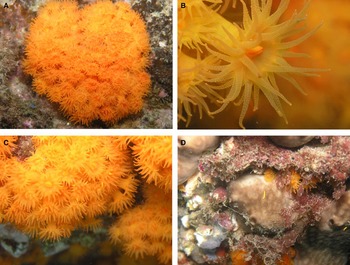
In order to study the distribution, a total of 195 monitoring sites were selected (59 in Cádiz, 37 in Málaga, 49 in Granada and 50 in Almería shorelines) according to the substrata-type preferences of the orange coral. Following Benedetti-Cecchi et al. (Reference Benedetti-Cecchi, Airoldi, Abbiati and Cinelli1996), we studied the species’ abundance in terms of cover percentage, as observed visually by scuba divers. The percentage of species covered may be estimated for sessile species such as corals, sponges and encrusting bryozoans (Katsanevakis et al., Reference Katsanevakis, Weber, Pipitone, Leopold, Cronin, Scheidat, Doyle, Buhl-Mortensen, Buhl-Mortensen, D'Anna, de Boois, Dalpadado, Damalas, Fiorentino, Garofalo, Giacalone, Hawley, Issaris, Jansen, Knight, Knittweis, Kröncke, Mirto, Muxika, Reiss, Skjoldal and Vöge2012). At each monitoring sites, two scuba divers carried out three dives at different range depths (0–3 m, 3–6 m and 6–12 m), meaning a total of 585 points were sampled. At each depth, the scuba divers localized the A. calycularis colonies (Figure 2) and took data relating to date, geographic position (ED 1950; WGS 84), depth and substratum type. Four random replicate samples were collected using a 1 × 1-metre quadrant to assess the relative abundance in percentage of coverage. All data were registered in a database to perform statistical and spatial distribution analyses.
The orange coral Astroides calycularis. (A) Colony from Granada coast. (B) Detail of a polyp extended. (C) Colony with some polyps with larvae in the tentacles. (D) Larvae on the sponge Chondrosia reniformis.

Five hundred and eighty-five dives were performed for the study and a total of 2340 m2 were visually estimated, obtaining data of the presence or absence of orange coral, its abundance, its depth, its geographic position and the sea-bottom composition in the four provinces studied. For abundance, the mean and standard error of the mean were calculated.
A multifactor analysis of variance (ANOVA) was used to test whether the relative abundance of A. calycularis was similar across provinces and depths, with the following factors: province as a fixed factor with four levels (Cádiz, Málaga, Granada and Almería); and depth as a fixed factor, orthogonal with province, including three levels (3, 6 and 12-m depth) where the species is typically found (Kružic et al., Reference Kružic, Zibrowius and Pozar-Domac2002). For ANOVA analysis, considering that Málaga was the province with the lowest number of sites (N = 37), 37 sites were used as replicates for both factors, because a balanced ANOVA test is more suitable than an unbalanced ANOVA (Underwood, Reference Underwood1997). Prior to ANOVA, the heterogeneity of variance was tested via a Cochran test. Univariate analyses were conducted with GMAV5 (Underwood et al., Reference Underwood, Chapman and Richards2002). When statistical differences were detected, an a posteriori Student-Newman-Keuls (SNK) test was applied.
Geospatial data from A. calycularis abundance were interpolated by means of raster analyses using a gridding of 1 m2 and were represented spatially. We only interpolated the six points closest to the abundance of orange coral (no further than 2 km between the presence points) and used the bathymetric line of 15 m of the marine cartography. Mean abundances were grouped into five categories (absent; scarce: >0–25% coverage; moderate: >25–50% coverage; abundant: >50–75% coverage; very abundant: >75% coverage) to perform SIG graphics in order to make the visualization of the map easier. ArcGIS 9.2 (http://www.esri.com/) software was used to represent and analyse the spatial distribution.
RESULTS
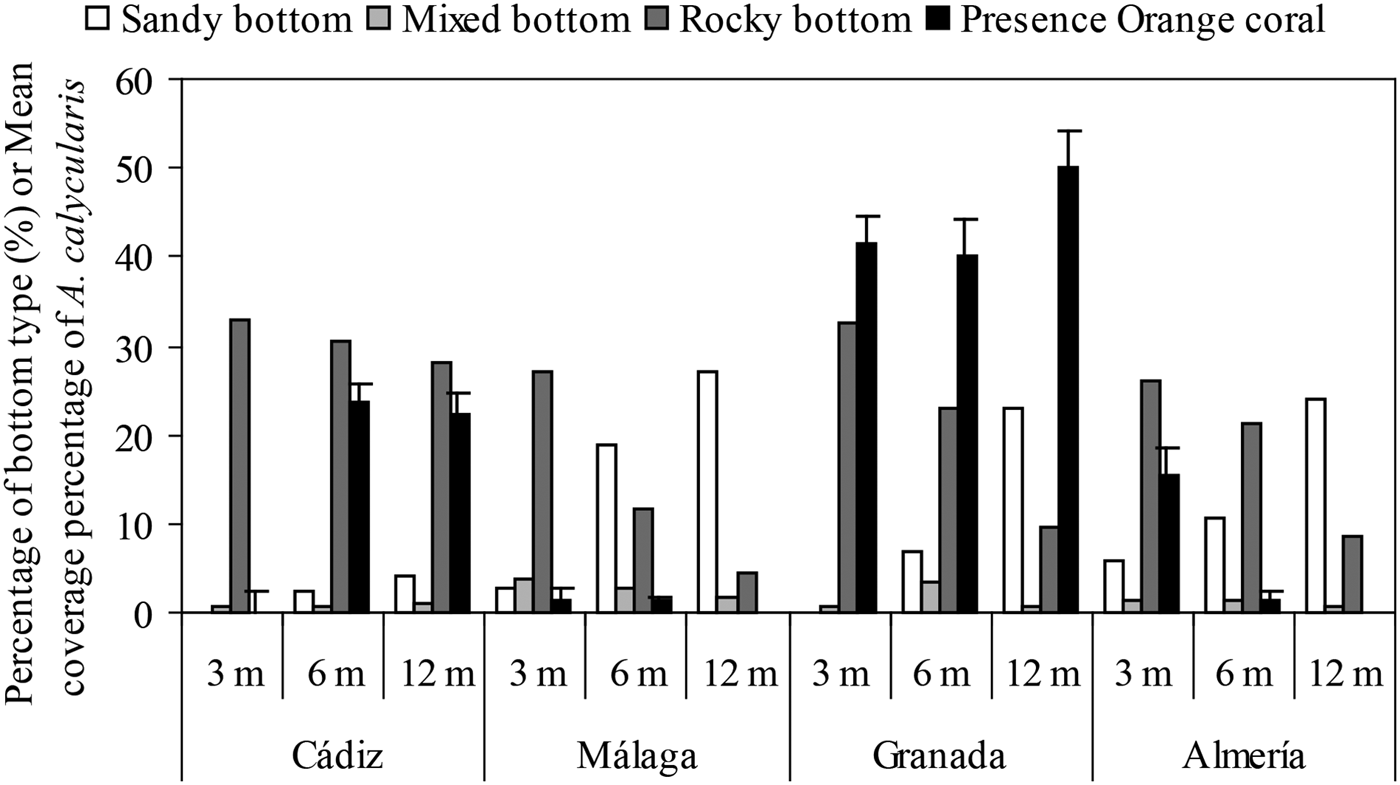
A rocky shore bottom was the most predominant substrata in all provinces, followed by a sandy bottom and, finally, a mixed bottom (66.7, 29.1 and 4.2% respectively). Cádiz showed the greatest coverage for the rocky bottom, followed by Granada, Almería and Málaga. The rocky substrata were predominant at 3 m in all provinces, followed by depths of 6 and 12 m (Figure 3).
Percentage of bottom type per provinces and depth and data of that A. calycularis appeared in the provinces; depths and abundance (mean coverage percentage and standard error of the mean).

Astroides calycularis was present in 135 of the 585 monitoring points studied (Figures 3 & 4). Figure 4 shows the different abundances found in the 135 monitoring points where A. calycularis was found. Cádiz had a mean coverage of 23.11%, with similar values at the different depths studied. However, Granada showed higher abundances, with a mean coverage above 40% and maximum values observed at the deepest points (49.89%).
Presence of Astroides calycularis along the shoreline studied. (A) grey circles show the points sampled; (B) black circles show the A. calycularis presence.

Almería and Málaga were the provinces with the lowest mean coverage: 12.6 and 1.31% respectively. Neither province hosted any populations at 12 m. However, Málaga had similar population coverage at 3- and 6-m depths, while Almería showed a higher mean coverage at 3 m (15.43% for 3 m and 1.25% for 6 m).
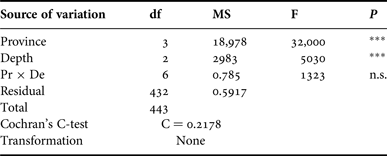
ANOVA analysis showed significant differences between provinces and depths regarding the abundance of A. calycularis coverage, but there were no interactions between the two factors (Table 1). Regarding depth, the highest presence of A. calycularis was found at 3 m, with the presence decreasing at lower depths. The SNK test showed variation between provinces (Table 1), with a break between Cádiz, Granada, and the group formed by Málaga and Almería. This test also showed variation between depths, grouping 0–3 m with 3–6 m and 3–6 m with 6–12 m. Finally, complete data for all the points sampled are provided as a Supplementary Table (Appendix 1).
Two-way ANOVA results for the influence of province and depth on the abundance of Astroides calycularis. Underlined provinces and depths corresponding with homogeneous groups based also on SNK test.

n.s. = not significant, ***P < 0.01
Ca Gr Ma Al 0–3 m; 3–6 m; 6–12 m
Raster analyses showed three areas where well-established populations could be found on the Andalusian coastline (Figure 5). The westernmost area was found to be in the Natural Park of the Strait of Gibraltar (Cádiz), which was also the biggest area. Here the population density was medium. Further east, a small area (which includes the Natural Reserve of Maro-Cerro Gordo) between Málaga and Granada had the highest abundance. The last area was found on the Castell de Ferro cliffs and the nearby area. This was not an MPA but had a high population density. The analysis showed that the population in the Natural Park of the Cape of Gata-Níjar was localized and had low density.
Raster analyses of the three populations well-established on the Andalusian coastal line. Scale density: 0 = absence; >0 < 1 = scarce; >1 < 2 = moderate; >2 < 3 = abundant; >3 < 4 = very abundant.

DISCUSSION
This study has established a current assessment of the distribution and abundance of Astroides calycularis populations in the Iberian Peninsula (in particular, the Andalusian coast). The purpose was to identify a population baseline for future studies. Previous studies in the region have only focused on species distribution (Zibrowius, Reference Zibrowius1980; López-González, Reference López-González1993; Ocaña et al., Reference Ocaña, Sánchez Tocino and López-González2000; Moreno et al., Reference Moreno, De la Linde, Arroyo, López-González, Barea-Azcón, Ballesteros-Duperón and Moreno2008), and only a few have provided abundance data (Cebrián et al., Reference Cebrián, Ballesteros and Canals2000; Moreno et al., Reference Moreno, De la Linde, Remón, De la Rosa, Arroyo, Fernández-Casado, Gómez, Barrajón, Gordillo, Nevado, Barba and Paracuellos2007). Furthermore, none have documented the entire Andalusian littoral zone, only some localities.
Our study area, the Alboran Sea, is a biodiversity hotspot in the Mediterranean Sea (Coll et al., Reference Coll, Piroddi, Steenbeek, Kascher, Lasram, Aguzzi, Ballesteros, Bianchi, Corbera, Dailianis, Danovaro, Estrada, Froglia, Galil, Gasol, Gertwagen, Gil, Guilhaumon, Kesner-Reyes, Kitsos, Koukouras, Lampadariou, Laxamana, López-Fé de la Cuadra, Lotze, Martin, Mouillot, Oro, Raicevich, Rius-Barile, Saiz-Salinas, San Vicente, Somot, Templado, Turon, Vafidis, Villanueva and Voultsiadou2010). However, harbours and enclosures of medium-high to very-high impact (Micheli et al., Reference Micheli, Levin, Giakoumi, Katsanevakis, Abdulla, Coll, Fraschetti, Kark, Koutsoubas, Mackelworth, Maiorano and Possingham2013a) create a fundamental problem of balancing human use with the conservation of nature (Micheli et al., Reference Micheli, Halpern, Walbridge, Ciriaco, Ferretti, Fraschetti, Lewison, Nykjaer and Rosenberg2013b). In this area, urbanization appears to be a high threat to marine ecosystems (Malvárez García et al., Reference Malvárez García, Pollard and Domínguez Rodríguez2000; Costello et al., Reference Costello, Coll, Danovaro, Halpin, Ojaveer and Miloslavich2010). This phenomenon increases pollution, local eutrophication, and water turbidity (Malvárez García et al., Reference Malvárez García, Pollard and Domínguez Rodríguez2000; Chapman, Reference Chapman2003; Mangialajo et al., Reference Mangialajo, Chiantore and Cattaneo-Vietti2008). Shallow marine assemblages (up to 10 m depth) can be considered good indicators of environmental change, because species living at shallow depths are particularly exposed to the impacts of coastal activities and thus tend to exhibit stronger responses to human pressure than assemblages from deeper habitats (Fraschetti et al., Reference Fraschetti, Terlizzi, Micheli, Benedetti-Cecchi and Boero2002). Ocaña et al. (Reference Ocaña, Templado and Templado2009) already reported that A. calycularis is also affected by siltation caused by high coastal urbanization. The fragmented distribution of A. calycularis populations in the Andalusian shores has been clearly demonstrated and is certainly an effect of high urbanization. Interestingly, the three MPAs along the studied coastline enclosed the majority of the populations. Marine reserves have become a highly advocated form of marine conservation (Allison et al., Reference Allison, Lubchenco and Carr1998). Given the high fecundity of many marine organisms, as well as evidence of limited larval dispersal distances, it is likely that reserves are able to maintain their own biodiversity while also servicing nearby non-reserve areas (Halpern & Warner, Reference Halpern and Warner2003). Many invertebrate populations located within the MPAs can act as source populations, as reported by some authors (e.g. Goñi et al., Reference Goñi, Quetglas and Reñones2003; Espinosa et al., Reference Espinosa, Rivera-Ingraham, Maestre, González, Bazairi and Gracía-Gómez2013).
On the other hand, orange coral populations are well established in some coastal zones, such as eastern Granada. These populations are far from urbanized areas and/or present difficulties in terms of access for recreational activities. This distribution pattern could support the hypothesis that A. calycularis is affected by urbanization stress and also, potentially, by high levels of siltation. Furthermore, orange coral could be considered a good indicator of well-oxygenated waters (García-Gómez, Reference García-Gómez2007; Casado-Amezúa, Reference Casado-Amezúa2012). As a consequence, it can be concluded that the species is being increasingly affected by coastal development. In fact, the extremely urbanized coastline of Malaga harbours scarce and isolated populations, suggesting that habitat fragmentation is a major threat to this species and could potentially lead to local extirpation of populations, thereby limiting the gene flow at different scales (Fauvelot et al., Reference Fauvelot, Bertozzi, Constantini, Airoldi and Abbiati2009; Bulleri & Chapman, Reference Bulleri and Chapman2010).
It has already been demonstrated that recreational activities such as scuba diving or fishing can have negative effects on A. calycularis populations, because colonies can be damaged or removed by the impact of fins, hands and other diving equipment parts (Moreno et al., Reference Moreno, De la Linde, Arroyo, López-González, Barea-Azcón, Ballesteros-Duperón and Moreno2008). Lloret et al. (Reference Lloret, Marín, Marín-Guirado and Carreño2006) claimed that orange coral had a middle-level population in a dive-perturbation assessment. However, in Andalusian MPAs, scuba diving is allowed, and prohibitions of certain human activities are not totally effective (Linares et al., Reference Linares, Garrabou, Hereu, Díaz, Marschal, Sala and Zabala2011). In this regard, some regulations such as a maximum number of divers per day could be applied, although the paucity of data and turnover rates for most organisms does not allow a quantitative estimate to be made of diver capacity (Sala et al., Reference Sala, Garrabou and Zabala1996). These management measures could be greatly effective in preserving benthic invertebrate assemblages.
Moreno et al. (Reference Moreno, De la Linde, Remón, De la Rosa, Arroyo, Fernández-Casado, Gómez, Barrajón, Gordillo, Nevado, Barba and Paracuellos2007) reported A. calycularis abundances in some localities of the Andalusian coast. These authors observed the greatest abundances in Cádiz and Granada, reaching densities of 80–85%. We have already observed the highest abundance in these provinces, showing densities of 90–95%, but in Málaga the populations are localized inside MPAs. Nevertheless, these authors observed an abundance that reached 70% in only one locality – in an MPA of Almería. In the same locality, we only found a maximum density of 50%. These populations are isolated and should be monitored to understand their population dynamics and possible threats.
In the last decades, shallow bottoms have been monitored in several studies to evaluate mass mortality events of invertebrate populations in the Mediterranean (e.g. Cebrián et al., Reference Cebrián, Uriz, Garrabou and Ballesteros2011; Sala et al., Reference Sala, Ballesteros, Dendrinos, Di Franco, Ferretti, Foley, Fraschetti, Friedlander, Garrabou, Güçlüsoy, Guidetti, Halpern, Hereu, Karamanlidis, Kizilkaya, Macpherson, Mangialajo, Mariani, Micheli, Pais, Riser, Rosenberg, Sales, Selkoe, Starr, Tomas and Zabala2012; Serrano et al., Reference Serrano, Coma, Ribes, Weitzmann, García and Ballesteros2013). Following Goffredo et al. (Reference Goffredo, Caroselli, Gasparini, Marconi, Putignano, Pazzini and Zaccanti2008), the demographic traits of coral populations may reveal relationships between the organisms and their environment and can be used to assess habitat stability and suitability. Therefore, the populations of this species should be studied in relation to the changes that could appear because of global changes.
Current observations suggest that an increase in the frequency of mass mortality events around the Mediterranean Sea is expected due to global climate change (Vargas-Yáñez et al., Reference Vargas-Yáñez, García, Salat, García-Martínez, Pascual and Moya2008). In fact, Maldonado et al. (Reference Maldonado, Sánchez-Tocino and Navarro2010) have already observed mass mortality events in marine invertebrates along the Andalusian coastline. Mortality associated with these global phenomena can result from increases of 1–2°C above the mean sea temperature in the summer (e.g. Bensoussan et al., Reference Bensoussan, Romano, Harmelin and Garrabou2010; Cebrián et al., Reference Cebrián, Uriz, Garrabou and Ballesteros2011). Therefore, knowledge of abundance and distribution of A. calycularis as a baseline would be of great interest. In this sense, monitoring programmes are an important tool (Calvo et al., Reference Calvo, Simó, Coma, Ribes, Pascual, Sabatés, Gili and Pelejero2011) that will enable scientists to assess the orange coral populations and detect the possible impacts of human activities on the local, regional and global scale. In this way, environmental managers may be able to implement appropriate measures for species conservation.
Connectivity among environmental managers, researchers, NGOs, private agents and citizens is required. Setting up volunteer webs could be a good management tool when the species being studied covers large areas (Bramanti et al., Reference Bramanti, Vielmini, Rossi, Stefano and Santangelo2011). A simple qualitative and/or semi-quantitative sampling methodology will allow for routine collection of data about the targeted species’ presence/abundance. These studies must be accompanied by temperature serial analyses by establishing control stations in MPAs or additional strategic localities. All of these data will show evidence of changes in coastal areas.
The knowledge of population dynamics through time and space is crucial, and therefore, baseline studies are also urgently required in order to implement management measures on the conservation, protection and restoration of endangered habitats and ecosystems.
ACKNOWLEDGEMENTS
Our research was supported by the Regional Government of Andalucía. We also thank the General Office of Marine Protected Areas from the Spanish Estate (National Ministry of Environment). The authors kindly acknowledge L. Moreno and F. Luengo for their help during the fieldwork and Manuel González O'Sullivan for his assistance during the English review process. The authors are grateful to two anonymous reviewers for their useful comments and suggestions, which improved the manuscript.
FINANCIAL SUPPORT
Financial support was provided by the Asociación Hombre y Territorio (http://www.hombreyterritorio.org) and by the Laboratorio de Biología Marina (Departamento de Zoología, Facultad de Biología, Universidad de Sevilla).