Numerous studies have examined the development of infants’ perception of speech sounds from birth (e.g., Eimas, Siqueland, Jusczyk, & Vigorito, Reference Eimas, Siqueland, Jusczyk and Vigorito1971; May, Gervain, Carreiras, & Werker, Reference May, Gervain, Carreiras and Werker2018; Vouloumanos & Werker, Reference Vouloumanos and Werker2007), through the first year of life (e.g., Werker & Tees, Reference Werker and Tees1984), and into the period of lexical development (e.g., White & Morgan, Reference White and Morgan2008). A fundamental characteristic of this development is the narrowing of perceptual capabilities toward the native language(s) during the second half of the first year of life (Pons, Lewkowicz, Soto-Faraco, & Sebastián-Gallés, Reference Pons, Lewkowicz, Soto-Faraco and Sebastián-Gallés2009; Werker & Tees, Reference Werker and Tees1984; Werker, Yeung, & Yoshida, Reference Werker, Yeung and Yoshida2012). This narrowing is shaped by the particular linguistic characteristics of caregiver speech (Cristia, Reference Cristia2011).
While much of the research on the development of early receptive phonology has focused on phoneme discrimination and perceptual narrowing, knowledge of phonotactics – the rules or constraints governing permissible sound sequences – also emerges during this period. Knowledge of phonotactics is posited to play an important role in the development of word segmentation and lexical acquisition (e.g., Estes, Gluck, & Grimm, Reference Estes, Gluck and Grimm2016; Mattys & Jusczyk, Reference Mattys and Jusczyk2001). Specifically, it has been separately argued that phonotactic knowledge aids in the segmentation of the speech stream (e.g., Mattys, Jusczyk, Luce, & Morgan, Reference Mattys, Jusczyk, Luce and Morgan1999) and that infant segmentation ability predicts toddler lexicon size (e.g., Newman, Ratner, Jusczyk, Jusczyk, & Dow, Reference Newman, Ratner, Jusczyk, Jusczyk and Dow2006; Singh, Steven Reznick, & Xuehua, Reference Singh, Steven Reznick and Xuehua2012). Thus, phonotactic knowledge should indirectly impact lexical knowledge. Data seem to support this relationship as recent work shows a clear relationship between phonotactic ability and lexical knowledge. For example, Graf Estes, Gluck, and Grimm (Reference Estes, Gluck and Grimm2016) show there is a clear association between 19-month-olds’ phonotactic knowledge and their vocabulary size.
A cluster of studies in the early 1990s points to a developmental timeline for native language phonotactic patterns, suggesting that native language phonotactics are preferred over non-native phonotactics by 9 months but not 6 months. In one study, using the Headturn Preference Procedure, Dutch- and English-learning infants’ preferences for Dutch and English phonotactic patterns were directly compared (Dutch and English have very similar phonemes but different phonotactics). At 9 months, Dutch-learning infants preferred listening to Dutch phonotactic sequences, while English-learning infants preferred English sequences, but not at 6 months (Jusczyk, Friederici, Wessels, Svenkerud, & Jusczyk, Reference Jusczyk, Friederici, Wessels, Svenkerud and Jusczyk1993). In a related study, English-learning infants’ preferences for frequent and infrequent English phonotactic patterns (e.g., frequent ‘riss’ vs. infrequent ‘yowdge’, both of which are legal phoneme strings in English) were compared (Jusczyk, Luce, & Charles-Luce, Reference Jusczyk, Luce and Charles-Luce1994). Again, 9-month-olds, but not 6-month-olds, preferred the more phonotactically frequent sequence. In a third study, Dutch-learning infants’ preferences for word-initial vs. word-final consonant clusters that were only licit in word-initial (e.g., ‘br’) or word-final position (e.g., ‘ks’) were compared (Friederici & Wessels, Reference Friederici and Wessels1993). As with the previous two studies, 9-month-olds, but not younger infants (6- and 4.5-month-olds) preferred the phonotactically licit sequences.
More recently, the issue of phonotactic knowledge in infants has emerged in the context of discussions about the relative impact of intra-uterine and extra-uterine experience, and maturation, on the development of infant speech perception capabilities, and in particular on the speech perception capabilities of preterm infants. Preterm infants are an informative population to study in this respect because they have more exposure to the full range of speech sounds (vs. the restricted speech sounds heard in utero; e.g. Abrams & Gerhardt, Reference Abrams and Gerhardt2000) when compared with gestational age-matched peers. In general, findings tend to support the idea of maturational constraints on the developing perceptual system – preterm infants acquire phonetic and prosodic knowledge at a rate consistent with gestational age-matched peers (Peña, Pittaluga, & Mehler, Reference Peña, Pittaluga and Mehler2009; Peña, Werker, & Dehaene-Lambertz, Reference Peña, Werker and Dehaene-Lambertz2012). Indeed, one study of very low birth weight preterm infants found evidence that acquisition of a preference for the native-language stress pattern was delayed in these infants (Herold, Höhle, Walch, Weber, & Obladen, Reference Herold, Höhle, Walch, Weber and Obladen2008), consistent with studies finding disadvantages for children born preterm in later language abilities (Barre, Morgan, Doyle, & Anderson, Reference Barre, Morgan, Doyle and Anderson2011; Foster-Cohen, Edgin, Champion, & Woodward, Reference Foster-Cohen, Edgin, Champion and Woodward2007; Foster-Cohen, Friesen, Champion, & Woodward, Reference Foster-Cohen, Friesen, Champion and Woodward2010). In other words, children born preterm are limited by maturational constraints and unable to avail themselves of the earlier access to the full range of speech sounds, and in some cases further disadvantaged even beyond their gestational age-matched peers. However, one study of French-learning infants’ phonotactic knowledge found the opposite – healthy preterm infants performed similarly to birth-age-matched peers (Gonzalez-Gomez & Nazzi, Reference Gonzalez-Gomez and Nazzi2012), suggesting that the preterm infants’ additional extra-uterine experience was not limited by maturational constraints. In this study, preterm and full-term infants were presented with labial coronal (LC, e.g., /pat/, frequent) and coronal labial (CL, e.g., /tap/, infrequent) syllables. For full-term infants, 7-month-olds showed no listening preferences, but 10-month-olds preferred the LC pattern, suggesting that they had learned the phonotatic pattern that was more frequent in French. By contrast, preterm infants age-corrected to 7 months (i.e., maturationally 7 months old but with 10 months of extra-uterine sound experience) behaved like the full-term 10-month-olds.
The current study seeks to expand on this work by examining a different kind of phonotactic regularity, that of sibilant–liquid combinations. In English, the combination of /s/ and /l/ in initial position is permissible and frequent (e.g., it occurs in the word sleep), but /s/ and /r/ is unattested. By contrast, /ʃ/ paired with /r/ is fairly frequent (e.g., it occurs in the word shriek), but /ʃ/ and /1/ is infrequent and found primarily in borrowed words (e.g., the Yiddish word schlep). Sibilants are of particular interest because they should be poorly perceived in utero due to the filtering properties of the uterine environment (Griffiths, Brown, Gerhardt, Abrams, & Morris, Reference Griffiths, Brown, Gerhardt, Abrams and Morris1994). This makes them ideal candidates for studying the relative influence of intra-uterine and extra-uterine experience and maturational effects on infant speech perception. Further, discrimination and production of sibilants is challenging for infants and children (Cristia, Reference Cristia2011; Li, Edwards, & Beckman, Reference Li, Edwards and Beckman2009; Nittrouer, Reference Nittrouer2001), so phonotactic sensitivity which varies from cluster to cluster depending on the identity of the sibilant in question (as well as the liquid) may be slower to mature than other phonotactic sensitivity.
In the current study, we examined preterm and full-term 7-, 9-, 11-, and 14-month-olds’ preferences for frequent and infrequent sibilant–liquid pairs in syllable onset position. We first established whether this phonotactic preference could be found, consistent with the existing literature, at 9 months, and we expanded on this literature by testing two older age groups than in previous work, 11- and 14-month-olds, and a younger group, 7-month-olds. Based on previous findings, we expected to find this preference at 11 and 14 months, but not at 7 months, in full-term infants. Next, we compared the behavior of infants born full term with those born prior to 37 weeks gestation (maturationally matched to their full-term peers) to determine whether, as with the labial–coronal phonotactic regularity (Gonzalez-Gomez & Nazzi, Reference Gonzalez-Gomez and Nazzi2012), preterm infants would show evidence of benefiting from their longer exposure to sibilant–liquid speech sound combinations outside of the uterine environment. We hypothesized that preterm infants who were matched for corrected age to full-term infants (thus having more experience with sibilant–liquid speech sound combinations) would outperform full-term infants by discriminating between common versus uncommon sibilant–liquid sound pairs at an earlier age compared to full-term infants. Finally, we examined whether phonotactic preference as measured in our study was related to vocabulary acquisition as measured by parental report in order to address our secondary question of whether phonotactic ability was related to lexical acquisition. In accordance with previous findings (e.g., Estes et al., Reference Estes, Gluck and Grimm2016), it was hypothesized that infants’ ability to discriminate between frequent and infrequent sibilant–liquid pairs would be related to later vocabulary acquisition.
Methods
Participants
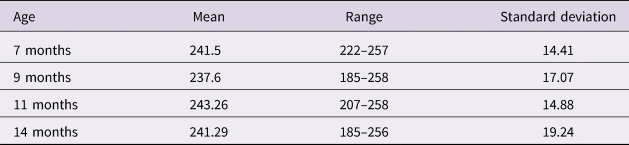
Participants consisted of healthy (at the time of study) full-term and preterm infants from Winnipeg, Canada (see Table 1 for participant demographic summary, and Table 2 for gestational ages at birth for preterm infants). The study was approved by the University of Manitoba Psychology-Sociology Research Ethics Board. Infants who required oxygen after birth were not included in the study, due to lack of oxygen at birth possibly affecting brain development. Infants were from monolingual environments, with no more than 20% of a language other than English occurring in their daily environments.
Participant data with gestationally corrected ages

Preterm infant gestational birth ages in days

The data reported here were part of a larger semi-longitudinal (infants could participate at one or more age-ranges based on parental interest) study with data collected at 5, 7, 9, 11, and 14 months, and ‘follow-up’ measures at 18 months and 24 months. Here we report on data primarily from the 7-, 9-, 11-, and 14-month ranges, and the 18-month follow-up. In terms of the full-term infants, 16 participants were run in both the 9- and 11-month age-groups, five participants were run in both the 9- and 14-month age-groups, and 14 participants completed the 9-, 11-, and 14-month groups. For the preterm infants, one infant participated in both the 7- and 9-month age-groups, four in the 9- and 11-month age-groups, one in the 7- and 14-month age-groups, six in the 9- and 14-month age-groups, three in the 11- and 14-month age-groups, one in the 7-, 9-, and 14-month age-groups, five in the 7-, 9-, and 11-month age-groups, five in the 9-, 11-, and 14-month age-groups, and one in the 7-, 11-, and 14-month age-groups. Overall, the sample was somewhat limited in socioeconomic and ethnic diversity, with the majority identifying as White (70.5% in the full-term group, 58.6% in the preterm group) and the median household income reported as above $90,000 per year for most of the preterm and full-term age-groups.
The preterm infant group was made up of infants born at a gestational age of less than 37 weeks. Infants in both groups (i.e., preterm and full-term) born prior to 40 weeks were corrected to a 40-week gestational age in order to be compared at maturationally similar ages at 7, 9, 11, and 14 months. For data analysis purposes, 43 infants were included in the 7-month full-term group (23 male) and 14 in the 7-month preterm group (5 male). Within the 9-month age-group, 52 full-term (26 male) and 30 preterm (18 male) infants were included. Sixty full-term (24 male) and 21 preterm (12 male) infants were included in the 11-month age-group. Finally, 38 full-term (12 male) and 16 preterm (12 male) infants participated in the 14-month age-group. Prior to any analyses, data from 36 full-term and 15 preterm infants were discarded from the study. In the full-term group, eight 7-month infants, ten 9-month infants, ten 11-month infants, and eight 14-month infants were discarded. Within the preterm group, three 7-month infants, three 9-month infants, six 11-month infants, and three 14-month infants were discarded. Infants were discarded due to: technical problems (preterm: N = 3, full term: N = 2), infant run under the wrong study condition (preterm: N = 1), fussiness (full term: N = 6), infant inattentive during testing (full term: N = 2), infant run outside of their age-range (preterm: N = 10, full term: N = 22), infant deemed unhealthy at birth (preterm: N = 2), or infant exposed to over 20% of a language/dialect other than Canadian English (full term: N = 3).
Research design
The independent variables of this study were gestational age at birth (preterm, full-term), chronological age (7 months, 9 months, 11 months, 14 months), phonotactic regularity (frequent, infrequent), and sibilant sound (/s/, /ʃ/). The dependent variable was the infant's orientation time to frequent and infrequent sound pairings.
Instruments
The Bayley Scales of Infant and Toddler Development–Third Edition (BSID; Bayley, Reference Bayley2006a, Reference Bayley2006b) was administered to infants participating in the current study, typically at their first visit (5 or 7 months) and again at 11 or 14 months and 18 months. Parents were asked to complete the MacArthur-Bates Communicative Development Inventory (MCDI; Fenson, Bates, Dale, Marchman, Reznick, & Thal, Reference Fenson, Bates, Dale, Marchman, Reznick and Thal2007) at 11 or 14 months, and at 18 and 24 months (data from 24 months were not examined due to a smaller response rate). For the purposes of the current study, Part A, which involves a 680-word checklist of words that their infant was able to produce, was examined. Parents of all infants who participated completed a demographic questionnaire with items related to health of the infant, ethnic background, household socioeconomic status (SES), parent education level, and childcare arrangements.
Procedure
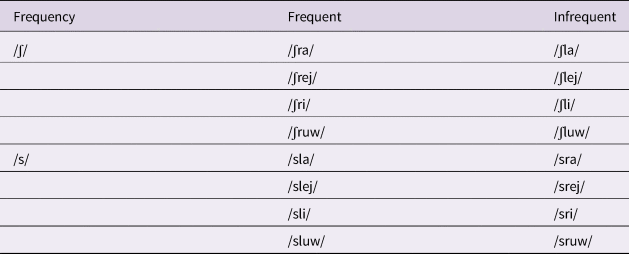
A version of the Headturn Preference Procedure was used to measure the infants’ level of interest in frequent versus infrequent phonotactics (Kemler Nelson, Jusczyk, Mandel, Myers, Turk, & Gerken, Reference Kemler Nelson, Jusczyk, Mandel, Myers, Turk and Gerken1995). Two warm-up trials consisting of classical music were followed by twelve test trials consisting of 3 blocks of the 4 phoneme combinations. Each trial consisted of 4 repeated syllables constructed from the relevant phoneme sequence and a vowel sound. A speaker whose first language was Canadian English recorded all sounds. See Table 3 for a listing of the stimuli used. Using the phonotactic probability calculator (Vitevitch & Luce, Reference Vitevitch and Luce2004) revealed that our two infrequent combinations were both .0000, while frequent /sl/ was calculated at .0041, and frequent /ʃr/ was calculated at .0010. In sum, both frequent phonotactic pairings were higher than infrequent ones, but /sl/ was more frequent than /ʃr/.
Sibilant–liquid sound pairings

During testing, a caregiver sat in the testing booth with his/her child on his/her lap facing forward. There were three computer screens mounted to the walls: one computer screen directly in front of the child (approximately 91.5 cm away from the parent's chair), and two on either side of the child (approximately 51 cm from the parent's chair). A video camera was also connected from below the center monitor (i.e., in front of the child) to a monitor in an adjacent control room where the researcher was located. The caregiver wore Aviator headphones playing music to mask the test stimuli. The researcher, who recorded the child's looking behavior via mouse presses, was also blind to the conditions of the study as no sound from the test booth reached the control room. Before the beginning of each trial, a yellow circle flashed on the center screen. Once the child attended to this screen, a yellow circle then flashed on either the right or left screen. Side order was randomized. Once the child looked at this circle, it was replaced with a picture of a colorful checkerboard, and the audio (syllable repetitions) began to play. Infants’ interest in the audio was measured based on their looking time toward the checkerboard on a given trial. If infants looked away from the screen, the sound stopped. If they looked back toward the screen within 2 seconds, the sound resumed and the trial continued until the maximum trial time of 20 s. A look-away lasting longer than 2 s ended the trial. Trials shorter than 2 s were immediately repeated. Infants who became fussy partway through the test were included in the sample provided they completed at least half of the trials before the procedure was terminated.
Results
Sample characteristics
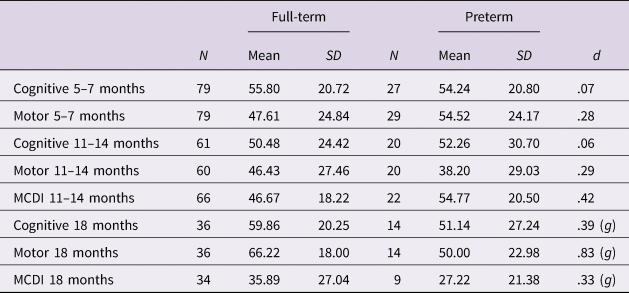
Table 4 provides the BSID cognitive and motor scores, and MCDI scores for full-term and preterm groups, as well as effect sizes. In cases where sample sizes were < 20, Hedges’ g was used as a measure of effect size.
Bayley and MCDI measures

Infant preference for frequent phonotactics at 9 months
Based on prior findings, we first tested whether infants preferred the phonotactically frequent sibilant–liquid sequences at 9 months for the full-term infants. We ran a linear model using RStudio and the lmer function in the lme4 package Version 1.1-21 (Bates, Maechler, Bolker, & Walker, Reference Bates, Maechler, Bolker and Walker2015) with the Type 3 anova function of the lmerTest add-on Version 3.1-0 (Kuznetsova, Brockhoff, & Christensen, Reference Kuznetsova, Brockhoff and Christensen2017), with the following formula:
 $${\rm Looking\ Time} \sim {\rm Frequency} + {\rm Sibilant} + {\rm Frequency}{^\ast}{\rm Sibilant} + {\rm} \lpar {1{\rm} \vert \;{\rm participant}} \rpar $$
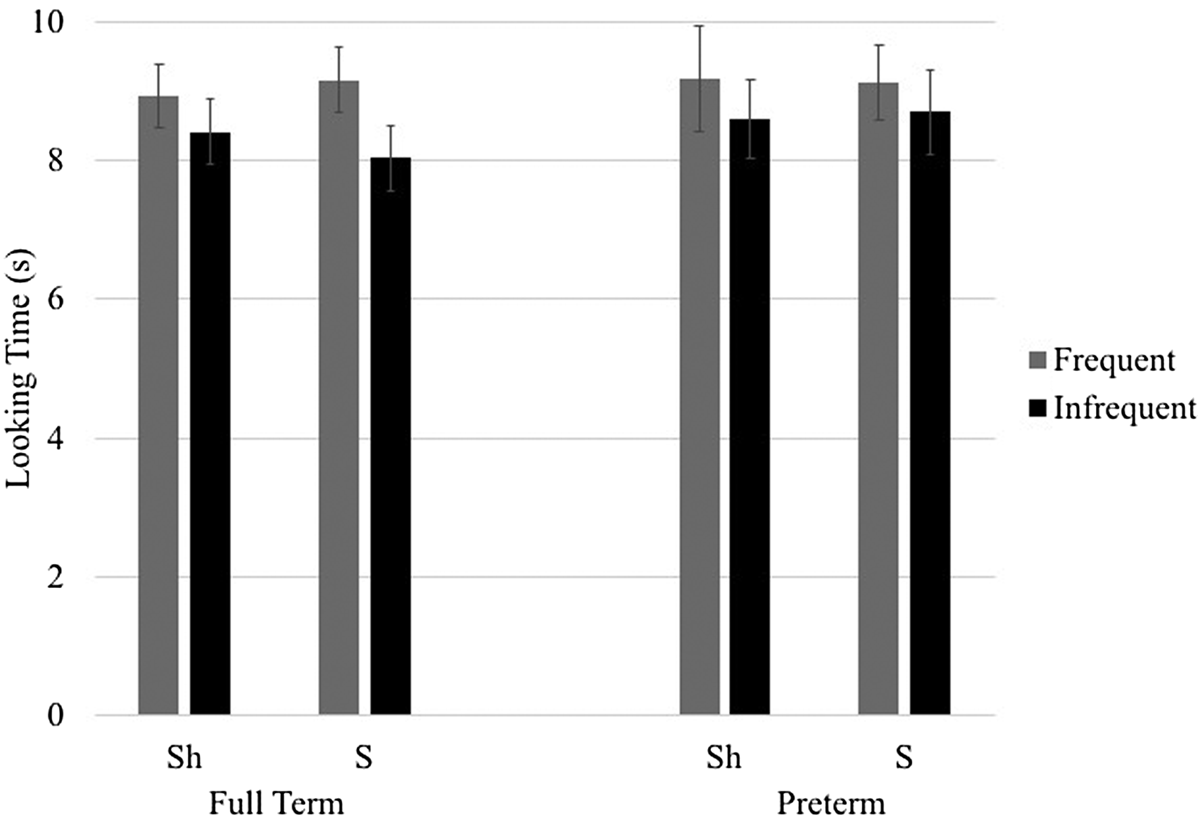
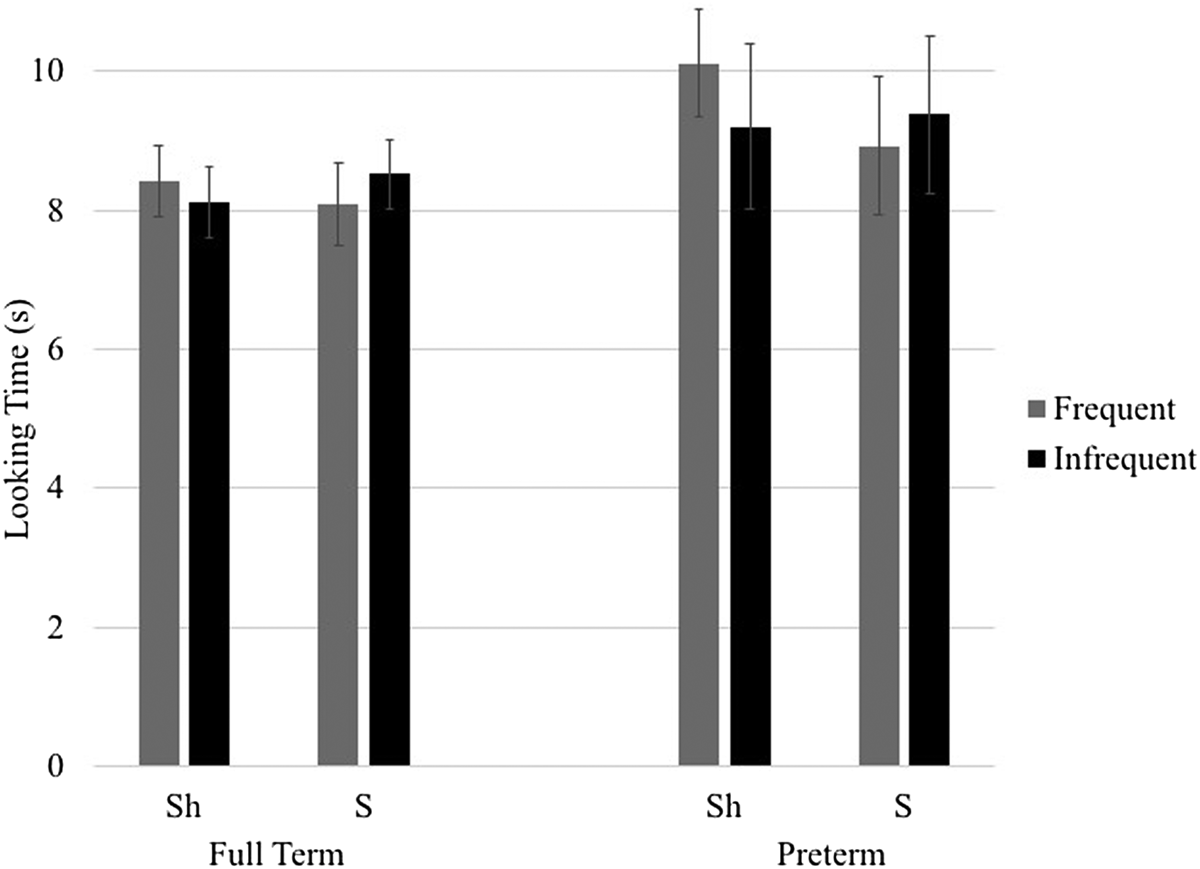
A significant effect of Frequency (phonotactic regularity) was found (F(1) = 7.7, p = .006), suggesting that, at 9 months, full-term infants prefer phonotactically frequent sibilant–liquid sequences (see Figure 1). No effect of sibilant or interaction was found, despite slight differences in the frequency of our two ‘frequent’ phonotactic patterns.
Nine-month full-term and preterm looking time for frequent versus infrequent sibilant–liquid sound combinations.

Developmental trajectory of sibilant–liquid phonotactics
We next examined whether a developmental trajectory could be established for the full-term infants by including the 7-, 11-, and 14-month-olds in the model. The following model was examined:
 $$\eqalign{{\rm Looking\ Time} & \sim {\rm Age} + {\rm Frequency} + {\rm Sibilant} + {\rm age}{^\ast}{\rm Frequency} \cr & \quad+ {\rm Frequency}{^\ast}{\rm Sibilant} + {\rm} \lpar {1{\rm} \vert \; {\rm participant}} \rpar} $$
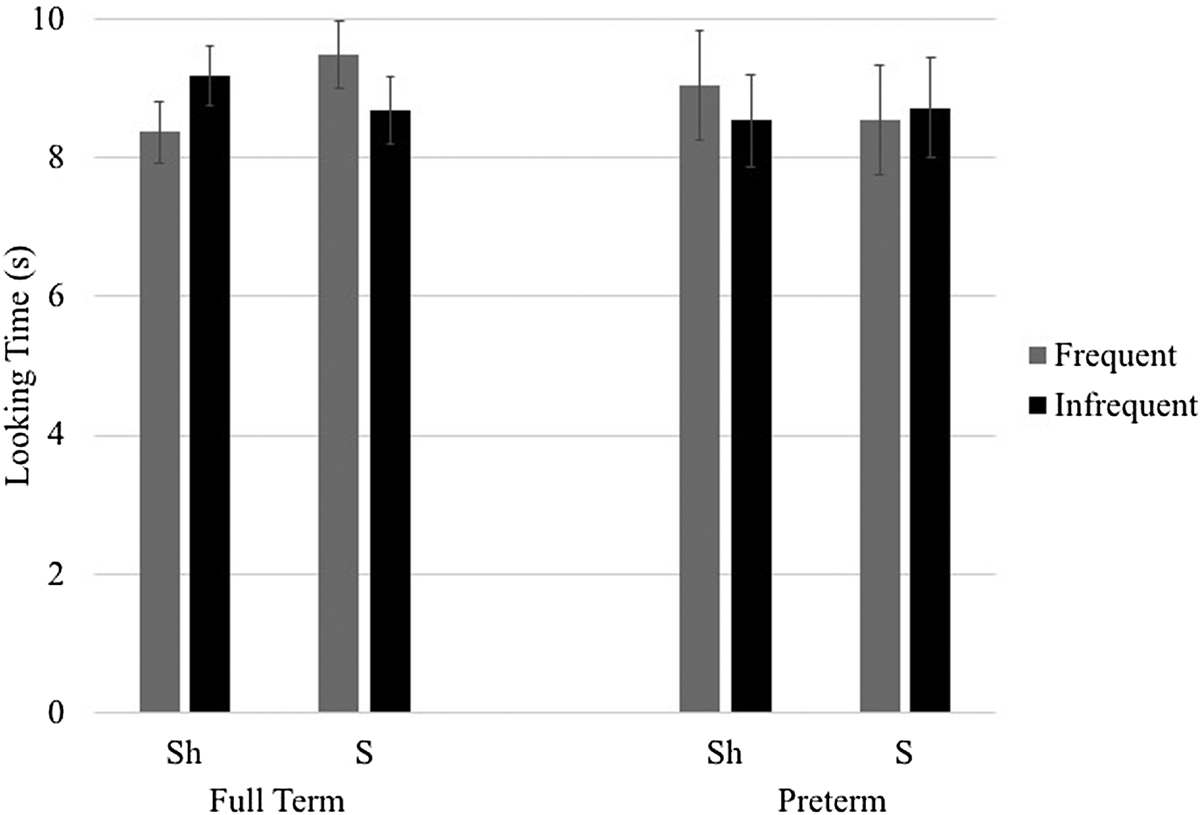
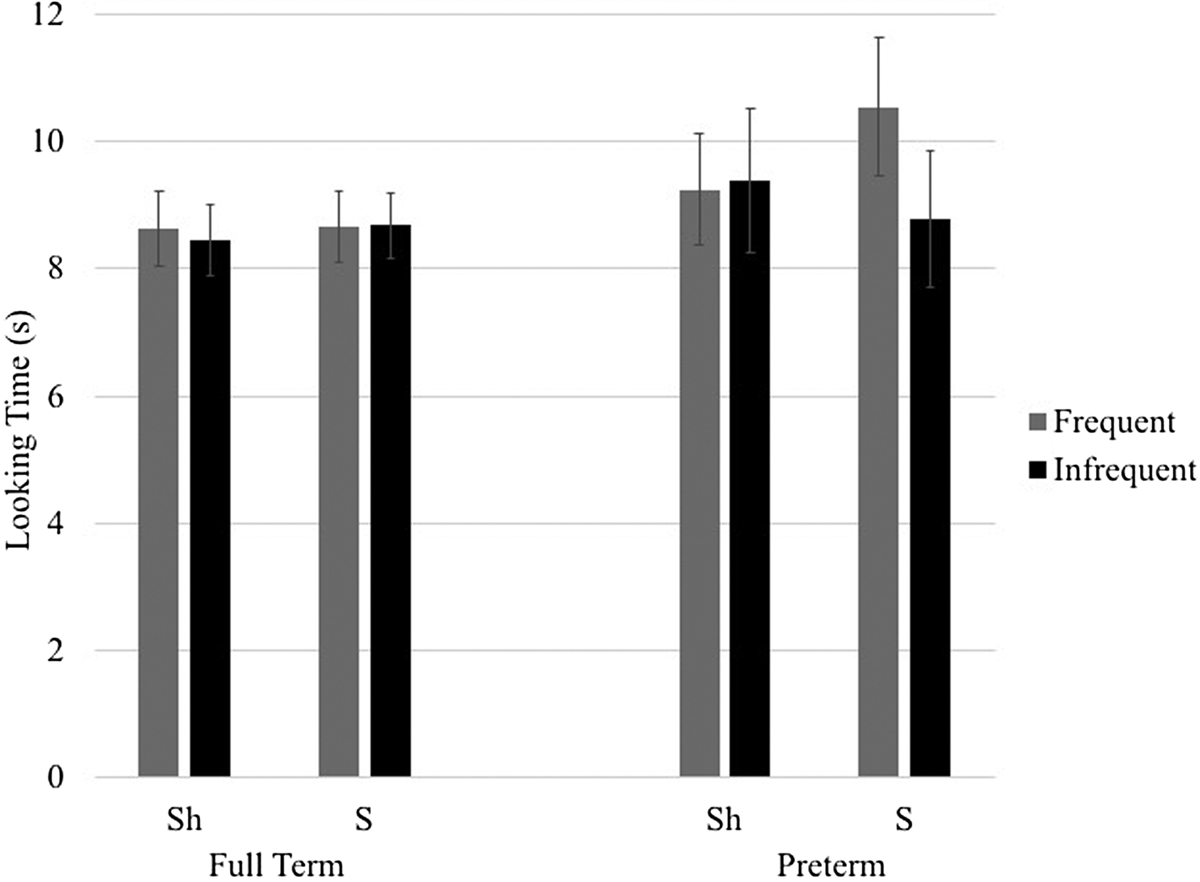
In this model, no significant effects were found, including most notably the interaction effect between Age*Frequency and the main effect of Frequency that was found for the 9-month-olds when analyzed alone. Note that, as this null finding would suggest, parallel separate analyses for 7-, 11-, and 14-month-olds yielded no significant effects aside from an interaction effect of Frequency by Sibilant in the 11-month analysis (further inspection of this interaction effect did not lead to significant effects of Frequency) (see Figures 2–4). In other words, although our original analysis of the 9-month-old data on their own revealed an effect of Frequency, this effect did not emerge in the developmental model, and we are therefore unable to draw any conclusions regarding a developmental trajectory.
Seven-month full-term and preterm looking time for frequent versus infrequent sibilant–liquid sound combinations.

Eleven-month full-term and preterm looking time for frequent versus infrequent sibilant–liquid sound combinations.

Fourteen-month full-term and preterm looking time for frequent versus infrequent sibilant–liquid sound combinations.

Influence of early exposure to sibilants
We next compared the full-term group with our data from preterm infants, first with the 9-month-old group alone and then in the full model. For the 9-month-old analysis, our model was as follows:
 $$\eqalign{{\rm Looking\ Time} & \sim {\rm Gest} + {\rm Frequency} + {\rm Sibilant} + {\rm Gest}{^\ast}{\rm Frequency} \cr & \qquad + {\rm Frequency}{^\ast}{\rm Sibilant} + {\rm} \lpar {1{\rm} \vert \;{\rm participant}} \rpar} $$
As with the analysis with just the full-term infants, we found a significant effect of Frequency. Crucially, there was no interaction effect of gestational age (pre-, full-term) with frequency (high, low) of the phonotactic pattern. However, a separate analysis of only the preterm 9-month-olds (N = 30) did not reveal an effect of Frequency. It would, therefore, be premature to conclude from the null interaction above that preterm infants show the same pattern of preference as full-term infants.
For the all-ages analysis, our model was as follows:
 $$\eqalign{& {\rm Looking\ Time} \sim {\rm Age} + {\rm Gest} + {\rm Frequency} + {\rm Sibilant} + {\rm Gest}{^\ast}{\rm Frequency} \cr &+ {\rm Age}{^\ast}{\rm Frequency} + {\rm Age} {^\ast}{\rm Gest}{^\ast}{\rm Frequency} + {\rm Frequency}{^\ast}{\rm Sibilant} + {\rm} \lpar {1{\rm} \vert \,{\rm participant}} \rpar } $$
No significant effects were found.
Relationship between sensitivity to phonotactic frequency, vocabulary size, and general cognition
To examine whether achievement on our 18-month measures were related to sensitivity to the frequency of sibilant–liquid phonotactics, full-term infants who participated in the main study at 9 months and whose caregivers contributed measures at 18 months were included (N = 21). (This analysis could not be run with the preterm infant group as the sample size was too low (N = 8).) We conducted a stepwise regression to examine the relationship between the Bayley Cognitive percentile scores at 18 months and MCDI percentile scores at 18 months to a listening preference to the frequent pattern at 9 months. Thus, we used a preference score calculated by dividing listening times to the frequent pattern by the sum of the listening times to the frequent and infrequent pattern for each child at 9 months. Results revealed that neither MCDI nor Bayley cognitive percentile scores were related to this preference score (Fs < 0.22, ps > .79). Thus, it appears that, contra our prediction, there was not a relationship between phonotactic sensitivity and later lexicon size.
Discussion
Findings
The 9-month full-term group significantly preferred frequent to infrequent sibilant–liquid sound pairings. This result is consistent with findings from previous studies that have outlined that typically developing infants will begin to show native-like phonotactics by roughly 9 months of age (e.g., Friederici & Wessels, Reference Friederici and Wessels1993; Jusczyk et al., Reference Jusczyk, Luce and Charles-Luce1994), but adds to this literature by showing that this is true for even difficult to discriminate sounds (sibilants are challenging to perceive (Nittrouer, Reference Nittrouer2001), but not liquids (Kuhl, Stevens, Hayashi, Deguchi, Kiritani, & Iverson, Reference Kuhl, Stevens, Hayashi, Deguchi, Kiritani and Iverson2006) and sound-pairs that are not well perceived in utero (Griffiths et al., Reference Griffiths, Brown, Gerhardt, Abrams and Morris1994) and so would show little benefit from in-utero experience. Thus, given the difficulty of discrimination of these sounds, and the unlikelihood of infants getting a ‘leg up’ on learning these phonotactic patterns by beginning to perceive these sounds in utero, we might have predicted a protracted development for these phonotactic pairs, just based on experience-driven predictions. The similarity of the timeline for these pairings as compared to other, easier to perceive pairings, is thus informative and motivates future work exploring whether all pairings follow the same timecourse in development which could strengthen maturation- as opposed to experience-driven accounts.
Surprisingly, we were not able to find evidence of a preference at any other age-group. While a lack of preference at 7 months was predicted, since it is before the age where a preference for native phonotactics is usually reported, a lack of preference at 11 and 14 months is unexpected, especially in light of the difficulty in perception of the sounds in our pairings highlighted above. It is important to note that we did not see either a main effect (i.e., preference for the frequent phonotactic form) or an interaction with Age, so our finding with respect to age is difficult to interpret. If the lack of preference at 11 and 14 months is a true null finding, it may be attributed to infants’ attention to other emerging skills, such as growth of the lexicon (see similar results regarding shifts in infants’ perception in Stager & Werker, Reference Stager and Werker1997), but only future work can help tease this out.
As we did not see any evidence of preterm infants ‘outperforming’ their full-term peers, we did not find support for the hypothesis that preterm infants would be able to make use of the extra ex-utero experience with sibilant–liquid sound pairs (although, see below). Neither did we see explicit evidence for a preterm disadvantage. However, since the preterm infants did not show a statistically significant preference for frequent sound patterns when analyzed on their own, it is possible that the small sample size was simply not sufficient to detect effects.
Finally, we did not find evidence of a relationship between performance on the MCDI at 18 months and achievement on discriminating frequent from infrequent sibilant sound pairings at 9 months. That is, infants who scored higher on the MCDI were not significantly more likely to spend more time listening to frequent sibilant sound pairs (therefore successfully discriminating between frequent and infrequent sound pairs). This null result is unexpected given the relationship that previous studies have established between phonotactic ability and lexicon size (e.g., Graf Estes et al., Reference Graf Estes, Gluck and Grimm2016, find a relationship between concurrent phonotactic sensitivity and lexicon size at 19 months). One possible explanation for this null result is that as we only hypothesize that phonotactics are indirectly related to vocabulary (i.e., phonotactics help segmentation, which in turn aids in the development of the lexicon), such indirect relationships would likely result in small effects, which might require a much larger sample size to detect.
Limitations
Although one of our original goals had been to examine the possibility that preterm infants might benefit from additional extra-uterine experience, many of the preterm infants in our sample were ‘late preterm’ births, born between 34 and 36 weeks’ gestation (Committee on Obstetric Practice, 2008; see ‘Appendix’ for a listing of all uncorrected ages for both preterm and full-term age-groups), meaning that these infants may have had only a few weeks’ difference in extra-uterine experience from gestational age-matched full-term infants. If a larger gap was obtained in experience between preterm and full-term samples that were matched for maturation, we may have been better able to measure experience-driven effects on a preference for sibilant–liquid sound pair frequency. For example, Gonzalez-Gomez and Nazzi (Reference Gonzalez-Gomez and Nazzi2012) tested preterm participants who were born earlier compared to our sample of preterm infants, and found that these infants were outperforming their gestationally matched full-term peers in responding to sounds unable to be heard in utero. A second limitation is that infants in our sample were from a relatively high socioeconomic status. This, and the lack of ethnic diversity in our sample, limit the generalizability of our findings. Finally, due to a lack of preregistration of the analyses and our power limitations as discussed above, this study's findings should be considered exploratory in nature.
Future research and conclusions
Despite these limitations, this study adds to the literature examining the development of phonotactic knowledge in both full-term and preterm infants. Our findings provide additional support for the notion that knowledge of phonotactics is evident at 9 months. Additionally, it provides some support for the possibility that preterm infants acquire this knowledge at a similar rate to that of their gestational age-matched full-term peers. Last, we did not find evidence that this developing knowledge predicts later vocabulary development. While necessarily tentative, our findings provide an initial starting point for future research on this topic. Examining both full-term and preterm infants’ knowledge of other phonetic and phonotactic properties of the language that both can, and cannot, be detected in utero, will be crucial in developing an understanding of the relative role of maturational and experiential influences on infant speech perception.
Acknowledgments
We would like to thank the participating families and the members of the Baby Language Lab, especially Lindsay Bacala, Robin O'Hagan, Jacquelyn Klassen, Alex Holt, and Laurisa Adams. We would also like to thank Manitoba Health for their assistance with participant recruitment. The results and conclusions are those of the authors and no official endorsement by Manitoba Health is intended or should be inferred. This research was funded by the University of Manitoba, an operating grant from the Children's Hospital Research Institute of Manitoba, and NSERC Discovery grant 371683–2010 to the second author. A portion of this research is reported as part of an unpublished Master's thesis by the first author.
Appendix