

Introduction
Sinus node dysfunction is a frequent cardiac disorder in the elderly that may occur because of intrinsic causes (abnormality of impulse generation/formation or propagation because of age-related fibrosis, coronary artery disease, etc.) or extrinsic causes (pharmacologic agents, electrolyte imbalances, autonomic nervous system dysfunction, hypothyroidism, hypothermia, etc.). Electrocardiogram (ECG) manifestations include sinus bradycardia, sinus arrest, sinoatrial block, atrial fibrillation with slow ventricular response and bradycardia-tachycardia syndrome. More than one manifestation can occur in the same patient on different occasions (Reference Adán and Crown1). In the present case, antipsychotic agents were suspected of inducing sinus node dysfunction.
Case report
A 53-year-old woman was referred to the cardiology department with severe fatigue and a slow heart rate. Her past medical history included lumbar spondylosis, hyperlipidemia, bipolar affective disorder, post-thyroidectomy (20 years previously) and L-thyroxin substitution therapy. Her medications included lithium carbonate (250 mg b.i.d.), carbamazepine (200 mg q.d.), quetiapine (200 mg q.d.), atorvastatin (40 mg), levothyroxin (150 μg), clonazepam (1-1-2 mg), cinolazepam (40 mg). Previous ECG records showed normal sinus rhythm 7 and 6 months before the admission.
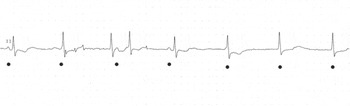
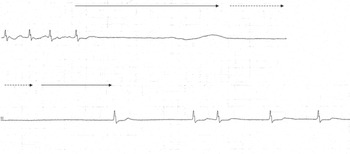
Her physical examination was remarkable for obesity (body mass index 31.9), tremor and bradycardia with a heart rate of 45 beats per minute. A complete blood count, repeated serum troponin T, serum electrolyte levels measurements, and tests of kidney, liver and thyroid function all showed normal. An ECG on admission showed sinus bradycardia and junctional escape rhythm. Mobitz II type second degree sinoatrial block was later observed (Figs 1 and 2). She was admitted to a coronary care unit to permit continuous ECG monitoring. One hour later temporary pacing was applied using an external transvenous pacemaker because of the evolving symptomatic 7-second-long sinus arrest (Fig. 3).
Sinus bradycardia with junctional escape rhythm and atrioventricular dissociation. P waves are signed.

Mobitz II type second degree sinoatrial block.

Sinus arrest (7 s) followed by junctional escape rhythm (parts of continuous electrocardiogram).

A transthoracic echocardiogram showed left ventricle hypertrophy, normal left ventricle size and systolic function with an estimated ejection fraction of 69%, mild left atrial enlargement (42 mm) and mild aortic valve regurgitation, without significant wall motion abnormalities.
Because the patient attempted suicide 2 years earlier, giving up lithium was inadvisable. Lithium's antisuicidal effect is independent from its mood-stabilising property; and lithium evidently lowers suicide mortality even in moderate and poor responders (Reference Ahrens and Müller-Oerlinghausen2). Whereas suicide-prevention effects have not been shown for long-term anticonvulsant treatment (Reference Müller-Oerlinghausen, Berghöfer and Ahrens3). Consequently, carbamazepine administration was discontinued. Normal sinus rhythm gradually returned in 2 days, with a heart rate of 70 bpm. The temporary pacemaker was switched off on the third day. Continuous ECG monitoring showed stable sinus rhythm during the following days until the patient was discharged. ECG showed negative T waves in leads I, II, V2-5, but the exercise stress test results and thallium scans did not reveal significant coronary artery disease. Therefore, these repolarisation abnormalities could be in connection with a transient change in the direction of cardiac activation because of ventricular pacing that might persist for a while after the end of pacing (cardiac memory phenomenon). The patient was discharged in a good general condition after 9 days, she did not consent to coronary angiography. A cardiology control examination found normal sinus rhythm 3 months later.
Five months after the first episode, she was readmitted to the cardiology department because of palpitation and fatigue from the day before. Ten days prior to admission, 200 mg ketoconazole once per day had been initiated for intertrigo under the breasts. At that time her medications included lithium carbonate (500 mg b.i.d.), escitalopram (10 mg), quetiapine (200 mg q.d.), amiloride (5 mg), hydrochlorothiazide (50 mg), acetylsalicylic acid (100 mg), levothyroxin (150 μg), clonazepam (0.5-0.5-3 mg), cinolazepam (40 mg) and ketoconazole (200 mg). Her physical examination and laboratory test findings were within normal limits.
In the coronary care unit, continuous ECG monitoring was carried out that revealed intermittent sinus bradycardia with a heart rate of 45 bpm. Occasional episodes of sinus arrest (with a maximum of 2.6 s) also occurred with junctional escape beats followed by short episodes of atrial fibrillation or atrial tachycardia (Fig. 4).
Sinus bradycardia and two junctional escape beats. The second one is followed by an episode of atrial fibrillation.

Ketoconazole was discontinued. The patient's mental status did not allow giving up her antipsychotic or antidepressant therapy. Temporary pacing was not necessary at this time, sinus rhythm with a heart rate of 60 bpm returned in 1 day and remained stable. Four days later, she was discharged in a good condition. Because cessation of the antipsychotic and antidepressant therapy was not possible, one month later a permanent VVI pacemaker was implanted to prevent subsequent bradyarrhythmia episodes.
Discussion
This patient presented two episodes of symptomatic sinus node dysfunction with different ECG manifestations (sinus bradycardia, Mobitz II second degree sinoatrial block, sinus arrest and tachycardia-bradycardia syndrome). Though not fully ruled out, intrinsic causes were unlikely because of the relative young age, negative history for angina pectoris and normal results with noninvasive tests (echocardiography, exercise stress test, and thallium scan) that did not show coronary artery disease. Thyroid stimulating hormone was in the normal range with substitution, excluding hypothyroidism as a cause. The patient was not on medication with well-known sinus node function affecting action (digitalis, beta-blockers, non-dihidropyridine calcium channel blockers and antiarrhythmic drugs) but her medications included psychotropic agents that might explain the bradycardia.
Lithium carbonate is frequently used for the treatment of manic-depressive disorders, without significant cardiotoxicity in most patients. However, chronic lithium therapy has been associated with a wide range of cardiac side effects, including asymptomatic electrocardiographic changes, sinoatrial and atrioventricular conduction disturbances, tachyarrhythmias, myocarditis and congenital heart disease (Reference Brady and Horgan4). Reversible T-wave flattening and subclinical or symptomatic sinus node dysfunction are the most frequently reported cardiac abnormalities. Conduction abnormalities may occur even at subtherapeutic serum lithium levels (Reference Shiraki, Kohno, Saito, Takayama and Fujimoto5).
Carbamazepine, a drug used primarily for the treatment of epilepsy, neuralgias and bipolar disorder, was also reported to exert cardiac side effects. Sinus node dysfunction, atrioventricular block and bradycardia-tachycardia syndrome have been observed during carbamazepine treatment when used alone or when coadministered with lithium (Reference Johnson, Rivera and Jiménez6–Reference Steckler8). The mechanism is unclear, though, in animal models, carbamazepine was shown to block cardiac Na+ channels in a frequency-independent manner (Reference Mestre, Djellas, Carriot and Cavero9). Most case reports describe bradyarrhythmias in elderly women even at therapeutic carbamazepine serum levels (Reference Kasarskis, Kuo, Berger and Nelson10).
Quetiapine, an atypical antipsychotic agent, is usually well tolerated and possesses minimal proarrhythmic effects (Reference Gareri, De Fazio, De Fazio, Marigliano, Ferreri Ibbadu and De Sarro11). However, QTc prolongation and first-degree atrioventricular block were reported with quetiapine overdose (Reference Gajwani, Pozuelo and Tesar12,Reference Nudelman, Vinuela and Cohen13). Moreover, sinus bradycardia has been observed in two quetiapine-treated patients without QT interval prolongation (Reference Janse and Marijnissen14,Reference Chou, Lin, Lee, Lan and Chan15). Quetiapine is extensively metabolised by the cytochrome P450 system, primarily by CYP3A (Reference Bakken, Rudberg, Christensen, Molden, Refsum and Hermann16). Concomitant administration with ketoconazole, a potent CYP3A4 inhibitor, may lead to a significant reduction in the first-pass metabolism and hepatic clearance of quetiapine and thus potentially increase adverse effects. Coadministration of ketoconazole increased mean Cmax of quetiapine by 3.35-fold and decreased its clearance by 84% in vivo(Reference Grimm, Richtand, Winter, Stams and Reele17). Ketoconazole is also an inhibitor of P-glycoprotein (Pgp) and may increase plasma concentrations of Pgp substrates (Reference Wang, Lew, Casciano, Clement and Johnson18). Quetiapine has been suggested to be a substrate for this transporter (Reference Boulton, Devane, Liston and Markowitz19). On the contrary, Grimm et al. showed that quetiapine is not a substrate of Pgp (Reference Grimm, Richtand, Winter, Stams and Reele17). Therefore, the interaction is likely to take place only on the metabolic level.
On the other hand, coadministration of carbamazepine, a potent CYP3A4 inductor, leads to a decrease in serum levels and clinical efficacy of quetiapine (Reference Grimm, Richtand, Winter, Stams and Reele17). In the present case, discontinuation of carbamazepine after the first episode might also have increased quetiapine serum levels.
Selective serotonin reuptake inhibitors (SSRIs) are the first line therapy for depression and anxiety because of their tolerability. In contrast to tricyclic antidepressants, long-term SSRI therapy is not associated with an elevated risk of cardiovascular disease (Reference Kemp20). However, among other SSRIs, citalopram, and its more effective S-enantiomer, escitalopram, can exert cardiotoxic effects, probably because of the inhibition of cardiac Na+, Ca2+and K+ channels (Reference Hamplova-Peichlova, Krusek, Paclt, Slavicek, Lisa and Vyskocil21,Reference Pacher, Ungvari, Nanasi, Furst and Kecskemeti22). Citalopram induced bradycardia has been reported in overdose or at therapeutic doses in the elderly (Reference Padala, Padala and Wengel23). Beyenburg et al. presented a case of severe bradycardia caused by a single small dose (5 mg) of escitalopram (Reference Beyenburg and Schönegger24). Escitalopram is metabolised by CYP2C19, CYP2D6 and CYP3A4 (Reference Rao25). Though theoretically concomitant therapy with CYP3A4 inhibitor ketoconazole might have resulted in an increased plasma concentration of escitalopram that is not likely because of the several metabolic pathways of the antidepressant agent.
Patients with severe mental illness often require long-term treatment with a combination of psychotropic drugs. However, as far as possible, polypharmacy should be avoided to prevent dangerous interactions. If concomitant use of potentially cardiotoxic agents is necessary, clinicians should routinely monitor the ECG at least at baseline and after initiation of a new drug. Moreover, if the cardiotoxic drug is a CYP substrate, dose titration is also advisable after initiation of a potent CYP inhibitor.