INTRODUCTION
Climate and hominin evolution
Southern Africa is recognized as a region in which past climate changes may have played a role in modern human behaviour (Lahr and Foley, Reference Lahr and Foley1998; Potts, Reference Potts1998; Mellars, Reference Mellars2006; Campisano and Feibel, Reference Campisano and Feibel2007; Field et al., Reference Field, Petraglia and Lahr2007; Hughes et al., Reference Hughes, Haywood, Mithen, Sellwood and Valdes2007; Maslin and Christensen, Reference Maslin and Christensen2007; Scholz et al., Reference Scholz, Johnson, Cohen, King, Peck, Overpeck and Talbot2007; Trauth et al., Reference Trauth, Larrasoaña and Mudelsee2009; Compton, Reference Compton2011; Thomas et al., Reference Thomas, Burrough and Parker2012; Ziegler et al., Reference Ziegler, Simon, Hall, Barker, Stringer and Zahn2013). However, paleoclimate records for sub-Saharan Africa are scarce, seldom well dated, and often contradictory. There are problems with correlating terrestrial and marine records and southern hemisphere climate data with those from northern latitudes, which experience different temperature regimes and monsoon patterns (Chase and Meadows, 2007; Maslin and Christensen, Reference Maslin and Christensen2007; Gasse et al., 2008; Chase, 2010; Chase et al., 2010; Blome et al., 2012). Over the last few years, this record has been enriched by the analysis of speleothems (Bar-Matthews, Reference Bar-Matthews, Marean, Jacobs, Karkanas, Fisher, Herries and Brown2010), hyrax middens (Lim et al., Reference Lim, Chase, Chevalier and Reimer2016), and marine pollen and microcharcoal sequences (Dupont et al., Reference Dupont, Caley, Kim, Castañeda, Malaizé and Giraudeau2011; Daniau et al., Reference Daniau, Sánchez Goñi, Martinez, Urrego, Bout-Roumazeilles, Desprat and Marlon2013; Urrego et al. Reference Urrego, Sanchez Goñi, Daniau, Lechevrel and Hanquiez2015). These sequences have shown that orbital-scale warm phases in the northern hemisphere between 160 ka and 40 ka (Marine Isotope Stage [MIS] 6-3) are marked in the western-central part of southern Africa by the expansion of semi-desert and decrease in fire regime, indicating an increase in summer aridity (Daniau et al., Reference Daniau, Sánchez Goñi, Martinez, Urrego, Bout-Roumazeilles, Desprat and Marlon2013; Urrego et al., Reference Urrego, Sanchez Goñi, Daniau, Lechevrel and Hanquiez2015). Ziegler et al. (Reference Ziegler, Simon, Hall, Barker, Stringer and Zahn2013) have identified millennial-scale humid events during the last glacial period (MIS 4-2, 73 ka to 15 ka) from a marine sedimentary sequence collected at ~95 km off the mouth of the Great Kei River on the Eastern Cape coast. The comparison of this paleoclimatic sequence with the Middle Stone Age (MSA) archaeological record has recently led these authors to propose that major cultural innovation pulses coincided with abrupt climate change towards humid conditions in southern Africa (Ziegler et al., Reference Ziegler, Simon, Hall, Barker, Stringer and Zahn2013). Increase in moisture would have multiplied water sources, mammalian and plant resources, and stimulated human population growth. Recent environmental data obtained from archaeological sites of the Southern Cape coast have been instead used to argue (Roberts et al., Reference Roberts, Henshilwood, van Niekerk, Keene, Gledhill, Reynard, Badenhorst and Lee-Thorp2016) that climate did not trigger the cultural and technological innovations of the southern African MSA (personal ornaments, abstract engravings, ochre use, bone tools, pressure flaking, and pyrotechnology). Chronological uncertainties in 14C and Optically Stimulated Luminescence (OSL) dating challenge an accurate correlation between terrestrial and marine records (Jacobs et al., Reference Jacobs, Roberts, Galbraith, Deacon, Grün, Mackay, Mitchell, Vogelsang and Wadley2008; Jacobs and Roberts, Reference Jacobs and Roberts2009; Tribolo et al., Reference Tribolo, Mercier, Valladas, Joron, Guibert, Lefrais and Selo2009, Reference Tribolo, Mercier and Valladas2005, Reference Tribolo, Mercier, Douville, Joron, Reyss, Rufer and Cantin2013). In addition, the virtual absence of climate records and well-preserved MSA sites for the interior of southern Africa makes it difficult to verify whether the inferred trend, almost exclusively supported by coastal sites, is also valid for inland sites.
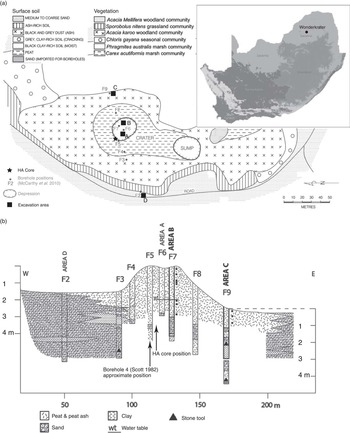
To fill this gap we have conducted a new pollen analysis on contemporaneous MSA levels at Wonderkrater, an open-air site located in inland southern Africa, 160 km north of Pretoria in Limpopo Province (Fig. 1). Wonderkrater is a spring site, which has yielded, like Florisbad (Dreyer, Reference Dreyer1938; Brink Reference Brink1987; Kuman et al. Reference Kuman, Inbar and Clarke1999; Scott and Nyakale Reference Scott and Nyakale2002), important environmental, archaeological, paleontological and archeobotanical remains (e.g., Scott, Reference Scott1982a, Reference Scott1999; Backwell et al. Reference Backwell, McCarthy, Wadley, Henderson, Steininger, Barré and Lamothe2014). Wonderkrater provides a window to understand the impact of climate and environmental changes on human occupation, and a means by which to evaluate to what extent subsistence strategies and cultural adaptations of populations living far from the coast were different from those of coastal populations having at their disposal a range of aquatic resources such as shellfish, sea mammals and, to some extent, fish (e.g., Deacon and Deacon, Reference Deacon and Deacon1999; Marean et al., Reference Marean, Bar-Matthews, Bernatchez, Fisher, Goldberg, Herries and Jacobs2007; Clark and Plug, Reference Clark and Plug2008; Marean, Reference Marean2010a, Reference Marean2010b; Will et al. Reference Will, Kandel, Kyriacou and Conard2016).
(a) Map of southern Africa showing the location of Wonderkrater (modified after Barré et al., Reference Barré, Lamothe, Backwell and McCarthy2012) and subsurface soil map of the site showing the position of excavation areas and core HA along the F-line transect (modified after Backwell et al., Reference Backwell, McCarthy, Wadley, Henderson, Steininger, Barré and Lamothe2014). (b) Cross-sectional reconstruction of subsurface stratigraphy of the mound obtained through sediment cores bored along the F-line, and approximate position of core HA (modified after McCarthy et al., Reference McCarthy, Ellery, Backwell, Marren, De Klerk, Tooth, Brandt and Woodborne2010).

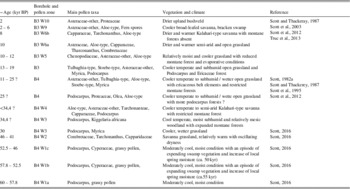
Wonderkrater has provided a record of the vegetation and, by inference, the climate of this region (Table 1), until recently thought to extend back for at least the past 34 ka (Scott Reference Scott1982a, Reference Scott1999; Scott and Vogel Reference Scott and Vogel1983; Scott and Thackeray Reference Scott and Thackeray1987, Scott et al. Reference Scott, Steenkamp and Beaumont1995). Earlier palynological results have been reinterpreted (Scott et al. Reference Scott, Holmgren, Talma, Woodborne and Vogel2003, Reference Scott, Neumann, Brook, Bousman, Norström and Metwally2012; Truc et al. Reference Truc, Chevalier, Favier, Cheddadi, Meadows, Scott, Carr, Smith and Chase2013; Chevalier and Chase Reference Chevalier and Chase2015), and recent excavation and dating of the deposits (McCarthy et al. Reference McCarthy, Ellery, Backwell, Marren, De Klerk, Tooth, Brandt and Woodborne2010; Barré et al. Reference Barré, Lamothe, Backwell and McCarthy2012; Backwell et al. Reference Backwell, McCarthy, Wadley, Henderson, Steininger, Barré and Lamothe2014) has led to a review of the pollen sequence and a new interpretation of the pollen data being proposed (Scott Reference Scott2016). By applying probability density functions to the last 20 ka of the Wonderkrater pollen sequence, Truc et al. (Reference Truc, Chevalier, Favier, Cheddadi, Meadows, Scott, Carr, Smith and Chase2013) found that, during both the warm and cold seasons, the last glacial maximum and Younger Dryas temperatures were 6±2°C colder than the Holocene, with summer precipitation 50% lower than in the Holocene. Using a similar approach, Chevalier and Chase (Reference Chevalier and Chase2015) identify at Wonderkrater a decrease of 2° C across the second part of MIS 3 (ca. 45–27 ka). In his new contribution, Scott (Reference Scott2016) supersedes his previous interpretations and proposes, based on a comparison with the Tswaing pollen sequence, that between ca. 60 and ca. 46 ka moderately cool and moist conditions characterised the regional climate. An expansion of savanna grassland, suggesting relatively warm and dry conditions, would have occurred between ca. 46 ka and 41 ka, followed by a gap of ca.10 ka, between ca. 40 ka and ca. 30 ka. From ca. 30 ka to ca. 25 ka, the expansion of Podocarpus and fynbos would indicate dropping temperature and increasing moisture conditions.
Summary of pollen data and interpretations proposed in previous palynological studies

In 2012, we collected a new sedimentary sequence to conduct an in-depth pollen analysis of the sand layer containing MSA lithic assemblages and underlying clay deposit. Our intention was to extend the record back to around 70 ka, a time marked by innovative behaviour preserved at coastal sites in the form of pre-Still Bay (Sibudu), Still Bay (Blombos) and Howiesons Poort (Klasies River) assemblages. Some of these coastal sites are a few hundred kilometers far from Wonderkrater and the chronology of the Wonderkrater sequence suggests that some layers of these coastal sites where innovative behaviour is recorded are contemporaneous with Wonderkrater. Wonderkrater does not present the same stratigraphic resolution that one observes at some coastal sites, but it is, nevertheless, a stratified site with clearly defined lithological differences, alternating archaeologically rich and sterile layers, and virtually the only one in which these changes can be directly associated with vegetation changes. Our aim was to discriminate paleoenvironmental changes at local (within peat) and regional (around the peat) scales over the same period using different vegetation markers, and refine previous paleoclimatic interpretations of the sand layer to better understand the relationship, if any, between climate and cultural change, and periods of human occupation and abandonment at Wonderkrater.
Background of the site
The Wonderkrater site appears as a large peat mound featuring at the top a large depression located above a mineral-rich spring, which draws its water from the circulation of deep groundwater (McCarthy et al., Reference McCarthy, Ellery, Backwell, Marren, De Klerk, Tooth, Brandt and Woodborne2010). The water is retained as a result of artesian pressure due to the low hydraulic conductivity of peat, and may at times have pooled in the middle of the mound (see Ashley et al., Reference Ashley, Goman, Hover, Owen, Renaut and Muasya2002). The peat mound presently rises 2.5 m above the surrounding landscape and covers an area of approximately 25,000 m2. Excavations conducted in different areas of the site over four field seasons from 2005 to 2007 yielded three small MSA lithic assemblages with age estimates of 30 ka and >45 ka in Area B (Barré et al., Reference Barré, Lamothe, Backwell and McCarthy2012), where they are associated with Late Pleistocene mammal fauna and flora, and 138.01±7.7 ka from Area C on the margin of the mound (Backwell et al., Reference Backwell, McCarthy, Wadley, Henderson, Steininger, Barré and Lamothe2014).
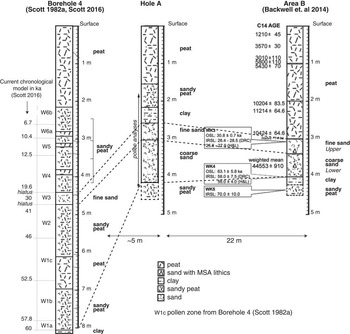
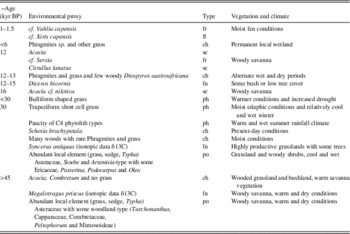
The upper layers of the sedimentary sequence in Area B comprise peat that preserves macrobotanical and faunal remains reflecting local fen conditions in Acacia savanna woodland at 12 ka (Table 2). Below the upper peat layers, a 1-m-thick layer of white sand features two MSA lithic assemblages in association with faunal remains (Fig. 2). The 14C and OSL dates for the white sand place the sand deposition in the age range ca. 60–30 ka. The poorly sorted nature of the sediment, its angularity, and fresh state suggest deposition during flash flooding, but it could not be determined if these sediments reflect a durable long-term change in mean environmental conditions or single events (Backwell et al. Reference Backwell, McCarthy, Wadley, Henderson, Steininger, Barré and Lamothe2014). Faunal remains in the lower sand levels and dental stable carbon isotope analysis of herbivores indicate a substantial grassland component in the landscape during late MIS 3 (>45 ka; Table 2). Charcoal and phytolith assemblages show a change from moderately warm and dry grassy savanna in the lower sand levels to cooler and wetter grassland with woody shrubs in the uppermost levels by 30 ka (Table 2). A provisional examination of pollen from the centre of the mound in Area B focusing only on levels 33–43, between 2.90 and 3.90 m below the surface, suggests two vegetation phases within the sand layer, a shift from warm and dry >45 ka to cool and wet conditions by 30 ka (Table 2; Backwell et al., Reference Backwell, McCarthy, Wadley, Henderson, Steininger, Barré and Lamothe2014).
Schematic diagram of stratigraphic columns of core HA, excavated Area B in the wet centre of the mound, and Area C on the dry margin. Layers with Middle Stone Age (MSA) stone tools are represented in bold italics (modified after Backwell et al., Reference Backwell, McCarthy, Wadley, Henderson, Steininger, Barré and Lamothe2014).

Summary of botanical and faunal remains retrieved during excavation of Areas A, B and C and interpretations proposed by Backwell et al., Reference Backwell, McCarthy, Wadley, Henderson, Steininger, Barré and Lamothe2014.

fr: fruit, fl: flower, se: seed, ph: phytolith, fn: fauna, ch: charcoal, po: pollen from preliminary study of Area B.
The archaeological record is limited (fig. 8 and Appendix D in Backwell et al., Reference Backwell, McCarthy, Wadley, Henderson, Steininger, Barré and Lamothe2014,). Area B includes two assemblages: the upper dates to ca. 30 ka and includes 21 lithics >2 cm in size, and the lower dates to >45 ka includes 69 lithics. Area C also has two horizons: the upper, with age estimates between 32 and 46 ka, contained only 6 lithics, and the lower, dating to 138 ka, yielded 292 lithics. Although the lithic assemblages are too small to reach firm conclusions about technological changes through time, the lower assemblage from Area B differs from the others by the presence of large cobbles and slabs presenting traces of grinding and pitting. Statistically significant differences were observed in the size of flakes between Areas B and C, the former being longer, broader, and more elongated. No evidence of invasively modified stone tools such as backed pieces, pièces esquillées, or bifacially shaped pieces is observed. Differences in the spatial distribution of lithics, interpreted as reflecting different activity areas, are identified between the wet centre of the peat mound (Area B) and its drier margin (Area C; Fig. 1a–b). Area B yielded 54 faunal remains, of which 32 are identified to the taxon and/or element.
Tool knapping and carcass processing would have been preferentially conducted in Area B, whereas most knapping and hide working would have taken place in Area C (Backwell et al., Reference Backwell, McCarthy, Wadley, Henderson, Steininger, Barré and Lamothe2014). Richness in cutting tools is consistent with the hypothesis that the site was used for processing animals that were deliberately or accidentally trapped in mud or peat (Weigelt, Reference Weigelt1989). Lithic assemblages found in the wet centre of the mound suggest that people may also have visited the site to exploit other resources such as edible and medicinal plants, or plants used for shelters, bedding, and to produce shafts for composite tools and weapons (Backwell et al. Reference Backwell, McCarthy, Wadley, Henderson, Steininger, Barré and Lamothe2014). However, the hypothesis that carcasses were processed at the site remains speculative since no anthropogenic modifications were so far identified on the faunal remains. Thus, no formal proof exists that the latter were accumulated by humans.
Present-day vegetation and climate
The climate of the Limpopo region is influenced by tropical and subtropical atmospheric circulation (Tyson and Preston-Whyte, Reference Tyson and Preston-Whyte2000), and by the Indian Ocean (Beal and Bryden, Reference Beal and Bryden1999). Austral-summer heat allows evaporation and relatively high precipitation in southeastern Africa and the interior of the continent, due to the position of tropical low pressure systems, such as the Inter-Tropical Convergence Zone, and reduced subtropical high pressure (Tyson and Preston-Whyte, Reference Tyson and Preston-Whyte2000). Wonderkrater is located at an altitude of ca. 1100 m above sea level and receives a mean annual rainfall of approximately 630 mm (McCarthy et al., Reference McCarthy, Ellery, Backwell, Marren, De Klerk, Tooth, Brandt and Woodborne2010). Annual potential evaporation is about 2,400 mm, resulting in a net water deficit, and about 60% of the rain falls during the austral summer in the form of localized convective thunderstorms (White, Reference White1983; Rutherford, Reference Rutherford1997; McCarthy et al., Reference McCarthy, Ellery, Backwell, Marren, De Klerk, Tooth, Brandt and Woodborne2010).
Wonderkrater is situated in a mixed bushveld environment (Low and Rebelo, Reference Low and Rebelo1996), in the vegetation unit of Springbokvlakte Thornveld (SVcb 15), at the very edge of the Central Sandy Bushveld (SVcb 12), which forms part of the current tropical savanna biome (Mucina and Rutherford, Reference Mucina and Rutherford2006). The regional vegetation in the alluvial plain surrounding the Wonderkrater spring is dominated by Acacia woodland with Acacia tortilis and Acacia karoo as dominant species, and Acacia mellifera to a lesser extent. The spring mound itself is covered by Phragmites australis (Poaceae), with hygrophilous grasses and sedges, such as Carex acutiformis (Cyperaceae), dominating the wetland, and some Acacia karoo trees (Fabaceae; McCarthy et al, Reference McCarthy, Ellery, Backwell, Marren, De Klerk, Tooth, Brandt and Woodborne2010).
MATERIALS AND METHODS
Sampling core
In November 2012 (austral summer with rain), a core was extracted by us from the northwest area of the centre of the mound (Fig. 1). This location was selected because previous exploratory coring showed that it features the most continuous and least disturbed sedimentary deposit at this site. Its proximity (10 m) to the sequence analyzed by Scott (Reference Scott1982a, Reference Scott2016) allows for comparison with previously published palynological results. Based on lithology, the studied samples correspond to Borehole 4 Zones W2 to W4 analyzed by Scott (Reference Scott1982a, Reference Scott1999, Reference Scott2016), and the deposits ranging from 2.90 to 3.90 m below the surface of Area B (Backwell et al. Reference Backwell, McCarthy, Wadley, Henderson, Steininger, Barré and Lamothe2014), corresponding to their 1-m-thick sand unit and sediment located above it (Fig. 2). Its distance (20 m) from excavation areas A and B enables correlation between lithological and archaeological 14C and OSL dated levels recorded in these areas, and the age estimation of pollen spectra (Fig. 2).
A motorized drilling instrument with a 7 cm diameter and 100-cm-long drill was used to extract a 4.7 m sediment core designated Hole A (HA) (Fig.1a–b). The core was sealed in the field, transported to the University of the Witwatersrand, and sampled every 4 cm to obtain a fine resolution analysis of vegetation changes. Thirty-eight samples between 260 and 444 cm depth, encompassing levels of human occupation, and two samples at 179 and 226 cm depths, where no human occupation is observed, were analyzed.
Pollen analysis
Sample volumes were estimated by water displacement, and pollen concentrations (pollen grains.cc−1) were calculated based on a known spike of exotic Lycopodium spores added to each sample. Pollen extraction techniques from terrestrial sediments included treatment with hydrofluoric and hydrochloric acids, and sieving through 150 and 10 μm meshes. The 10-μm sieving allowed elimination of small non-palynomorph particles and concentration of pollen grains and spores. An independent test of this protocol showed that the use of a 10 μm filter had no effect on the pollen composition of the samples; i.e., comparison of filtered and unfiltered samples confirmed that taxa were not selectively filtered out during pollen preparation and concentration (see http://ephe-paleoclimat.com/Files/Other/Pollen%20extraction%20protocol.pdf for the detailed pollen preparation protocol). Concentrated residues were mounted in glycerol and observed under a Zeiss ImagerA1 light microscope at 400 x and 1000 x magnification.
Pollen identification was aided by the pollen reference collection of the African pollen database (http://apd.sedoo.fr/pollen), the Universal Pollen Collection of the University of Montpellier (https://collections.umontpellier.fr/lames-de-pollen), and pollen descriptions published by Scott (Reference Scott1982b). A total of 90 pollen morphotypes were identified in the 38 analyzed samples, 76 of them were attributed to known plant genuses and families.
Pollen grains from the Asteraceae family were grouped into three pollen taxa: Artemisia, Stoebe, and Asteraceae-other. Since only one pollen morphotype characterizes the plants belonging to some families (Acanthaceae, Chenopodiaceae-Amaranthaceae, Crassulaceae, Cyperaceae, Ericaceae, Myrtaceae, Ranunculaceae, Restionaceae, and Solanaceae), these morphotypes are named after their family. The main pollen sum includes terrestrial pollen from regional vegetation and therefore excludes pollen and spores from local vegetation relating to the peat mound. Local pollen taxa include aquatics and semi-aquatic species. The total sum includes the main sum plus pollen and spores of aquatics, semi-aquatics, unidentified, and unknown. Terrestrial (regional) and local pollen percentages were calculated based on the main and total sums respectively. Pollen zones were established from a change in pollen percentage greater than 10% of at least two taxa with different ecological requirements. Each pollen zone includes at least two contiguous pollen samples (Birks and Birks, Reference Birks and Birks1980; Reille, Reference Reille1990). These zones have the prefix HA to distinguish them from those identified by Scott (Reference Scott1982a, Reference Scott1999), which have the prefix W.
RESULTS
Stratigraphy and chronology of the sedimentary sequence
From the bottom to the top, the HA sequence is composed of a first layer of sandy peat of unknown thickness. Overlying this layer is a 1.15-m-thick coarse sand layer 4.22–3.07 m below the surface (Fig. 2), which is overlain by a layer of a 0.47-m-thick medium-grained sand (3.07–2.6 m). Above the sand is a 0.40 m clay layer (2.6–2.2 m), overlain by a 0.62 m sandy peat layer (2.2–1.58 m). Finally, the sequence is capped by a layer of peat 1.6 m thick (Fig. 2).
The two white sand layers of HA core, from 4.22 to 3.07 m, are correlated with those of the excavated Area B (Fig. 2). Thus, the MSA sand layer dated at 30 ka in the upper coarse sand layer from Area B provides an age for the upper coarse sand layer in HA. Pollen analysis focused on these two sand layers containing the MSA lithic assemblages that evidence human occupation at Wonderkrater between 70 and 29 ka (Barré et al., Reference Barré, Lamothe, Backwell and McCarthy2012, Backwell et al., Reference Backwell, McCarthy, Wadley, Henderson, Steininger, Barré and Lamothe2014), i.e, during MIS 4 and MIS 3.
Relationships between South African pollen assemblages, vegetation, and climate
The pollen representation of the different African biomes has been documented by Gajewski et al. (Reference Gajewski, Lézine, Vincens, Delestan and Sawada2002) and recently increased by Urrego et al. (Reference Urrego, Sanchez Goñi, Daniau, Lechevrel and Hanquiez2015) to include the southwestern part of Africa. All South African biomes include grass species (Cowling et al., Reference Cowling, Richardson and Pierce1997) that are well recorded by the occurrence of Poaceae pollen in all surface samples. However, the spatial distribution of Poaceae pollen percentages is essential information to distinguish major biomes from their pollen spectra. In the eastern and northeastern part of Southern Africa, the broad-leaved savanna and grasslands produced a pollen rain characterised by very high percentages of Poaceae pollen (up to 90%), usually associated with Combretaceae, Acacia and Capparaceae (Gayewski et al., 2002; Urrego et al., Reference Urrego, Sanchez Goñi, Daniau, Lechevrel and Hanquiez2015).
Poaceae pollen percentages up to 60% are concentrated in the Nama-Karoo, Succulent-Karoo, and fine-leaved savanna. In the area of Wonderkrater, Phragmites australis and Imperata cylindrica are the Poaceae that represent the local swamp and peat mound vegetation. The regional vegetation is also dominated by Poaceae such as Themeda trianda, Brachiaria serrate, or Eragrostis curvala, which characterize the herbaceous savanna (Scholes, Reference Scholes1997; Scott, Reference Scott1982b). Pollen analysis cannot discriminate wetland from savanna grasses, which are both from the Poaceae family. However, the permanence of wetland conditions at Wonderkrater can be tested by the occurrence of Cyperacee, which provide direct evidence of this phenomenon. The pollen of Cyperacee in a swamp reaches 20% or more and this proportion rapidly decreases a few meters from it (Sanchez Goni and Hannon, Reference Sanchez Goñi and Hannon1999)
We interpret the increase of Podocarpus and Kiggelaria africana that grow in moist to wet forests (Coetzee, et al., Reference Coetzee1967; Gajewski et al., Reference Gajewski, Lézine, Vincens, Delestan and Sawada2002; Urrego et al., Reference Urrego, Sanchez Goñi, Daniau, Lechevrel and Hanquiez2015) as an increase of precipitation that could trigger the expansion of wetlands.
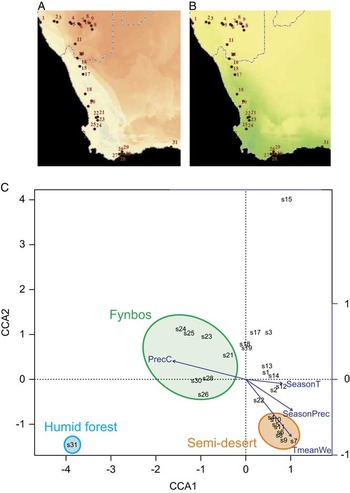
At present, the regional development of Stoebe, Passerina, Protea, and Ericaceae, which characterize the Fynbos, is favored by high precipitation during the austral cold winter (Fig. 3; Urrego et al., Reference Urrego, Sanchez Goñi, Daniau, Lechevrel and Hanquiez2015). The pollen of Capparaceae, a bushveld and woodland savanna family that grows along rivers and forests, indicate relatively wet and warm conditions in summer and a dry winter season (Truc et al., Reference Truc, Chevalier, Favier, Cheddadi, Meadows, Scott, Carr, Smith and Chase2013). Pollen of Asteraceae-other and Chenopodiaceae together include a large number of species that do not characterize a particular biome and are considered as ubiquitous taxa.
Distribution of climatic parameters in the western part of Southern Africa. (A) Mean temperature of the wettest quarter (June–August): high in red, low in blue. (B) Mean precipitation of the coldest quarter (June–August): high in green, low in yellow. (C) Canonical Correspondence Analysis (CCA) of modern pollen assemblages and climatic data (Lechevrel, Reference Lechevrel2012; Urrego et al., Reference Urrego, Sanchez Goñi, Daniau, Lechevrel and Hanquiez2015). Climatic data from WorldClim (spatial resolution of 1 km2; Hijmans et al., Reference Hijmans, Cameron, Parra, Jones and Jarvis2005) using ArcGIS. PrecC, Mean precipitation of the coldest quarter; TmeanWe, mean temperatures of the wettest quarter; SeasonP, seasonality of precipitation; SeasonT, seasonality of temperatures. Circles group the samples collected in the same biome (modified after Lechevrel, Reference Lechevrel2012). (For interpretations of the references to color in this figure legend, the reader is referred to the web version of this article.)

Apart from Poaceae, the local vegetation is characterized at the site by the aquatic plant Typha, and a semi-aquatic plant Carex of the Cyperaceae family. Both plants are indicators of lake level. Typha testifies to swamp conditions and grows at a depth of 1–2 m; Cyperaceae typically grows on lakeshores and adapts to lake-level fluctuations of 0.5–1 m in depth (Harrison and Digerfeldt, Reference Harrison and Digerfeldt1993, Hannon and Gaillard, Reference Hannon and Gaillard1997). Thus, the increase of Cyperaceae can be taken as an indicator of water source extension. Monolete spores associated with moist conditions and Pseudoschizaea, a cyst of fresh water algae, are linked to lacustrine or swamp vegetation (Rossignol, Reference Rossignol1962, Reference Rossignol1964; Christopher, Reference Christopher1976) but their ecological meaning is not clear because Pseudoschizaea and other fern spores could have been transported by herbivores visiting the site. They can also develop during desiccation of swamp sediment, alternating wet-dry phases, or prolonged summer drought (Scott Reference Scott1992; Carrion et al., Reference Carrión, Scott, Huffman and Dreyer2000; Carrion and Navarro, 2002).
Regional vegetation versus local vegetation and artesian spring-level fluctuations
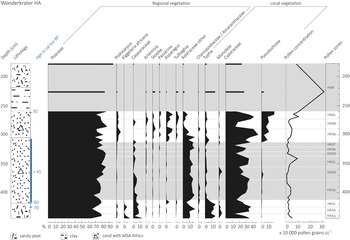
Figure 4 presents a synthetic pollen diagram listing the 15 main pollen taxa represented, which are continuously recorded in the sequence. These are divided into regional and local vegetation. Changes in the pollen percentages of terrestrial plants allow for the identification of four main pollen zones corresponding to changes in the regional climate. Changes in the pollen percentages of aquatic and semi-aquatic plants define the pollen subzones that are interpreted as changes in local vegetation responding to oscillations in the water table. Subzones thus provide information about changes in the depth and extent of the water source during the last glacial.
Synthetic pollen diagram with the percentages of the 15 main pollen taxa represented and the total pollen concentration with the associated lithology.

Poaceae pollen dominates the spectrum with an average of 75%. It increases progressively to reach 97% in the most recent sample. This indicates a long-term increase of grasslands in the broad-leaved savanna (Fig. 4). Concomitant increase of Poaceae and decrease of Cyperaceae pollen frequencies indicates a drying trend.
Recent studies in wetland ecosystems (McCormick et al., Reference McCormick, Kettenring, Baron and Whigham2010; Ireland et al., Reference Ireland, Booth, Hotchkiss and Schmitz2012; Kotze et al., Reference Kotze2013; Hazelton et al., Reference Hazelton, Mozdzer, Burdick, Kettenring and Whigham2014) show that Phragmites outcompetes the sedges (Cyperaceae). It has three reproductive strategies – sexual (seeding) and asexual (rhizomes and stolons) – and crowds out other grasses as it can achieve the highest grass density per square meter. Such an adaptation allows Phragmites to survive drought longer. Aquatic and semi-aquatic plants indicate a permanent water source and a waterlogged environment that preserves organic matter including pollen grains more readily. Thus, changes in pollen percentages and concentration of Cyperaceae appear to be a good indicator of past water table fluctuations in the Wonderkrater peat mound.
This long-term vegetation and water source evolution was marked by the four short-term phases that we describe, from the bottom to the top, as follows:
Pollen zone HA1 (4.44–4.12 m) is characterized by relatively high percentages of Podocarpus, Kiggeleria africana, Capparaceae, and Typha, likely indicating high moisture availability. Within this zone, however, a drying trend is inferred from the progressive decrease of their percentages and the abundance of Asteraceae-type pollen suggesting a relative reduction in the regional forest cover. Typha frequencies are relatively high and indicate the presence of a source in the centre of the peat mound with a water depth up to 2 m, and with a substantial fluctuation of the margin as inferred from the oscillating pollen percentages of Cyperaceae. Firstly, Cyperaceae decreases to 15% (sub-zone HA1a) before increasing up to 35% (HA1b). Finally, Cyperaceae and Typha pollen percentages substantially decrease to 15% and 7%, respectively, indicating a marked reduction in the water surface area (HA1c). The decrease in the percentages of moist forest and ferns indicates the weakening of regional precipitation.
Zone HA1 is characterized by humid conditions compared to the following zone but marks a relative regression of the woodland cover leading to the development of grassland savanna at a regional scale, with the presence of a local deep-water source with a fluctuating margin.
Pollen zone HA2 (4.12–3.14 m) corresponds to the deposition of coarse sand. Poaceae only marginally increases within this zone, revealing the moderate expansion of the savanna grassland. In addition, the disappearance of Podocarpus and Kiggelaria africana shows a period of more severe drought at the regional scale. Finally, Capparaceae pollen percentages decrease but persist in the record, and the Asteraceae relative frequencies are constant at around 15%. Many fluctuations of Cyperaceae pollen percentages occur in this zone. Sub-zones HA2a, HA2c, and HA2e reflect Cyperaceae increase and, therefore, the expansion of water source margins. In contrast, sub-zones HA2b, HA2d, and HA2f indicate Cyperaceae reduction and the shrinking of spring margins. However, Typha frequencies remain constant, suggesting that regional climate continued to be dry, and the spring did not exceed 1 m in depth. A significant sedimentary filling in the peat mound could additionally explain the smaller depth of the spring. In conclusion, pollen zone HA2 records drier regional conditions with a relatively shallow spring at Wonderkrater.
Pollen zone HA3 (3.18–2.62 m) corresponds to the deposition of medium-grained sand and the regional vegetation evolving in parallel with local vegetation. Podocarpus reaches its maximum value of 6%. Additionally, increases of Asparagus (8%), Artemisia (4%), Stoebe (3%), Passerina (3%), and Tulbaghia (4%) values reflect higher regional precipitation during the cold austral winter. This interpretation is corroborated by a slight decrease of Poaceae and Asteraceae-type percentages (Urrego et al., Reference Urrego, Sanchez Goñi, Daniau, Lechevrel and Hanquiez2015). The wetting trend was abruptly reversed in sub-zone HA3b, where a short and rapid decrease in moisture is inferred from the new development of Poaceae and Capparaceae. The local vegetation records this abrupt change as well. Cyperaceae increases sharply in sub-zones HA3a and HA3c, reaching a maximum of 45%, and is interrupted by a significant decrease in sub-zone HA3b. Pseudoshizaea appears significantly in zone HA3 in the record and sharply increases to a maximum of 18%. Pseudoshizaea percentage evolution contrasts that of Cyperaceae. Although less represented, Typha follows the same fluctuating trend as that of Cyperaceae. Thus, local vegetation indicates that the spring level increased slightly, while its surface seems to have been the largest in HA3a and HA3c sub-zones. In sub-zone HA3b, the strong reduction of Cyperaceae suggests the maximum size contraction of the spring during the studied interval. Pollen zone HA3 reveals cooler and wetter regional conditions than the previous zone, but interrupted by an abrupt dry episode.
Pollen zone HA4 (2.62–1.79 m) includes a clay sample and a sandy peat sample. The pollen assemblage of the regional vegetation of the clay sample, at 2.62 m, is quite similar to pollen zone HA3. Excluding the maximum percentages of Poaceae (97%) those of all the other taxa substantially decrease until they disappear from the record, reflecting very dry conditions during the period represented by the last sample. Typha percentages significantly increase (13%) and then decrease in the sandy-peat sample. Finally, Pseudoshizea percentages decrease until they virtually disappear. The maximum pollen concentration occurs at a 2.62 m depth, when Typha and Cyperaceae are abundant. However, this level corresponds to a clay layer, more favourable to pollen preservation than lower and upper levels, which does not necessarily indicate higher humidity. Reduction in Typha and Pseudoshizea in the last sample probably indicates the shrinking of the spring located at the centre of the peat mound, and the colonization of the peat mound by Cyperaceae. This interpretation could have resulted from a significant withdrawal of groundwater, but this should be taken cautiously given the low resolution of this pollen zone.
DISCUSSION
Paleoenvironmental changes and comparison with previous pollen studies
Pollen zone HA1, from sandy peat layers dated 70 ka at the bottom of the sequence, signals a relative regional moisture increase. A short and rapid Podocarpus increase is recorded at ~70 ka at Wonderkrater, and at other South African sites at the MIS 4/3 transition at 59.4 ka (Scott Reference Scott2016), where they are taken as indicators of a high rainfall period (Dupont, Reference Dupont2011; Urrego et al., Reference Urrego, Sanchez Goñi, Daniau, Lechevrel and Hanquiez2015).
Pollen zone HA2, dated between 60 and 45 ka, represents a period when regionally dry conditions caused variations in the margin of the spring, possibly resulting in a higher sedimentation rate (McCarthy et al., Reference McCarthy, Ellery, Backwell, Marren, De Klerk, Tooth, Brandt and Woodborne2010). Grass phytoliths, trees represented by charcoal, and faunal associations are consistent with our pollen spectra, interpreted as reflecting warm and dry conditions giving rise to shrub and woodland vegetation (Table 1; Backwell et al., Reference Backwell, McCarthy, Wadley, Henderson, Steininger, Barré and Lamothe2014; Scott, Reference Scott2016). A similarity in vegetation types is also observed between pollen spectra from Zone HA2 and Zone W2 of Borehole 4 (Table 2; Scott Reference Scott2016).
Pollen zone HA3, dated at the top to 30 ka, shows a period of regional humidity, with a maximum extension of the spring interrupted by a short dry episode. The remains of Syncerus antiquus and Megalotragus priscus found in this sand layer support the presence of a local water source attracting these large mammals to drink. Botanical remains from the same period confirm that regional conditions were cool and wet (Table 1; Backwell et al., Reference Backwell, McCarthy, Wadley, Henderson, Steininger, Barré and Lamothe2014). Regional pollen spectra from Zone HA3 are comparable with that found in Zone W4 from Borehole 4 (Scott Reference Scott1989, Reference Scott1999, Reference Scott2016). Pollen-based quantitative climate reconstructions further show a 2°C of cooling during this time interval (Chevalier and Chase, Reference Chevalier and Chase2015).
Finally, pollen zone HA4, younger than 30 ka, only includes two samples, with the first indicating moist regional conditions, and the second indicating strong regional drought with a shrinking of the local water source in the centre of the mound.
The results of the pollen analysis have implications for our understanding of the Wonderkrater site formation processes. They contradict the hypothesis that the deposition of the layers below the upper peat correspond to a single or few events, since they identify three substantially different pollen zones, each characteristic of a different vegetation and climate, which appear to reflect a long term trend.
Other paleoenvironmental proxies at Wonderkrater support our reconstruction of the regional history of vegetation and climate. Scott’s (Reference Scott2016) interpretation of Zones W2–W4 from Borehole 4, in particular, seems to be confirmed by our analysis of Zones HA2 to HA3 during the last two human occupations at the site at >45 ka and 30 ka (Table 1; Backwell et al., Reference Backwell, McCarthy, Wadley, Henderson, Steininger, Barré and Lamothe2014).
Although chronological uncertainties remain due to hiatuses above and below the sand layer (Backwell et al. Reference Backwell, McCarthy, Wadley, Henderson, Steininger, Barré and Lamothe2014; Scott Reference Scott2016), it is reasonable to associate the two wet periods identified at around 70 and 30 ka with the northern hemisphere cold periods of MIS 4 and Heinrich Stadial 3 (Sanchez Goñi and Harrison, Reference Sanchez Goñi and Harrison2010), respectively. Previous observations and model simulations have shown that MIS 4 and Heinrich stadials are periods of increased austral summer precipitation in southern Africa (Harrison and Sanchez Goñi, Reference Scott2010; Daniau et al., Reference Daniau, Sánchez Goñi, Martinez, Urrego, Bout-Roumazeilles, Desprat and Marlon2013; Ziegler et al., Reference Ziegler, Simon, Hall, Barker, Stringer and Zahn2013; Woillez et al., Reference Woillez, Levavasseur, Daniau, Kageyama, Urrego, Sánchez-Goñi and Hanquiez2014), a finding in accordance with our new data.
Implications of the Wonderkrater sequence for understanding MSA cultural adaptations
The interpretive framework that has influenced most research on the African MSA has been based on the notion that “modern” behaviour is the necessary outcome of the emergence of anatomically modern humans in Africa and that the process that led to such an emergence granted our species a new cognition. The cultural innovations recorded at a number of MSA sites would represent the tangible products of this process. Since not all MSA cultural adaptations feature substantial cultural innovations, it has been proposed that innovations were triggered by sea level changes (Compton Reference Compton2011) or increase in humidity and biomass that would have, in turn, stimulated population growth and cultural complexity (Ziegler et al. Reference Ziegler, Simon, Hall, Barker, Stringer and Zahn2013). What can the Wonderkrater record, one of the few in which archaeological and vegetational changes go hand-in-hand, contribute to this debate? Wonderkrater records two phases of occupation, dated to between 60 and 30 ka, the first associated with a relatively dry climate and the second with a wetter climate. This is the period during which coastal and some inland sequences feature Howieson Poort, Post-Howieson Poort, and Early Later Stone Age occupations. The absence of diagnostics of these cultural adaptations at Wonderkrater could be due to the specialized nature of this site or to the fact that Wonderkrater lies outside the geographic range in which coastal cultural adaptations developed. These hypotheses could be tested in the future by enlarging the sample size of the lithic assemblages, as one may expect that, even if specialized in nature, a repeated occupation of the site would result in the disposal of at least some diagnostic tools. A larger sample size of lithics and the identification of faunal remains with anthropogenic modifications would clarify the function of the site during the two occupations and provide indications about the size of groups that visited the site during the dry and wet phases, a necessary step to test the hypothesis that increase in humidity would lead to demographic increase and cultural complexity.
CONCLUSION
Pollen incorporated in the Wonderkrater sequence documents the evolution of the immediate spring and peat mound environment, as well as changes in regional vegetation and climate. Results strongly support the preliminary interpretation of the paleoenvironmental conditions that coincided with occupation of the site during the MSA. This work identifies wet conditions at 70 ka followed by previously undetected periods of alternating wet and dry climate from 60 to 30 ka. Wet conditions at 70 and 30 ka are tentatively correlated here with MIS 4 and Heinrich Stadial 3, respectively. A warm and dry savanna landscape was present during human occupation older than 45 ka, and a wet phase was contemporaneous with the final occupation, dated at ~30 ka.
ACKNOWLEDGMENTS
This research was conducted with a SAHRA excavation permit (No. 80/05/05/017/51) issued 13th July 2005 to Lucinda Backwell. We thank the landowner Dr. Walter Ward for allowing us to conduct research on his land. Specials thanks to Matt Kitching, and Terence and Erna McCarthy for their help with core extraction and the taking of GPS coordinates. We thank Abraham Dabengwa for useful discussions on South African swamps and Ludovic Devaux for sample preparation and pollen extraction. This work was funded by a European Research Council Grant TRACSYMBOLS n°249587, a National Research Foundation (NRF) of South Africa research rating grant, and the LaScArBx, a research programme supported by the ANR (ANR-10-LABX-52).
SUPPLEMENTARY MATERIAL
To view supplementary material for this article, please visit https:/doi.org/10.1017/qua.2017.42.