Needlestick injuries (NSIs) constitute a serious occupational health hazard because they can expose healthcare workers to infections by bloodborne pathogens, including hepatitis B virus (HBV), hepatitis C virus (HCV), and human immunodeficiency virus (HIV). In Japan, the NSI incidence rate in healthcare workers has been estimated to be 6.2 injuries per 100 beds at HIV/AIDS referral hospitals,Reference Yoshikawa, Wada and Lee 1 with 51.9% of NSIs occurring in nurses and 34.4% occurring in physicians. This indicates that as many as 105,000 injuries may occur every year. Accordingly, NSIs are a severe threat to the safety of workers in the healthcare industry, and measures are needed to reduce the risks of injury and infection.
As a means to protect healthcare workers from the occupational hazards of NSIs, the US government enacted the Federal Needlestick Safety and Prevention Act in 2000, which requires healthcare institutions to provide medical devices designed to have a higher level of safety. 2 Similarly, the European Parliament has issued at least 3 directives (89/391/EC, 89/655/EC, and 2000/54/EC) that deal with reducing the risk of NSIs in healthcare workers. Although the US and European governments have intervened to protect the safety of their healthcare workers, Japan has yet to mandate the use of safety-engineered devices (SEDs) in the healthcare sector, and the use of these devices is left to the discretion of each healthcare institution.
Because SEDs cost more than their non-SED counterparts, the purchase of SEDs would generate higher expenses for healthcare institutions. On the other hand, SEDs have been shown to reduce NSI incidence,Reference Fukuda and Yamanaka 3 , Reference Tosini, Ciotti and Goyer 4 which would help to avoid the additional costs incurred for the various tests and treatments required after the occurrence of NSIs. If the additional costs for purchasing SEDs exceed the additional costs incurred by NSIs, the decision to use SEDs would place a financial burden on healthcare institutions. This presents a barrier to the autonomous adoption of SEDs by healthcare providers because it would be antithetical to economic rationality, regardless of the documented effectiveness of these devices. Under those circumstances, there may be a need for government intervention to mandate the use of SEDs and improve the occupational safety of healthcare workers in Japan. In this study, we conduct a cost-effectiveness analysis of SED needle devices and examine the need for government intervention in their implementation in Japanese hospitals.
METHODS
Study Design
In this study, we developed a decision-analytic model to estimate and compare the life-cycle costs and benefits for SED and non-SED needle devices. The target needle devices examined in this study were winged steel needles, intravenous (IV) catheter stylets, suture needles, and insulin pen needles. Each device type was analyzed separately. An annual discount rate of 2% was applied to the life-cycle costs,Reference Fukuda, Shiroiwa and Ikeda 5 and the analysis was conducted from the hospital perspective. Life-cycle costs did not include indirect costs, such as from productivity loss. For the cost-effectiveness analysis, we analyzed costs in terms of 2014 US dollars and outcomes as the number of NSIs avoided. Incremental cost-effectiveness ratios (ICERs) were calculated to comparatively evaluate the SEDs and non-SEDs.
Decision-Analytic Model
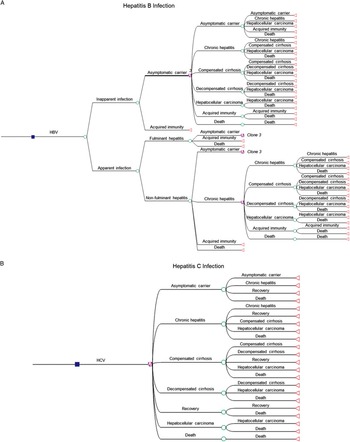
In Japan in 2015, the mean ages of physicians and nurses, who are most susceptible to NSIs, were 40.0 years and 38.2 years, respectively. 6 Therefore, we developed a 2-component model using a hypothetical cohort comprising 40-year-old healthcare workers. The first component of the model was a decision tree that evaluated the costs and outcomes for SEDs and non-SEDs beginning from an NSI event until the development of an infection (Figure 1). The second component continued after the decision tree, and it consisted of a state-transition Markov model that evaluated the postinfection long-term outcomes in affected healthcare workers. Healthcare workers who had been infected with HBV would transition to one of the following states within the first year of infection: asymptomatic carrier, chronic hepatitis, acquired immunity, or death. For workers who transitioned to the asymptomatic carrier or chronic hepatitis states, we used the Markov model to examine their state transitions in the second year of infection and beyond. State transitions were tracked for each subject until the age of 100 years for the states described in Figure 2A. For healthcare workers who had been infected with HCV, the Markov model was used to examine their state transitions until the age of 100 years (Figure 2B). The model was developed and analyzed using TreeAge Pro 2015 software (TreeAge Software).
Decision tree beginning from the use of a needle device until the development of an infection. anti, antibodies; HBV, hepatitis B virus; HCV, hepatitis C virus; HCW, healthcare worker; NSI, needlestick injury; PT, patient; SED, safety-engineered device.

Markov state transition pathways. A, After hepatitis B virus (HBV) infection; B, After hepatitis C virus (HCV) infection.

Outcome Measure
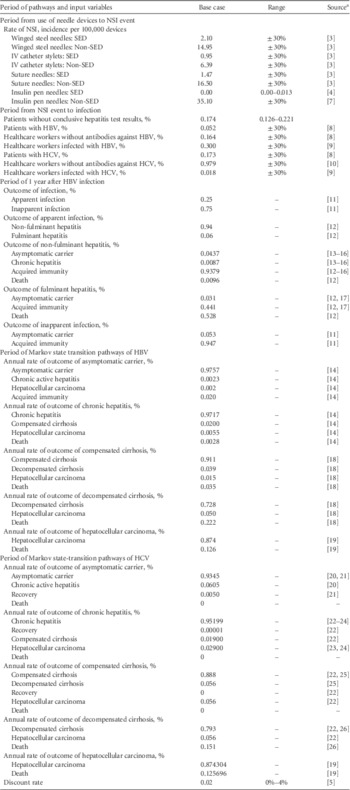
The outcome measure was the number of NSIs avoided. Twenty-six voluntary participant hospitals provided data on NSI incidence and device utilization quantities for the SED and non-SED versions of winged steel needles, IV catheter stylets, and suture needles. NSI incidence data were derived from the Japanese version of the Exposure Prevention Information Network survey. The NSI incidence rates per 100,000 devices for SEDs and non-SEDs were obtained from previous estimates based on a weighted regression analysis.Reference Fukuda and Yamanaka 3 The NSI incidence rate per 100,000 devices for SED insulin pen needles was obtained from the study by Tosini et al,Reference Tosini, Ciotti and Goyer 4 and the corresponding rate for non-SED insulin pen needles was obtained from a report by Mitsuda et al. 7 The incidence rates for the SED and non-SED needle devices are summarized in Table 1.
Model Variables: Base-Case Values and Ranges Used in Sensitivity Analysis

NOTE. HBV, hepatitis B virus; HCV, hepatitis C virus; IV, intravenous; NSI, needlestick injury; SED, safety-engineered device.
a If the source is not listed, the values are original estimates from this study.
Costs
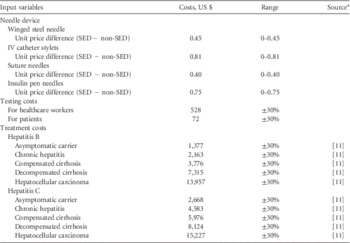
Using the decision-analytic model, we analyzed the following cost information (Table 2): purchase unit price for each type of needle device, testing costs in healthcare workers after an NSI, testing costs in patients (exposure source) without record of hepatitis B or hepatitis C status, treatment costs for hepatitis B, and treatment costs for hepatitis C. The brands of needle devices and purchase prices varied among the institutions. Using a survey analysis conducted on 28 hospitals, we collected data on the purchase of needle devices from 2009 to 2013; the data were categorized according to the types and brands of needle devices. We determined the manufacturer’s list price for each device, and we calculated the device-specific mean prices weighted by the number of devices purchased. These mean unit prices were then used in the base-case analysis. Table 2 shows the difference in unit prices between the SED and non-SED versions of each device. For the testing costs in healthcare workers and patients, we first identified the standard test items on the basis of expert opinions, and we calculated their costs according to the fees stipulated in the social insurance reimbursement schedule. The treatment costs for hepatitis B and hepatitis C were obtained from the report by Hirao.Reference Hirao 11 Reported costs were converted to US dollars using the purchasing power parity index of 2014 ($1=¥105.3).
Costs Included in the Decision-Analytic Model

NOTE. IV, intravenous; SED, safety-engineered device.
a If the source is not listed, the values are original estimates from this study.
State-Transition Probabilities
The probabilities of event occurrence (state transition) for the first year after the NSI event until hepatitis infection are presented in Table 1. To ascertain the proportion of hospitals with records on the hepatitis status of the exposure source patients at the time of the NSI, we conducted a survey analysis on 74 hospitals. In this survey, we queried the proportion of patients who did not have conclusive hepatitis test results for the 10 most recent NSI events, and we applied the mean values of the responses to this analysis. The prevalence of hepatitis B and hepatitis C in the general Japanese population has been estimated to be 0.8%–1.0% and 1.2%–1.6%, respectively 27 ; however, a previous report has estimated the prevalence in patients undergoing treatment at healthcare institutions to be 5.2% and 17.3%, respectively. 8 Here, we used the latter estimates as these are more likely to be representative of our study sample. With regard to the proportion of healthcare workers without anti-HBV antibodies, a previous study reported that approximately 92% of healthcare workers younger than 40 years had completed a series of HBV vaccinations, and that approximately 84% of healthcare workers aged 40 years and older had developed antibodies.Reference Averhoff, Mahoney, Coleman, Schatz, Hurwitz and Margolis 28 However, the vaccination statuses of the healthcare workers in our study participant hospitals were unknown, and we used estimates of hepatitis B surface antibody prevalence in healthcare workers from hospitals enrolled in the Japan-Exposure Prevention Information Network surveillance system. 8 For the proportion of healthcare workers without anti-HCV antibodies, we used a reported estimate of anti-HCV prevalence in healthcare workers in a Japanese university hospital.Reference Nishino, Higuchil and Michino 10
In this analysis, we assumed that the healthcare workers did not have hepatitis B or hepatitis C before the NSI event. The postinfection state-transition probabilities are shown in Table 1 for healthcare workers who were infected with either HBV or HCV from the patient. In HBV cases, the first year of the infection was analyzed using the decision tree model, while the second year and beyond was analyzed using the Markov model.
Sensitivity Analysis
In order to examine the robustness of the base-case analysis, we conducted a sensitivity analysis using changes to the purchase unit prices of the needle devices. Because these prices varied widely among the hospitals, we analyzed the unit price difference between the SED and non-SED versions for each device.
In addition, we conducted a sensitivity analysis for other parameter changes to test their effects on the base-case analysis. The parameters included in the sensitivity analysis and their ranges are shown in Tables 1 and 2. To establish a plausible range for each parameter, we preferentially used estimates from reports that provided 95% confidence intervals. If the confidence intervals were not reported, we used a range of ±30% of the reported estimate.
RESULTS
Base-Case Analysis
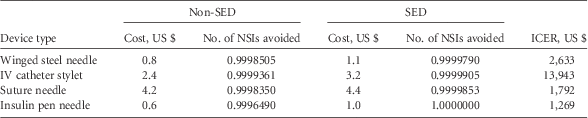
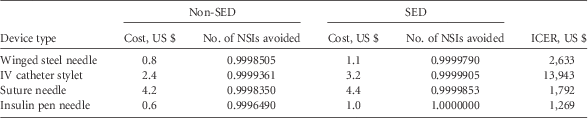
The results of the cost-effectiveness analysis are shown in Table 3. The expected cost for each SED winged steel needles was $1.1, which was $0.3 higher than the expected cost for the non-SED version. The use of SED winged steel needles facilitated the avoidance of 0.0001285 more NSIs than the non-SED version (SED: 0.9999790; non-SED: 0.9998505). Using these estimates, the ICER for SED winged steel needles over non-SED winged steel needles was $2,633 per NSI avoided.
Base-Case Cost-Effectiveness Analysis Between Non-SEDs and SEDs by Device Type
NOTE. ICER, incremental cost-effectiveness ratio; IV, intravenous; NSI, needlestick injury; SED, safety-engineered device.
Similarly, the ICERs (cost per NSI avoided) for IV catheter stylets, suture needles, and insulin pen needles were $13,943, $1,792, and $1,269, respectively.
Sensitivity Analysis
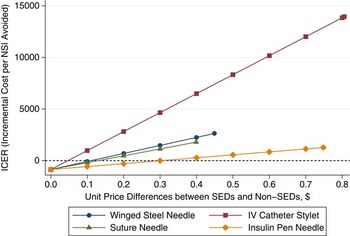
Figure 3 shows the results of the sensitivity analysis for the price differences between SEDs and non-SEDs with the other conditions kept constant. An ICER value below zero would indicate that the SED version of a device is dominant to the non-SED version, and that the use of the former would not only provide better safety but also result in cost savings for the hospital. If the unit price difference between the SED and non-SED versions for each device falls below the following values, the SED version would be considered dominant to the non-SED version: $0.11 for winged steel needles, $0.05 for IV catheter stylets, $0.13 for suture needles, and $0.30 for insulin pen needles.
Results of the sensitivity analysis of the incremental cost-effectiveness ratios for the unit price differences between safety-engineered devices (SEDs) and non-SEDs. IV, intravenous; NSI, needlestick injury.

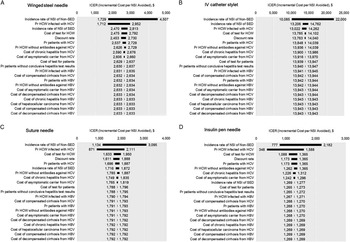
The results of the sensitivity analysis on the effects of changes in various parameters on the base-case analysis are shown in Figure 4. Changes to the NSI incidence of non-SEDs and the proportion of HCV-infected healthcare workers with anti-HCV antibodies were found to have large effects on the base-case analysis. However, the calculated ICER values did not fall below zero in all 4 target devices throughout the analyzed ranges.
Tornado diagrams of the sensitivity analysis results of various parameters. HBV, hepatitis B virus; HCV, hepatitis C virus; HCW, healthcare worker; ICER, incremental cost-effectiveness ratio; IV, intravenous; NSI, needlestick injury; Pr, probability; SED, safety-engineered device. Note: The ranges in ICERs are calculated according to the ranges of each parameter described in Table 1 and Table 2. For example, the NSI incidence rate of non-SED winged steel needles ranged from 10.47 to 19.44 per 100,000 devices (±30% of 14.95 per 100,000 devices), and the corresponding ICER varied from $1,729 to $4,507 per NSI avoided.

DISCUSSION
In this cost-effectiveness analysis, we calculated the ICERs of SED winged steel needles, IV catheter stylets, suture needles, and insulin pen needles to be $2,633, $13,943, $1,792, and $1,269 per NSI avoided, respectively. These results indicate that the adoption of SEDs would not produce cost savings for hospitals. In order for healthcare institutions to voluntarily adopt the use of SEDs based on economic rationality, the purchase unit price differences between the SED and non-SED versions of winged steel needles, IV catheter stylets, suture needles, and insulin pen needles should be $0.11, $0.05, $0.13, and $0.30, respectively.
SED insulin pen needles were the most cost-effective among the 4 target devices examined. This can be explained by the fact that the NSI incidence for non-SED insulin pen needles was the highest among the target devices at 35.10 per 100,000 devices, whereas the SED version had the lowest NSI incidence at zero per 100,000 devices. Despite the higher expenses needed to implement SEDs, our findings demonstrate that it would be judicious for employers who place a high value on employee safety to gradually implement the transition from non-SED insulin pen needles to the SED versions.
The sensitivity analysis results established the robustness of the main analysis findings. We used previously reported and predicted estimates of the various parameters, and the calculated ICER values were consistently above zero even after adjusting the values of each parameter. It is therefore unlikely for the adoption of SEDs to be cost saving under current conditions. This suggests a need for government intervention to increase the adoption of SEDs in order to improve the safety of Japan’s healthcare workers.
Although the governments in the United States and Europe have intervened to mandate the use of SEDs with the aim of improving occupational safety for healthcare workers, the cost-effectiveness of these devices has not undergone in-depth examination. At present, there are only 2 published studies that used real-world data from hospitals to examine the cost-effectiveness of SEDs.Reference Laufer and Chiarello 29 , Reference Roudot-Thoraval, Montagne, Schaeffer, Dubreuil-Lemaire, Hachard and Durand-Zaleski 30 However, those 2 studies present very different ICERs: based on the provision that the costs associated with implementing the use of SEDs was 15% higher than the costs of non-SEDs, Laufer and ChiarelloReference Laufer and Chiarello 29 estimated that the ICER per NSI avoided was $790. In contrast, Roudot-Thoraval et alReference Roudot-Thoraval, Montagne, Schaeffer, Dubreuil-Lemaire, Hachard and Durand-Zaleski 30 estimated that the ICER per NSI avoided was $4,000 under the assumption that the annual costs associated with implementing the use of SEDs was $100,000 higher than non-SEDs. A possible reason for these differences is that these studies, as well as our own, were conducted in different countries (United States, France, and Japan), which would have different unit prices for devices, tests, and treatments. Next, the proportion of source patients without conclusive hepatitis test results was as high as 45% in the study by Laufer and Chiarello,Reference Laufer and Chiarello 29 whereas our estimate was much lower at 17.4%. The study by Roudot-Thoraval et alReference Roudot-Thoraval, Montagne, Schaeffer, Dubreuil-Lemaire, Hachard and Durand-Zaleski 30 did not take into account this factor, nor did it examine the proportion of healthcare workers with antibodies against hepatitis. In addition, our study calculated the life-cycle costs from the start of infection until death, whereas Laufer and ChiarelloReference Laufer and Chiarello 29 did not examine long-term costs, and Roudot-Thoraval et alReference Roudot-Thoraval, Montagne, Schaeffer, Dubreuil-Lemaire, Hachard and Durand-Zaleski 30 did not analyze infection treatment costs.
Previous studies conducted in Canada and Sweden have performed cost-savings analyses on the differences between the increased expenses associated with the adoption of SEDs and the ensuing reductions in NSI-associated costs.Reference Yassi, McGill and Khokhar 31 , Reference Glenngard and Persson 32 In an analysis of real-world data obtained from a hospital in Canada, Yassi et alReference Yassi, McGill and Khokhar 31 estimated that the economic impact of implementing a needleless IV access system ranged from a 5.3% additional cost to a 5.7% cost savings. However, that study did not account for the infection status of source patients, the acquisition of antibodies by healthcare workers, and the additional costs for treating infected cases. Glenngard and PerssonReference Glenngard and Persson 32 obtained SED effectiveness data from a multi-institutional analysis of Swedish hospitals, but cost estimates were derived from published research; this aspect of their study was similar with our analysis. Although the additional costs for testing source patients were found to increase overall costs, Glenngard and PerssonReference Glenngard and Persson 32 did not take into account the infection status of the source patients and the postinfection treatment costs.
In comparison with these previous studies, our analysis is firstly characterized by the use of a decision-analytic model that incorporated life-cycle costs beginning from the NSI event. The detailed analysis of the treatment costs after HBV and HCV infections gives a considerable advantage to our study design. Second, the effectiveness data, cost data, and state-transition probability data were acquired from previous research after careful examination. Although the findings of many previous studies have issues with external validity owing to their use of empirical data from single institutions, our findings have higher generalizability owing to the use of a wide variety of data from multiple sources. Third, this study investigates 4 target devices. Because the costs and effectiveness of SEDs vary among the different devices, their ICERs are also different. The decision-making managerial staff of hospitals would base their decisions to adopt the use of an SED on both the actual utilization of the needle device in their hospital and the corresponding ICER. As a result, the separate analysis of each device supports this decision-making process.
This study has several limitations. First, our analysis does not take into account the risk of HIV infection. This risk was not included owing to the low prevalence of HIV in Japan, as well as the lack of data on the proportion of patients infected with HIV, the infection rates of healthcare workers, the state-transition probabilities after infection, and the associated medical costs. However, because the number of patients with HIV is estimated to be approximately 23,000 throughout Japan, 33 the non-inclusion of this infection risk is unlikely to have a major effect on our findings. Second, this analysis was conducted from the perspective of the hospital, and the various testing and treatment costs were calculated based on the reimbursement point system used by Japanese hospitals. However, the use of actual costing data for each test and treatment may provide a higher level of accuracy. Nevertheless, the sensitivity analysis showed that changes to treatment costs had little effect on the ICERs, and the use of reimbursement points is therefore expected to have a limited impact on the interpretation of our findings. Third, although the infection treatment costs and the probability of NSI incidence are likely to be dependent on age, we utilized a hypothetical cohort comprising 40-year-old healthcare workers. As a result, the age of the healthcare workers was not taken into account in our analysis. Younger and more inexperienced healthcare workers generally have higher NSI incidencesReference Fukuda and Yamanaka 3 and would be expected to incur higher costs owing to the increased need for long-term treatment. The influence of age should be addressed in a future study.
Although healthcare workers in the United States are protected from bloodborne pathogens through the Bloodborne Pathogens Standard promulgated by the Occupational Safety and Health Administration, 34 Japan currently does not have any similar safety regulations in effect. Matters pertaining to labor and health services in Japan are administered under the Ministry of Health, Labour and Welfare, but there is no specific department tasked with the health and safety of healthcare workers, and the establishment of relevant standards does not appear to be a priority for the government. Furthermore, there is an unfortunate tendency for healthcare safety policies to be established in Japan only after the occurrence of major medical incidents that have generated public concern. At present, there are no cases in Japan where a healthcare worker has been infected with HIV in the course of their duties. Despite numerous documented occupational infections for HBV and HCV, professional organizations for healthcare workers are not advocating for the introduction of regulations to improve occupational safety. Therefore, the health and safety of healthcare workers is left to the discretion of healthcare institutions. In this context, this study sheds light on the financial burden on healthcare institutions associated with the use of SEDs.
In conclusion, the use of SED needle devices would not produce cost savings for hospitals in Japan. Our study indicates that government intervention is needed to systematically protect healthcare workers in Japan from the risk of bloodborne pathogen infections. Specific interventions may include mandating the use of SEDs or providing financial support for the adoption of these devices.
ACKNOWLEDGMENTS
Financial support. The Japan Society for the Promotion of Science (KAKENHI grant 25713029 [Grant-in-Aid for Young Scientists A]).
Potential conflicts of interest. Both authors report no conflicts of interest relevant to this article.