[W]e have for many years suffered untold hardships … the issues raised by the Togoland problem are not merely [of a] political nature … to be solved by [the] counting of heads … the issue involves violation of fundamental legal rights of the people of Togoland … the power and influence of the Administering Authorities … are such, that your petitioners are placed in [an] absolutely helpless and disadvantageously unfair position to cope with the situation.Footnote 1
The Nawuri have had a pretty fair deal and have nothing whatever to grumble about.Footnote 2
The problem has attained the force and dimension of a nationalist movement, and a solution should be sought with urgency in the interest of peace and stability.Footnote 3
The above quotations illustrate contrasting perceptions of a complex political and traditional contest that unfolded around 1950 in East Gonja, northern Ghana. It hinged on the recognition of traditions that were to substantiate ethnically defined authority, representation, and land rights. Ranged on one side were the administering authority, emerging Gold Coast political parties, and dominant northern ethnic groups – most notably the Gonja. Opposing them were dissident Nawuri, Nanjuro, and Nchrumbru minorities, who together appealed through the Togoland Congress to the UN Trusteeship Council. The aim of this coalition was to pressure the administering authority into recognizing their native status.
This article traces African agency at this important juncture in Gold Coast history, during which local traditional actors accessed, adopted, and appealed to the constitutions of much more powerful global institutions. The decolonization period in the Gold Coast is not generally known as a time of ethnic mobilization, but in this under-researched area, minority groups were inspired by the UN's ameliorative language of rights based on equality, justice, political development, and self-determination. These ideas justified the generation of ethnically-defined chiefs to increase influence over local affairs and to challenge the colonial project. This was necessary because neither colonial rule nor independence rhetoric offered much to the minority groups in terms of recognition or representation. The local production of chieftaincy based on the reformist, liberal ideals of global institutions contrasts with the findings of studies that present the meeting of Europeans and Africans as inherently conducive to undemocratic forms of customary authority.Footnote 4
In one sense, the campaign was conservative because by developing chieftaincy, the minority groups adopted the structures and power idioms of colonial rule in their mobilization against it.Footnote 5 However, the use of a reformist anticolonial language of rights demonstrates a form of chieftaincy that was not defined exclusively by the colonial rationale. The use of liberal ideas gave ideological substance to the struggle of these minority groups and successfully distinguished their political arguments from those of the British administering authority, traditional authorities recognized by the colonial power, and the emerging nationalist rhetoric of Gold Coast political parties. This article contributes to studies on the use of tradition from two perspectives. I show, first, that excluded groups cultivated a sense of cultural distinctiveness and used a language of rights derived from external institutional structures; and, second, that the colonial power affirmed alternative versions of tradition that limited the legitimacy and effectiveness of rule.
Recent scholarship on British colonial Africa rejects the ‘invention of tradition’ approach because it overstates colonial power while neglecting interactive processes and African agency.Footnote 6 Thus, recent studies of the Gold Coast tend to highlight the emergence of a relatively accommodating social contract between the state and chiefs, grounded in negotiation and inclusion.Footnote 7 The focus on emerging consensual relations, however, has diverted attention from the creation of traditional authority as a reaction against unfavourable incorporation into the colonial state.
Benjamin Talton makes a significant contribution in this respect by exploring African agency amongst the Konkomba in the Northern Territories, who reinterpreted and redefined traditional institutions to challenge and change colonial authority. As Talton shows, the Konkomba produced local notions of citizenship, belonging, and authority that had a great impact on the exercise of state power.Footnote 8 He explores the ‘autonomous domains beneath the state’ where traditional authority was produced, and which enabled Konkomba unity and increased political participation.Footnote 9 This is similar to East Gonja, where excluded groups created their own traditional institutions based on local discourses of self-determination to exert pressure on institutions of authority recognized by the colonial state.Footnote 10 Analysis of East Gonja thus extends a central argument against the invention of tradition approach, namely that colonial power was limited by chiefs' obligations to their communities.Footnote 11 It shows, moreover, that excluded groups took their grievances above and beyond the specific locality, shaping their political project around the organizing principles of global institutions. In this way East Gonja exemplifies a multiplicity of African experiences with colonial rule, and the variety of ways local actors reacted to and organized in response to it using both local and global institutions.
In other studies on the use of tradition in the Northern Territories of the Gold Coast in this period, Lentz (2000) and Hawkins (1996) focus on the north-west, where chieftaincy was created amongst the Lodagaa by the administering authority. Termed a ‘historical fiction’ by Hawkins, the production of Lodagaa traditional institutions provides evidence of the spatial and temporal integration of modern and traditional politics.Footnote 12 The use of tradition by the administering authority in East Gonja contrasted with the north-west, in that great effort was vested in affirming a particular idea of a seamless continuation from the precolonial period, so that inclusive relations between the colonial power and majority northern groups could form. The corollary in East Gonja was another type of historical fiction where the colonial power, instead of imposing chieftaincy as in the north-west, rejected outright the attempts of excluded Africans to establish their own understandings of the past in terms of chieftaincy. Studies of Togoland in this period have tended to focus on majority groups.Footnote 13 Studies of the territory from the viewpoint of minority groups are uncommon and tend to detach ethnic dynamics from political developments.Footnote 14
This article is based on archival research and interviews with key informants, including contemporary Nawuri leaders.Footnote 15 The first section, which outlines relations between the administering authority and ethnic groups in the early colonial period, serves as a background for the conflicts in the 1950s. This is followed by a depiction of Nawuri actions and complaints against the 1951 local government reforms after they were denied traditional representation on the newly created Alfai Local Council. Next, I present the international perspective of this local dispute, when the minority groups took their protests to the UN. The reactions of the British administering authority follow, when a UN-influenced inquiry into the minority groups' protests was used to substantiate alternative versions of tradition in favour of broader policy objectives. I go on to consider how the minority groups' status as trustees of the Trusteeship Territory influenced their sense of grievance and their emerging perception of uniqueness. Finally, I discuss this case in relation to research on chieftaincy and close with a few broader observations on Africans' use of tradition across local and global institutions.
THE STATUS OF NAWURI IN THE EARLY COLONIAL PERIOD
The territory that was to become East Gonja district fell under German colonial control and was administered from Kratchi (in present-day Volta Region) from 1899. A little over a century later, many Nawuri leaders look back at the period of German rule as beneficial, believing that groups like theirs enjoyed a relatively high level of autonomy, mainly because an affinity to their southern brethren remained intact.Footnote 16 German acknowledgment of the Nawuri presence and claims in the area is evident in a detailed and authoritative 1906 German map, on which a swathe of the future East Gonja area is labelled ‘Nawuri’ and the name of the Gonja chiefly institution Kanunkula, recognised by Germany as the traditional ruler of the area, is given in smaller and less bold letters underneath it in brackets.Footnote 17 After Germany lost its overseas territories at the Treaty of Versailles in 1919, Togoland was divided vertically between Britain and France, and, in 1924, an Order in Council established a temporary north–south British Togoland boundary.Footnote 18 A large part of the area claimed by Nawuri, together with the southern Keti Krachi district, came under the jurisdiction of the chief commissioner of the Northern Territories of the Gold Coast.Footnote 19 In defining the area for administration, the British colonial authorities attempted to find an appropriate balance between the land claims of what were perceived as a hotchpotch of tribal affinities. The district was thus defined as:
[A]ll lands subject to the Head-Chiefs of Krachi, Adele and Adjati together with the tribal lands of the Owura [Gonja subdivisional chief] of Nchumeru (Sungbungwura of Salaga) and together also with the tribal lands belonging to the Nawuri (or Gonja) tribe and subject to the Chief of Kpandai etc.Footnote 20
The Yapai Conference, held in May 1930, was intended to end the plethora of conflicting land rights and fulfilling the policy of Govenor Guggisberg to incorporate ostensibly scattered communities into large native states. Land claims were decisively rewritten to underpin a Gonja Native Authority with traditional jurisdiction over a newly named East Gonja District. The minority groups in the area were brought under the Gonja Native Authority on the basis of perceived precolonial tribal allegiances to Gonja overlords.Footnote 21 The decision was explained by the British government to the League of Nations in 1932: ‘[T]he Districts were re-organised in such a way that their boundaries now coincided with those of the … native states which had been divided by the arbitrary Anglo-German boundary.’Footnote 22 As such, 1932 marked a watershed for the minority groups. The relative level of autonomy in land matters they had experienced under German rule was lost and they were subordinated to ethnically defined institutions on the basis of traditional citizenship. Significantly, the minority groups' newfound position in the Northern Territories meant that they came under protectorate laws, which restricted the spread from the south of cash cropping and individual sales of land.Footnote 23
The change required a newly validated Gonja version of history. In brief, this stated that the Gonja, Nchrumbru, and Nawuri were collectively known as Kagbanya, and were unified under the powerful chief Ndawura Jakpa, who conquered the area and settled the minorities under a Gonja chief.Footnote 24 This history justified an understanding of property where the land in principle belonged to the Gonja, who in turn delegated rights of allocation to loyal Nawuri.Footnote 25 The dominant Nawuri version, which was negated by the administering authority, maintained that they had arrived in the area with their own chiefs long before the Gonja, and that there had been no conquest.Footnote 26
In this way, colonial officers satisfied themselves that the new administrative demarcations dovetailed with ancient tribal allegiances, and privileged Africans affirmed histories to suit their newfound positions as traditional authorities. Gonja history would now legitimize decision-making. Land claims were based on narratives of conquest and superior status, though on the basis of autochthony, these were rejected by the Nawuri and Nchrumbru. Versions of the past enabled processes of inclusion and exclusion, influenced regulation and market participation, and secured ethnically defined rights to land and positions of authority.
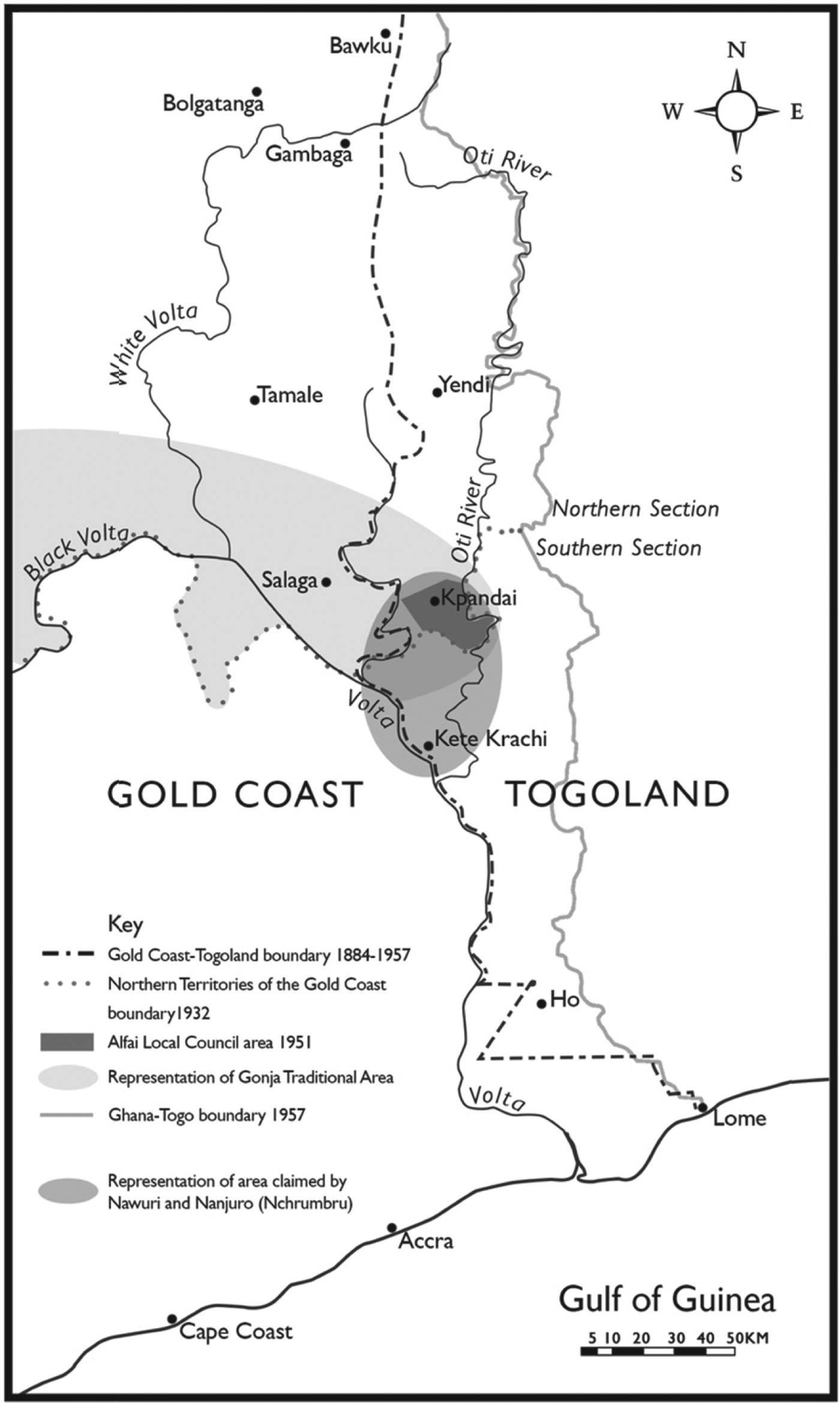
Map of international and administrative boundaries, and illustrating the traditional claims of Gonja, Nawuri, and Nanjuro (Nchrumbru) in the Kpandai area.Footnote 31

Incidents of identity-based friction arose soon afterwards. In 1932, for example, Nawuri protested against not being consulted about the selection of a new Gonja Chief of Kpandai.Footnote 27 By 1935, animosity against the Gonja Native Authority led officers to warn of ‘a united front of secession from Gonja’.Footnote 28 And, in 1943, a group of Nawuri under the leadership of one Nana Atorsah moved south to Kratchi district to join kinsmen there – a ‘secession’ that was also a protest against Gonja chiefs' conscription drives for the Second World War.
CREATING THE ALFAI LOCAL COUNCIL
The 1951 local government reforms replaced the native authorities with district councils and local councils, where two thirds of membership was elected and one third was reserved for traditional authorities. Head chiefs who were recognized by government – ‘a chief who is either the head of a tribe … or is accepted as paramount within an area under the jurisdiction of the Native Authority’ – sat as presidents of the district councils and appointed the traditional members of the new local councils.Footnote 29 They were not eligible for election and had no original vote, but could stand as laypersons and had the casting vote in the case of a tie.Footnote 30 As the native authorities were dismantled, the new councils gained powers that included acquiring land for development, issuing permits and licences, and charging market fees.Footnote 32
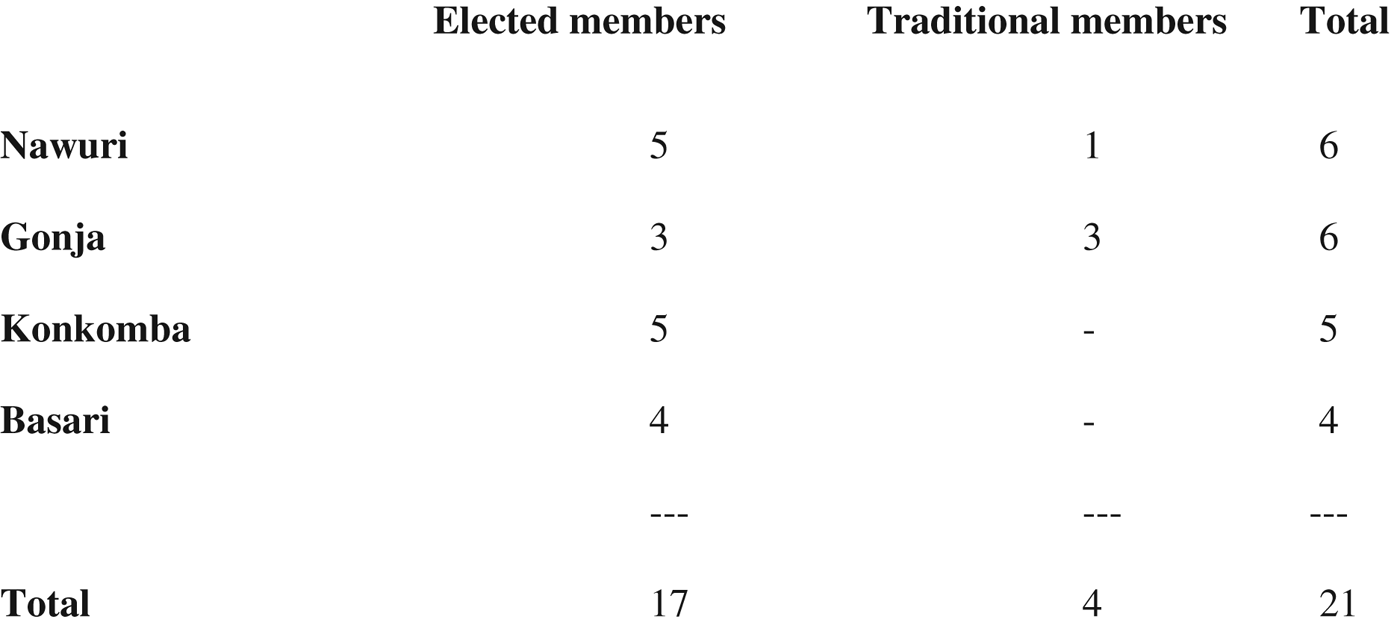
The Gonja Volta District Council included ten traditional members out of a total of thirty, but lacked any representation for the traditional authorities of the minority groups.Footnote 34 The Alfai Local Council (based in Kpandai town), established in the spring of 1951, was one of 12 wards of the district council. The local council was named ‘Alfai’ after the Gonja traditional area that covered Kpandai. The Gonja term was used to signify that the new local government institution was a continuation of the Native Authority system of rule.Footnote 35 The Alfai Local Council comprised 17 elected members and four traditional members: the Gonja Chief of Kpandai (the Kanankulaiwura) as chairman, two ethnic Gonja from his state council, and a Nawuri fetish priest.Footnote 36 It is clear that representation on the council did not reflect the make-up of the local population. According to the 1948 Census of the local council area, the Nawuri numbered 1,195, Gonja 436, Konkomba 2,281 and Basari 1,363. The Alfai Local Council was dismantled shortly after independence when President Kwame Nkrumah centralized power and stripped chiefs of their rights.
Representation on the Alfai Local Council following first election in April 1952.Footnote 33
PROTESTS AGAINST THE ALFAI LOCAL COUNCIL
The new local council quickly became synonymous with Gonja rule – an affront to the Nawuri, and a continuation of their lack of influence under the native authority system. The Nawuri protested when the council was named ‘Alfai’ after the Gonja subdivision, rather than Nawuri, who outnumbered the Gonja and considered themselves the autochthons. Complaints centred on the Gonja Chief of Kpandai having control over the new Native Tribunal ‘C’ Court that was attached to the council, and who decided the local council's traditional membership. Challenges to Gonja traditional authority became more blatant and serious when a riot that broke out in October 1950 resulted in 17 arrests and two deaths. Significantly, a year later in October 1951, Nana Atorsah (who had returned to Kpandai from Kratchi) was elevated ‘by popular election’ as the first ‘Nawuri-wura’ and ‘Chief of the Nawuri Land’.Footnote 37 The creation of a Nawuri chief affirmed fundamental ethnic differences as between the Nawuri and the Gonja, and aimed to mobilize opposition and raise broader awareness of Nawuri dissatisfaction. Subsequent celebrations in Kpandai mocked the new local government institution and resulted in a police station being built to support the native tribunal, which was not acknowledged by the Nawuri. There were numerous reports of trivial issues flaring up by late 1951, with fighting on market days and refusals to pay stall rents to the local council. In January 1952, 23 persons were charged with breaching the peace and one was sentenced to hard labour.Footnote 38
Following the first local elections in April 1952, a motion was put forward by dissident Nawuri villages under Atorsah petitioning for an administrative move to Kratchi Local Council in Southern Togoland. This was rejected by the Alfai Local Council by 18 votes to three, an outcome that prompted a walk-out by the elected Nawuri members. A revote in their absence rejected the motion again, this time by 18 to nil.Footnote 39 After this, the number of Nawuri petitions and complaints sent to all levels of government increased significantly. These communications typically contained one or two main signatories with up to a dozen thumbprints that carried the Akan prefix Nana to affirm southern ancestry, accentuating a distinction from the Gonja – seen by implication as a foreign element in Kpandai. While the Nawuri petitioners used titles that were recognized and vested with agency by the British colonial administering authority, they also adopted other power motifs to justify claims to authority and land – including paramount chief, divisional area, native authority, traditional area, traditional council, customary rights and native land rights. In this way, Nawuri created their own set of ethnically defined traditional institutions to counter the narrower set of categories that were recognized by the administering authority.
To paraphrase Sara Berry, the emergence of the new traditional institutions demonstrated the decisive role that alternative interpretations of history played in ongoing debates about the ownership of land. The creation of Nawuri chiefs aimed to affirm social and political status, and the ethnic group as an independent, resource-controlling entity.Footnote 40 As we shall see in a moment, the locally confined perspective of the contests concerned much broader questions about recognition given to identity-based authority, and procedures governing relations between different types of institution.
JUMPING INTO COURT
One such enlargement spiralled unexpectedly from a small incident on 7 September 1953. Abortasin Nawura, a nephew of the Nawuri dissident chief of Kpandai, was arrested by a Gonja sergeant in Kpandai for carrying a person on a bicycle without a bell ‘amidst a mob of people’. He was summoned to appear in the Alfai court two days later, where a £2 fine was imposed. During the hearing, the Nawuri chief and some 12 others ‘jumped into the court’ and caused mayhem by grabbing the charge book. They then emboldened the accused to read from it, and heckled and wrestled with the court members – aiming, in effect, to take ownership of the court and undermine it as a Gonja-controlled institution.
When things settled down a charge of contempt of court was issued against the group.Footnote 41 However, based on a previous incident in which a Nawuri had been sentenced to six months' hard labour by the Alfai court for ‘attempted corruption’ without any witnesses being called, the district commissioner cautioned the court about targeting the Nawuri unjustly. The court members responded by protesting they were not discriminating but were unable to call the Nawuri as witnesses to the previous case because of their ‘disobedience’ (that is, the Nawuri refused to acknowledge the tribunal). The district commissioner's allegation of discrimination resulted in the court members refusing forthwith to rule on cases involving the Nawuri, and they promised to refer these to the district commissioner's court in the district capital, Salaga.Footnote 42 Similarly, the arresting Gonja sergeant stressed he would no longer arrest any Nawuri, and that neither he nor the court members would give statements if the contempt charge was taken to Salaga. Meanwhile, the proclaimed Nawuri chief and supporters challenged the Alfai court to pursue the case in the district capital, knowing full well that this was highly unlikely, because it would indicate to the Kanankulaiwura's senior, the Gonja Chief of Kpembe, that he was unable to keep a lid on his own affairs in Kpandai.
The formal right to refer cases to district commissioners' courts was frequently problematic, in any case, because it risked undermining the central objective of improving the native tribunals' capabilities.Footnote 43 Eventually, the complexity and sensitivity of the case led to the charges of contempt against the group being dropped, despite some 15 testimonies given under oath by witnesses who described the furore in the court.Footnote 44 The episode was a morale booster for the dissidents: they could celebrate the successful demonstration of their standing – they were too strong to be tried, and the Alfai court had no real authority because it lacked the clout to pursue even the most straightforward of incidents. The dropping of the contempt charge and the backing down of the Gonja chief of Kpandai were popularly interpreted as proof that Gonja institutions had no jurisdiction over the dissidents. We can also see that the legitimacy of the Nawuri chiefs was not based on the fulfilment of colonial demands or an ability to negotiate the contradictions of customary law. Rather, their local standing and social status were raised because of their acumen in outmanoeuvring government-created institutions of traditional authority.
THE TOGOLAND QUESTION
The UN Trusteeship Council monitored the British- and French-held Trust Territories placed under the UN Trusteeship system in December 1946. The Togoland question was: should the present system be maintained, or should the two territories be unified? The push for Gold Coast independence by the southern-based Convention People's Party (CPP) made the future status of Togoland a leading political issue. By 1952, the Trusteeship Council had adopted two main proposals put forward by Britain and France: the future of the Trust Territories must pay full regard to the wishes of the population, and any political outcome should be economically and fiscally practical.Footnote 45 Besides these explicit policy outlines, the British administering authority's stance, as supported by Governor Arden-Clarke from 1951, was to pursue a veiled policy of integrating British Togoland into the Gold Coast.Footnote 46 Integration was highly appealing, moreover, to both the Northern People's Party (NPP) and CPP – which otherwise were political rivals along north-south and pro-chief/anti-chief lines respectively.Footnote 47 For the NPP, integration would ensure for the northern native states of Mamprusi, Dagbon, Nanumba, and Gonja the preservation of traditional areas and control over land that extended into Togoland under their paramount chiefs. For the CPP, integration was a core element of the nationalist struggle to maximize the territorial span of an independent Ghana. Consequently, a high degree of consensus in favour of the integration of Togoland into the Gold Coast united the administrative authority, prominent northern region chiefs, the NPP, and the CPP. Conversely, a unification of the Trust Territories, as favoured by the southern-based Togoland Congress, would mean that the northern native states would be divided by a new and permanent international border. This set of interests gave the dissident groups and their chiefs in East Gonja good reason to identify with the Togoland Congress policy of unification. First, support for unification allowed historical ties to the Ewe, and the ‘south’ more generally, to be asserted. Second, unification would mean an end to the Gonja traditional jurisdiction over Kpandai, as a new international border would separate the Gold Coast from Togoland. Third, they could hope that unification would lead to the minority groups' land claims being recognized by a new Togoland government.
FRAMING THE TOGOLAND ISSUE AS A ‘NATIVE’ QUESTION
The minority groups' challenges against Gonja authority and the Alfai Local Council were thus integrated with their stance on the Togoland question, and the local contest about attaining autochthonous native status was invariably framed as an international issue. The new traditional leaders argued, for example, that the local council breached an international border, Northern Territories of the Gold Coast laws did not apply in Togoland, their rights as trustees of a mandated territory were violated, and that income raised on ‘their land’ was appropriated by ‘foreign’ Gonja powers. The confluence of local and international concerns is exemplified when we examine what happened when the British established new Togoland institutions to ensure local consultation in accordance with the Trusteeship Council's guidelines. The process of choosing members of the new institutions, the Enlarged Joint Togoland Consultative Commission (EJTCC) and the Joint Togoland Council (JTC), demonstrates the cumulative effect of ostensibly apolitical, administrative decision-making that produced social fault lines between ethnic groups, pulling the nonrecognized chiefs further away from the rationale of the British administering authority.
Following Trusteeship Council guidelines that a single representative be chosen from the Alfai area, in autumn 1950 the Gonja Native Authority requested the Alfai Local Council to put forward a nominee to be elected to the EJTCC.Footnote 48 The dissidents ignored this initiative, as they did not acknowledge either the Gonja Native Authority or the Alfai Local Council as having a legitimate say in Togoland affairs. The Gonja Native Authority subsequently nominated a son of the Gonja Chief of Kpandai (one Allassan Jawula) who was elected by the Local Council to stand on the EJTCC. In the meantime, while continuing to withhold recognition from the Local Council, the dissidents – on the basis of claiming to be the rightful landowners and having jurisdiction over the area – elected a candidate of their own (one Sawli Friko). Following protest and debate, a ballot was eventually held at the Alfai Local Council to decide whether Friko or Jawula should take up membership of the EJTCC. Unsurprisingly, given the venue, this was won by the Gonja candidate by 19 votes to six. Due to a splintering of Togoland interest groups however, the EJTCC was short-lived and was soon replaced by the Joint Togoland Council (JTC).Footnote 49 Following the previous guidelines, the Gonja chief's son was again nominated and elected by the Alfai Local Council.Footnote 50 This result amplified resentment against Gonja traditional authority because, in all earnestness, the Nawuri sought access to the new international institutions to improve on their lack of influence over local affairs – while the winning Gonja candidate had no intention of participating, due to the broad Gonja support for integration.Footnote 51 The Gonja use of the Alfai Local Council to secure a position on the institutions designed to improve representation in Togoland led the Nawuri to take their protests to the Trusteeship Council.Footnote 52
One of the numerous written formulations to the Trusteeship Council was signed ‘the people of Nanjuro and Nawuri in the Kpandai area’ and called for the groups' native status to be recognized with representation on the international institutions. The Trusteeship Council rejected the request on the advice of the British governor through the secretary of state for the Colonies, and the British administering authority's special representative to the UN (Michael Ensor).Footnote 53 The response given was that;
(a) The traditional ties of the Nawuris lay with the Gonjas [sic] and there were no grounds for considering any change in their position.
(b) The Nanjuros were a small group of Nchumurus [sic] who were not even a majority in the seven villages which they inhabited and whose views could not be considered as representative of the Kpandai area.Footnote 54
So the Trusteeship Council substantiated the British policy of ruling through the Gonja institutions and ‘traditional ties’ took precedence over ballot box logic. The petitioners' call for an election to be held on the basis of Togoland rather than local council boundaries was rejected on the grounds of being outside the Trusteeship Council's mandate.Footnote 55 The petitioners responded that the affirmation of the Nawuri as traditional subjects, the denial of an election, and stating that the Nanjuro were not representative of the area's population, were all contrary to the Trusteeship guidelines to ensure popular consultation.
In July 1952, a second Nawuri petition to the Trusteeship Council was signed by the newly proclaimed ‘Nana Atorsah Agyeman, Head Chief of the Nawuris, Kpandai’, which again was refuted.Footnote 56 This petition alleged that people in two dissident villages (Kabonwule and Kateijeli) had not been informed of the registration procedure for the Alfai Local Council's first election, and that taxes had deliberately not been collected in order to automatically disqualify would-be voters.Footnote 57 An investigation concluded there had been no improprieties although the elections in both villages were rescheduled and attention levels were raised.
In December 1952, the Nawuri dissident J. Mbimgadong (who had lost the vote to attain JTC membership and had walked out on the second local council vote on the motion to move to Kratchi), spoke to the UN in New York on behalf of the Togoland Congress delegation.Footnote 58 Among many issues, his speech denounced the encroachments on Nawuri native affairs and called for a reversal of the 1932 administrative demarcation, which had placed the Kpandai area in the Northern Territories under Gonja rule:
We are unduly suppressed. We in the North are not allowed to speak except through our chiefs who are subjected to District Commissioners or the Government Agents. … We are subjected to severe punishment if we stay too long with our brothers in the South. … In order to bury our voice, men from the Northern Territories Protectorate of Gold Coast have been brought over to Northern Togoland and are made chiefs superceding [sic] our own chiefs. … We hope that this Committee being made up of sympathetic people – people who are really humanitarian [will ensure that] a humanitarian measure will be taken so that a final decision satisfactory to the needs of the people is taken.Footnote 59
Mbimgadong drew the attention of British politicians and in July 1953 was the subject of a House of Commons question-time session. The secretary of state for the Colonies was asked by a Mr Sorensen ‘why the chieftaincy in the Nacouri [sic] State in British Togoland has been superseded by chiefs of the Gold Coast northern territories?’ The reply, that ‘the Nawuris traditionally owe allegiance to the Gonja in the northern territories and have no State or chieftaincy of their own’, demonstrates how traditional allegiances were objectified and depoliticized to legitimize supposedly positive political developments.Footnote 60 Following these rejections, the petitioners endeavoured to maintain international attention by sending occasional alarmist telegrams: ‘Intimidation and human torture being administered … for supporting Togoland’;Footnote 61 ‘Inhuman atrocities being inflicted on peoples Bawuri [Nawuri] areas for their protest against integration through instrumentalities [sic]’.Footnote 62
Long and pointed appeals were sent to the General Assembly. One emphasized that the Togoland Congress had ‘abiding faith and confidence in the United Nations as the World Organization dedicated to peace, law, order, justice and fair play among the nations irrespective of size, race, or strength’. But the relationship between the British administering authorities and the Trusteeship Council was found wanting because ‘in a concerted and ingeniously planned policy [they had subverted the] basic guarantees, securities, rights and protections granted to the people … under the UN Charter’.Footnote 63 Particular attention was drawn to the principle stated in the Covenant of the League of Nations that ‘the well-being and development of such peoples [in Trust Territories] form a sacred form of civilization and that securities for the performance of this trust should be embodied in the Covenant’.Footnote 64 The protesters pointed out that the case for the unification of Togoland was actually iterated in the conclusion of the first report of the Visiting Mission of the Trusteeship Council in 1949. This stressed that ‘the problem has attained the force and dimension of a nationalist movement, and a solution should be sought with urgency in the interest of peace and stability’.Footnote 65 The question of acknowledging the autochthonous native status of the minority groups exposed a divide between the East and West in the Security Council on the holding of overseas territories. The USSR denounced the Togoland policy of the British because it had brought about the
artificial division of the Ewes as a calculated repression of their national aspirations in the interest of the colonial powers who were profiting [and who] had defied the Charter, the Trusteeship Agreements, and the General Assembly resolutions.Footnote 66
China, however, defended the role of the Visiting Mission but recognized its limitations as ‘nothing could be expected from it without the approval of the administering authorities’.Footnote 67 Opposing the USSR, the USA supported the Joint Council and claimed that the session had been misleading because groups opposing unification had not been heard. Following the address to the UN General Assembly, the British representatives to the UN expressed annoyance that many Trusteeship Council member states ‘showed a distressing readiness to accept these persons as fully representative of the people of the Territories’.Footnote 68 This outline demonstrates that the minority groups got across a sense of their autochthonous status as they protested against exclusion from colonial institutions of authority. Simultaneously, they won international sympathy as UN member states raised concerns about colonial rule and the need to protect native rights.
THE MALCONTENT NAWURI
The dissidents' engagement with the British administering authority featured forms of collaboration as well as obvious resistance. The campaign to attain recognition increased the central administrative burden significantly because complaints were often not addressed to the Gonja institutions that were under critique. Frequently, as a tactic, protests were sent to the ‘wrong’ administering authority institutions, or directly to the very seat of government in Accra. In this way, the dissidents ensured that all administrative levels were well aware of their campaign. The protests created an abundance of extra correspondence, reports, and files – and won the Nawuri a general reputation among the officials as a persistent nuisance. Six months prior to the first local elections, for example, district officials felt compelled to explain to their superiors the ‘considerable amount of unnecessary work … in the Alfai area [caused by] frivolous reports of “atrocities” and disturbance’.Footnote 69 Another official complained that ‘No measures have been taken [regarding allegations of human rights abuses]. We are far too busy reporting on the work we would be doing if we weren't too busy reporting on it even actually to do anything.’Footnote 70
Protests gave rise to panicky reports – ‘Alfai is a veritable political powder barrel which one spark may set off’ – and illustrate the dissidents' success in giving cause for concern to an administering authority whose main political objective was to present an orderly state of affairs to the Trusteeship Council's Visiting Missions.Footnote 71 Still, despite the acrimony against colonial policy, the minority groups' ‘anticolonial revolt’, to use Mamdani's term, was expressed relatively peacefully. It did not reach the level of hostility seen in the conflict between Konkomba and Dagomba, where a Dagomba chief and some twenty others were killed in Jagbel in 1940.Footnote 72 The Nawuri mobilization was directed towards recognition of their autochthonous status and land rights in an altered native authority system; it did not amount to an outright rejection of the system.
Hence, Nawuri engagement ranged from manipulating and undermining ruling institutions, to conformity within colonial social and political codes – though there is little direct evidence of collaboration as such. Respect for colonial authority is evident, however, from petitioners' addresses to senior figures, one of which read: ‘To the honourable WH Ingrams, Commander of the Most Distinguished Order of Saint Michael and Saint George, Chief Commissioner of the Northern Territories.’Footnote 73 Another, an address to Governor Arden-Clarke on a visit to Kpandai, began: ‘We the Head Chiefs of Nawuri and Nanjuro … do heartily welcome Your Excellency to these our parts [sic]. It is a second time now Your Excellency is also according us the honour of visiting.’Footnote 74
PRODUCING NATIVE RIGHTS AND PROTECTING NATIVE STATUS
The Nawuri campaign demonstrates the production of chieftaincy beyond the bounds of colonial authority, a process that emerged as groups appealed to global institutions seeking the protection of their native rights. In effect, African agency developed discourses that invoked the constitutional might of much more powerful institutions to dismantle the colonial project. The process of discrediting the existing form of rule is evident in a petition to the Trusteeship Council that describes how ‘we have been protesting against this unconstitutional action of the Administering Authority’ since an ‘Order in Council held at Buckingham Palace in November 1934’ had instructed the governor of the Gold Coast to ‘respect any Native Laws by which the civil relations of any Native Chiefs, Tribe, or populations … are regulated, and shall not be injurious to the welfare of the said Natives’.Footnote 75
The petition then poses the rhetorical question:
[I]s there any wors[e] injury to a tribe whose dialect, customs and culture are not identical to each other, [to force] that tribe in his own God-Given-Land to subjugate entirely to [another] tribe, who is in no way superior in anything to that of the aborigines [?] [A]nd for the Administering Authority [to keep silent] over our repeated petitions and resolutions. [This] is a serious challenge to our integrity, which is not the least expected from a representative of such a Great Empire whose democracy the whole British Subjects are proud of [sic].Footnote 76
Here we see the making of local discourses of belonging, identity, tradition, and land rights, as embodied in chiefship, occurring simultaneously with appeals made at the international level to protect these very unique social traits. The minority group's sense of grievance was based on the conviction that the administering authority should be held to account for ignoring Trusteeship guidelines, and breaching agreements to which it was a signatory, in order to pursue the colonial project of integration. Another petition stressed that Great Britain and France, in ‘classic colonial style through suppression, oppression, [and a] reign of terror [had contradicted] the sacred, international, legal, and moral duties they have assumed’.Footnote 77 Affirming the British government's violation of the UN Charter, it stated:
[The British government] wilfully, deliberately and knowingly authorised and permitted the CPP, a political party in the Gold Coast, to cross the international boundary … for the sole purpose … to defeat the objectives [of the Nawuri to exercise their native rights]. [The British government's actions] constitute aggression, illegal and subversive acts committed against the people [that have been] given a distinct international status by the UN.Footnote 78
The British government was accused of breaking the ‘Cardinal Principle of Law of Trust’ where administering authorities' interests in a mandated area were to be kept separate from the interests of the beneficiaries under the trust. From this viewpoint the Trust Territory had unlawfully become an antiquated and undemocratic de facto colonial possession, while incorporation of the area into the Northern Territories of the Gold Coast had hindered economic development significantly, as revenues had been ‘unlawfully’ extracted.Footnote 79
Subsequently, the petitioners' sense of grievance was influenced by the cumulative, incremental effects of British policy in favour of integration, and the measure of disillusionment that followed the inaction or indifference of the Trusteeship Council, a body to which the dissidents had looked – with raised hopes – as an anticolonial and progressive force.
THE DIXON INQUIRY
A new round of petitions to the Trusteeship Council sent in December 1954 was rejected and directed back to the administering authority. Diplomatically the Council expressed
the hope that the Administering Authority will continue to keep this matter under review, with a view to ensuring that the boundaries between the sections of the territory are drawn and modified in accordance with the wishes of the majority of the inhabitants.Footnote 80
On this basis, senior administrators convened a confidential committee to discuss the protests and the advantages of holding an inquiry with the objectives of appeasing the petitioners and satisfying the impending Visiting Mission until a planned plebiscite on the future status of the territory could be held. It was reasoned that an ‘investigation would not of course commit the Government to any subsequent course of action but would demonstrate to UNO and the Visiting Mission that the Trusteeship Council recommendations were not being ignored’.Footnote 81
It was agreed that colonial officer J. Dixon should undertake an inquiry with the following terms of reference:
[T]o investigate the representations made to the Governor in December, 1954 from persons from the area of the Gonja District lying in Togoland and to advise on the administrative arrangements appropriate to the area and in particular local government organisation having regard, inter alia, to the traditional relations between the inhabitants of this area and the inhabitants of neighbouring areas.Footnote 82
The dissidents had been calling for an investigation for years and, as the news spread, a stream of some forty very similar petitions were sent to all levels of government calling for acknowledgment of native status.Footnote 83 Despite the minority groups' great hopes that Dixon's inquiry would vindicate their claims, there is no evidence to suggest its intentions went beyond substantiating the current policy. From the above communications it is apparent that the ‘traditional relations’ intended to substantiate Gonja rule. The terms of reference negated in advance the tribal identity of the protesters, who were named only as ‘persons … of Gonja District’, and already acknowledged Gonja district as lying in Togoland, which was exactly the bone of contention.
On a practical note, Dixon's preparation included only a two-day visit to Tamale (the Northern Territories capital) and a mere one full day spent in Kpandai (4 April 1955). His written brief comprised incomplete files, notes, and reports – and, significantly, these were only from the perspectives of the administering authority and the Gonja, the parties who together had justified Gonja-defined authority.Footnote 84 Moreover, the inquiry's preliminary findings were written some two weeks prior to Dixon's arrival in Kpandai to interview Nawuri stakeholders. Dixon wrote to Chief Regional Officer (CRO) MacDonald-Smith that the findings would be in agreement with the ‘wishes of the Trusteeship Council, statements already made by administering authority, and the historical fact surrounding the representations of the petitioners'. Explaining the awkward task of balancing between the different interests, Dixon explained:
I have attempted to comply with the first, have adopted the second in entirety, and, as regards the third, have made recommendations which I believe will, if implemented, do no harm and may do some good. … I have thought it essential to show … that what grievances can legitimately be said to exist have their roots in the past and are not part of present-day politics.Footnote 85
To improve minority group representation, Dixon recommended membership for ‘Nawuri headmen’ and the ‘Nanjurowura’ on the panels of their respective native courts, but saw no reason to depart ‘from the clear statement made in the 1932 Togoland report that the Nawuris and Nanjuros were desirous of renewing their allegiance with the Gonja’.Footnote 86 Disagreeing with Dixon, MacDonald-Smith was against creating ‘another traditional authority’ with ‘a status and a salary personal to himself and created by Government’.Footnote 87 To safeguard and reiterate Gonja authority the minority groups' traditional representation was made conditional on the approval of the Gonja Chief of Kpandai and the Gonja Chief of Kpembe in the Alfai Local Council and Kpembe Local Council respectively. The underlying objectives of the inquiry were now fulfilled and the circle complete: the administering authority satisfied the Trusteeship Council that the protests were taken seriously and that an inquiry had been held; Gonja authority on the basis of superior native status was confirmed; and, as planned, the minority groups' claims were dismissed with no change to government policy. The pivotal role of the Gonja chiefs was kept deliberately vague in replies to countless requests by Nawuri figures to release the inquiry findings. The deferral aimed to stave off further protests until after the UN Visiting Mission to Togoland in 1955 and ideally until after the plebiscite that was planned for May 1956.Footnote 88 The result of the plebiscite fulfilled government objectives because a majority voted in favour of Togoland integration with the Gold Coast. Nevertheless, many in East Gonja went against the stream of northern sentiment and voted for the unification of the Trust Territories.Footnote 89 Perhaps because of the strength of dissident sentiment, the recommendations of the Dixon inquiry had not been implemented by the time independence came in March 1957.Footnote 90
THE RENEWAL OF TRADITIONAL CLAIMS
Macdonald-Smith's reservations about recognizing new traditional authorities proved well-founded when, in the following year, the ‘Nanjuro’ informed the administering authority that they now wished to be known as the ‘Nchrumbru’ after having unified ‘two Nchumbru areas’. The attempt to expand and unite was influenced by the Trusteeship Council's negative response that Nanjuro did not represent the whole area.Footnote 91 Leaders argued that because the traditional status of the Nanjurowura warranted local council membership, a now larger group under a ‘Paramount Chief of the Nchrumbru’ deserved a separate local and traditional council.Footnote 92 This larger group quickly fragmented, however, with each splinter group demanding its own council. Convinced that tribal allegiances were a source of social stability rather than a reaction of people coming to terms with political upheaval, Macdonald-Smith dismissed the likelihood of establishing any new councils.Footnote 93
Hence, groups produced chiefs because avenues of representation and group ability to influence local affairs were limited or closed off, and they appealed to external structures to validate their claims, in efforts to impress an identity on a social reality that had defined them as unequal. The process of incorporating groups into the colonial state by excluding them conditioned the making of a nonrecognized category of chiefs. In East Gonja the prototypes were the dissident Nanjuro Paramount Chief, and the Nawuri Paramount Chief Nana Atorsah, who was systematically depicted as a ‘self-elected’ leader, a ‘self-styled chief’, and ‘person describing himself as a Head Chief’.Footnote 94 After the Dixon inquiry, instructions were sent to district offices to address Atorsah by lay name only, and to desist from acknowledging his claimed title of Nawuriwura.Footnote 95
The colonial fiction in East Gonja did not comprise an invention of chiefs, which occurred in the north-west of the Northern Territories. Rather, Africans' ability to create their own chiefs was vehemently rejected, lest it should jeopardize colonially endorsed categories vested with authority. This meant that the colonial use of tradition in British Northern Togoland had retrogressive, normative, and instrumentalist features.Footnote 96 The retrogressive use legitimized the demarcation of the new administrative boundaries, the constitution of the new local government system, and the planned future boundaries of an independent Gold Coast. Normatively it was reified as the lynchpin of sociopolitical organization, which provided notions of a seamless continuity and depoliticized power relations. Last, it was instrumental because it legitimized administering authority pronouncements that political developments respected ancient allegiances.
CONCLUSION
The examination of the Nawuri chiefs' struggle for power and authority illuminates important features of postwar Gold Coast history that have eluded historical inquiry and broadens our understanding of chieftaincy in British colonial Africa. It challenges both the conventional ‘invention of tradition’ approach, which overstates colonial agency, and its later elaborations, in which ‘invention’ becomes the site of political transactions between chiefs and colonial authorities within the framework of a colony. The article also contrasts with the more typical pattern of productive and inclusive relations developing between chiefs and the administering authority within the boundaries of what was to become Ghana, as well as an assessment that African agency was strong enough to force a change in patterns of rule.Footnote 97 It shows that the social construction of authority within colonial borders occluded particular types of chieftaincy. In turn, the dominant scholarly view of mutually accommodating state–chief relations in the Gold Coast has elided the chiefly losers of this process of accommodation out of much of the scholarship on chieftaincy.
The nonrecognized chiefs obviously did not owe their existence to the colonial authority's reliance on them to be able to rule effectively, nor were they drawn into the colonial order to occupy positions as middlemen between the administering authority and communities.Footnote 98 Such chiefs' local viability did not rest on an ability to fulfil colonial demands, nor were they made ‘acceptable, given meaning and imbued with respect and awe’.Footnote 99 Significantly, Africans' ability to resist colonial rule was shaped not only by the colonial idioms vested with agency, but by groups' positioning within global institutions whose ideas became synonymous with and inseparable from the local production of discourses centred on self-determination. East Gonja exemplifies the variegated quality of chieftaincy in the Gold Coast and the myriad manifestations of reactions and organization against colonial rule.Footnote 100 Such local contests over ethnically defined rights to land and authority complicate Mamdani's argument that colonial powers could enforce their will on Africans through an institutional bifurcation between despotic customary rule and a civil, modern state.Footnote 101 The case invites a rethinking of traditional authority as a strictly ‘imagined’ elitist project or an ‘invention’ undertaken by higher powers taking place within colonial borders.Footnote 102 In East Gonja the right of locally legitimate traditional authorities to negotiate had to be dismissed by the British administration, and Africans' ability to invent their own chiefs had to be systematically curbed.
The historiography frames the Gold Coast's emerging nationalist movement, as embodied by the CPP, as mounting an assault on chieftaincy to dislodge the economic, political, and social privileges chiefs gained during the colonial period, and which made them ‘imperialist stooges’.Footnote 103 This study illustrates a rather different trajectory of chieftaincy in this period through which it could gain influence outside the immediate reach of government and utilise notions of justice and equality taken from external, progressive structures, to claim the right to self-determination and redefine international demarcations. Thus, global ideals shaped the local production of chieftaincy while concomitantly the colonial power affirmed alternative versions of tradition that reproduced social and political inequality. The dilemma for the colonial power in East Gonja, and the limit for its framing of tradition, was that recognition given within a traditional register designed to provide for stability and authority produced an ‘off-register’ social fault line that excluded locally legitimate traditional leaders. The local production of native status and the focus of global institutions on native rights meant that the struggle oscillated between local and international points of reference and in many ways the contest was about defining the legitimate authority to resolve such contests.