


Introduction
Perinatal anxiety refers to anxiety symptoms experienced during the perinatal period, defined as pregnancy through to 12 months postpartum (Austin et al., Reference Austin and Highet2017). The Mental Health Care in the Perinatal Period Australian Clinical Practice Guideline (Austin et al., Reference Austin and Highet2017) highlights that mental health conditions in the perinatal period often go undetected, despite research indicating that up to 15% of women experience significant anxiety symptoms during pregnancy, and up to 20% of women experience significant anxiety symptoms postpartum (Goodman et al., Reference Goodman, Watson and Stubbs2016). Numerous studies have demonstrated that women with perinatal mental health symptoms often do not seek help, despite treatment options being available (Maguire et al., Reference Maguire, Clark and Wootton2018).
To date, few studies have specifically explored the perceived barriers to accessing psychological support for women experiencing perinatal anxiety symptoms. Goodman (Reference Goodman2009) found that the most prevalent perceived barriers to accessing treatment for perinatal depressive symptoms were a lack of time, stigma associated with accessing mental health, and lack of childcare. In a qualitative study, Maguire et al. (Reference Maguire, Clark, Cosh and Wootton2022) found similar results, with lack of time, concerns about confidentiality, and stigma identified as the main barriers to help-seeking. This study also found that women residing in rural or remote geographical locations reported additional barriers during the perinatal period, including distance, isolation, and lack of support network (Maguire et al., Reference Maguire, Clark, Cosh and Wootton2022). Whilst the aforementioned studies have provided preliminary data on the barriers to accessing care, both studies have several limitations, including a small sample size (Maguire et al., Reference Maguire, Clark, Cosh and Wootton2022) and a focus on depressive rather than anxiety symptoms (Goodman, Reference Goodman2009). Additionally, due to Australia’s unique healthcare system (i.e. access to government-subsidised psychological sessions), the barriers experienced in the Australian context may differ from those reported in international studies. Thus, further research specifically exploring the ubiquity of these perceived barriers to accessing treatment in Australian women experiencing clinically significant symptoms of perinatal anxiety is needed.
The Health Belief Model (HBM; Rosenstock, Reference Rosenstock1966) is a useful theoretical framework to examine help-seeking behaviour. The model postulates that an individual’s engagement in health behaviours depends on the degree to which an individual perceives: (1) they are susceptible to the illness, (2) that the illness is severe, (3) the benefits to taking action, and (4) limited barriers to acting against the illness (Rosenstock, Reference Rosenstock1966). The HBM postulates that demographic variables (e.g. age, gender, education) and external influences (e.g. cues to action such as information, past health behaviour) influence an individual’s perceptions of illness susceptibility and severity, benefits of treatment, and barriers to accessing treatment. There is a growing body of evidence indicating that the HBM can accurately predict physical health help-seeking behaviours, such as those relating to healthy eating (Mascioli & Davis, Reference Mascioli and Davis2019), vaccinations (Scherr et al., Reference Scherr, Jensen and Christy2017), and breast screening (Farajzadegan et al., Reference Farajzadegan, Fathollahi-Dehkordi, Hematti, Sirous, Tavakoli and Rouzbahani2016).
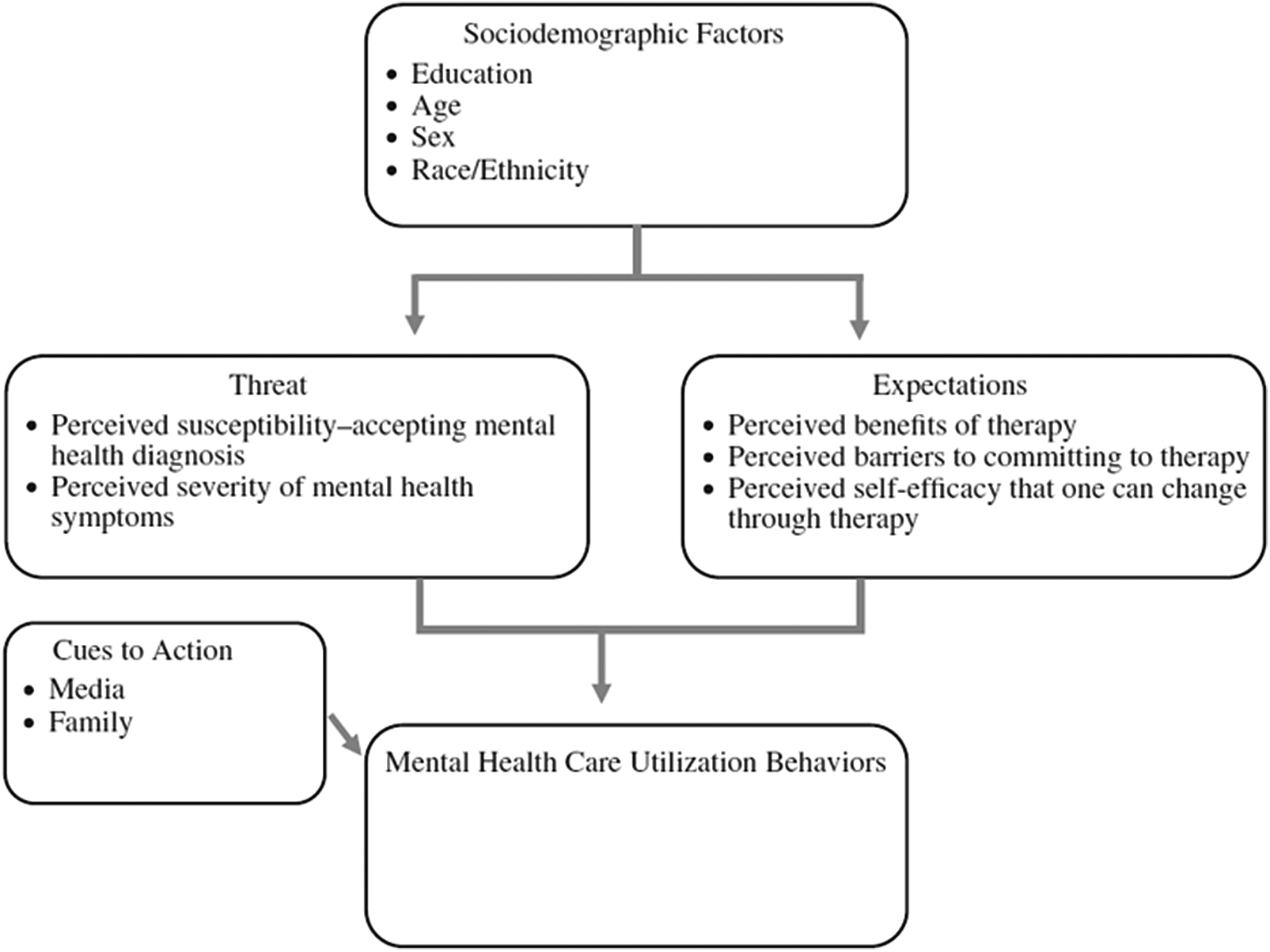
While the bulk of the literature examining the HBM is focused on help-seeking in relation to physical health conditions, a modified HBM has been proposed to predict help-seeking behaviour in relation to mental health conditions (Henshaw and Freedman-Doan, Reference Henshaw and Freedman-Doan2009). The amended model (Fig. 1) proposes that three variables impact treatment utilisation behaviours in mental health conditions, including threat (i.e. the individual’s beliefs about their susceptibilty to the condition and the severity of the condition); expectations (i.e. perceived benefits, perceived barriers, and self-efficacy); and cues to action (i.e. factors that make the threat of the condition prominent). Consistent with the original HBM, the amended HBM indicates that several demographic variables impact threat and expectancies correlates of help-seeking behaviour (Henshaw and Freedman-Doan, Reference Henshaw and Freedman-Doan2009). This modified HBM has been examined in participants with mental health conditions such as anxiety and depression and has been found to explain 49% and 51% of the variance in help-seeking in these diagnostic groups, respectively (Langley et al., Reference Langley, Wootton and Grieve2018; Langley et al., Reference Langley, Clark, Murray and Wootton2020).
Conceptualising mental health care utilisation using the Health Belief Model (Henshaw and Freedman-Doan, Reference Henshaw and Freedman-Doan2009). Copyright [2009] by American Psychological Association. Reproduced with permission.

To promote and deliver acceptable treatment for women experiencing perinatal anxiety symptoms, it is important to examine women’s treatment preferences. Cognitive behavioural therapy (CBT) has been found to be an efficacious treatment for perinatal anxiety symptoms (Maguire et al., Reference Maguire, Clark and Wootton2018) and can be effectively delivered via a number of different treatment modalities. For instance, low-intensity CBT interventions, such as internet-delivered CBT and bibliotherapy delivered CBT (which are largely self-help in nature) have been demonstrated to be effective in the treatment of anxiety and related disorders (i.e. Kladnitski et al., Reference Kladnitski, Smith, Uppal, James, Allen, Andrews and Newby2020; Wootton et al., Reference Wootton, Titov, Dear, Spence and Kemp2011). High-intensity CBT interventions include face-to-face individual and group-based CBT, as well as internet-videoconferencing and telephone-delivered CBT. Such treatment modalities are effective in the treatment of a variety of mental health conditions in the general population (Rees and Maclaine, Reference Rees and Maclaine2015). There is also emerging evidence that both low- (Forsell et al., Reference Forsell, Bendix, Holländare, Szymanska von Schultz, Nasiell, Blomdahl-Wetterholm, Eriksson, Kvarned, Lindau van der Linden, Söderberg, Jokinen, Wide and Kaldo2017) and high-intensity CBT (i.e. Milgrom et al., Reference Milgrom, Gemmill, Ericksen, Burrows, Buist and Reece2015; Misri et al., Reference Misri, Reebye, Corral and Milis2004) can be effective for the treatment of perinatal anxiety symptoms.
Remote CBT has proven to be a useful treatment option during the COVID-19 pandemic. A recent meta-analysis exploring the efficacy of internet-delivered CBT for the treatment of anxiety and depressive symptoms in the general population during the COVID-19 pandemic found that internet-delivered CBT significantly decreased depression and anxiety scores (Komariah et al., Reference Komariah, Amirah, Faisal, Prayogo, Maulana, Platini, Suryani, Yosep and Arifin2022). In perinatal samples in particular, Puertas-Gonzalez et al. (Reference Puertas-Gonzalez, Mariño-Narvaez, Romero-Gonzalez and Peralta-Ramirez2021) explored the efficacy of an 8-session internet-delivered group CBT program for stress management in pregnant women and found participants presented with lower rates of pregnancy-specific stress, decreased anxiety, depression, and obsessions-compulsions symptoms (Puertas-Gonzalez et al., Reference Puertas-Gonzalez, Mariño-Narvaez, Romero-Gonzalez and Peralta-Ramirez2021).
Given the prevalence of perinatal anxiety symptoms and the small proportion of women who access psychological treatment, further research is required in order to increase treatment uptake. Therefore, the present study aims to address the abovementioned gaps in the existing literature by examining: (1) the barriers to treatment uptake for women experiencing perinatal anxiety symptoms; (2) the CBT treatment delivery preferences of women with symptoms of perinatal anxiety; and (3) the utility of the HBM to predict treatment intention of women with perinatal anxiety symptoms. The study is exploratory with no a priori hypotheses.
Method
Participants
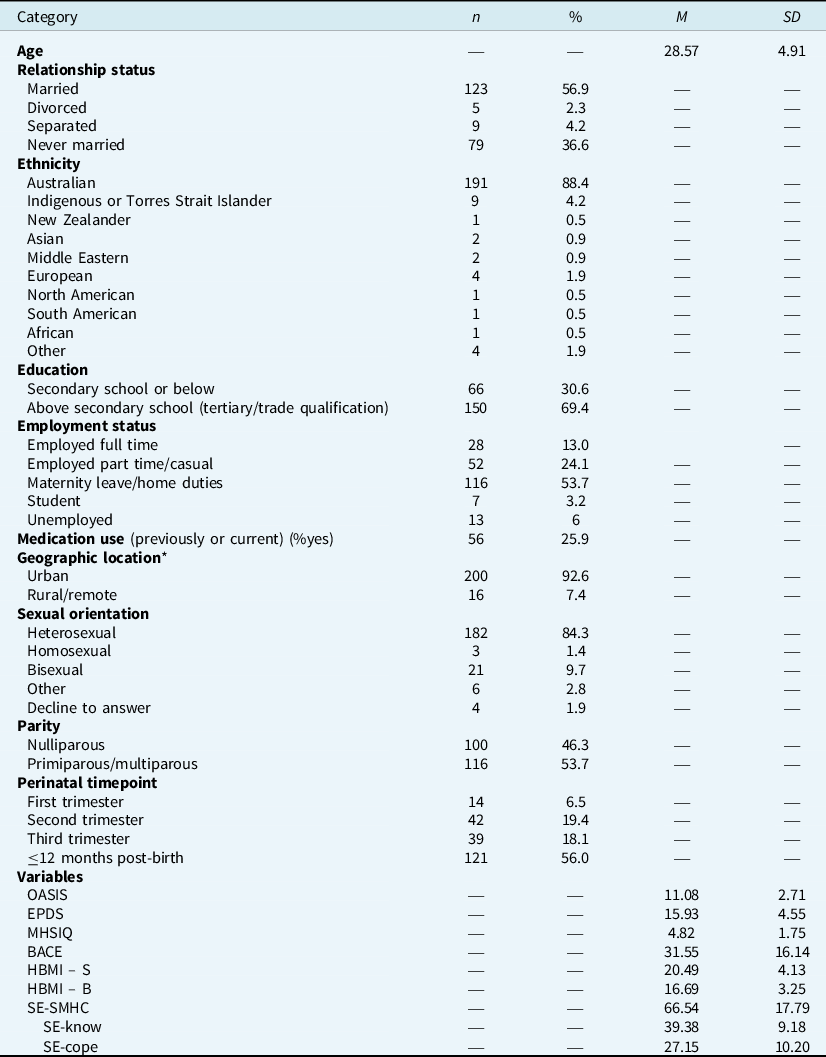
A total of 216 women (M age=28.57 years; SD=4.91) met study inclusion criteria. To be included in this study, participants were required to be: (a) a woman within the perinatal period (i.e. in their first trimester of pregnancy up to 12 months post-birth), (b) 18 years of age or older, (c) be experiencing symptoms of anxiety as determined by a score of ≥8 on the Overall Anxiety Severity and Impairment Scale (OASIS; Norman et al., Reference Norman, Hami Cissell, Means-Christensen and Stein2006), (d) be fluent in written and spoken English, and (e) be located in Australia. Exclusion criteria included high levels of suicidality as indicated by a score of 3 on question 10 of the Edinburgh Postnatal Depression Scale (EPDS; Cox et al., Reference Cox, Holden and Sagovsky1987). Table 1 outlines participant demographic information and descriptive statistics for all key study variables.
Sample characteristics (N=216)

* Geographical location based on Australian Statistical Geography Standard (ASGS) Volume 5 – Remoteness Structure; OASIS, Overall Anxiety Severity and Impairment Scale; EPDS, Edinburgh Postnatal Depression Scale; MHSIQ, Mental Help Seeking Intention Question; BACE, Barriers to Access to Care Evaluation; HBMI, Health Beliefs about Mental Illness Instrument; SE-SMHC, Self-Efficacy Scale for Seeking Mental Health Care.
Procedure
The study employed a cross-sectional design and participants were a convenience sample of women who were recruited using noticeboard advertisements on community noticeboards and social media posts on pregnancy-related social media pages. The measures were administered online using QualtricsTM (Qualtrics, Provo, UT). Participants accessed the online study link provided on the advertisements, which opened the participant information sheet and consent form. Participants who did not meet inclusion criteria were automatically excluded from the study and were taken to an exit page of the survey. This final page contained information on 24-hour crisis lines and recommended that the participant speak with their General Practitioner about their mental health concerns. Participants who met inclusion criteria were offered the opportunity to enter a prize draw to win a $50 gift card. The questionnaire was administered in a fixed order and took approximately 25 minutes to complete.
Measures
Demographic questions
Participants completed a demographic questionnaire to obtain information relating to age, postcode, marital, employment and education status, medication use, and pregnancy details.
Overall Anxiety Severity and Impairment Scale (Norman et al., Reference Norman, Hami Cissell, Means-Christensen and Stein2006)
The Overall Anxiety Severity and Impairment Scale (OASIS) is a 5-item self-report measure used to assess the severity and impairment associated with anxiety symptoms. The OASIS total scores range from 0 to 20 and a cut-score of ≥8 demonstrates a probable anxiety disorder (Campbell-Sills et al., Reference Campbell-Sills, Norman, Craske, Sullivan, Lang, Chavira, Bystritsky, Sherbourne, Roy-Byrne and Stein2008). The scale has demonstrated excellent internal consistency in previous samples in the general population (Cronbach’s α ranging from .80 to .84) (Campbell-Sills et al., Reference Campbell-Sills, Norman, Craske, Sullivan, Lang, Chavira, Bystritsky, Sherbourne, Roy-Byrne and Stein2008; Norman et al., Reference Norman, Hami Cissell, Means-Christensen and Stein2006); however, to date the psychometric properties of the scale have not been measured in a perinatal sample. Cronbach’s α in the current sample was .72.
The Edinburgh Postnatal Depression Scale (Cox et al., Reference Cox, Holden and Sagovsky1987)
The Edinburgh Postnatal Depression Scale (EPDS) is the most widely used instrument for the assessment of depressive symptoms during the perinatal period. This 10-item scale with a cut-off score of ≥13 demonstrates a probable depressive disorder (Cox et al., Reference Cox, Holden and Sagovsky1987). The EPDS reflects women’s experiences over the past 7 days and includes one question (Item 10) regarding suicidal thoughts. The scale has demonstrated adequate internal consistency in previous perinatal samples (α=.79–.88) (Kheirabadi et al., Reference Kheirabadi, Maracy, Akbaripour and Masaeli2012; Logsdon et al., Reference Logsdon, Usui and Nering2009). Cronbach’s α in the current sample was .83.
Barriers to Access to Care Evaluation Scale (Clement et al., Reference Clement, Brohan, Jeffery, Henderson, Hatch and Thornicroft2012)
The Barriers to Access to Care Evaluation (BACE) is a 30-item scale designed to assess stigma, institutional and attitudinal barriers related to help-seeking for mental health care. Participants were asked to indicate on a 4-point-Likert-scale, where 0 is not at all and 3 is a lot, which barriers are likely to inhibit their ability to access treatment. The BACE can be scored to create an overall score, or the mean of each individual barrier can be scored. The items comprising the BACE scale were considered to be applicable in the Australian context. Furthermore, the scale has demonstrated good internal consistency in previous samples in the general population (α=.61 to .80) (Clement et al., Reference Clement, Brohan, Jeffery, Henderson, Hatch and Thornicroft2012); however, to date the psychometric properties of the scale have not been measured in perinatal samples. Cronbach’s α in the current sample was .90.
Health Beliefs about Mental Illness - Susceptibility Scale (Saleeby, Reference Saleeby2000)
The Health Beliefs about Mental Illness - Susceptibility Scale (HBMI-S) is a 5-item measure used to measure perceived susceptibility to developing an anxiety disorder. The scale was modified by the investigators to be specific to perinatal anxiety symptoms. For example, questions included perinatal anxiety specifiers, such as ‘it is extremely likely that I will have emotional or nervous problems during the perinatal period’. The scale is scored on a 5-point Likert scale where 1=strongly disagree and 5=strongly agree. The scale demonstrates adequate construct and content validity (Saleeby, Reference Saleeby2000) and good internal consistency in previous samples (α=.76 to .95) (Langley et al., Reference Langley, Wootton and Grieve2018; Saleeby, Reference Saleeby2000); however, to date the psychometric properties of the scale have not been measured in a perinatal sample. Cronbach’s α in the current sample was .88.
Health Beliefs about Mental Illness - Benefits Scale (Saleeby, Reference Saleeby2000)
The HBMI - Benefits Scale (HBMI-B) is a 4-item measure designed to measure perceived benefits of psychological help. The scale was modified by the investigators to be specific to perinatal anxiety symptoms. The scale is scored on a 5-point Likert scale where 1 is disagree and 5 is agree. The scale has demonstrated good internal consistency in previous samples (α=.68 to .82) (O’Connor et al., Reference O’Connor, Martin, Weeks and Ong2014; Saleeby, Reference Saleeby2000); however, to date the psychometric properties of the scale have not been measured in a perinatal sample. Cronbach’s α in the current sample was .80.
Self-Efficacy Scale for Seeking Mental Health Care (Moore et al., Reference Moore, Schofield, van Rooyen and Andersson2015)
The Self-Efficacy Scale for Seeking Mental Health Care (SE-SMHC) is a 9-item scale that assesses participant’s confidence in their ability to do each of the listed behaviours relating to seeking mental health care, such as ‘find a place to get mental health treatment’. The scale is scored on a 10-point Likert scale from 1 (no confidence) to 10 (complete confidence). The scale contains two subscales, SE-KNOW (one’s confidence in their own ability to know how to successfully interface with mental health care systems) and SE-COPE (one’s own confidence in their ability to cope with consequences of seeking care). Whilst the scale has not been validated on perinatal populations to date, the overall scale has demonstrated excellent internal consistency (α=.90 to .93) in previous studies in the general population (Langley et al., Reference Langley, Clark, Murray and Wootton2020; Moore et al., Reference Moore, Schofield, van Rooyen and Andersson2015). Cronbach’s α in the current sample was .87.
Mental help seeking intention
Participants first read information about common symptoms and features of various anxiety disorders that may present during the perinatal period to ensure an informed response. Participants were asked to rate their degree of intention to access mental health professionals, with higher scores indicating greater intention to seek help. To assess help-seeking intention participants were asked to respond to the following question using a 7-point Likert scale, where 1 is extremely unlikely and 7 is extremely likely, ‘if I had a mental health concern, I would seek help from a mental health professional’. Participants were informed that ‘for the purposes of this survey, “mental health professionals” include psychologists, psychiatrists, clinical social workers, and counsellors. Likewise, “mental health concerns” include issues ranging from personal difficulties (e.g. loss of a loved one) to mental illness (e.g. anxiety, depression)’. Given the scale only included one item, Cronbach’s α was not computed.
Treatment Preferences Questionnaire
The Treatment Preferences Questionnaire (TPQ) has been used in previous studies (Robertson et al., Reference Robertson, Paparo and Wootton2020; Smith et al., Reference Smith, Paparo and Wootton2021) and assesses cognitive behavioural treatment delivery preferences. Participants were asked to indicate on a 10-point-Likert-scale, where 1 is extremely unlikely and 10 is extremely likely their likeliness to engage in each treatment type. Treatment types assessed included low-intensity (i.e. self-help workbook, etc.) and high-intensity treatment options (i.e. therapy conducted in a therapist’s office, etc.). The TPQ has not been validated using perinatal samples previously.
Data analytic plan
Perceived barriers and treatment preferences were analysed using descriptive statistics. Independent samples t-tests were used to explore differences in participant groups. Where assumptions were violated, the Mann–Whitney U-test was conducted. For group differences effect estimates (Cohen’s d) was calculated. A hierarchical multiple regression analysis was conducted to examine whether intention to seek help for perinatal anxiety symptoms could be predicted by a set of the HBM variables. Before interpreting the results of the analysis, several assumptions were tested, and checks were performed. An examination of the Mahalanobis distance scores indicated multivariate outliers, which on further investigation of the cases revealed the individual response pattern across the variables was not sufficiently abnormal to indicate illegitimate respondents, or unrepresentative of the participant population. Examination of the parameter estimates, when excluded from the model, confirmed this, indicating that no cases had a large influence on the regression parameters (Field, Reference Field2018), thus bootstrapping methods were employed. For regression analysis, effect estimates for Cohen’s f 2, and 95% confidence intervals, were calculated. All data were analysed using IBM SPSS Statistics for Windows, Version 22 (IBM Corporation, 2020).
Results
Participant characteristics
Table 1 presents descriptive statistics for all key study variables. The majority of the sample (73.6%; n=159) reported either currently or previously seeking help from a mental health professional. All participants scored ≥8 on the OASIS, indicating clinically significant anxiety symptoms, and (77.3%; n=167) indicated clinically significant depressive symptoms.
Barriers to accessing treatment
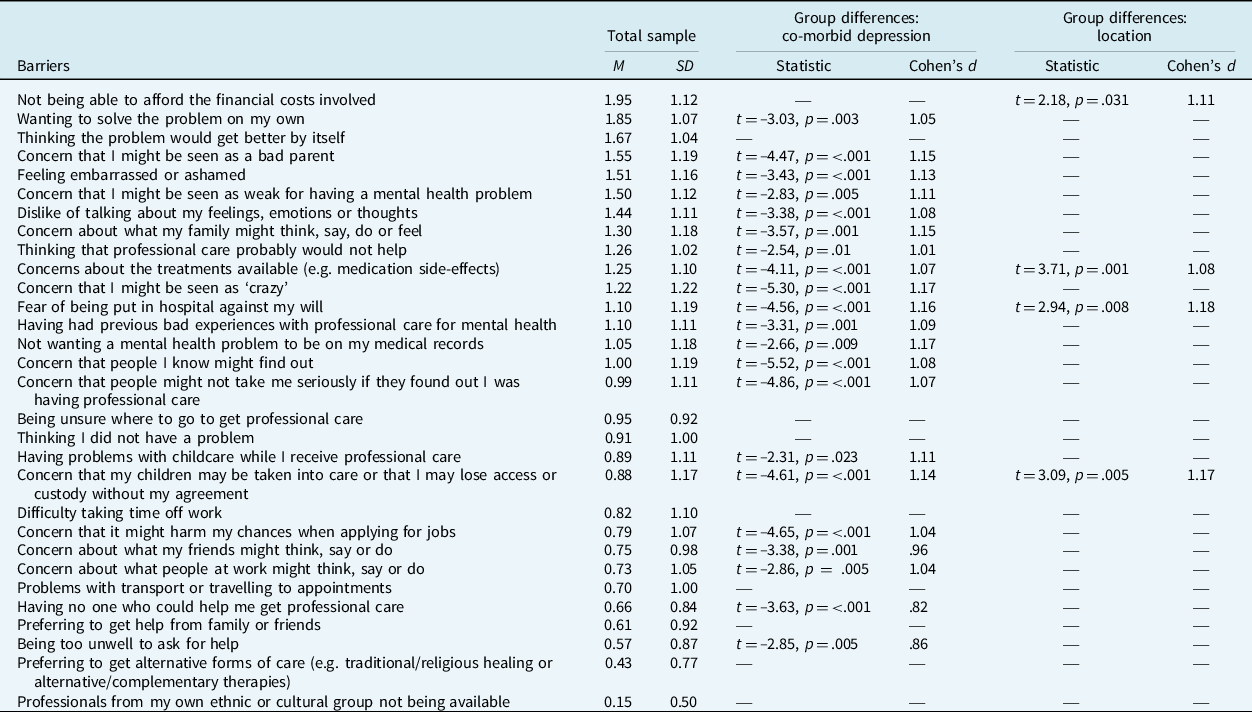
Table 2 provides a summary of the mean score and standard deviation of each individual perceived barrier to accessing treatment during the perinatal period. On a scale of 0 (not at all) to 3 (a lot), the most frequently endorsed major barrier was ‘not being able to afford the financial costs involved’ (M=1.95; SD=1.12), followed by ‘wanting to solve the problem on my own’ (M=1.85; SD=1.07), ‘thinking the problem would get better by itself’ (M=1.67; SD=1.04), and ‘concern that I might be seen as a bad parent’ (M=1.55; SD=1.19).
Perceived barriers to accessing treatment and group differences based on comorbid depression status and location

N=216. Each barrier item is scored on a 4-point scale, where 0 is not at all and 3 is a lot, and higher mean scores on each barrier indicates greater endorsement of the barrier.
Independent samples t-tests were used to compare barriers (calculated by mean score for each barrier) by participants with co-morbid depressive symptoms as assessed by the EDPS (n=167) to the barriers reported by those without co-morbid depressive symptoms (n=49). There were statistically significant differences between groups for several barriers (see Table 2) with those with co-morbid depressive symptoms reported higher mean scores. Comparison of barriers for those living in a rural/remote location (n=16) and those living in an urban location (n=200) showed significant differences on several barriers (see Table 2), where those residing in urban locations reporting higher mean scores on the barrier.
Utility of the HBM
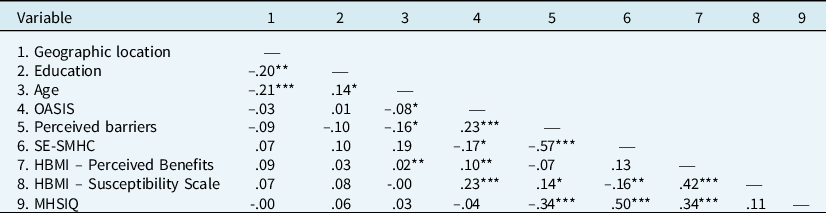
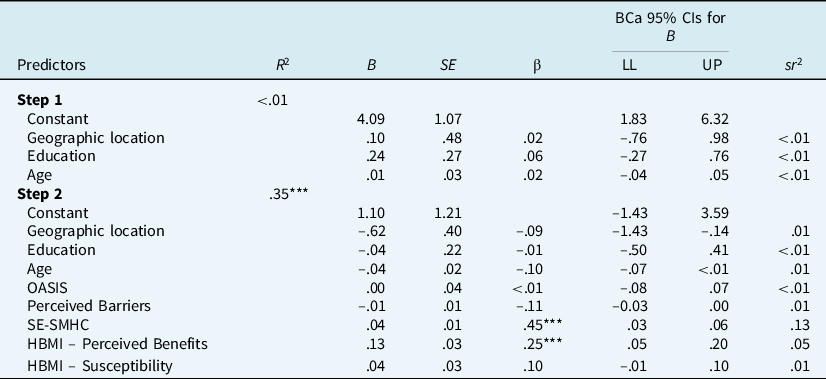
In Step 1 of the hierarchical multiple regression, the demographic variables (age, geographical location and education) were added to the model and accounted for a non-significant 0.5% of variance in help seeking intention, F 3,212=.33, p=.81, R 2=<.01. The OASIS, perceived barriers, self-efficacy, perceived treatment benefits, and perceived susceptibility scales were added to the multivariate model in Step 2 and accounted for an additional 35% of variance in help seeking intention, F 8,207=13.95, p<.001, R 2=.35. Table 3 provides a summary of the correlation matrix of the study variables. According to Cohen’s (Reference Cohen1992) guidelines, a combined effect of this magnitude can be considered ‘large’ (f 2=.54). Results, summarised in Table 4, showed that self-efficacy (β=.45, p<.001) and perceived treatment benefits (β=.25, p<.001) were the only significant predictors and explained unique variance (13% and 5%, respectively) in help-seeking intention. The OASIS, perceived barriers, and perceived susceptibility scales were not significantly associated with greater help seeking intention.
Correlation matrix of the multivariate model variables

N=216. OASIS, Overall Anxiety Severity and Impairment Scale; HBMI, Health Beliefs about Mental Illness Instrument; SE-SMHC, Self-Efficacy Scale for Seeking Mental Health Care; MHSIQ, Mental Help Seeking Intention Question. *p<.05; **p<.01; ***p<.001.
Summary of hierarchical multiple regression analysis: predictors of help-seeking intention

N=216. OASIS, Overall Anxiety Severity and Impairment Scale; SE-SMHC, Self-Efficacy Scale for Seeking Mental Health Care; HBMI, Health Beliefs about Mental Illness Instrument; R 2, the amount of variation in the outcome variable accounted for by the model; B, unstandardised beta coefficients; SE, standard errors; β, standardised beta coefficients; BCa Cis, bias-corrected and accelerated confidence intervals based on 1000 bootstrapped samples; LL, lower limit; UL, upper limit; sr 2, squared semi-partial correlation (amount of unique variance in the DV explained by a predictor after controlling for the other predictors in the model). ***p<.001.
CBT treatment preferences
Overall, high-intensity individual face-to-face therapy was the most endorsed treatment preference (M=8.32; SD=2.43) followed by low-intensity therapy delivered via the internet (M=6.95; SD=2.78) or app (M=6.95; SD=2.49). The treatment endorsed the least favourably was group-based CBT (M=3.04; SD=2.43). Furthermore, therapy delivered via an app (M=6.95; SD=2.49) and therapy delivered via bibliotherapy (i.e. self-help books) (M=5.47; SD=2.92) were also rated highly by participants. Despite a preference for face-to-face therapy or therapy delivered via the internet, less than half of participants indicated that they would be extremely likely to utilise high-intensity therapy delivered via videoconference (M=4.64; SD=3.21).
Mann–Whitney U-tests were performed to compare CBT treatment preferences amongst those with and without co-morbid depressive symptoms. Among all treatment preferences, group therapy was the only significant difference, where results indicated participants without co-morbid depressive symptoms were more likely to engage in group therapy (mean rank=103.54, n=167), U=3536.00, z=–2.27, p=0.02, two-tailed), than those with co-morbid depression. This effect can be described as medium in size (r=.15). Mann–Whitney U-tests were also performed to compare CBT treatment preferences amongst those residing in urban areas and those residing in rural areas. There were no significant differences for treatment preferences amongst participants residing in rural areas and those residing in urban areas.
Discussion
The aims of the current study were to extend the literature by examining: (1) the barriers to treatment uptake for women experiencing perinatal anxiety symptoms, (2) the CBT treatment delivery preferences of women experiencing perinatal anxiety symptoms, and (3) the utility of the HBM to predict treatment intention of women experiencing perinatal anxiety symptoms. Given the small amount of literature in this research area, the study was designed as exploratory, with no a priori hypotheses.
Barriers to accessing treatment
The current study revealed the most frequently endorsed barriers to accessing treatment during the perinatal period were related to: (1) the cost of treatment, (2) wanting to solve the problem alone, and (3) thinking the problem would go away. This finding is consistent with previous research exploring mental health help-seeking in the general Australian population (McCausland et al., Reference McCausland, Paparo and Wootton2021; Robertson et al., Reference Robertson, Paparo and Wootton2020; Smith et al., Reference Smith, Paparo and Wootton2021), in international studies (Marques et al., Reference Marques, LeBlanc, Weingarden, Timpano, Jenike and Wilhelm2010), and in perinatal samples (i.e. Smith et al., Reference Smith, Lawrence, Sadler and Easter2019) which have identified affordability as the most commonly reported barrier across mental health conditions. Similarly, several Australian (Langley et al., Reference Langley, Clark, Murray and Wootton2020; Prins et al., Reference Prins, Meadows, Bobevski, Graham, Verhaak, van der Meer, Penninx and Bensing2011) and international studies (Heinig et al., Reference Heinig, Wittchen and Knappe2021) conducted in the general population have identified a preference for dealing with one’s own mental health concerns as a common barrier to accessing treatment; however, to our knowledge this is the first study to report this barrier in a perinatal sample.
Further, the current study found that participants experiencing symptoms of depression and anxiety were more likely to report higher mean scores on each barrier than those experiencing anxiety symptoms alone. This is the first study to report these findings in the perinatal sample, which is consistent with the literature demonstrating that those with higher levels of co-morbidity have poorer mental health treatment outcomes in the general population (Gaspersz et al., Reference Gaspersz, Nawijn, Lamers and Penninx2018; Stålner et al., Reference Stålner, Nordin and Madison2022). These findings may have implications for the delivery of treatment, with those mothers experiencing depression and anxiety symptoms potentially requiring additional assistance to overcome treatment barriers and greater support during treatment.
This study is one of the first to explore the difference in perceived barriers between Australian women residing in urban locations compared with those residing in rural locations. The findings indicate that barriers to accessing mental health care during the perinatal period are common for women residing in both rural and urban geographical locations, but some barriers were more significant for women residing in urban areas, including affordability, concerns about the treatments available, fear of being hospitalised, and concerns that their children may be taken into care. Whilst this finding is consistent with international research which has found that some barriers are more prominent in urban populations (Loftus et al., Reference Loftus, Allen, Call and Everson-Rose2018), qualitative research exploring barriers to accessing mental health care has found women residing in rural populations experience additional barriers to those residing in urban areas during the perinatal period (Maguire et al., Reference Maguire, Clark, Cosh and Wootton2022).
Women’s CBT treatment preferences
Consistent with the existing research exploring women’s treatment preferences (Goodman, Reference Goodman2009), the current study found the vast majority of women prefer individual face-to-face therapy. This result is also consistent with studies exploring CBT treatment preferences in the general population (McCausland et al., Reference McCausland, Paparo and Wootton2021; Robertson et al., Reference Robertson, Paparo and Wootton2020; Smith et al., Reference Smith, Paparo and Wootton2021). Further, our results indicated participants with co-morbid symptoms of anxiety and depression were less likely to engage in group therapy than those with symptoms of anxiety alone. Of the remote treatment options, women indicated a preference for CBT delivered via an app or via the internet and less than half of participants indicated they would be extremely likely to utilise high-intensity therapy delivered via internet videoconferencing software. This means that availability of a variety of evidence-based treatment approaches for women experiencing clinically significant symptoms of perinatal anxiety is important.
Utility of the Health Belief Model
Our study findings support the utility of the HBM in predicting help-seeking intention, as the HBM variables accounted for approximately 35% of variance in help-seeking intention, with self-efficacy and perceived treatment benefits as significant predictors. Although the HBM predicted help-seeking intention in the current study, the existing literature exploring the utility of the HBM in the general population in different diagnostic groups including depression (Langley et al., Reference Langley, Clark, Murray and Wootton2020) and anxiety (Langley et al., Reference Langley, Wootton and Grieve2018) have found the HBM accounts for a higher variance in help-seeking intention (49% and 51%, respectively).
Perceived treatment benefits significantly predicted help-seeking intention. This finding is consistent with the HBM model and similar studies findings in the general population (Hathorn et al., Reference Hathorn, Lochner, Stein and Bantjes2021; Langley et al., Reference Langley, Clark, Murray and Wootton2020). Therefore, mental health help-seeking may be increased if further emphasis is placed on increasing an individual’s knowledge and understanding of the percevied treatment benefits. Providing brochures and posters in waiting rooms and examination rooms can provide information about perinatal anxiety symptoms and contact information for local, accessible and evidence-based services, which may enhance perceived treatment benefits.
Self-efficacy also significantly predicted help-seeking intention. While this is the first study to explore the HBM variables in predicting help-seeking intention during the perinatal period, this finding is consistent with other studies which have indicated that higher levels of self-efficacy are related to physical health help-seeking in pre-menopausal women (Chou and Shih, Reference Chou and Shih2018) and in mental health help-seeking in adolescents (O’Connor et al., Reference O’Connor, Martin, Weeks and Ong2014). Research suggests self-efficacy can be improved using brief interventions (Franco-Antonio et al., Reference Franco-Antonio, Santano-Mogena, Sánchez-García, Chimento-Díaz and Cordovilla-Guardia2021), thus it may be important for primary health physicians to provide women in the perinatal period with preventative education as well as a brief motivational interviewing session regarding help-seeking, as this may assist in building women’s confidence, and subsequently their self-efficacy, resulting in higher levels of treatment seeking.
Furthermore, perceived symptom severity did not significantly predict help seeking intention. This finding is inconsistent with the HBM (Henshaw and Freedman-Doan, Reference Henshaw and Freedman-Doan2009); however, to date the HBM has primarily been used to predict physical health help-seeking, thus physical health symptom severity may be perceived differently to mental health symptom severity. Despite this, the current findings are consistent with the existing research exploring help-seeking intention in the general population, which has found that help-seeking intention is not predicted by symptom severity (Langley et al., Reference Langley, Wootton and Grieve2018; Langley et al., Reference Langley, Clark, Murray and Wootton2020). It is important to highlight that the majority of participants in our sample (73.6%) reported currently or previously seeking help from a mental health professional, but no formal anxiety disorder diagnosis was provided. It is possible that the HBM may be more applicable to women who are treatment-naïve and the provision of a formal diagnosis may also increase a patient’s understanding of the severity of the condition which may potentially increase help-seeking behaviour.
Strengths and limitations
The current study has several strengths. First, it builds on a small body of literature examining barriers to treatment for women with perinatal anxiety symptoms. Second, this study is the first to examine the CBT treatment preferences for women with perinatal anxiety symptoms, when a full spectrum of treatment options is presented. Finally, this was the first study to specifically explore the utility of the HBM in predicting future help-seeking intention for women experiencing significant perinatal anxiety symptoms.
The current study also has several limitations that require acknowledgement. First, the current study employed the use of a cross-sectional design which only allowed data to be collected at a single time point, therefore, casual inferences are not possible. The study sample was not representative, thus results may not be applicable to all women experiencing significant perinatal anxiety symptoms.
Second, the current study used self-report data obtained from screening assessments rather than a diagnostic interview, thus may not be generalisable to those with diagnosed anxiety disorders. Given a transdiagnostic measure of anxiety symptoms (i.e. OASIS) was used, it is not clear what type of anxiety disorder the participants were suffering from. Additionally, the assessed barriers were pre-determined based on those outlined in the BACE, which has not previously been validated in a perinatal sample, and during the perinatal period there may be different barriers to those reported in the BACE. For example, women may seek treatment to reduce the impact of parental mental health problems on the child (Rominov et al., Reference Rominov, Pilkington, Giallo and Whelan2016) – which is not assessed in the BACE. Similarly, barriers associated with attitudes relating to professional care not being helpful may not be relevant to a sample with a high proportion of individuals who have previously, or who are currently, accessing treatment.
Third, the HBM demonstrates potential in understanding help-seeking, but is not without limitations. For example, the HBM primarily explores the service user, rather than the services, thus the current study focuses predominantly on individual-focused barriers. Additionally, the HBM does not explore motivation to seek help, for example research indicates that perinatal anxiety during pregnancy and early childhood is associated with increased emotional problems (Rees et al., Reference Rees, Channon and Waters2019) and that perinatal anxiety has a significant negative effect on infant language development (Reck et al., Reference Reck, Van Den Bergh, Tietz, Müller, Ropeter, Zipser and Pauen2018), which may prompt women to seek help.
Future directions
Future research could examine: (1) barriers specific to women, in the perinatal period, who are treatment-naïve; (2) barriers for different gender identities; (3) specific barriers for differing anxiety diagnostic groups, geographical locations and in participants with a single diagnosis vs multiple diagnoses; (4) efficacy of various low- and high-intensity CBT treatment approaches for perinatal anxiety; (5) efficacy of different treatments using randomised controlled trials to ascertain how to potentially sequence treatments using a stepped-care model to ensure that treatments are provided in the most cost-effective away; (6) longitudinal study designs exploring help-seeking intention and subsequent behaviour over gestation and the postnatal period to observe changes in components of the HBM; (7) whether providing education and motivational interviewing as part of perinatal care can increase help-seeking; and (8) demographic factors that correlate with self-perception of perceived self-efficacy and perceived treatment benefits.
Conclusions
The current study examined treatment barriers and CBT treatment preferences for women experiencing perinatal anxiety symptoms as well as explore the utility of the HBM in predicting help-seeking intention. The study findings revealed that women with perinatal anxiety symptoms experience multiple barriers to accessing treatment, including: (1) the cost of treatment, (2) wanting to solve the problem on their own, and (3) thinking the problem would go away without treatment. Additionally, the study found face-to-face individual CBT was the most acceptable treatment modality, whilst group-delivered CBT was the least favourable treatment method. In terms of predicting help-seeking for women with perinatal anxiety symptoms, only perceived self-efficacy and treatment benefits emerged as significant predictors. These findings have important implications for enhancing help-seeking for women who experience significant perinatal anxiety symptoms.
Data availability statement
The authors confirm that the data supporting the findings of this study are available within the article.
Acknowledgements
None.
Author contributions
Peta Maguire: Investigation (equal), Methodology (equal), Project administration (equal), Writing – original draft (equal); Bethany Wootton: Project administration (equal), Supervision (equal), Validation (equal), Writing – review & editing (equal); Suzanne Cosh: Supervision (equal), Writing – review & editing (equal); Navjot Bhullar: Supervision (equal), Writing – review & editing (equal).
Financial support
This research was funded by the primary author’s PhD funds, supported by the University of England, Australia.
Conflicts of interest
The authors report no conflicts of interest.
Ethical standards
The current study was approved by the Human Research Ethics Committee at the University of New England. The authors have abided by the Ethical Principles of Psychologists and Code of Conduct as set out by the British Association for Behavioural and Cognitive Psychotherapies and the British Psychological Society.



Comments
No Comments have been published for this article.