Infective endocarditis is an uncommon but life-threatening infection. Infective endocarditis has higher morbidity and mortality, despite advances in diagnostic and treatment strategies,Reference Knirsch, Haas, Uhlemann, Dietz and Lange 1 , Reference Niwa, Nakazawa, Tateno, Yoshinaga and Terai 2 and therefore prevention has become very important. In 1955, the first official documents were published by the American Heart Association regarding antibiotic prophylaxis for infective endocarditis. Since then, many changes have been made, the most recent one being in 2007.Reference Wilson, Taubert and Gewitz 3 Before 2007, the 1997 American Heart Association guidelinesReference Dajani, Taubert and Wilson 4 recommended infective endocarditis prophylaxis for high- and moderate-risk groups, which included most of the congenital and valvular heart disease patients. In the 2007 guidelines, the indications for administering antibiotic prophylaxis were narrowed to only the high-risk group, making fewer patients eligible for infective endocarditis prophylaxis: These indications include: (i) prosthetic cardiac valve or prosthetic material used for cardiac valve repair; (ii) previous infective endocarditis; (iii) congenital heart disease (CHD) including unrepaired cyanotic CHD; completely repaired congenital heart defect with prosthetic material or device, during the first 6 months after the procedure, or repaired CHD with residual defects at the site or adjacent to the site of a prosthetic patch or prosthetic devices (which inhibits endothelialization); and (iv) cardiac transplantation recipients with valvulopathy. This change was based on the following facts: the risk of antibiotic-associated adverse events may outweigh the benefits, the occurrence of infective endocarditis is likely from random bacteraemia, a very small number of cases are prevented by prophylaxis, and an emphasis on maintaining optimal oral health may be more important than prophylaxis in the prevention of infective endocarditis. The recent 2007 guidelines represent a significant change from the previous guidelines (1997) and differ significantly from the long-standing clinical practice of infective endocarditis prophylaxis. A surveyReference Pharis, Conway, Warren, Bullock and Mackie 5 conducted within one year after the publication of the revised infective endocarditis guidelines showed considerable heterogeneity among cardiologists regarding infective endocarditis prophylaxis for certain cardiac lesions; however, the survey was conducted soon after the new guidelines were published. There are no recent studies evaluating infective endocarditis prophylaxis practice among paediatric cardiologists. This study aimed at evaluating the current practice regarding infective endocarditis prophylaxis among paediatric cardiologists.
Materials and methods
A questionnaire was designed focussing on current practice and describing the use of antibiotics for infective endocarditis prophylaxis in various forms of congenital and acquired heart diseases. The survey was designed for the purpose of this study and has not been previously validated. Participants were identified through the members’ directory of the American College of Cardiology and pediheart.net. Invitation to participate in the survey was distributed via e-mail using surveymonkey.com in 2013. The survey was kept anonymous and was distributed twice. Exemption status was granted by the institutional review board of Penn State Hershey Medical Center, Hershey, Pennsylvania. Participants who did not respond to a specific question were excluded from the analysis for that particular question. Chi-square tests were used to evaluate any association between practice types – academic versus private – and use of infective endocarditis prophylaxis (yes or no). Analysis of variance and non-parametric correlation tests were used to evaluate any association between practice duration and use of infective endocarditis prophylaxis (yes or no). Use of infective endocarditis prophylaxis in certain selected conditions for which infective endocarditis prophylaxis has been indicated as per current American Heart Association guidelines, by authors’ interpretation of guidelines, was analysed for all the respondents as well as in a subset of respondents who stated that they were practising the current American Heart Association guidelines for infective endocarditis prophylaxis exclusively. Data were analysed using SPSS version 22.0.
Results
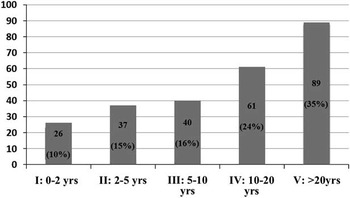
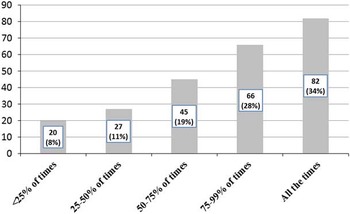
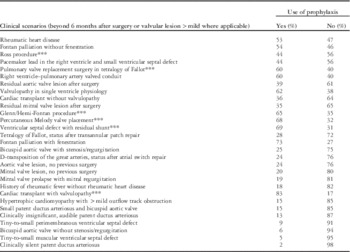
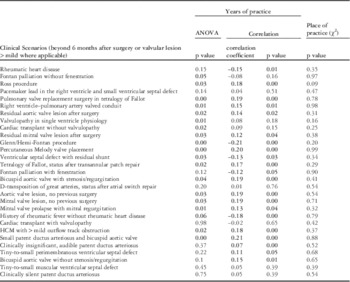
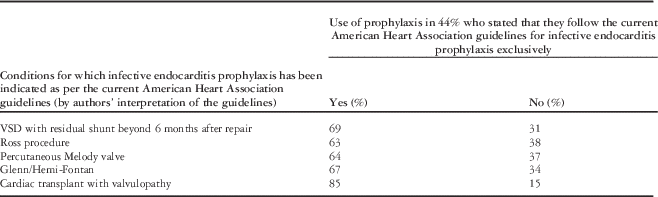
A total of 304 responses were received; fifty-one participants – 28 participants who were fellows in training and 23 participants who answered none of the questions describing infective endocarditis prophylaxis practice – were excluded from the analysis. Responses from the remaining 253 participants were included in the analysis: 91% of them were from North America and the rest were from Europe, Asia, and South America and 72% of them were from academic institutions. Figure 1 shows the participants’ practice duration (groups I–V). More than 50% of the respondents were in practice for more than 10 years, with 35% practising for more than 20 years. Table 1 describes infective endocarditis prophylaxis practice for various cardiac conditions among paediatric cardiologists. From top to bottom, clinical scenarios are listed from the highest level of disagreement to the highest level of agreement for either prescribing or not prescribing infective endocarditis prophylaxis among the paediatric cardiologists. The highest level of disagreement was noted for rheumatic heart disease, with 53% recommending infective endocarditis prophylaxis. For each cardiac condition described in Table 2, there was no association between practice setup and recommendation of infective endocarditis prophylaxis. There was a statistically significant difference in prescribing infective endocarditis prophylaxis for various conditions among groups based on their duration of practice (Table 2, analysis of variance test). There was a weak but statistically significant correlation between duration of practice and prescribing infective endocarditis prophylaxis for several conditions. In Table 2, positive values of the correlation coefficient signify that paediatric cardiologists with longer practice duration tend to prescribe infective endocarditis prophylaxis more often compared with those with shorter practice duration, whereas negative values of the correlation coefficient signify that paediatric cardiologists with shorter practice duration tend to prescribe infective endocarditis prophylaxis more often compared with those with longer practice duration. Certain selected conditions for which infective endocarditis prophylaxis has been indicated as per current the American Heart Association guidelines, by authors’ interpretation of guidelines, are marked (***) in Table 1. Use of infective endocarditis prophylaxis in these conditions varies from 44 to 83%; 61% of them perceived no change in the incidence of infective endocarditis after the 2007 guidelines compared with before the 2007 guidelines, while 28% were unsure. The practice of discussing dental hygiene with patients who are at risk for infective endocarditis is shown in Figure 2. Moreover, 56% of them admitted that they do not follow the current American Heart Association guidelines for infective endocarditis prophylaxis exclusively. Reasons for not following the guidelines were conservative approach (22%), patient/family’s unwillingness to change to new guidelines (16%), lack of clarity about certain conditions in the new guidelines (13%), and other reasons (5%). Surprisingly, the practice of remaining the 44%, who stated that they followed the current American Heart Association guidelines for infective endocarditis prophylaxis exclusively, did not represent true adherence to the current guidelines based on their responses regarding use of infective endocarditis prophylaxis for specific conditions for which infective endocarditis prophylaxis has been indicated as per the current American Heart Association guidelines, according to the authors’ interpretation of the guidelines (Table 3).
Duration of paediatric cardiology practice.

Discussion of dental hygiene between paediatric cardiologists and patients at risk for infective endocarditis.

Infective endocarditis prophylaxis practice for various cardiac conditions.

*** Conditions for which infective endocarditis prophylaxis has been indicated as per current American Heart Association guidelines (by authors’ interpreation of guidelines)
Analysis of infective endocarditis practice with years and place of practice.

ANOVA=analysis of variance
Bold values are statistically significant (P<0.05)
Infective endocarditis prophylaxis practice in respondents stating adherence to current guidelines.

Discussion
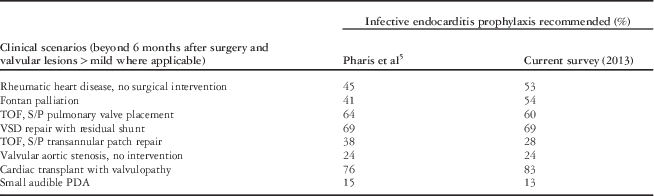
This study describes the current practice of infective endocarditis prophylaxis among paediatric cardiologists. It shows that paediatric cardiologists are in agreement for not prescribing infective endocarditis prophylaxis for patients with simple lesions such as small ventricular septal defect, patent ductus arteriosus, and bicuspid aortic valve without stenosis or regurgitation; however, a significant controversy persists in prescribing infective endocarditis prophylaxis for certain cardiac conditions such as rheumatic heart disease, Fontan palliation without fenestration, and the Ross procedure. Pharis et alReference Pharis, Conway, Warren, Bullock and Mackie 5 showed significant heterogeneity regarding infective endocarditis prophylaxis practice in their survey conducted in 2008. Table 4 compares the responses of several similar clinical scenarios included in the study by Pharis et al with the current survey. Infective endocarditis prophylaxis in rheumatic heart disease continues to be highly controversial in both studies. Significant heterogeneity still persists in the practice of infective endocarditis prophylaxis among paediatric cardiologists even several years after publication of the 2007 American Heart Association guidelines. This wide variation in practice of infective endocarditis prophylaxis can lead to significant confusion for dentists as well as patients.
Comparison of responses from the Pharis et alReference Pharis, Conway, Warren, Bullock and Mackie 5 survey and the current survey (2013).

PDA=patent ductus arteriosus; S/P=status post; TOF=tetralogy of Fallot; VSD=ventricular septal defect
Our survey revealed that only 44% of paediatric cardiologists follow the 2007 guidelines exclusively. Various committees from different parts of the world have published guidelines reflecting somewhat similar changes in infective endocarditis prophylaxis during a similar time period, such as the British Society for Antimicrobial Chemotherapy in 2006,Reference Gould, Elliott and Foweraker 6 the National Institute for Health and Clinical Excellence guidelines, United Kingdom, in 2008,Reference Richey, Wray and Stokes 7 and the European Society of Cardiology in 2009.Reference Habib, Hoen and Tornos 8 Although the American Heart Association, British Society for Antimicrobial Chemotherapy, and the European Society of Cardiology continued to recommend antibiotic prophylaxis for high-risk patients, the National Institute for Health and Clinical Excellence in the United Kingdom recommended the cessation of antibiotic prophylaxis for all patients at risk for infective endocarditis undergoing dental and other invasive procedures. Thornhill et alReference Thornhill, Dayer and Forde 9 showed significant (78%) reduction in prescribing antibiotic prophylaxis without any large increase in the incidence of infective endocarditis cases or deaths from infective endocarditis after the introduction of the National Institute for Health and Clinical Excellence guidelines. Population-based studies conducted withinReference Desimone, Tleyjeh and Correa de Sa 10 , Reference Rogers and Schiller 11 and outsideReference Duval, Delahaye and Alla 12 the United States of America did not show increased incidence of infective endocarditis after the new guidelines were introduced. Despite these facts, 22% of paediatric cardiologists believe in the “conservative approach” and continue to recommend infective endocarditis prophylaxis for conditions for which it is no longer required based on the 2007 American Heart Association guidelines. Substantive changes in infective endocarditis prophylaxis guidelines have deviated from previous recommendations and have violated the long-standing practice patterns of healthcare providers. A placebo-controlled, multicentre, randomieed, double-blinded study is needed to answer long-standing unresolved questions regarding the efficacy of infective endocarditis prophylaxis. Sixteen percent of the respondents encountered patient/family unwillingness to change to new guidelines. The change in infective endocarditis prophylaxis is of concern for some patients, particularly those who have had antibiotic prophylaxis for many years but who are now told that it is no longer necessary. Detailed counselling on optimal oral health and on the risks and benefits of antibiotic prophylaxis may be helpful for clinicians in re-educating their patients about these changes. The 2007 American Heart Association guidelines are short and simple; however, 13% found them to be at times unclear, particularly for complex congenital heart conditions. As an example, one might consider tetralogy of Fallot with transannular patch as a complete repair and might not recommend infective endocarditis prophylaxis beyond six months after surgery, whereas others may feel that a residual lesion in the form of pulmonary insufficiency makes a case for infective endocarditis prophylaxis. Similarly, patients with Fontan completion have near-normal oxygen saturation and are no longer cyanotic; however, the procedure is merely palliative and not a complete repair. Furthermore, it was found that practitioners’ belief of adhering to the current guidelines did not represent true adherence based on their responses regarding the use of infective endocarditis prophylaxis for specific conditions (Table 3). Part of the problem may be due to incorrect interpretation of the current guidelines in context of congenital heart disease. Guidelines focussing on congenital heart conditions may be helpful to avoid such confusion.
We observed significant under-utilisation of antibiotics in certain conditions in which infective endocarditis prophylaxis is warranted by our interpretation of the 2007 American Heart Association guidelines. Recommendations for infective endocarditis prophylaxis is particularly suboptimal in conditions involving a bioprosthetic – bovine, porcine, or homograft – valve in a pulmonary position such as in the Ross procedure (44%), surgical valve replacement in tetralogy of Fallot patients (60%), and Melody valve placement (68%). In contrast, 98% recommended infective endocarditis prophylaxis in the case of mechanical prosthetic valves in a previous study.Reference Pharis, Conway, Warren, Bullock and Mackie 5 This shows the vast difference in recommending prophylaxis for patients with mechanical valves versus bioprosthetic valves, despite the fact that it is well-known that bioprosthetic valves carry a greater risk for infection than mechanical valves.Reference Brennan, Edwards and Zhao 13 The occurrence of infective endocarditis limiting the longevity of bioprosthetic valves in a pulmonary position has been shown in various studies where valves were implanted surgicallyReference Breymann, Blanz and Wojtalik 14 as well as percutaneously.Reference McElhinney, Benson, Eicken, Kreutzer, Padera and Zahn 15 The American Heart Association recommends infective endocarditis prophylaxis for patients with “prosthetic cardiac valves”, whereas the British Society for Antimicrobial Chemotherapy guidelines are described in more detail, recommending infective endocarditis prophylaxis in cases of “cardiac valve replacement surgery, i.e., mechanical or biological prosthetic valve”. Although both guidelines recommend infective endocarditis prophylaxis in cases of prosthetic – mechanical and bioprosthetic – valves, a detailed description in the American Heart Association guidelines may help avoid such confusion.
In the 2007 American Heart Association guidelines, emphasis has been placed on maintaining optimum dental hygiene. It is known that 33–47% of infective endocarditis cases are caused by oral viridans streptococci.Reference Griffin, Wilson, Edwards, O’Fallon and Kurland 16 – Reference Strom, Abrutyn and Berlin 18 It has been shown that transient bacteraemia occurs with daily routine activities such as brushing teeth and may pose a greater threat for individuals at risk for infective endocarditis.Reference Lockhart, Brennan, Sasser, Fox, Paster and Bahrani-Mougeot 19 Furthermore, bacteraemia after tooth brushing is more frequently associated with poor oral hygiene and gingival bleeding.Reference Lockhart, Brennan and Thornhill 20 The prevalence of dental disease is as high as 58% in children with congenital heart disease.Reference Balmer and Bu’Lock 21 These data suggest the importance of good oral hygiene; however, our study showed that counselling about oral health care is significantly suboptimal.
Our study has a few limitations that are typical for any survey. Respondents’ answers could not be confirmed with their actual practice. We distributed the survey to a group of paediatric cardiologists to make sure that the questionnaires are understandable and appropriate to the research topic. Suggestions from the group were incorporated before distributing the survey for data collection. We focussed primarily upon various congenital heart conditions and did not include questions regarding the use of infective endocarditis prophylaxis for different dental, gastrointestinal, or genito-urinary procedures. The majority of respondents were from North America; thus, the results could not be generalised. Respondents’ bias cannot be excluded. With all the pitfalls, we still believe that this survey is highly valuable in understanding the current practice of infective endocarditis prophylaxis among paediatric cardiologists.
Conclusion
Significant heterogeneity still persists among paediatric cardiologists in recommending infective endocarditis prophylaxis for several cardiac lesions. Use of antibiotics is suboptimal for cardiac conditions for which prophylaxis has been recommended in the current American Heart Association guidelines. More than half of the survey participants (56%) did not follow the current guidelines exclusively in their practice. A conservative approach, patient/family’s unwillingness, and ambiguity about particular conditions in the guidelines were the main reasons for not following the current guidelines. Counselling for optimal oral health and hygiene in patients at risk for infective endocarditis needs to be optimised in current practice.
Acknowledgements
None.
Financial Support
This research received no specific grant from any funding agency, commercial, or not-for-profit sectors.
Conflicts of Interest
None.