During adolescence, personality processes are consolidated and the factors and mechanisms that contribute to emerging personality disorders can be identified. The Diagnostic and Statistical Manual of Mental Disorders—Fourth Edition, Text Revision (DSM-IV-TR; American Psychiatric Association, 2000) criteria for personality disorders require “an enduring pattern” of inner experiences and behaviors that deviates markedly from the expectations of the individual's culture. Further, personality disorders have an onset in adolescence or early adulthood and are stable over time. Yet, identifying patterns of behavior that are markedly deviant presents a challenge in adolescent samples. Risk-taking behaviors generally show a normative increase during this period as adolescents are in the process of forming romantic and peer relationships that provide high levels of emotional intensity and test interpersonal strategies for maintaining close relationships (Steinberg et al., Reference Steinberg, Albert, Cauffman, Banich, Graham and Woolard2008). Socioeconomic status (SES) further complicates assessing deviant aspects of personality. Economically disadvantaged adolescents face additional challenges in the form of increased rates of school failure, association with deviant peer groups, contact with the police, and higher rates of antisocial behaviors (Dodge & Pettit, Reference Dodge and Pettit2003). In this population, the deviant patterns of impulsive or aggressive behaviors that are common to both borderline personality disorder (BPD; Clarkin & Posner, Reference Clarkin and Posner2005) and antisocial personality disorder (ASPD; Paris, Reference Paris2005) must be identified against a general background of increased adolescent risk-taking and antisocial behaviors.
Both temperament and attachment organization have been proposed as personality models that are relevant to understanding BPD and ASPD (Clarkin & Posner, Reference Clarkin and Posner2005; Paris, Reference Paris2005). Attachment theory and research suggest that preoccupied states of mind may play a central role in the development of BPD (Gunderson & Lyons-Ruth, Reference Gunderson and Lyons-Ruth2008). Preoccupation is characterized by a pattern of affective instability and oscillating representations of attachment figures that overlap with some of the interpersonal criteria for BPD. Although there have been fewer studies implicating dismissing states of mind in personality disorders, there has been some speculation that this pattern would be associated with the more purely externalizing symptoms that are consistent with ASPDs (Dozier, Stovall-McClough, & Albus, Reference Dozier, Stovall-McClough, Albus, Cassidy and Shaver2008). The goal of the current study is to test the effects of dismissing and preoccupied states of mind in the Adult Attachment Interview (AAI; George, Kaplan, & Main, Reference George, Kaplan and Main1996) as predictors of adolescents' trajectories of impulsive and hostile behavior between ages 13 and 17. Growth curve analyses will allow us to examine the effect of preoccupied attachment on adolescents' overall levels of hostile and impulsive behavior, as well as rates of change in these behaviors as adolescents move toward early adulthood. A secondary goal of the study is to consider possible factors that differentiate risk trajectories for antisocial and BPDs. Although both ASPD and BPD may share some common core features as impulsive spectrum disorders, the trajectories leading to these disorders may be influenced by gender or by the degree of emotionality associated with impulsive and aggressive behavior. Whereas individuals with BPD are characterized by labile emotions, individuals with ASPD are more likely to fit a personality profile characterized by callous or unemotional behavior (Frick & White, Reference Frick and White2008).
Preoccupied States of Mind and BPD
During the past 20 years, the AAI has been used with both community and clinical samples to assess attachment-related aspects of adolescent and adult personality (Hesse, Reference Hesse, Cassidy and Shaver2008). The AAI provides an opportunity to test an individual's ability to access memories of childhood experiences with caregivers and organize these memories into a general understanding of how these early relationships have influenced the self. Coding of the AAI proceeds at two levels. The first set of scales assesses probable experience with caregivers from the content of episodic memories, whereas the second focuses on the coherence of participants' responses to the interview. Coherent discourse requires participants to manage the emotions associated with childhood memories of distress, loss, and trauma to maintain a focus on the interviewer's questions. Although secure or autonomous states of mind in the AAI are characterized by coherent discourse throughout the interview, dismissing states of mind are marked by violations of coherency characterized by a general difficulty in accessing attachment-related memories and a tendency to describe relationships with parents as superficially positive. Dismissing states of mind are characterized by evidence of rejection at the level of probable experience and by lack of memory for attachment experiences or by positive descriptions of parents that remain unsupported or contradicted by more specific memories.
Although dismissing states of mind have generally been implicated in psychopathology, preoccupied status has been most extensively linked to personality disorders (Dozier et al., Reference Dozier, Stovall-McClough, Albus, Cassidy and Shaver2008). The descriptive features of preoccupied states of mind share much in common with criteria for BPD. These interviews are marked by depictions of weak or inconsistent parenting and by a style of discourse characterized by angry-involving or passive speech that substantially interfere with the participant's ability to focus on the interview questions. The difficulty in managing angry or helpless feelings during the interview indicates a potential problem with participants' close interpersonal relationships. Gunderson and Lyons-Ruth (Reference Gunderson and Lyons-Ruth2008) have described a similar interpersonal style among adults with BPD characterized by “a paradoxical, seemingly contradictory combination of intense needs for closeness and attention with equally intense fears of rejection or abandonment” (p. 23). Such a style is consistent with a chronically activated attachment system that results in excessive mental and emotional involvement with attachment issues that are mirrored in preoccupied states of mind during the AAI.
A number of clinical studies have linked preoccupied states of mind to BPD. Although the prevalence of preoccupied status in community samples is generally between 10% and 15% (van IJzendoorn & Bakermans-Kranenburg, Reference van IJzendoorn and Bakerman-Kranenburg1996), studies using the AAI with adult clinical samples report that between 50% (Levy et al., Reference Levy, Meehan, Kelly, Reynoso, Weber and Clarkin2006) and 88% (Patrick, Hobson, Castle, & Howard, Reference Patrick, Hobson, Castle and Howard1994) of patients with BPD diagnoses are classified as preoccupied. Other studies have reported rates of preoccupied attachment in general clinical samples ranging from 64% (Rosenstein & Horowitz, Reference Rosenstein and Horowitz1996) to 75% (Fonagy et al., 1996). Preoccupied status also co-occurs at high rates, with unresolved status with respect to loss and trauma. The unresolved classification is based on momentary lapses in participants' “monitoring of discourse or reason” during discussions of abuse or loss (Hesse, Reference Hesse, Cassidy and Shaver2008). The unresolved classification occurs at high rates among individuals with histories of abuse and has generally been linked to increased risk for several forms of psychopathology.
Despite both the phenotypic similarity between preoccupied states of mind and interpersonal aspects of BPD, empirical studies have yet to determine if preoccupied status predates the emergence of BPD. Further, criteria for preoccupation that include angry involvement with and ongoing vigilance toward attachment figures produce a substantial overlap with some of the DSM-IV-TR diagnostic criteria for BPD, including fears of separation or abandonment, unstable and intense interpersonal relationships, and inappropriate intense anger. In this respect, the high rates of preoccupied attachment style reported in samples of BPD patients may inflate the degree of concordance observed in clinical samples. Prospective designs that examine preoccupied attachment as a potential diathesis for BPD can help to disentangle direction of effects. However, such designs need to investigate risk mechanisms for BPD that show less overlap with preoccupied status.
Attachment, Gender, and Trajectories of Hostile and Impulsive Behavior During Adolescence
A central focus in the past decade of research on BPD is identifying core processes or mechanisms that account for the symptoms of the disorder (Lenzenweger & Cicchetti, Reference Lenzenweger and Cicchetti2005). In addition to interpersonal processes characterized by fear of abandonment and relationship instability, most of the remaining symptoms of BPD cluster around dimensions of affect regulation and impulsivity (Clarkin & Posner, Reference Clarkin and Posner2005; Crick, Murray-Close, & Woods, Reference Crick, Murray-Close and Woods2005). Affective dysregulation includes a broad range of negative emotional experiences that may have a temperamental component (Clarkin & Posner, Reference Clarkin and Posner2005). Difficulty modulating affect is a component of three of the nine DSM-IV-TR criteria: affective instability, chronic feelings of emptiness, and inappropriate intense anger. This proneness to distress is often characterized by hostility or dysfunctional anger (Gardner, Leibenluft, O'Leary, & Cowdry, Reference Gardner, Leibenluft, O'Leary and Cowdry1991; McGirr, Paris, Lesage, Renaud, & Turecki, Reference McGirr, Paris, Lesage, Renaud and Turecki2007). Examples of inappropriate anger include frequent displays of temper, constant anger, or recurrent physical fights, whereas a high level of mood reactivity includes intense dysphoria, irritability, or anxiety and affective instability.
DSM-IV-TR describes impulsivity in terms of behaviors that are self-damaging. Examples of domains in which impulsive behaviors can be self-damaging include risky sex, substance abuse, and reckless driving. In addition to these problem areas, DSM-IV-TR uses separate criteria of overt self-harming behaviors such as suicidal threats, gestures, or self-mutilation. Impulsivity has been identified as a stable feature of adult BPD and was most predictive of persistence of BPD symptoms in a 7-year follow-up study of adults diagnosed with the disorder (Links, Heslegrave, & van Reekum, Reference Links, Heslegrave and van Reekum1999). However, the combination of impulsivity and hostility may be most important in understanding the lethality of self-harming behaviors. In a follow-up study that differentiated between BPD patients who had died from suicide attempts compared to those who had survived, higher levels of both impulsivity and aggression accounted for much of the difference between the two groups (McGirr et al., Reference McGirr, Paris, Lesage, Renaud and Turecki2007). The features of impulsivity and aggression have also been associated with other Cluster B disorders, including antisocial and narcissistic personality disorders.
Although interpersonal difficulties, hostility, and impulsive behaviors capture the broad dimensions of BPD symptomatology, the degree to which these behaviors are deviant needs to be considered in the context of normative trends in adolescent impulsive and aggressive behavior. There is some evidence that a subset of youth develop antisocial and aggressive behaviors during adolescence, but that these behaviors tend to decline as these individuals transition into adulthood (Moffitt, Reference Moffitt, Cicchetti and Cohen2006). As a result, risk for a personality disorder would only be evident among those who demonstrated persistent antisocial behavior. Conversely, risk-taking behaviors are likely to increase over the course of adolescence, as teenagers gain increased autonomy with peers, develop sexual relationships, and begin driving (Steinberg et al., Reference Steinberg, Albert, Cauffman, Banich, Graham and Woolard2008). Consequently, risky behaviors such as substance abuse, risky sexual behaviors, and reckless driving that are risk factors for the emergence of BPD may be prevalent among many adolescents who will not develop the disorder (Clarkin & Posner, Reference Clarkin and Posner2005). By later adolescence, this normative increase in impulsive behavior may also contribute to a pattern of highly unstable, aggressive, and intense relationships. A challenge in identifying risk trajectories for BPD disorder is to identify impulsive behaviors, relationship instability, and difficulties in managing intense negative affect that deviate from the norms of their peer group.
Socioeconomic context may influence the way in which hostile or impulsive aspects of personality influence adaptation and the development of psychopathology. Adolescents from economically disadvantaged families are at increased risk for antisocial behavior (Bradley & Corwyn, Reference Bradley and Corwyn2002; Kuperschmidt, Griesler, DeRosier, & Patterson, 1995) and school failure (Eccles & Roeser, Reference Eccles, Roeser, Adams and Berzonsky2003). Disadvantaged minority status further increases risk with higher rates of teenage pregnancy, substance abuse, and contact with the criminal justice system among African American adolescents (Bradley & Corwyn, Reference Bradley and Corwyn2002). Yet, although low SES is associated with increased prevalence of ASPD (American Psychiatric Association, 2000), there is little evidence of a link between poverty and increased rates of BPD. Although both types of personality disorder share a common dimension of impulsive behavior and may have a high rate of co-occurrence, the two are differentiated by interpersonal goals. Whereas the antisocial individual is thought to engage in behavior to gain “profit, power or some other material gratification,” an individual who meets criteria for BPD engages in deviant behavior to “gain the concern of caretakers” (American Psychiatric Association, 2000, p. 710). As a result, preoccupied states of mind in the AAI may be an important factor in differentiating between trajectories that increase risk for the two types of personality disorder. On the basis of these DSM descriptions, the hyperactivating attachment strategy that characterizes preoccupied states of mind would predispose an individual toward BPD rather than ASPD.
Gender may also play an important role in shaping the expression of impulsive and hostile aspects of personality (Crick & Zahn-Waxler, Reference Crick and Zahn-Waxler2003) in ways that influence the emergence of both BPD and ASPD. Whereas males are much more likely to be diagnosed with ASPD than females, the gender difference in the prevalence of BPD is reversed (American Psychiatric Association, 2000). There are several ways in which gender differences may influence the expression of impulsive and hostile aspects of personality. First, the tendency of girls to be more sensitive to interpersonal stressors and interpersonal goals has been extensively documented (Zahn-Waxler, Crick, Shirtcliff, & Woods, Reference Zahn-Waxler, Crick, Shirtcliff, Woods, Cicchetti and Cohen2006). As a result of this focus, girls may be prone to expressing hostile and impulsive behaviors in ways that are guided toward interpersonal goals. Conversely, boys may be more sensitive to status concerns than are their female peers (Maccoby, Reference Maccoby, Putallaz and Bierman2004). As a result, boys may be more likely to express hostile and impulsive behaviors in ways that include physical aggression, property theft, or trafficking illegal substances. These gender differences in goal orientations may account for the tendency of boys to use impulsive and aggressive behavior to enhance themselves, whereas girls may be more prone to using such behavior in an attempt to maintain interpersonal relationships. Common underlying personality factors such as a preoccupied attachment, impulsivity, and hostility may be expressed in different symptoms patterns for boys and girls. Whereas hostile–impulsive boys may be more prone to the delinquent and criminal behaviors that are characteristic of ASPD, hostile–impulsive girls may be more inclined toward relationally focused forms of aggression and impulsivity that are characteristic of BPD.
If adolescence is the period during which “enduring patterns” of personality are established, repeated assessments of impulsivity, hostility, and interpersonal difficulties are needed over the course of childhood and adolescence. Longitudinal studies of high-risk community samples can address several issues that are important to understanding the emergence of personality disorders. First, by assessing trajectories of hostile and impulsive behaviors, community samples provide a baseline that makes it possible to distinguish more deviant forms of hostility and impulsivity that are features of BPD and ASPD form normative trends in these behaviors that occur over the course of adolescence. Second, longitudinal data allow investigators to distinguish persistent from episodic forms of deviant behaviors. Third and finally, longitudinal designs allow investigators to assess trajectories of hostile and impulsive behaviors that take into account both the stability of these behaviors over time as well as individual differences in rates of change in hostile and impulsive behaviors.
The current study examines the effects of dismissing and preoccupied states of mind on trajectories of hostile and impulsive behaviors among economically disadvantaged adolescents. Adolescents' whose trajectories are marked by persistent and or increasing rates of impulsive and hostile behavior are likely to be especially vulnerable to the emergence of ASPD and BPD in early adulthood. We anticipated that aggressive behaviors would generally decline over this period, whereas risky sexual behavior would increase. However, if preoccupied states of mind are an aspect of adolescent personality that increases risk for adult personality disorder, it should effect overall levels of impulsive and aggressive behaviors as well as the rates of growth in these behaviors from early to late adolescence. A secondary aim of the study is to consider how gender might influence the expression of adolescents' symptom trajectories. Although there is relatively little evidence of different rates of preoccupied attachment among boys and girls, gender may influence the phenotypic expression of underlying personality. Because ASPD is more prevalent among males and BPD is more prevalent among females, we expected preoccupied girls to show more of the types of emotion regulation difficulties that are characteristic of BPD, and to report higher levels of negative emotionality than boys.
Method
Participants and procedures
Participants were 224 adolescents and their caregivers recruited at age 13 from two sources of economically disadvantaged families. The first source was a longitudinal sample of families whose children had participated in Head Start. A second group was recruited from free- and reduced-price lunch lists from four public school districts. The sample was followed at 2-year intervals that included assessments at ages 13, 15, and 17. The sample sizes at these the three time points were 224, 198, and 174, respectively. There were similar numbers of female (51%) and male (49%) participants with 74.5% African American, 21.5% Caucasian, and 4.0% other ethnicities.
At each time point, individual interviews were conducted with adolescents and their caregivers during home and laboratory visits. Both reported on the adolescents' aggressive behaviors and adolescents reported on their own impulsive behaviors at each time point. All questions were read aloud by trained research assistants. When the adolescents were 15, they were interviewed with the AAI during a laboratory visit. Both caregivers and adolescent were compensated for their time.
Measures
AAI
The AAI (George et al., Reference George, Kaplan and Main1996) was administered to adolescents during the laboratory visit during the age 15 assessment. The AAI is a semistructured 60- to 90-min interview that focuses on memories of childhood experiences with attachment figures. Reliability and validity of the AAI are well established (Bakersman-Kranenburg & van IJzendoorn, Reference Bakermans-Kranenburg and Van IJzendoorn1993; Crowell et al., Reference Crowell, Treboux, Gao, Fyffe, Pan and Waters2002). All AAIs were recorded and transcribed and transcripts were coded using the AAI Q-sort (Kobak, Cole, Fleming, Ferenz-Gillies, & Gamble, Reference Kobak, Cole, Fleming, Ferenz-Gillies and Gamble1993) based on the Main and Goldwyn (Reference Main and Goldwyn1998) experience and state of mind scales. Two blind raters sorted 100 Q-sort items to describe each transcript. At least one of the two raters coding each transcript had attended a 2-week training workshop and passed reliability testing on the Main and Goldwyn (Reference Main and Goldwyn1998) coding method. If interrater reliability fell below .60 (Spearman–Brown formula), a third rater sorted the transcript and the highest two-rater correlation was used to form a composite description. A third rater was required on 45 (23%) transcripts. The average reliability for the composite Q-sorts across all transcripts was .82 (Spearman–Brown formula). Composited Q-sorts were correlated with prototype sorts for secure, dismissing, and preoccupied derived from the Main and Goldwyn (Reference Main and Goldwyn1998) system, resulting in continuous scores for each adolescent on all three dimensions.
Scale of Sexual Risk Taking (SSRT)
The SSRT (Metzler, Noell, & Biglan, Reference Metzler, Noell and Biglan1992) is a 13-item measure of the extent to which an adolescent is engaging in various types of sexual behavior, and particularly in risky sexual behavior. Participants indicated the frequency with which they engaged in each of 13 different sexual behaviors. A risky sex score was created by summing weighted item-level scores. Internal consistency for this scale in the present sample was .56 (Cronbach alpha). Metzler et al. (Reference Metzler, Noell and Biglan1992) found acceptable internal consistency and good convergent validity for the SSRT.
Achenbach Child Behavior Checklist (CBCL)—Parent Report Form
The CBCL (Achenbach & Rescorla, Reference Achenbach and Rescorla2001) is a measure of the child's behavioral and emotional problems, based on behavior at home. Parents were asked to rate children on 113 items on a 3-point scale of 0 (not true), 1 (somewhat true), and 2 (very true). Nine behavioral indices and three composite scores can be calculated. In the present study, items from only the aggression index were used. Scores for the index were calculated by summing the appropriate item scores. The Cronbach alpha for the current sample on the aggression subscale was .90. Achenbach and Rescorla (Reference Achenbach and Rescorla2001) report evidence for good interrater reliability, good test–retest reliability, good criterion-related validity, and good convergent and discriminant validity for the CBCL.
Achenbach CBCL—Youth Self-Report (YSR)
The YSR (Achenbach & Rescorla, Reference Achenbach and Rescorla2001) is a measure of the child's behavioral and emotional problems. Children were asked to rate their own behavior on 113 items on a 3-point scale of 0 (not true), 1 (somewhat true), and 2 (very true). Nine behavioral indices as well as three composite scores can be calculated. Scores for the aggression index were calculated by summing the appropriate item scores. The Cronbach alpha for the current sample was .88 for the aggression subscale. Achenbach and Rescorla (Reference Achenbach and Rescorla2001) report evidence for good interrater reliability, good test–retest reliability, good criterion-related validity, and good convergent and discriminant validity for the YSR.
Differential Emotions Scale—Fourth Edition, A (DES IV-A)
The DES IV-A (Izard, Libero, Putnam, & Haynes, Reference Izard, Libero, Putnam and Haynes1993) was administered to the adolescent participants in order to measure their experience of fundamental emotions. Several studies have demonstrated the construct validity of the DES scales (e.g., Blumberg & Izard, Reference Blumberg and Izard1985). Twelve factors, each representing the experience of a discrete emotion, can be obtained from this measure. Three overarching factors (positive, negative, and hostile emotion) of these 12 discrete emotions had internal consistencies of .62, .87, and .67, respectively. For this study, the hostile factor consisting of disgust, anger, and contempt was used.
Results
Descriptive statistics
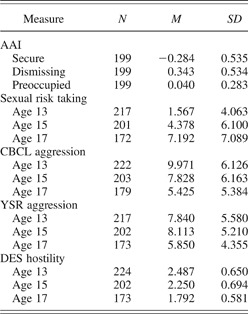
Means and standard deviations for attachment and risk variables are presented in Table 1. The means for the secure, dismissing, and preoccupied dimensions are the correlation between each participant's Q-sort and the three prototypes scores for dismissing, preoccupied, and secure states of mind. Raters trained with Main and Goldwyn's classification system also assign classifications. The majority of the transcripts were classified as dismissing (n = 128 or 64%) followed by secure or free to evaluate attachment (n = 49 or 25%) followed by preoccupied (n = 22 or 11%). Examination of means for sexual risk-taking behavior shows a pattern of increase over the course of the three assessments with substantially higher levels reported at age 17.
Descriptive statistics for attachment and risk variables

Note: AAI, Adult Attachment Interview (George et al., Reference George, Kaplan and Main1996); CBCL, Child Behavior Checklist (Achenbach & Rescorla, Reference Achenbach and Rescorla2001); YSR, Youth Self-Report (Achenbach & Rescorla, Reference Achenbach and Rescorla2001); DES, Differential Emotions Scale (Izard et al., Reference Izard, Libero, Putnam and Haynes1993).
AAI states of mind and average levels of impulsive and hostile behavior across time
Our initial goal was to examine the effects of preoccupied and dismissing states of mind on overall levels of sexual risk taking and hostile behaviors across the three assessments when adolescents were 13, 15, and 17. A two-level hierarchical linear modeling (HLM) model (Raudenbush, Bryk, Cheon, & Congdon, Reference Raudenbush, Bryk, Cheon and Congdon2004) was used with repeated measures of impulsive and hostile behaviors as a within-subject factor at Level 1. Dummy codes for adolescents' gender (males = 0, females = 1) along with continuous scores for dismissing and preoccupied state of mind were entered as between-subject factors at Level 2.
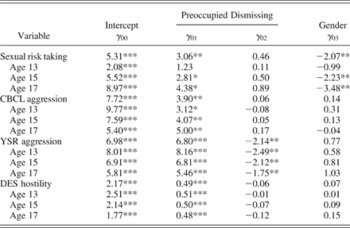
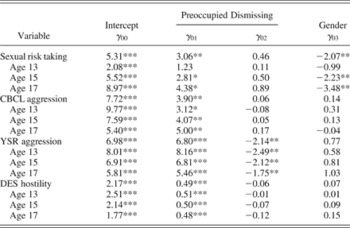
In the initial analysis for each of the four repeated measures (sexual risk taking, self-reported hostile emotions, caregiver, and adolescent reports of aggressive behavior), the Level 1 model estimated the mean of each scale across the three assessments (ages 13, 15, and 17) with no additional Level 1 predictors. At Level 2, adolescent gender along with preoccupied and dismissing states of mind were entered as predictors of the Level 1 intercept. As shown in the first row for each measure in Table 2, preoccupied adolescents had consistently higher levels of self-reported sexual risk taking, hostile emotions, and aggressive behavior as well as increased levels of caregiver-reported aggressive behavior. Dismissing states of mind was related to only related to lower self-reported aggressive behavior. Gender also produced only one effect on average levels of risk behaviors with girls reporting lower levels of sexual risk-taking behaviors compared to boys.
Effects of Adult Attachment Interview strategies and gender on levels (intercepts) of adolescent aggressive and impulsive behavior
Note: CBCL, Child Behavior Checklist (Achenbach & Rescorla, Reference Achenbach and Rescorla2001); YSR, Youth Self-Report (Achenbach & Rescorla, Reference Achenbach and Rescorla2001); DES, Differential Emotions Scale (Izard et al., Reference Izard, Libero, Putnam and Haynes1993).
* p < .05. **p < .01. ***p < .001.
AAI states of mind effects on impulsive and hostile behaviors at ages 13, 15, and 17
The next set of analyses tested whether preoccupied and dismissing states of mind in the AAI affected impulsive and hostile behaviors at each of the three time points (ages 13, 15, and 17). These analyses test the degree to which effects are limited to concurrent associations between AAIs administered at age 15 and risk behaviors measured in the same wave or are more enduring pattern of effects at earlier (age 13) and later (age 17) time points. To test these effects, a time variable coded as (0, 1, 2) was entered at Level 1. This model, presented in the second row for each variable in Table 2, examined the effect of states of mind variables on the average levels of each of the risk measures at age 13. In the third and fourth rows for each risk variable in Table 2, the time variable was coded as (−1, 0, 1) and (−2, −1, 0), respectively, to test state of mind effects on the risk variable at ages 15 and 17.
Preoccupied states of mind show a consistent pattern of association with self and caregiver-reported aggressive behavior as well as the experience of hostile emotions across all three time points. There was no evidence that concurrent associations between these variables were more robust at age 15 than the associations measured at age 13 or age 17. However, the associations between preoccupied attachment and sexual risk taking behavior were only evident at the age 15 and age 17 assessments. The gender difference between boys' and girls' sexual risk behavior was also only evident at the age 15 and 17 assessments and not at age 13. Finally, dismissing states of mind were associated with lower levels of self-reported aggressive behavior across all three time points.
Preoccupied states of mind and growth in hostile and impulsive behavior
Our next analysis examined the effects of preoccupied states of mind on rates of growth in impulsive and hostile behaviors between ages 13 and 17. Adolescents with higher rates of growth in these behaviors are presumably following trajectories that increase their risk for antisocial or BPDs in early adulthood. Given the increased prevalence of BPD among women and ASPD among men, we also tested the extent to which gender moderated the effect of preoccupied states of mind on rates of growth in risk behaviors. Table 3 presents the results from the four hierarchical linear growth models investigating the effects of preoccupied states of mind, gender, and the interaction between these between-subject variables on trajectories of hostile and impulsive behavior.
Effects of preoccupied attachment and gender on trajectories of hostile and impulsive behavior

Note: Time was centered at the age 13 assessment. CBCL, Child Behavior Checklist (Achenbach & Rescorla, Reference Achenbach and Rescorla2001); YSR, Youth Self-Report (Achenbach & Rescorla, Reference Achenbach and Rescorla2001); DES, Differential Emotions Scale (Izard et al., 1995?); AAI, Adult Attachment Interview (George et al., Reference George, Kaplan and Main1996).
The first row of Table 3 shows the intercept or average starting level of each of the risk variables at the age 13 assessment. The second row of Table 3 shows the fixed effect or rate of change in the risk variable across the age 15 and age 17 assessments. These effects indicate that the average adolescent reported increases in their rate of sexual risk-taking behaviors between ages 13 and 17, whereas the rates of self-reported and caregiver aggression and feelings of hostility decreased overall.
The effect of preoccupied states of mind on rates of growth in adolescents' risk trajectories was examined in the third row of Table 3. Preoccupied status predicted accelerated growth of sexual risk-taking behaviors, and was associated with reduced rates of decline in caregivers' reports of adolescents' aggressive behavior. Gender affected rates of growth in risky sexual behaviors and feelings of hostility. Girls showed less growth in risky sexual behaviors, but were less likely to show a decline in hostile feelings, compared to boys. A test of gender as a moderator of preoccupied states of mind produced only one significant interaction on self-reported feelings of hostility. Analyses of this interaction indicated that preoccupied girls were less likely to show a decline in hostile feelings when compared to preoccupied boys.
Discussion
The current findings are among the first to link adolescent states of mind to risk trajectories over the course of adolescence. Adolescents who fail to show normative reductions in hostile behavior and who demonstrate more rapid rates of growth in impulsive behaviors are at increased risk for Cluster B personality disorders. The current findings highlight the importance of examining normative trends in adolescent behaviors as the basis for identifying risk trajectories (Cicchetti, Reference Cicchetti, Cicchetti and Cohen2006). Overall, sexual risk-taking and aggressive behaviors moved in opposite directions between ages 13 and 17. Adolescents' aggressive behaviors and self-reported hostile feelings showing a linear decrease that is quite similar to the pattern observed in other longitudinal studies of aggressive behavior (Maccoby, Reference Maccoby, Putallaz and Bierman2004). This decrease in aggressive behavior is consistent with the notion that adolescents gradually gain increased self-regulatory control over aggressive impulses (Steinberg et al., Reference Steinberg, Albert, Cauffman, Banich, Graham and Woolard2008). Conversely, sexual risk-taking behaviors showed a linear increase between ages 13 and 17. Although there were no gender differences in aggressive behaviors or self-reported hostile feelings, girls were likely to engage in fewer sexual risk-taking behaviors than boys by ages 15 and 17 and showed a slower rate of growth in sexual risk-taking behaviors. This is consistent with Steinberg's findings that boys are more prone to sensation seeking during middle adolescence, and consequently, would be more likely to engage in sexual risk-taking behaviors.
The primary goal of the current study was to test whether adolescents' preoccupied states of mind in the AAI increase rates of hostile and impulsive behaviors over the course of adolescence. Prior cross-sectional studies of both clinical and community samples have generally converged on identifying preoccupied and unresolved states of mind as risk factors for psychopathology, with less evidence indicating that a dismissing state of mind is implicated in the development of a psychological disorder (Dozier et al., Reference Dozier, Stovall-McClough, Albus, Cassidy and Shaver2008). The current findings are largely consistent with the prior literature. Dismissing states of mind did not influence adolescents' trajectories, except for reducing adolescents' overall levels of self-reported aggressive behavior. Dismissing states of mind have often been linked to a tendency to minimize expression of negative feelings and to idealize self and others (Kobak et al., Reference Kobak, Cole, Fleming, Ferenz-Gillies and Gamble1993); the current findings lend further support to this literature.
Although cross-sectional studies have clearly identified preoccupied states of mind as a concurrent risk factor for BPD, the current findings lend further support preoccupied attachment as a prospective risk factor for disorders involving impulsivity and hostility. Not only was preoccupied status linked to elevated levels of aggressive behavior, hostile feelings, and sexual risk-taking behavior across all three assessments, but also preoccupied youth showed less decline in aggressive behavior and faster rates of growth in sexual risk-taking behaviors. The effects of preoccupied states of mind on increased reporting about negative aspects of self, is consistent with the literature on this hyperactivating attachment style (Mikulencer & Shaver, 2007). However, preoccupied participants' increased levels of aggressive behaviors were supported by caregiver as well as self reports and the growth models indicated that preoccupied status was associated not only with increased levels but also with faster rates of growth in aggressive and sexual risk-taking behaviors.
Although the current findings are among the first to prospectively link AAI states of mind to trajectories of risk behavior, the implications of these trajectories for the emergence of Cluster B disorders remains uncertain. In considering the current findings it is important to note that although preoccupied status is associated with trajectories of hostile and impulsive behavior, there are clearly other factors or pathways that influence these trajectories. This is consistent with the developmental psychopathology principal of equfinality (Cicchetti & Rogosch, Reference Cicchetti and Rogosch1996) or the notion that there are multiple pathways to a development outcome. Consequently, although preoccupied states of mind clearly influenced trajectories hostile and impulsive behavior, there are other factors that may shape these trajectories and increase the likelihood of Cluster B disorders in early adulthood. The current findings point to only one of many possible pathways to the Cluster B disorders.
Although preoccupied states of mind, adolescent sexual risk taking, and hostility are factors that increase risk for Cluster B disorders, these trajectories may clearly increase risk for a number of other forms of psychopathology or problems in adaptation. This view is consistent with the notion of multifinality or the notion the early risk factors may lead to branching developmental pathways that result in a number of different types of outcome (Cicchetti & Rogosch, Reference Cicchetti and Rogosch1996). Clearly, sexual risk-taking behavior put adolescents and adults at increased risk for sexually transmitted diseases and unintended pregnancy. These factors, in turn, can contribute to lower educational attainment, problems with employment, and difficulties in the transition to parenthood. As adolescents move into adult roles, these functional impairments can, in turn, increase financial and interpersonal stressors and subsequent psychiatric morbidity.
The principal of multifinality also raises questions about factors that may influence the way in which trajectories of hostile and impulsive behaviors branch into different types of personality disorders such as BPD or ASPD. Gender is likely to shape how impulsive and hostile behaviors are expressed and, subsequently, increase risk for BPD and ASPD. Girls may be predisposed to expressing these traits in an interpersonal context that is likely to result in the types of unstable close relationships that are a criteria for BPD, whereas boys may be more prone to expressing these tendencies in delinquent or criminal activities designed to enhance their status, which may result in behaviors that are consistent with ASPD. The role of gender in moderating the effect of preoccupation on rates of growth in hostile feelings provides a clue to a possible difference in how preoccupied status is expressed among boys and girls. Although girls reported less sexual risk-taking behavior than boys, preoccupied girls reported more persistent hostile feelings than preoccupied boys. This suggests that the preoccupied girls may have to devote more resources to contain hostile feelings, which increases the likelihood that these feelings will interfere with maintaining close relationships. This struggle with hostile emotions and difficulty maintaining close relationships is more characteristic of the diagnostic criteria for BPD than ASPD. Preoccupied girls awareness of hostile feelings may also result in aggressive behaviors that are expressed in contexts that are more consistent with relational rather than physical forms of aggression (Cullerton-Sen et al., Reference Cullerton-Sen, Cassidy, Murray-Close, Cicchetti, Crick and Rogosch2008). A predisposition toward relational forms of aggression may, in part, result from experiencing and acknowledging high levels of hostile feelings.
The context created by economic disadvantage may also influence the way in which impulsive and hostile behaviors are expressed and perceived. By virtue of their relatively low SES, the adolescents in our sample are at increased risk for antisocial problems as has been evident in substantially higher rates of teacher-reported externalizing problems (Kobak, Zajac, & Levine, Reference Kobak, Zajac and Levine2009). Increased opportunity for association with deviant peers in neighborhood and school contexts may also produce increased risk for engaging in behaviors associated with ASPD. Whereas the context of economic disadvantage may increase the likelihood of meeting diagnostic criteria for ASPD, this context may reduce the likelihood of BPD. Because many of the adolescents live in families with little or no contact with biological fathers or had single mothers with live-in boyfriends, norms for the stability of adult relationships are quite different and are less likely to provide useful criteria for identifying BPD.
Limitations and Future Directions
Investigation of personality processes in a community sample of high-risk adolescents required a dimensional approach to assessing two of the core symptom clusters that form diagnostic criteria for the Cluster B disorders. This approach has several advantages as well as disadvantages. The central advantage of assessing impulsive and hostile behaviors in a longitudinal design is that it allowed us to test preoccupied states of mind as an early risk factor for the emergence of Cluster B personality disorders. Yet there are several problems with using dimensional assessments of impulsivity and hostility as markers of emerging personality disorders. Although a dimensional assessment is a more sensitive measure of personality processes than the categorical criteria provide by the DSM-IV, these dimensions lack specificity for identifying individuals who would meet diagnostic thresholds for a personality disorder. The prevalence of individuals who meet criteria for BPD in community samples is very low, with prevalence rates of less than 1%. For example, a Norwegian community sample reported a prevalence rate of 0.7% (Torgersen, Kringlen, & Cramer, Reference Torgersen, Kringlen and Cramer2001), an American community sample found 0.5% (Samuels et al., Reference Samuels, Eaton, Bienvenu, Brown, Costa and Nestadt2002), but an American sample of university students found only 0.3% (Lenzenweger, Loranger, Korfine, & Neff, Reference Lenzenweger, Loranger, Korfine and Neff1997). These rates suggest that a very low number of adolescents in our sample will ultimately meet diagnostic criteria for BPD.
Adolescence represents a period in which multiple risk factors may converge to produce a range of potentially problematic adult outcomes. An important question for future research centers on the extent to which persistent patterns that the DSM attributes to personality disorders may be maintained by contextual factors. Both interpersonal and socioeconomic context may place constraints on the trajectories of individuals who are at risk for personality disorders. For instance, risk for antisocial behavior is clearly increased among individuals who fail to complete high school and who lack skills for successful employment. Young adults failure to complete school and gain steady employment places constraints on their developmental pathways that are likely to have long-term consequences and act as persistent sources of stress and adversity.
The trajectories of risk identified in the current study may also create risk for a range of other Axis I disorders or problems in adaptation. Prior studies of preoccupied attachment have indicated that a number of these individual are at increased risk for depressive or internalizing symptoms. Although our findings provide further support for preoccupied states of mind as a risk factor for BPD and ASPD, we should note at least two potential problems in applying AAI categories to adolescent samples. First, there is growing evidence from high-risk samples that the majority of participants tend to be classified as dismissing rather than secure (Sroufe, Egeland, Carlson, & Collings, Reference Sroufe, Egeland, Carlson and Collins2005). In part, this tendency can be attributed to the lack of opportunity for disadvantaged adolescents to reflect about self and others in the context of the parent–adolescent relationships. With maturation, leaving home, and forming adult relationships, some of these adolescents are likely to move toward a secure or free to evaluate type of discourse. A second limitation of adolescent AAIs is they provide less opportunity to systematically explore abuse or loss topics that are central to the unresolved classification. In our sample, consent procedures required that adolescents were informed that discussions of abuse could lead to the need to contact child protective services, and as a result we did not question our participants about abuse during the interview. Similarly, major loss of an attachment figure is relatively infrequent among younger children and adolescents than is the case with adult samples that have had substantially more exposure to disruption of major attachment bonds (Zajac & Kobak, Reference Zajac and Kobak2009). It is likely that a subset of our preoccupied adolescents will be better characterized by the unresolved states of mind with respect to loss or abuse at a later period of development, with these classification being more often linked to serious adjustment difficulties (Kobak, Cassidy, Lyons-Ruth, & Ziv, Reference Kobak, Cassidy, Lyons-Ruth, Ziv, Cicchetti and Cohen2006).