Introduction
Intensive care is accepted as an integral component of secondary care service provision within the health services in the U.K. and elsewhere. Intensive care is often concerned with the provision of life support or organ support systems in patients who are critically ill and who usually require intensive monitoring. It is generally the most expensive, high technology and resource intensive area of medical care, and encompasses a variety of specialties, such as neonatal intensive care, coronary care and surgical intensive care. Founded in 1970, the Society of Critical Care Medicine is the largest multiprofessional organization for practitioners in the speciality, with members in 80 countries.
Within the mental health arena, descriptions of psychiatric intensive care units (PICU) appeared initially from the U.S.A. (Rachlin, Reference Rachlin1973), the U.K. and Australia (Jeffery and Goldney, Reference Jeffery and Goldney1982). In the U.K., psychiatric intensive care is now well established (Royal College of Psychiatrists, 1998), although it remains an inadequately researched component of psychiatric care provision (Bowers et al., Reference Bowers, Jeffrey, Bilgin, Jarrett, Simpson and Jones2008). Psychiatric intensive care is for “patients compulsorily detained usually in secure conditions, who are in an acutely disturbed phase of a mental disorder. There is an associated loss of capacity for self-control, with a corresponding increase in risk, which does not enable their safe, therapeutic management and treatment in a general open acute ward.”(Department of Health, 2002). The PICUs act analogously to the medical intensive care environments in providing higher staffing ratios with increased staff expertise. In PICUs this expertise is in managing severely disturbed and behaviorally challenging patients with mental disorders. The U.K. National Association of Psychiatric Intensive Care Units (NAPICU, www.napicu.org.uk) was formed following the 1st National Conference on Psychiatric Intensive Care in London in 1996. At that time a national survey (Beer et al., Reference Beer, Paton and Pereira1997) identified 110 PICUs in the U.K.; there are now 170 units (Pereira et al., Reference Pereira, Dawson and Sarsam2006a), with 15 units identified in Scotland (Smith, Reference Smith1997). National minimum standards for general adult services in psychiatric intensive care units and low secure environments were launched by the Department of Health in 2002, with the National Health Service (NHS) Quality Improvement Scotland (www.nhshealthquality.org/mentalhealth/projects) commissioning an audit of PICUs in Scotland against these standards, with a report planned for 2010.
According to the General Register Office for Scotland (www.gro-scotland.gov.uk), the increase in Scotland's population over the next 25 years includes a projected 31% rise in the number of people aged 65 years and older from 0.98 million in 2006 to 1.29 million in 2031. This projected demographic change in the population will influence how services for older people are delivered in the future (Information Services Division, 2007). Currently, little provision is made for this older population or those patients with dementia in the Department of Health's current national minimum standards for PICUs, which generally exclude adults over the age of 65 years and specifically exclude patients with a primary diagnosis of dementia (Department of Health, 2002). Most patients admitted to a PICU are young males with psychotic illness and a history of violence and substance misuse (Brown and Bass, Reference Brown and Bass2004; Pereira et al., Reference Pereira, Dawson and Sarsam2006b; Bowers et al., Reference Bowers, Jeffrey, Bilgin, Jarrett, Simpson and Jones2008). Nevertheless, throughout the published literature there is mention of patients over the age of 60 years admitted to PICUs (Jeffery and Goldney, Reference Jeffery and Goldney1982; Mitchell, Reference Mitchell1992; Smith and Humphreys, Reference Smith and Humphreys1997; McLeod et al., Reference McLeod, Yorston and Gibb2008). While this older adult population forms only a small percentage of admissions identified from surveys of PICUs, this in part may reflect previous (Smith, Reference Smith1997) and current (Department of Health, 2002) exclusion criteria for this group of older adults and those with dementing illnesses. There has been an identified need for PICUs appropriate for managing psychiatrically disturbed older adults or those younger adults with dementing illnesses (Stevenson et al., Reference Stevenson, Menon and Gallacher2006a).
Such a PICU for older adult males was established in a Scottish health region in 2001 in response to a local need (Stevenson et al., Reference Stevenson, Shankar and Malkison2005). It was recognized that the behavioral and psychological symptoms associated with dementia – including aggression, agitation, mood changes and psychotic symptoms – could be influenced by a number of factors including physical illness, pain, drugs and environmental changes. Occasionally, these behavioral disturbances were less manageable within the standard acute admission psychiatry wards for older adults in the region, and the patients were felt to pose particular difficulties and risks that could benefit from assessment and management in a separate and secure environment. This PICU for older adults operates as a regional NHS unit of 12 beds serving Fife, a region in east central Scotland. This health region contains a population of 350,000, with four acute psychiatric admission wards for older adults based in two modern district general hospitals and one Victorian-era mental health asylum. More recently the PICU has accepted admissions from adjacent health regions. One consultant psychiatrist for older adults acts as the responsible medical officer for the service, which is supported by a multidisciplinary team including a psychologist, an occupational therapist and an aromatherapist. The unit, described in detail previously (Stevenson et al., Reference Stevenson, Menon and Gallacher2006a), operates on criteria modified from the Department of Health's current national minimum standards for PICUs (Department of Health, 2002), but accepts adults over the age of 65 years, or younger if the primary diagnosis is of dementia, whose behavioral disturbances secondary to mental disorder exceed, or are likely to exceed, the capacity of the admitting service to safely contain the clinical situation. Admitted patients were either detained under the Scottish mental health legislation or treated under provisions of the relevant incapacity legislation.
Clinically it was perceived that since the inception of the Fife PICU for older adults in 2001, admissions to the unit were of an increasingly younger patient population who were then remaining for a shorter period in the PICU before being discharged back to the referring clinical team. The aims of this audit are to compare clinical characteristics and outcomes of patients admitted to the Fife PICU for older adults during two periods commencing in 2001 and 2006 respectively, and to determine whether the aforementioned clinical impressions were accurate.
Methods
Data on patients admitted to the Fife PICU for older male adults were prospectively collected for the 18-month period commencing January 2001 (“2001 cohort”) and compared with patients admitted to the same unit over an 18-month period commencing January 2006 (“2006 cohort”). Data were collected by medical and nursing staff on the PICU for older adults utilizing a formal recording chart. Data included patient demographics, details of previous psychiatric contact and use of mental health legislation, psychiatric diagnoses (using the International Classification of Disorders, version 10; WHO, 1992), and reasons for transfer to the PICU, the level of recorded behavioral incidents, the use of treatments for psychiatric and behavioral problems, and outcome measures that included length of stay in the PICU.
Two-sample t-tests were used to test for statistical differences between groups for normally distributed continuous variables, Mann-Whitney U-tests were used for all other continuous variables and χ2 tests were used for the remaining categorical variables (all two-tailed tests). Small patient numbers precluded valid power calculations. Results were considered to be significant at the 5% level. The statistical package for social sciences version 13.0 and Microsoft Excel were used to carry out the data analysis.
Results
Demographics
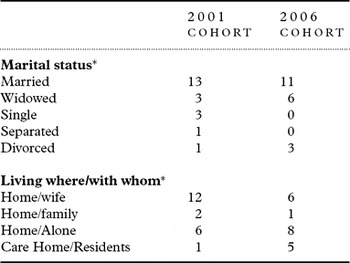
Twenty-one male caucasian patients were admitted in the 2001 cohort with a mean age of 72.9 years (range 58–88 years; standard deviation (SD) 9.0), and 20 male caucasian patients were admitted in the 2006 cohort also with a mean age of 72.9 years (range 54–98 years; SD 10.8), a non-significant difference. Their marital status and living arrangements prior to admission are given in Table 1, neither displaying a significant cohort difference.
Marital status and living arrangements prior to psychiatric hospital admission for the 2001 (N = 21) and 2006 (N = 20) cohorts, as patient numbers.

*Neither marital status nor living arrangements between the cohorts have a significant difference at the 5% level.
Morbidity
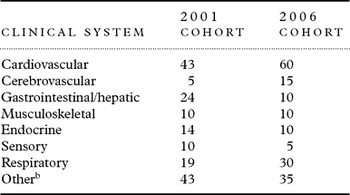
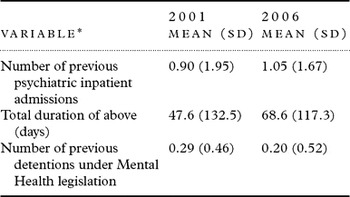
In addition to psychiatric morbidity, the patients had a range of other medical conditions, noted in Table 2. Ten patients from each cohort had been admitted to psychiatric NHS inpatient care previously on a total of 40 occasions (2001 cohort: 19 occasions, range 1–9; 2006 cohort: 21 occasions, range 1–6), with the number of previous admissions to NHS psychiatric inpatient care, duration of admission and previous detentions under the mental health legislation given in Table 3. Twenty-nine percent and 15% respectively of the 2001 and 2006 cohorts had previously been detained under mental health legislation residing between 1–588 days and 17–365 days in psychiatric inpatient care respectively.
Clinical system pathologiesa recorded on admission to the PICU for the 2001 (N = 21) and 2006 (N = 20) cohorts, as cohort percentages*.

aPatients may present with more than one recorded clinical pathology.
bIncludes hematological, metabolic, seizure, renal and metastatic disorders.
*None of the cohort differences in clinical systems pathologies is significant at the 5% level.
Number of previous psychiatric inpatient admissions, their total durations in days, and detentions under mental health legislation for the 2001 and 2006 cohorts, as means and standard deviations.

*None of the variables displays significant inter-cohort differences at the 5% level.
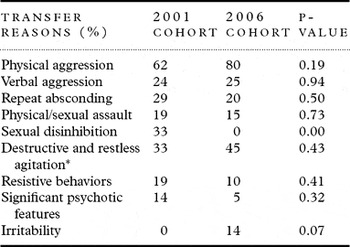
Admissions to the PICU of patients detained under mental health legislation rose non-significantly (p = 0.96) from 48% to 60% between the 2001 and 2006 samples. The source of transfers to the PICU were similar between the cohorts (p = 0.117), and were primarily from psychiatric admission wards within the same health region (81% vs 60%), the remaining admissions in the 2001 cohort being from nursing homes (14%) and day hospitals (5%); the 2006 cohort being from nursing homes (10%), general hospitals (10%), day hospitals (5%) and home (15%). Prior to transfer into the PICU, the 2001 cohort had spent a mean of 71.1 days (range 0–485 days; SD 104.3) in psychiatric hospital inpatient care compared to 26.6 days (range 0–204; SD 50.8) for the 2006 cohort, a significant decrease (p = 0.036). The reasons for transfer to the PICU are recorded in Table 4.
Reasons for transfer to the PICU (patients could present with more than one transfer reason), as a percentage of cohort admissions for 2001 (N = 21) and 2006 (N = 20).

*Includes restless wandering, stripping clothes, destructive or interfering behaviors.
Diagnoses
In 2001, nine (43%) of the patients had vascular dementia, 38% Alzheimer's dementia, 10% alcohol-related dementia, 5% frontotemporal dementia, and 5% mixed dementia. In 2006 the respective and non-significant differences of occurrences were 30%, 25%, 5%, 5%, 20%, with the remaining patients having primarily a psychotic disorder (10%) or behavioral disturbance in association with Huntington's disease (5%). The mean Mini-mental State Examination (MMSE) scores on admission to the PICU were 12 (range 0–22; SD 8) in the 2001 cohort, and 14 (range 6–30; SD 7) in the 2006 cohort (p = 0.276). There were non-significant differences between the 2001 and 2006 cohorts in terms of previous alcohol or substance misuse (24% and 45% respectively), or forensic history (10% and 5% respectively).
Treatments
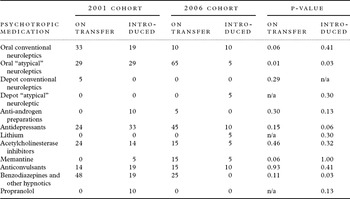
Prior to admission to the PICU, the patients had been tried on several psychotropic medications and Table 5 indicates those prescribed at the time of admission to the PICU. In the unit, 48% and 50% of patients in the 2001 and 2006 cohorts respectively had their medication regimes altered in dosage only, and usually a reduction in psychotropic load. The remaining patients had dosages altered in addition to other medications being introduced as shown in Table 5. The multidisciplinary staff employed a wide range of behavioral programs including intensive individual and group therapies depending on the assessed level of need, patient preference and the patient's ability to participate.
Psychotropic medications prescribed at time of transfer to, and introduced on, the PICU for the 2001 (N = 21) and 2006 (N = 20) cohorts, as cohort percentages.

Incidents
There were recorded disturbances on the unit against both staff and other patients. There were reports on 43% of patients in the 2001 cohort, recording a total of 134 incidents (range 1–59 per patient), and 80% in the 2006 cohort, recording a total of 29 incidents (range 1–4 per patient), which included head-butting with resultant nasal fracture, and an attempted stabbing, with the majority of incidents in both cohorts being directed against staff. Neither the number nor type of recorded incidents reached a statistically significant difference between the cohorts.
Outcomes
Thirteen patients were discharged (6 to NHS wards, 7 to community care homes) from the PICU in the 2001 cohort, and 18 (7 to NHS wards, 6 to home, 5 to community care homes) in the 2006 cohort. No patients were discharged directly home in 2001 compared with 30% in 2006 (p = 0.003). There were four deaths (3 in 2001, 1 in 2006) with two deaths each attributable to cardiovascular and cerebrovascular events. At the end of the two survey periods, five patients and one patient remained in the PICU respectively. For discharged patients, the mean durations of inpatient care in the PICU were 105 days (range 5–395 days; SD 98.6) and 55 days (range 6–221 days; SD 53.4) for the 2001 and 2006 cohorts respectively (p = 0.085). Of the 13 patients discharged in the 2001 cohort, 36% were on a section of the Mental Health (Scotland) Act 1984, and of the 18 discharges in the 2006 cohort, 61% were on a section of the Mental Health (Care and Treatment) (Scotland) Act 2003 (p = 0.96).
Discussion
The definition of psychiatric intensive care has become increasingly standardized in the U.K. with the publication of the Department of Health guidance on minimum standards in 2002 (Department of Health, 2002). This guidance focuses primarily on the general adult population, and excludes older adults or those with a primary diagnosis of dementia. More recent standards, however, recommend that people with dementia should not be excluded from other services that they require because of their diagnosis or age (NHS Quality Improvement Scotland, 2007). The Fife PICU for older adults serves the older adult population in a manner similar to that provided by the longer established Fife PICU for general adults. Other units dealing with mentally disturbed older adults are likely to exist, and these units may be described under different terms, reflecting perhaps a lack of consistency in this arena (Beer et al., Reference Beer, Pereira, Paton, Beer, Pereira and Paton2001).
Similar numbers of patients were admitted to the PICU for older adults during the two 18-month periods commencing in 2001 and 2006. Twenty-nine percent of the 2001 cohort were living alone at home, as were 40% of the 2006 cohort. Approximately 50% of the patients had required previous psychiatric inpatient care, while many also suffered from other medical pathologies. The data for the two cohorts display consistency on the continuous variables tested for significance (patient's age; previous psychiatric admission, duration of admission and number of detentions under mental health legislation; MMSE score) with no statistical differences observed between the means. During the study, patients remained for shorter periods in psychiatric acute admission units prior to transfer to the PICU (71.1 days in 2001; 26.6 days in 2006), and stayed in the PICU for shorter periods (105.1 days in 2001; 55.4 days in 2006). This trend of referring patients to the PICU earlier in their acute hospital stay may reflect the increasing recognition and acceptance by acute ward staff of the role of the PICU in the region. It may also reflect a change in ability or confidence of acute ward staff to deal effectively and efficiently with acute behavioral disturbances on the referring wards (Crowhurst and Bowers, Reference Crowhurst and Bowers2002; Michalon and Richman, Reference Michalon and Richman1990).
Although the mean inpatient stay in the PICU shortened by almost 50% between the two samples, it remains longer than for many general adult PICU populations (Brown and Bass, Reference Brown and Bass2004; Bowers et al., Reference Bowers, Jeffrey, Bilgin, Jarrett, Simpson and Jones2008). This decrease may reflect admissions with less severe behavioral disturbances in the 2006 cohort, but this would not be supported by the findings in Tables 3 and 4. However fewer admissions in the 2006 cohort were from acute psychiatric admission wards. Equally, the PICU staff may have gained confidence in making discharge recommendations, with more patients discharged directly home in the 2006 cohort. Previously, patients may have waited in the PICU for a bed to become available in the acute admission wards, a situation which may have a detrimental impact on the function of the service (Michalon and Richman, Reference Michalon and Richman1990; Brown and Bass, Reference Brown and Bass2004). Other developments in this particular health region that may have contributed to the reduction of stay in the PICU is the expansion of community mental health teams for the elderly that can facilitate earlier hospital discharge (Stevenson et al., Reference Stevenson, Ewing, Herschell and Keith2006b), and the opening of a specialized nursing home accepting demented males with behavioral difficulties.
Treatment guidelines for behavioral disturbances associated with dementias are published nationally, and deal with both pharmacological and non-pharmacological modalities (NICE, 2006; NICE and Social Care Institute for Clinical Excellence, 2006; Scottish Intercollegiate Guidelines Network, 2006). Currently, in the U.K. there are only four drugs licensed for the treatment of dementias, primarily Alzheimer's disease and dementia in Parkinson's disease, and these are recommended for only certain stages of the disease (NICE, 2006). These drugs are less efficacious in other types of dementia (Kavirajan and Schneider, Reference Kavirajan and Schneider2007) and their usefulness in behavioral disturbances and agitation is questionable (Howard et al., Reference Howard2007). Antipsychotics often remain the treatment cornerstone of neuropsychiatric disturbances in dementia (Burns and De Deyn, Reference Burns and De Deyn2006) and remained the major psychotropic group prescribed at time of transfer to the PICU (Table 5), but concerns over increased mortality (Gill et al., Reference Gill2007; Schneeweiss et al., Reference Schneeweiss, Setoguchi, Brookhart, Dormuth and Wang2007) and efficacy relative to adverse effects (Schneider et al., Reference Schneider2006) remain. Other pharmacological trials were initiated in the PICU, often antidepressants and primarily trazadone, despite lack of robust evidence of clinical effectiveness in behavioral disturbances associated with dementia (Scottish Intercollegiate Guidelines Network, 2006). For individuals with dementia, the environmental design of residential units influences behavior (Day et al., Reference Day, Carreon and Stump2000) while the relationship between crowding and aggressive behavior on a psychiatric intensive care unit is long established (Palmstierna et al., Reference Palmstierna, Huitfeldt and Wistedt1991) with “the need for personal space within a safe, secure and low-stimulus setting” acknowledged (Crowhurst and Bowers, Reference Crowhurst and Bowers2002; Dix and Williams, Reference Dix and Williams1996). These issues may have contributed to the fact that 50% of patients were maintained on their pre-PICU admission medication regime, with admission to the PICU environment itself being the therapeutic measure.
The rise of patient aggression in mental health inpatient settings is acknowledged (Rippon, Reference Rippon2000), with conceptual models proposed (Nijman, Reference Nijman2002). Physical aggression remained the primary transfer reason to the PICU (Table 4), in line with other reports (Bowers et al., Reference Bowers, Jeffrey, Bilgin, Jarrett, Simpson and Jones2008). This may reflect dynamic interactions between inherent patient factors and psychopathology, environmental factors and patient/staff interactions (Nijman, Reference Nijman2002; Duxbury and Whittington, Reference Duxbury and Whittington2005). For the incidents that were recorded, many were directed towards staff when they were actively involved with the patient, often during personal care, a finding consistent with other studies (Walker and Seifert, Reference Walker and Seifert1994; Almvik et al., Reference Almvik, Rasmussen and Woods2006). For a number of patients transferred to the PICU for older adults, 57% for the 2001 cohort and 20% for the 2006 cohort, there were no completed incident forms and only case-note documented episodes of behavioral disturbance.
During the study period, patients admitted to the PICU during the two cohort periods exhibited greater similarities than differences in demographic and recorded clinical characteristics. However, the small sample sizes and lack of valid power calculations limits the statistical power of the study. Contrary to initial clinical impressions, the cohorts were of similar ages but patients in the 2006 cohort were transferred earlier into and discharged from the PICU. These findings may reflect changing attitudes within this health region towards the function of the PICU within the older adult mental health service as a whole and provides a further avenue of enquiry for future study. The ongoing presence of the unit, increasing admissions from neighboring health regions and interest in the unit from other U.K. health regions, coupled with the known expansion of the older adult population and an increased recognition for parity of service provision for older adults with dementia (NHS Quality Improvement Scotland, 2007) suggest a future role for this type of regional service provision.
Conflict of interest
None.
Description of authors' roles
G. Stevenson designed the survey, assisted in and supervised the data collection, and wrote the paper. M. Khan and N. Perumal assisted in data collection.
Acknowledgments
We gratefully acknowledge the assistance of Andrew Elders, statistician, NHS Fife.