1. Introduction
Norms, the rules that tell us how we ought to behave, form a central part of our everyday lives. Some of these norms, the moral norms, have been a central concern in several different fields in the history of thought, including philosophy, psychology, evolutionary biology, and anthropology. But where do our moral norms come from? Why do we have the norms we do? According to one prominent naturalistic proposal, “evolutionary ethics,” moral norms are evolutionary adaptations (e.g., Reference Ruse and WilsonRuse and Wilson 1986). Although there has been a great deal of interest in evolutionary ethics among philosophers of science, there is widespread skepticism about such evolutionary explanations of why we have the moral norms we do. Indeed, even those who are attracted to an evolutionary explanation of basic mental capacities often remain dubious of evolutionary explanations of specific norms (e.g., Reference AyalaAyala 1987, Reference Ayala and Rolston1995, Reference KitcherKitcher 1990, Reference Kitcher and Sober1994).Footnote 1 In this paper, I will develop an alternative naturalistic approach to explaining the genealogy of norms that does not assume that the moral norms are themselves adaptations.
Genealogical approaches have important philosophical precedents of course (e.g., Nietzsche and Rousseau), but I'll advance a genealogical account that owes more to cognitive anthropology than to the canon of Western philosophy. In recent cognitive anthropology, the epidemiological account offers a promising approach to cultural evolution (e.g., Reference SperberSperber 1996, Reference Boyer, Carruthers and ChamberlainBoyer 2000). On this account, one investigates cultural evolution by considering not the origin of cultural items, but rather, what makes certain cultural items more likely to prevail; furthermore, the epidemiological approach maintains that the characteristics of human psychology will play an enormous role in determining which items are likely to survive. After sketching the epidemiological approach, I will proceed first by arguing that existing work on affect suggests that epidemiological approaches should recognize affective systems as important factors in determining which cultural items get preserved. I maintain that emotional responses will affect the cultural viability of norms as well as other cultural items. In particular, norms prohibiting actions that elicit negative affect will, I argue, be more likely to survive than affectively neutral norms. I will then consider some historical evidence on the development of manners in our culture, and I'll argue that the historical evidence supports the hypothesis that norms prohibiting emotionally upsetting actions are more likely to survive. The role of emotion in the cultural survival of norms might also, I suggest, shed light on why some central moral norms have prevailed. The result is that we have a fragment of the genealogy of norms which does not depend on the assumption that the norms themselves are adaptations. In addition, as I'll discuss in the final section, the theoretical and historical considerations brought to bear in the case of norms suggest that current scientific approaches to cultural evolution need to accord greater attention to the role of emotion. Indeed, although the paper will focus largely on etiquette norms, this case suggests more broadly that emotion is a powerful force in affecting which mental representations get preserved in a culture.
2. Origin Stories
Most genealogical accounts of norms focus on moral norms, and the most familiar attempts to explain the genealogy of morals strive to give an account of the origin of moral norms in our cultural past. The problem with such origin explanations is not that we don't have any good explanations, but rather that we have too many good explanations, and not enough historical evidence to decide between them. This is true even if we restrict ourselves to non-adaptationist explanations for the emergence of moral norms in the culture. Here is a quick and incomplete catalog of some candidate explanations of the cultural origins of moral norms prohibiting harming others.
-
a. Nietzsche's “slave morality”: The weak invented the norms as a self-serving strategy to protect themselves against harm from the powerful (Reference Nietzsche, Kaufman and HollingdaleNietzsche 1887; see Reference BoehmBoehm 1999 for a related view).
-
b. Reciprocal altruism: Individuals agree not to harm each other because (at least if resources aren't scarce) this agreement is beneficial to both parties (cf. Reference TriversTrivers 1971).
-
c. Indirect reciprocity: Adopting the norm of not harming others might make one more attractive for alliances (cf. Reference AlexanderAlexander 1987, Reference FrankFrank 1988).
-
d. Kin selection: Adopting the norm not to hurt kin might confer a selective advantage, and the norm prohibiting harm might then be generalized to the group (cf. Reference Sober and WilsonSober and Wilson 1998).
-
e. Emotional sensitivity: The emotions might play a key role in the origination of the norms against harming others. Witnessing the suffering of others is emotionally upsetting, and it's possible that the norms against harm arose as a concession to this emotional sensitivity.
-
f. Random mutation: The origin of harm norms might have been an arbitrary fluke that was promoted by a dominant individual who happened to wield unusually strong influence. One way that this might be implemented is if the dominant individual punishes transgressors and punishes those who don't punish transgressors (Reference AxelrodAxelrod 1986; Reference Boyd and RichersonBoyd and Richerson 1992).
I think that we must frankly acknowledge that all of these stories are possible accounts of the origin of norms against harming others in our culture. No doubt further possible origin stories could be cooked up. However, while origin stories have proliferated over the last several decades, the crucial historical details that could decide between the stories remain elusive. To confirm such an origin story, one would want to have a detailed record of a culture that lacked harm norms and then developed them. We have no such detailed records, which is not surprising since harm norms are culturally ubiquitous and historically ancient.
A further problem with the origin stories is that we can't assume that a single origin account applies to all cultures. It might be that harm norms originated for one reason in one culture and for another reason in another culture. So even if we were presented with the crucial historical details for how the harm norms arose for some tribe in the Pleistocene, we could not casually generalize this origin story to other groups.
Given this problem with the proliferation of origin stories in the absence of the relevant historical evidence, one might become abjectly discouraged about the possibility of getting any insight into the actual genealogy of these norms. I think that a rather different genealogical goal might offer greater promise for success. Instead of seeking an account of the origin of moral norms, we might try to determine which features make certain norms more likely to prevail than other norms. This might then help us explain why harm norms prevailed. To pursue this project, we need to turn to cognitive anthropology.
3. Cultural Transmission
Rather than ask for the origin of cultural items like norms, one might try to determine which cultural items are more likely to survive in a culture. Such “cultural transmission” stories have been widely discussed and explored for decades (e.g., Reference DawkinsDawkins 1976, Reference DennettDennett 1995). I won't take the time to review this literature. Rather, I'll simply begin by adopting one of the most promising and interesting recent approaches to cultural transmission—the epidemiological account introduced by Dan Reference SperberSperber (1996) and taken up by a few colleagues (e.g., Reference AtranAtran 1998, Reference Boyer, Hirschfeld and GelmanBoyer 1994, Reference Boyer1999, Reference Boyer, Carruthers and Chamberlain2000).Footnote 2
The epidemiological approach focuses on a crucial class of cultural items—mental representations. Since norms are widely regarded as mental representations, this focus will suit us well. According to Sperber, in trying to evaluate which cultural items (in the form of mental representations) are likely to prevail, one needs to look not only at ecological factors, but also at the details of human psychology. In this section and the next, I want to present and try to extend the general epidemiological approach to cultural transmission. I will eventually bring these points to bear on the transmission of norms.
One crucial idea behind the epidemiological approach is that if you want to understand cultural transmission, it isn't enough to look at the cultural items themselves. You need to look at human psychology, because you need to see which cultural items are likely to be attractive to creatures who have the kind of psychology that we do. Sperber illustrates this by noting that some variants of “Little Red Riding Hood” are more likely to survive than others, because different versions differ in their “attractiveness”:
In the logical space of possible versions of a tale, some versions have a better form: that is, a form seen as being without either missing or superfluous parts, easier to remember, and more attractive. The factors that make for a good form may be rooted in part in universal human psychology and in part in a local cultural context. (Reference SperberSperber 1996, 108)
What do we need to know about human psychology to know which cultural items will enjoy greater cultural fitness? Sperber is somewhat less systematic here than one might like in the progenitor of a new methodology. But there are a couple of points on which Sperber is quite clear. First, one wants to know which features of human psychology are universal. Sperber adopts the view, now prominent in evolutionary psychology, that the mind is composed of a set of modules that are adaptations to the environment. So, there is a module for reasoning about physics, a module for reasoning about psychology, and so forth. Moreover, these modules are species general—every normal member of the species has the modules (or will have them if they are allowed to mature). Sperber embraces modules as vital forces in cultural transmission: “Mental modules… are crucial factors in cultural attraction. They tend to fix a lot of cultural content in and around the cognitive domain the processing of which they specialize in.” (Reference SperberSperber 1996, 113) Similarly, Pascal Boyer's deployment of the epidemiological model appeals to species-universal, but domain-specific, cognitive mechanisms. Boyer focuses on a particular cluster of domain-specific bodies of information—intuitive physics, intuitive biology, and intuitive psychology. Boyer maintains that all of these should be considered part of basic “intuitive ontology” (Reference Boyer, Hirschfeld and GelmanBoyer 1994, Reference Boyer1999, Reference Boyer, Carruthers and Chamberlain2000).
To understand which cultural items are likely to survive, then, we need to know as much as possible about universal human psychology. The species-general mechanisms are likely to affect attraction and shape the kind of information that we retain. But this still doesn't give us much guidance about how to measure whether one item is more culturally fit than another. How can we test, experimentally, whether a given cultural item is more likely to survive? Sperber and Boyer offer few hints here. But one experimental approach rises to the top of the list for both: cultural items are more likely to survive if they are easier to remember. For instance, Sperber writes, “Potentially pertinent psychological factors include the ease with which a particular representation can be memorized” (Reference SperberSperber 1996, 84; see also Reference SperberSperber 1996, 62, 73, 74–75). Similarly, Boyer focuses on differences in whether a representation is likely to be recalled as “one aspect that is crucial to differences of cultural survival” (Reference Boyer, Carruthers and ChamberlainBoyer 2000, 105). Indeed, in their work on religious ideas, Boyer and Justin Barrett have been investigating whether “counterintuitive” representations (i.e., representations that violate some aspect of intuitive ontology) are more likely to be remembered than representations that are distinctive but not counterintuitive. They find that counterintuitive representations are more likely to be remembered; more importantly for present purposes, this evidence on retention is the central experimental evidence offered to support the claim that counterintuitive representations enjoy greater cultural fitness (see Reference Boyer, Carruthers and ChamberlainBoyer 2000, 105).
I've set out two central features of the epidemiological approach, and both of these features will be important in what follows. First, on the epidemiological approach, we need to attend closely to the universal features of human psychology. Second, we can expect that cultural items that are more easily remembered will have greater cultural fitness.
One further feature of the epidemiological approach worth emphasizing is that it is well equipped to deal with the apparently enormous variation we find in norms across cultures. Anthropologists like to regale us with stories of the astonishingly exotic norms and practices found in other cultures. For instance, some maintain that there are no norms prohibiting harming others in some cultures (e.g., Reference BenedictBenedict 1934, Reference TurnbullTurnbull 1972). Even if one regards these claims with skepticism, there seems to be considerable variation in the harm norms that are embraced in different cultures. One of the best known examples in philosophy comes from the anthropological explorations of philosopher Richard Brandt. He found that the Hopi thought it was morally permissible for children to capture birds, tie them up, and let them starve to death. According to Brandt, the Hopi believed that the bird felt pain, but still didn't regard the treatment as counternormative (Reference BrandtBrandt 1959, 102–103). The history of the Aztecs provides an even more disturbing picture. According to de Sahagun's sixteenth-century account, the Aztecs ritually killed and cannibalized huge numbers of slaves and prisoners taken in battle, including children. De Sahagun reports that the victims were often tortured in unspeakably gruesome ways before they were killed, and this was done as part of a public celebration (Reference de Sahagun, Anderson and Dibblede Sahagun 1981). Perhaps the most compelling illustration of differences in harm norms comes from the treatment of women in other cultures. Chagnon maintains that the Yanomamo routinely beat their wives, often to display their fierceness to other men in the group (Reference ChagnonChagnon 1992, 17). The Yanomamo also try to abduct women when they raid enemy villages. According to Chagnon, “A captured woman is raped by all the men in the raiding party and, later, by the men in the village who wish to do so but did not participate in the raid. She is then given to one of the men as a wife” (Reference ChagnonChagnon 1992, 190). Of course, in our own culture, we regard it as impermissible to torture birds, prisoners, and every other sentient being. We also regard rape and abduction as impermissible regardless of whether the woman is part of an enemy group. Prima facie, the best explanation of this is that not all cultures embrace the same harm norms. There are, of course, subtle moves one might make to maintain that the cultures really agree about the normative claims and only disagree about the facts. But the epidemiologist need not resort to subtle moves, since the epidemiological approach is entirely consistent with rich normative diversity. The epidemiological approach merely tries to explain which norms, once they emerge in a culture, will survive better.
4. Affect And Epidemiology
As Sperber and Boyer develop the epidemiological approach, they recommend that to understand cultural transmission, we attend to species-general information-based cognitive mechanisms like intuitive physics and intuitive psychology. However, there is a quite different class of basic mental mechanisms that are almost certainly crucial on an epidemiological approach: emotion systems. Sperber and Boyer devote little attention to the role of affective mechanisms as forces of cultural attraction. Yet a number of affective mechanisms are regarded as universal denizens of human psychology. And the idea that affective mechanisms partly determine which cultural items succeed is certainly consistent with the epidemiological approach. I will try to put some detail on this suggestion over the next couple of pages.
There is, of course, a simple commonsense reason why we might expect emotion to be a powerful force in cultural transmission. Emotional items are typically accorded extra importance. Put crudely, we care more about information that is emotionally gripping for us. And it seems likely that information that we care more about will be more culturally viable. But this commonsense idea needs to be sharpened in the context of the epidemiological approach.
In contemporary psychology, emotions provided the battleground for one of the most important early debates over human universals. Paul Ekman and his colleagues generated a varied and impressive array of data indicating that there is a set of universal “basic emotions” that have a cluster of features including the following: automatic appraisal, quick onset, involuntary occurrence, distinctive physiology, and distinctive facial expression. Further, across cultures, there are common elements in the contexts that elicit a basic emotion. Among the emotions that fit all the criteria of basic emotions are sadness, anger, fear, and disgust (Reference Ekman, Ekman and DavidsonEkman 1994). These emotions are taken to be evolutionary adaptations that are universally instantiated in the species, although there might be important cultural variations in some of the eliciting conditions and some of the ways the emotions are displayed (see e.g., Reference Mallon and StichMallon and Stich 2000).
Knowing the character of universal affective systems will presumably help us to determine which cultural items will succeed. But we still haven't considered how emotions might facilitate cultural transmission. As we saw above, one crucial experimental assay for cultural fitness is the retention test. Items that are better remembered will have an edge in cultural fitness. As it happens, we already have in the coffers of science a heap of evidence that affect confers this advantage.
Over the last 40 years, there has been an impressive experimental tradition tracking the effects of affect on memory. The broad pattern of findings indicates that increased emotion at encoding facilitates retention (for reviews, see Reference Heuer, Reisberg and ChristiansonHeuer and Reisberg 1992 and Reference Revelle, Loftus and ChristiansonRevelle and Loftus 1992). This pattern is what matters particularly for us, since we want to see whether affect will facilitate cultural survival. However, some of the details of this research are worth examining a bit more closely.
One interesting fact is that emotion facilitates long-term retention much better than it does short-term retrieval. In one famous series of studies on word recall, subjects were shown affectively neutral and affectively charged words (e.g., “rape”). Subjects exhibited worse recall for the emotion words when asked 2 minutes after being given the word lists. However, when the same subjects were tested for recall a week later, they recalled the emotion words better than the neutral words (Reference Kleinsmith and KaplanKleinsmith and Kaplan 1963). This finding has been widely replicated, and the broad interpretation of these and related findings is that emotional arousal improves memory, so long as memory is not tested shortly after encoding (see, e.g., Reference Heuer, Reisberg and ChristiansonHeuer and Reisberg 1992, 161).
There are two important points about cultural transmission to draw from these findings. First, the crucial mnemonic dimension for cultural fitness is long-term retention, and that is exactly the dimension that affect most clearly facilitates. Second, the retention benefits can't be attributed to a self-serving bias to remember things that are affectively pleasing; for the evidence indicates that retention benefits are generated when the stimuli elicit negative affect. Indeed, most of the experiments showing that affect facilitates retention have been done using negative affect. For example, in the word recall experiments, the affectively charged words were words that generate considerable unease (e.g., “rape” and “vomit”). So, stimuli that are emotionally valenced contribute to greater retention even though the valence is negative.
Another interesting feature of the work on memory and emotion is that, while emotion facilitates memory for the central events in an emotional stimulus, emotion also seems to undermine memory for peripheral information. In one study, subjects were shown a film in which a teacher and a student get into an argument. One group saw a film in which the argument escalates into an emotional confrontation; the other group saw a film in which the argument remained civil. Subjects in both groups remembered the central elements of the story well, but subjects in the emotion-condition had poorer memory for peripheral features of the film (Reference Kebeck and LohausKebeck and Lohaus 1986). Subjects also apparently show impaired memory performance for stimuli presented shortly before or shortly after an emotional stimulus (see e.g., Reference Bower, Ekman and DavidsonBower 1994). One explanation of this phenomenon is that emotional stimuli attract and command attentional resources, which are then unavailable for processing peripheral stimuli (Reference Christianson, Payne and ConradChristianson 1997). Thus, it seems that affect not only facilitates long-term retention, affect seems to determine which information gets reliably encoded.
There are several possible mechanisms that might be responsible for the effects of emotion on memory. Emotional events are often more distinctive than other events, and distinctiveness in general enhances retention. So one mechanism that plausibly facilitates the retention of emotional stimuli is distinctiveness. However, Reference Christianson and LoftusChristianson and Loftus (1991) pitted distinctiveness against emotion and found that a fairly common emotional stimulus (a picture of a woman in an accident) produced better retention for central features (e.g., the color of the woman's coat) than a neutral stimulus (a woman riding a bike) and an affectively neutral but distinctive stimulus (a woman carrying a bicycle upside-down on her shoulder). A rather different explanation for the retention effects is that because emotional items have greater salience, they are more frequently recalled and rehearsed (Reference Heuer, Reisberg and ChristiansonHeuer and Reisberg 1992). A related explanation is that emotional events get encoded in more elaborate ways since they typically have “greater implications for the individual's sense of self and integrity” (Reference Christianson, Engelberg, Dalgleish and PowerChristianson and Engelberg 1999, 222).
Although it is not yet clear which mechanisms underlie the contribution affect makes to retention, we don't need to know this to see that the work on the emotions and memory already provides an important tool for epidemiological approaches. For instance, the work suggests that the emotional elements of stories will have greater cultural fitness than the non-emotional parts of stories. So, if we could trace transmission of stories in an oral tradition (cf. Reference SperberSperber 1996, 74–75), we should find that the emotional elements of the stories are better preserved across the ages than the non-emotional elements. Further, since the psychological evidence indicates that emotional stimuli actually impede retention for peripheral information, the greater cultural fitness of emotional elements might come at the expense of lower cultural fitness for surrounding elements.
So far, I've tried to elaborate the epidemiological approach to include affective systems as crucial forces in cultural transmission. Affective systems provide a rich source of likely human universals, and there is considerable evidence that affective systems contribute to greater retention. We can combine these two facts to generate a fairly interesting prediction: items that are likely to elicit a basic emotion will be more culturally fit than items that are affectively neutral. This is significant because insofar as there are eliciting conditions for basic emotions that are broadly consistent across cultures, we can expect stimuli that have those features to be better remembered and hence have greater cultural fitness.
5. Affect And The Epidemiology Of Norms
Epidemiological theorists note that we need to know features of human psychology to explain cultural transmission. This is as true for norms as it is for religious beliefs or scientific beliefs. That is, if you want to understand the cultural transmission of norms, the epidemiological approach suggests that you need to know some general features of human psychology. In the preceding section, I tried to make the case that affect is an important factor in the transmission of cultural items, and this will certainly apply to the transmission of norms. Indeed, affect might be especially important to the transmission of norms.
The first thing to note is that the retention benefit afforded by affect will apply to norms as it does to other cultural items. Normative claims that are “affect-backed,” i.e., that prohibit an action that is emotionally upsetting, will be better remembered than non-affect-backed normative claims.Footnote 3 Thus, if more memorable representations have greater cultural fitness, then affectively salient norms will plausibly accrue this advantage just as much as affectively salient beliefs.
There is reason to think that normative claims would be especially strongly influenced by affective systems, since a normative claim would plausibly gain strength if, for instance, it prohibited an action that elicits negative affect. That is, a norm prohibiting an action that is likely to elicit negative affect would presumably have enhanced cultural fitness because the proscribed action is already regarded as unpleasant. In fact, there is a bit of evidence that helps to confirm this claim. In a recent set of experiments, affectively neutral normative violations (e.g., a dinner guest drinks tomato soup out of a bowl) were pitted against affectively charged normative violations (e.g., a dinner guest spits into a water glass before drinking from it) (Reference NicholsNichols forthcoming). Subjects rated the affectively charged, “disgust-backed,” violations as much worse than the neutral violations. Subjects also were more likely to say that the disgust-backed violations would be wrong even if the host had said that it was okay. A follow-up experiment compared the responses of low versus high disgust-sensitivity subjects. Low-disgust subjects judged a disgusting violation as less serious than high-disgust subjects. Low-disgust subjects were also more likely to say that the disgusting violation would not be wrong if the host had said it was okay. The evidence thus suggests that affect makes a significant contribution to the salience of norms. Disgust-backed violations are treated as more serious and authority-independent. And this seems to be partly a function of the level of disgust sensitivity.
So affect-backed norms are regarded as more serious and important than affectively neutral norms. And the evidence on affect and memory suggests that affect-backed norms will be easier to recall than non-affect-backed norms. This provides ample reason to expect that affect facilitates transmission of norms, and that, in particular, norms prohibiting actions likely to elicit negative affect will have enhanced fitness. We might now frame this as a hypothesis:
-
A. Normative prohibitions against action X will be more likely to survive if action X elicits (or is easily led to elicit) negative affect.
It's important to be clear that the hypothesis is not that only affect-backed norms are culturally fit. No doubt societal factors play an enormous role in determining which norms survive. My claim is only that by virtue of the connection to affect, affect-backed norms have a survival advantage over non-affect-backed norms.
6. Norms: An Historical Approach
Although I've argued that affect-backed norms should have a survival advantage over affectively neutral norms, I haven't actually provided any evidence that helps to confirm that affect-backed norms in fact do survive better than affectively neutral norms. One might worry that there are lots of other features of normative transmission, like the processes that send norms to fixation in an individual, and these other features might subvert any alleged survival advantage for affect-backed norms. So it is important to have some kind of confirmation that affect-backed norms have fared better than affectively neutral norms. I aim to provide a bit of evidence along these lines in what follows, focusing on norms governing manners in our culture.
The hypothesis that I'll promote is that affect-backed manners norms enjoy greater cultural fitness than affectively neutral manners norms. To evaluate this hypothesis, we need first to know what the manners norms were–i.e., we need a list of norms from our culture's past. As these things go, we happen to be in a surprisingly good evidentiary situation. The closest things we have to primary sources on past norms are etiquette manuals, and the history of etiquette manuals in the West is rich and long. The genre really began to flourish in the fifteenth and sixteenth centuries, shortly after the introduction of the printing press. These documents reveal the culture's norms from the perspectives of people within the culture itself, rather than through the distorting telescope of historical hindsight. There are, of course, lots of problems with using etiquette manuals. To list a few of these worries: Are the books really representative of the prevailing norms? To what extent are they written to instill new norms rather than reflect prevailing norms? What audience are the books written for? Did the authors have other agendas in mind that corrupt their presentation? It would be much better to bring sixteenth-century Europeans into the lab. Nonetheless, by the standards that apply to historical evidence, the etiquette manuals constitute a fantastically rich vein of information. We are extremely fortunate to have such a detailed historical record in our own cultural heritage, and they provide us with the best window on past manners we could hope to have.
The twentieth-century tour guide for European etiquette manuals is Norbert Elias, whose work, The Civilizing Process provides the best known treatment of the materials (Reference Elias and JephcottElias [1939] 2000). Perhaps the most celebrated feature of Elias’ account is his claim that people's sense of disgust actually becomes more refined as the culture develops a more refined sense of manners. He maintains that with the rise of the modern state, societal pressures shaped our emotions, and he uses excerpts from the manners books to argue for this thesis. “Images must be placed together in a series to give an overall view … of the process: the gradual transformation of behaviour and the emotions, the expanding threshold of repugnance” (Reference Elias and JephcottElias [1939] 2000, 71, emphasis added; see also 98).
Elias builds his case by tracing the prohibitions in manners books from the Middle Ages to the present. He considers several different areas, including bodily functions, nose blowing, and spitting. The pattern he sets out can be elucidated by focusing on any of these domains. I've opted for spitting. To illustrate the changes in the norms surrounding spitting, Elias digs out gems like the following from medieval etiquette verse:
“Do not spit across the table in the manner of hunters.” (130)
“Do not spit into the basin when you wash your hands, but beside it.” (129)
With Erasmus’ etiquette book, On Good Manners for Boys (Reference Erasmus, McGregor and Sowards[1530] 1985), we get a slightly more refined set of admonitions:
“Turn away when spitting, lest your saliva fall on someone. If anything purulent falls on the ground, it should be trodden upon, lest it nauseate someone.” (Reference Elias and JephcottElias [1939] 2000, 130)
Elias reports the following elaboration on this norm from a 1714 manual on civility:
“Do not spit so far that you have to look for the saliva to put your foot on it.” (131)
But, according to Elias, already in the seventeenth century the norms against spitting are showing signs of much greater restrictions. He writes that the next step in the development of spitting norms is exhibited by Courtin in 1672, who wrote: “Formerly … it was permitted to spit on the ground before people of rank, and was sufficient to put one's foot on the sputum. Today that is an indecency” (130). The emerging norm was to spit into a handkerchief, as expressed in a 1729 manual: “When you are with well-born people, and when you are in places that are kept clean, it is polite to spit into your handkerchief while turning slightly aside” (131). Within another 150 years, spitting is more roundly rejected. Elias quotes from a nineteenth-century English etiquette manual that briefly advises, “Spitting is at all times a disgusting habit. I need say nothing more than—never indulge in it” (132).
Elias’ agenda, as noted, is to argue that societal pressures force us to have a lower threshold of repugnance. It's quite possible that this is so. However, for present purposes, I'm interested in drawing a less theoretically burdened lesson from Elias’ review. His review suggests the following descriptive claims. First, many activities that are likely to elicit disgust and that are now regarded as counternormative in our culture (e.g., spitting beside the basin, spitting into a handkerchief, blowing the nose with two fingers) were once regarded as permissible in the culture. This, of course, fits with broader anthropological findings of cultural differences in etiquette norms. More interestingly, Elias’ review suggests that when disgust-backed norms became part of the culture's manners, those norms were, by and large, preserved. That is, at least in our culture, normative prohibitions against disgusting actions typically did not go away. Elias reports no cases in which disgusting prohibitions are repealed. Rather, new prohibitions against disgusting actions are introduced, and those prohibitions were then preserved in the culture.
This trend depicted by Elias fits the hypothesis I'm urging, viz., that disgust-norms will fare well since affect facilitates transmission. But one might worry that my attempt to exploit Elias’ review for my hypothesis is thwarted by Elias’ own interpretation of the pattern. For when Elias claims that social pressures expand the threshold of disgust, what he is saying, effectively, is that the norms come first and the emotions are then shaped by the norms. What I want to claim is that the norms succeed in part because of the emotions that are already in place.Footnote 4
If emotional responses were entirely malleable, then Elias’ review probably could not support the hypothesis I'm pushing. But there is no reason to think that emotions are that malleable. Even if Elias is right that social pressures expand the threshold of disgust, it's likely that a crucial feature here is that the disgust mechanism is at least predisposed to find saliva and mucus objectionable. That is, we come prepared to be disgusted by certain things and not others (cf. Reference SeligmanSeligman 1971; Reference GarciaGarcia 1990). As noted earlier, disgust is a basic emotion (Reference Ekman, Ekman and DavidsonEkman 1994; Reference Rozin Paul, McCauley, Lewis and Havilland-JonesRozin et al. 2000, 638–639), and by common consensus, body products are at the core of the eliciting conditions for disgust (Reference Rozin Paul, McCauley, Lewis and Havilland-JonesRozin et al. 2000, 647). Indeed, Haidt and colleagues maintain that it's useful to distinguish “core disgust,” which is elicited by body products, food, and animals (especially animals associated with body products or spoiled food) (Reference Haidt Jonathan and RozinHaidt et al. 1994). Similarly, Rozin and colleagues write that “Body products are usually a focus of disgust. … There is widespread historical and cultural evidence for aversion to virtually all body products, including feces, vomit, urine, and blood” (Reference Rozin Paul, McCauley, Lewis and Havilland-JonesRozin et al. 2000, 640). For present purposes, then, it will be safest to focus on core disgust, and even somewhat more conservatively, on body products as the important elicitor category for core disgust. Given this more conservative notion of disgust, we can now sharpen our hypothesis:
-
B. Norms prohibiting “core-disgusting” actions (i.e., actions that are likely to elicit core disgust) will enjoy greater cultural fitness than norms prohibiting actions that are unlikely to elicit core disgust (or other emotions).
Once the hypothesis is thus sharpened, it largely sidesteps the concern over the ductile nature of human emotion. For core disgust is plausibly a basic emotion that has been in the human repertoire for millennia. On this more restricted hypothesis, Elias’ review still fits the hypothesis since activities like spitting and nose blowing fit squarely in the elicitor category for core disgust.
7. Testing The Hypothesis
In the previous section I suggested that Elias’ review of manners fits with our hypothesis. But there is a crucial body of information that Elias’ review entirely neglects. What Elias’ review fails to do is to compare the norms that survive with the norms that fall into desuetude. In effect, Elias only gives us one dimension, the dimension that traces the manners that survive. At a minimum, to evaluate hypothesis B, one needs to consider another dimension: the norms that don't survive. And hypothesis B generates a clear prediction: if we look to the manners books from our cultural past, we should find that the norms prohibiting core-disgusting actions are more likely than the non-affect-backed norms to be part of contemporary manners in our culture.
To join this task in a systematic fashion, one needs to examine closely the manners at some particular juncture in our culture's past, and since our primary data are etiquette manuals, this means focusing on some particular manners book. Thus, the first question to answer is which manners book to use. I used a simple method—I chose what is likely the most important manners book in history: Erasmus’ On Good Manners for Boys. This text was enormously popular and influential. There were 130 editions of the book. It was first published in Latin (1530), but was quickly translated into English (1532), and shortly thereafter into French, German, and Czech. Erasmus’ treatise also exerted a huge influence over later etiquette manuals, many of which simply lifted large portions of Erasmus’ text. In addition to its enormous influence, this book was one of the first manners books in this tradition to be aimed at the general population rather than the members of the court. Finally, this text occupies the central place in Elias’ review. Elias treats Erasmus’ treatise as the pivotal work in beginning the “civilizing process” (Reference Elias and JephcottElias [1939] 2000, 47ff.). So Erasmus provides an excellent place to join the project.
In fact, Erasmus’ book looks to me to be a remarkable miscellany that includes prohibitions that seem completely arbitrary and prohibitions of things too obviously repulsive to need mentioning. But I don't expect that my intuitions about this are sufficient to support the theoretical conclusions. After all, I had a very clear agenda in mind when I read over Erasmus’ text—I hoped to find that the text confirmed my hypothesis. As a result, I tried to develop this into something a little more methodologically reputable. I had independent coders who were blind to the hypothesis evaluate large portions of Erasmus text, and analyzed the results.
Selection of materials. On Good Manners for Boys includes hundreds of normative proclamations, but to explore the issue of interest, it suffices to look at a representative sample. The goal is to explore whether prohibitions against core-disgusting actions are more likely to survive than other manners-norms. So I sought out items that were plausibly connected to core disgust and included those items and the surrounding items as well. Prohibitions against core-disgusting actions appear in several places in On Good Manners. To help ensure representative samples, where possible I used complete entries for given areas. So, for instance, in the contemporary English translation of On Good Manners for Boys, there is a paragraph devoted to manners about the nose, two paragraphs about the mouth (excluding the teeth, which are treated in a third paragraph), a paragraph about “the parts of the body which nature has invested with modesty” (277), and two paragraphs on dress. I used all the items from these portions of the text. The text also includes a long section on table manners, and I included all the items from the first paragraph on table manners.
There remains the difficult issue of how to individuate the norms. Relying on etiquette books provides us with a means of individuating norms that is at least relatively unbiased. For Erasmus basically presents the norms as a list, and we can merely adopt his listing procedure. This is exactly what I did, and, as far as possible I used the items verbatim from the English translation. But there was one important complication. For a few of Erasmus’ items, it seemed likely that part of the item would fit with contemporary manners and part would not. As a result, I instructed the primary coder that if she regarded part of the claim as fitting and part as not fitting with contemporary manners, then she was to indicate this. There were 5 items coded this way; I reworded three of these items to eliminate the conflict and split the other two items into separate claims. This resulted in a total of 61 items given to the secondary coder.
Coding. All coders were unaware of the purposes of the study and unaware of the source of the items, and all of them worked independently. There were two coding processes. One coder determined which items forbid something likely to elicit “core disgust,” which items permitted something likely to elicit core disgust, and which items did not involve anything likely to elicit core disgust. The coder was instructed that core disgust was elicited by body products including especially bodily fluids. Two other coders determined whether the normative claim fit or did not fit with contemporary manners. For items that did not fit with contemporary manners, the coders had to note whether contemporary manners is neutral about the action or forbids the action. Inter-rater agreement on whether the items were part of contemporary manners was high (88%), and the statistics were calculated using the primary coder.
Analysis. Of the 61 items, 44 were coded as not likely to elicit core disgust and 17 items were coded as likely to elicit core disgust. For 4 of the 17 disgust items, Erasmus maintains that the action is permissible. For instance, one of the items was: “If it is impermissible to ground spit under foot, catch up the spittle with a cloth.” The two manners-coders maintained that all four of the disgusting items that were permitted by Erasmus are prohibited by contemporary manners. Subsequent analyses excluded these 4 items, leaving 57 items.
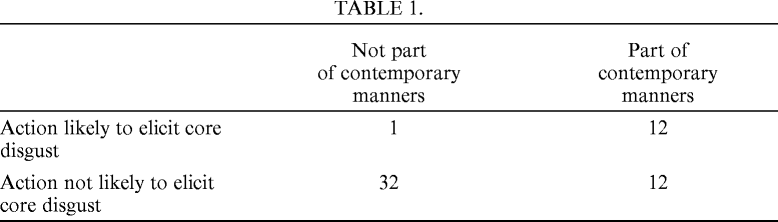
To see the statistic of most interest for evaluating our hypothesis, it will be helpful to consult a table of the raw numbers (Table 1). What we want to know is whether the sixteenth-century norms prohibiting core-disgusting actions are more likely to be part of contemporary manners than the sixteenth-century norms prohibiting actions unlikely to elicit core disgust.

| Not part of contemporary manners | Part of contemporary manners | |
|---|---|---|
| Action likely to elicit core disgust | 1 | 12 |
| Action not likely to elicit core disgust | 32 | 12 |
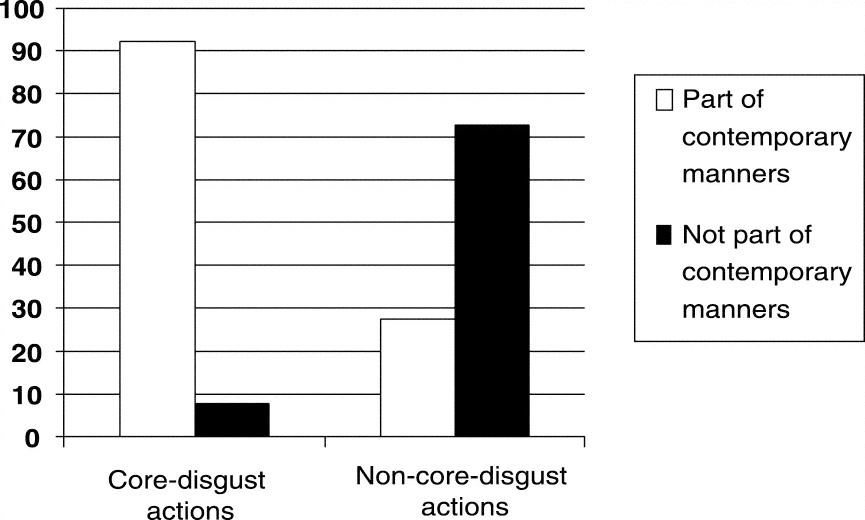
Prohibitions against core-disgusting actions were indeed more likely to survive than prohibitions against actions that aren't core-disgusting: χ2(1, N = 57) = 17.411, p < .0001 (two-tailed), Φ 2 = .305. (See Chart 1.)
Chart 1

The findings thus confirm the hypothesis. Sixteenth-century norms prohibiting core-disgusting actions are significantly more likely to be part of contemporary manners than sixteenth-century norms that prohibit actions unlikely to elicit core disgust. To underscore the nature of the findings, let me add some more anecdotal remarks on Erasmus’ treatise. As the coders bore out, several of the items from Erasmus now seem simply arbitrary or even run against contemporary etiquette:
“The person who opens his mouth wide in a rictus, with wrinkled cheeks and exposed teeth, is … impolite.” (276)
“When sitting down [at a banquet] have both hands on the table, not clasped together, nor on the plate.” (281)
“If given a napkin, put it over either the left shoulder or the left forearm.” (281)
On the other hand, many of the claims that prohibit core-disgust actions are now so deeply entrenched that they seem too obvious to mention. Consider, for example, the following:
“It is boorish to wipe one's nose on one's cap or clothing, and it is not much better to wipe it with one's hand, if you then smear the discharge on your clothing.” (274)
“Withdraw when you are going to vomit.” (276).
“Reswallowing spittle is uncouth as is the practice we observe in some people of spitting after every third word.” (276).
“To repress the need to urinate is injurious to health; but propriety requires it to be done in private.” (277).
While the norms prohibiting core-disgusting actions have gained in normative strength, the non-core-disgust norms have often simply disappeared from the culture. Of course, it's also the case that some of the etiquette rules that have prevailed have nothing to do with core disgust or with any other emotion. For instance, Erasmus tells us that: “The cup and small eating knife, duly cleaned, should be on the right-hand side” (281). This remains part of our tradition of etiquette today. But this in no way threatens our hypothesis, which is probabilistic, not categorical: norms prohibiting actions that elicit negative emotions are more likely to survive than affectively neutral norms.Footnote 5 The evidence from Erasmus looks to provide impressive confirmation for this hypothesis.
Although I've focused on Erasmus’ text for the statistical evaluation, similar trends are apparent in etiquette books that were not influenced by Erasmus. For instance, in John Russell's The Boke of Nurture (Reference Russell and Furnivall[1460] 1969), the table settings (which are typically clear cases of manners norms that don't connect with core disgust) differ significantly from contemporary settings (see e.g., lines 200–212). The text also offers the following variegated set of prohibitions in quick succession: Don't twist your neck, don't claw at your crotch…, don't pick your ears, don't be slow to hear, don't retch, don't spit too far, don't laugh loudly (lines 285–286, 289–290). Contemporary manners are rather tolerant of twisting one's neck, being slow to hear, and laughing loudly. But contemporary manners continue to frown upon groping at one's crotch, ear picking, retching, and projectile spitting.Footnote 6
8. Harm Norms Revisited
I've argued that a central chunk of our manners norms seems to be preserved partly because the norms are connected to core disgust. This argument was intended to help confirm the hypothesis that norms gain greater cultural fitness when they prohibit actions that are likely to elicit negative affect. Similarly, then it might well be that some of our moral norms gained an edge in cultural fitness by prohibiting actions that are likely to elicit negative affect. The moral norms that I'll focus on here are the norms against harming others, since those norms are plausibly at the heart of our moral outlook and seem to be cross-culturally widespread. When we consider our emotional repertoire, I think it will seem plausible that our emotional responses helped to secure moral norms against harming others.
Witnessing or learning of suffering in others often excites considerable affective response in humans. This emotional responsiveness to others’ suffering emerges very early in ontogeny. Indeed, emotional responses to suffering in others seem to be present in infancy (e.g., Reference SimnerSimner 1971); such responses are almost certainly cross-culturally universal, and they might even be present in some non-human primates (e.g., Reference Miller Robert and OgawaMiller et al. 1963). We come pre-tuned to be upset by the distress signals of others. And our emotional responsiveness to suffering in others is fairly impressive before the second birthday. By 18 months or so, children seem to be emotionally sensitive not just to distress cues, but to the knowledge that someone else is in pain (Reference NicholsNichols 2001).Footnote 7
I suggest that our emotional sensitivity to suffering in others played an important role in securing for harm-norms the central role they occupy in our moral outlook. Suffering in others leads to serious negative affect, so norms that prohibit harming others would prohibit actions that are likely to elicit negative affect. Thus, like the norms against disgusting actions, the norms against harmful actions would seem to have increased cultural fitness over norms that are not backed by affective response.Footnote 8 In Section 2, I reviewed several stories about how harm-norms originated. Whatever story one prefers to tell about how the harm-norms were generated in the first place, the fact that we are emotionally sensitive to others’ suffering helps to explain why the harm-norms ended up being so successful.
9. Implications
The line of argument I've been pushing has primarily been an attempt to contribute to our understanding of the genealogy of norms. However, the apparent role of emotion in the genealogy of norms also signals some broad implications for work in cultural evolution. In Sections 4 and 5, I argued that mental representations that are affectively salient would enjoy enhanced cultural fitness. This claim is reinforced by the historical evidence on etiquette norms. Emotion systems seem to play a powerful role in securing which mental representations survive in a culture. As a result, epidemiological theorists would do well to pay greater attention to the role of emotion in cultural transmission. For instance, some of the most interesting work in the epidemiological tradition has focused on the cultural transmission of religious representations (Reference Boyer, Hirschfeld and GelmanBoyer 1994, Reference Boyer, Carruthers and Chamberlain2000). But given the potential significance of affect for cultural transmission, a deeper understanding of the transmission of religious representations requires charting the role of affect in preserving religious representations. For, like etiquette norms, religious norms and beliefs plausibly gain in cultural fitness as a function of being connected to affective systems.
The role of emotion in cultural transmission also has a rather different implication for epidemiological theorists. In keeping with the orientation of earlier work in the epidemiological tradition, I have focused on apparently universal features of human affective systems. However, some theorists maintain that there is considerable cross-cultural variation in emotion systems. For example, in some cultures anger seems to be elicited and displayed in different ways than in other cultures (see Reference Mallon and StichMallon and Stich 2000 for a useful discussion). If there are such systematic cross-cultural differences, they might help epidemiologists explain why some norms and ideas are more likely to survive in some cultures than in others. In any case, epidemiological approaches to cultural evolution will need to be sensitive to such potential systematic differences in the affective repertoire of people in different cultures.
Of course, these implications for the epidemiological approach are only crudely sketched. The actual deployment of epidemiological accounts requires careful attention to both the empirical details of emotion systems and the historical patterns of cultural representations. But the available historical and empirical evidence certainly indicates that the emotions played a significant historical role in determining which norms survived into the present, and this evidence also suggests that an adequate naturalistic account of cultural evolution must begin to accommodate the role of affect in cultural transmission.