Introduction
The organizational legitimacy perspective argues that firms operate within an institutional environment that serves as a framework for defining both legal boundaries and notions of legitimacy (Kostova, Beugelsdijk, Scott, Kunst, Chua, & van Essen, Reference Kostova, Beugelsdijk, Scott, Kunst, Chua and van Essen2020). Within this context, institutions pose various challenges to firms with respect to their international business (IB) activities. One crucial factor determining a firm’s success at the IB front is its effective management of the institutional distance between its home country and the host countries. This distance plays a significant role in shaping overall firm performance, subsidiary performance, decisions regarding entry modes and location choices, and the dynamics of relationships between headquarters and subsidiaries (Aguilera & Grøgaard, Reference Aguilera and Grøgaard2019; Brouthers & Hennart, Reference Brouthers and Hennart2007; Jackson & Deeg, Reference Jackson and Deeg2019; Kogut & Singh, Reference Kogut and Singh1988; Kostova et al., Reference Kostova, Beugelsdijk, Scott, Kunst, Chua and van Essen2020; Kotler, Manrai, Lascu, & Manrai, Reference Kotler, Manrai, Lascu and Manrai2019; Shenkar, Reference Shenkar2001). The concept of institutional distance encompasses formal and informal dimensions (North, Reference North1990, Reference North2005). Formal institutional distance (FID) includes aspects such as regulatory quality, corruption, political stability, ease of doing business for foreign firms, and economic risk, while informal institutional distance is grounded in values, norms, and beliefs (Estrin, Baghdasaryan, & Meyer, Reference Estrin, Baghdasaryan and Meyer2009; Geleilate, Andrews, & Fainshmidt, Reference Geleilate, Andrews and Fainshmidt2020). Previous studies frequently employ aggregated measures of FID, citing the strong correlations among different governance dimensions as the rationale for this approach (Ang & Michailova, Reference Ang and Michailova2008; Brouthers, Brouthers, & Werner, Reference Brouthers, Brouthers and Werner2003; Estrin et al., Reference Estrin, Baghdasaryan and Meyer2009; Gaur & Lu, Reference Gaur and Lu2007; Gölgeci, Assadinia, Kuivalainen, & Larimo, Reference Gölgeci, Assadinia, Kuivalainen and Larimo2019; He, Brouthers, & Filatotchev, Reference He, Brouthers and Filatotchev2018; Ho, Ghauri, & Kafouros, Reference Ho, Ghauri and Kafouros2019; Ho, Ghauri, & Larimo, Reference Ho, Ghauri and Larimo2018; Keig, Brouthers, & Marshall, Reference Keig, Brouthers and Marshall2019; Kostova et al., Reference Kostova, Beugelsdijk, Scott, Kunst, Chua and van Essen2020; Salomon & Wu, Reference Salomon and Wu2012; Tashman, Marano, & Kostova, Reference Tashman, Marano and Kostova2019; Yiu & Makino, Reference Yiu and Makino2002). For example, Ang and Michailova (Reference Ang and Michailova2008: 562) state, ‘We also find that these six dimensions are highly correlated with pairwise correlations of greater than 0.732. Thus, we take the mean score of these dimensions to indicate the degree of regulatory institutions’. Tashman et al. (Reference Tashman, Marano and Kostova2019: 160) describe, ‘Because the six WGI indices are highly correlated, we followed Globerman and Shapiro (Reference Globerman and Shapiro2003) and developed a meta-index, estimated from the first principal components of the indices. We then reverse-coded the measure so higher values imply higher degrees of institutional voids (or poorer institutional quality)’. Beugelsdijk, Ambos and Nell (Reference Beugelsdijk, Ambos and Nell2018) report that FID variable explains 86% of the variation across the six indicators. However, this approach hinders scholars from examining the individual dimensions of FID. Specifically, the absence of individual dimensions as explanatory variables in the regression model prevents investigating their effects. Consequently, this approach fails to capture the subtleties and variations within each dimension, thus limiting the exploration of the individual impacts of FID dimensions.
In recent times, an increasing number of studies have started to utilize disaggregated measures of formal institutions (Berry, Guillén, & Zhou, Reference Berry, Guillén and Zhou2010; Cuervo-Cazurra & Genc, Reference Cuervo-Cazurra and Genc2008; Demirbag, Glaister, & Tatoglu, Reference Demirbag, Glaister and Tatoglu2007; Demirbag, Tatoglu, & Glaister, Reference Demirbag, Tatoglu and Glaister2010; Ellis, Moeller, Schlingemann, & Stulz, Reference Ellis, Moeller, Schlingemann and Stulz2017; Henisz, Reference Henisz2000; Jory & Ngo, Reference Jory and Ngo2015; Meyer & Nguyen, Reference Meyer and Nguyen2005; Shirodkar & Konara, Reference Shirodkar and Konara2017; Shirodkar, Konara, & McGuire, Reference Shirodkar, Konara and McGuire2017). These studies make a valuable contribution to the organizational legitimacy perspective by contextualizing the legitimacy of a firm across multiple dimensions of institutions. By exploring various facets of institutions, these studies provide insights that enhance our comprehension of the intricate relationship between a firm and its legitimacy. Upon careful observation, it becomes evident that a significant portion of these studies relies on a single dataset, namely the Worldwide Governance Indicators (WGI), to disaggregate the FID variable (Cuervo-Cazurra & Genc, Reference Cuervo-Cazurra and Genc2008; Ellis et al., Reference Ellis, Moeller, Schlingemann and Stulz2017; Jory & Ngo, Reference Jory and Ngo2015; Shirodkar & Konara, Reference Shirodkar and Konara2017; Shirodkar et al., Reference Shirodkar, Konara and McGuire2017). This dataset systematically categorizes country-level governance into six dimensions: (1) voice and accountability, (2) political stability and absence of violence, (3) government effectiveness, (4) regulatory quality, (5) rule of law, and (6) control of corruption. By adopting this disaggregation approach, researchers can conduct a more precise examination of the influence of individual dimensions on different outcomes. To exemplify one study, Cuervo-Cazurra and Genc (Reference Cuervo-Cazurra and Genc2008) examined whether least developed countries with poor formal institutions had a higher presence of developing-country firms compared to developed-country firms. They disaggregated formal institutions using the six WGI dimensions, of which only three (regulatory quality, rule of law, and control of corruption) were found to be significant. In line with their expectations, they found that least developed countries with poor formal institutions in terms of regulatory quality and control of corruption had a greater prevalence of developing-country firms. Contrary to their expectations, least developed countries with poor formal institutions in terms of the rule of law had a lesser prevalence of developing-country firms. One can imagine how less insightful – and potentially misleading – their results would have been if they were based on an aggregated measure of formal institutions. If the authors had relied on such an aggregated measure, they would have been compelled to draw a uniform conclusion that encompassed all dimensions of formal institutions. This approach would have overlooked the nuances and variations within each dimension, which, in reality, have distinct impacts on the prevalence of developing-country firms in least developed countries.
In line with this approach, the purpose of this paper is to broaden our understanding of the organizational legitimacy perspective by analyzing whether FID variables, based on WGI, affect the choice between partial and full acquisitions for Japanese cross-border acquirers. Thus, the paper seeks to answer the following research question: Do differences in formal institutions between the home country (Japan) and host countries, based on WGI data, help explain the variation in the likelihood of full versus partial acquisitions? We have selected the choice of acquisition as our outcome of interest due to its significance within the academic community (Ahammad, Leone, Tarba, Glaister, & Arslan, Reference Ahammad, Leone, Tarba, Glaister and Arslan2017; Ahmed & Bebenroth, Reference Ahmed and Bebenroth2022; Amar, Arouri, Dufrénot, & Lecourt, Reference Amar, Arouri, Dufrénot and Lecourt2023; Dikova, Panibratov, & Veselova, Reference Dikova, Panibratov and Veselova2019; Lahiri, Elango, & Kundu, Reference Lahiri, Elango and Kundu2014; Mariotti, Piscitello, & Elia, Reference Mariotti, Piscitello and Elia2014; Yoon, Peillex, & Buckley, Reference Yoon, Peillex and Buckley2021). The prevailing perspective in the entry mode literature is that the higher the perceived uncertainty vis-à-vis formal institutions, the higher the likelihood that multinationals prefer the shared-ownership entry mode over the full-ownership entry mode. Our focus on Japan stems from the substantial involvement of Japanese firms in cross-border acquisitions (Belderbos, Reference Belderbos2003; Fukuda, Reference Fukuda2020; Pease, Paliwoda, & Slater, Reference Pease, Paliwoda and Slater2006; Sartor & Beamish, Reference Sartor and Beamish2018, Reference Sartor and Beamish2020; Tanganelli, Schaan, & Cook, Reference Tanganelli, Schaan and Cook2014; Wang & Schaan, Reference Wang and Schaan2008; Zhang & Beamish, Reference Zhang and Beamish2019). Furthermore, the variations in institutional distance between Japan (home country) and host countries offer a valuable context for examining the link between FID dimensions and acquisition choices (Ando, Reference Ando2012; Bremer, Hoshi, Inoue, & Suzuki, Reference Bremer, Hoshi, Inoue and Suzuki2017; Dunning, Kim, & Lee, Reference Dunning, Kim and Lee2007). Furthermore, only a few studies have examined the influence of WGI-based disaggregated formal institutional variables on entry mode decisions (Chang, Kao, Kuo, & Chiu, Reference Chang, Kao, Kuo and Chiu2012; Slangen & Van Tulder, Reference Slangen and Van Tulder2009; Williams, Martinez, Gastelaars, Galesloot, & van de Kerke, Reference Williams, Martinez, Gastelaars, Galesloot and van de Kerke2011; Wu, Liu, & Huang, Reference Wu, Liu and Huang2012). These studies have made important contributions to IB literature, focusing on different acquirer countries such as Taiwan (Chang et al., Reference Chang, Kao, Kuo and Chiu2012), Netherlands (Slangen & Van Tulder, Reference Slangen and Van Tulder2009; Williams et al., Reference Williams, Martinez, Gastelaars, Galesloot and van de Kerke2011), and China (Wu et al., Reference Wu, Liu and Huang2012). However, the impact of WGI-based FID variables on the choice between partial and full acquisitions for Japanese acquirers remains unexamined.
Furthermore, while prior studies utilizing disaggregated WGI measures have primarily focused on the absolute level of governance quality in the host country, our study emphasizes the importance of a difference-based operationalization. By taking into account both the multinational enterprises’ experience in the home country and their prospective operations in the host country, this approach enables us to capture the distinct impacts of FID dimensions on acquisition choices (Contractor, Lahiri, Elango, & Kundu, Reference Contractor, Lahiri, Elango and Kundu2014; Fuentelsaz, Garrido, & González, Reference Fuentelsaz, Garrido and González2020; Keig et al., Reference Keig, Brouthers and Marshall2019; Lahiri et al., Reference Lahiri, Elango and Kundu2014; Malhotra & Gaur, Reference Malhotra and Gaur2014). It is worth noting that studies based on a single home country have also included institutional variables that take into account the disparities in institutional quality between the home and host countries, rather than solely concentrating on host country institutions (Berry et al., Reference Berry, Guillén and Zhou2010; Dikova et al., Reference Dikova, Panibratov and Veselova2019). Hence, in this study, we extend entry mode studies by disaggregating separate WGI dimensions between a home country and host countries to examine the effects of FID on the choice of partial versus full acquisitions, using a dataset of Japanese firms.
Our results indicate that the choice of partial versus full acquisitions made by Japanese acquirers is affected by only three dimensions of FID, namely regulatory quality, rule of law, and control of corruption. We found that FID in terms of regulatory quality and control of corruption is linked to a decreased likelihood of full acquisitions. However, FID in terms of the rule of law is associated with an increased likelihood of full acquisitions. In terms of methodology, this paper utilizes logistic regression models and conducts several robustness tests to ensure the reliability of our findings.
This study has implications for the IB literature. It corroborates earlier findings that WGI dimensions are indeed heterogeneous (Cuervo-Cazurra & Genc, Reference Cuervo-Cazurra and Genc2008; Slangen & Van Tulder, Reference Slangen and Van Tulder2009). Our study makes a valuable contribution to the understanding of the variations within institutional distance and emphasizes the necessity of going beyond aggregated measures. Therefore, it raises concerns regarding the reliability of studies based on aggregated measures of WGI (Ahammad et al., Reference Ahammad, Leone, Tarba, Glaister and Arslan2017; Ahmed & Bebenroth, Reference Ahmed and Bebenroth2019; Ang & Michailova, Reference Ang and Michailova2008; Contractor et al., Reference Contractor, Lahiri, Elango and Kundu2014; Elango, Lahiri, & Kundu, Reference Elango, Lahiri and Kundu2013; Keig et al., Reference Keig, Brouthers and Marshall2019; Lahiri et al., Reference Lahiri, Elango and Kundu2014; Lai, Lin, & Chen, Reference Lai, Lin and Chen2017). In the same way, our findings suggest that studies utilizing aggregated FID variables from alternative databases, such as the Index of Economic Freedom (Estrin et al., Reference Estrin, Baghdasaryan and Meyer2009; Kottaridi, Giakoulas, & Manolopoulos, Reference Kottaridi, Giakoulas and Manolopoulos2019; Tang, Reference Tang2019), the World Competitiveness Report (De Beule, Klein, & Verwaal, Reference De Beule, Klein and Verwaal2020), the Global Competitive Index (Chao & Kumar, Reference Chao and Kumar2010; He et al., Reference He, Brouthers and Filatotchev2018; Muralidharan & Pathak, Reference Muralidharan and Pathak2017; Romero-Martínez, García-Muiña, Chidlow, & Larimo, Reference Romero-Martínez, García-Muiña, Chidlow and Larimo2019), or the International Country Risk Guide (Chari & Chang, Reference Chari and Chang2009; Henisz, Reference Henisz2000; Valentino, Schmitt, Koch, & Nell, Reference Valentino, Schmitt, Koch and Nell2019; Wooster, Blanco, & Sawyer, Reference Wooster, Blanco and Sawyer2016), might also be susceptible to the aggregation bias.
Furthermore, extending prior entry mode studies with disaggregated WGI measures that show the significance of the absolute level of institutional development in the host country (Slangen & Van Tulder, Reference Slangen and Van Tulder2009; Williams et al., Reference Williams, Martinez, Gastelaars, Galesloot and van de Kerke2011, our study highlights the importance of considering the institutional distance between the home and host countries. Thus, we follow a call by; Zaheer, Schomaker and Nachum (Reference Zaheer, Schomaker and Nachum2012: 26) ‘that the greatest danger lies in the oversimplification of distance. Distance constructs have potential to be both powerful forensic tools and a means of comparing options. Conceptualizing and measuring them in the easiest way possible may make the job easier, but it also diminishes their effectiveness.’ Our study highlights the importance of considering the disparity in formal institutions between the home and host countries, even when examining a single home country and multiple host countries. This is demonstrated by the significant findings obtained for the difference-based FID variables. Thus, it is valuable to take into account the variation in institutional factors rather than solely relying on the institutions within the host countries.
The following section presents a literature review, followed by six hypotheses. Next, the methodology is discussed. Afterwards, we present the descriptive statistics, results of the logistic regression, and four robustness checks. Then, we provide the discussion, theoretical implications, future research directions, and limitations of the study.
Literature review
Organizational legitimacy perspective and the role of formal institutions
The dominant view in the entry mode literature suggests that as the perceived uncertainty related to formal institutions increases, multinational enterprises are more likely to opt for the shared-ownership entry mode instead of the full-ownership entry mode (Agarwal & Ramaswami, Reference Agarwal and Ramaswami1992; Brouthers, Reference Brouthers2002; Delios & Beamish, Reference Delios and Beamish1999; Henisz, Reference Henisz2000; Yiu & Makino, Reference Yiu and Makino2002). Furthermore, maintaining a low ownership stake in foreign firms enables investors to retain flexibility, facilitating an easier exit strategy when required (Delios & Beamish, Reference Delios and Beamish1999). Significantly, two distinct perspectives have emerged in this regard. The first school of thought emphasizes the quality of formal institutions by examining the absolute level of formal institutional development (or the lack thereof) in host countries (Ahammad et al., Reference Ahammad, Leone, Tarba, Glaister and Arslan2017; Chari & Chang, Reference Chari and Chang2009; Chikhouni, Edwards, & Farashahi, Reference Chikhouni, Edwards and Farashahi2017). The second school of thought directs attention toward the degree of dissimilarity or the distance between the home and host countries (Ando, Reference Ando2012; Contractor et al., Reference Contractor, Lahiri, Elango and Kundu2014; Dikova et al., Reference Dikova, Panibratov and Veselova2019; Lahiri et al., Reference Lahiri, Elango and Kundu2014). In this study, we adopt the latter approach as it entails ‘the logic of FDI that the multinational firm bridges the difference between the home and host nation, with one leg in each country’ (Contractor et al., Reference Contractor, Lahiri, Elango and Kundu2014: 932). We acknowledge the potential for confounding effects stemming from the institutional characteristics of host countries (Van Hoorn & Maseland, Reference Van Hoorn and Maseland2016). However, the significance of investigating the FID between the home and host countries, rather than solely focusing on the absolute level of formal institutional development in the host country, is supported by prior IB literature (Berry et al., Reference Berry, Guillén and Zhou2010; Dikova et al., Reference Dikova, Panibratov and Veselova2019; Fuentelsaz et al., Reference Fuentelsaz, Garrido and González2020; Keig et al., Reference Keig, Brouthers and Marshall2019; Malhotra & Gaur, Reference Malhotra and Gaur2014).
Institutional distance often leads to increased perceived uncertainties. However, firms can mitigate these effects by collaborating with local partners, which helps to reduce the liability of foreignness and minimize risk (Zaheer, Reference Zaheer1995). Working with a local partner also facilitates the acquisition of legitimacy (Trąpczyński, Halaszovich, & Piaskowska, Reference Trąpczyński, Halaszovich and Piaskowska2020) and reduces transaction costs (Chen & Hennart, Reference Chen and Hennart2004; Hennart, Reference Hennart1991). According to Kostova, Roth and Dacin (Reference Kostova, Roth and Dacin2008: 1002), the organizational legitimacy perspective views ‘social environments as evolving rule systems that are the products of a continuous process of sensemaking, enactment, and negotiated political interactions.’ This perspective emphasizes the importance of sensemaking for the cross-border acquirers to understand the evolving rule systems of the host country, enactment to implement strategies aligned with these systems, and negotiated political interactions to establish legitimacy and navigate local stakeholders. By considering these aspects, cross-border acquirers can decide whether a partial acquisition or a full acquisition might be more appropriate to enhance their success and effectively integrate their operations in the post-integration phase of cross-border deals. The actors, which in our study refer to firms engaged in cross-border deals, operate based on a logic of social appropriateness (Aguilera & Grøgaard, Reference Aguilera and Grøgaard2019) to bolster their social legitimacy (Scott, Reference Scott2013; Tashman et al., Reference Tashman, Marano and Kostova2019).
A review of the literature reveals that most entry mode studies typically employ a single aggregated variable to represent formal institutions (Chari & Chang, Reference Chari and Chang2009; Chikhouni et al., Reference Chikhouni, Edwards and Farashahi2017; Contractor et al., Reference Contractor, Lahiri, Elango and Kundu2014; Lahiri et al., Reference Lahiri, Elango and Kundu2014; Meyer, Estrin, Bhaumik, & Peng, Reference Meyer, Estrin, Bhaumik and Peng2009; Schwens, Eiche, & Kabst, Reference Schwens, Eiche and Kabst2011; Vasudeva, Nachum, & Say, Reference Vasudeva, Nachum and Say2018). However, it is important to note that studies utilizing aggregated measures often yield conflicting results. For instance, Chari and Chang (Reference Chari and Chang2009) find a negative association between the level of formal institutional development in the host country and the share of equity sought in cross-border acquisitions. In contrast, Chikhouni et al., (Reference Chikhouni, Edwards and Farashahi2017), using a similar aggregate variable, arrive at the opposite conclusion. Contractor et al. (Reference Contractor, Lahiri, Elango and Kundu2014) demonstrate that FID is positively related to the choice of full acquisitions over minority acquisitions (i.e., ownership below 50%), but it does not significantly influence the choice between full acquisitions and majority acquisitions (ownership in the range of 50% to 99%). Focusing on the moderating effect of the acquirer’s country-of-origin, Lahiri et al. (Reference Lahiri, Elango and Kundu2014) show that acquirers from developed countries prefer partial acquisitions when faced with higher FID between their home country and the host country (viz. India). However, acquirers from developing countries exhibit a different behavior, preferring full acquisitions when confronted with higher FID. Using OECD (Organization for Economic Co-operation and Development) data, Vasudeva, Nachum, & Say (Reference Vasudeva, Nachum and Say2018) find a positive association between the restrictiveness of FDI in the host country and the likelihood of partial acquisitions.
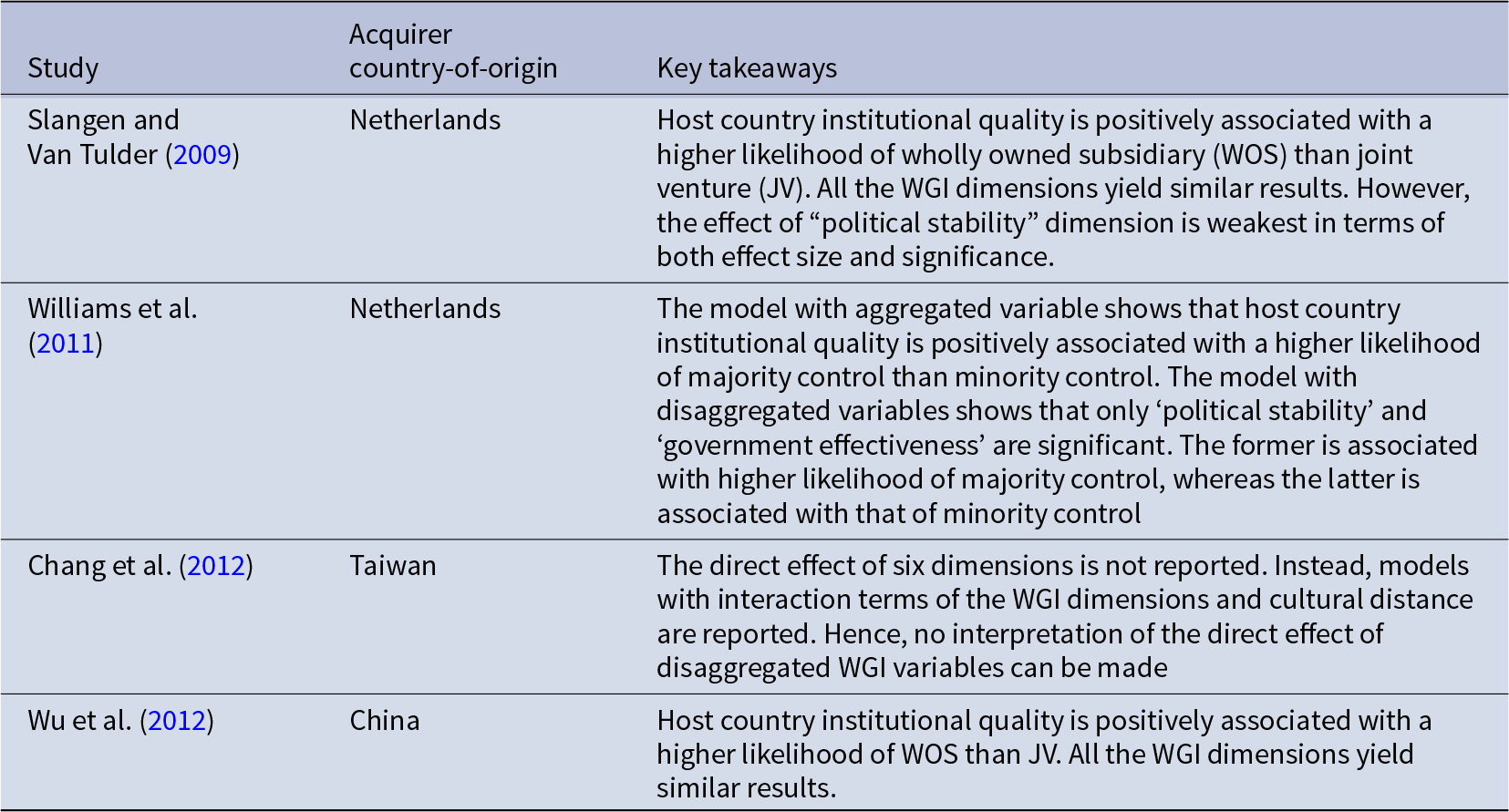
Conflicting results in entry mode studies with a single variable for formal institutions highlight the importance of disaggregating the FID variable. However, it must be noted that a fraction of entry mode studies which include multiple variables for formal institutions suffer from comparability issues as they use different data sources to measure different dimensions of formal institutions (Delios & Beamish, Reference Delios and Beamish1999; Demirbag et al., Reference Demirbag, Glaister and Tatoglu2007, Reference Demirbag, Tatoglu and Glaister2010; Dikova et al., Reference Dikova, Panibratov and Veselova2019; Henisz, Reference Henisz2000; Meyer & Nguyen, Reference Meyer and Nguyen2005; Sartor & Beamish, Reference Sartor and Beamish2018, Reference Sartor and Beamish2020). Additionally, most of these studies focus only on two dimensions of formal institutions, viz. political stability and corruption, while neglecting other important dimensions covered by the WGI, e.g., regulatory quality and rule of law. Therefore, we argue that conducting entry mode studies using the complete set of disaggregated WGI variables would yield valuable insights for the IB community (Chang et al., Reference Chang, Kao, Kuo and Chiu2012; Slangen & Van Tulder, Reference Slangen and Van Tulder2009; Williams et al., Reference Williams, Martinez, Gastelaars, Galesloot and van de Kerke2011; Wu et al., Reference Wu, Liu and Huang2012). We summarize key takeaways of entry mode studies with disaggregated WGI variables in Table 1.
Key takeaways of entry mode studies with disaggregated WGI variables

Worldwide Governance Indicators
The WGIs are country-level governance scores provided by the World Bank. Kaufmann, Kraay and Mastruzzi (Reference Kaufmann, Kraay and Mastruzzi2007) developed these indicators and conceptualized governance as traditions and institutions by which authority (or power) in a country is exercised. The WGIs have been widely used in academic research because of their extensive coverage of over 200 countries and territories. In IB research, these indicators have been used as a proxy for variables such as FID, formal institutional development, and institutional voids (Ang & Michailova, Reference Ang and Michailova2008; Contractor et al., Reference Contractor, Lahiri, Elango and Kundu2014; Keig et al., Reference Keig, Brouthers and Marshall2019; Lahiri et al., Reference Lahiri, Elango and Kundu2014; Tashman et al., Reference Tashman, Marano and Kostova2019).
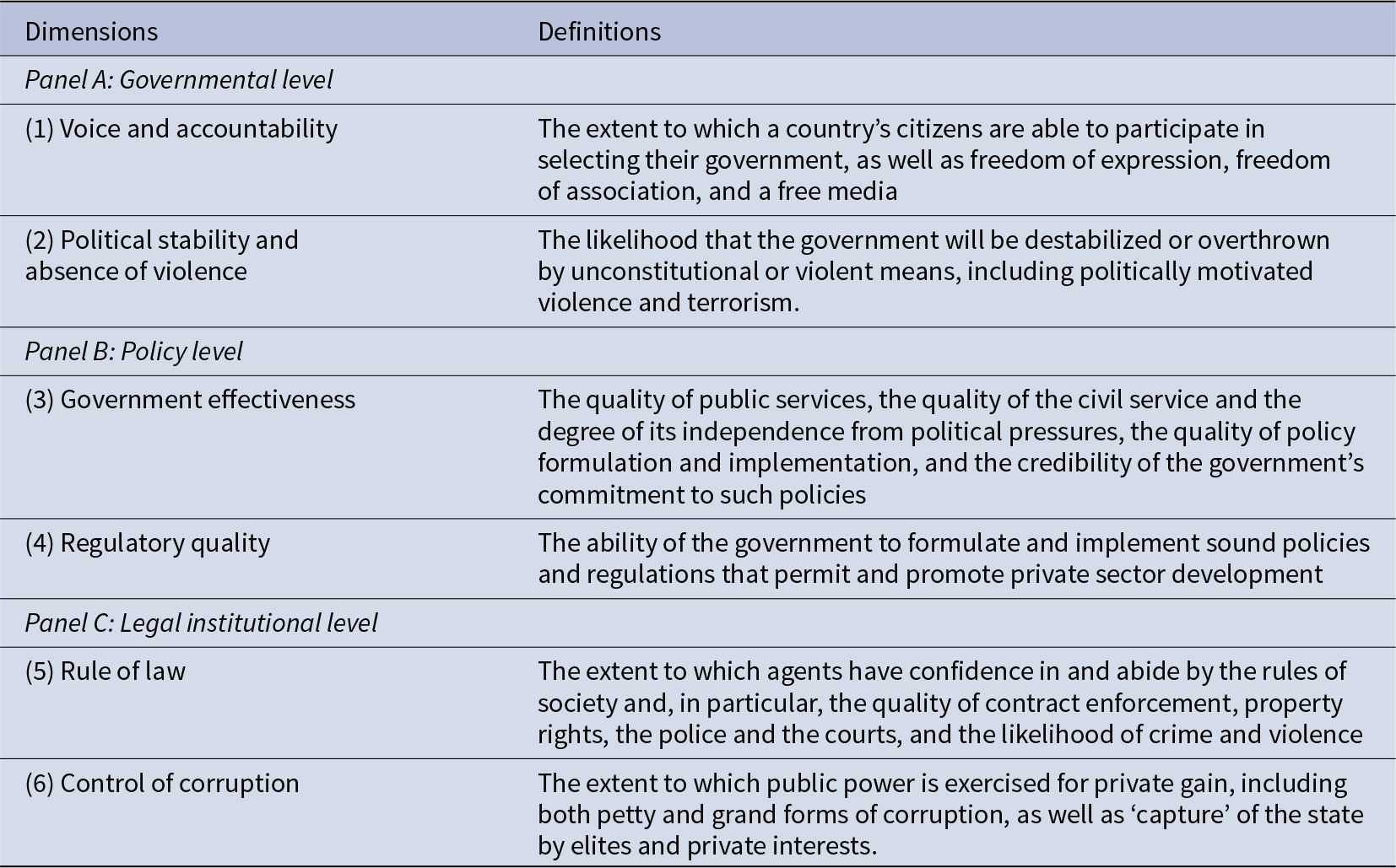
The WGIs classify governance into three levels, viz. government, policy, and legal institution. The governmental level focuses on the process by which governments are selected, monitored, and replaced. At the level of policy, it focuses on the capacity of governments to effectively formulate and implement sound policies. The legal institutional level focuses on the respect of citizens and the state for institutions that govern economic and social interactions among them. The three major levels are broken down into six dimensions in total. The definitions of each dimension are provided in Table 2.
Definitions of the WGI dimensions

Adopted from Kaufmann et al. (Reference Kaufmann, Kraay and Mastruzzi2007).
Hypothesis development
Since the central claim of this study is that FID should be studied in a disaggregated form for a thorough analysis (Cuervo-Cazurra & Genc, Reference Cuervo-Cazurra and Genc2008), we examine all six dimensions of the WGI separately to understand better the underlying effect of FID on the choice of partial versus full acquisitions.
Governmental level
Governmental level covers two dimensions: first, voice and accountability, and second, political stability and absence of violence. The dimension of voice and accountability relates to the degree to which people in a country are given liberty to select governments. It can be said that this dimension of governance focuses on the process of government selection. Countries with low absolute scores on this dimension denote that power in such countries stays with dictators or authoritarian regimes, whereas high absolute scores indicate the presence of a smooth democratic system (Kaufmann et al., Reference Kaufmann, Kraay and Mastruzzi2007). The role of such political actors on the firm’s internationalization has been discussed in a number of studies (Chidlow, Ghauri & Hadjikhani, Reference Chidlow, Ghauri and Hadjikhani2019; Delios & Henisz, Reference Delios and Henisz2003). Distance makes access to information more difficult (Morschett, Schramm-Klein, & Swoboda, Reference Morschett, Schramm-Klein and Swoboda2010). Also following transaction cost logic, a higher distance will discourage entry with high commitment modes (Beugelsdijk et al., Reference Beugelsdijk, Ambos and Nell2018) Hence, a greater distance between home and host countries suggests that acquirers have to work in unfamiliar host countries and may face discriminatory institutional pressures from the government of host countries (Poynter, Reference Poynter2013; Yiu & Makino, Reference Yiu and Makino2002). For example, as Japan’s score is similar to Taiwan’s but distant to China’s on this dimension, Japanese firms face greater uncertainties working in China. In order to deal with such external pressure of political environments, Japanese firms prefer to undertake partial acquisitions to lessen external uncertainties (Inkpen & Beamish, Reference Inkpen and Beamish1997; Makino & Delios, Reference Makino and Delios1996; Xu, Pan, & Beamish, Reference Xu, Pan and Beamish2004). We thus present our first hypothesis:
Hypothesis 1: The greater the formal institutional distance vis-à-vis voice and accountability, the higher the tendency of acquiring firms to prefer partial acquisitions over full acquisitions.
The dimension of political stability and absence of violence focuses on the degree of destabilization of governments by political instability and violent means. A high absolute score on this variable suggests that the country has a lower likelihood that its government will be overthrown or destabilized through unconditional means (Mengistu & Adhikary, Reference Mengistu and Adhikary2011). However, also the institutional distance between home and host countries has important implications. A greater distance on this dimension between home and host country for a given deal suggests that the acquirer is not familiar with the host country’s political system (Contractor et al., Reference Contractor, Lahiri, Elango and Kundu2014; Lahiri et al., Reference Lahiri, Elango and Kundu2014). Working with local partners reduces the risk of discriminatory treatment by the host country government (Cui & Jiang, Reference Cui and Jiang2010). In fact, foreign acquirers avoid investing in politically different host countries where they do not expect to understand the system. For example, on this dimension, Japan’s score is similar to Singapore’s but distant to Thailand’s. Hence, Japanese firms feel relatively comfortable investing in Singapore due to similarities in the working environment with respect to political stability and absence of violence. In contrast, Japanese firms investing in Thailand request more help from local partners, leaving them with a lower likelihood of full acquisitions (Inkpen & Beamish, Reference Inkpen and Beamish1997; Makino & Delios, Reference Makino and Delios1996; Xu et al., Reference Xu, Pan and Beamish2004). Hence, we present the second hypothesis below:
Hypothesis 2: The greater the formal institutional distance vis-à-vis political stability and absence of violence, the higher the tendency of acquiring firms to prefer partial acquisitions over full acquisitions.
Policy level
Policy level subsumes the dimensions of government effectiveness and regulatory quality. The dimension of government effectiveness focuses on the extent to which the process of policy formulation implemented in a given country is independent of the ruling government. In other words, it signifies the quality of bureaucracy and public service in a country. A high absolute score on this dimension shows the tendency of governments to refrain from using their power to influence policies (Kaufmann et al., Reference Kaufmann, Kraay and Mastruzzi2007). Thus, a greater distance between host and home countries on this dimension shows that acquirers are unfamiliar with the bureaucracy and public service provisions of the host country. In such a scenario, risk expropriation may result from opportunistic behavior of local authorities, changes in investment regulations, or trading agreements (Chan & Makino, Reference Chan and Makino2007). According to organizational legitimacy perspective, even if host country government effectiveness is higher than that of the home country, acquirers prefer partial acquisitions as they are unfamiliar with the host country system. An example of FID with respect to government effectiveness can be seen in Japanese investments in Malaysia versus Indonesia. Japan’s score is relatively similar to Malaysia’s in terms of government effectiveness as compared to Indonesia’s. Hence, ceteris paribus, Japanese firms face more uncertainties in Indonesia due to a greater difference in government effectiveness. As a result, we expect Japanese bidders to have a higher preference for partial acquisitions in countries such as Indonesia, as they expect to enlist assistance from local partners (Inkpen & Beamish, Reference Inkpen and Beamish1997; Makino & Delios, Reference Makino and Delios1996; Xu et al., Reference Xu, Pan and Beamish2004). Hence, the third hypothesis is presented as follows:
Hypothesis 3: The greater the formal institutional distance vis-à-vis government effectiveness, the higher the tendency of acquiring firms to prefer partial acquisitions over full acquisitions.
The dimension regulatory quality corresponds directly to the promotion of private sector development. Countries that have better contract enforcement and international trade regulations are more efficient in attracting FDI. In addition, better regulatory capacity also matters for the ease of doing business (Slesman, Abubakar, & Mitra, Reference Slesman, Abubakar and Mitra2021). A high absolute score for this dimension indicates that the government is keen to assist local businesses through supportive policies and regulations (Kaufmann et al., Reference Kaufmann, Kraay and Mastruzzi2007). The impact of pro-market institutions on firms’ global strategy has long been investigated (see Cuervo-Cazurra, Gaur, & Singh, Reference Cuervo-Cazurra, Gaur and Singh2019, for review). A greater distance between home and host countries on this dimension signifies that acquirer is treated differently in host countries with respect to policies and regulations. In other words, firms from countries with a certain type of regulatory framework feel restricted in host countries where a different type of regulatory framework is prevalent (Contractor et al., Reference Contractor, Lahiri, Elango and Kundu2014; Lahiri et al., Reference Lahiri, Elango and Kundu2014). For example, on this dimension, Japan stands close to France but distant to India. Hence, ceteris paribus, Japanese firms face greater uncertainties in India and, therefore, prefer partial acquisitions in India than in France (Inkpen & Beamish, Reference Inkpen and Beamish1997; Makino & Delios, Reference Makino and Delios1996; Xu et al., Reference Xu, Pan and Beamish2004). We present our fourth hypothesis as follows:
Hypothesis 4: The greater the formal institutional distance vis-à-vis regularity quality, the higher the tendency of acquiring firms to prefer partial acquisitions over full acquisitions.
Legal institutional level
Legal institutional level covers the rule of law and the control of corruption. The rule of law relates to the quality of contract enforcement in protecting individuals and property rights in public institutions that are credible, honest, and stable (Sesman et al., Reference Slesman, Abubakar and Mitra2021). The presence of rule of law encourages FDI, especially for new firm entrants (Agostino, Di Tommaso, Nifo, Rubini, & Trivieri, Reference Agostino, Di Tommaso, Nifo, Rubini and Trivieri2020). A low absolute score on this dimension indicates a higher likelihood of the occurrence of crime or violence in the given country. In contrast, a high absolute score on this dimension indicates that its legal institutions operate fairly (Kaufmann et al., Reference Kaufmann, Kraay and Mastruzzi2007). Thus, if the host countries’ legal institutions are weaker than those of the own home country, investors opt for partial acquisitions to avoid a risky environment. Precisely, acquirers are concerned about a lack of norms prevalent in judicial systems of host countries to ensure the enforcement of contracts (Contractor et al., Reference Contractor, Lahiri, Elango and Kundu2014; Lahiri et al., Reference Lahiri, Elango and Kundu2014). The reason is that acquirers do not have experience of working in a distant environment and avoid operating alone in a country with unfamiliarity. Thus, a higher FID vis-à-vis rule of law is expected to be associated with the choice of partial acquisitions. Acquirers also prefer partial acquisitions over full acquisitions to set a ‘local image’ (Trąpczyński et al., Reference Trąpczyński, Halaszovich and Piaskowska2020). For example, Japan’s score ranks close to the United States’ but distant to China’s. Therefore, Japanese firms are expected to prefer partial acquisitions in China as they need more support from local business partners to deal with external uncertainties related to the rule of law (Inkpen & Beamish, Reference Inkpen and Beamish1997; Makino & Delios, Reference Makino and Delios1996; Xu et al., Reference Xu, Pan and Beamish2004). Hence, the fifth hypothesis is presented as follows:
Hypothesis 5: The greater the formal institutional distance vis-à-vis rule of law, the higher the tendency of acquiring firms to prefer partial acquisitions over full acquisitions.
The dimension of control of corruption addresses all forms of corruption. Godinez and Liu (Reference Godinez and Liu2015) argue that developed market firms face difficulties to deal with corruption as it is rare in their home markets. Higher levels of corruption – compared to the home country – encourages investors to join forces with local partners (Doh, Rodriguez, Uhlenbruck, Collins, & Eden, Reference Doh, Rodriguez, Uhlenbruck, Collins and Eden2003).
Thus, in cases of a greater distance between home and host country on this dimension, acquirers experience a different style of economic and regulatory institutions in the host countries, and hence, their perception of uncertainty is higher (Contractor et al., Reference Contractor, Lahiri, Elango and Kundu2014; Lahiri et al., Reference Lahiri, Elango and Kundu2014). Japan’s score on this dimension is very high, leading acquirers to be relatively comfortable in host countries that are ranked close to Japan such as the United States, France, or Hong Kong. In contrast, Japanese firms are not prepared for countries that show a high degree of corruption such as India, China, and Thailand. Hence, ceteris paribus, when Japanese firms invest in countries with low scores on control of corruption, they need the help of local partners, leading to a preference for partial acquisitions (Inkpen & Beamish, Reference Inkpen and Beamish1997; Makino & Delios, Reference Makino and Delios1996; Xu et al., Reference Xu, Pan and Beamish2004). Hence, our sixth hypothesis:
Hypothesis 6: The greater the formal institutional distance vis-à-vis control of corruption, the higher the tendency of acquiring firms to prefer partial acquisitions over full acquisitions.
Methodology
Data and sample
We retrieved the acquisition deals from Bloomberg database. First, we shortlisted completed cross-border deals by Japanese firms announced in the period 2010–2017 involving only publicly listed acquirers and targets. We limited the search on publicly listed acquirers and targets owing to the nature of control variables used in entry mode studies (Sartor & Beamish, Reference Sartor and Beamish2018). Also, we chose 2010 as the starting year for data collection to focus on the behavior of Japanese firms in the post-global financial crisis era (Jean & Lohmann, Reference Jean and Lohmann2016). The acquisition data were covered until 2017 because it was the most recent completed year at the time of data collection. This gave us an initial sample of 346 deals. From this sample, we deleted 63 deals involving firms in the finance industry. Such firms follow different accounting regulations, and therefore it is not appropriate to analyze them together with firms from industry sectors (Kim, Haleblian, & Finkelstein, Reference Kim, Haleblian and Finkelstein2011). Given that this study focuses on the entry mode decision, we further deleted 97 deals where acquirers subsequently increased their ownership instead of having an initial acquisition (Cuypers, Ertug, & Hennart, Reference Cuypers, Ertug and Hennart2015; Dow, Cuypers, & Ertug, Reference Dow, Cuypers and Ertug2016), reducing our sample to 186 deals. Because of data limitations on further control variables, the final sample consisted of 151 observations.
Econometric model
The categorical dependent variable in our study represented the choice of partial versus full acquisitions. Therefore, we employed a binary logistic regression analysis similar to the ones used in previous studies (Dikova et al., Reference Dikova, Panibratov and Veselova2019; Liang, Musteen, & Datta, Reference Liang, Musteen and Datta2009; Sartor & Beamish, Reference Sartor and Beamish2018). Our binary logistic model can be represented as
 \begin{equation*}P\left( {{Y_i} = 1} \right) = {1 \over {1 + \exp \left( { - {{\alpha }} - {X_i}{{\beta }}} \right)}}\end{equation*}
In the above model, Yi represents the dependent variable, α represents the intercept, Xi represents the vector of independent and control variables, and β represents the vector of regression parameters.
Dependent variable
The dependent variable, acquisition mode, took the value of one for full acquisitions and zero for partial acquisitions. In the definition of full acquisitions, we relied on previous literature, where a full acquisition means that acquirers obtain 100% ownership in the target after the deal. Likewise, ownership of any percentage less than 100% represents a partial acquisition (Lahiri et al., Reference Lahiri, Elango and Kundu2014; Liang et al., Reference Liang, Musteen and Datta2009; Mariotti et al., Reference Mariotti, Piscitello and Elia2014). Note that a common view in the literature is that a cutoff slightly lower than 100% (such as 90%) should be used to classify deals into partial and full acquisitions. We discuss the impact of this view on our results in the robustness tests.
Independent variables
The independent variables of this study are six disaggregated FID variables: (1) voice and accountability, (2) political stability and absence of violence, (3) government effectiveness, (4) regulatory quality, (5) rule of law, and (6) control of corruption. We measured these variables based on the absolute value of the difference between the WGI score of the home (Japan) and the host country on a given deal (Aybar & Ficici, Reference Aybar and Ficici2009; Fuentelsaz et al., Reference Fuentelsaz, Garrido and González2020; Jiang, Holburn, & Beamish, Reference Jiang, Holburn and Beamish2014). We represent this measure in the equation below:
 \begin{equation*}{\textrm{FI}}{{\textrm{D}}_{ij}} = \left| {{\textrm{WG}}{{\textrm{I}}_{j,{\textrm{acquirer}}}} - {\textrm{WG}}{{\textrm{I}}_{j,{\textrm{target}}}}} \right|\end{equation*}
Here FIDij represents the disaggregated FID score for ith deal on jth dimension and WGIj ,acquirer and WGIj ,target represent WGI score on jth dimension for acquirer and target country, respectively. We additionally included an aggregated measure of FID in a separate model to compare the results of aggregated measure with the disaggregated ones. The aggregated measure was calculated by using the rank function built upon WGI scores of the home (Japan) and the host country in a given deal (Aybar & Ficici, Reference Aybar and Ficici2009).
 \begin{equation*}{\textrm{FI}}{{\textrm{D}}_i} = {1 \over N}{1 \over J}\sum\limits_{j = 1}^J {{\textrm{Ran}}{{\textrm{k}}_j}\left( {{\textrm{FI}}{{\textrm{D}}_{ij}}} \right)} \end{equation*}
In the above equation, FIDi represents the aggregated FID score for ith deal considering the sample size N (151) and number of dimensions J (6). Rankj(FIDij) is the rank function, which assigns a rank to each observation from 1 (to the smallest value of FIDij) to N (to the largest value of FIDij). As mentioned, FIDij represents a disaggregated FID score for ith deal on jth dimension, calculated as the absolute value of the difference between the WGI score of the home (Japan) and the host country. FIDi is bounded between 0 and 1, where higher values imply greater FID and vice versa.
Moreover, for both aggregated and disaggregated measures, we based our calculations on a 3-year average value prior to the year of the acquisition announcement. This method allowed us to consider the behavior of managers who based their decision on a broader trend of key variables rather than on their values in a single year (Ahammad et al., Reference Ahammad, Leone, Tarba, Glaister and Arslan2017; Ahmed & Bebenroth, Reference Ahmed and Bebenroth2019; Chari & Chang, Reference Chari and Chang2009; Waqar, Reference Waqar2020). We tested alternative measures of aggregated and disaggregated FID variables in the robustness tests.
Control variables
We added several control variables into our regression at three different levels regarding firm, industry, and country. At the firm level, we controlled for the size of acquirers (Han, Jo, & Kang, Reference Han, Jo and Kang2018), as well as targets (Ahammad et al., Reference Ahammad, Leone, Tarba, Glaister and Arslan2017). We measured the size of acquirers and targets as the natural logarithm of total assets (Chiu, Huang, Liu, & Vasarhelyi, Reference Chiu, Huang, Liu and Vasarhelyi2018; Huang, Jiang, Lie, & Yang, Reference Huang, Jiang, Lie and Yang2014; Park, Yul Lee, & Hong, Reference Park, Yul Lee and Hong2011; Pattnaik & Lee, Reference Pattnaik and Lee2014). For acquirers, we additionally controlled for acquisition experience in the host country. Following prior studies, we operationalized acquirer experience as the number of years since their first investment in that country (Chen, Reference Chen2008; Chen & Hennart, Reference Chen and Hennart2004; Chikhouni et al., Reference Chikhouni, Edwards and Farashahi2017; Mariotti et al., Reference Mariotti, Piscitello and Elia2014).
At the industry level, we controlled for deal relatedness (Chari & Chang, Reference Chari and Chang2009; Contractor et al., Reference Contractor, Lahiri, Elango and Kundu2014; Lahiri et al., Reference Lahiri, Elango and Kundu2014). Specifically, we operationalized deal relatedness as a dummy variable which took the value of one when acquirers and targets were from the same industry subgroup (i.e., same third-level classification as per Bloomberg Industry Classification Systems), and zero otherwise (Ahmed, Bebenroth, & Hennart, Reference Ahmed, Bebenroth and Hennart2020; Waqar, Reference Waqar2020). We also added industry dummy variables to control for industry fixed effects based on the first-level BISC (Lahiri et al., Reference Lahiri, Elango and Kundu2014).
At the country level, we controlled for cultural distances between Japan and host countries by using Kogut and Singh’s (Reference Kogut and Singh1988) composite index, based on the four dimensions of Hofstede’s (Reference Hofstede1980) national cultural difference index (Ang & Michailova, Reference Ang and Michailova2008; Demirbag et al., Reference Demirbag, Glaister and Tatoglu2007; Lahiri et al., Reference Lahiri, Elango and Kundu2014; Liang et al., Reference Liang, Musteen and Datta2009; White, Fainshmidt & Rajwani, Reference White, Fainshmidt and Rajwani2018). The data for cultural distance was obtained from Hofstede, Hofstede and Minkov (Reference Hofstede, Hofstede and Minkov2010). We additionally controlled for the host country size. This variable was operationalized as the natural logarithm of the host country GDP based on a 5-year average, with data ending a year before the acquisition (Liang et al., Reference Liang, Musteen and Datta2009). We received host country GDP figures from World Bank. As the GDP data for Taiwan could not be retrieved from the World Bank data source, we obtained necessary data from an online database (Taiwan, Reference Taiwan2018). Since the sample was drawn from multiple years, the year dummies were also included in the regression analysis.
Results
Descriptive statistics
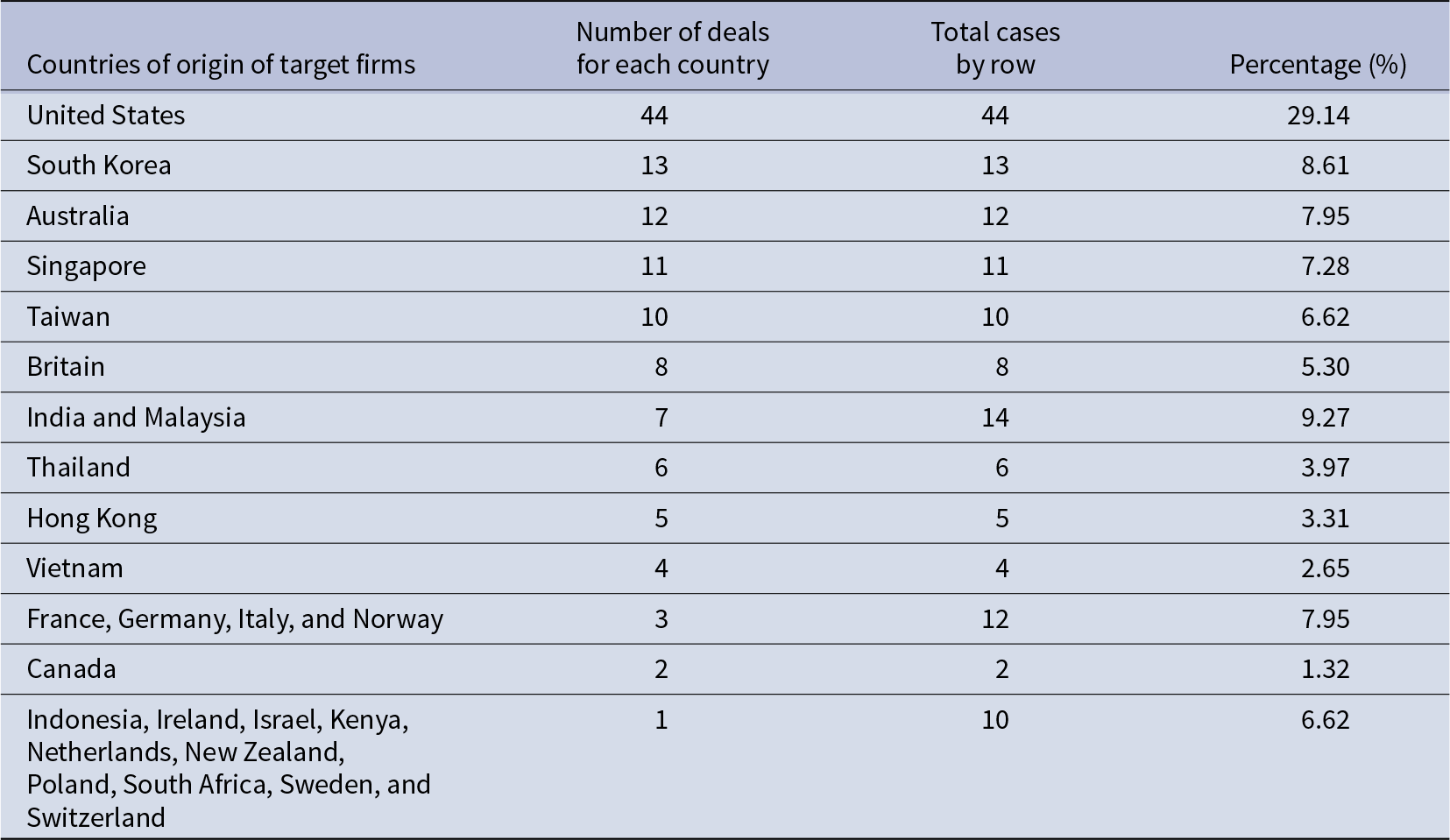
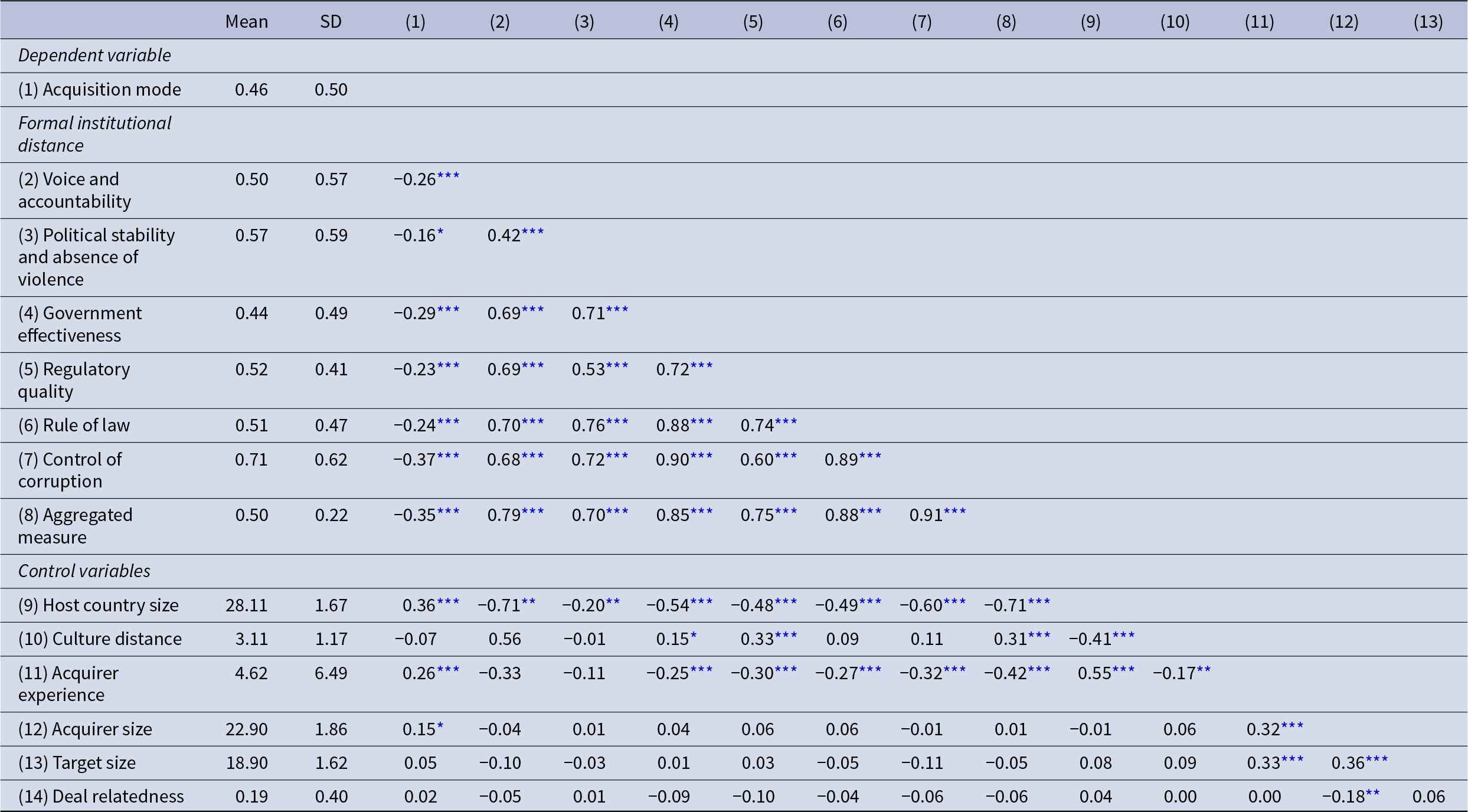
Overall, our sample of 151 deals was representative of Japanese investments in 26 countries. In accordance with high Japanese outward FDI to the United States, most of the targets in our sample were based in the United States. Other locations included South Korea, Australia, Singapore, and Taiwan representing 13, 12, 11, and 10 cases, respectively. Table 3 provides a detailed overview of the host countries. Also, the number of partial and full acquisitions in our sample is 81 and 70, respectively. The descriptive statistics and correlation matrix are provided in Table 4.
Countries of origin of target firms

Compiled by the authors.
Descriptive statistics and correlation matrix

***, **, and
* represent statistical significance at 1%, 5%, and 10% levels, respectively.
The correlation among disaggregated WGI variables was high, as reported in previous studies (Ang & Michailova, Reference Ang and Michailova2008; Berden, Bergstrand, & Van Etten, Reference Berden, Bergstrand and Van Etten2014). However, low variance inflation factor figures assured us that multicollinearity was not a concern in our analysis. The highest variance inflation factor value for our study was 4.07, which was much below the threshold value of 10 (Chari & Chang, Reference Chari and Chang2009). Also, the inclusion of multiple WGI dimensions into a single model is in line with a number of prior studies (Albassam, Reference Albassam2015; Berden et al., Reference Berden, Bergstrand and Van Etten2014; Brandl, Darendeli, & Mudambi, Reference Brandl, Darendeli and Mudambi2019; Jory & Ngo, Reference Jory and Ngo2015; Kwon & Kim, Reference Kwon and Kim2014; Williams et al., Reference Williams, Martinez, Gastelaars, Galesloot and van de Kerke2011; Zubair & Khan, Reference Zubair and Khan2014). Moreover, IB scholars recently clarified that collinear independent variables should be analyzed in a single model for conservative results (Lindner, Puck, & Verbeke, Reference Lindner, Puck and Verbeke2020).
Results of logistic regression
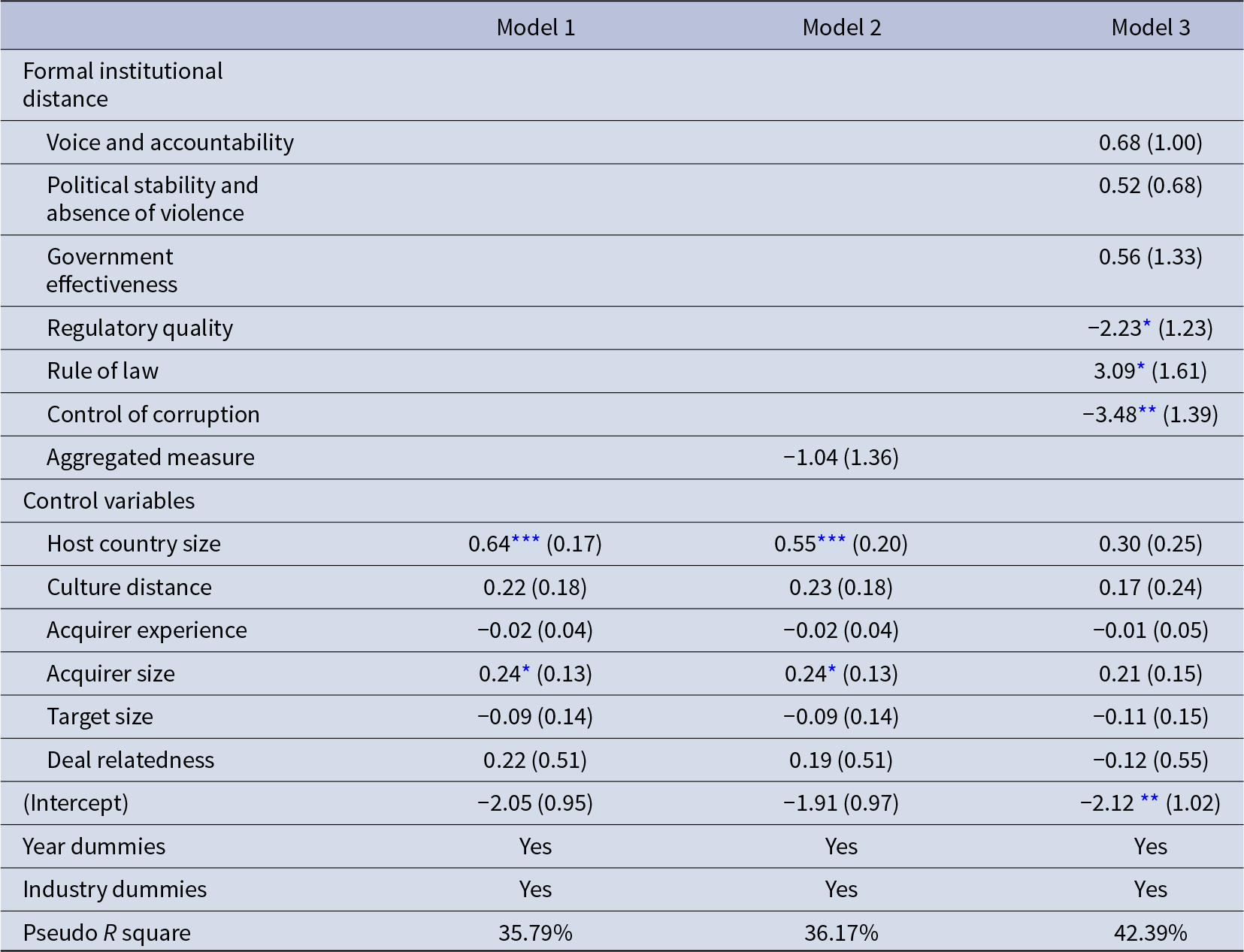
The results of our regression analysis are presented in Table 5. Model 1 was run only with control variables. Host country size and acquirer size variables were significant. Since the dependent variable was coded 1 for full acquisitions and 0 for partial acquisitions, a significant positive coefficient of the acquirer size variable suggested that large acquirers tended to prefer full acquisitions. Furthermore, deals involving targets located in countries with high GDP are more likely to be full acquisitions, as shown by a significant positive coefficient of the variable host country size.
Main results: The effect of WGI-based disaggregated FID variables on the choice of partial versus full acquisitions

The dependent variable takes the value of 1 for full acquisitions and 0 for partial acquisitions. Standard errors are reported in parentheses. ***, **, and
* represent statistical significance at 1%, 5%, and 10% levels, respectively.
In Model 2 (Table 5), we entered the aggregated FID measure. This variable was not statistically significant (β = −1.04, p = ns). However, in line with our contention regarding the importance of disaggregating the FID variable, we obtained several significant results when we disentangled the six dimensions of FID (Model 3). We additionally compared Model 2 and Model 3 by conducting the Vuong non-nested test (Vuong, Reference Vuong1989). The results showed that Model 3 was significantly better than Model 2 at the 1% level, lending support to our central argument that the FID variable should be disaggregated in order to detect meaningful contribution of each dimension.
The first three dimensions of the FID were not significant. Hence, H1, H2, and H3 were not supported. In accordance with our expectations, larger differences in ‘regulatory quality’ (β = −2.23, p < 0.10) and ‘control of corruption’ (β = −3.48, p < 0.05) were associated with a higher likelihood of partial acquisitions. Hence, H4 and H6 received support. However, in contrast to our expectations, larger differences in ‘rule of law’ (β = 3.09, p < 0.10) were associated with a higher likelihood of full acquisitions. While a statistically significant association was obtained, the direction was contrary to our expectations. Hence, H5 was not supported.
Robustness tests
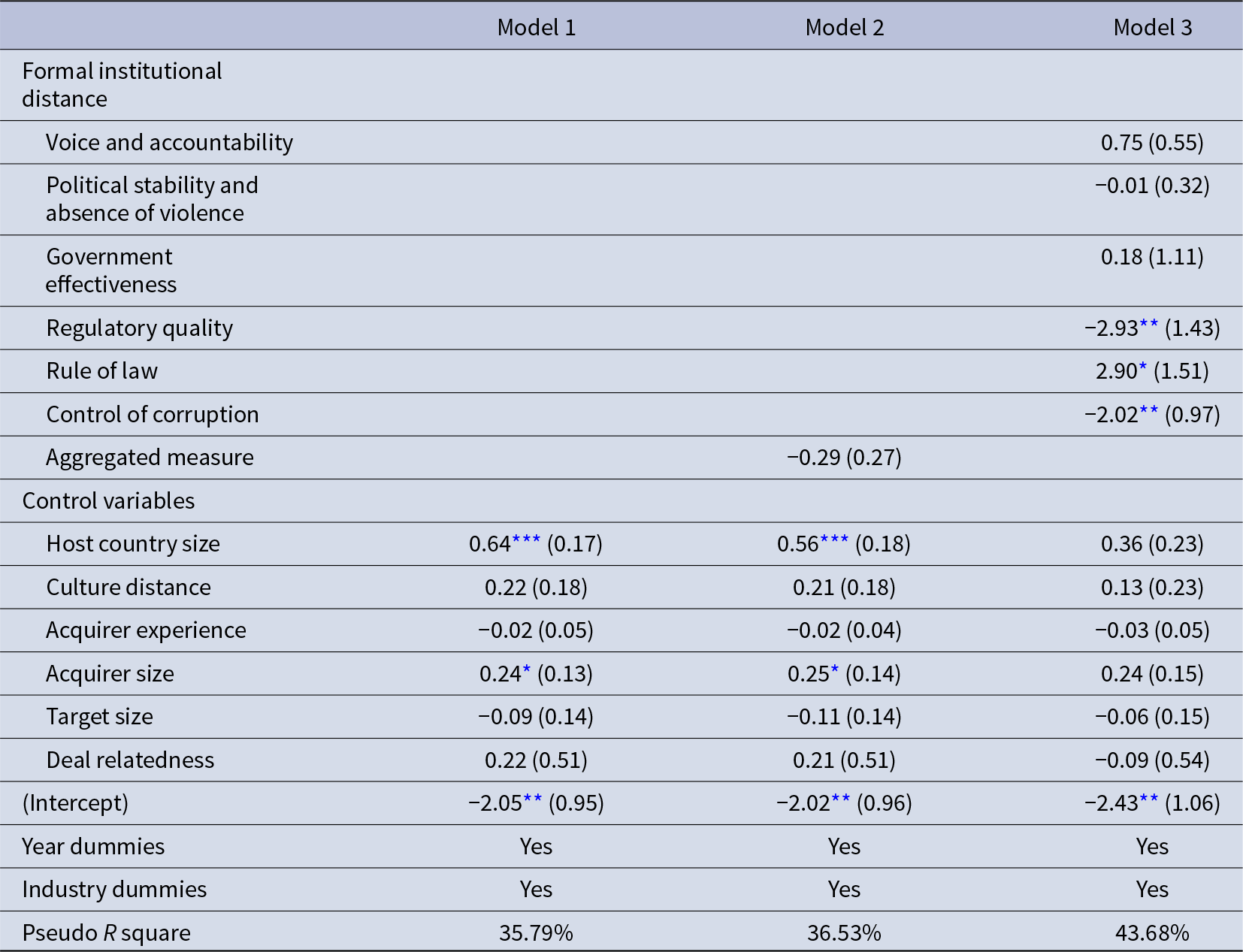
We conducted four robustness checks in this study. In our first robustness test, we operationalized the aggregated and disaggregated measures of FID by using alternate distance formulas adopted from Kogut and Singh (Reference Kogut and Singh1988). Specifically, the aggregated FID variable was operationalized based on the Kogut and Singh index as represented in the equation below:
 \begin{equation*}{\textrm{FI}}{{\textrm{D}}_i} = {1 \over 4}\sum\limits_{j = 1}^4 {{{{{\left( {{\textrm{WG}}{{\textrm{I}}_{j,{\textrm{acquirer}}}} - {\textrm{WG}}{{\textrm{I}}_{j,{\textrm{target}}}}} \right)}^2}} \over {{V_j}}}} \end{equation*}
where FIDi represents the aggregated FID score for ith deal, WGIj ,acquirer and WGIj ,target represent WGI score on jth dimension for acquirer and target country, respectively, and Vj represents the variance of jth dimension.
To make our disaggregated FID score comparable to those of the aggregated ones, we used the following distance formula to calculate the disaggregated FID scores (Ahammad et al., Reference Ahammad, Leone, Tarba, Glaister and Arslan2017; Ahmed & Bebenroth, Reference Ahmed and Bebenroth2019; Chari & Chang, Reference Chari and Chang2009):
 \begin{equation*}{\textrm{FI}}{{\textrm{D}}_{ij}} = {{{{\left( {{\textrm{WG}}{{\textrm{I}}_{j,{\textrm{acquirer}}}} - {\textrm{WG}}{{\textrm{I}}_{j,{\textrm{target}}}}} \right)}^2}} \over {{V_j}}}\end{equation*}
where FIDij represents the disaggregated FID score for ith deal on jth dimension, WGIj ,acquirer and WGIj ,target represent WGI score on jth dimension for acquirer and target country, respectively, and Vj represents the variance of jth dimension.
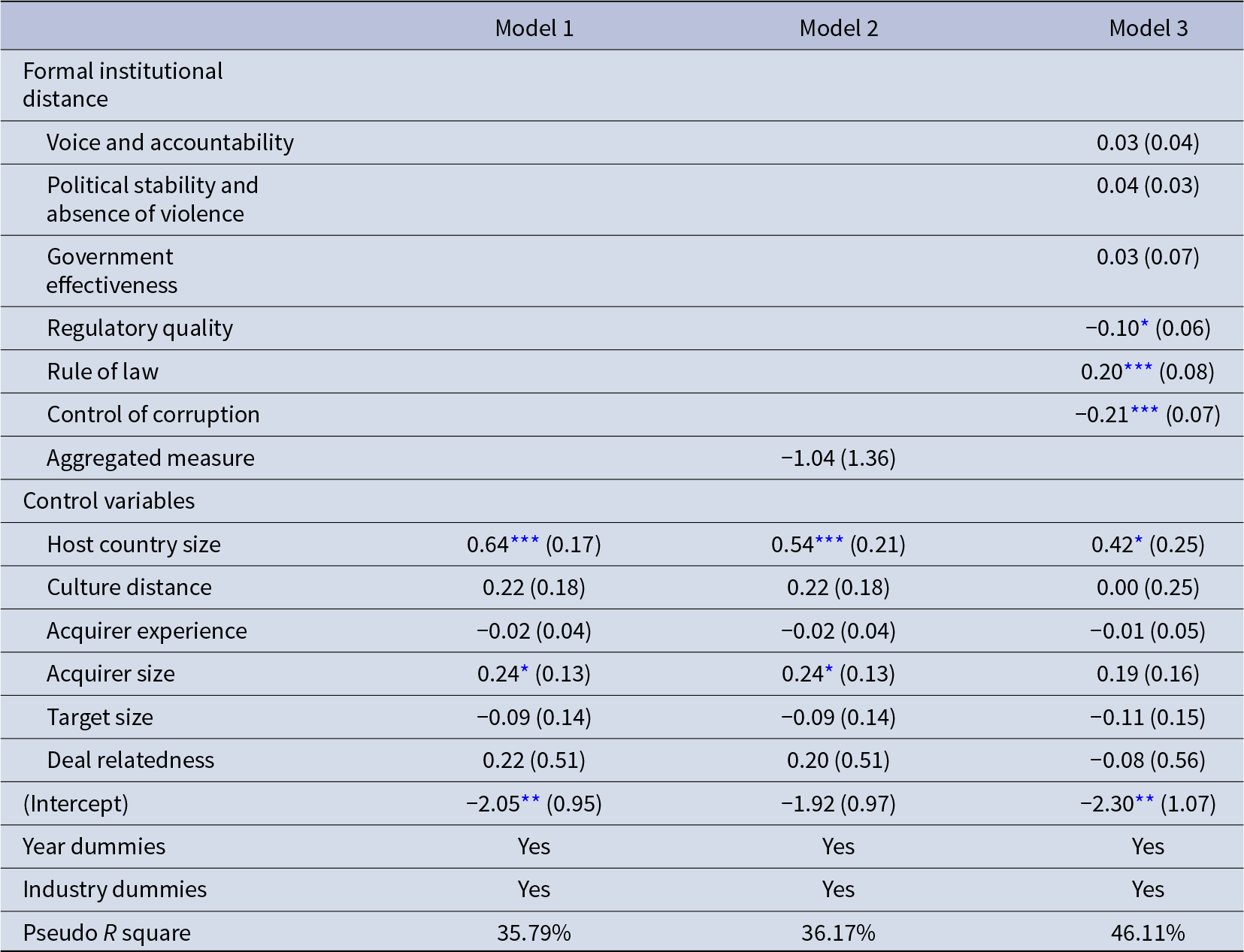
In our second robustness test, we used percentile scores of countries to calculate FID. This operationalization was aimed at measuring the difference between the ranks of the countries instead of the differences between their estimated scores (Russell & Gray, Reference Russell and Gray1994).
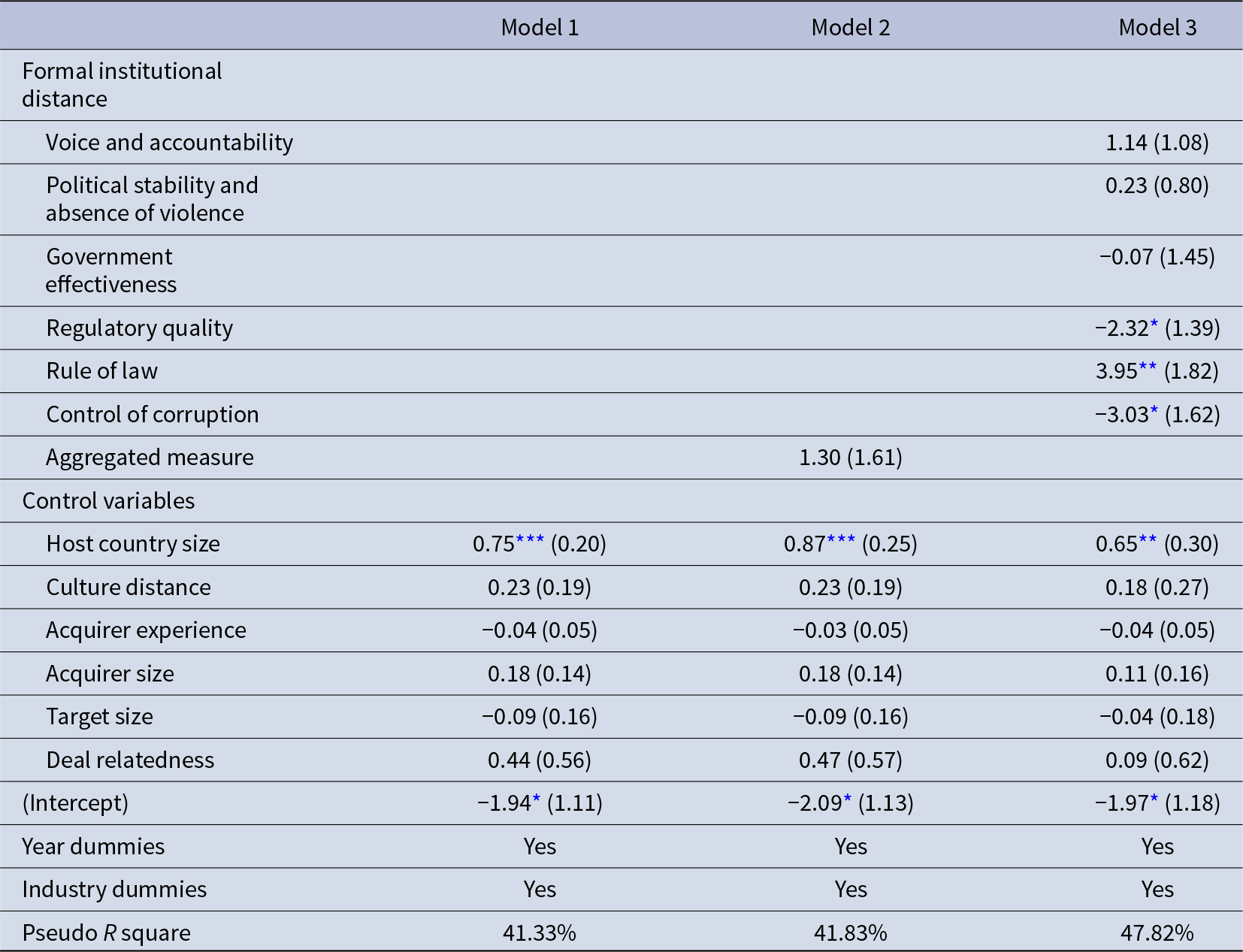
In our third robustness test, we defined partial acquisitions as those in which the acquirer took a stake in the range of 10–90% (Demirbag et al., Reference Demirbag, Glaister and Tatoglu2007). The idea behind this operationalization is that investments smaller than 5% or 10% rather serve as financial investments and hence can be safely ignored. Similarly, a share greater than 90% (such as 92% or 95%) may in fact be treated as a full acquisition (Dang & Henry, Reference Dang and Henry2016).
For our fourth robustness test, we conducted a step-wise backward elimination regression process based on Akaike information criterion, Bayesian information criterion, and p-value criterion (Zubair & Khan, Reference Zubair and Khan2014). In a backward elimination procedure, we start off by having all relevant variables and eliminate the non-important variables one-by-one based on certain criteria until only the important predictors remain in the model.
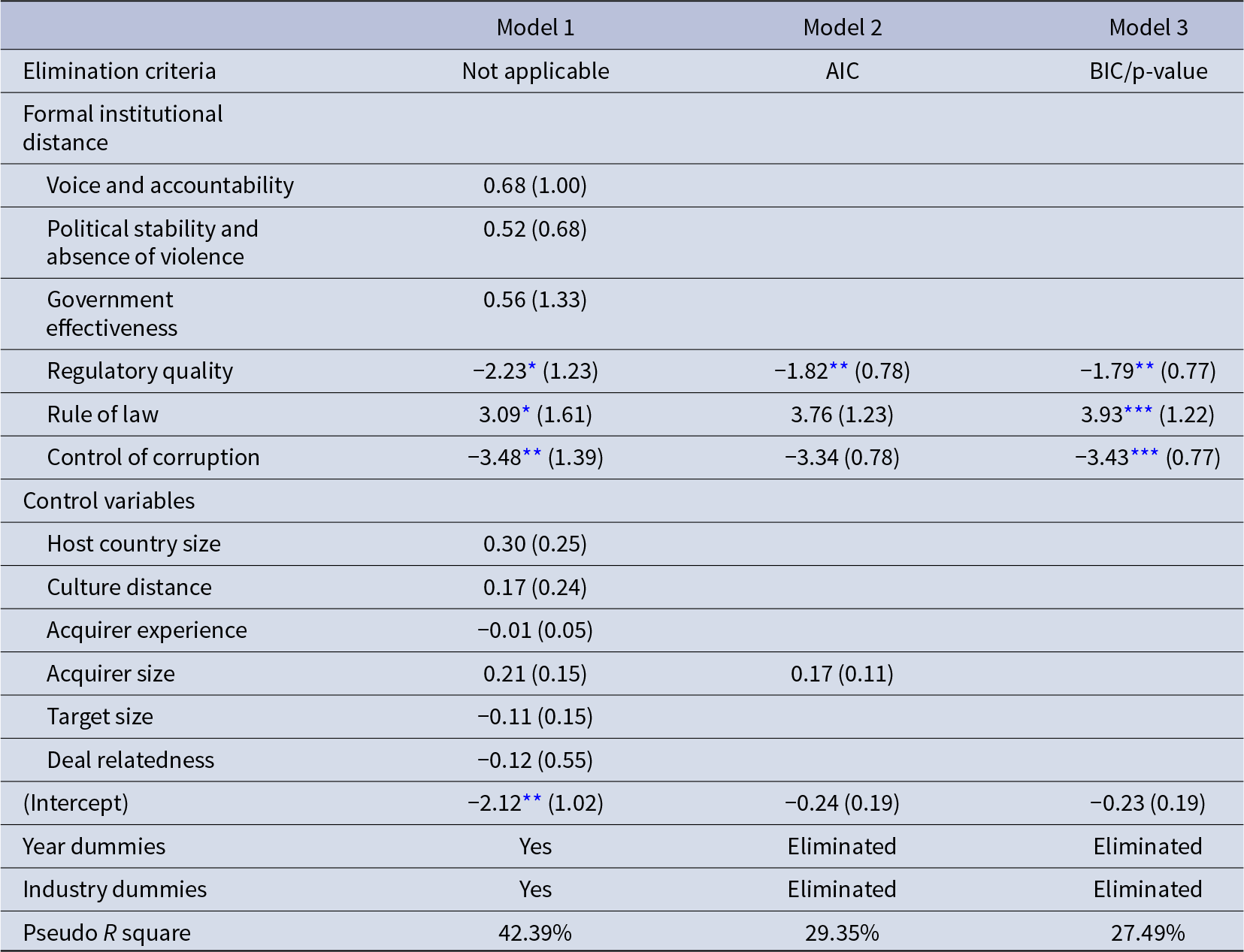
In all of these cases, the results were qualitatively similar to our main results. The results of the robustness tests are reported in Tables 6–9.
Robustness check 1: Aggregated and disaggregated FID variables based on alternate distance formulas

The dependent variable takes the value of 1 for full acquisitions and 0 for partial acquisitions. Standard errors are reported in parentheses. ***, **, and
* represent statistical significance at 1%, 5%, and 10% levels, respectively.
Robustness check 2: FID variables based on percentile scores of countries

The dependent variable takes the value of 1 for full acquisitions and 0 for partial acquisitions. Standard errors are reported in parentheses. ***, **, and
* represent statistical significance at 1%, 5%, and 10% levels, respectively.
Robustness check 3: Partial acquisitions defined as those in which the acquirer takes a stake in the range of 10 to 90%

The dependent variable takes the value of 1 for full acquisitions and 0 for partial acquisitions. Standard errors are reported in parentheses. ***, **, and
* represent statistical significance at 1%, 5%, and 10% levels, respectively.
Robustness check 4: Step-wise backward elimination regression

The dependent variable takes the value of 1 for full acquisitions and 0 for partial acquisitions. Model 1 in this table is the reproduction of Model 3 from Table 5. Model 2 and Model 3 in this table are step-wise backward elimination models. The criterion for Model 2 was Akaike information criterion (AIC). Results from Bayesian information criterion (BIC) and p-value (both 5% and 10% level) criteria were identical and are reported in Model 3. Standard errors are reported in parentheses. ***, **, and
* represent statistical significance at 1%, 5%, and 10% levels, respectively.
Discussion
Theoretical contributions
This study extends previous research by providing two key theoretical implications. First, it advances the organizational legitimacy perspective by emphasizing the importance of examining FID in a disaggregated form based on the WGI (Albassam, Reference Albassam2015; Berden et al., Reference Berden, Bergstrand and Van Etten2014; Cuervo-Cazurra & Genc, Reference Cuervo-Cazurra and Genc2008; Kwon & Kim, Reference Kwon and Kim2014; Zubair & Khan, Reference Zubair and Khan2014). By analyzing FID dimensions separately, the study enhances our theoretical understanding of how different dimensions of FID exert distinct effects on firms’ international activities. It highlights that not all dimensions influence outcomes in the same direction, unveiling the nuanced and heterogeneous nature of their impact on firms’ international activities. These findings challenge the notion that FID operates uniformly across all dimensions and emphasize the need for a comprehensive and granular examination to obtain a more accurate depiction of the relationship between FID and firm outcomes. Similar studies exist on the adoption of global intellectual property protection standards (Brandl et al., Reference Brandl, Darendeli and Mudambi2019), subsidiary performance (Shirodkar & Konara, Reference Shirodkar and Konara2017), lobbying expenditure incurred by multinational enterprises (Shirodkar et al., Reference Shirodkar, Konara and McGuire2017), and initial public offering activity (Gupta, Veliyath, & George, Reference Gupta, Veliyath and George2018). Williams et al. (Reference Williams, Martinez, Gastelaars, Galesloot and van de Kerke2011) note that only two dimensions of the WGI, namely political stability and government effectiveness, affect the choice of shared-ownership entry mode versus full-ownership entry mode. Similarly, Slangen and Van Tulder (Reference Slangen and Van Tulder2009) conclude that host country governance quality vis-à-vis political instability is relatively less important in affecting the entry mode choice than other WGI dimensions. In the same way, our analysis of Japanese outbound acquisitions shows that also the differences between home and host countries only with respect to the last three dimensions of WGI are important to consider. Interestingly, our results corroborate to those of Cuervo-Cazurra and Genc (Reference Cuervo-Cazurra and Genc2008) who found that the very same dimensions of governance were significantly related but using a different dependent variable. Our results have three similarities with those of Cuervo-Cazurra and Genc (Reference Cuervo-Cazurra and Genc2008): (1) the first three dimensions of WGI are insignificant, (2) the fourth and sixth dimensions are significant – as hypothesized, and (3) the fifth dimension is significant – but in the opposite direction as hypothesized. The unexpected results for the dimension of rule of law in our study could be due to the fact that a greater FID for this dimension represents a case of higher internal uncertainty rather than that of external uncertainty. To be more specific, our argument for the dimension of rule of law that partial acquisitions allow acquirers to enlist the help of local partners in dealing with external issues, for example, court cases involving suppliers or customers, might be more strongly related with external aspects of uncertainty. However, in such a scenario, working with local partners may also increase internal uncertainty because local partners can behave opportunistically knowing that foreign acquirers will have difficulty in dealing with the court, etc. Stated differently, acquirers expecting greater uncertainty with respect to judicial systems of host countries may fear opportunistic behavior from local partners, and hence – in logic of transaction cost theory – prefer full acquisitions to avoid conflicts with them (Trąpczyński et al., Reference Trąpczyński, Halaszovich and Piaskowska2020). Therefore, the study raises questions regarding the reliability of previous studies that used aggregated measures for FID. For instance, Ang and Michailova (Reference Ang and Michailova2008) demonstrated the insignificance of their aggregated variable of formal institutions of host countries (derived from the six WGI dimensions) in two out of their three models. It is conceivable that the dependent variable could have been influenced by any dimension of the formal institutional variable when measured in a disaggregated form.
In contrast to the first contribution, which underscores the significance of disaggregation, the second contribution of this study offers a novel insight to the organizational legitimacy perspective by emphasizing the examination of formal institutions in both the home and host countries (Kostova et al., Reference Kostova, Beugelsdijk, Scott, Kunst, Chua and van Essen2020). This significant finding challenges prior literature that predominantly focused on assessing the absolute level of institutional development solely within the host country, disregarding the crucial consideration of institutional distance between the home and host countries (Slangen & Van Tulder, Reference Slangen and Van Tulder2009; Williams et al., Reference Williams, Martinez, Gastelaars, Galesloot and van de Kerke2011). Drawing upon the organizational legitimacy perspective, our study sheds light on the necessity of adopting a difference-based operationalization approach when analyzing formal institutions, enabling a more nuanced and insightful analysis (Contractor et al., Reference Contractor, Lahiri, Elango and Kundu2014). By accounting for this institutional distance, researchers can gain insights into how firms navigate and respond to institutional variations, contributing to a more robust understanding of their strategic decisions and outcomes in cross-border contexts.
In summary, by examining the institutional distance and its impact on the acquisition process, researchers can gain a deeper understanding of how institutional variations (the first contribution) and differences between the home and host countries (the second contribution) shape strategic decisions, negotiation processes, and ultimately the outcomes of cross-border acquisitions. This approach enables a more comprehensive assessment of the challenges and opportunities that arise in different institutional contexts and facilitates the development of appropriate strategies for successful acquisitions.
Practical contributions
Our study brings forth two significant practical contributions that directly impact managers involved in cross-border acquisitions.
First, we emphasize the criticality of carefully considering the differences between the home and host countries by conducting a comprehensive examination of all subdimensions of governance, instead of relying on aggregated measures. To illustrate, let us consider the scenario where a Japanese firm acquires a target company in the United States. Traditionally, managers would assess the overall level of institutional distance between Japan and the United States. However, our study argues that a more detailed analysis of FID dimensions is essential. Managers need to recognize that each FID dimension may exert a distinct impact on acquisition outcomes. By separately analyzing regulatory quality, government effectiveness, and control of corruption, researchers can gain deeper insights into how each dimension influences the firm’s international activities. This approach empowers managers to make informed decisions, fine-tune their strategies, and navigate the complexities of cross-border acquisitions more effectively.
Second, we stress the significance of avoiding a singular focus on the governance level of host countries. Instead, managers should thoughtfully consider the differences in the institutional environment between their home country and the host country. To illustrate, let us consider a Japanese company acquiring a target in Brazil. The conventional approach would evaluate the absolute level of institutional development in Brazil, taking into account factors such as the legal system, regulatory frameworks, and business environment. However, the second contribution of our study suggests that it is crucial to consider both the formal institutions in Japan and Brazil and analyze the institutional distance between the two countries. By adopting a difference-based operationalization approach, our research showcases the importance of understanding how Japanese firms, drawing from their experience with home country institutional factors such as legal frameworks, contract enforcement, and corporate governance practices, navigate and engage with the respective institutions in Brazil. This nuanced understanding of the institutional context equips managers with valuable insights to fine-tune their strategic approach, thereby increasing the likelihood of successful cross-border acquisitions.
In conclusion, our study offers practical insights for managers involved in cross-border acquisitions, emphasizing the importance of thoroughly examining all governance dimensions and understanding institutional differences between home and host countries. By applying these insights to real-world scenarios, managers can make well-informed decisions, tailor their strategies accordingly, and enhance their overall performance in cross-border acquisitions.
Limitations
Like in all other studies, the results of this study need to be interpreted in light of its limitations. First, our data collection was limited to acquirers from Japan. While this limits the generalizability of our outcomes to some degree, it also offers advantages. Japanese managers might be more sensitive to uncertain situations than managers in other countries (Ando, Reference Ando2012). Second, as in almost all other studies in this field, we used only publicly listed firms in our sample owing to the nature of data limitations. We did not use qualitative data such as questionnaires or interviews in this study (Trąpczyński et al., Reference Trąpczyński, Halaszovich and Piaskowska2020). Third, our FID variables were based on the dominant conceptualization of institutional distance, whereby we cannot sort out the possibility that we observed rather institutional characteristics of host countries (Van Hoorn & Maseland, Reference Van Hoorn and Maseland2016). Also, distance is asymmetric, meaning that the distance between Japan and China is different with respect to whether we consider Japanese FDI in China or Chinese FDI in Japan (Shenkar, Reference Shenkar2001; Zaheer et al., Reference Zaheer, Schomaker and Nachum2012). Fourth, a lack of distance does not automatically convey similarity (Zaheer et al., Reference Zaheer, Schomaker and Nachum2012). This is a common criticism related to the concept of institutional distance (Ang & Michailova, Reference Ang and Michailova2008; Aybar & Ficici, Reference Aybar and Ficici2009; Chari & Chang, Reference Chari and Chang2009; Fuentelsaz et al., Reference Fuentelsaz, Garrido and González2020; Jiang et al., Reference Jiang, Holburn and Beamish2014; White et al., Reference White, Fainshmidt and Rajwani2018). Recently, empirical studies have started to consider institutional direction as well, that is, whether an acquirer invests in institutionally more developed countries or less developed countries compared to its own (Konara & Shirodkar, Reference Konara and Shirodkar2018; Rabbiosi & Santangelo, Reference Rabbiosi and Santangelo2019). Trąpczyński et al. (Reference Trąpczyński, Halaszovich and Piaskowska2020) examined the relationship of distance perceptions and ownership on a sample of Polish outward FDI because Poland would represent a mid-range economy. In contrast, we focus on Japan – a country with a stable and highly developed institutional system, acknowledging the caveat that firms may have shown a certain behavior not because of the distance but because of the particular characteristics of the foreign market (Van Hoorn & Maseland, Reference Van Hoorn and Maseland2016).
The objective of this study was to contribute to the existing body of literature on the organizational legitimacy perspective by showing the importance of disaggregating WGI-based FID variables. Our findings demonstrate that these disaggregated variables have a considerable impact on the choice between partial and full acquisitions, as supported by our main results and a series of robustness tests. Consequently, our study serves as a catalyst for future research on the potential influence of WGI-based disaggregated FID variables on other phenomena, such as the choice of strategic alliances (Ang & Michailova, Reference Ang and Michailova2008), knowledge acquisition (Ho et al., Reference Ho, Ghauri and Larimo2018, Reference Ho, Ghauri and Kafouros2019), or subsidiary survival (Gaur & Lu, Reference Gaur and Lu2007; Peng & Beamish, Reference Peng and Beamish2019). This research direction promises to shed further light on the broader implications of FID variables in different aspects of IB activities.
Acknowledgements
An earlier version of this manuscript received the Best Paper Award at the Interdisciplinary Business and Economics Research Conference organized by the Society of Interdisciplinary Business Research (SIBR) held on 4-5 July 2019 in Osaka, Japan.
Conflicts of Interests
The authors declare none.
Kashif Ahmed is a Research Associate at Research Institute for Economics and Business Administration (RIEB), Kobe University. He received PhD degree from Graduate School of Business Administration, Kobe University. His research interests are broadly on international business. He has published several research articles in international journals, such as Review of International Business and Strategy, International Finance, and Multinational Business Review. He can be reached at k_ahmed@rieb.kobe-u.ac.jp.
Ralf Bebenroth is a Full and Tenured Professor at Kobe University and since 2001 living and working in Japan. After receiving a PhD in Germany, he was awarded with Monbusho-DAAD Research Fellowship and with a Humboldt Fellowship, each for 2 years to conduct research in Japan. Since 2005, Ralf Bebenroth joined Research Institute for Economics and Business Administration at Kobe University. He conducts research and teaching in English and Japanese language. His primarily research interests are on mergers and acquisitions, where in 2015 a book by Springer was published.