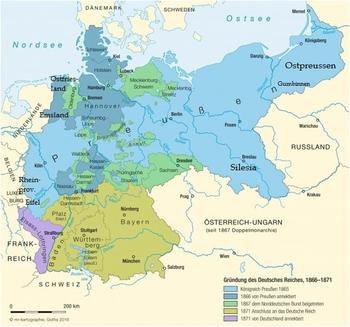
In July 1867, heavy rains battered the remote Prussian province of East Prussia (Fig. 1).Footnote 1 The complete failure of the harvest caused widespread hunger and turned a contained typhus outbreak into an epidemic. Local farmers raised the alarm in August, and officials warned their Berlin superiors that “the suffering will be overcome only with supreme effort.”Footnote 2 Soon the Prussian and southern German presses carried regular stories about the calamity, and East Prussian notables formed a charity to solicit donations from across the German lands.Footnote 3 Beginning in late 1867, the Prussian parliament debated two emergency relief bills for the badly damaged districts of Königsberg and Gumbinnen.Footnote 4 The first proposed funds for road-building projects to ease unemployment and bolster poor relief coffers; a second, larger bill aimed to help farmers with loans to purchase seed for the coming year. When he took the parliamentary floor in February 1868, Dr. Rudolf Virchow, who had just published the speech “On Hunger-Typhus” to promote the relief effort, insisted that the proposed aid for farmers was insufficient.Footnote 5 A founder of the Progressive Party and a member of the German National Association, which supported Prussian leadership of national unification, Virchow had begun his political career with a searing critique of the Prussian state's handling of the 1847 typhus outbreak in another eastern province, Silesia. He reiterated his appraisal that “a failure of general politics” was to blame for the current misery, and warned that any more dithering would taint Prussia's recent military successes.Footnote 6 Many of Virchow's colleagues agreed, fretting that East Prussia had stumbled “at the very moment Prussia [had] attained its greatest military and political glories.”Footnote 7 As we shall see, others asserted that the crisis had been decades in the making as a result of the province's unhappy mix of geographical isolation, low population, and raw climate, coupled with economic and social “backwardness.”
Map of Prussian disaster location regions. Source: Created by author.

Prussia's successes were indeed remarkable in the years before the East Prussian disaster, especially its defeat of Austria and her German allies in 1866 and the annexation of large parcels of western German territory to form the North German Confederation in July 1867. The Kingdom of Hanover was the largest prize by far, but its absorption by Prussia created sharp political divisions in the province. The Guelphist supporters of the deposed Hanoverian king were, naturally, hostile to the new order, but Prussia's ascension also divided the majority liberals.Footnote 8 Those who hoped that Otto von Bismarck would find a path to German unity, like Rudolf von Bennigsen, formed the new National Liberal Party, whereas Progressives, including Virchow, decried Prussia's overreach. Simmering political tensions were not the only reason the new province proved to be, as Bismarck quipped, an “indigestible lump in our craw.”Footnote 9 While much of southern Hanover was prime farmland, there were also vast peat bogs, or high moors, which extended along the Dutch border and north to the Atlantic. Here, in the regions of the Emsland and East Frisia (Fig. 1), destitute inhabitants of isolated moor colonies used fire farming (Brandkultur) to grow buckwheat and rye. Like East Prussia, northern Hanover suffered devastating harvest failures because of bad weather between 1867 and 1869.Footnote 10 Bremen publicist and social reformer August Lammers claimed that the tragedy in Hanover was just as horrific as the one in East Prussia.Footnote 11 Hanoverian members of parliament agreed, and, with Virchow's support, lobbied to make the relief funds available to all Prussian cultivators in need. In doing so, they adamantly rejected the idea of tightly circumscribed disaster zones, but that version was voted down. The broader economic and political context of the debates was crucial: the costs of the 1866 war had created a large budget deficit even as Hanover was granted more say over its own finances, a privilege long sought by the eastern provinces. In 1871, Prussia again affirmed its military and political might with the victory over France and the founding of the first modern German nation-state.Footnote 12
This article examines how the rural crises in East Prussia and northern Hanover in the late 1860s forced politicians to define the parameters of disaster; how they and the public developed new expectations about the provision of state aid to “backward” regions; and how the state responded to similar catastrophes after German unification.Footnote 13 Between 1866 and 1871, Prussian liberals in the North German Confederation faced mounting pressure to shed their familiar roles as the voice of opposition and instead burnish their leadership credentials through effective governance.Footnote 14 This made it unlikely that the diffuse, or flexible, definition of disaster advocated by Virchow would have prevailed. As historians of European natural calamities have observed, nineteenth-century officials often cast them as singular events to be resolved quickly in order to bolster the narrative of progress they worked hard to craft.Footnote 15 Others have stressed how such crises offered opportunities for political maneuvering and the display of state competence.Footnote 16 In this context, defenders of the decision to prioritize East Prussia for state aid sought a clear legislative win that would not interrupt Prussia's political momentum. But the stakes changed after 1871: grappling with the social and economic challenges of national integration pushed politicians to use the management of disasters as a chance to strengthen vulnerable regions in every part of the province. Likewise, whereas private charities had led disaster relief efforts in the 1860s, by 1890, all but the most conservative policymakers recognized that concerted government action was necessary to prevent crises from festering and deepening the divide between desolate and prosperous rural areas. This followed the trend toward greater state intervention in the interests of economic and social reform after 1866, but there was still constant friction over the forms and the scope of state aid, its distribution and oversight, as well as the question of who was eligible for assistance. How to draw the temporal and spatial boundaries of disaster remained, in short, an open and contentious question.Footnote 17
Prussian lawmakers’ nagging dissatisfaction with the 1868 law meant that competition among ailing regions for state resources intensified after 1871. The projections of Prussian unity on the battlefield and its dominant place in the new German nation masked the rivalries among representatives of poor, isolated rural districts in the Prussian parliament. Now Berlin politicians struggled to balance conflicting interests within Prussia, as well as between it and the southern German states. In 1872, Prussia again confronted a rural emergency in the western Rhineland; to the north, even more ruinous harvest failures between 1879 and 1883 crippled the Eifel region, as well as the easternmost district of Silesia (Fig. 1). In 1883, the Prussian Agricultural Ministry created the first permanent fund for rural disaster relief and development: the Eifelfonds. The Ostfonds was established a year later, and the Westfonds in 1897. A few critics denounced these institutions as excessive government intrusion, but they signaled lawmakers’ acceptance of a more elastic definition of rural catastrophe: terms like acute (dringend, akut) and chronic (ständig, dauernd), distress (Bedrängnis) and emergency (Notstand), were now seen as links in a continuum. At the same time, new political battles erupted over the funds, with western parliamentarians resenting the special treatment of the Eifel region, as well as the consistently larger budget awarded to the eastern provinces.
Besides the competition for disaster relief, another consequence of the rural crises of the late 1860s was the new resolve of Prussian politicians to tackle the unproductive moor landscapes along the empire's northeastern and northwestern edges, and the grinding poverty of Hanover's moor-burning colonies, i.e., settlements established decades earlier that relied on fire farming (Brandkultur). After 1871, lively debates over the many unknowns of moor science and the previous century's ruinous settlement endeavors forged new coalitions of officials who pledged to do better.Footnote 18 The Central Moor Commission, a new subcommittee of the Prussian Agricultural Ministry formed in 1876, helped to recast the problem of rural backwardness as a scientific and social hurdle rather than as a cultural failing. The 1877 establishment of Prussia's first moor research station in Bremen, followed by substations in East Frisia and the Emsland, worked to facilitate expert collaborations between the eastern- and westernmost districts of rural Prussia. If the problems of Hanover's moor-burning colonies were properly addressed, the thinking went, those insights could be applied to new settlements in the remote moor districts of East Prussia. Such collaborations were not always equable, but the new zeal for moor science and colonization forged links among peripheries, which existed alongside the constant jostling for state support.
Prussia's rise and consolidation in the years before and after German unification have long been the subject of lively historical debate. Some scholars argue that Bismarck's unflinching exercise of military power in the 1860s remained the state's defining feature after 1871.Footnote 19 Abigail Green notes that the research on German federalism, in which Prussia acts as a foil for its progressive southern neighbors, has reinforced assumptions about Prussian unity and authoritarianism.Footnote 20 More recently, Christopher Clark has urged a closer look at the ad hoc nature of Prussian state-building and the “pragmatic dimensions” of its social and political conflicts.Footnote 21 With regard to Prussian attempts to integrate Hanover after 1866, Heide Barmeyer's pioneering work underscored how Bismarck sought to ease Hanoverian discontent by granting the province relative political and fiscal autonomy.Footnote 22 More recently, Siegfried Weichlein has stressed how these concessions smoothed Hanover's integration into Prussia, whereas Jasper Heinzen's new study explores how pro- and anti-integration actors exploited the political volatility, either to cement Prussian control or reconstruct Hanoverian identity in a variety of cultural arenas.Footnote 23
Several key aspects neglected in the research on Prussian state-building, however, are how its expansion after 1866 disrupted the relations between “old” and “new” provinces, as well as the perceived need to reform, in the words of National Liberal Wilhelm Lette, Prussia's “backward internal politics.”Footnote 24 The political battles over the spatial and temporal boundaries of disaster and the competition for state aid between East and West offer some clues. The Prussian state's decisions about emergency assistance challenged not only established conservative and liberal models of good governance, but also stoked inner-Prussian political rivalries, as well as expectations of support on the part of constituents, which, in turn, channeled the flows of state relief. Precisely because the disasters and backwardness they exposed were scattered, “fixing” Prussia's peripheries simultaneously tested and reinforced the bonds among Prussians, and later between Prussians and Germans. The regions discussed here were distant from Berlin both geographically and culturally, but, for most observers, their marginality did not derive from racial and ethnic difference.Footnote 25 The shocking otherness of German moor colonists was an unpleasant reminder that national unification was a gargantuan task not confined to the eastern provinces of Prussian Poland. Moreover, like the studies of liberalism's resilience in German municipal governance—despite its waning influence on the national stage after 1871—an investigation of the debates over disaster management and rural development reveals another policy arena strongly imbued with liberal ideals, namely, the belief in individual fortitude and the power of scientific and state partnerships to transcend environmental and social impediments to progress.Footnote 26
The East Prussian Disaster of 1867–1868
The immediate cause of the East Prussian catastrophe was a deadly mix of contagious disease and the failure of rye, wheat, and potato crops in the autumn of 1867. A physician attending workers constructing the railway line between Bartenstein and Rastenburg, in the district of Gumbinnen, first reported cases of typhus that April.Footnote 27 According to Dr. Theodor Stamm, who was based in Berlin but traveled to the province in January 1868, the outbreak remained isolated until food shortages and extreme cold caused it to spread rapidly southeastward.Footnote 28 By the end of 1868, some reports claimed that fifty thousand people had died; another source reported twenty thousand dead and a mortality rate of 10–11 percent of those infected.Footnote 29 Contemporary physicians explained that the statistics varied because it was often difficult to pinpoint the exact cause of death, but the demise that winter of at least fourteen physicians who had treated the sick drew widespread publicity.Footnote 30 There was agreement, however, that the epidemic's severity was being magnified by the “famine” (Hungersnot), and that even better-off rural workers were going hungry. One might view the farmers’ laments about flooded fields and pastures, as well as about the toll taken by crop disease, with a grain of salt, but even the Royal Statistical Bureau in Berlin painted a grim picture of the 1867 harvest: “In many districts of East Prussia, the complete loss of the harvest spawned a real emergency [thatsächlichen Nothstand] … There has not been such a disastrous harvest since 1846 and farmers have lost millions of Thaler … They have very little winter seed, their livestock holdings are decimated, workers are weakened; forced auctions, loss of capital, and declining land values were the hallmarks of this abnormal situation.”Footnote 31 The bureau's report for the Königsberg district was similarly bleak. The cascade of terrible news continued into the spring: bread and other food became scarcer, farm workers were let go, and livestock was sold off. The crisis abated in late 1868, when that summer's dry weather ensured average grain yields; the following two years witnessed further recovery.Footnote 32
Aside from the immediate causes, experts of all political persuasions agreed that the origin of the East Prussian disaster was the province's “backwardness” (Zurückbleiben). But this was an imprecise label that variously connoted its geographical isolation, sparse population, meager infrastructure, and harsh climate, as well as an array of social problems afflicting its poor, such as a lack of education and alcoholism. Some observers stressed the ethnic dimension of East Prussian backwardness, citing the deficient sanitary habits, ignorance, and “lethargy” of the minority Slavic populations as especially harmful. The perceptions of East Prussia's supposed lag grew after 1866, when it became one of the North German Confederation's “old” provinces and Berlin officials turned their attention to the political and economic integration of the “new” western provinces like Hanover.Footnote 33 The founding of the German Empire in 1871 further magnified the perceived East-West gap in Prussia in terms of wealth, economic dynamism, and population growth.
In 1868, an anonymous East Prussian estate owner characteristically blamed the emergency on the province's agricultural backwardness.Footnote 34 He noted that passing travelers might get an impression of prosperity, but that many factors were responsible for the harvest shortfalls. These included the farmers’ deficient agricultural education, an incomplete and poorly maintained transport system, high taxes, labor shortages, weak institutions of local government, and lack of credit. He observed that, by contrast, the greater rate of personal savings in the western provinces had allowed for the funding of major agricultural improvement projects, better transport networks, and the cultivation of more food for larger numbers of customers.Footnote 35 His wish list for the region included a state-sponsored soil mapping project, an experiment station for conducting chemical soil analyses, and the fostering of farmers’ associations.Footnote 36 Perhaps because the report's focus was on the deficiencies of East Prussian farming, the author did not cite the region's “culture” as a source of weakness, a theme that runs like a red thread through other expert accounts.
Two contemporary reports about the typhus epidemic in Gumbinnen, by Drs. Leopold Müller and Carl Kanzow, stressed, for example, the destitution and supposedly inferior moral character of the East Prussian rural population. Noting that his invitation to study the epidemic had been prompted by his twelve years of research on typhoid and yellow fever in the tropics. Müller nonetheless cautioned readers that East Prussian conditions were so unfamiliar that outsiders like him found it difficult to discern between “normal” levels of poverty and the distress caused by the famine and epidemic.Footnote 37 In the Masurian and Lithuanian communities, Müller emphasized, a “permanent crisis” existed that could not be eased with temporary charitable assistance. Claiming that he did not have the space to discuss the “vast moral and social problems” he had observed, Müller instead listed “customs” that promoted the spread of disease, such as East Prussians’ “preference” for living in crowded earth huts rather than in houses.Footnote 38 Kanzow's portrayal was equally grim, stressing the “slow-wittedness,” poor diets, and crowded, filthy living conditions of the rural poor.Footnote 39 Other observers also singled out poor Germans for their coarseness and ignorance: “the German remnant [der deutsche Rest] is also terribly backward.”Footnote 40 At the same time, experts agreed that “reform of the poorer classes” was attainable if the state were to provide better roads, well-paid industrial work, and access to credit.
Virchow's “On Hunger-Typhus,” first delivered as a speech in Berlin in early 1868, placed the East Prussian crisis on the world stage. He compared the calamity to other world disasters, such as the 1770 Bengal famine, the 1840s Irish potato famine, and the diseases that had plagued European armies in the Crimea in the mid-1850s.Footnote 41 The text was translated immediately into English as “On Famine Fever,” and into French as “Du typhus famélique.” Virchow rebuffed criticism from his fellow physicians that he was being overly political and falsely promoting the idea that hunger caused disease, demanding to know whether the scientific community “truly want[ed] to deny a connection between famine and typhus?” and whether “the outbreak of hunger-typhus in East Prussia [was] just a coincidence?”Footnote 42 Echoing his report on the Silesian epidemic of 1847–1848, he used the East Prussian catastrophe to urge social reform as the surest path to democracy, and to denounce bureaucratic inertia and blundering. Edwart Kattner's 1868 essay also cited East Prussia's “backward” economic conditions as major contributing factors. Footnote 43 He informed readers that the 1867 harvest failure had capped four years of poor yields, while detailing the region's multiple environmental handicaps.Footnote 44 His denunciations of Prussian politicians and the conservative press—among the harshest of all criticisms at the time—condemned their alleged foot-dragging and clumsy efforts to minimize the province's suffering.Footnote 45 One could only wait, Kattner concluded gloomily, for the outcome of deliberations in Berlin.
Politicians had not entirely ignored East Prussia's plight, but, as Virchow caustically observed, the hunger crises of 1816–1817 and the 1840s had not prompted a dramatic rethinking of state policy.Footnote 46 In late December 1867, the Prussian parliament approved the first bill to alleviate the catastrophe. Presented by National Liberal Ludwig Jacobi as a case of “emergency measures in emergency circumstances,” it requested 628,000 Reichsthaler (Rthl.) in loans for road building to provide work for the unemployed, and another 398,000 Rthl. for poor relief.Footnote 47 He also stated, however, that the government refused to intervene in the market by increasing food supplies and instead expected private charities to step in.Footnote 48 In February 1868, when it was clear that more needed to be done, the parliament considered two more bills for emergency aid: the first would have allowed distressed farmers from across Prussia to apply for state loans, whereas the second limited eligibility to the districts of Königsberg and Gumbinnen. The lawmakers’ newfound urgency to find remedies for the East Prussian disaster meant that even conservatives questioned only the amount to be made available and not the principle of intervention itself. King Wilhelm, in his speech opening the Landtag on November 15, 1867, emphasized how the terrible harvests “in certain especially hard-hit districts” had led the government to take “extraordinary measures”; one year later, he expressed relief that “the disaster that devastated a part of the province of Prussia, and that we addressed through measures endorsed by you … has been overcome.”Footnote 49 There was no talk at the time of forgiving the loans to farmers altogether, however, but rather a focus on the exact terms of repayment.
The biggest sticking point was whether the definition of “emergency” (Notstand) should be dictated by location or instead assessed without respect to state or district borders. National Liberal Eduard Lasker, representing the city of Magdeburg, presented the case for limiting the scope of the emergency bill to East Prussia. He argued that, if all of Prussia were included, too many farmers in regions not experiencing a “technical emergency” would apply for assistance and grow angry when the government could not respond.Footnote 50 For Lasker, the East Prussian case was worthy of state action because “whole classes of people were suffering,” in contrast to being merely “in distress” (Bedrängnis). He implied that the term emergency would be meaningless if it were declared for the entire kingdom, and he accused advocates of the broader bill, including Virchow, of sabotaging the effort to aid East Prussia. Support the more limited version, he urged his colleagues, “so that every province will know that if one limb of the body is injured, it will not be treated separately but as part of the whole state organization … We oppose unjustified claims … as if the state were in a position to assist whole populations under normal circumstances.”Footnote 51
The main advocate for uncoupling the definition of emergency from a specific location was Old Liberal (Altliberal) Georg von Vincke, the representative of Minden in the northwestern province of Westphalia. His sarcastic retort to Lasker was cheered on the Left: “Surely you cannot mean that no emergencies exist outside of Prussia, and certainly they exist [in Prussia] outside of Gumbinnen and Königsberg, even using the strictest definition of the word. I do not know how to respond to the observation that a place is ‘in distress’ but no emergency exists; where does one begin and the other end?”Footnote 52 Besides calling for a precise definition of the term disaster to guide official decision-making, Vincke asserted that the parameters of natural catastrophes and disease outbreaks rarely corresponded to political boundaries. He added that his colleague Ludwig Windhorst, the leader of the Catholic Center Party, could give a full report on the crisis afflicting his districts of the Emsland, where soils were poorer than those in East Prussia and where moor farmers grew only buckwheat rather than “proper wheat” (anständiger Weizen).Footnote 53 Windthorst confirmed that recent flooding had indeed wreaked havoc in the Emsland's moor colonies, and predicted that the state would eventually be forced to intervene there, too. He reminded his colleagues that Vincke's language specified that “aid be made available ‘if there is a demonstrable emergency’; [but] that does not imply a proclamation of emergency for the whole monarchy.”Footnote 54 Their arguments were nevertheless rejected in favor of the narrower version, which meant that only East Prussian farmers could apply for state assistance; this passed by a large majority.
The second-guessing began before the ink had dried on the law of March 3, 1868, with a mid-February edition of the satirical magazine Kladderadatsch wondering: “Oh agriculture, oh agriculture, what have you gained? The loan certificate hides the specter of emergency from the light of day!”Footnote 55 The East Prussian Agricultural Association commented in 1869 that the loans had helped some small farmers, but the demands for support far exceeded the available funds.Footnote 56 One report estimated that just 4 percent of East Prussian cultivators were aided by the loans.Footnote 57 According to another for the district of Königsberg, where the total amounted to 1,180,000 Rthl., some 38,000 of the poorest cultivators each received an average of 4 to 5 Rthl., approximately 17,600 small farmers an average of 28 Rthl., and 900 estate owners an average of 500 Rthl.; by 1874, there were just 4,700 borrowers (not broken down by socioeconomic category) who still owed 98,328 Rthl.Footnote 58 East Prussia's lag behind the western half of the Empire nonetheless persisted. Over twenty years later, Chancellor Leo von Caprivi worried that East Prussian agriculture, industry, and trade were not keeping pace with the “better-situated western regions of the monarchy.”Footnote 59 On a less impressionistic note, economist Adolf Wagner's analysis of German taxpayers between 1892 and 1902 exposed the stubborn wealth gap between East and West.Footnote 60 And, in 1894, one former East Prussian official vigorously defended the state's handling of the 1867–1868 catastrophe by contending that it was only when compared to the western provinces that East Prussia appeared to be so far behind.Footnote 61 Experts also worried about continuing East-West migration: between 1871 and 1880, some twenty thousand inhabitants left the eastern provinces annually for better-paid work in the West. That same decade, another thirty-six thousand East Prussians left for the United States.Footnote 62 East Prussian criminologist Hermann Valentini even claimed that the crime patterns he observed were rooted in different moral norms: whereas Eastern criminality stemmed from poverty and “moral depravity,” those in the West were the result of luxury and “cultural parasitism.”Footnote 63
Prussia's Wild West: The Moor-Burning Colonies of the Emsland and East Frisia, 1867–1870
East Prussia was not the only rural region that worried Prussian bureaucrats. In 1869, the Hanover branch of the Prussian State Agricultural Commission (Landes-Oekonomie-Kollegium) informed the central office in Berlin that “northern and southern Hanover differ greatly … Agriculture in the south has attained a very high level of development, but this is not at all the case in the north.”Footnote 64 It added that the buckwheat crop in the district of Arenberg-Meppen, where many of the Emsland's most destitute moor colonies were located, had failed completely for the seventh year in a row.Footnote 65 By this time, the region was commonly known as Muffrika, an epithet derived from a derogatory Dutch term for Germans: muffen.Footnote 66 “All our readers are familiar with Africa,” began an 1867 article in the popular periodical Die Gartenlaube, “even if most of us only read about it; but very few will know about Muffrika, especially because Hanoverians who use it do not agree on what and where it is.”Footnote 67 This was only half true. The location of Muffrika’s borders may have been hazy, but scientists and, increasingly, politicians had no doubt that its primary threat to Prussia and beyond were the billowing clouds of dark smoke produced by moor burning, as well as the steady impoverishment of the approximately thirty thousand colonists who relied on it.Footnote 68 Established in the late eighteenth and early nineteenth centuries on the peat bogs of the Emsland and East Frisia, Hanover's approximately 250 moor-burning colonies had become “a pus-filled boil on the land, the flourishing hothouses of crime.”Footnote 69
After Hanover acquired the territories of the Emsland and East Frisia in 1815, regional agricultural journals and amateur scientists began to report on the risks of moor smoke to crops; public outrage over the sooty clouds surged in the 1860s, especially among well-to-do city dwellers. Footnote 70 Their objections were rooted in fears about the damage the smoke caused to those in fragile health, its noxious smell, and, above all, its disruption of treasured outdoor pastimes. Moreover, as lingering doubts about the true origin of the “rural plague” (Landplage) had disappeared, reformers like August Lammers recast the grey-brown pall as an insult to German civilization and swelling national pride. He was inspired by local initiatives organized against the practice in the Emsland towns of Neu-Arenberg, Werlte, and Sögel, and his Society against Moor Burning attracted an eclectic group of regional notables, including agronomists, physicians, prosperous landowners, state bureaucrats, and businessmen.Footnote 71 The colonies in northern Hanover were not the only source of the problem, however, since Moorbrandkultur was still practiced in eastern Holland and in the neighboring Duchy of Oldenburg. But, for reform-minded and patriotic Prussians of the 1860s, the colonists’ backwardness came to define and burden the region's inhabitants, just as it had the rural poor in East Prussia. Colonists were denigrated as “gypsies,” “bedouins,” and “nomads,” who lived with their scrawny sheep in cramped and smoky sod huts.Footnote 72
Lammers and other reformers succeeded in publicizing the threats of moor smoke and the horrors of Muffrika to the bourgeois public in cities like Bremen and Dortmund, but it was the harvest crises of 1868–1869 that alarmed Prussian officials and thus raised the political stakes of the newly absorbed territory's supposed backwardness. To be sure, Prussian bureaucrats were aware of the emerging consensus among agronomists that moor burning constituted Raubbau, i.e., overexploitation of the soil. They were also acutely conscious that neighboring Holland had transformed once barren peat bogs into thriving fen colonies. (The fen model was based on the removal of the top layer of peat, which was then shipped to nearby cities for fuel via an extensive canal network.) The largest and most prosperous German fen colony in the Emsland was Papenburg, established in the 1630s, but observers agreed that it and others in East Frisia compared unfavorably to the Dutch examples.Footnote 73 Besides, German chemists had, in the 1860s, only begun the work of finding the right combination of chemical fertilizers to offset the acidity of peat soils; agricultural associations then had to struggle to persuade farmers even to try them. The cheapness of fire farming, compared to other cultivation techniques, meant that, despite the substantial risks of bad harvests and soil exhaustion, Brandkultur remained the lifeline of the region's rural poor.
In 1868, one of the first signs that the colonists’ precarious livelihoods had reached a breaking point in the majority Catholic Emsland district of Arenberg-Meppen was a local official's request for foster families, sent in late January to the magistrate in Hümmling.Footnote 74 He explained that, because of harvest losses, many of the colonists in Sögel could not look after their children until the end of July. A month later, the same official wrote again, informing his superior and six local priests that “the colonists plead and pray for something to plant on their flooded fields … Any crust [you can provide] is welcome.”Footnote 75 In the district of Bentheim, located to the southwest of Arenberg-Meppen, two dozen town and village magistrates notified the head of the district in April that colonists needed both work and material aid.Footnote 76 The summer apparently brought no relief: reporting on Christmas Eve 1868 that the colonists had again “harvested nothing,” local priests in Arenberg-Meppen persuaded three district newspapers to publicize the ongoing need for charitable donations and foster parents.Footnote 77
Ten months later, an early frost decimated the buckwheat crop, prompting the head of the Meppen district to write a long report on the disaster.Footnote 78 The account conveyed both the gravity of the situation and the strict professionalism of local observers. Colonists had lost 25 percent of the rye crop, 5–25 percent of the potato crop, and 90 percent of the buckwheat crop. It noted that the 1867 yields had been even poorer, but that the worsening conditions had been exacerbated by the colonists’ existing debt, the district's poor roads, and Holland's luring away of the best workers. Moreover, it warned that, without state aid, “the origins of the disaster should in key respects be seen as permanent … and, until the next harvest, the number of colonists who require help, and their needs, will both increase.” The proposed remedies included more canal- and road-building projects in the district, and a fifteen-year extension for colonists to repay state loans. In response to the appeals, Prussian Finance Minister Otto von Camphausen maintained that, because the district had declined the state loan of 5000 Rthl. in 1867 and relied instead on charity, he was reluctant to act until the full scale of the emergency was known.Footnote 79 Camphausen also expressed the usual caveat “that great caution must be exercised so that such assistance does not awaken unrealistic expectations and lame the individual will [to recover].” That assistance, compared to the one-million-Reichstaler loan to East Prussia, was puny. In 1868, the Hanover provincial parliament allotted 4277 Rthl. to road-building in Arenberg-Meppen; in 1869, the Prussian king granted the district a loan of 5000 Rthl., and, one month later, another 3000.Footnote 80 To put these amounts in perspective, Prussia's budget for agricultural improvement that year totaled 410,742 Rthl., and an additional 500,000 in one-time funding.Footnote 81 This was dwarfed by the North German Confederation's 1867 approval of 8 million Rthl. annually for ten years to establish the long-desired navy that would allow the empire to assume its place as a competitive European power; in 1870, 91 percent of the state budget was used to fund the military, 5 percent the new navy, and 4 percent civil spending.Footnote 82
To the north in East Frisia, there were eight-two moor-burning colonies with some thirty thousand inhabitants who comprised 15 percent of the population.Footnote 83 Established under Frederick the Great as a means of quickly populating East Frisia's desolate peat bogs, the colonies had never overcome their meager beginnings. By the 1860s, they exemplified rural poverty in a region of bustling commercial hubs.Footnote 84 In 1867, Göttingen agronomist Wilhelm Wicke described the most infamous of these settlements, Moordorf, in an article that appeared in a scholarly journal.Footnote 85 He averred that moor colonists were not work-shy and indolent, as some charged, but literally starving: “Here nothing has changed or improved, but instead, as before, poverty has reached a soaring pinnacle of suffering, hunger, and moral depravity.” The following year, botanist Karl Müller observed, “It's true that buckwheat grows bigger and better here than anyplace else, but … what it yields is too much for people to starve, but too little [for them] to survive.”Footnote 86 One of the leaders of the Northwest German Society against Moor Burning (Nordwestdeutscher Verein gegen das Moorbrennen), Otto von Linsingen, published a shattering exposé of Prussia's moor-burning colonies in 1868, which estimated that just 26 of approximately 250 moor settlements were fen colonies with access to a canal.Footnote 87 His portrait of the others (which, he claimed, was based on a recent visit), depicted unspeakable living conditions, with colonists so desperate for meat that some had resorted to digging up diseased livestock; there was also widespread alcoholism, and the entire population was riddled with infectious disease. His report also stressed that the surrounding landscape was also destroyed: burned out and scarred from overcutting the peat, which, in turn, had dried out the land so much that there was not enough water available for navigable canals even if they were to be constructed.Footnote 88 Von Linsingen also emphasized that the town dwellers who had hastened to assist in the Emsland “compared what they had seen and heard there with the disaster reports from East Prussia, and concluded that the western German crisis was the more devastating of the two.”Footnote 89 The simultaneous mention of both was also typical of press reports in more distant cities.Footnote 90
The East Frisian Moor Commission, appointed by the Prussian government in late 1869, undertook the most thorough diagnosis of the problems that beset Hanover's moor-burning colonies.Footnote 91 Comprised of sixteen regional officials, it identified numerous obstacles to reform, such as high tax burdens and high personal debt; members also discussed how to improve the colonists’ “economic, moral, and intellectual circumstances,” as well as ideas for agricultural development projects. Its recommendations to Berlin were ambitious, and included calls for the enlargement of colonist plots, the construction of canals, more fen colonies, and large-scale drainage projects. The report also recognized that reforms in one area might necessitate unexpected changes—and thus incur more expenses—in others, noting, for example, that the enlargement of plots would mean a need for new and better plows, and that it might spark conflicts among neighbors. The Commission urged prompt state action: “The present conditions hinder any agricultural progress and therefore, improvement cannot be undertaken by the colonists; instead, the government must recognize finally that its interests lie in funding” the necessary reforms.Footnote 92 Moreover, it stressed that the large-scale drainage projects it endorsed were “merely the fulfillment of a previously neglected duty … this, more than any other change, would immediately improve conditions.”Footnote 93 On the issue of moor burning, the report referred to the suffering caused by the 1869 failure of the buckwheat crop, but noted that “the ever-present promise of moor burning makes it hard to give up, despite such massive failures … An outright ban would, however, lead right now to the colonists’ total ruin.”Footnote 94 Instead, it urged the Prussian finance minister to fund ambitious experiments with potash fertilizers, and the East Frisian Agricultural Association to distribute test plots across a wide enough area, “so that as many colonists as possible can see the successful results for themselves.”Footnote 95
The East Frisian Commission also underscored the link between the material want of the colonists and their moral laxness: “Hunger and vice, suffering and sin, are never far apart in life,” the report opined, “one is the father of the other and they go hand in hand.”Footnote 96 As this suggests, the report expressed sympathy for the colonists’ misery, as well as a “reluctance to judge those who, for generations, had grown up in sod huts,” but it condemned colonists’ “lack of order and thrift, avoidance of honest work, and desire for an easy buck, [their] unmanly failing and childish nonsense, … the true bequest of their nomadic brown forbears.”Footnote 97 Members recommended the building of new schools, churches, and roads, and also the provision of wage labor in winter so that the colonists would not be forced into “nomadic existences,” peddling crude brooms. Furthermore, they emphasized that private charities could not respond adequately to the scale of the colonies’ deterioration, and demanded once more that the government fund its proposals. The preoccupation with the exotic that colored so many contemporary reports on Hanover's moor-burning colonies recalls that of the previous travelers cited earlier. But, instead of amusing curiosities, the inhabitants of such places were now viewed as more odious than the annual haze that blanketed the region. And, as in the East Prussian case, experts used racial language to label an inferior rural “other,” a population whose backwardness undermined the liberal and national ideals they held dear and whose potential for improvement could only be realized through state intervention.Footnote 98 The racialized discourse strengthened the case for state action and depicted rural peripheries as fertile arenas for state-sponsored “civilizing” missions.
Rural Disaster in the German Empire: From Singular Event to Chronic Condition
The state efforts to alleviate the rural emergencies of 1867–1869 did not settle the question of how such events were defined. Almost immediately, at the height of the Franco-Prussian war in January 1871, Prussian lawmakers debated the merits of a law proposed by members-of-parliament from the western district of Trier to provide loans to suffering farmers there; the necessary capital would come from repayment of the East Prussian loans under the 1868 law.Footnote 99 Located on the far western edge of the Rhenish province bordering Luxemburg, Trier's representative described a series of calamities that were overwhelming small farmers and thus demanded prompt action: harvest failures, constant troop movements, and cattle plague (Rinderpest) had fueled what he thought ought to be considered a “notorious” (notorische) emergency.Footnote 100 He observed that the East Prussian example had guided decisions about the role of local authorities in the allocation of aid, but that the new law spelled out the loan guidelines in much greater detail. Starkly opposing views emerged during the debate that recalled the earlier rifts over the supply of aid to East Prussia. First, two parliamentarians from the neighboring Eifel and Hunsrück regions announced that their constituents were anguished about being excluded, and that their tribulations should make the districts eligible for assistance. Both men described small farmers who were panicked about poor yields, dead cattle, blocked roads, and the huge cost of dealing with the losses. They also emphasized that these farmers were defending the border region with their staunch support for the Prussian war effort and their displays of “true German feeling.”Footnote 101 Just as adamant was the rejoinder to these pleas by parliamentarian Wilhelm von Meyer, who represented Brandenburg Province in the East: “In my opinion, the East Prussian emergency was very overblown. During the same period, our conditions in the Mark were at least as bad—they're always that bad in the Mark. But we didn't shriek and we survived. The Trier emergency was spawned by the East Prussian [one], and now it seems like Trier is spawning another. I want to break this chain [Kette], and therefore will vote against the bill.”Footnote 102 The proposal to expand the bill to include districts beyond Trier was subsequently withdrawn, but the law passed with a large majority, making it more unlikely that the “chain” would be broken in the future.
In later decades, it certainly became axiomatic that the government would intervene when natural disasters struck already miserable and isolated regions. But there were more dramatic shifts that not only confirmed Meyer's prediction but also anchored the concept of “chronic emergency” in the debates over rural peripheries and in the programs and policies adopted in response to them. In 1880 and again in 1883, the flooding of the Oder River in eastern Silesia, coupled with the harvest failures that followed, prompted the passage of a law that pledged up to sixteen million marks (Goldmark) from state funds to improve drainage systems, promote more efficient land use and systems of tenure, and increase credit to small farmers. The Agricultural Ministry explained that the emergency's spatial boundaries had been drawn to compensate for “nature's poor treatment of the territory and its Slavic population's lack of industriousness … which has caused a certain atrophy [Verkümmerung] of its land and people.”Footnote 103 In 1883, the Prussian Agricultural Ministry also established a permanent rural disaster fund for the Eifel: a series of harsh winters had caused harvest failures there that tipped “chronic and weighty economic distress” into a “proper emergency” (förmlicher Nothstand).Footnote 104 The Eifelfonds was categorized as a “one-time and special expenditure” in the state budget, subject to annual review by the Prussian parliament. Over the next eighteen years, it allotted three hundred thousand marks annually for regional rural improvement projects in a “two-thirds—one-third” cost-sharing deal, i.e., two hundred thousand Marks from Berlin, and one hundred thousand from the province. The Agricultural Ministry cautioned that there would be numerous setbacks to reform, “but the only way to secure progress within a reasonable period is for the state to assume the bulk of the costs.”Footnote 105
Certainly this was the rule by 1907, when rural sociologist Gustav Wesche averred that the “promotion of agricultural improvement is, in the first instance, the business of the state.”Footnote 106 This was confirmed several years later by a regional official who explained that the closure of the Eifelfonds in 1900 had not meant the end of aid to the region. Instead, it became “a model for all of Prussia, as the first example of a large, ongoing, comprehensive endeavor at the national and state levels to promote rural development.”Footnote 107 The Eifel experiment with long-term aid was followed in 1884, when officials created the Ostfonds to support small farmers in the East, and the Westfonds in 1897 to support all the western provinces.Footnote 108 Between 1892 and 1899, the Prussian Agricultural Ministry spent 4.17 million marks on agricultural improvement, including flood prevention in the eastern provinces; between 1897 and 1899, it spent an additional 560,000 marks in the western provinces, excluding the Eifel.Footnote 109 In 1906, Hanover received 37,260 marks from the Westfonds, out of a total of 114,635 marks, whereas the Ostfonds distributed 58,471 marks to East Prussia, from a total of 166,895 marks.Footnote 110 East Prussia was also awarded a one-time grant of 552,886 marks in 1906 from the Ostfonds, the largest amount, by far, of all the eastern provinces; the next greatest amount was awarded to Silesia, which received 168,058 marks.Footnote 111
The regular earmarking of state funds to alleviate rural disasters in the empire did nothing to soothe the political conflicts over how to fix the spatial parameters of eligibility. The opposite was true, in fact: friction between parliamentarians in the East and West, and among representatives from the western provinces, became the order of the day. Just as it had in 1868, the Prussian parliament grappled in 1895 with the question of why some regions merited emergency aid, whereas others that were just as isolated and impoverished did not. However, one notable change from the 1860s were the terms used to describe the rural poor. Perhaps because such terms now had uncomfortable echoes with the heated debates over the empire's overseas colonies, epithets like “barbarians” and “nomads” had disappeared from the political discourse. Indeed, when one Westphalian parliamentarian asserted that the Eifeler were “without energy and ambition,” compared to those in neighboring regions, his colleagues claimed that it was unfair to denigrate the character of an entire regional population.Footnote 112 Others contended that, if a “certain apathy” was detectable among some segments of the population, it was a result of their poor diet of potatoes and oat gruel—“like in Ireland.”Footnote 113
In 1900, after the creation of the Westfonds, some parliamentarians questioned whether the Eifel's crisis had been alleviated “enough to place it in the ranks of other economically backward regions in the West,” but there was no consensus on this issue.Footnote 114 Tensions escalated when a representative from the Hunsrück, also located in the Rhine province, asserted that the Eifel had been treated like “Aschenputtel” and was now the state's “spoiled child,” whereas “her stepsisters, who find themselves in equally difficult circumstances, are overlooked.”Footnote 115 In a debate over the 1903 agricultural budget, two Westphalian parliamentarians vigorously contested the idea that access to relief should be uniform across a given province rather than restricted to specific areas hit by disaster. “To my knowledge,” Karl von Savigny mused, “the Westfonds was originally intended to address specific [geographical] areas of emergency, but, in recent years, for a host of mundane reasons, it has become the practice to ignore the limitation to specific areas in individual provinces … I believe that the rule now is to consider the province's entire territory as eligible for aid … and that, out of the emergency fund, we now have a general improvement fund available to the whole province.”Footnote 116 Georg von Detten reminded his colleagues that, when he had first proposed the creation of the Westfonds, members agreed that there were “certain circumscribed mountainous landscapes and districts of small farmers that ought to qualify for assistance, and that are worthy of it because of climate, elevation, as well as chronic and deep economic deficiencies and crises.”Footnote 117 Praising the decision, the Allgemeine Forst- und Jagdzeitung explained that a thorough investigation of rural conditions in the western provinces had convinced the government to offer extra support, “so that inhabitants will be in a solid position to withstand emergencies on their own.”Footnote 118 Detten cautioned the government not to allow the Westfonds to be diverted from the “designated emergency districts,” and to ensure that the funds were available to those for whom it was intended.Footnote 119 But, by this time, policymakers rarely questioned the blurry distinctions between one-time natural catastrophes and the suffering caused by chronic economic and social backwardness. As agricultural economist Wilhelm Graeschke observed in 1905: “That the distribution of [improvement and relief] funds should not be automatic goes without saying … Instead, it should follow the principle of unbiased evaluation of all observable conditions… There will always be unevenness [Unebenheiten] … but the agricultural authorities should strive to minimize it.”Footnote 120
Moor Cultivation and Colonization in Hanover and East Prussia: A Tale of Linked Peripheries
Over time, the Ost- and Westfonds funded the supply of better seed and fertilizers to small farmers, subsidies for “improving cultivation,” prizes for “best farm,” the construction of model farms, and fertilizer experiments.Footnote 121 The widening array of projects and practices that garnered support indicate that German policymakers were prepared to stretch the definition of “emergency” to conditions that persisted over years or even decades. Some observers stressed that the term's growing elasticity was actually desirable, since it might allow state officials to get ahead of a looming problem and thereby blunt its impact. The concept of a chronic, or perpetual, emergency on Prussia's peripheries also prompted many politicians to reexamine moor science and settlement as an engine of rural development. As we have seen, the East Frisian Moor Commission compiled a long list of reforms in 1870 aimed at easing the plight of colonists there. The few moor settlements east of the Elbe were clustered in East Prussia, and none of them practiced Brandkultur.Footnote 122 Elsewhere in the German lands, Bavaria and Oldenburg had also experimented in the previous century with moor reclamation and colonization as a tool of reform; however, widespread moor burning had, especially in Oldenburg, fueled a downward spiral that mirrored the predicament of the Hanoverian colonies.
After the founding of the German Empire, the indefatigable August Lammers led the push for reform. In 1876, his Society against Moor Burning became the nucleus of the Berlin-based Central Moor Commission (CMC). Over the decades, its members represented districts across northern Prussia; among the most eminent were the Hanoverian National Liberal Rudolf von Bennigsen and the Conservative Conrad von Wangenheim. A year later, Bremen was selected as the site of the empire's first Moor Research Station (Moor-Versuchs-Station, MVS). The CMC's most ambitious goal was the creation of new colonies on the forty-six thousand hectares of state-owned high moors in Hanover and East Prussia.Footnote 123 Members were especially enthusiastic about East Prussia's settlement potential, given the transport possibilities offered by the Memel (Nemunas/Neman) River and the availability of sea sludge, which the Dutch had used to improve peat soils for decades. It was no surprise, then, that the MVS singled out Hanover and East Prussia for special attention. Hanover's proximity to Bremen was a clear advantage, and it had the largest area of uncultivated moorland in Prussia (almost 15 percent), whereas East Prussia fell in the middle, with 5.3 percent, mostly in the district of Gumbinnen.Footnote 124 Equally central to the mission of the MVS was finding answers to a host of scientific questions about wasteland cultivation and then, more crucially, using the newly acquired knowledge to “improve” the moor-burning colonies that served as a humiliating reminder of Prussian—now German—backwardness.
At its first meeting in 1878, CMC members visited the Emsland and Dutch moor colonies; later that year, they traveled to down-at-heel East Prussian settlements located at the Große Moosbruch.Footnote 125 MVS substations were created in Lingen/Emsland in 1884 and in Aurich in 1905. By World War I, the Prussian state had reclaimed slightly more than eighteen thousand hectares of high moors in Hanover; the next largest area was 3,768 hectares in East Prussia. The CMC's best-known colonization project was, however, the settlement of Marcardsmoor in East Frisia, which was located ten kilometers from the infamous Moordorf and settled in 1890. In the East Prussian district of Gumbinnen, new colonies were established on the Augstumal and Rupkalwener moors after 1900.
The CMC published hundreds of reports on moor colonization, as well as the minutes of their biannual meetings. MVS scientists also published widely in scientific journals. But the first MVS director, agricultural chemist Moritz Fleischer, was aware from the outset that the effort to improve moor cultivation would falter unless ordinary smallholders could be persuaded to change their practices. In an 1883 publication, he reflected with unusual candor on the social challenges that he and his colleagues faced: “Only with careful procedures, only through frequent personal contact with moor dwellers, the honest admission of any mistakes, and the message that this is about experimentation, about learning, do we have any chance of winning the trust—and this has happened—of at least the more intelligent moor dwellers.”Footnote 126 It is difficult, of course, to generalize about colonists’ attitudes toward their scientific advisers, but the latter frequently debated the importance of gaining the trust of the former as essential to the success of a given project and to the broader endeavor of moor colonization as a whole.Footnote 127
The debate among rural policymakers over the wisdom of enacting a total ban on moor burning exemplified the balancing act that scientists faced between a need to foster colonists’ confidence, on the one hand, and still unanswered questions about best alternatives, on the other. The CMC finally endorsed the introduction of local restrictions on Brandkultur in 1883; without a reliable substitute, experts feared that a total ban would unleash another hunger crisis in the Emsland and East Frisia. The MVS and its substations launched numerous initiatives that tried to pique the curiosity of moor colonists about the new farming methods being developed in Bremen. These included test plots, model farms, regional moor science exhibitions, free soil testing, as well as subsidies to purchase chemical fertilizers, which were emerging as the backbone of high moor cultivation; the training of traveling teachers; and MVS summer courses for schoolteachers from those rural districts where peat soils predominated.
The scientific network forged by Bremen scientists and junior MVS representatives in Prussia's western and eastern moor districts was characterized by close collaboration and occasional testiness. In the late 1870s, the first demonstration plots were established on state-owned moors in East Frisia, the Emsland, as well as Königsberg and Gumbinnen. Moritz Fleischer noted that such plots had originally been confined to northern Hanover, but “soon it was obvious that our analytical work opened up connections to other moor regions.”Footnote 128 These links were then carefully cultivated. Indeed, Fleischer specified that it was the “absolute duty” of substation agronomists to maintain “the liveliest relationship” with “the mother institute.”Footnote 129 This was more easily accomplished between the MVS and personnel in Lingen and Aurich than with scientists working in the Memel region. East Prussian moor scientist Alfred Jentzsch complained in 1882 that the overburdening of the Bremen station was at least as much of a problem as distance.Footnote 130 But relations were mostly collegial and, after 1900, assistants experienced with the oversight of test plots often spent months working in both the Emsland and East Prussia.Footnote 131 By 1914, the MVS and its substations oversaw 531 test plots totaling 250 hectares.Footnote 132 A similar pattern typified the MVS program to train school teachers from moor regions: when it began in 1899, all eight teachers had come from the Hanoverian district of Stade but, by 1907, one third of the twenty-five candidates were from rural districts east of the Elbe.Footnote 133
Imperial moor scientists and their allies forged strong links between eastern and western Prussia because of their familiarity with the Berlin-based politics of rural disaster relief. The CMC's political acumen was exemplified by a session on moor colonization that it hosted in 1899, attended by the kaiser himself.Footnote 134 The lead discussant at the meeting was Moritz Fleischer, who observed that, whereas formerly high moors were considered to be “God's punishment … today we see them as a valuable resource that will permit the settlement of numerous people of modest means.”Footnote 135 Fleischer recalled the colonists’ “constant battle with hunger and misery until the most recent time” as the result of Brandkultur: “The sad state of East Frisian colonies and the never-ending emergency in the Emsland colonies also reliant on moor burning drew the state's attention.”Footnote 136 His colleague Georg Quaet-Faslem then described the new Marcardsmoor colony in East Frisia, settled in 1890–1891, and its influence on the Augstumal endeavor in East Prussia.Footnote 137 Prussian Agricultural Minister Ernst von Hammerstein reminded his audience that the session was “not merely about moor science, but instead how it connects the many branches of the state government politically and economically.”Footnote 138 The Prussian state's real innovation and the source of its recent success, he insisted, was the decision to aid the “mass of poor colonies in East Frisia and the eastern parts of the monarchy … I still remember precisely how, in East Frisia and the Duchy of Arenberg … the provincial authorities met to discuss how to ease the emergency in the colonies caused by the failure of the buckwheat crop.”Footnote 139 Based on a recent visit, Hammerstein claimed that, “while we frequently hear urgent cries of disaster from other parts of the monarchy … I heard on this visit from very reliable sources that there has been no decline [Rückgang] in the colonies.” His speech ended with a direct appeal to the kaiser for more vigorous financial support for the CMC's work—“trusting that Your Most Honored Majesty's presence at our meeting today means he will extend his powerful and protective hand over this rural endeavor.”Footnote 140 The 1899 session was exemplary political theater, but it underscored how the catastrophes of the 1860s created the context for future rural development planning, as well as a case for decisive state action to counteract the persistent threat of decline on Prussia's peripheries. Moreover, politicians’ decision to spotlight East Frisia and the Emsland in these discussions demonstrated how strengthening ties between Prussia's remote western and eastern edges promised to improve the German state's approach to managing—and overcoming—future rural disasters.
Conclusion
For conservative and progressive Prussian patriots alike, the torrent of bad news from remote rural districts on the eve of German unification constituted an emergency that demanded prompt attention. The Prussian parliament's decision to address the East Prussian disaster in late 1867 and early 1868 was undoubtedly motivated by genuine concern for the hungry and sick, but lawmakers also sought to blunt embarrassing headlines, just as Prussia was cementing its military and political ascendancy in the German lands and Europe. The push led by Georg von Vincke to contest the singularity of the crisis in the Königsberg and Gumbinnen districts did not achieve a legislative win, but it fundamentally altered the subsequent political debates about the state's proper response to rural calamities. It was certainly no coincidence that, in the late 1860s, many observers of Hanover's moor-burning colonies mentioned the simultaneous suffering in East Prussia and the state measures aimed at allaying that disaster. By asserting the comparability of the catastrophes in East and West, contemporary policymakers launched a Prussian—or even German—conversation about the pitfalls of governing widely scattered peripheries. The widespread expert and public worries about mushrooming crises also underscored that the hazards of backwardness, however defined, were not restricted to the East—thus making the threat seem more diffuse and therefore more difficult to fix.
Contemporary observers who quickly compared the state's decision to intervene in East Prussia to its half-hearted attempts to alleviate the suffering in Muffrika made the events of 1868 and 1869 a test of the principle of state relief as whole. Creating such a benchmark was exactly what some Prussian politicians had hoped to avoid, which was the reason they emphasized the unique social and geographical scale of the East Prussian disaster. Reformers and politicians in the West, meanwhile, contended that the focus ought to be on the depth of the inhabitants’ suffering and the failures of state policy, especially its promotion of moor burning despite its hazards—and in contrast to the confluence of natural disasters and disease they blamed for the East Prussian crisis. Taken together, the debates over Prussia's peripheries exposed visible fractures in the bombastic images of unity and strength crafted by Bismarck and his supporters in the era of unification.
After 1871, the constant political wrangling over what constituted a “true” emergency fed the competition for state resources among poor remote regions of Prussia. If leaving the door of eligibility open was tactical, even vital, from the perspective of individual districts, it certainly bedeviled the politics of disaster relief for policymakers in Berlin responsible for balancing such demands—not to mention those of other provinces. Moreover, the decision to create permanent relief funds for besieged rural districts in dire need of large state investments, starting with the Eifelfonds, greatly raised the stakes of attaining an “emergency” classification, while heightening tensions among neighboring districts and distant regions for support. At the same time, there was now broad political consensus, led by Liberal voices, that disaster management was the job of the state. Support at the highest political levels for the Bremen Moor Research Station and its scientific endeavors exemplified the pragmatic dimensions of Prussian state-building, as officials used the problem of rural backwardness to make the case for strengthening the material and intellectual ties crucial to state—and national—consolidation on the peripheries of post-unification Prussia. How politicians and scientific experts wrestled with the problem of Muffrika and other impoverished rural corners of the empire points to challenges and vulnerabilities that do not fit easily into the narrative of Prussia's “glorious” ascension before and after 1871—just as efforts by policymakers to advance moor science and build trust between poor colonists and their advisers reveal heretofore unexamined facets of how unified Germany subsequently stabilized.