INTRODUCTION
During the early stages of language acquisition, children pass through a stage in development when they produce both finite sentences containing an auxiliary (she is sleeping) and non-finite sentences where the auxiliary is omitted (she sleeping). Although English-speaking children begin to acquire the different forms of auxiliary BE between the ages of two to three years, even by age 3 ; 0 they alternate between the use and non-use of these forms in declaratives.
One explanation for this observed pattern of auxiliary use and non-use is the Optional Infinitive (OI) hypothesis (Wexler, Reference Wexler, Hornstein and Lightfoot1994). Within this framework, children are thought to possess the grammatical knowledge necessary to mark tense and agreement appropriately in their early declaratives, but they lack the knowledge that marking tense and agreement is obligatory. This is suggested to lead to the apparently optional auxiliary use observed in children's early speech, as well as the optional use of other markers of tense and/or agreement, for example third person singular and past tense marking on verbs. Although the OI hypothesis provides a broad description of the data from children's early speech, a number of researchers have argued that as it currently stands, this account cannot provide a full explanation for the data because it fails to explicitly predict observed differences in children's patterns of tense and agreement marking with both auxiliaries and main verbs at the lexical level (Theakston et al., Reference Theakston, Lieven and Tomasello2003; Wilson, Reference Wilson2003; Theakston, Lieven, Pine & Rowland, Reference Theakston, Lieven, Pine and Rowland2005).
In this paper, we explore the possibility of explaining the patterns of auxiliary use and non-use observed in children's early speech from within a constructivist framework. We first outline some processes that are assumed to operate in early language acquisition before turning to the specific issue of use and non-use of auxiliaries, in particular, auxiliary BE. From a constructivist perspective, grammatical constructions are learned directly from the language children hear. Children are assumed to begin with lexically-specific constructions, and only gradually, over the course of development, develop the more abstract constructions that are thought to co-exist with more lexically-specific constructions to support adult language use (Goldberg, Reference Goldberg1995; Croft, Reference Croft2001; Tomasello, Reference Tomasello2003). This means that at any given point in development, children will be operating with constructions that are specified at different levels of abstraction from the fully lexically-specific to the more abstract. In the case of auxiliary BE, this might mean that children operate with constructions where the subject and auxiliary forms are fully lexically-specified, for example, he's V-ing, it's V-ing, specified at the level of an individual form of BE, for example NP's V-ing, specified in terms of a related set of forms of BE, for example NP BE V-ing, or specified at the level of the abstract grammatical category, for example NP AUX V (see also Wilson, Reference Wilson2003).
The nature of children's grammatical representations will reflect the type and token frequencies of use of those constructions in the language to which they are exposed (Bybee, Reference Bybee1998). High token frequency is thought to lead to entrenchment, meaning that constructions that are produced frequently in the input with a high degree of lexical consistency will be learned early, have a strong representation in children's linguistic systems and therefore be produced more accurately by children. In contrast, high type frequency is thought to lead to productivity, but this may take considerable developmental time. Constructions in the input in which a large number of different lexical items appear will initially be learned more slowly. This is because each individual lexical instantiation of that construction will typically have relatively low token frequency and, initially at least, must be learned separately. In order for the construction to become productive for children, they must recognize the similarity between the different lexical items that instantiate the more abstract construction in adult speech. This process is currently not well understood, but it means that initially children will operate with weak representations of those constructions, and may in fact operate with a series of lexically-specific constructions, rather than the more abstract constructions that underlie adult speechFootnote 1. Ultimately, high type frequency is thought to lead to greater generalization to novel exemplars because it enables speakers to extract more abstract constructions (Bybee, Reference Bybee1995, Reference Bybee1998) in a process similar to analogy-making (Gentner & Markman, Reference Gentner, Markman and Cacciari1995).
One account has applied the central processes of a constructivist model of language to derive more specific predictions about the patterns of use and non-use of auxiliary BE and HAVE in children's early speech, two auxiliaries that show overt tense and agreement marking (Theakston et al., Reference Theakston, Lieven, Pine and Rowland2005). This account incorporates a central role for type and token frequencies in the input, and explores the influence of these factors on the degree of abstractness present in children's constructions containing auxiliary BE and HAVE, and how these representations determine children's early patterns of language use. Theakston et al. examined naturalistic longitudinal data from 11 English-speaking children between the ages of 2 ; 0 to 3 ; 0 to investigate the development of the children's use of auxiliary BE and HAVE. They argued that the likelihood that children would provide a specific form of the auxiliary in declaratives would depend on two factors; the input frequency of specific subject+auxiliary combinations in the input, and the type frequency of the subject argument produced in combination with individual forms of the auxiliary. They predicted that high-frequency subject+auxiliary combinations with no variation in the subject slot in the input (e.g. he's, it's), would be learned early and become entrenched as lexically-specific constructions. As these forms will have strong representations in children's linguistic systems, they should be easily retrieved, leading to relatively high levels of auxiliary provision in children's declaratives. In contrast, lower-frequency subject+auxiliary combinations (e.g. we're) would be learned later in development and would initially have weaker representations in children's linguistic systems. More abstract constructions such as NP's that are derived over a number of different lexical instantiations might be relatively frequent in the input overall, but each individual instantiation of that construction is likely to be of relatively low frequency. These constructions will take longer for children to learn, and will be more difficult for children to retrieve, leading to initially low levels of auxiliary provision. Thus the differing levels of entrenchment of the different constructions will lead to higher levels of auxiliary provision with some lexical subjects than with others (see also Wilson, Reference Wilson2003).
The results of the study provided preliminary support for these predictions. The children's levels of auxiliary provision in declaratives were higher with specific high-frequency pronoun+auxiliary combinations than with non-pronominal subject forms. Moreover, the order in which the children acquired specific subject+auxiliary combinations reflected their relative frequencies in the input (Theakston et al., Reference Theakston, Lieven, Pine and Rowland2005).
An additional explanation for the optional marking of tense and agreement from within a constructivist perspective is provided by Theakston et al. (Reference Theakston, Lieven and Tomasello2003). They argue that although the use of non-finite forms in finite contexts in English is ungrammatical in the adult language (e.g. He go there, It going here), children do in fact receive input in the form of questions that might lead them to develop non-finite constructions where finite marking is required. In yes-no questions and non-subject wh-questions, the auxiliary is placed before the subject, and thus many questions model Aux-S-V word order, for example Does it go there?, Is he going here? If children learn combinations of words for use in declaratives from a variety of sources in the input including questions, this might lead them to produce S-V combinations in their own declaratives, leading to both the use of unmarked verb forms and auxiliary omission.
Theakston et al. (Reference Theakston, Lieven and Tomasello2003) carried out an experimental study to investigate the role of questions in children's use of third person singular marking on known and novel verbs. Children were exposed to a series of verbs that were modelled by the experimenter in declaratives only (This one jumps), yes-no questions only (Will this one jump?) or in a combination of declaratives and questions. They were then encouraged to produce declaratives using these verbs and their use or non-use of finite verb forms observed. The results showed that with known verbs, the specific nature of the input had no effect on the relative frequency of use of finite and non-finite verb forms in finite contexts in the children's speech. However, with novel verbs, there were significant differences in the children's relative use of third person singular and unmarked verb forms in finite contexts as a function of input type. For verbs that were modelled in declaratives, levels of third person marking in declaratives in the children's speech were high, whereas for verbs modelled in questions in the input, levels of third person marking in declaratives in the children's speech were low. This was taken as evidence that questions in the input have a direct and detrimental influence on the likelihood that children will produce finite verb forms in finite contexts. As this effect was observed for novel verbs rather than known verbs, it appears that the presence of questions in the input contributes directly to the initial learning of third person singular verb constructions containing unmarked verb forms.
It is also possible that the presence of questions in the input affects children's use of auxiliaries with progressive verb forms in finite contexts. Questions modelling Aux-S-V word order such as Is he going to school? might lead children to produce subject-verb combinations in their own declaratives where they consequently omit the required form of auxiliary BE, for example He going to school. Interestingly, Fey & Loeb (Reference Fey and Loeb2002) observed that children exposed to recast inverted yes-no questions containing auxiliary is and modal will failed to show an increased use of auxiliaries in declaratives in comparison with a control group who received no training. They conclude that children may fail to process the auxiliary, and suggest that counter to the Auxiliary Clarification Hypothesis (the suggestion that inverted questions facilitate the acquisition of auxiliaries, Richards, Reference Richards1990), questions may in fact hinder early auxiliary acquisition by reinforcing the child's own S-V utterances.
Both of the above studies were concerned primarily with children's learning of new linguistic forms. Novel verbs were used by Theakston et al. (Reference Theakston, Lieven and Tomasello2003), and Fey & Loeb (Reference Fey and Loeb2002) included only children who were not yet producing auxiliaries in their study. One issue, however, concerns what influence the language children hear has on their use of auxiliaries once they have begun to produce forms of the auxiliary in their own speech. In the case of auxiliary BE, for instance, children may be operating with constructions specified at a number of different levels that reflect individual subject-auxiliary combinations, the specific form of auxiliary BE, or the different allomorphs of BE as a set of related forms. In addition, they may have learned constructions where auxiliary BE is omitted based, in part, on questions in the input. One way of exploring this is to investigate the ways in which priming by a preceding construction might affect the use or non-use of the auxiliary in a particular child utterance.
Studies of adult language have shown that it is possible to use syntactic priming to influence the particular linguistic structures adults produce to describe depicted scenes. Thus, an adult who is told The man gave her a present is then more likely to describe an appropriate picture saying The boy sent her a letter rather than the alternative sentence The boy sent a letter to her (Bock, Reference Bock1986; Pickering & Brannigan, Reference Pickering and Branigan1999). This methodology has been adapted for use with children to investigate the extent to which their linguistic representations are lexically based or more abstract (see Savage, Lieven, Theakston & Tomasello, Reference Tomasello2003; Huttenlocher, Vasilyeva & Shimpi, Reference Huttenlocher, Vasilyeva and Shimpi2004). In addition, Leonard, Miller, Deevy, Rauf, Gerber & Charest (Reference Leonard, Miller, Deevy, Rauf, Gerber and Charest2002) adopted a priming methodology to investigate the underlying representation of specific language impaired (SLI) and normally developing children's non-finite utterances produced in finite contexts (see also Leonard, Miller, Grela, Holland, Gerber & Petucci, Reference Leonard, Miller, Grela, Holland, Gerber and Petucci2000). They report that prime sentences containing auxiliary are (e.g. The boys are washing the car) result in a higher proportional use of auxiliary is in target sentences (e.g. The nurse is feeding the cat) than non-finite prime sentences (e.g. The girl chasing the boy). Interestingly, Leonard et al. claim that the different prime sentences activate distinct syntactic representations that are either finite or non-finite. Therefore, children who omit auxiliary is in target sentences are thought to be using a non-finite syntactic structure, rather than producing a finite structure with optional use of the auxiliary form. This claim has some similarities with the suggestion we aim to investigate in the current study, namely that children may be using a non-finite construction in finite contexts (we suggest that this construction may be derived in part from questions in the input).
In principle, therefore, it should be possible to investigate whether the presence of declaratives vs. questions in the input primes the use of declarative constructions with and without the auxiliary in children's speech for auxiliary forms/constructions that the children have already acquired. Priming could operate at a number of different levels, such that children might be primed to use individual lexical items perhaps resulting in the use of specific forms of the auxiliary, or priming could operate at the level of the abstract construction, in which case the presence of declaratives containing the auxiliary should promote the use of all the forms of the auxiliary known to the child, whereas questions might inhibit the production of the auxiliary. The level at which priming occurs should reveal something about the nature of the children's underlying linguistic representations. In addition, we might expect that the presence of declaratives and questions in the input may contribute to the learning of constructions with which children are less familiar and that have weaker representations in their linguistic systems. Thus, priming can be seen as a form of implicit learning (see Savage, Lieven, Theakston & Tomasello (Reference Savage, Lieven, Theakston and Tomasello2006) for a discussion of this proposal). This is because children's grammatical representations are based on a much smaller number of heard exemplars than adults'. Therefore, exposure to additional instances of a construction is suggested to alter children's underlying grammatical representations by strengthening their knowledge of lexically-based constructions which, over time, results in the extraction of more abstract constructions. The aim, therefore, is to investigate the nature of children's underlying representations and, more specifically, to determine the extent to which different forms of BE are related, and the extent to which questions in the input contribute to auxiliary omission in children's speech.
There are three reasons why it might be particularly interesting to investigate the influence of questions on children's use of auxiliary BE in declaratives. First, unlike finite third person singular verb forms that do not occur in simple yes-no questions, auxiliary BE does appear in yes-no questions, albeit in a different sentence position to that found in declaratives (compare Is he going/He is going vs. Does it jump/It jumps). It is therefore possible that the presence of questions in the input has a less detrimental effect on children's use of auxiliary BE in declaratives than on their use of third person singular verb forms because, sometimes at least, the relevant auxiliary form is modelled in the input. Second, in English, auxiliary BE is differentially marked for first, second and third person singular forms (I am/You are/He is going, and for singular vs. plural third person forms (He is/They are going). This means that there may be a complex relationship between children's use or non-use of auxiliary BE in declaratives and the presence of declaratives vs. questions in the input. One possibility is that only those declaratives that model the appropriate form of auxiliary BE will lead to increased auxiliary provision in children's speech. Third, declaratives that require a form of auxiliary BE are much more frequent in children's early speech than those requiring a third person singular verb form, and questions involving a progressive verb form are very frequent in the input. Thus, auxiliary BE provides a useful testing ground to evaluate the possible effect of questions on children's early use of tense and agreement marking.
The present paper documents two studies that investigate the influence of questions and declaratives in the input on children's use of auxiliary BE. The first is an experimental study with 96 children aged from 2 ; 5 to 2 ; 10. The second is a study using naturalistic data from a single child from age 2 ; 8 to 3 ; 2.
STUDY 1: AN EXPERIMENTAL INVESTIGATION OF THE EFFECT OF INPUT TYPE ON CHILDREN'S LEVELS OF AUXILIARY PROVISION IN DECLARATIVES
AIMS
The aim of Study 1 was to investigate whether questions and declaratives in the input influence children's use of auxiliary BE in declaratives. Two forms of auxiliary BE, am and are were examined. Am is typically first used in declarative constructions by around age 2 ; 3, and therefore should be familiar to the children in the study (Lieven, Theakston, Pine & Rowland, Reference Lieven, Theakston, Pine, Rowland and Clark2000). We would expect that children have already learned constructions to support the use (and non-use) of am. The aim was to determine whether the presence of yes-no questions in the input would lead to lower levels of provision of am than declaratives containing am in the input, as this would suggest that declaratives and questions differentially prime the children's production of constructions with and without the relevant form of BE. Are is typically first used in declarative constructions between ages 2 ; 6 and 3 ; 0, and therefore will be less well known to the children. They are therefore unlikely to have well learned constructions to support the use of this form in their own speech. If declaratives and yes-no questions in the input differentially contribute to the acquisition of S-Aux-V and S-V frames in children's speech, we would expect that children who only hear are modelled in questions in the input will be less likely to produce are in declaratives than children who hear are modelled in declaratives in the input. On the other hand, if children's inability to produce are in declaratives reflects a lack of knowledge of the lexical form of BE required, as both questions and declaratives in the input model the specific lexical form are, both should contribute equally to the children's acquisition of the lexical form for use in declaratives.
In addition, the extent to which children were able to generalize auxiliary use to novel verbs with each form was investigated. The rationale was that if declaratives and yes-no questions differentially prime the use of constructions with and without well known forms of auxiliary BE (in this study the form am), differential use of these constructions should be generalized to novel verbs. In addition, if exposure to declaratives and questions contributes to the strengthening of representations of constructions with less-well-known forms of BE (in this study the form are), these constructions should also be available, although possibly to a lesser extent, for generalisation to novel verbs. Therefore, if we find a difference in rates of auxiliary provision with novel verbs as a function of whether children have been exposed to declaratives or questions in the input, this would provide further support for the suggestion that both questions and declaratives in the input contribute to the acquisition of constructions with and without auxiliary BE.
METHOD
Participants
Ninety-six children aged from 2 ; 5 to 2 ; 10 (M age=2 ; 6) took part in the study. There were 38 males and 58 females. The children were recruited from local nurseries in the Greater Manchester area, and through the Max Planck Child Study Centre at the University of Manchester. All the children were monolingual English speakers. A further 18 children were excluded from the study because they failed to complete the test sessions or did not produce any utterances that contained both a sentence subject and a progressive verb form, thus making it impossible to evaluate their use of auxiliary BE.
Design
The study employed a between groups design. Forty-eight children took part in game 1 designed to investigate children's use of auxiliary am, and 48 children took part in game 2 designed to investigate children's use of auxiliary are. Within each game, half of the children were exposed to declaratives modelling the target auxiliary form in Subject-Auxiliary-Verb word order, and half of the children were exposed to yes-no questions modelling the target auxiliary form in Auxiliary-Subject-Verb word orderFootnote 2. Yes-no questions rather than non-subject wh-questions were modelled because yes-no questions provide the closest match to declarative sentence structure (only the auxiliary form changes sentence position), and intransitive sentences were used that did not take a verb complement (thus making non-subject wh-questions inappropriate).
Stimuli
For each game, 24 intransitive sentences were created to describe 24 different actions modelled in the present progressive. In the am game, all sentences were designed to describe actions carried out by the investigator and were of the form I'm V-ing or Am I V-ing? according to condition (declaratives or questions). In the are game, the sentences were designed to describe the actions of various toys and were of the form The X-s are V-ing or Are the X-s V-ing? according to condition (declaratives or questions). In the am game, all actions were performed by the investigator, and thus the sentence subject was always the pronominal form I. In the are game, the actions were performed by different pairs of toys, e.g. the cats, the birds, thus creating variation in the lexical form of the sentence subject. Twelve different pairs of toys were used to model the actions. All of the verbs (except one, wriggle) were monosyllabic. Roughly half of the verbs were taken from those listed in Tomasello (Reference Tomasello2003: Figure 4.6) as the most frequent intransitive verbs used to describe physical activities in the speech of two- to four-year-olds. The remaining verbs were chosen to describe additional physical activities that were: (1) easily modelled by the investigator; and (2) likely to be known to young children, e.g. climb, crawl, draw.
Procedure
Following an initial warm-up period when the children were introduced to the investigator, the children were invited to take part in a game. In the am game, the children were told that the investigator was going to show them some actions, and they would then be asked to join in and copy the investigator. Sometimes she would tell the children what she was doing, and at other times she would ask them what they were doing and they had to tell her. In the are game, the children were told that they would see some toys doing different things, and that sometimes the investigator would tell them what the toys were doing, and sometimes she would ask them to tell her what the toys were doing.
The game then started. In total, the children participated in four ‘blocks’ of actions. A single ‘block’ consisted of four elements: (1) known verb models; (2) known verb elicitation test; (3) novel verb models; and (4) novel verb elicitation test.
(1) Known verb models. In each condition, the investigator began by modelling one action and describing the action with a pair of identical linguistic models, for example I'm jumping, I'm jumping or Are the giraffes flying?, Are the giraffes flying? The investigator then modelled a second action accompanied by two linguistic models. This procedure continued so that in a single block, the children heard six pairs of linguistic models resulting in a total of twelve sentences modelling the relevant form of BE, either in question or declarative form.
(2) Known verb elicitation test. The children were then encouraged to take part in or watch one of the target actions again. This time, the children were encouraged to describe the action themselves. After the action had been modelled by the child or the relevant toys, the child was asked What's happening? If the child failed to respond, or responded with a verb but not its associated sentence subject, the question was repeated. Finally, if the child had still not provided a response including both a sentence subject and progressive verb form, the investigator asked either What're you doing? or Who's V-ing? in the am game, or What's happening? The X-s … in the are game to encourage the children to produce either a full declarative, or in the case of the are game, the relevant auxiliary and verb.
(3) Novel verb models. Immediately following the elicitation questions, the children were told that they were going to learn a new game. The investigator then modelled a novel intransitive action herself (dacking), or modelled a novel intransitive action (tamming) with a pair of new toys (the dogs). The novel action was performed and described using a series of four neutral sentences designed to avoid modelling either Subject-Auxiliary-Verb or Auxiliary-Subject-Verb word order. The children were told This is called dacking/tamming. Can you say dacking/tamming? Watch me/the dogs dacking/tamming. Look at me/them dacking/tamming.
(4) Novel verb elicitation test. Following the linguistic models with the novel verb, the children were encouraged to use the novel verb in a declarative to establish whether prior exposure to Aux-S-V or S-Aux-V word order with known verbs would influence their use of auxiliaries in declaratives with the novel verb. In the am game, the children were encouraged to copy the investigator's action, while in the are game, they were encouraged to make the dogs perform the new action. The children were then asked What's happening? to elicit use of the novel verb in a declarative construction. The same series of questions as above were asked if the children failed to respond.
This complete procedure (block of tasks) was repeated four times in total resulting in 48 linguistic models with known verbs in questions or declaratives, four elicitation tests for known verbs, 16 novel verb models in neutral sentence structures, and four novel verb elicitation tests.
Utterance transcription and coding
Throughout the experimental procedure, the children were audio-recorded. The first author and a trained research assistant then independently transcribed all of the children's spontaneous and elicited declaratives containing a sentence subject and progressive verb form (including those produced as completions of sentences started by the investigator during the elicitation tests, e.g. The dogs …). There were only a small number of disagreements between them, and in these cases a third researcher listened to the utterances in question. If she agreed with one of the two original transcriptions, the utterance was coded accordingly. If she did not agree with either coder, the utterance was excluded (although in practice this did not happen). Declaratives that either contained or required the target auxiliary form, i.e. am in the am game, or are in the are game were entered into the analyses. Excluded from the analyses were any declaratives where the child's word order and lexical forms exactly matched the word order and lexical forms just modelled by the investigator. For example, if the investigator asked Am I jumping? and the child replied I jumping, this utterance was excluded from the analysis. However, if the child replied I'm jumping this utterance was included in the analysis as it is not a direct imitation of the lexical forms produced by the investigator. Similarly, if the investigator said I'm eating and the child replied I'm eating, this would be excluded from the analysis, but if the child replied I eating, this would be included because the child has omitted the auxiliary form provided by the investigator. All utterances produced by the child following a specific linguistic model by the investigator, and prior to her modelling a different verb were excluded or included according to these criteria. Coding was carried out by the first author from the transcripts. Note that this coding strategy works in opposition to the experimental hypothesis by excluding auxiliary omissions when the children were exposed to questions if they were an immediate repetition of S-V word order modelled by the investigator, and excluding auxiliary provisions when the children were exposed to declaratives if they were an immediate repetition of S-Aux-V word order modelled by the investigator. This strategy meant that a small number of additional children were effectively excluded from the analyses because they only produced declaratives with a subject and progressive verb form as direct imitations of the investigator. For each child, the proportional auxiliary provision with known verbs and with novel verbs that required the target form of BE was calculated.
RESULTS
Proportional auxiliary provision with known verbs
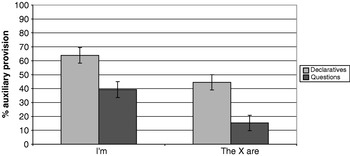
First, the children's mean levels of auxiliary provision in declaratives with known verbs were compared as a function of whether they had been exposed to declaratives modelling S-Aux-V word order, or questions modelling Aux-S-V word order. Figure 1 shows the children's levels of auxiliary provision in each condition.
Mean proportional auxiliary provision (and standard error) with known verbs as a function of sentence type (declaratives vs. questions) in the input.

It is immediately clear that in both games, the children's levels of auxiliary provision are higher following declaratives than following questions modelled in the input, and auxiliary provision for the form am is higher overall than for the form are. A 2 (auxiliary type: am, are)×2 (input type: declaratives, questions) ANOVA was carried out to determine whether these differences were significant. As the data were in percentages, arcsine and square root transformations were applied to the data. The results show that there are significant main effects of auxiliary form (F(1, 89)=15·27, p<0·001, large effect size f=0·41) and input type (F(1, 89)=23·43, p<0·001, f=0·51), but there is no significant interaction between the variables (F(1, 89)=0·17, p>0·05, f=0·00)Footnote 3.
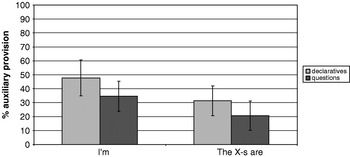
Figure 2 shows the children's levels of auxiliary provision with novel verbs according to condition. There again appears to be a tendency for auxiliary provision to be higher following declaratives than following questions modelled in the input, and higher levels of provision for am than for are. However, much smaller numbers of children contribute to the mean levels of provision displayed in Figure 2 (between 9 and 14 children in each condition) because few children produced declaratives containing both a sentence subject and novel verb.
Mean proportional auxiliary provision (and standard error) with novel verbs as a function of sentence type (declaratives vs. questions) in the input.

A 2 (auxiliary type: am, are)×2 (input type: declaratives, questions) ANOVA was carried out to determine whether these differences were significant. The results show that there were no significant main effects (auxiliary type F(1, 45)=1·80, p>0·05, f=0·20; input type F(1, 45)=1·11, p>0·05, f=0·16) and no interaction between the variables (F(1, 45)=0·01, p>0·05, f=0·00). However, many of the children who produced a subject+novel verb combination did so fewer than 3 times, and therefore the calculation of proportional auxiliary use for these children may be unreliable. We therefore examined the data for those children who produced 3 or more subject+novel verb combinations. There were not enough children to carry out an ANOVA. However, an examination of the mean levels of auxiliary provision shows that for both am and are the children produced a higher proportion of auxiliaries following declaratives in the input (am M=73·7%, N=4; are M=63·6, N=5) than following questions (am M=60·0%, N=3; are M=25·9, N=6), and a higher proportion of auxiliary use with am than with are. This suggests that in cases where there is sufficient data to determine the children's proportional use of auxiliaries, the same trends can be observed as were noted with known verbs.
Summary
The results show that there is an effect of input type on children's provision of auxiliaries in declaratives. Hearing large numbers of declaratives modelling Subject-Aux-V word order in the input seems to result in an increased use of auxiliaries in children's declaratives relative to their use following large numbers of yes-no questions in the input that model Aux-S-V word order. This is true both for a form that we expect to be reasonably familiar to the children (am), and for a relatively unknown form (are). Within a constructivist framework, this suggests that the presence of questions in the input primes the children's use of previously acquired constructions that do not contain an auxiliary, while declaratives but not questions in the input may contribute to the children's acquisition of declarative constructions containing an auxiliary form.
Although the findings of the current study suggest that the presence of questions vs. declaratives in the input leads to different levels of auxiliary provision in children's speech, either by priming existing representations or by contributing to the acquisition of constructions at differing levels of abstraction, there are a number of important issues that have not been addressed.
(1) In the current study children exclusively heard either declaratives or questions. This is not typical of a naturalistic setting where children routinely hear both questions and declaratives in discourse. Thus, it is possible that the apparent influence of questions vs. declaratives is an artefact of the experimental context.
(2) We cannot tell whether it is declaratives that have a positive effect, or questions that have a negative effect on children's levels of auxiliary provision, because we did not include a control group who were asked to produce declaratives in the absence of either declaratives or questions modelled in the input.
(3) It is unclear to what extent the children's use or non-use of auxiliaries results from the patterns of use of declaratives and questions in the input, and to what extent the different patterns of use and non-use might reflect self-priming. Children who initially omit auxiliaries because they model their declaratives on questions in the input may continue to omit auxiliaries if a frame such as I V-ing is primed by prior use and therefore more easily retrieved.
(4) Naturalistic studies of children's early use of auxiliary BE show that children learn the forms is and am early in development, and that these forms appear to be used ‘optionally’ for a prolonged period of development. It would be interesting to determine whether the presence of questions and declaratives in the input with these forms in a naturalistic setting influences children's relative use of auxiliaries in declaratives.
(5) In naturalistic discourse, although mothers and children use the same auxiliary form is when talking about third person people or objects, they use different auxiliary forms (are vs. am) when talking about themselves. Typically mothers talk about the actions of their children using second person forms, while children talk about themselves using first person forms. It is therefore unclear to what extent declaratives and questions in the input might influence children's use of auxiliary BE in a context when the input does not necessarily contain concentrated exemplars of the target auxiliary form that is required in the child's utterances.
To investigate these issues, a naturalistic case study using a dense database was carried out to examine the role of immediate discourse context on the child's use of forms of auxiliary BE. The aim was to establish whether input context (declaratives vs. questions), child context (prior use of a declarative with use or non-use of auxiliary BE) and the specific form of auxiliary BE present in the prior discourse (target form vs. different form) had any effect on the child's use of auxiliary BE in declaratives.
STUDY 2: A NATURALISTIC STUDY OF THE INFLUENCE OF DISCOURSE CONTEXT ON AUXILIARY PROVISION
METHOD
Participants
The data for this study are taken from a single child, Brian, interacting with his mother in their home environment. Brian is a monolingual, English speaking, only child. He was recorded for five separate hours in every week period from the age of 2 ; 0 to 3 ; 2 and then for five hours during a one-week period in every month until 5 ; 0. The recordings were conducted by trained staff from the Max Planck Child Study Centre at the University of Manchester. Brian's family live in the Manchester area. Brian's mother is the primary caregiver.
The speech corpora
Research assistants transcribed all of the tapes using standard CHAT procedures (MacWhinney, Reference MacWhinney2000). During the training stage, all transcripts were checked by the research coordinator. Following this, each transcript was subsequently linked to the sound file by a second transcriber. Any differences noted between the transcript and what the second transcriber could hear on the sound file were referred to the research coordinator for adjudication and, if necessary, subsequently changed. Finally, the transcripts were run through the MOR program and any further errors in morphemization were corrected. Thus, we can be reasonably confident that the transcripts correctly record the use and non-use of auxiliary forms, and can therefore provide the basis for the current analysis.
Brian's data were searched for all utterances containing both a sentence subject and a progressive verb form using the CLAN programs to locate all declaratives that required a form of auxiliary BE. All self-repetitions, imitations, incomplete or partially intelligible utterances and routines (e.g. counting, nursery rhymes) were excluded from the analysis. The data for this study are taken from the six month period when Brian was aged from 2 ; 8 to 3 ; 2. This period was chosen as 2 ; 8 represents the earliest stage in development when Brian produces sufficient numbers of declaratives containing auxiliary BE to enable a detailed analysis of his use and non-use of auxiliary BE to take place, and 3 ; 2 marks the end of the dense period of data collection. Prior to 2 ; 8, Brian produced a maximum of 15 declaratives containing a form of auxiliary BE in any one-month period. During the month at 2 ; 8, Brian produced 74 declaratives containing a form of auxiliary BE (and approximately the same number of declaratives where BE was omitted), showing a marked increase in auxiliary use that was maintained across subsequent months. In addition, in each month period from 2 ; 8, Brian produced a minimum of 6 uses of each of the auxiliary forms is, am and are which account for the vast majority of forms of BE required in declaratives in his speech. This means that auxiliary omissions cannot be due to a lack of knowledge of the relevant form of BE. The data were split into two three-month-long developmental periods; from 2 ; 8 to 2 ; 10, and from 2 ; 11 to 3 ; 2. Auxiliary provision typically increases gradually with age, and therefore we might find differential effects of discourse context at different stages of development.
Each utterance was extracted from the transcripts along with the five previous utterances to provide prior discourse context for the target utterance. Each target utterance was coded for: (1) the presence or absence of auxiliary BE; and (2) the form of the auxiliary required or produced (i.e. is, am, are, was or were).
Prior input context. The five previous utterances were searched to establish the prior input context for each target utterance. For each target utterance, the input context was coded as either: (a) a declarative containing a form of BE that maintained Subject-Auxiliary-Verb word order; (b) a question containing a form of BE that modelled Auxiliary-Subject-Verb word order (yes-no and non-subject wh-questions); or (c) no prior auxiliary context. Where the input contained either a declarative or question including a form of BE, the precise form of BE produced was noted. In cases where there was more than one possible input context, for example two declaratives, or a question and declarative, only the most recent utterance produced prior to the target utterance was coded.
Prior child context. The five previous utterances were searched to establish the prior child context for each target utterance. For each target utterance, child context was coded as either: (a) a declarative containing a form of BE; (b) a declarative with an omitted form of BE; or (c) no prior declarative context requiring a form of BE. Where the child context contained a declarative that required a form of BE, the precise form of BE required (omitted) or produced was noted. If the previous five utterances contained more than one utterance providing child context, only the most recent utterance prior to the target utterance was coded.
All coding was carried out by the first author. Twenty-five percent of the data were independently coded by a trained research assistant who was blind to the specific focus of the study. There was a 97·8% agreement between coders. The overall proportional auxiliary provision in declaratives that required a form of BE was calculated for each input context and each child context separately to determine whether auxiliary provision varied as a function of the presence of declaratives vs. questions in the input, or as a function of Brian's prior use or non-use of a form of BE in declaratives.
RESULTS
Do questions reduce subsequent auxiliary provision relative to declaratives?
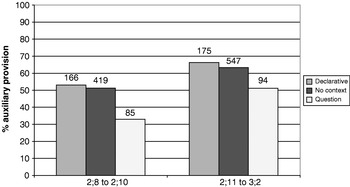
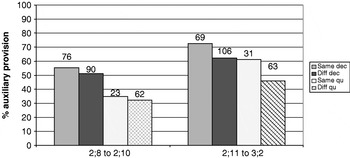
Figure 3 shows Brian's proportional use of auxiliaries following declaratives, questions, and no preceding context in the input for each of the two developmental periods. Although auxiliary provision increases across the two developmental stages, it is clear that at both stages there is a tendency for him to omit auxiliaries more frequently following a question in the input than both following a declarative and following no preceding context. Chi-squared tests showed this difference to be significant at both developmental stages (2 ; 8 to 2 ; 10 χ2(2, N=670)=10·69, p<0·01; 2 ; 11 to 3 ; 2 χ2(2, N=816)=6·53, p<0·05).
Proportional auxiliary provision in the child's speech following a prior declarative, question or no auxiliary context in the input (showing overall number of utterances).

The role of child context: does prior auxiliary omission reduce future auxiliary provision?
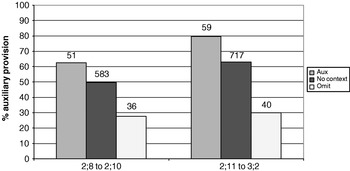
Figure 4 shows the proportional use of auxiliaries in declaratives following a declarative with an auxiliary present or omitted, and with no preceding context in Brian's speech. Although auxiliary provision increases across the two developmental stages, it is clear that at both stages auxiliary provision tends to be higher when he has previously produced a declarative containing BE than following no preceding context, and lower when he has previously produced a declarative where BE is omitted than following no preceding context. Chi-squared tests showed this difference in proportional auxiliary provision to be significant at both developmental stages (2 ; 8 to 2 ; 10 χ2(2, N=670)=10·40, p<0·01; 2 ; 11 to 3 ; 2 χ2(2, N=816)=25·56, p<0·001).
Proportional auxiliary provision following a prior declarative with an auxiliary, an omitted auxiliary or no prior declarative context in the child's speech (showing overall number of utterances).

Does the specific auxiliary form modelled in the input influence auxiliary provision?
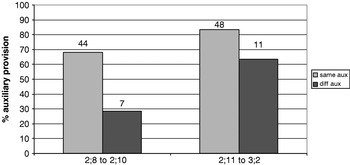
Questions in the input tend to reduce auxiliary provision in Brian's speech relative to both no prior context and previous declaratives in the input. Further analyses were carried out to determine whether the specific form of BE in declaratives and questions had an effect on provision of BE in Brian's speech. Figure 5 shows the levels of auxiliary provision following declaratives and questions with the target vs. a different form of BE at each developmental stage.
Proportional auxiliary provision following declaratives and questions containing the target form of BE vs. a different form of BE in the input (showing overall number of utterances).

First, the effect of auxiliary form in declaratives was examined. Chi-squared tests revealed that there was no significant difference in Brian's levels of auxiliary provision following declaratives containing the target form of BE compared to those containing a different form of BE at either stage (2 ; 8 to 2 ; 10, χ2(1, N=166)=0·29, p>0·05; 2 ; 11 to 3 ; 2 χ2(1, N=175)=1·95, p>0·05). The presence of either the target or a different form of BE in declaratives in the input results in levels of auxiliary provision in his speech that are similar to levels of provision following no prior context in the input (see Figure 3). Second, the effect of auxiliary form in questions was examined. Chi-squared tests revealed that there was no significant difference in Brian's levels of auxiliary provision following questions containing the target form of BE compared to those containing a different form of BE at either stage (2 ; 8 to 2 ; 10, χ2(1, N=85)=0·05, p>0·05; 2 ; 11 to 3 ; 2, χ2(1, N=94)=1·94, p>0·05). Questions in the input that contain either the target form or a different form of BE result in lower levels of auxiliary provision in Brian's speech than utterances in the input that provide no prior context or a declarative context.
Does the specific form of BE produced in Brian's speech influence subsequent auxiliary provision?
Brian's auxiliary provision is significantly higher following a previously produced declarative containing a form of BE than following either a declarative where BE is omitted or no prior context. A further analysis was carried out to determine whether the specific form of BE produced in a preceding utterance affected the likelihood that he would produce a form of BE in the target utterance. Figure 6 shows Brian's levels of auxiliary provision following declaratives containing the target form of BE, and those containing a different form of BE at each developmental stage.
Proportional auxiliary provision following a declarative containing the target auxiliary vs. another form of BE in the child's speech (showing overall number of utterances).

It is clear that declaratives containing the target form of BE result in an increase in auxiliary provision relative to those containing a different form of BE (and those with no prior context, see Figure 4) at both stages of development, although the difference is more marked at 2 ; 8 to 2 ; 10. Declaratives that contain a different form of BE result in levels of provision that are similar to or lower than declaratives produced in the absence of any prior context. Chi-squared tests showed that the difference in rates of auxiliary provision following the same vs. a different form of BE was significant at 2 ; 8 to 2 ; 10 (χ2(1, N=51)=4·05, p<0·05) but non-significant at 2 ; 11 to 3 ; 2 (χ2(1, N=59)=2·14, p>0·05).
Isolating the effects of child vs. input contexts
In the previous analyses, to establish whether there was any overall effect of input and child context, each context was examined separately. However, as the two are sometimes present simultaneously, it is difficult to tell whether it is Brian's prior use or non-use of BE (self-priming), or the presence of questions vs. declaratives in the input that affects his use of BE in declaratives (i.e. any given target utterance in Brian's speech can be preceded by both a declarative or question in the input and a prior declarative with or without a form of BE in his speech).
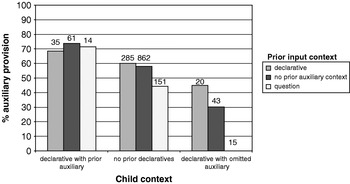
To investigate the relative contributions of each factor, utterances were coded into nine categories according to the combination of input and child context, and the proportional auxiliary provision in each category calculated. For this analysis, data from the two developmental stages were combined as there were very few data points for some of the nine coding categories when the data were separated (this decision is justified by the fact that we found an effect of both child prior context and input prior context at both developmental stages). Figure 7 shows the nine groupings and the proportional auxiliary provision holding the child context constant.
Proportional auxiliary provision in the child's speech as a function of prior input context holding prior child context constant (showing number of utterances).

Figure 7 shows that prior child context influences auxiliary provision regardless of the type of prior input context. In all input contexts (declaratives, questions and no prior context), prior provision of BE in declaratives in Brian's speech coincides with higher levels of auxiliary provision in the target utterance in comparison with target utterances with no prior child context. In contrast, input context only appears to have an effect when there is either no preceding child context, or when Brian has previously produced a declarative where BE is omitted. Chi-squared tests show that: (1) when Brian produced a prior declarative containing an auxiliary, there were no significant differences in auxiliary provision as a function of input context (χ2(2, N=110)=0·30, p>0·05); (2) when he did not provide any prior declaratives, there was a significant effect of input context such that he produced significantly fewer auxiliaries following a question in the input than following a declarative or no input context (χ2(2, N=1298)=11·31, p<0·01); and (3) when he previously produced a declarative where BE was omitted, there was a significant effect of input context such that he produced fewer auxiliaries following no prior input context than following a declarative in the input, and fewer auxiliaries following a question in the input than following no input context (χ2(2, N=63)=8·77, p<0·05).
Summary
These findings show that the presence of questions containing auxiliary BE in the input has a detrimental effect on Brian's provision of auxiliary BE in declaratives. However, this effect is moderated by Brian's own prior use of declaratives that either contain or omit auxiliary BE. When Brian has previously produced a declarative containing a form of BE, he is likely to produce this form again regardless of input context. However, if he has previously omitted BE, or there is no prior child context, the presence of questions in the input seems to inhibit his use of BE in declaratives even further.
Although the specific form of BE produced in the input has no apparent effect on the likelihood that Brian will produce a form of BE in his own speech, the specific form produced in his own prior declaratives does influence subsequent use. This raises the question of why Brian's own utterances seem to prime use of the auxiliary, while declaratives in the input containing the same lexical form do not. One possibility is that the lexical items that support priming are even more specific: it could be that it is the combination of subject and auxiliary, rather than the auxiliary form alone that contributes to the likelihood that the auxiliary will be provided in a subsequent utterance. To investigate this, contextual utterances containing the same auxiliary form as required in the target utterance were examined further to determine whether they also shared their lexical subject with the target utterance. In Brian's speech, 61·7% of these contextual utterances contained the same lexical subject as was produced in the target utterance. In comparison, only 38·1% of contextual utterances in the input shared the same lexical subject with the target, this difference is significant (χ2(1)=12·81, p<0·001). Moreover, when Brian's contextual utterance contained both the target subject and auxiliary, 70% of targets contained an auxiliary, but when the contextual utterance shared the auxiliary but had a different subject to the target, only 40% of targets contained the auxiliary. It appears therefore that overlap in both the lexical subject and specific form of BE required is important in determining subsequent auxiliary provision. Declaratives in the input may fail to promote increased auxiliary provision in Brian's speech because the overlap between lexical subjects in the input and in Brian's speech is relatively low. A high degree of overlap between Brian's preceding utterances and the target utterance may also explain why questions in the input do not have a detrimental effect on auxiliary provision for target utterances that also follow Brian's prior use of an auxiliary form. These data suggest that Brian may not be operating with an abstract representation of the specific form of BE (i.e. knowledge of how a specific form of BE combines with a variety of lexical subjects), let alone a more abstract representation of the forms of BE as a whole.
OVERALL DISCUSSION
This paper reports the results of two studies investigating the influence of questions in the input on children's use and non-use of auxiliary BE in declaratives. In Study 1, 96 children were exposed to yes-no questions or declaratives modelling two forms of auxiliary BE, am and are. The main findings were that for both am and are, children exposed to questions in the input produced a much lower rate of auxiliary BE in declaratives than children exposed to declaratives in the input. The same trend was observed in the children's use of novel verbs that were modelled in neutral sentence frames, although there were not enough children who used the novel verbs often enough to allow a detailed and reliable analysis to be carried out.
In Study 2, the effect of prior discourse context on a single child's use of auxiliary BE in declaratives was examined. The main findings were that questions in the input (yes-no and non-subject wh-questions) had a detrimental effect on the child's use of BE in declaratives, but that the child's own prior use of declaratives containing auxiliaries was also an important determinant of subsequent auxiliary use. In addition, although the specific form of BE modelled in the input had no effect on auxiliary provision in the child's speech, the specific form of BE produced in the child's own prior declaratives was important. Only declaratives that contained the target form of BE served to increase subsequent levels of provision in the child's speech. Moreover, auxiliary provision was highest when prior contextual utterances shared both the target form of BE and the same lexical subject as produced in the target utterance. This suggests that any scaffolding provided by previous utterances operates at a highly lexically-specific level at this stage in development.
These two studies extend the findings of Theakston et al. (Reference Theakston, Lieven and Tomasello2003) with respect to third person singular verb use to children's use of auxiliary BE in declaratives. Questions in the input have a detrimental effect on children's use of auxiliary BE in declaratives, both under experimental conditions and in a naturalistic setting. However, the presence of declaratives in the input does not appear to facilitate children's use of auxiliary BE in a straightforward manner. The naturalistic data show that Brian's use of auxiliary BE is similar both when there is no prior input context, and when the input contains declaratives, showing that there is no overall relation between the presence of BE in declaratives in the input and their subsequent production in Brian's speech.
One way of interpreting these results is that they provide support for claims that children operate with frames at differing levels of abstractness that are derived from various sources in the input. If children operate with frames learned from declaratives (I'm V-ing) and frames learned, at least in part, from questions (I V-ing), then both frames would theoretically be available to children, and subject to the influence of priming. Although frames that do not contain an auxiliary seem more susceptible to priming from the input than those that do, in many ways, this is not surprising. Previous research has shown that at the age of 3 ; 0 to 3 ; 6, children are beginning to operate with a more abstract representation of the transitive S-V-O construction and some children are able to use novel verbs in this construction productively (Akhtar & Tomasello, Reference Akhtar and Tomasello1997; Tomasello & Brooks, Reference Tomasello and Brooks1998; Akhtar, Reference Akhtar1999). However, these studies focus on children's use of verbs with subject and object arguments, and not on their use or non-use of auxiliaries. If children's emerging representation of the transitive construction does not incorporate an abstract representation of auxiliary syntax, then the overlap between S-V constructions in questions in the input and the children's emerging S-V-O declarative constructions could result in priming that leads to the omission of auxiliary BE. In contrast, children seem to take much longer to acquire constructions that contain forms of auxiliary BE and, initially, auxiliary production in declaratives in the children's speech appears to rely quite heavily on producing a specific subject+auxiliary combination. As there are relatively few instances where the lexical subject in the input matches that required in the target utterance, the priming of constructions containing auxiliary BE between the input and children's speech does not often occur.
Further evidence for the existence of lexically-based representations of auxiliary syntax comes from the fact that S-Aux-V frames are primed by the children's own prior language use, under circumstances where both the lexical subject and auxiliary form are repeated in the target utterance. Thus, in the naturalistic study when Brian produced an auxiliary, he was likely to do so again with the same sentence subject, but when he omitted an auxiliary, he was likely to omit the form again. Similarly, children in the experimental study who previously produced auxiliaries were likely to do so again, while those who omitted auxiliaries continued to do so. There is evidence that specific subject+auxiliary combinations played a role in auxiliary provision in the experimental study. In the am game, this is necessarily the case as the first person subject form I was constant across utterances. However, in the are game where variation in the lexical subject is possible, 65% of the children's responses containing an auxiliary were based around either the fixed pronoun+aux combinations they're and these are, or NP+aux combinations that were used at least twice by the individual child. This suggests that the priming observed in the experimental context might also rely to a large extent on the repeated use of specific subject+auxiliary combinations in the speech of individual children. That is, self-priming may account for a greater proportion of the children's auxiliary provision than priming from the input, especially given that the NP combinations modelled in the input were not those required in the target utterance.
The reliance on specific subject+auxiliary combinations in the experimental study raises two questions. First, why did we not observe a greater priming effect with I'm than with The X-s are, given that the subject+auxiliary combination modelled in the I'm game mirrored that required in the target utterance, whereas in the The X-s are game it did not. Second, how were children ‘primed’ in the The X-s are game, given that the modelled subject+auxiliary combinations contained NPs whereas many of the children's responses contained pronominal subjects? One suggestion is that questions inhibit auxiliary provision, while declaratives in the input have only a small facilitative effect. Thus, in both games questions inhibit auxiliary provision relative to a baseline measure of use that depends on the children's knowledge of associated subject+auxiliary constructions. As the children are more familiar with I'm, their overall levels of provision are higher for this form. The children's use of pronominal subjects in the The X-s are game may reflect one of two possibilities: either they are retrieving a specific pronominal+auxiliary construction to describe the actions of plural agents that may be independent of the construction modelled in the input (i.e. they do not have an abstract NP-s are construction, and therefore they are not primed by the form modelled in the input); or they have a relatively abstract construction The X-s/pN are V-ing that is subject to priming effects. We cannot differentiate between these possibilities without a control group. However, the former suggestion is in line with the findings from Study 2.
The exact nature of the children's linguistic representations may also help to explain, first, why levels of auxiliary provision were lower with novel verbs than with known verbs when the children in the experimental study were exposed to declaratives in the input, and second, why levels of provision of the forms am and are differed. If children's representations are initially lexically based and only gradually become more abstract, their knowledge of the constructions I'm V-ing and The X-s are V-ing is likely to be only partially abstract. This might mean that children are able to extend use of the constructions to verbs they have heard before, but that they have more difficulty extending use of the constructions to novel verbs. Moreover, the children's lower levels of provision of are may reflect the fact that children are thought to take longer to abstract a frame The X-s are to support auxiliary use with a variety of lexical subjects than to extract the fixed unit I'm. We might therefore expect that even children who have managed to abstract such a frame may not yet have the frame sufficiently well represented to support priming from one utterance to the next. In fact, this is exactly what Savage et al. (Reference Savage, Lieven, Theakston and Tomasello2003) found with respect to the priming of the transitive active and passive structures. Children showed a stronger priming effect when there was high lexical overlap between exemplars than when utterances shared less lexical overlap, suggesting that lexical overlap facilitates priming because children's underlying linguistic representations are highly lexically based.
This raises another interesting issue, namely the extent to which different forms of BE form a coherent whole for young children. Certainly, the results of these studies add to previous studies that suggest that children's representations of the different forms of BE are initially independent. Thus, Wilson (Reference Wilson2003) and Theakston et al. (Reference Theakston, Lieven, Pine and Rowland2005) have argued that children's use of the subforms of auxiliary BE differs, with some forms being produced more often than others in obligatory contexts (see also Brown, Reference Brown1973). In the context of wh-question formation, others have argued that children's patterns of inversion differ according to the specific subform of BE (Rowland & Pine, Reference Rowland and Pine2000; Rowland, Pine, Lieven & Theakston, Reference Rowland, Pine, Lieven and Theakston2005). It is clear from the current studies that: (1) children's levels of provision of am and are in declaratives differ; and (2) production of one form of BE does not initially prime use of a different form of BE, although use of the same form can result in priming. Although these data may appear to conflict with the finding that use of auxiliary are primes use of auxiliary is (Leonard et al., Reference Leonard, Miller, Grela, Holland, Gerber and Petucci2000; Reference Leonard, Miller, Deevy, Rauf, Gerber and Charest2002), this probably reflects the age of the children taking part. Leonard et al. tested normally developing children between the ages of 2 ; 8 to 4 ; 0, whereas the children in Study 1 ranged in age from 2 ; 5 to 2 ; 10, and the child in Study 2 was aged between 2 ; 8 and 3 ; 2. Recall that in Study 2, we found an effect of prior auxiliary form in Brian's speech such that prior use of the same form as required in the target utterance increased levels of auxiliary provision when compared to prior use of a different form of BE. However, this was only true of the earlier developmental period (2 ; 8 to 2 ; 10). Although the same trend was observed at a later age, this was not significant, and rates of provision of BE were similar regardless of whether Brian had previously produced a different form of BE or produced no prior context for BE. Thus it is unclear whether the different forms of auxiliary BE are beginning to link up, or whether he is simply producing constructions containing auxiliary forms more frequently in finite contexts, regardless of prior use. These findings suggest that researchers should exercise caution in attributing children with knowledge of the different person markings associated with BE.
Of course, it is possible to interpret these data within a more generativist framework. One argument might be that even if children operate with a full knowledge of auxiliary syntax, their ability to produce auxiliaries in declaratives is subject to performance limitations in production. Thus, the recent use of auxiliaries in declaratives in the input or in the child's own speech is likely to lead to higher levels of auxiliary provision than under circumstances where no prior auxiliary use has occurred, because prior use should increase the ease with which specific lexical items are retrieved from memory, thus reducing processing demands (Bloom, Miller & Hood, Reference Bloom, Miller, Hood and Pick1975). However, if performance limitations were responsible for auxiliary omission, levels of provision following declaratives in the input should be higher than a baseline measure of auxiliary use following no prior auxiliary context in the input. The data from Study 2 provide no support for this prediction. In fact, the presence of questions in the input reduces auxiliary provision relative to a baseline measure, but rates of provision following declaratives are very similar to the baseline. It might be possible to modify a performance limitations account to try to explain these data within a generativist framework, but to our knowledge, a detailed account of this nature does not currently exist.
Similarly, these data are broadly consistent with an Optional Infinitive framework, in that the children show apparently optional use of auxiliary BE in declaratives. However, the account would need to be substantially modified to explain why: (1) children's levels of auxiliary provision differ according to whether they have recently heard questions or declaratives modelled in the input; (2) levels of provision differ according to the specific form of BE required; and (3) prior use of the target form of BE but not different forms of BE in children's speech promotes higher levels of auxiliary provision, given that the OI account assumes that children understand how person-marking operates. Although some theorists would argue that these factors lie outside the remit of accounts that aim to explain children's underlying grammar, we believe that understanding the complex interaction between children's performance and their knowledge of grammar is crucial to understanding how children learn language, and what form their underlying linguistic representations take.
These studies add to a growing body of evidence that suggests that children build up an inventory of increasingly abstract linguistic constructions by abstracting over lexically-based exemplars in the language to which they are exposed. The influence of patterns in the input extends beyond the acquisition of specific lexical items to the particular frames in which those items appear in children's speech, showing that high frequency, lexically-based combinations form the basis for children's early grammars (Naigles & Hoff-Ginsberg, Reference Naigles and Hoff-Ginsberg1998; Dabrowska, Reference Dabrowska2000; Rowland & Pine, Reference Rowland and Pine2000; Theakston, Lieven, Pine & Rowland, Reference Theakston, Lieven, Pine and Rowland2001, Reference Theakston, Lieven, Pine and Rowland2002, Reference Theakston, Lieven, Pine and Rowland2004, Reference Theakston, Lieven, Pine and Rowland2005; Wilson, Reference Wilson2003; Matthews, Lieven, Theakston & Tomasello, Reference Matthews, Lieven, Theakston and Tomasello2005). We suggest, however, that researchers need to take a very broad view of the input to fully understand how the language children hear influences their linguistic representations. For example, an analysis of the current data indicates that questions in the input that model S-V word order may provide a partial explanation for the patterns of auxiliary omission observed in children's early speech. This finding is not predicted by most current models of language acquisition. Thus, to fully understand language acquisition, researchers need to focus on the process of abstraction, and the complex interaction between the child's existing knowledge and the influence of the input at any given point in development.