INTRODUCTION
The symbiotic community associated with tropical shallow-water hermit crabs (Crustacea: Decapoda: Paguroidea) is relatively diverse including large shrimps, mysids, polychaetes and other marine invertebrates. Worldwide, in total about 550 species of marine invertebrates from 16 phyla are found in associations with hermit crabs (review in Williams & McDermott, Reference Williams and McDermott2004). The small alpheid genus Aretopsis De Man, Reference de Man1910 is exclusively known as a symbiont of shallow-water tropical Indo-West Pacific hermit crabs of genera Dardanus Paulson, 1875 and Aniculus Dana, 1952 (Decapoda: Diogenidae) (e.g. Bruce, Reference Bruce1969; Williams & McDermott, Reference Williams and McDermott2004). Records of Aretopsis amabilis De Man, Reference de Man1910 are relatively numerous and presently the species is known from Egypt (Ramadan, Reference Ramadan1936), Maldives and Madagascar (Banner & Banner, Reference Banner and Banner1979), Seychelles (Bruce, Reference Bruce1984), Japan (Nomura, Reference Nomura1986), Philippines (Chace, Reference Chace1988; ‘Panglao Expedition’ 2004, unpublished), Indonesia, Australia and the Marshall Islands (Banner & Banner, Reference Banner and Banner1968).
During a project studying the diversity of marine crustaceans in Nhatrang Bay, Vietnam, numerous specimens of large, shallow-water hermit crabs of the genera Dardanus and Aniculus were collected and examined for the presence of symbionts. As the result, a symbiotic pontoniine shrimps Periclimenes dardanicola Bruce & Okuno, Reference Bruce and Okuno2006 (Decapoda: Palaemonidae: Pontoniinae) were found in association with the hermit crab Dardanus lagopodes (Forskål, 1775) (Diogenidae) and occupied empty shells of the marine gastropod genus Cassis Scopoli, 1777 (Mollusca: Gastropoda) (see Bruce & Okuno, Reference Bruce and Okuno2006). Other symbiotic crustaceans, such as alpheid shrimps of the genus Aretopsis De Man, Reference de Man1910 and mysids of the genus Gnathomysis Bonnier & Pérèz, 1902, which are known as symbionts of tropical hermit crabs elsewhere (e.g. Bacescu & Bruce, Reference Bacescu and Bruce1980; Williams & McDermott, Reference Williams and McDermott2004), has to date not been found in Nhatrang Bay.
Field collecting in Nhatrang Bay during November 2009 revealed a male–female pair of mature specimens of Aretopsis amabilis inside a gastropod shell occupied by a large specimen of Dardanus cf. lagopodes constituting the first record of this alpheid shrimp from Vietnam. The specimens were found inside a large shell of a strombid gastropod (Strombiidae) occupied by the hermit crab, whilst specimens of D. cf. lagopodes and Dardanus spp. were more frequently observed occupying shells of different turbinid gastropods, Turbo spp. (Turbinidae). All hermit crabs inhabiting turbinid shell were observed without large symbionts supposing that the free space inside the shell of a turbinid gastropod is possibly not enough for living of symbiotic species.
Carapace length (cl, in mm) is used as a standard measurement of the size. Both specimens of the shrimp species are deposited in the zoological collection of the Oxford University Museum of Natural History (OUMNH), Oxford, United Kingdom.
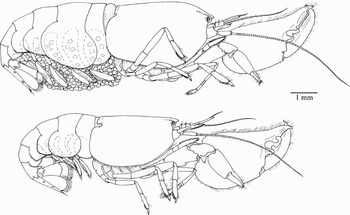
Aretopsis amabilis De Man, Reference de Man1910, ovigerous female (upper) and mature male (lower).

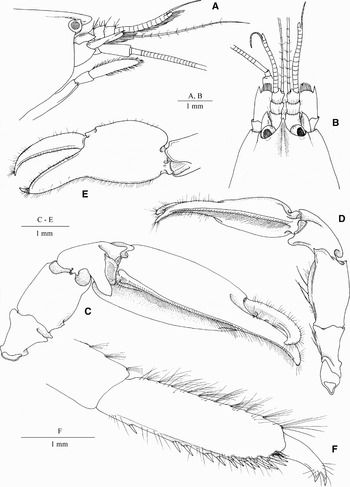
Aretopsis amabilis De Man, Reference de Man1910, ovigerous female: (A, B) front of carapace; (C) major first pereiopod; (D) minor first pereiopod; (E) chela of minor first pereiopod; (F) propodus and dactylus of the third pereiopod.

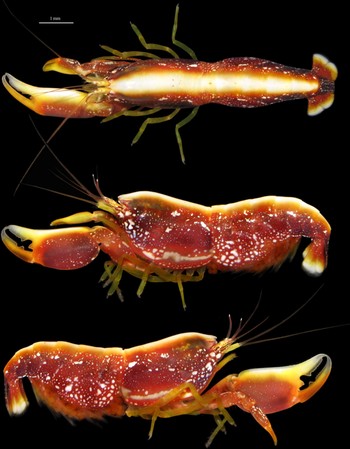
Live coloration of ovigerous female of Aretopsis amabilis De Man, Reference de Man1910.

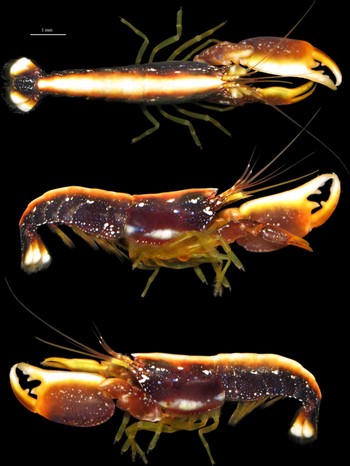
Live coloration of mature male of Aretopsis amabilis De Man, Reference de Man1910.

Aretopsis amabilis De Man, Reference de Man1910: 311 (type locality: Pulau Kaniungan-Ketjil, Borneo); 1911:171, pl. 4: figure 14.
Aretopsis aegyptiaca Ramadan, Reference Ramadan1936: 16, pls. 1, 2: figures 9–17 (type locality: Hurghada, Egypt, Red Sea).
MATERIAL EXAMINED
1 ovigerous female, cl 4.0 mm; 1 male, cl 3.4 mm. (Pacific Ocean, South China Sea, Vietnam, Nhatrang Bay, Tre Island, small shallow water creek near Dam Bay, 2 m depth, corals and coral rubble, inside a large strombid shell occupied by hermit crab Dardanus cf. lagopodes) (OUMNH.ZC.2010-03-012). Collected by I. Marin, 22 November 2009.
REMARKS
The specimens adhere closely to previous species descriptions and have an identical coloration as previously reported (De Man, Reference de Man1910, Reference de Man1911; Ramadan, Reference Ramadan1936; Bruce, Reference Bruce1969).
HOSTS
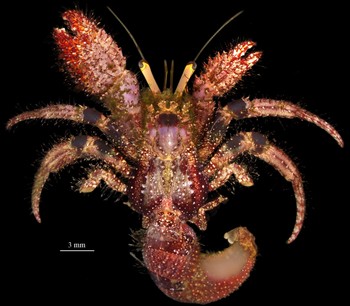
The Vietnamese specimens were found inside a strombid shell, occupied by Dardanus cf. lagopodes (Forskål, 1775) (Figure 5) in shallow water, at a depth of 1.5–2 m, among coral rubble. The host species was identified as Dardanus lagopodes (Figure 5), but it is possible that this widely distributed and common tropical shallow-water hermit crab could be a complex of several sibling species (G. Paulay, personal communication), and is thus referred to as D. cf lagopodes. Aretopsis amabilis has been exclusively recorded inside gastropod shells occupied by large diogenid hermit crabs of the genus Dardanus, such as Dardanus megistos (Herbst, 1804), D. sanguinolentus (Quoy & Gaimard, 1824) and Dardanus lagopodes (Forskål, 1775) (Figure 5), and a species of the genus Aniculus (e.g. Bruce, Reference Bruce1969; Banner & Banner, Reference Banner and Banner1968, Reference Banner and Banner1979).
Live coloration of the host specimen of hermit crab Dardanus cf. lagopodes (Forskål, 1775).

DISTRIBUTION
Recorded from Vietnam for the first time. Also known from the Red Sea, Madagascar, Seychelles and Maldives, Indonesia, Philippines, Japan, Australia and Marshall Islands (Ramadan, Reference Ramadan1936; Miyake & Miya, Reference Miyake and Miya1966; Banner & Banner, Reference Banner and Banner1968, Reference Banner and Banner1979; Bruce, Reference Bruce1969, Reference Bruce1984; Nomura, Reference Nomura1986; Chace, Reference Chace1988).
ACKNOWLEDGEMENTS
This research was carried out with the support of the Russian–Vietnamese Tropical Centre in Nhatrang City, Vietnam. The author wishes to thank his scientific supervisor Dr Temir Britayev, the administration of IPEE RAS, Moscow, and the Coastal Department of the Tropical Centre in Nhatrang City for the opportunity to work in Nhatrang Bay. The work is partly supported by grants from the Russian Foundation of Fundamental Researches (08-04-92244-GFEN_a, 09-05-00736а).