Jazz tunes present different models of identity and authority from most Western musical works. Jazz tunes are played and heard inside a multitude of performance traditions.Footnote 1 As with language and in other oral cultures, players learn them in performances by others, full of specific traditions, tempos, keys, grooves, chord substitutions, melodic embellishments, intros, endings, and other structural elements. All of these elements can change, and together they both describe and influence the history of how jazz tunes actually sound. In jazz, the multiplicity of recorded versions is a primary source, and neither notation nor original versions are generally authoritative.
Musicology, however, was developed to study the composer-based music of the European art tradition with stable written scores, through which performances are closely tied to notation.Footnote 2 Jazz scholars are often trained in classical music and sometimes still analyze jazz performance using European models better suited to the Western relationship between performance and score. There is also a long tradition of jazz criticism that (with all good intentions) argues that jazz is “America's Classical Music,” and so great composers and great works are emphasized to make jazz seem more “serious” and more like classical European music.Footnote 3 This “neo-classical” privileging of authentic roots (implying the existence of inauthentic roots) has even inspired a movement of musicians in suits playing masterworks by the honored greats in pristine, well-lit concert venues at Lincoln Center.Footnote 4
Recent jazz scholarship, however, has increasingly examined jazz as an oral culture and viewed the music through the lens of ethnomusicology.Footnote 5 As an oral culture, jazz has a different relationship between its “tunes” and performances, different aesthetic values, different modes of transmission and different standards for influence.Footnote 6 The jazz community is more likely to emphasize the unique contributions of the performer, but there are still competing sources of authority in jazz performance: David Ake points out that, at least in liner notes, jazz performances of pop or Broadway tunes position sources other than the original as authoritative.Footnote 7 Although ethnographic studies now look at the cultures of performance and the interactions of performers with each other and with works, jazz scholars are still often handicapped by a conception of jazz tunes influenced by our musicological training. We need more robust ways to foreground the relationship between performer and tune in the history of jazz. We also need to look more closely at the cultural systems that lead to canonic traditions, tunes, or performances. This study examines how the recorded history of one of our most famous tunes reveals the profound influence performers and performances have on each other in jazz. By doing so, it also reveals competing hierarchies of value, influence, and authority in jazz and offers a new method and phenomenological model for the study of jazz, using recordings as sources.
An Original
Johnny Green and lyricists Edward Heyman and Robert Sour wrote “Body and Soul” as a “torch song” for British musical comedy star Gertrude Lawrence in 1929. Its bridge was a leftover from Green's first important arrangement for Guy Lombardo in 1927, “Coquette,” composed while he was still a student at Harvard. Carmen Lombardo had liked the song but offered to re-write what he thought was an “unconventional” bridge. Green agreed and later used the discarded bridge in “Body and Soul.” Lawrence liked the song and introduced it into her act, sang it on the radio, and brought it back to London, where it became a hit in 1930.Footnote 8 To acquire a copyright, however, the music still needed to be submitted in the “tangible form” of an official notated score.Footnote 9 Henry Spitzer of Harms, Inc. secured the English publishing rights, and the piece was copyrighted there on 18 February 1930, with Frank Eyton listed as a third lyricist and a score in C.Footnote 10
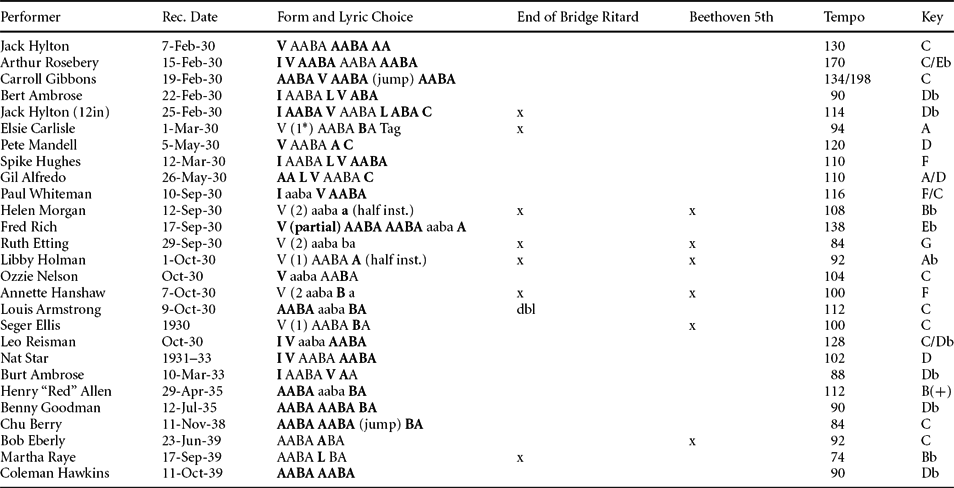
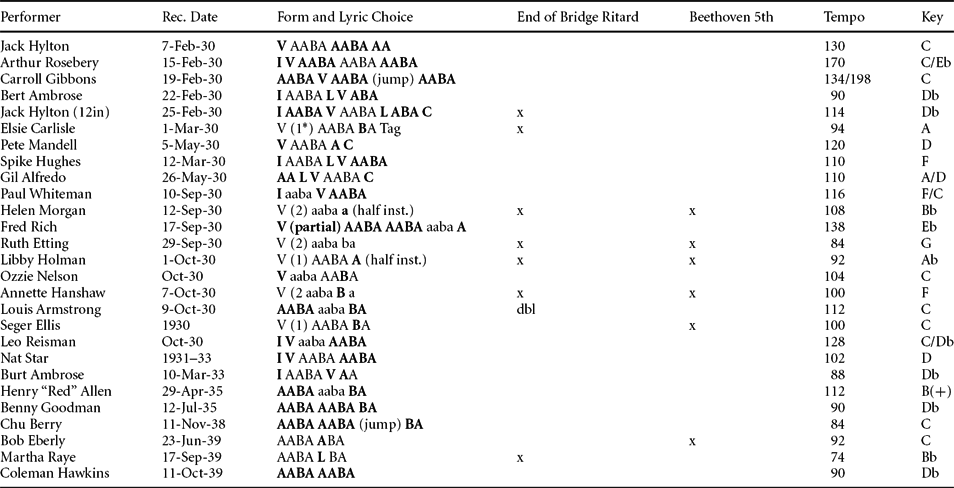
In classical music we might care about this history and seek out the original notation for accuracy and perhaps some composer intent, but in jazz, it is superfluous.Footnote 11Table 1 demonstrates the lack of cultural consensus about key, tempo, lyrics, or form in the early performances. The performances are radically different from each other, and there is no musical indication that any one of them stands out as a version worthy of special status. Jack Hylton, one of London's most popular bandleaders of the 1930s, made the first of them with vocals by Pat O’Malley.Footnote 12 This recording is in the “original” key of C and hardly sounds like a torch song at this dance tempo. Other bands and singers, of course, easily disregarded these performance “details,” eager to place their own stamp on the piece.
1930 recordings of “Body and Soul” and selected recordings before Coleman Hawkins’, showing structure, lyrics, tempo, key, and the presence of two short-lived performance features. The letters A and B refer to the song's AABA form, B being the bridge to the A return. Bold type indicates instruments only regardless of section. Key: I introduction; V verse; L interlude; A or B (capital letters) section with lyrics version 1 (British; see Figure 1); a or b (lower-case letters) section with lyrics version 2 (American); C coda. End of bridge ritard through the last two bars of the bridge. Beethoven 5th reference in the accompaniment of each A section (at m. 6) to the opening of the Beethoven fifth symphony (see Example 1).
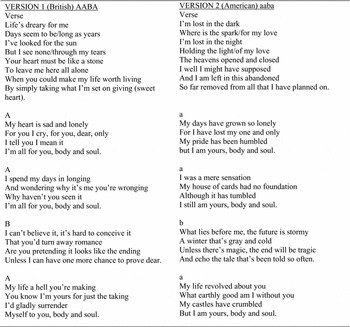
The two most common versions of the lyrics of “Body and Soul.” Version 1 was used for the original recordings and copyrighted in Britain in 1930. It is represented in the tables with capital letters. Version 2 was the American re-write for the show Three's a Crowd and is shown in the tables in lower case. Used by permission of Alfred Music Publishing.

The early recordings are experiments on a blank canvas: various arrangers and performers try different keys, tempos, forms, lyrics, and versions of the opening verse (which eventually vanishes from modern performances altogether). It is not surprising that early dance bands played the piece at tempos for dancing, but even the early vocal versions are much faster than would become the norm. Why, then, did the piece slow down?
By contrast, if jazz is all about innovative performances and not about authentic recreations of canonic masterpieces, why do most performers now play this piece the same way: even more slowly, always in D-flat, without any verse, and with a now standard, but altered, set of lyrics? Knowing the subsequent history of the piece, we know that Coleman Hawkins's interpretations set many of these parameters for future performers, but there is nothing in the early versions to indicate that would happen. Paul Whiteman's version (with a Jack Fulton vocal) put the song at the top of the charts for six weeks (from 11 October 1930), and Libby Holman first sang the song on Broadway (and making it to no. 3 on the pop charts). Either performer might equally be considered to carry some authority: for many people, these were the first versions they encountered. Louis Armstrong, already an authoritative figure in both jazz and popular music, recorded it as part of the first wave of American covers of the song. (The Armstrong recording eventually made it to no. 7 in the charts, but not until 1932.)Footnote 13 However, none (!) of the unique characteristics of these performances has had any long-term effect on the performance history of “Body and Soul.”
Given the jazz aesthetic of spontaneity, we would hardly expect a canonic performance practice, and yet most players can identify the “usual” keys, tempos, introductions, and the like, for most “standards.” These traditions are less formalized in jazz education, but as in opera programs, this sort of “insider” information is passed along to students before auditions and first gigs. And in jazz, much of it is institutionalized in lead sheets and study aids. There are plenty of canonic recordings in jazz, but they often contribute only a part of their interpretation to the eventual canonic performance practice: perhaps the introduction or the bass line is adopted in standard practice, but not the key. How these traditions develop is surely a combination of the popularity and availability of a performance and the aesthetic preferences of later musicians, so that the performance history of an individual piece is the nexus for understanding how personal, aesthetic, and cultural histories intersect in jazz.
In the Beginning
In the beginning, every performance is an innovation. Before there is a tradition for a piece, it is impossible to tell the odd performance quirk from an essential feature of the tune. Even in classical music, the interpretation and the composition are intertwined at the first performance: to the listener, there is no difference between a fast piece and a fast performance of a slow piece. It is only in hindsight that “standard” or “normal” are defined, and some innovations become canonic traditions and others dead ends.
In retrospect, we know that one of the first performance innovations of “Body and Soul” to catch fire occurs in Jack Hylton's version on a twelve-inch disc. His first recording had proven so popular that only three weeks later he recorded a longer and more complex “concert” arrangement. Among its many hairpin changes of tempo and mood is the initial bridge, where a faster tempo with a little Latin tinge requires a ritardando at the end to return the band to the original tempo. Elsie Carlisle's recording, made only a week later (1 March 1930), does not have any tempo shifts over the course of the bridge, but she (and her arranger) still decide to use the large ritardando at the end. The dance versions never do so, but all of the early female singers do.Footnote 14 Regardless of the basic tempo or choice of lyrics, the subsequent singers in 1930 perform this ritardando as if it were in the score. (In Table 1, the performances that include this innovation are checked in the column End of bridge ritard) Martha Raye does the same in 1939, and Frank Sinatra is still doing it in 1947. Billie Holiday never includes it, and perhaps it is her influence that finally eliminates it from the performance tradition, but it vanishes.
Along with the ritardando in her 12 September 1930 recording, Helen Morgan includes two new gestures that are also emulated. At the end of the third line of each A section (m. 6 after “My pride has been humbled,” 1:04, and in every subsequent A section), she slows down, and the orchestra plays four concert Ds in a rhythm that recalls Beethoven's Fifth Symphony (see Example 1).Footnote 15 Vocal recordings by Ruth Etting, Libby Holman, Annette Hanshaw, and Bob Eberly all use both gestures. (In Table 1, these recordings are marked in the column Beethoven 5th.) Because all four recordings were made within three weeks of each other, perhaps the method of transmission was through the studio musicians or arrangers. Nonetheless, neither innovation catches on with instrumentalists, and neither one survives the 1940s.
Rhythmic reference to Beethoven, Symphony No. 5 in the A section accompaniment of Helen Morgan's 1930 recording (mm. 6–7, at 1:04) in concert pitch. (All transcriptions and reductions by author).

The Jump
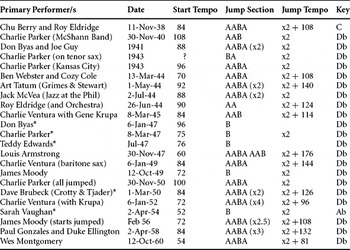
The 1940s are instead dominated by two important changes: references to Coleman Hawkins's popular and authoritative 1939 performance and a jump chorus borrowed from Chu Berry and Roy Eldridge's performance of 1938, an innovation Hawkins himself ignores. As shown in Table 2, the jump idea will itself split into three overlapping traditions—the jump chorus, the jump bridge, and Latin jumps.Footnote 16
Versions of “Body and Soul” from 1938 to 1960 that include a “jump chorus” (or “double-time feel”) in the rhythm section, showing the primary performer/s, performance date, starting and jump tempo, section jumped, whether the jump suggests a section in a “Latin” groove, and the key of the performance. Key: x2 = Rhythm section has kept the harmonic rhythm exactly the same and doubled the pulse. +n = Tempo is also increased. n is measured using the initial harmonic rhythm; the actual tempo feels twice as fast. * after performer's name = Performance includes a Latin section.

By today's standards, the initial recordings of “Body and Soul” still sound fast, but a tradition of playing the solos with double-time rhythm became popular for a short time. When soloing over a slow ballad, jazz musicians often cannot resist the usual flurry of faster notes and often move into a double-time feel for brief periods, which rhythm sections often ignore, continuing instead to emphasize the original slow pulse to create a mild tension with the soloist. Hawkins, for example, employs this technique throughout his famous 1939 performance. Especially in the second chorus, he slips easily back and forth between straight sixteenth notes (for example, at the beginning of the first B section, which simply sound fast) and sixteenth notes that imply a swing groove at twice the rhythm section's actual tempo (for example, most of the three middle A sections).Footnote 17 Sitting on top of a steady rhythm section, a soloist can tease and flirt with a number of potentials, but these melodies only hint at potential double times. Hawkins is a master of suggestion, and as is often the case in art or romance, the possibility is more provocative than the reality.Footnote 18
Hawkins was not the first to play with this tension in “Body and Soul”; Henry “Red” Allen had done so in his 1935 recording. Despite the relatively quick 112-bpm two-step in the rhythm section, Allen begins with a fairly free improvisation, much of which suggests a band swinging at twice the speed. The rhythm section remains impervious. Chu Berry was playing tenor saxophone on this recording, and it may have inspired his 1938 rendition with Roy Eldridge.Footnote 19 Berry and Eldridge make the suggestion a reality and change the pulse in the rhythm section, thereby adding the “jump chorus”—Gary Giddins calls it the “long-meter approach to ballads,” and many musicians might call a “double-time feel”—to the performance tradition.Footnote 20
Chu Berry's rather loose treatment of the melody in 1938 was unusual for its day and perhaps served as both inspiration and a challenge to Hawkins's even greater melodic excursions. Berry's choice of the key of C was not uncommon, but its tempo of quarter = 84 bpm was very slow at the time. Eldridge takes the two-bar break at the end of Berry's opening chorus (with the rhythm section silent) and not only doubles the feel, but also pushes the tempo to 108 (or quarter = 216 bpm) keeping it there for an entire chorus.Footnote 21 In a way that sounds equally planned, the band halves the tempo in the last four bars of the Eldridge solo to set up a final half chorus (BA) from Berry—a final tempo substantially faster (108 vs. 84) than when the tune began. This performance creates multiple ripples as performers tried out variations on it (see Table 2).
One such variation in the jump is an exact doubling of tempo first tried in jam sessions. In a 1941 field recording by Jerry Newman at Minton's in New York, someone can be heard to say, “play anything, just play something,” before Thelonious Monk launches into an introduction that leads to Joe Guy and Don Bias sharing “Body and Soul’s” first chorus melody. It is clearly a jam session. After complete choruses by Guy and Byas in the original tempo, Guy jumps in on the last two bars of the chorus (just as Eldridge had) to jump the tempo. The rhythm section follows him. Guy and Byas each play complete choruses in this jump feel, but unlike most of the other jump examples that include an open break (in which the rhythm section stops playing entirely, leaving the soloist playing alone), they only double the feel without any additional increase in tempo. In a jam session there are no rehearsed tempo changes. An unrehearsed band trying to stay together will generally look to maintain a relationship with the initial pulse during any tempo change. It is therefore no surprise that, in the 1944 Jack McVea JATP recording, another jam session, Nat King Cole only jumps the tempo to exactly double, as Guy and Byas had done.
The jump choruses employed in more formal recordings, however, tend to be the “more than double time” jump introduced by Berry and Eldridge, rather than the Byas/Guy version. Similarly, the Webster/Cole, Art Tatum, and Eldridge 1944 recordings all include the jump seemingly as a planned part of the form. If the second tempo is not to be metrically related to the first, the safest option is for one player alone to make a clean break and establish the new tempo. That is the method used in all three examples cited here: Cozy Cole takes the two-bar break to set up the faster tempo between Ben Webster's two choruses, Art Tatum (in a trio with Tiny Grimes on guitar and Slam Stewart on bass) sets up the new tempo alone before launching into his solo, and Eldridge takes his own unaccompanied solo break in 1944 just as he did with Chu Berry in 1938.
Later versions (Louis Armstrong in 1947, Dave Brubeck in 1950, Paul Gonzalez/Duke Ellington in 1958, and Wes Montgomery in 1960) all use a solo break to set a new tempo. (Start and jump tempos are given in Table 2.) The Gene Krupa Trio, with Charlie Ventura on tenor and Teddy Napoleon on piano, plays a jump in both recorded and live versions, each one set up by a drum break. When Ventura recorded on his own in 1949, he switched to baritone sax in an arrangement for sextet, but he still kept the drum break to set up the jump. All of these versions jump at the end of a complete chorus before the start of the next one.
Charlie Parker also played “Body and Soul” throughout the 1940s as he tried to absorb the recorded performances of both Hawkins and Eldridge. He made four private recordings in the early 1940s, and Dean Benedetti captured six live partial performances in 1947. Parker's first recording (in 1940, although the month is unknown) is an unaccompanied solo that starts with “Honeysuckle Rose” and continues with “Body and Soul.”Footnote 22 Parker's ability to quote and integrate melodies from other sources is already apparent here, and pieces of other tunes appear throughout.Footnote 23 His familiarity with the Berry/Eldridge 1938 recording is evident from his entry into the bridge (see Example 2), a direct quote of Eldridge.
Charlie Parker quoting Roy Eldridge in the bar before the bridge. Parker frequently uses this device, including in his recordings from 1940, “Honey and Body” (2:54) and with Jay McShann (0:40), in 1943 playing alto in the Vic Damon studio in Kansas City (2:11), and in a 1950 post-concert jam with his Swedish All-Stars (0:09 and 2:17).

At the end of 1940, Parker records “Body and Soul” again, now with Jay McShann in Wichita. He again quotes Eldridge in the transition to the bridge (bar 15 of the form) and borrows the general format of the Berry arrangement: brief introduction (guitar for Berry, piano for McShann), a full chorus on saxophone with fluid references to the melody, a jump chorus for trumpet, and a partial chorus as a ballad to end.Footnote 24 (Parker and McShann do not give Orville Minor an open break for the start of his trumpet solo, their exact double time starting another tradition in studio recordings [Table 2].) Parker, however, has also been listening to Hawkins. In addition to playing in D-flat, he also injects an obvious borrowing from Hawkins's performance: from the second and third bars of Hawkins's last A section in his first chorus (1:27) into the second A (Example 3), Parker displaces this phrase into the third and fourth bars of his second A (0:27). He changes one note in the process (the E-flat at the end of the first bar is a D in the original).Footnote 25
Charlie Parker quoting Coleman Hawkins in the second A section of his 1940 recording with Jay McShann in Wichita. The quotation is from the second and third bars of Hawkins's last A in his first chorus (1:27). Parker uses it in the third and fourth bars of his second A (0:27). The E-flat at the end of the first bar is a D-natural in the Hawkins original.

Only a partial performance remains of Parker's damaged 1943 acetate disc recording made by Bob Redcross at the Savoy Hotel in Chicago. Carl Woideck reports that the original disc included a full chorus of Parker playing at “ballad tempo” before a guitar interlude (where the existing recording starts). We can hear Parker playing the tenor saxophone and suggesting double time before the guitar eventually joins him, but the guitar slows down and the recording fades before the return to ballad tempo.Footnote 26 Fortunately, we have another complete performance from 1943, in which Parker again uses the slow-fast-slow Berry format he used with McShann (soloing here in both tempos).Footnote 27 Again, he uses the Eldridge transition to the bridge (Example 2). Parker soon abandoned this reference, but touring Sweden with Eldridge in 1950 he would use it again during a post-concert jam session.Footnote 28
Then in Paris in 1947, Parker and two other players start to experiment with changing the feel of the B section. Don Byas recorded “Body and Soul” again, this time with Billy Taylor on piano, Jean Bouchety on bass, and Buford Oliver on drums, and with a hint of Latin for the second and last bridge. Dean Benedetti's multiple (but partial) recordings of Parker solos from March of that year provide a clear example of Parker's rhythm section (with Hampton Hawes at the piano) playing an “in-time” (i.e., exactly double time) bridge, but also with a Latin groove. This choice seems to have been an experiment because it was not replicated in other recordings from that week. Then from a few months later, we have a Teddy Edwards recording with another Latin bridge. Although direct influence among these performances cannot be determined, it is clear that in 1947, at least, the Latin bridge was hot.
Later players chose either to adopt the standard jump bridge tradition (as did Gonzales/Ellington in 1958 and Wes Montgomery in 1960) or to experiment with various combinations of the Latin groove or other innovations. Brubeck, for example, combines the “more than double jump” with a Latin groove, whereas James Moody's 1949 version jumps only the second bridge. Moody's 1956 recordings start immediately with solos in jump (including a reference to the phrase Ben Webster uses to inaugurate his 1944 jump chorus), and only slows to a ballad for the last B A (the same ending Berry used) with William Shepherd on trombone to finish. All of these were variants of a specific performance innovation, more than they were variations on the tune “Body and Soul.”
Whereas “Body and Soul” renditions in the 1930s had been dominated by big band arrangements and singers, 1940s performances, even those with the jump, could not avoid the shadow of Coleman Hawkins's popular 1939 version. In a way, Hawkins's version was so popular and authoritative that it closed off possibilities in many ways. “Body and Soul” became a tenor saxophone feature (Charlie Parker being largely an exception), with Hawkins's key and tempo becoming equally normative. Although Hawkins's version overshadows Chu Berry's even now, in the 1940s, the jump chorus Berry and Eldridge introduced remained popular. Hawkins had not taken this path. Perhaps so many performers experimented with the jump chorus as a way to do something unrelated to his example.
Trane
The last major innovation in “Body and Soul” comes from John Coltrane and McCoy Tyner. By now, with a canonic performance tradition of very slow ballad in D-flat firmly established, it would take a brave performer to imagine a new path, but indeed Coltrane remakes the piece in his own image in almost every way possible, even altering the harmony and structure itself. In turn, he creates a new set of choices for future players.
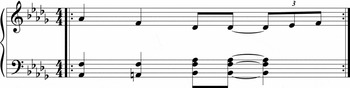
Coltrane's best-known performance is the studio recording from 1960. Like many great reimaginings, it begins with a complete change of the frame: we have no idea “Body and Soul” is coming. This new world opens with a McCoy Tyner minor vamp (Example 4) and then an A-flat pedal on the beat from Steve Davis on bass, before a rather ordinary swing pattern from Elvin Jones's drumming completes the groove. In this context, Coltrane's version of the melody needs to be recognizable, and it is. He plays with the elements of the melody (we hear the opening whole-step interval three times before the upward fifth), and the harmonic modifications force a few changes, but the tune is clearly “Body and Soul.” Rhythmically, it is balanced between the lazy half-time feel of the piano, bass, and melody, and the “double-time” drums—all the more remarkable given that the harmonic pattern we know so well has been extended and disrupted. The slower underlying tempo (76 bpm) also contributes to this balance between half and double time. Unlike the James Moody version from 1959, for example, which is doubled from the beginning, this version does not feel like it belongs in the same “jump” tradition.
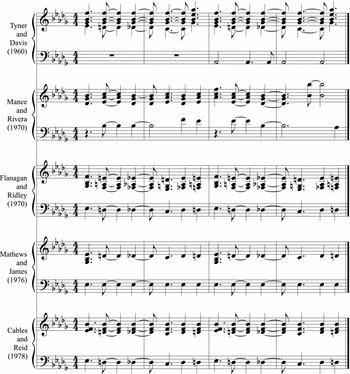
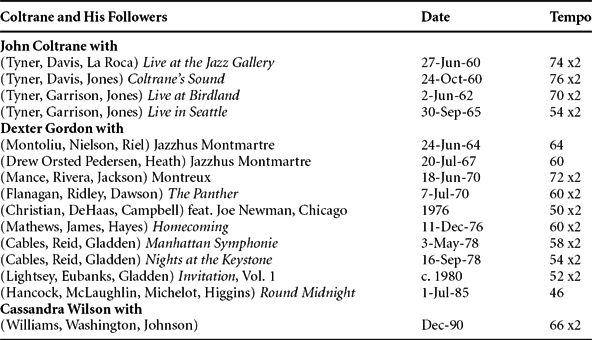
Opening piano and bass vamps by McCoy Tyner and Steve Davis (on Coltrane's Sound, 1960), Junior Mance and Martin Rivera (on Dexter Gordon with Junior Mance at Montreux, 1970), Tommy Flanagan and Larry Ridley (on Dexter Gordon's The Panther, 1970), Ronnie Matthews and Stafford James (on Dexter Gordon's Homecoming: Live at the Village Vanguard, 1976), and George Cables and Rufus Reid (on Dexter Gordon's Nights at the Keystone, Vol. 3, 1978).

This version remains in the traditional D-flat, but the extended dominant pedal and the modal extensions in the piano allow Coltrane to reinvent the melody. The bridge begins normally, and the usual harmonic motion resumes in the bass, but in bars 3 and 4 (and similarly in bar 7), Tyner inserts a brief “Giant-Steps” cycle of thirds to add even more key changes: D–F7–B-flat–D-flat7–G-flat–A–D.
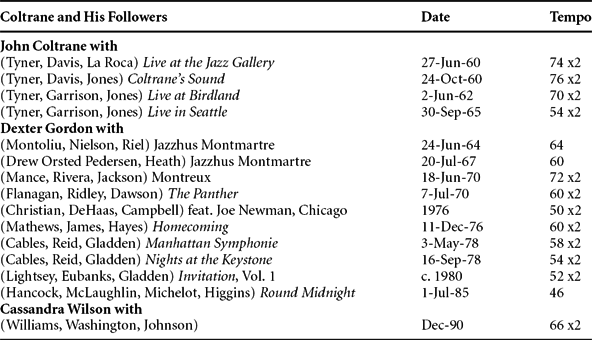
Other than the studio recording, Coltrane recorded three live versions. The first is a private recording from the Jazz Gallery in Greenwich Village made only a few months before the studio version and with the band personnel in transition. After leaving Miles Davis in April, Coltrane opened on his own at the Jazz Gallery for a ten-week run on 3 May 1960 with Steve Kuhn on piano, Steve Davis on bass, and Peter Sims “LaRoca” on drums. Tyner replaced Kuhn at the end of May; this recording, from 27 June 1960, reveals the infancy of their five-year relationship.Footnote 29 Still, most of the features of the studio arrangement are already set. Although the performance starts without any opening vamp, the harmonic and rhythmic patterns are in place. Coltrane takes an extra solo chorus here before handing off to Tyner, but the ending, where Coltrane returns to play a final B A and then a coda, are also present. Each of the two remaining live recordings is a little slower and more intense (see Table 3). Tyner and Jones have now been playing with Coltrane and each other for years instead of months, and Jimmy Garrison has replaced Davis at the end of 1961. By the time of Live at Birdland in 1962, Jones and the entire band are more aggressive in their “Body and Soul” from the beginning, and Coltrane plays more notes but less melody, instead inserting intense “sheets of sound.”Footnote 30 The arrangement and the format, however, remain constant, with Coltrane taking the first solo followed by Tyner, and with Coltrane returning for the last B A and the Quartet's usual coda. Then, however, a live recording made in Seattle in 1965 is more than twice the length, with a group that now includes Pharaoh Sanders on tenor and a second bassist, Donald Rafael Garrett (who plays long bowed tones on this performance). Jones is much more subdued here with an even slower tempo (54 bpm), but the solos from Coltrane and Tyner are more intense. After an extra solo from Sanders, Coltrane still returns at the bridge to close the piece in their usual fashion.
Recordings by John Coltrane and others using a new modal vamp and chord substitutions (see Example 4). All performances are in D-flat, and all of the tempos correspond to the melodic/harmonic movement (and so are consistent with those in the other tables). In all cases the drums are in a double-time feel, so the entire performance feels faster despite the slower harmonic tempo marked.
Coltrane's new performances of “Body and Soul,” however, would remain largely hidden, for many of the 1960 studio recordings were released only gradually as individual albums over time. Instead, My Favorite Things was released in March 1961, followed by Coltrane Plays the Blues in 1962; only in 1964, with Coltrane's Sound, was “Body and Soul” included on a commercial album.Footnote 31 Only at this point can we hear the performances and the development of Coltrane's performance tradition in sequence. Before the release of the studio recording in 1964, this tradition could only have been transferred through a live performance.Footnote 32
Dexter Gordon knew Coltrane's playing well, and he went on to both preserve and transform Coltrane's “Body and Soul” legacy. Yet living and working in Europe during the 1960s, he might have had to wait for the 1960 studio recording to be released in 1964 to hear Coltrane's version. But surely he encountered it soon thereafter. Still, Gordon's live recordings from Copenhagen in 1964 and 1967 are both standard renditions (64 and 60 bpm respectively). Before considering Coltrane's version as a potential model, Gordon liked to start and end “Body and Soul” with a solo cadenza that led into a true ballad. At some point, he encountered or reencountered Coltrane's version and began to adapt it into his own performances. The transformation begins with a recording from the Montreux Jazz Festival with Junior Mance on piano in 1970. The rhythmic approach is Coltrane’s: a piano vamp in dotted quarters over two bars, a bass pedal, and swing drums (see Example 4). Here, however, the piano vamp does not include Tyner's chromatic motion, and the bass pedal is B-flat. Gordon adds Coltrane's substitution of G-flat minor for G-flat major in the third bar (single time) of the A section, adopts the resulting melody change from A-flat to A-natural, and includes chord additions from “Giant Steps” in the bridge.Footnote 33 Gordon abandons his opening solo cadenza, substituting Coltrane's opening vamp, but he preserves his own final cadenza. His cadenzas were already longer than Coltrane’s, but Gordon also filled them with quotes from other songs. His cue for the band's last note (in all of his recordings before the 1978 performance at the Keystone Korner) is a final quotation from “Four” by Miles Davis.Footnote 34
A month later, Gordon enters the studio with another new rhythm section (Tommy Flanagan on piano, Larry Ridley on bass, and Alan Dawson on drums) and again records “Body and Soul” for the album The Panther (1970). This time both Ridley's bass and Flanagan's piano create a vamp that emphasizes the chromatic movement that had been excised from the Mance version (see Example 4). By the 1976 recording at Chicago's Jazz Workshop, Gordon himself is doubling the chromatic bass line (taking it up a fourth at the end of the vamp, after first singing it to the band before they start). At the end of that year at the Village Vanguard in New York, the piano plays this chromatic line (later joined by Gordon in unison and then up a fourth) while the bass pedals the tonic (see Example 4). In 1978, two club recordings with the same rhythm section use the same chromatic vamp, but now with more common chord tones in the piano (B-flat and F), which bring these versions closer to the original Tyner vamp (see Example 4). All of these performances feature the Coltrane harmonic changes and additions. Gordon's final recordings from 1980 and 1985 (the last one for the film Round Midnight) use the same devices in gradually slower tempos. By 1985 any hint of double-time feel in the vamp has gone, and we are left with a very slow ballad version of the Coltrane rendition.
Despite Gordon's dedication to them, Coltrane's innovations have not become a permanent part of the tune. More typical in the history of a new tune, an early innovation has a greater chance of becoming the tradition. In the beginning, vocal, big band, hula, or novelty piano versions all seem equally “normal,” and there is little to define the appropriate performance style. Gradually, however, a cultural norm or center of gravity is created—a performance tradition that sets a normative tempo, structure, or melody—and innovations can now seem like deviations. As time goes by, new innovations have more tradition to move, and they become less likely to join the permanent tradition of the tune. Like most “Body and Soul” innovations, the jump chorus and the Coltrane version are imitated for a while and then abandoned.
As a performance tradition solidifies, it demands more imagination to rethink a tune and create innovation, as Coltrane does. The payoff for the effort is that against the backdrop of tradition, an innovation/deviation becomes easier to hear. It also creates new choices for younger players. As new players hear things they like in older performances, they often reproduce and alter them to fit new contexts.
Dexter Gordon “likes” Coltrane's introduction and chord substitutions, so he simply integrates them into his own unique performances. Current legal standards might call this practice “stealing,” but in jazz, this sampling or reproducing is common and even seems to honor the original: it is the means by which innovations are preserved and turned into traditions. In an oral culture, tunes become indistinguishable from their performances.Footnote 35 In jazz, tunes can change.
A Better Key? A Slower Tempo
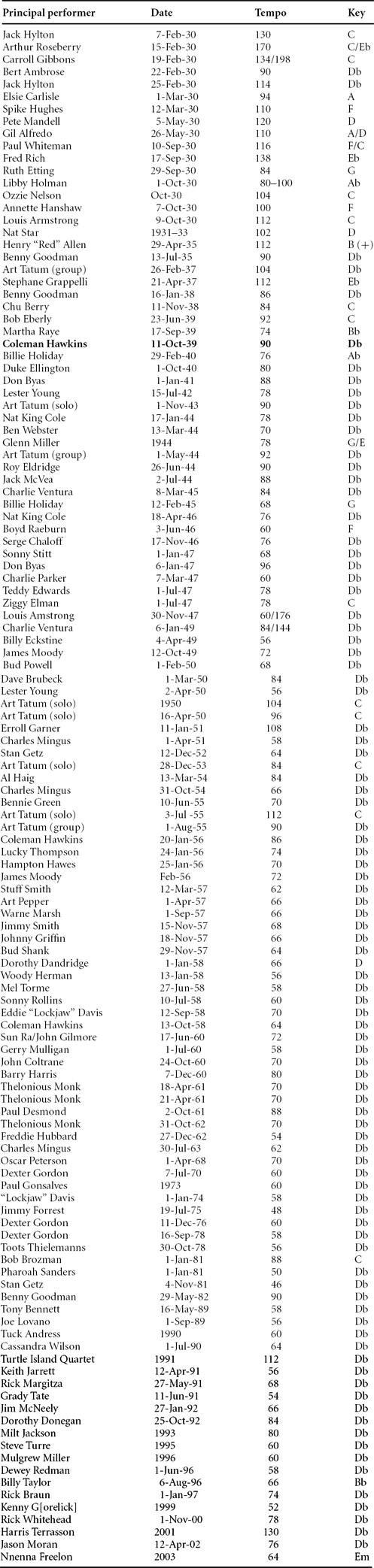
Is D-flat a “better” or more “authentic” key for “Body and Soul” than C (or any other key)? The early performances occur in a wide range of keys, including Jack Hylton's first recording in C and Bert Ambrose's in D-flat two weeks later, but after Coleman Hawkins played it in D-flat, it became the canonical key (see Table 4.) Were later players simply honoring (canonizing?) Hawkins's accomplishment by playing the tune in “his” key? Or was the key perhaps something of a talisman, and later players hoped it would provide luck and make their recording a hit? Could there be a desire to prove that you too can play in five flats?
Recordings made both before and after Coleman Hawkins's first recording in 1939 (shown here in bold), with principal performer, date, tempo and key. Art Tatum is a rare performer who recorded the piece in both D-flat (before it was the canonical key) and in C, which he seemed to prefer later in life.
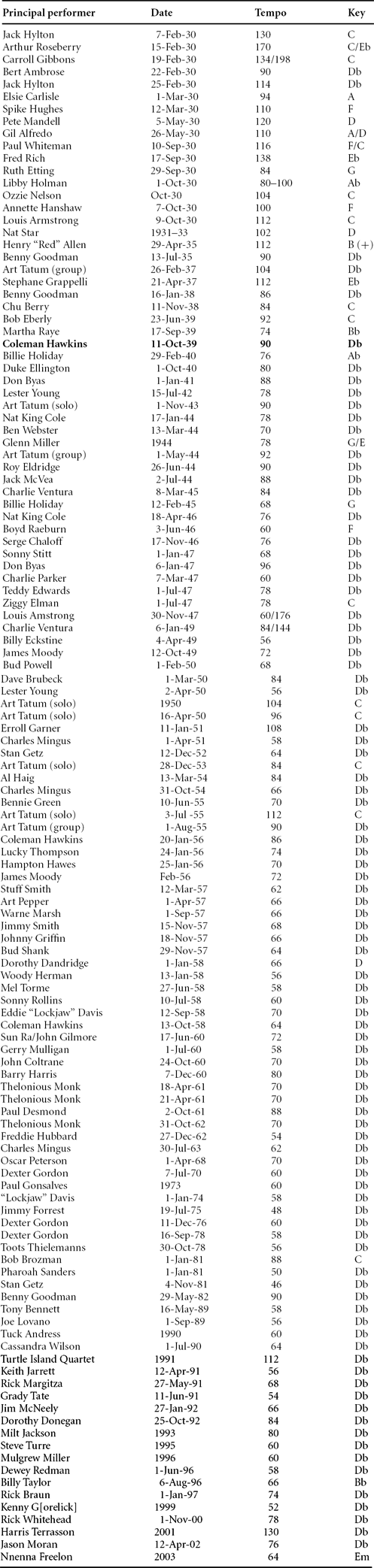
It can be argued that D-flat is either a harder key or an easier, more convenient one. For B-flat instruments, concert D-flat transposes to only three flats in E-flat, whereas C becomes the awkward D with two sharps. Indeed, one of the few post-Hawkins versions in C is for steel guitar.Footnote 36 Piano players (Art Tatum, for example) often like D-flat because of the way it positions the hand: long fingers on the black keys and the shorter thumbs on the white ones. Tatum, perhaps in an even greater feat of bravado, made multiple recordings of “Body and Soul” in both C and D-flat (see Table 4).Footnote 37 His first recording, in 1937, was in D-flat, before that key was canonical, whereas his later solo performances are in C, a rarity after Hawkins. The group performances are all in D-flat (including the recording with Lionel Hampton and Buddy Rich from August 1955, a month after he had recorded the piece as a solo in C), suggesting perhaps that others were not as comfortable with what was now the unusual key of C.Footnote 38 Of course, because the bridge modulates up a half-step, any comparative advantage is at least briefly lost; B-flat instrument players must play in four sharps for four bars.
If the “original” key (on the sheet music) was C, why does D-flat carry more authority in the jazz community? Even if D-flat is “easier” for saxophonists or pianists, why would “easier” be better? In jazz, harder might equally be considered “better.” Eric Friedwald reports that Johnny Green wrote “Body and Soul” in D-flat, preferring the key “where all the jazz guys played” and suggesting that a harder key is more authentic for jazz players.Footnote 39 Jimmy Heath thought it was just a better sounding key for the tenor sax: “The older tenor players like Hawkins and Webster played in the key of D-flat because it was the heaviest key for tenor—gets the best sound. ‘Body and Soul,’ all those tunes were in D-flat. Duke wrote a lot of tunes in D-flat.”Footnote 40 There might also be a practical explanation. Hawkins's recording was the most widely distributed jazz improvisation of its time, and surely countless musicians played along with the record. Practicing to a record was something new. Jazz had been passed along orally and aurally, and players had to catch what they could in real time. Now, for the first time, here was a solo everyone wanted to dissect and learn preserved in a new format that made it easier. By playing along with the record, perhaps musicians simply learned the piece in D-flat. Although there may not have been any authoritative sheet music, the physical record may have acted here as its own authority.Footnote 41
Whatever the reason, almost all recordings after 1939 are in D-flat. Although having a standard key seems practical, such standardization seems to violate the jazz aesthetic of asking players for unique renditions. In new arrangements and recordings, especially for big band or large ensemble, we would expect some variety of key, and in fact the recent history of “Body and Soul” demonstrates some of this variety (see below and Table 6). For decades, however, the weight of Hawkins's canonical performance sustained an unusually uniform tradition.
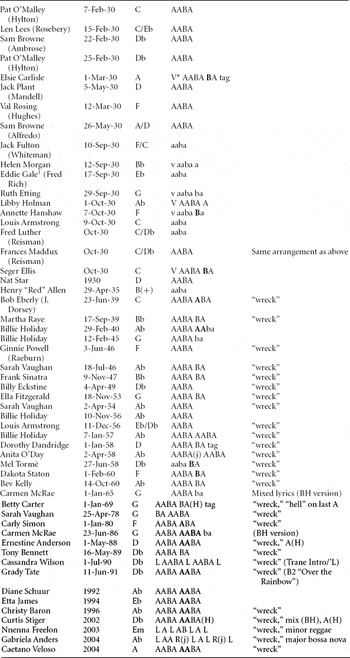
Sample vocal recordings, including singer (with the band leader in parentheses, if applicable), recording date, key, structure, and version of the lyrics. KEY: AABA = original British lyrics (version 1); aaba = American lyrics (version 2; see figure 1). V = verse with British lyrics; v = verse with American lyrics. A or B in bold = section performed by instruments only. (j) = jump. A(H) = “hell” sung in the final A section. BH = text and structure from Billie Holiday's 1940 studio recording. L = “lude” (from “interlude”): a short, repeated phrase or vamp that can be played in more than one place. R = refrain.

1According to Friedwald, Dick Robertson sings the verse. See Will Friedwald, Stardust Melodies: The Biography of America's Most Popular Songs (New York: Pantheon Books, 2002), 158.
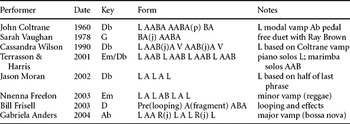
Innovations in performance, which tend to focus on breaking down the formal structure. L = “lude” (from “interlude”): a short, repeated phrase or vamp that can be played in more than one place. (j) = jump. R = refrain.

Key should vary even more widely for singers, who generally prefer (sometimes insist) on singing jazz tunes in the keys that most suit their own voices.Footnote 42Table 4, however, demonstrates that Hawkins's D-flat and Holiday's key of A-flat occur more often than any other, even for singers (see also Table 6). In this case, it appears that the authority of Hawkins or Holiday, rather than any authenticity to oneself or an original, determines the key performers choose. The “Real Book” (initially an underground collection of lead sheets passed among students at the Berklee College of Music as a shortcut to learning tunes) also developed its own authority in the 1970s for standard keys. Nonetheless, the overwhelming prominence of D-flat, even in an arrangement immediately after the Hawkins recording and by such a range of highly skilled professional players (such as the Turtle Island String Quartet in 1991), is striking and underlines the authority of Hawkins's recorded source.
The authority given Hawkins's key, however, does not apply to either his tempo or form, both of which have settled into various traditions. Table 4 demonstrates that the tempos were initially much faster and more varied, but after Hawkins, the tune gradually became a ballad. Hawkins's performance clearly has an effect on the tempo, but his tempo does not stay canonical: “Body and Soul” slows down even more in the next decades, with tempos of quarter note = 70, 60, 50, or lower becoming common. Performance traditions seem to respect the authority of a great or popular performance, but not all elements are selected.
Indeed, Hawkins's “Body and Soul” holds a place in jazz history akin to Beethoven's Ninth Symphony in the western tradition. Like the symphony, it opened new vistas for later artists while simultaneously making the possibility of following his paths intimidating. Hawkins's performance gained an aura and authority to jazz musicians that is hard to overstate. It defined a new “model of the progressive jazz improviser-as-virtuoso,” with techniques and ideas that would inspire a new style.Footnote 43 The fame surrounding his performance only added to what Gunther Schuller called Hawkins's “overwhelming, permanent and unquestioned” hold on all who followed him.Footnote 44
Initially, both Hawkins's tempo and key are reproduced in subsequent recordings, but it is impossible to alter a key gradually, and so the key remains canonical until the twenty-first century, when players start to alter the tune more radically (see below). The tempo, however, continues to gradually slow down.Footnote 45 The tempo change may, of course, equally be under the authority of some other slower performances, perhaps Ben Webster's commanding response to Hawkins from 1944. By contrast, Charlie Parker played and recorded “Body and Soul” many times (see Table 2), but he used the slower tempos to play in double time, and none of his recordings of the piece was widely distributed.
A more likely influence for the slow tempo may be Lester Young (1942 and even slower in 1950, see Table 4). In 1933, Hawkins was featured with Fletcher Henderson as the “Greatest Saxophonist in the World.” When the band stopped in Kansas City, Hawkins had perhaps his first cutting contest with Young and Ben Webster, held at the Cherry Blossom Club.Footnote 46 When he had returned from Europe at the end of July 1939, he made the rounds of New York clubs and announced, “I didn't hear a thing that was new.”Footnote 47 There was general agreement that his only real rival was Young, and their duel in August was a major event in the jazz world. Responses to the duel varied widely, which is not surprising given that they represented two such different and important ways forward.Footnote 48 With public (or at least saxophone) opinion focused on the prominence of these competing titans, Young's performances and first recording of “Body and Soul” could hardly avoid comparison with Hawkins’s. Even so, Young makes no attempt to mask the recent performance history of the tune, beginning with a piano introduction and then a direct reference to Hawkins (see below and Example 4). In the end, what remains of Young's influence on “Body and Soul” are his slower tempos. One of greatest saxophone descendants, Stan Getz, used slower tempos in his 1952 and 1981 recordings (see Table 4), perhaps as homage to Young. Or perhaps the slower tempos were only a way (maybe unconscious) to create some distance from the most famous version of “Body and Soul” ever recorded. The paths of tradition are often easier to see than their causes.
Lyric Choices
Another place where competing authorities appear is in the choice of lyrics. Like tempo, key, and form, lyrics seem another completely independent choice for performers, but again, there is a history that informs these choices and ties them to authoritative recordings.
The British recordings from the spring of 1930 all use the original version of the refrain lyrics (given as “Version 1” in Table 5 and with capital letters—AABA—in Table 1 and Figure 1 below). The British sheet music, copyrighted on 18 February, lists Heyman, Sour, and Eyton as lyricists and provides a set of refrain lyrics and two verses.Footnote 49
Then, in the summer of 1930, the song was added to the Philadelphia tryouts for a new Broadway revue, Three's a Crowd, with songs mainly by Arthur Schwartz and Howard Dietz. “Body and Soul” was almost cut, but Robert Sour and Edward Heyman wrote several sets of lyrics to try and save its place in the show.Footnote 50 The first American recording (with Jack Fulton and Paul Whiteman) in September of 1930 uses a version of what Sour and Heyman had written in Philadelphia (version 2 and in lower case letters—aaba—in Table 5 and Figure 1 below). The other recordings from September 1930 (Helen Morgan, Eddie Gale, and Ruth Etting) all use this same set of lyrics, with Morgan being the first to record the new verse.Footnote 51 These lyrics are in the American sheet music, in the key of E-flat and with only Heyman and Sour receiving credit for them, copyrighted on 14 October 1930.
With the published versions creating a more complicated set of lyric choices in 1930 (there is even a second refrain in the American sheet music, which has never been recorded),Footnote 52Tables 5 and 6 show what they looked like to singers. There were two versions, one with an original British pedigree, and a second American version that now dominated. In October (before the American copyright was submitted), Libby Holman reverted to the original British lyrics and gave future singers a second recorded choice. “Body and Soul” arrived in two chart-topping versions using different words.
Both sets of lyrics were undeniably suggestive, and both versions were initially banned from American radio. Version 1 contains the most provocative line: “My life a hell you’re making” (to rhyme with “You know I’m yours for just the taking”), but the version 2, the American re-write, does little to tone down the suggestion that we should take the words “I am yours, body and soul” any less than literally. Version 2 contains an additional rhyme scheme in which the third line of each verse also rhymes:
Version 2 makes more use of metaphor, substituting “My house of cards had no foundation” for “And wondering why it's me you’re wronging,” and it has a significantly more picturesque bridge. Neither version seems “better,” however, and neither could be sung on the radio, so why the switch? Given the quality of both (and their individual historical pedigrees), we might expect still to hear different singers choosing one or the other.
Initially, that is precisely what happened. In October 1930, Leo Reisman recorded the same arrangement twice with different singers to be released on the same day.Footnote 53 Listeners had their choice of male singer Fred Luther singing version 2 or female singer Frances Maddux singing version 1. Meanwhile, Louis Armstrong used both sets of lyrics, but importantly, he recorded version 2 in 1930 (when this choice was more popular) and then version 1 in 1956 (when it had become the popular choice).
By 1939, however, American sensibilities toward the lyrics had changed. Whereas the word “hell” had been acceptable in a pop song in 1930, it had apparently become too risqué; the versions by Bob Eberly and Martha Raye that year substituted “wreck” for “hell.” The British version of the lyrics with its best line neutered to “wreck”—is the one that stuck (see Table 6). Billie Holiday was left uniquely willing to sing “hell” after 1939. She also recognized the value of both sets of lyrics and was the first to combine them.Footnote 54 Like most jazz singers, Holiday neglects the verse and sings a chorus and a half, repeating the bridge and the closing A section either directly or after two instrumental As. But she cleverly switches to the American version on the return, creating the verbal pattern AABA ba or AABA AAba, where the darker bridge lyrics and final American “a” seem to extend the song and create a complete narrative. It seems a perfect aesthetic solution from an authoritative and admired singer. We would expect it to be widely copied.
Instead, both Frank Sinatra and Sarah Vaughan adopt Holiday's AABA BA structure while simply repeating the British set of lyrics. This version becomes the closest thing to a vocal tradition in later years.Footnote 55 Only a few singers imitate Holiday's mixing of lyrics, however (see Table 6). Mel Tormé stands alone in starting with the American version and then ending with the British, but still with “wreck.” Ernestine Anderson, Betty Carter, and Curtis Stigers all sing only the British, using “hell” in the final A. Only Carmen McRae follows Holiday in her lyric choices, including the use of “hell.”
Although Holiday's promising mixing of lyrics is largely ignored, her choice of key seems to carry some weight. Singers are more eager (for the reasons discussed above) to personalize the key than instrumentalists, but both D-flat and A-flat (Holiday's preferred key) appear more often than other keys. Even new large ensemble arrangements (such as the big band Anita O’Day version from 1958) often occur in these authoritative keys. In sum, form, key, tempo, and choice of lyrics all seem to change independently of each other. Later players adopt Hawkins's key but not his tempo. Singers adopt Billie Holiday's AABA ba form, and some even use her key of A-flat but omit her use of both versions of lyrics or her re-introduction of “hell.” Although the performances remain authoritative, performers clearly feel able to pick and chose which parts of the tradition they wish to incorporate in their own performance.
Honoring Hawkins and Dissecting the Form
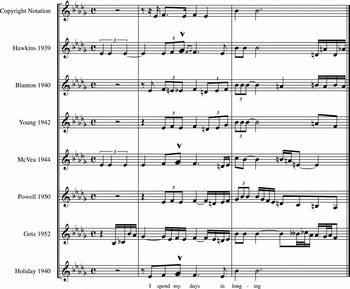
Although Coleman Hawkins's 1939 version is famous for making reference to the melody only in the first two bars, his particular version of those bars is widely imitated. Hawkins opens and closes his first phrase with three repeated notes (see Example 5). Jimmie Blanton (with Duke Ellington, 1940), Lester Young (1942), Bud Powell (1950), and Stan Getz (1952) all refer to Hawkins by quoting this three-note repetition in the second bar of the melody. Jack McVea (1944) not only imitates the opening, but also plays a version of the melody that seems more a paraphrase of Hawkins's than of any standard (or original) version.
Melodic versions of the opening two bars of “Body and Soul” transposed to D-flat: U.S. copyright (1930), Coleman Hawkins (1939), Jimmie Blanton with Duke Ellington (1940), Lester Young (1942), Jack McVea (1944), Bud Powell (1950), Stan Getz (1952), and Billie Holiday (1945).

This form of signifying or referring to the authoritative does two things: it pays respect to Hawkins and demonstrates that the performer is “in the know” about the tradition. Just as scholars sometimes use quotation to bolster a thesis while simultaneously demonstrating how well-read and perhaps multilingual the author is, citing the Hawkins solo looks like a gesture of humility, while also distinguishing the player as someone knowledgeable about the tradition. Convention in both jazz performance and scholarship holds that a quotation should be acknowledged or at least easily recognized as such. Kenny G almost surely crosses a line when he repeats note for note in his second A section all of what Stan Getz plays in his first A.Footnote 56 Instead of a quotation with reference, this gesture appears more like musical plagiarism.
Singers, of course, cannot perform Hawkins's figure without adding more words, but Hawkins left another marker: he changes the third note of the tune from E-flat to G-flat (see Example 5). Billie Holiday often sang it this way, and many players make the same change, including Jack McVea.
Later performers face standard tunes laden with these traditions. Knowing which versions to honor and that the printed versions carry little weight are all part of learning jazz culture. Many innovations have already been tried, and an inexperienced musician's new version may not be as unique as it sounds without adequate knowledge of precedent. The easiest way to make an obviously new version is simply to change the rhythmic setting or the context. Klezmer, polka, tango, and wedding bands have all adapted “Body and Soul” for new audiences. It should be no surprise that there are smooth jazz and hula versions.Footnote 57 These performance innovations, however, are usually attempts to connect with audiences outside the jazz mainstream and are unlikely to be adopted within the central tradition or set a new style. They do not contribute to a performer's “sound” or what Travis A. Jackson calls “iconicity of style.”Footnote 58 What then, is a new player to do?
Jazz musicians have prized “Body and Soul” for its complex harmonic movement and our most exalted performance, by Coleman Hawkins, exploits this potential to the maximum. Paradoxically (or perhaps as a reaction) the most radical new performances attempt to rework the form with modal or vamp sections (marked as “V” for vamp or “L” for interlude in Table 6) that attempt to suspend the harmonic progress of the tune. Coltrane's modal vamp and A section can be considered the first move in this direction, even though he included third cycles in the most static measures of the bridge, which added more harmonic movement. On the other hand, Cassandra Wilson's adaptation spends most of its time (sixty percent of the almost eleven minute total) playing with Coltrane's modal vamp.Footnote 59
Two other contemporary vocalists adapt Coltrane's strategy of emphasizing long, single-chord grooves, but they also radically deconstruct the tune. Nnenna Freelon (2003) picks the melody apart and eventually creates a recognizable A section as the band maintains an E minor reggae vamp. The one harmonic moment in her rendition is the sole visit to the bridge (in F to maintain the half-step relationship to the A section in A-flat). Argentinian singer Gabriela Anders (2004) alters the tune even more radically, turning the entire three minutes into one long A-flat major (pentatonic) pedal. She moves the melody to start on the tonic and sings a recognizable A, but instead of a bridge, she stays in A-flat, doubles the pulse, and creates a new “refrain” on the words “I can't believe it, I can't conceive it, you threw away romance.” Jazz (re)adopted the one-chord groove from the soul/funk tradition, and perhaps it is more of a native language to these singers and younger players. Although jazz performers sometimes articulate a resistance to popular music, it remains an influence in jazz performance.
Other performers reframe the tune and neutralize the harmonic complexity by fragmenting its components. For example, Jacky Terrasson (on piano), Stefon Harris (on marimba), and their band (2001) alternate between an E minor vamp (where all of the piano solos occur) and an AAB “chorus” that follows the chord changes (but skips the final A) with the marimba either playing the melody or soloing. To the careful repeat listener, Bill Frisell and his trio (in 2003) play a single chorus of AABA in D, but the first half of the performance is so fragmented with melodic half-step pairs and distorted with loops and electronic effects that he reasonably calls the first A section a “Prelude.” Gradually (starting at 1:17) fragments of the melody (not in their expected harmonic relationships) start to emerge until the performance concludes with the final phrase recognizable and alone on guitar.Footnote 60
Similarly, in his 2002 solo version, Jason Moran condenses all of this tradition and both fragments and atomizes the tune. Moran seems to play with the similarities between the beginning and the final line of the A until he lands on a figure that both combines them and suspends the harmonic motion (see Example 6). He never plays the bridge, and instead solos on both a new vamp and the A. His 2003 live version starts immediately with his vamp and includes the band, but again it alternates between almost finished A sections and this vamp. The vamp melody is a kind of Schenkerian shorthand for the A section: up from E-flat and falling back down to the tonic D-flat. Just as part of the beauty of “Body and Soul” is the way it elides its own tonic (which appears only in the third measure and the final bar of each A), Moran's suspensions keep the tune unsettled, even while concentrating it into a single bar. D-flat is ever present but never resolved. It is a thoughtful and beautiful thesis that is then integrated into its own performance, ending when Moran stops on the penultimate chord.
Jason Moran reduces the tune to this one-bar phrase and uses it as a basis for improvisation and restructuring.

All of these new performances are highly personal responses to both the tune and the tradition. They seem to react against the very harmonic complexity Hawkins helped define in both jazz and “Body and Soul.” Only future performers will determine if any of these mutations will become part of the “new normal.”
Navigating Performance Traditions
Some players consciously adopt the performance traditions of authoritative performers (as Gordon imitated Coltrane), but others no doubt absorb some of these traditions second and third hand. Although singers are likely to continue drawing on Holiday, and tenor players can hardly escape comparisons to Hawkins, it is possible, and even common, to learn about these traditions from anyone on any bandstand—where they may or may not know their origins. Jazz musicians like to tell younger players that they must learn their roots, but knowing the tradition may be enough to impress without really understanding the authority behind every citation.
No score or performance in isolation can really tell us how the tune goes. Any single performance of “Body and Soul” is only an example. Without both Hawkins and Moran, we would have an incomplete understanding of what “Body and Soul” can be. Great performances enhance the tune by creating new possibilities.Footnote 61
Nineteenth-century ideas about the stability of musical works and a transparent performer continue to inform popular conceptions of music and even copyright law, which still dictates that music is created by a composer, who fixes intellectual property in a score or tangible medium. None of this concept applies to jazz, where we care more about the performer than the tune, and traditions are made to be broken. Similarly, notation and lead sheets in jazz are convenient but hardly authoritative. In many cases, the notation was only created after the first performance (as written notation was required to “fix” a composition for copyright protection). Even where notation predates performance in jazz (as with “Body and Soul”), it is not generally authoritative. As with language and other performance traditions, performers learn tunes as performed by others, in the same way that Mikhail Bakhtin says we learn words from other speakers and not out of dictionaries. There are also no neutral words or performances.Footnote 62 Both words and tunes come to us already rich with the inflection and authority of individual performances.
Jazz performances attempt to personalize tunes, but these idiosyncratic innovations may also end up altering the tradition inherited by the next player. Many innovative new ideas were applied to “Body and Soul,” and many of them were reproduced for a short time. A few, like the change of the word “hell” to “wreck” or Coleman Hawkins's use of the key of D-flat, became more permanent traditions.
The recognition of a musical work is more than a legal or phenomenological question; it is also a cultural question. Jazz performers remain in an active dialogue with tradition. As a hybrid music, jazz might more fruitfully be understood from a more African and less European perspective. Jazz tunes are less fixed than Western musical works, and the unique contributions of the performer require more study—not only as aesthetic objects, but also as cultural ones. Jazz performances are more than just “versions” of tunes: performer innovations routinely become part of the tune's tradition. Other players and audiences decide what remains in the tradition, and the performing tradition contains voices that speak with competing levels of authority. Who is speaking is important. Performers learn tunes as performed by others, but the question of exactly which others is complex.
If we want our students to “know” “Body and Soul,” then we must present the tune in its wide variety of innovative and influential performances. Notated scores have the advantage of giving us a stable object of study, but then we miss the complicated, contradictory, and ongoing history of performances. Tunes change. Using sound recordings as the primary sources in jazz can help us understand why we play what we play, but it can also help us recover its deeper history.