





1. Introduction
It is common knowledge that bilingual first language acquisition follows the same developmental trajectory as monolingual first language acquisition, although it may progress somewhat more slowly. This more protracted development is generally attributed to the fact that, in theory, bilingual children receive quantitatively less input in each language than their monolingually raised peers (Tsimpli, Reference Tsimpli2014). Complex linguistic phenomena that are acquired late in monolingual acquisition are particularly affected by input effects and protracted development in bilingual acquisition settings, as they involve context-dependent variation, requiring the integration of information from different linguistic domains (Rinke et al., Reference Rinke, Flores, Torregrossa, Polinsky and Putnam2024; Tsimpli, Reference Tsimpli2014). The appropriate use of null and overt pronouns in null subject and null object languages is one example of late acquisition. It has been shown that monolingually raised children acquiring European Portuguese (EP) deviate from adult-like norms at school age for null subjects (Lobo & Silva, Reference Lobo and Silva2016; Rinke & Flores, Reference Rinke and Flores2018) and for null objects (Costa & Lobo, Reference Costa, Lobo, Baauw, Drijkoningen and Pinto2007; Flores et al., Reference Flores, Rinke and Sopata2020). Bilingual children may take even more time to acquire the adequate context-appropriate use of null and overt subjects and objects (Paradis & Navarro, Reference Paradis and Navarro2003; Rinke & Flores, Reference Rinke and Flores2018; Serratrice, Reference Serratrice2007: Shin et al., Reference Shin, Cuza and Sánchez2023; Sopata et al., Reference Sopata, Rinke and Flores2024; Sorace et al., Reference Sorace, Serratrice, Filiaci and Baldo2009). Hence, examining late-acquired phenomena in bilinguals is like zooming in into the mechanisms underlying the late stages of grammatical development in bilingual as well as in monolingual acquisition.
This study explores the production of null and overt pronouns by child heritage speakers of EP, focusing on subject–object asymmetries in written narratives of 10- to 12-year-old EP–German bilinguals living in Switzerland. By examining a population that has already passed the early stages of acquisition but may still be consolidating late-acquired phenomena, the present study contributes to our understanding of how late stages of grammatical development unfold in bilingual contexts and how they compare to monolingual development. We compare their use of subject and object pronouns with that of age-matched monolingual peers, examining how the two groups handle variation in the subject and object domain. In particular, this study aims to investigate what determines variation in bilingual production. We show that although the production of subject and object pronouns by bilingual and monolingual children differs in some respects, the observed variation is systematic and can be linked to general linguistic principles governing reference and discourse integration.
2. Theoretical background: Subject and object realization in monolingual and bilingual language acquisition
EP is a null subject and a null object language, allowing for the omission of subject (1a.) and object (1b.) pronouns under specific conditions.
(1) a.
Ontem
(eles/elas)
visitaram
a
cidade.
yesterday
(theymasc./fem.)
visited
the
city
“Yesterday, they visited the city.”
b.
Looking at a book in the bookstore:
Vais
comprar ø
/comprá-lo?
will
buy __
/buy-it
“Will you buy it?” (Barbosa et al., Reference Barbosa, Flores, Rinke, Barbosa and Flores2025)
Target-like use of overt and null subjects and objects requires the integration of syntactic and pragmatic/semantic knowledge and is acquired relatively late in EP, as we will briefly outline in the following sections.
2.1. Subjects
In general, in EP as in any null subject language, null subjects are the unmarked option of pronoun use, whereas overt subjects tend to be the marked choice, for example, in emphatic or contrastive contexts.Footnote
1 Adult speakers preferentially use null subjects when the topic of the preceding clause is carried over to the topic of the following clause (topic continuity, TC). Overt subject pronouns are employed when a new topic is established (topic shift, TS) (see Barbosa et al. Reference Barbosa, Flores, Rinke, Barbosa and Flores2025 for EP). In example (2), a null subject in the subordinate clause would preferentially be interpreted as referring to the subject of the preceding main clause (
a mãe
“the mother”) and an overt pronoun to the object (a avó “the grandmother”).
(2)
A mãe
cumprimentou
a avó
quando
pro/ela
the mother
greeted
the grandmother
when
pro/she
entrou
na
cozinha.
entered
in-the
kitchen
“The mother greeted the grandmother when she entered the kitchen.” (Lobo & Silva, Reference Lobo and Silva2016: 327)
It has been shown that children acquiring EP in a monolingual environment master the pragmatic constraints governing subject realization very late, approximately by the age of 9 years (Lobo & Silva, Reference Lobo and Silva2016). In particular, they take long to acquire the interpretation of overt subject pronouns, which are mastered later than the interpretation of null subjects and tend to be overextended to contexts of topic continuity (see Lobo & Silva, Reference Lobo and Silva2016; Rinke & Flores, Reference Rinke and Flores2018). Rinke and Flores (Reference Rinke and Flores2018) attribute this delayed stabilization of overt subject use to the complexity of overt subject pronouns in EP, which display greater variability in the adult language, as they can function either as weak or strong pronominals, depending on various factors. For example, topic continuity interpretations with overt pronouns are more likely in the adult target language in non-ambiguous contexts with only one potential antecedent given in the context (3a) or in two adjacent main clauses (intersentence contexts) like (3b) (Morgado, Reference Morgado2013; Rinke & Flores, Reference Rinke and Flores2018 for EP; see Alonso Ovalle et al., Reference Alonso Ovalle, Fernández-Solera, Frazier and Clifton2002 for Spanish).
(3)
a.
A mãei
tropeçou
quando
ela
i
entrou
na
cozinha.
the mother
stumbled
when
she
entered
in-the
kitchen
“The mother stumbled when she entered the kitchen.”
b.
A Sóniai
telefonou
à
Susana.
Como
sempre
ela
i
the Sónia
called
to+the
Susana.
as
always
she
está
atrasada
is
late
“Sónia called Susana. As usual she is late.” (Rinke & Flores, Reference Rinke and Flores2018)
Null subjects do not exhibit the same variability and context-sensitivity as strong pronouns in EP. As shown by Lobo and Silva (Reference Lobo and Silva2016) and Rinke and Flores (Reference Rinke and Flores2018), monolingual children master their interpretation earlier and with less variation than that of overt subject pronouns in EP.
There is abundant research on the acquisition of subject realization by bilingual children. The majority of these studies focused on bilingual children with a dominant non-null subject language (e.g. English or German) and a non-dominant null subject language (e.g. Italian or Spanish) (e.g. Sánchez et al., Reference Sánchez, Goldin, Hur, Jimenez, López Otero, Thane, Austin and Markovits Rojas2023, for Spanish–English; Serratrice et al., Reference Serratrice, Sorace and Paoli2004, for Italian–English; Argyri & Sorace, Reference Argyri and Sorace2007, for Greek–English bilinguals). In general, these studies have revealed a tendency for bilingual children to overuse overt subject pronouns in their null subject language during prolonged stages of acquisition. Some researchers explain this outcome in terms of cross-linguistic influence (CLI) from the non-null subject language on the null subject language, (e.g. Argyri & Sorace, Reference Argyri and Sorace2007; Serratrice et al., Reference Serratrice, Sorace and Paoli2004). Other authors attribute differences between monolingual and bilingual speakers in the use of referential expressions to bilingual processing (Kaltsa et al., Reference Kaltsa, Tsimpli, Marinis and Stavrou2016; Sorace, Reference Sorace2011; Torregrossa et al., Reference Torregrossa, Andreou, Bongartz and Tsimpli2021). Many studies have confirmed that the use of overt pronouns is more challenging than null subjects as bilinguals generally perform similarly to monolingually raised speakers with respect to null but not overt subject pronouns (e.g. Paradis & Navarro, Reference Paradis and Navarro2003, for a Spanish–English bilingual child; Serratrice et al.’s (Reference Serratrice, Sorace and Paoli2004), for a bilingual English–Italian). A study by Rinke and Flores (Reference Rinke and Flores2018) on the comprehension of null and overt subject pronouns by German–Portuguese and Spanish–Portuguese bilingual children and teenagers showed that bilingual – but also monolingual – children differ in all overt pronoun conditions from the monolingual adults, revealing a stronger tendency to interpret overt pronouns in terms of topic continuity. Interestingly, this tendency is independent from the contact language German versus Spanish, showing that CLI (alone) cannot explain the results.
A similar tendency is found in a recent study which analysed the written narratives of Portuguese–French bilingual children (Flores & Rinke Reference Flores and Rinke2024). School-age bilingual children performed similarly to age-matched monolinguals in topic-shift contexts (showing preference for overt pronouns), but they differed in pronoun choice in topic-continuity contexts (with an overuse of overt pronouns). This aligns with the generally observed tendency for bilingual children speaking at least one null subject language to overuse overt subject pronouns in topic-continuity contexts but not to overuse null subjects in topic-shift contexts.
2.2. Objects
Null objects are a subtype of missing object constructions, which are found only in some languages, among them EP. In EP, null objects are non-lexically constrained, they can be definite or indefinite, and they lack verb agreement, similarly to Hebrew, Hindi, and many Slavic languages (Barbosa et al., Reference Barbosa, Flores, Rinke, Barbosa and Flores2025). Null objects receive their reference from an entity that is salient and accessible in the discourse (like in example 1 above). According to Costa et al. (Reference Costa, Lobo and Silva2009), they are licensed in a context like (4a), where the antecedent is mentioned in the previous sentence but not in (4b), where the antecedent (“your car”) is not mentioned. A corpus study by Rinke and Kerezova (Reference Rinke and Kerezova2024) confirms that the likelihood of a null object increases if the antecedent is explicitly mentioned in the previous sentence. However, there are also some examples in which the antecedent is mentioned in the more distant previous discourse context.
(4) a.
E
o
teu
carro?
Tive
de levar
Ø
para
a
oficina.
and
the
your
car
had
to take
to
the
repair shop
“And your car? I had to take it to the repair shop.”
b.
Estás
com
ar
chateado. /
#Tive
de levar
Ø
para
a
oficina.
are
with
look
upset
had
to take
to
the
repair shop
“You look upset. / #I had to take it to the repair shop.” (Costa et al., Reference Costa, Lobo and Silva2009)
Another factor contributing to the production of null object constructions is the animacy of the referent. In a corpus study with monolingual and bilingual adults of different age groups, Rinke et al. (Reference Rinke, Flores and Barbosa2018) found a strong tendency to realize clitics with animate antecedents and null objects with propositional and inanimate (= less referential) antecedents (although this tendency was less clear in the heritage bilingual speakers investigated in this study). In an acceptability judgement task with monolingual adults, Rinke (Reference Rinke, Barbosa and Flores2025) found no effect of animacy in the realization of clitics. However, the study confirmed that null objects showed a significant tendency to be more accepted with inanimate antecedents. As for the acquisition of direct objects, according to Pérez-Leroux et al. (Reference Pérez-Leroux, Pirvulescu and Roberge2017), at the initial stage of language development, children universally dispose of a null object construction as they base their grammatical representation on a (universal) transitivity requirement (Hale & Keyser, Reference Hale and Keyser2002) for all verbs. Previous research on monolingual language acquisition shows that children acquiring null object languages like EP or Polish show high rates of illicit object omissions until later stages of development (cf. Costa & Lobo, Reference Costa, Lobo, Pires and Rothman2009; Flores et al., Reference Flores, Rinke and Sopata2020; Sopata, Reference Sopata2016; Sopata et al., Reference Sopata, Rinke and Flores2024; Varlokosta et al., Reference Varlokosta, Belletti, Costa, Friedmann, Gavarró, Grohmann and Yatsushiro2016). Using an elicited production task, Varlokosta et al. (Reference Varlokosta, Belletti, Costa, Friedmann, Gavarró, Grohmann and Yatsushiro2016) found that 5-year-old children acquiring EP exhibit 51.6% object omissions and only 19.3% clitic realizations whereas children acquiring other Romance clitic languages like Catalan, Italian, or French hardly show any omissions (up to max. 2.5%). This aligns with an earlier study by Costa and Lobo (Reference Costa, Lobo, Baauw, Drijkoningen and Pinto2007), showing that children acquiring EP omit objects to a higher degree and for a longer period of time than children acquiring other Romance languages. In fact, children acquiring EP have early knowledge of licit and illicit contexts as they produce more object omission structures with third-person than with first- and second-person antecedents and more null objects in licit main clause contexts than in illicit island clauses. However, comprehension experiments also show that they overextend the null object option to island contexts in which a clitic would be required. Costa et al. (Reference Costa, Lobo, Silva, Larrañaga and Guijarro-Fuentes2012) argue that children know the syntax of null object constructions, but they take time to differentiate operator variable relations from pronominal binding. At the same time, children show early pragmatic knowledge and produce more null objects and clitics, adequately avoiding noun phrases (NPs) and strong pronouns when the antecedent is given in the immediate context (Costa et al., Reference Costa, Lobo and Silva2009). This is confirmed by Flores et al. (Reference Flores, Rinke and Sopata2020), who have shown that monolingual EP children demonstrate sensitivity to an antecedent’s accessibility approximately at age 4, when producing null/overt object constructions. The referential properties of null versus overt object pronouns, that is, the tendency of null pronouns referring to inanimate antecedents is mastered approximately at age 7.
With respect to bilingual language acquisition, research on null objects is less extensive than on subjects. A distinction must be made between studies on children acquiring a null object language and those acquiring a non-null object language. For the latter, evidence shows that bilingual children may remain in a target-deviant null-object stage in their non-null object language longer than their monolingual peers (e.g., Pirvulescu et al., Reference Pirvulescu, Pérez-Leroux, Roberge, Strik and Thomas2014). The reasons for this protracted stage and the higher incidence of object omissions in bilingual data remain under debate. One explanation emphasizes cross-linguistic influence. Müller and Hulk (Reference Müller and Hulk2001), for example, argue that the greater frequency of null objects in the French productions of bilingual German–French and Dutch–French children, relative to French monolinguals, reflects influence from the Germanic languages, which allow topic-drop constructions. Similarly, Sopata et al. (Reference Sopata, Długosz, Brehmer and Gielge2021) attributes the increased object omissions observed in early sequential acquisition of German, a non-null object language, to transfer of a generalized discourse strategy from L1 Polish, a null object language. An alternative approach considers higher object omission rates as a by-product of bilingualism itself (Pérez-Leroux et al., Reference Pérez-Leroux, Pirvulescu and Roberge2008; Pirvulescu et al., Reference Pirvulescu, Pérez-Leroux, Roberge, Strik and Thomas2014). Following this account, the reduced amount of input typically available to bilinguals, coupled with variability in the target grammars, prolongs the omission stage by delaying the restructuring of the default representation, eliminating null objects (Pirvulescu et al., Reference Pirvulescu, Pérez-Leroux, Roberge, Strik and Thomas2014).
Even fewer studies have examined object expression in null object languages in bilingual contexts. The available data so far point in the same direction, namely, that child heritage speakers show an overextension of null objects until later stages of development (which may even prevail in adult bilinguals, see Flores & Barbosa, Reference Flores and Barbosa2014). A relevant contribution is the study by Rinke et al. (Reference Rinke, Flores and Sopata2019). Using an elicited production task with bilingual children acquiring Portuguese and Polish as heritage languages with German as the majority language, the study shows that the bilingual children omit quantitatively more objects than age-matched monolingual children and for a longer period of time in their heritage language (HL). The authors conclude that children’s production resembles that of younger monolinguals, pointing to a slightly protracted development. To our knowledge, there is no previous research investigating null objects in written production of children (or adults). The reason is that null objects are in general a feature of the spoken and colloquial language and expected to occur residually in written production or more formal registers. However, as they do frequently occur in the spoken register, we still expect them to occur in written narratives of (younger) school-age children.
Taken together, a comparison of subject and object realization in monolingual/bilingual language acquisition reveals contrasting developmental trajectories. Although it is claimed that the expression of the overt variant (strong subject pronouns, clitic object pronouns) is a source of complexity in both cases, opposing tendencies of realization/omission emerge: In the subject domain, the delayed development primarily concerns overt subject pronouns, which are overused and extended to inappropriate pragmatic contexts of topic-continuity. This results in a prolonged stage of over-realization of subjects. In contrast, in the object domain, the opposite tendency is observed: Omissions are overextended and may persist into later stages of development. However, to our knowledge, no study has, so far, examined both subject and object expression in the same group of bilingual children, testing whether these opposing patterns emerge within the same corpus/group. The present study investigates whether these opposing tendencies can be confirmed regarding the realization of subjects and objects in the narrative production of Portuguese–German bilingual children in comparison to monolingually-raised EP children.
3. The present study
3.1. Research questions
In light of previous findings indicating that the distribution of overt and null subject and object pronouns constitutes a complex acquisition task – both for monolingual and bilingual children – and tends to stabilize relatively late, the present study addresses the following research questions:
RQ1: Do bilingual EP–German children produce more overt subject pronouns than monolingual EP children in their written narratives?
RQ2: Do they omit more objects than their monolingual peers?
RQ3: Which mechanisms account for the observed asymmetry between subjects and objects?
3.2. Participants
Sixty-one children, aged 10–12 years participated in this study: 30 monolingual EP children living in Portugal (mean age: 11.88 years, SD: 0.68) and 31 bilingual EP–German children, living in the German-speaking part of Switzerland (mean age: 11.48 years, SD: 0.98). The bilingual participants are simultaneous or early successive bilinguals who acquired EP as their heritage language (HL) from birth within the family setting and German, the societal language, either from birth (through the nuclear family) or by age 4 in kindergarten. All children have Portuguese parents who were born in Portugal and migrated to Switzerland in adulthood. All attend public German-speaking schools in Switzerland. In addition, they participate once a week in an extracurricular Portuguese HL course organized by the Camões Institute, which lasts approximately 2 hours. Thus, while their main language of instruction is German, they also develop literacy skills in Portuguese through the HL course.
With respect to language use, the bilingual children speak EP at home, with Portuguese friends, neighbours, and relatives, as well as during the HL course. They also travel regularly to Portugal during holidays.
The monolingual children live in the Lisbon area, where they attend a public Portuguese school. All grew up with unique exposure to EP within the family and started to learn English in preschool as a foreign language.Footnote 2
3.3. Methodology
3.3.1. Procedure
The data analysed in this study stem from written narrative productions elicited through a retelling task based on the Edmonton Narrative Norms Instrument (ENNI; Schneider et al., Reference Schneider, Dubé and Hayward2005). Participants were monolingual and bilingual children residing in Portugal and Switzerland, respectively. In both contexts, the elicitation procedures followed a standardized protocol, with minor adaptations depending on the setting. In Switzerland, data collection involved three instruments, background questionnaire, a cloze test in EP and in German, and a written retelling task in EP and German (for further details, see Flores et al., Reference Flores, Rinke, Torregrossa and Weingärtner2022). For the purposes of the present study, we focus exclusively on the Portuguese narratives. In Portugal, the data collection included a short background questionnaire and the same written retelling task in EP.
All data were collected in person, in a classroom setting, with the support of an instructor. The task was introduced through a model story based on the ENNI picture sequence, narrated by a native speaker of Portuguese. The story was presented aurally via audio recording, accompanied by a PowerPoint presentation displaying the corresponding sequence of images. Children were then asked to retell the story in writing, using a sheet that reproduced the same images. The story was played only once, in a classroom setting, and participants had access to the images while writing. We used the A3 Giraffe/Elephant Story from the ENNI toolsFootnote 3, which involves four characters and an airplane toy that falls into a pool. The recorded model story, which contained 258 words, had a total of 14 null subjects and 1 overt pronominal subject (93.3% omissions, excluding DPs). Furthermore, it includes five clitic pronouns and no null objects (see supplementary materials).
3.3.2. Corpus and coding
The bilingual group produced a total of 5,727 words, with an average of 127.27 words per participant (SD: 98.98) and a total of 957 predicates (mean: 33.5; SD: 9.5). The monolingual group produced a total of 4277 words, with an average of 142.53 words per participant (SD: 43.28) and a total of 819 predicates (mean: 29.1; SD: 6.96). The complete corpus comprises 8,004 words and 1776 predicates.
The narratives were transcribed verbatim, including orthographic errors, and coded for a range of grammatical and discourse-pragmatic features. For the purposes of the present study, the analysis focuses on the following:
-
• Subjects: subject form (noun phrase/NP, pronoun/PRON, or null subject/NULL); pragmatic context (topic-continuity/TC versus topic-shift/TS)Footnote 4
-
• Objects: object form (noun phrase/NP, pronoun/PRON, or null object/NULL); animacy (animate/ANIM, or inanimate/INANIM)
Example (5a) shows a sentence with an overt subject pronoun (ele “he”), which refers to a DP embedded in a PP-complement within the previous sentence (Girafo), being a TS context. Example (5b) shows a null subject (pro), which refers to the subject of the main clause (girafito), being a TC context.
(5) a.
Ela
simplesmente
tirou
o
avião
das
mãos
de
she
simply
took
the
plane
from+the
hands
of
Girafo (…).
Ele
ralhou
com
ela.
Girafo
he
scolded
with
her
(BIL_GER_13)
“She simply took the plane from Girafo’s hand. He scolded with her.”
b.
o
girafito
ficou
muito
triste
tão
triste
que
the
girafito
became
very
sad
so
sad
that
pro
até
chorou
even
cried
(MON_7)
“Girafito was very sad, so sad that he even cried.”
Example (6a) shows a sentence with a null object referring to an inanimate entity (a plane which fell into the pool). In (6b) a sentence with a clitic pronoun (o “him”) with an animate antecedent (Outro Elefante) is given.
(6) a.
Vejo
um
Elefante.
Ela
conzuri
tirar
Ø.
Footnote 5
(BIL_GER_3)
came
an
elephant
she
was+able
take+out
“An elephant came. It was able to take it out.”
b.
Outro
Elefante
veio
á
ésprementar
ir
buscar
o
avião
another
elephant
came
to
try
go
pick up
the
airplane
porque
a
Elefantina
chomou-o.
(BIL_GER_24)
because
the
Elefantina
called-him
“Another elephant came to try to pick up the plane because Elefantina called him.”
4. Results
4.1. Subjects
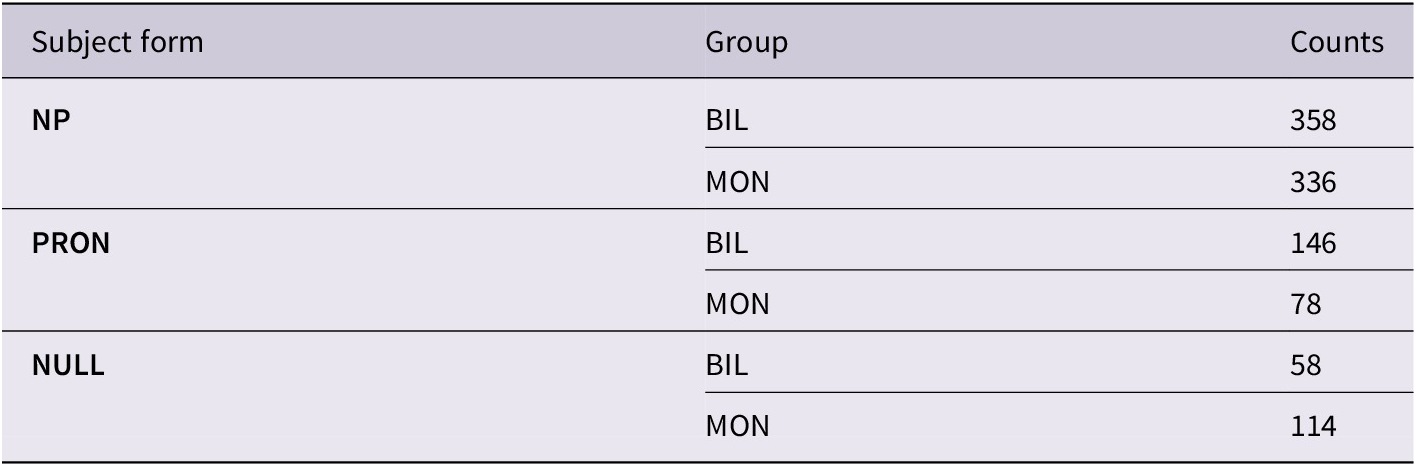
We start by presenting the raw counts for the production of noun phrases (NP), overt pronouns (PRON) and null subjects (NULL) for both child groups. The bilingual children produced a total of 562 predicates (min: 10, max. 35, mean: 18.13; SD: 4.56) and the monolingual children produced a total of 528 predicates with coded subjects (min: 7, max. 29, mean: 17.57; SD: 5.95), distributed as shown in Table 1.
Raw counts for NP, PRON, and NULL subjects by group

Table 1. Long description
The table consists of three columns labeled Subject form, Group, and Counts. It is organized into three main subject form categories.
* For the N P subject form, the B I L group has 358 counts and the M O N group has 336 counts.
* For the P R O N subject form, the B I L group has 146 counts and the M O N group has 78 counts.
* For the N U L L subject form, the B I L group has 58 counts and the M O N group has 114 counts.
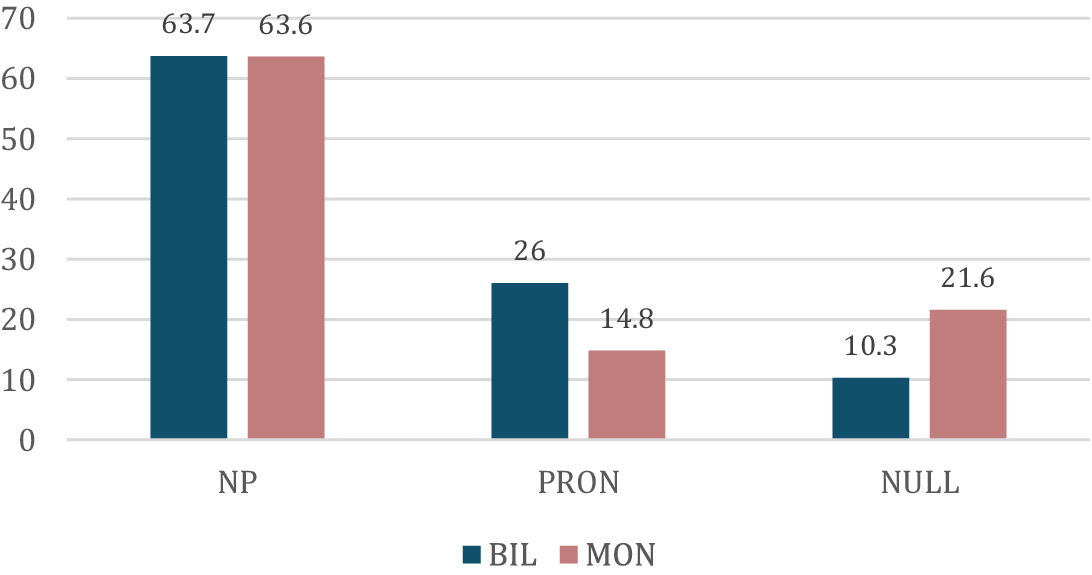
Figure 1 presents the distribution of the three referential forms per child corpus.
Percentage distribution of NP, PRON, NULL per group.

As shown in Figure 1, the rate of NP use is nearly identical across both child corpora, accounting for approximately 64% of all subject realizations. The differences between the groups emerge in the distribution of pronominal and null forms: The bilingual group produces more overt pronominal subjects than null subjects (26% PRON versus 10.3% NULL), whereas the monolingual children exhibit the opposite pattern, favouring null over overt pronouns (21.6% NULL versus 14.8% PRON).
Given that the inter-group differences pertain specifically to the distribution of pronominal and null forms, we excluded NPs in the subsequent analysis and focused exclusively on the comparison between PRON and NULL subjects. To this end, we conducted a generalized mixed-effects model analysis with the subject form as dependent variable (PRON/NULL). As fixed effects, the model included the binary variables group (BIL/MON) and the referential context (TC/TS), as well as lexical diversity as a continuous variable, with the interactions between group and referential context and group and lexical diversity. Participants were included as random intercept; the overt pronominal form is the reference level.Footnote 6 We did not include age as an independent variable as there were no substantial age differences between the children.
The results presented in Table 2 reveal a significant main effect of group: The negative estimate of −1.9081 (p < .001) indicates that monolingual children are significantly less likely to produce overt pronominal subjects compared to their bilingual peers. Additionally, a significant main effect of referential context is observed: The negative estimate of −1.7978 (p < .001) shows that pronominal subjects are less likely to occur in topic continuity (TC) contexts, confirming that overt forms are disfavoured in contexts that do not require referential disambiguation.
GLMM for subject form

Table 2. Long description
The table presents Generalized Linear Mixed Model G L M M results with columns for Effects, Estimate, S E, Exp B, Lower and Upper 95 percent confidence intervals for Exp B, z, and p.
* Intercept: Estimate 0.7375, S E 0.2313, Exp B 2.091, Confidence Interval 1.3286 to 3.290, z 3.1881, p 0.001.
* Group M O N minus B I L : Estimate negative 1.9081, S E 0.4700, Exp B 0.148, Confidence Interval 0.0591 to 0.373, z negative 4.0601, p less than .001.
* Lexical diversity: Estimate 0.0104, S E 0.0356, Exp B 1.010, Confidence Interval 0.9423 to 1.083, z 0.2909, p 0.771.
* T C forward slash T S : Estimate negative 1.7978, S E 0.3897, Exp B 0.166, Confidence Interval 0.0772 to 0.356, z negative 4.6128, p less than .001.
* Group M O N minus B I L forward slash T S: Estimate 0.0583, S E 0.7712, Exp B 1.060, Confidence Interval 0.2338 to 4.806, z 0.0756, p 0.940.
* Group M O N minus B I L Lexical diversity: Estimate 0.0924, S E 0.0717, Exp B 1.097, Confidence Interval 0.9530 to 1.262, z 1.2888, p 0.197.
Note: Covariates are centered to the mean.
Note. Covariates are centered to the mean
In contrast, lexical diversity, operationalized as the number of unique verb forms produced per child, does not significantly affect subject realization (p = .771). Furthermore, there are no significant interaction effects between group and lexical diversity or between group and referential context, suggesting that the influence of these variables does not differ across bilingual and monolingual children. Results confirm an overall tendency for bilingual children to produce more overt subjects than their monolingual peers in both referential contexts.
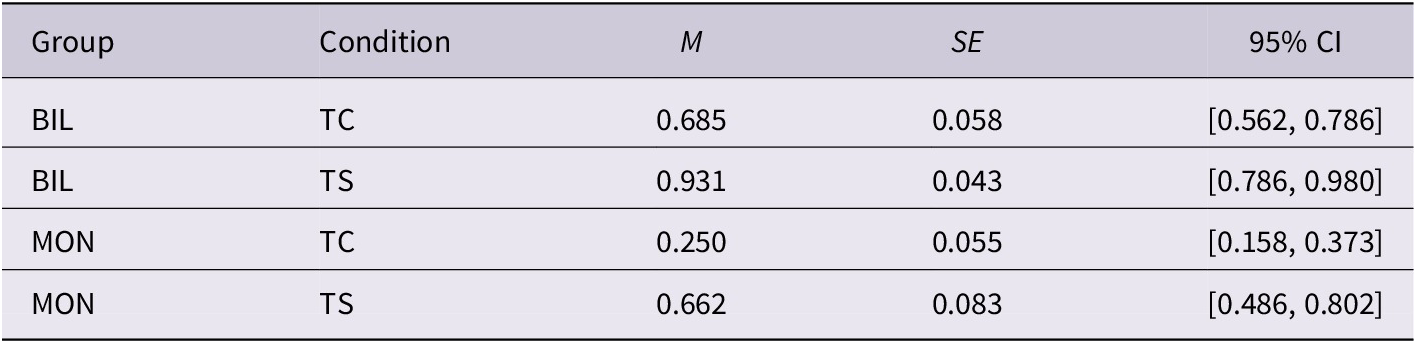
Table 3 and Figure 2 present the estimated marginal means for the likelihood of producing null subjects, broken down by group (BIL, MON) and referential context (TC = topic-continuity, TS = topic-shift).
Estimated marginal means – Group ✻ TC/TS (mean probabilities, standard errors and 95% confidence intervals

Table 3. Long description
The table consists of five columns: Group, Condition, M, S E, and 95 percent C I.
* Row 1: Group B I L, Condition T C, M 0.685, S E 0.058, 95 percent C I 0.562 to 0.786.
* Row 2: Group B I L, Condition T S, M 0.931, S E 0.043, 95 percent C I 0.786 to 0.980.
* Row 3: Group M O N, Condition T C, M 0.250, S E 0.055, 95 percent C I 0.158 to 0.373.
* Row 4: Group M O N, Condition T S, M 0.662, S E 0.083, 95 percent C I 0.486 to 0.802.
Estimate Marginal Means for pronominal subject per group and pragmatic context.

Figure 2. Long description
The Y axis is labeled null underscore pron and ranges from 0.00 to 1.00. The X axis is labeled T C forward slash T S and features two discrete points: T S on the left and T C on the right.
Two lines with error bars representing C I are plotted:
* The B I L group, represented by a blue line, starts at approximately 0.93 for T S and shows a linear decrease to approximately 0.69 for T C.
* The M O N group, represented by an orange line, starts lower at approximately 0.66 for T S and shows a steeper linear decrease to approximately 0.25 for T C.
Both groups exhibit a downward trend from T S to T C, with the B I L group maintaining higher values across both contexts compared to the M O N group.
The results indicate that in TC contexts, monolinguals show a low probability of producing overt subjects (0.250, 95% CI [0.158, 0.373]). In TS contexts, this probability increases to 0.662 (95% CI [0.486, 0.802]). This pattern is expected: null subjects are strongly associated with topic continuity, whereas topic shifts typically require overt forms.
For bilingual children, the probability of using overt subjects is much higher in both contexts compared to monolinguals. In TS contexts, the estimated probability is 0.931 (95% CI [0.786, 0.980]), and in TC contexts it is 0.685 (95% CI [0.562, 0.786]). As indicated above, bilinguals produce overt pronominal subjects more frequently overall, and their sensitivity to discourse context is attenuated. The difference between TC and TS conditions is smaller in the bilinguals’ narratives than in those of monolinguals, although the difference is not statistically significant. This suggests overall weaker discourse-pragmatic constraints on subject realization.
4.2. Objects
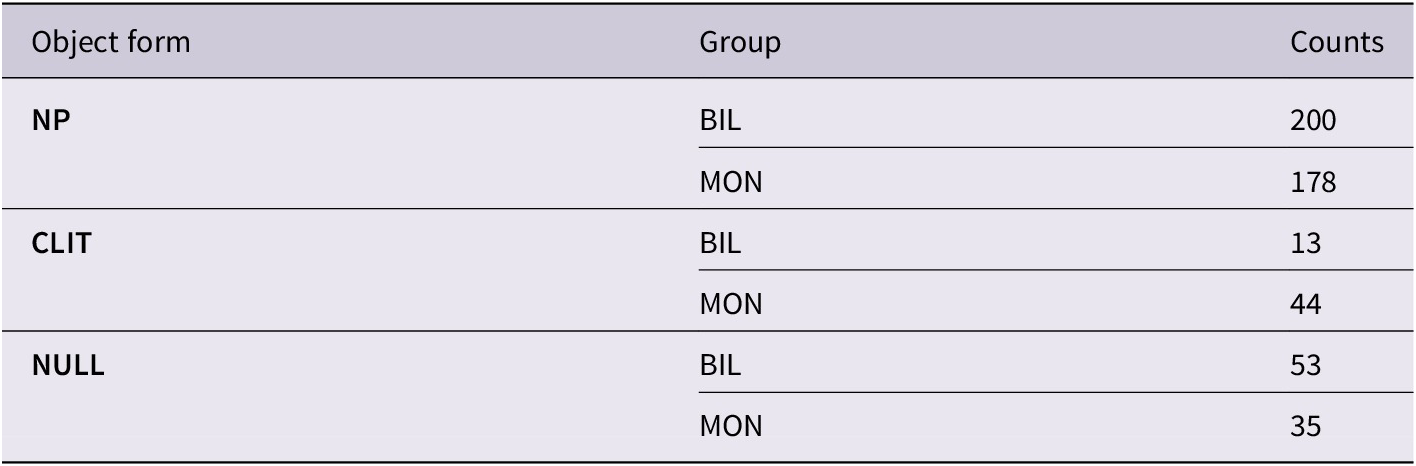
We start again by showing the raw counts for the production of noun phrases (NP), overt clitic pronouns (CLIT) and pronoun omission (NULL) for both child groups. The bilingual children produced a total of 266 sentences with transitive verbs (min: 4, max. 16), and the monolingual children produced a total of 257 transitive contexts (min: 4, max. 14) (see Table 4).
Raw counts for NP, CLIT, NULL objects by group

Table 4. Long description
The table consists of three columns: Object form, Group, and Counts.
* For the N P object form: the B I L group has 200 counts and the M O N group has 178 counts.
* For the C L I T object form: the B I L group has 13 counts and the M O N group has 44 counts.
* For the N U L L object form: the B I L group has 53 counts and the M O N group has 35 counts.
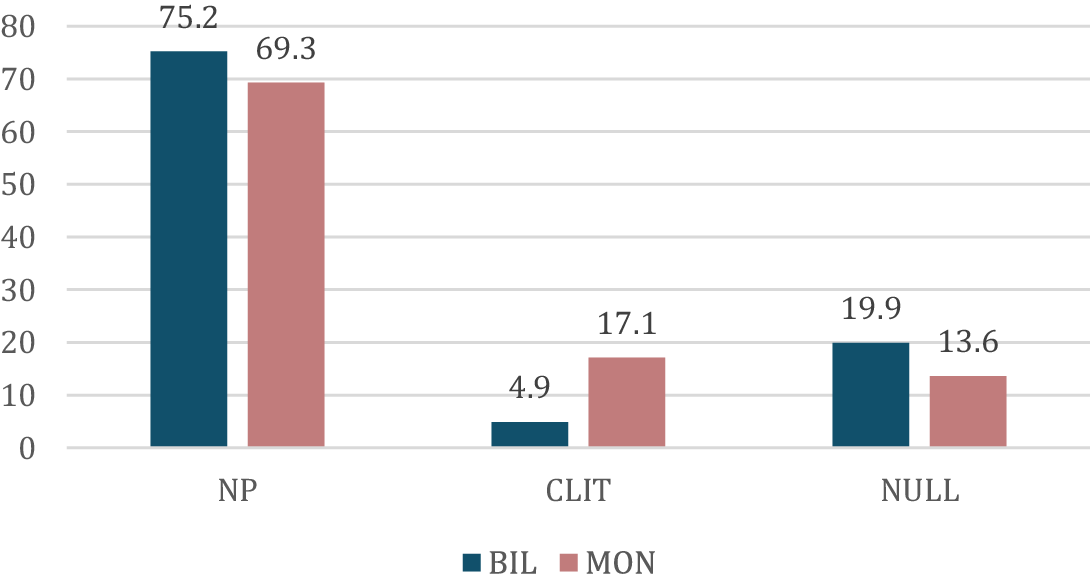
Figure 3 presents the percentual distribution of the three object forms across the two child corpora.
Percentage distribution of object forms by group.

As in the subject analysis, object NPs were excluded from the subsequent statistical analysis, which focused exclusively on the comparison between CLIT and NULL objects. The dependent variable was the object form (CLIT/NULL), analysed using a generalized linear mixed-effects model. The model included the binary variable group (BIL/MON) and lexical diversity as a continuous predictor, along with their interaction. Animacy (ANIM/INANIM) was also included as a fixed effect, and the interaction of animacy and group. Participant was added as a random intercept. The NULL form served as the reference level in this model.Footnote 7 Results are shown in Table 5.
Results of the generalized linear mixed-effects model (dependent variable: object form)

Table 5. Long description
The table consists of eight columns: Effects, Estimate, S E, Exp B, Lower 95 percent confidence interval, Upper 95 percent confidence interval, z, and p.
* Intercept: Estimate 0.8213, S E 0.3215, Exp B 2.274, z 2.554, p 0.011.
* Lexical diversity: Estimate negative 0.1119, S E 0.0458, Exp B 0.894, z negative 2.443, p 0.015.
* Animacy (inanim minus anim) (): Estimate negative 0.4695, S E 0.4977, Exp B 0.625, z negative 0.943, p 0.345.
* Group (M O N minus B I L) (M O N): Estimate negative 2.0600, S E 0.5781, Exp B 0.127, z negative 3.564, p less than .001.
* Lexical diversity by Group interaction: Estimate 0.0263, S E 0.0919, Exp B 1.027, z 0.287, p 0.774.
* Animacy by Group interaction: Estimate 0.7936, S E 1.0054, Exp B 2.211, z 0.789, p 0.430.
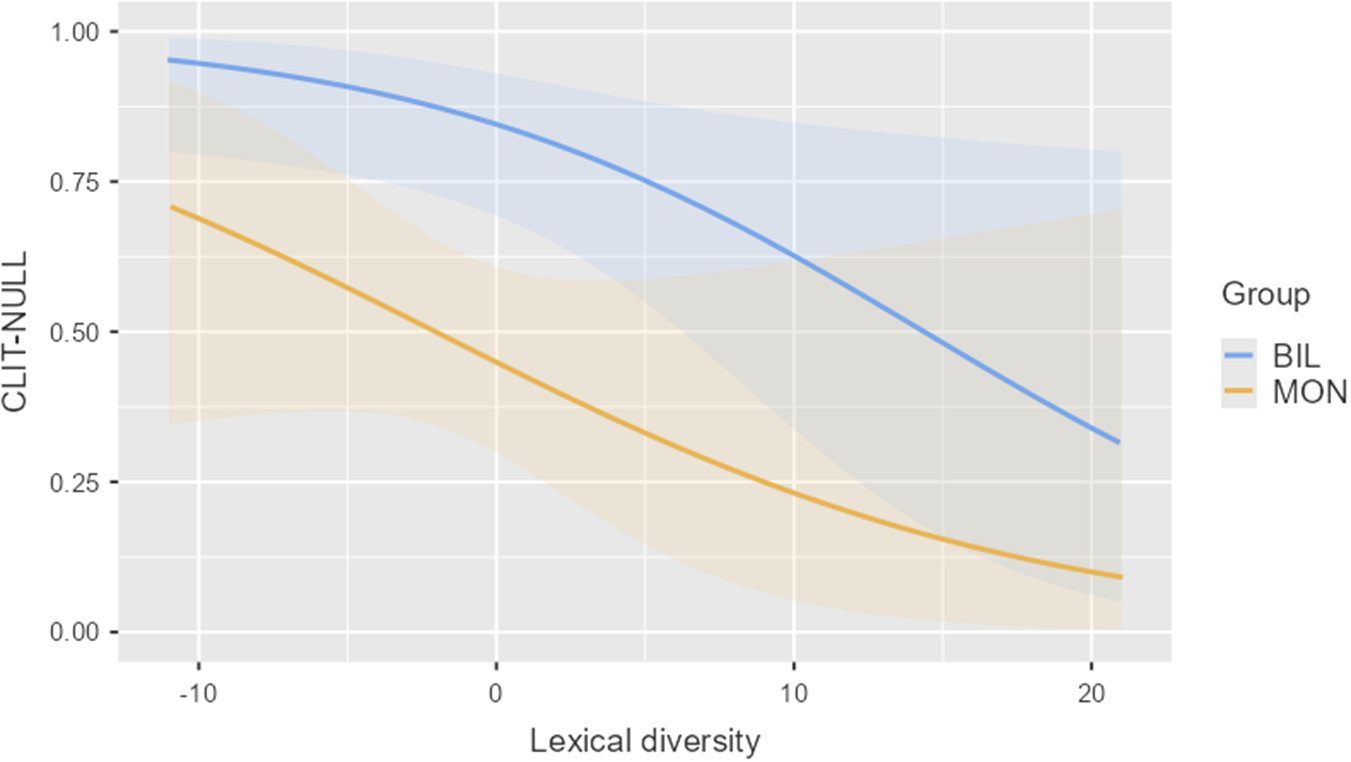
The model revealed a significant main effect of group, with a negative estimate (−2.0600, p < .001), indicating that bilingual children are significantly more likely to produce null objects than their monolingual peers. Additionally, there was a significant main effect of lexical diversity: the negative estimate (−0.1119, p = .015) suggests that increasing lexical diversity is associated with a lower likelihood of null object production. No significant interaction was found between group and lexical diversity, indicating that this effect holds across both groups. Animacy also did not significantly influence object realization (p = .345), nor did its interaction with group (p = .430).
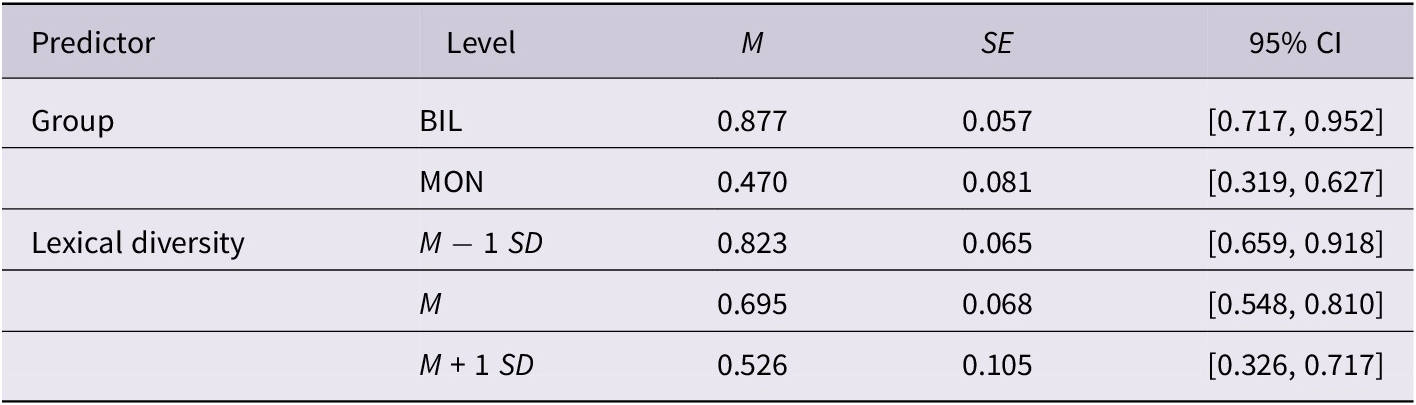
Table 6 and Figure 4 present the estimated marginal means for the likelihood of producing null objects as a function of group and lexical diversity. Results reveal that the probability of producing null objects is very high for bilinguals (0.877, 95% CI [0.717, 0.952]) and decreases to 0.470 for monolinguals (95% CI [0.319, 0.627]). With respect to lexical diversity, the estimated probability of omission is 0.823 (95% CI [0.659, 0.918]) at one standard deviation below the mean and decreases to 0.526 (95% CI [0.326, 0.717]) at one standard deviation above the mean.
Estimated marginal means for null objects, by group and by lexical diversity (mean probabilities, standard errors and 95% confidence intervals)

Table 6. Long description
The table consists of five columns: Predictor, Level, M, S E, and 95 percent C I.
Under the Predictor Group:
- Level B I L has a mean of 0.877, S E of 0.057, and C I of 0.717 to 0.952.
- Level M O N has a mean of 0.470, S E of 0.081, and C I of 0.319 to 0.627.
Under the Predictor Lexical diversity:
- Level M minus 1 S D has a mean of 0.823, S E of 0.065, and C I of 0.659 to 0.918.
- Level M has a mean of 0.695, S E of 0.068, and C I of 0.548 to 0.810.
- Level M plus 1 S D has a mean of 0.526, S E of 0.105, and C I of 0.326 to 0.717.
Estimated marginal means for null object production by lexical diversity and group.

Figure 4. Long description
The x-axis is labeled Lexical diversity with numerical markers at negative 10, 0, 10, and 20. The y-axis is labeled C L I T dash N U L L with values from 0.00 to 1.00 in increments of 0.25. A legend on the right titled Group identifies two categories. B I L represented by a blue line and M O N represented by an orange line. Both lines include shaded ribbons representing confidence intervals.
* The B I L blue line starts at approximately 0.95 at negative 10 lexical diversity and follows a gradual downward curve to roughly 0.30 at 20 lexical diversity. Its confidence interval is narrowest at the start and widens as lexical diversity increases.
* The M O N orange line starts lower at approximately 0.70 at negative 10 lexical diversity and follows a steeper downward curve reaching approximately 0.10 at 20 lexical diversity. Its confidence interval is wider than the B I L group throughout the range.
Both groups show a negative correlation where higher lexical diversity corresponds to lower N U L L production.
5. Discussion
The present study examined the distribution of overt and null subjects and objects in the narrative production of monolingual and bilingual children acquiring EP as their native language. Previous research has shown that adult-like mastery of these phenomena is late acquired by monolingual children. The results of our study reveal systematic differences between the two groups across the two domains, in line with previous findings on other language pairs and acquisition contexts: bilingual children tend to overspecify subjects, producing overt pronouns more frequently than expected, while at the same time underspecifying objects by using null objects at higher rates than monolinguals.
For subjects, the results revealed robust group differences regarding the amount of overt subject production. Bilinguals produced overt pronouns at much higher rates than monolinguals in topic-continuity contexts, where null subjects are pragmatically expected and preferentially produced by the monolinguals. In topic-shift contexts, where overt pronouns are expected, bilinguals also displayed an overall preference for overt forms that exceeded that of their monolingual peers. These patterns confirm that bilinguals overspecify subject reference. The results are consistent with earlier findings showing that it is particularly the interpretation and production of overt subject pronouns that is protracted in EP (Lobo & Silva, Reference Lobo and Silva2016; Rinke & Flores, Reference Rinke and Flores2018).
For objects, the results point in the opposite direction. Monolingual children produced a relatively balanced distribution of clitics and null objects, with more clitic production than object omission. By contrast, bilinguals strongly favoured null objects, producing clitics only rarely. The mixed-effects model confirmed that group was a significant predictor: Bilinguals were far more likely than monolinguals to omit objects in their written production. The estimated marginal means highlight this difference: While the probability of null object production for monolinguals was below 0.50, bilinguals reached values close to 0.90. These results indicate that bilingual children underspecify object reference. These findings are also consistent with previous research (Rinke et al., Reference Rinke, Flores and Sopata2019), showing that bilingual children omit object clitics in EP for a longer period of time and more extensively than monolinguals.
Another finding concerns the role of lexical diversity, operationalized as the number of different verb tokens. Our results reveal a divergent role of lexical diversity in subject and object realization. While it appears to have no effect on the distribution of overt versus null subjects, the model showed that greater lexical diversity was associated with a decrease in null object production. This effect was observed across both child groups. In other words, children with richer vocabularies used more clitic pronouns. The fact that lexical diversity is associated with the acquisition of the object domain but not the subject domain is linguistically grounded insofar as the occurrence of objects is fundamentally determined by the valency of the verb, while the occurrence of a syntactic subject is in principle independent of verb valency or verb semantics. In other words, it is to be expected that the progressive acquisition of the verb lexicon will have a positive influence on the acquisition of the object domain, but will not influence the subject domain.
Finally, the comparison with adult heritage grammars may add another layer of evidence that underscores the difference between the subject and the object domains. Previous corpus studies with adult heritage speakers of EP living in Germany show that while subject use most often tends to converge on monolingual norms in adulthood (Flores & Rinke, Reference Flores and Rinke2020), object omission remains persistent (Rinke et al., Reference Rinke, Flores and Barbosa2018). This suggests that subject expression is more resilient in heritage grammars, whereas object realization may undergo longer-term restructuring. This may also explain the different sensitivities to indicators of proficiency (lexical diversity) shown in this study.
Taken together, the results of the bilingual children show a subject–object asymmetry, that is an overspecification of subjects and underspecification of objects, pointing to a developmental divergence between subject and object domains (for similar observations see also Müller, Reference Müller2019). In the remainder of this section, we discuss several approaches proposed in the literature to account for the patterns found in the bilingual acquisition of subjects and objects. We argue that none of the existing accounts fully captures the observed subject-object asymmetry. As a novel contribution, we suggest an alternative approach that is based on the universal referential hierarchy determining subject and object realization cross-linguistically.
One prominent explanation attributes the overuse of overt subject pronouns in a NSL to cross-linguistic influence (CLI). In most studies, the contact language of the null subject language is a non-null subject language (e.g. Argyri & Sorace, Reference Argyri and Sorace2007, for Greek–English bilinguals; Sánchez et al., Reference Sánchez, Goldin, Hur, Jimenez, López Otero, Thane, Austin and Markovits Rojas2023, for Spanish–English; Tsimpli et al. Reference Tsimpli, Sorace, Heycock and Filiaci2004 for adult L1-attriters; Serratrice et al., Reference Serratrice, Sorace and Paoli2004 for a Italian–English bilingual child). According to the CLI approach, the obligatory use of subject pronouns in the non-null subject language is transferred to the null subject language, which is often the weaker, heritage language.
For null objects, CLI approaches assume that the language with a less restricted object omission grammar exerts influence on the language with the more restricted missing object system. French–German and Italian–German bilingual children as investigated by Müller and Hulk (Reference Müller and Hulk2001) show target-deviant object omissions in French and Italian more often and for a longer period of time. The authors assume that German exerts an influence on the Romance language because two conditions are fulfilled: First, object realization is a phenomenon at the interface between pragmatics and syntax and second, the existence of less restricted object omissions (topic drop) in colloquial German provides additional evidence for object omission in the Romance languages, leading to a delay in the acquisition process.
Although CLI cannot completely be ruled out as a factor influencing bilingual speakers’ linguistic behaviour, several studies show that it cannot fully explain the observed patterns.
For example, the overuse of pronominal subjects is not restricted to null subject languages in contact with a non- null subject languages but has also been observed for two null subject languages in contact, for example, Italian–Spanish bilinguals (see Filiaci et al., Reference Filiaci, Sorace and Carreiras2014; Serratrice et al., Reference Serratrice, Sorace, Filiaci and Baldo2009) and Portuguese–Spanish bilinguals (Rinke & Flores, Reference Rinke and Flores2018) (see Section 2.1).
Concerning the omission of objects, German topic drop may be less restricted than object omissions in Italian or French, but it is certainly not less restricted than object omissions in EP. In EP, null definite objects can (and do) occur independent of the structural position, whereas German topic drop is restricted to the sentence initial position. Also, the explanation provided for the object domain cannot easily be extended to the subject domain: If the less restricted language would exert an influence on the more restricted language, we would expect an influence of the null subject language on the non- null subject language in the subject domain, and not the other way around. A recent study by Sopata et al. (Reference Sopata, Długosz, Brehmer and Gielge2021) shows that bilingual children acquiring German and Polish even avoid topic drop in German compared to monolingual speakers although their first language Polish is a null subject language.
A different approach that we would like to mention is the silent problem hypothesis proposed by Laleko and Polinsky (Reference Laleko and Polinsky2017). According to the authors, bilinguals overuse overt forms to avoid silence due to difficulty in recovering missing elements that have discourse antecedents. Although this hypothesis is theoretically sound and grounded on empirical evidence, it cannot explain the observed subject–object asymmetry. While the silent problem might explain the overspecification of subjects in our bilingual corpus, it fails to account for the simultaneous increase in object omissions, where silence is chosen over realization.
A third account, partially related to the previous one, predicts that phenomena requiring the integration of syntax and discourse-pragmatics are especially vulnerable in bilingual contexts (‘interface hypothesis’, see Sorace, Reference Sorace2011 and references therein). Sorace (Reference Sorace2011) attributes this vulnerability in heritage speakers to their integration abilities in processing (see also Torregrossa et al., Reference Torregrossa, Andreou, Bongartz and Tsimpli2021). Tsimpli (Reference Tsimpli2014) points to an increased role of language-external resources necessary for appropriate language use in this domain. As both subject and object realization involve discourse-level constraints, the interface hypothesis correctly predicts that bilinguals may differ from monolinguals in these domains, and the productions of the bilinguals observed here may reflect indeed the kind of processing challenges at the syntax–discourse interface that have been identified in earlier work. However, based on this approach, it is unclear why subjects and objects are treated differently by the bilingual children, that is, why subjects are overrealized and objects more omitted.
In order to understand these divergent patterns we need to zoom in into the linguistic complexity of the target system. Indeed, both the subject and the object domains include properties that are highly variable and complex in EP (see Rinke et al., Reference Rinke, Flores, Torregrossa, Polinsky and Putnam2024 for criteria of complexity in acquisition). Concerning the subject domain, overt subject pronouns are particularly complex, because their use includes context sensitivity, that is the integration of syntactic and discourse knowledge. In addition, they behave partially as weak and partially as strong pronouns: as illustrated in Section 2.1, overt subject pronouns are typically employed when the subject referent is contrastive or emphatic or in contexts of topic-switch. However, there are also examples in which this is not the case and overt pronouns are nevertheless used in the way a weak pronoun (like a null subject) would be used (see the discussion in Section 2.1, see also Müller, Reference Müller2019, for a similar argumentation regarding the ambiguity of overt subject pronouns). Studies on the distribution of null and overt subject pronouns in near-native L2 learners of Italian also show an asymmetry between overt and null pronouns, pointing to a more general trend across acquisition types: as shown by Sorace and Filiaci (Reference Sorace and Filiaci2006) and Belletti et al. (Reference Belletti, Bennati and Sorace2007), these speakers also overextended overt subject pronouns to contexts of topic switch but they did not show any errors involving null subjects.
As already discussed in Section 2.2., the extended omission stage of objects in EP bilinguals (and monolinguals) has been attributed to the complexity of the EP clitic system. Clitic pronouns in EP are complex for several reasons (see Rinke et al., Reference Rinke, Flores, Torregrossa, Polinsky and Putnam2024): their target-like use requires context-sensitivity (the integration of syntactic and discourse knowledge, allomorphy dependent on the phonological context, enclitic and proclitic placement based on the syntactic context) and consideration of multiple form-function mappings (homophony with definite articles). Hence, bilingual children (like monolinguals at earlier stages of acquisition, see Flores et al., Reference Flores, Rinke and Sopata2020; Rinke et al., Reference Rinke, Flores and Sopata2019) tend to avoid the production of clitics by using a null object.
Still, the question arises as to why children, when faced with the complexity of overt subject pronouns and overt clitics in EP, tend to overproduce the former while omitting the latter. We argue that this pattern can be attributed to the same general mechanism, albeit with different outcomes across the two domains. Specifically, we propose that referential hierarchies guide the realization of pronouns, such that from a referential perspective, overt subject pronouns constitute the unmarked option in the subject domain, whereas null objects constitute the unmarked option in the object domain. In the remainder of this section, we explain in more detail what we mean by this.
Generally speaking, subject and object realization can be understood as an interplay of referential hierarchies and discourse-pragmatic constraints. From a discourse-pragmatic perspective, subjects typically encode highly accessible, given information, which is realized by the weak forms available in a language (Ariel, Reference Ariel1991). Therefore, in null subject languages, null subjects are prototypical subjects from a discourse pragmatic perspective. From a referential perspective, however, subjects typically relate to animate referents (see Fn. 1), which – according to the universal referential hierarchy proposed by Cyrino et al. (Reference Cyrino, Duarte, Kato, Kato and Negrão2000) – are universally more likely to be realized than less referential (e.g. inanimate elements). Hence, from the perspective of referential hierarchies, overt subject pronouns are prototypical subjects.
In the case of objects, we observe the reverse tendency. From a discourse-pragmatic perspective, objects typically encode non-topical, less accessible, or new information, as they are usually in focus or part of the focus domain. Such information is generally realized by stronger or overt, more explicit forms. Hence, from a discourse-pragmatic perspective, overt (clitic) objects represent the prototypical realization of objects. However, from a referential perspective, objects often refer to less referential entities (e.g., inanimate ones), which – according to the universal referential hierarchy – show a cross-linguistic tendency to be omitted. From this perspective, null objects constitute the prototypical realization of objects. Null objects show a general tendency to represent inanimate referents in EP (see Rinke, Reference Rinke, Barbosa and Flores2025), although clitics can of course also realize inanimate (and animate) object referents.
To conclude, we propose that when children overuse subjects and omit more objects, they are following the universal referential hierarchy while disregarding the discourse-pragmatic constraints that guide the target-like use of subject and object pronouns in EP.
6. Conclusions
We believe that the findings of this study have important implications for our understanding of the lateness of the acquisition of pronouns in bilingual (and monolingual) children acquiring European Portuguese as their L1. By investigating subject and object expression in the written narrative production of the same group of Portuguese–German bilingual children, we have shown that the two domains follow divergent developmental pathways: subjects are overspecified through the overuse of overt pronouns, while objects are underspecified through increased omission. We have argued that this asymmetry reflects the complexity of the target system across these domains and can be interpreted in terms of a stronger reliance on general referential principles, alongside a relaxation of discourse-pragmatic constraints on subject and object use.
The proposal that referential hierarchies take precedence over discourse-pragmatic constraints has far-reaching theoretical consequences and implications for other late acquired phenomena, for other types of language acquisition (e.g. L2 acquisition, see Fiéis and Teixeira (Reference Fiéis and Teixeira2025)), and for diachronic change, language attrition and language processing (Flores & Rinke, Reference Flores and Rinkesubmitted). We acknowledge that this proposal is exploratory and requires further empirical validation through a wider range of methodologies and populations.
Finally, it is important to note that the asymmetry observed in bilingual children is systematic and also found in the production of younger monolingual children. Analysing characteristic patterns in the production of late-acquired phenomena by bilingual children can contribute to a deeper understanding of these phenomena in monolingual language acquisition and beyond.
Funding statement
This work was funded by national funds through FCT – Fundação para a Ciência e a Tecnologia, I.P., under project UID/00305/2025.
Ethical approval
The study was approved by the ethics committee for Social and Human Sciences of the University of Minho (reference CEICSH 016/2019).




 Open access

