Introduction
Placopyrenium is a small genus with 17 currently accepted species (Breuss Reference Breuss2009; Orange Reference Orange2009; Roux & Gueidan Reference Roux and Gueidan2011). Most species grow on rock or are parasitic on rock-inhabiting lichens, and they are most diverse in mediterranean regions. Species are known from Europe, Asia and North America, including Mexico (Breuss Reference Breuss2009), with very few records from the Southern Hemisphere (e.g. Aptroot Reference Aptroot2008: St Helena, as Verrucaria cf fuscella). As many as six species, viz. Placopyrenium bucekii (Nádv. & Servít) Breuss, P. canellum (Nyl.) Gueidan & Cl. Roux, P. fuscellum (Turner) Gueidan & Cl. Roux, P. iranicum Breuss, P. tatrense (Vězda) Breuss, and P. trachyticum (Hazsl.) Breuss, are currently known from Turkey (Breuss & John Reference Breuss and John2004; Breuss Reference Breuss2009). One variety, P. bucekii var. triseptatum Breuss, is even described and so far known only from Turkey (Breuss Reference Breuss1993).
The genus Placopyrenium is characterized by a crustose-areolate to placodioid or subsquamulose thallus with prothallus absent or not, basally restricted to stipitate or rhizinate, immersed ascomata without an involucrellum, and simple to 1(–3)-septate ascospores (Breuss Reference Breuss2009). The genus is polyphyletic in the current circumscription (Prieto et al. Reference Prieto, Martínez, Aragón, Otálora and Lutzoni2010), with the crustose species from America falling far outside the core group of the genus. Placopyrenium is one of the few genera in the Verrucariaceae with 1-septate ascospores in at least some of the species. Other Verrucariaceae genera with 1-septate ascospores are the heterogeneous genus Thelidium, which has a crustose thallus without marginal lobes, and the genus Placidiopsis, which has a squamulose (not placidioid) thallus (Breuss Reference Breuss1996; Prieto et al. Reference Prieto, Martínez, Aragón, Otálora and Lutzoni2010).
Turkey has a lichen flora that is largely European in affinity (Yazici & Aslan Reference Yazici and Aslan2003), with the majority of the species still identifiable using a lichen flora (Smith et al. Reference Smith, Aptroot, Coppins, Fletcher, Gilbert, James and Wolseley2009) from a country at the other side of the continent. However, the lichens of the internal eastern region of Iğdır have more continental Asian affinities. During fieldwork by the second author, a new species of the genus Placopyrenium was collected from hard calcareous rock in dry scrub vegetation. It differs from all other currently known species in the genus by the combination of the bullate, areolate-subsquamulose thallus, the deeply immersed ascomata with an often blackened exciple and the 1-septate ascospores. In gross morphology, it seems closest to P. iranicum, a species that has not been sequenced so far, and which may or may not turn out to belong to the core group of the genus. Therefore, it is not certain whether the new species belongs to the core group of the genus Placopyrenium.
Material and Methods
Identification and descriptive work was carried out using an Olympus SZX7 stereomicroscope and an Olympus BX50 compound microscope with interference contrast, connected to a Nikon Coolpix digital camera. The secondary chemistry was investigated with spot reactions. The specimens are preserved in the herbarium of the Biology Department, Karadeniz Technical University (KTUB) and in ABL.
The Species
Placopyrenium bullatum Aptroot & Yazici sp. nov.
MycoBank No: MB 563685
Placopyrenium thallo bullato semicrustoso peritheciis immersis saepe nigrocircumdatis ascosporis uniseptatis.
Typus: Turkey, Iğdır, Tuzluca, between Uğurca and Yukarı Civanlı villages, 40°00′03·72″N, 43°26′25·80″E, on calcareous rock, 2056 m alt., 16 May 2010, K. Yazici 2501 (KTUB—holotypus; ABL—isotypus).
(Fig. 1)
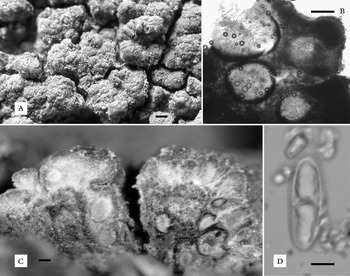
Placopyrenium bullatum (isotype). A, thallus; B & C, sections through the thallus; D, ascospore. Scales: A=0·2 mm; B & C=0·1 mm; D=5 µm.

Thallus covering an area up to 7 cm across, 2·5–4·0 mm thick in central parts, consisting of appressed stipitate areoles c. 0·5–2·0 mm wide that arise singly, are subsequently aggregating and compressed sideways to form a nearly continuous crust with an irregular surface, pale brownish. The individual areoles are generally higher (2·5–4·0 mm) than wide (0·5–2·0 mm), and narrower at the stipitate base, leaving holes between, under a nearly closed upper layer of compressed areoles. Upper surface dull, not distinctly corticate, but the upper layer contains a brown pigment, without distinct epinecral layer. Medulla whitish above, mottled blackish below (partly melanized), up to 2 mm thick, cells filamentous, lower surface without rhizines or rhizohyphae, not differentiated, not corticate. Algae green, c. 7×5 µm.
Perithecia globose, fully immersed in and throughout the algal layer and the medulla, 0·1–0·5 mm diam.; ostioles invisible from the surface; no periphyses or periphysoids observed. Exciple pale pinkish in ascomata near the upper surface, blackened to completely black in ascomata lower in the thallus, 55–95 µm thick. Asci clavate, with 8, irregularly biseriately arranged ascospores. Ascospores hyaline, mostly 1-septate, ellipsoid, 15–18×6·5–7·5 µm.
Pycnidia not observed.
Secondary chemistry. Thallus C−, K−, KC−, P−. No substances detected.
Etymology. The epithet ‘bullatum’ refers to the bullate overall thallus structure.
Ecology and distribution. On hard limestone, known only from the type locality, where it is not rare. Accompanying lichen species are Caloplaca decipiens (Arnold) Blomb. & Forssell and Physcia dubia (Hoffm.) Lettau. The type locality is in a rocky, dry upland (>2000 m) mediterranean region with very few trees and shrubs.
Discussion. The species seems closest to Placopyrenium iranicum, which grows in the same region and was collected on the same field trip (e.g. Örüşmüş köyü at 1943 m), but this species differs, for example, by the grey thallus, the hyaline exciple, the black ostioles and the simple ascospores. The placing of the new species in Placopyenium is somewhat provisional, as it shows more similarities with species of this genus that are phylogenetically outside the core group, such as P. caeruleopulvinum (Thomson) Breuss and P. stanfordii (Herre) K. Knudsen (Prieto et al. Reference Prieto, Martínez, Aragón, Otálora and Lutzoni2010), than with the core group of Placopyrenium. Species of the core group are characterized by a generally grey to whitish, often black-rimmed thallus, often effigurate with marginal lobes. These characters are absent in the new species, which is thus unlikely to belong inside the core group of Placopyrenium.
This study was supported by TUBİTAK (project 108T566). Several anonymous reviewers are thanked for the considerations they gave to the affiliation of this species.