NOMENCLATURE
- A
cross-sectional area of balloon (m2)
- A skin
atmosphere facing area of steam-filled volume (m2)
- C D
drag coefficient
- c p
specific heat capacity of air in constant pressure (J/Kg−1/K−1)
- F D
drag force (N)
- f r
rejected fraction of condensed water
- g
acceleration due to gravity, g = 9.81 m/s−2
- k
thermal conductivity of air (W/K−1/m−1)
- k B
boltzmann constant (J/K−1)
- L
length scale (m)
- L z
height of cylinder approximating balloon (m)
- m pay
payload mass (kg)
- m s
steam mass (kg)
- n
atmospheric number density (m−3)
- NuL
nusselt number corresponding to length scale L
- P
pressure (Pa)
- Pr
prandtl number of air, Pr = ν/α
- r
radius of balloon (m)
- ReL
reynolds number or air corresponding to length scale L
- T
temperature (K)
- u conv
convective cooling rate of balloon skin (W/m−2)
- u rad
radiative cooling rate of balloon skin (W/m−2)
- υ
vertical velocity (m/s−1)
- V
steam volume (m3)
Greek symbols
- α
thermal diffusivity of air (m2/s−1)
- γ
adiabatic index of water vapour, γ = 1.324
- ∊
thermal infrared emissivity of balloon skin
- η
relative lift
- ν
kinematic viscosity of air (m2/s−1)
- μ
dynamic viscosity of air, μ = ρν (Pa s)
- ρ
atmospheric mass density (kg/m−3)
- σ SB
stefan-Boltzmann constant, σ SB = 5.67 · 10−8 W/m−2/K−4
1.0 INTRODUCTION
Rockets benefit from launching at a high altitude(Reference Sarigul-Klijn, Sarigul-Klijn, Hudson, Mckinney, Menzel and Grabow1). High launch altitude reduces air drag and improves possibilities to optimise the nozzle. Launch above ground may also be desirable for other reasons such as avoidance of rocket noise and safety risks on ground.
Aircraft have been used for air launchers such as Pegasus(Reference Schade and Mosier2), Stratolaunch and Launcher One(Reference Niederstrasser and Frick3). Using a tailor-made plane such as White Knight 2 developed by Scaled Composites is a possible, but rather expensive, option. One could also use an existing military transporter such as Boeing C-17 Globemaster III(Reference Sarigul-Klijn, Sarigul-Klijn, Hudson, Mckinney, Menzel and Grabow1) or a civilian plane modified to carry or tow the rocket. However, the loaded maximum altitude of such aircraft is typically ~ 10 − 13 km, while nozzle vacuum performance would benefit from a somewhat larger altitude such as ~ 18 km. Also, if legislation or other considerations make it impractical to use the modified plane for other purposes, the per-launch capital and maintenance costs can become significant, unless the launch frequency is high.
Helium balloons can reach a higher altitude than standard aircraft, and they have been used for launching sounding rockets in the past(Reference Van Allen5) and are planned to be used again, e.g., by Zero2infinity company’s Bloostar launcher(Reference Williams4). However, helium is a moderately expensive gas. It is also a non-renewable resource that is currently obtained as a by-product of natural gas extraction(Reference Mullins and Timmerhaus6). In the future, the price of helium may increase, the price can fluctuate, and availability issues are possible. Thus there is a motivation to look for possible alternative lifting gases.
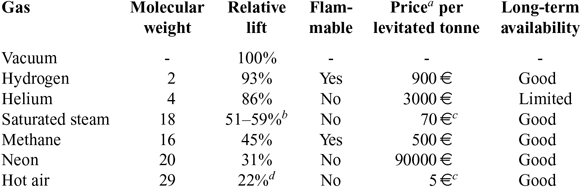
Hydrogen is the other well-known lifting gas (Table 1). Although readily available, hydrogen is likewise not very cheap. Its energy cost is relatively high: to levitate a 1 kg mass requires an amount of hydrogen that would release 10.5 MJ of energy upon combustion, and typically even more energy is needed to produce it. Hydrogen is also somewhat complicated to transport and handle. During the balloon filling operation, hydrogen carries a risk of fire if, e.g., the balloon skin is punctured so that a hydrogen stream escapes into the atmosphere and produces a flammable mixture that can be ignited, e.g., by a static electricity spark. Although the fire risk can be mitigated by quality assurance practices, running such practices incurs additional financial cost.
Properties of selected lifting media

a Exemplary prices from Internet shops and analyst reports, gathered in August 2018.
b The range is due to the dependence of temperature and pressure on altitude.
c Energy cost assuming methane as fuel, multiplied by 2 to approximate inefficiencies.
d For +100°C air at +20°C ambient.
Natural gas or methane could be used as a lifting gas as well, but like hydrogen this gas is flammable. Methane is a greenhouse gas whose escape into the atmosphere should be limited. Methane is also rather energy intensive in the sense that levitating a 1 kg mass requires an amount of methane that would produce as much as 68.3 MJ of heat if burned in a power plant instead of being used as a lifting gas. In this regard, methane is 6.5 times more energy intensive than hydrogen. The main reason is methane’s much larger molecular weight, which implies that a larger mass of the gas is needed to produce the same lift (Table 1).
Water vapour (steam) is a potent lifting gas (Table 1). Its lifting capacity is a result of the lower molecular weight (18 versus 29 in the atmosphere) and the higher temperature compared to the ambient air. At sea level at room temperature, +100°C steam has 51% of the lifting capacity of vacuum while unheated helium has 86 %. Steam was proposed as a lifting gas already 200 years ago(Reference Cayley7) and has been suggested thereafter several times for balloons(Reference Alcock8,Reference Giraud9) and airships(Reference Erdmann10,Reference Papst11) . More recently, a low-altitude balloon “HeiDAS” that used both hot air and steam was constructed(Reference Bormann, Hermann and Skutnik12). The HeiDAS balloon resembles a hot-air balloon as it carries a boiler to re-evaporate the condensed water. Using steam enables making the balloon’s volume smaller by factor ~ 2.5 than a hot-air balloon. On the other hand, the needed water collector and boiler is a more complex apparatus than the simple propane burner typically used in hot-air balloons.
In this paper we consider the possibility to use a steam balloon that does not need any onboard energy source or other onboard device. The balloon is filled by steam on ground. It then rises together with the payload to the target altitude. The rise time is relatively short, typically of the order of 10 minutes as will be seen later, so that the steam does not have time to cool significantly by heat loss through the balloon envelope. The device resembles a high-altitude zero-pressure gas balloon(Reference Rainwater and Smith13), except that it is filled with steam instead of helium. The underlying physics differs from the previously considered low-altitude steam balloons(Reference Cayley7,Reference Bormann, Hermann and Skutnik12) , because in addition to surface cooling, volumetric adiabatic cooling of the steam also becomes important. To the best of the authors’ knowledge, the possibility of filling a balloon with steam on ground and letting it rise to high altitude has not been treated in literature before.
As a baseline, we consider the task of lifting a 10 tonne payload into 18 km altitude. We also explore variations of these parameters. After the payload is released, the baseline idea is to release the steam from the top of the balloon so that the balloon falls down, typically into the sea from which it is recovered by a boat for material recycling or for re-flight.
The structure of the paper is as follows. We first present a mathematical model for the steam balloon and make vertical trajectory simulations to find the required steam mass. Then we explore the dependence of the steam mass on the various parametres and alternative assumptions. Next, we discuss three design variants and look into some insulation options. The paper ends with a discussion and conclusions section.
2.0 STEAM BALLOON MODEL
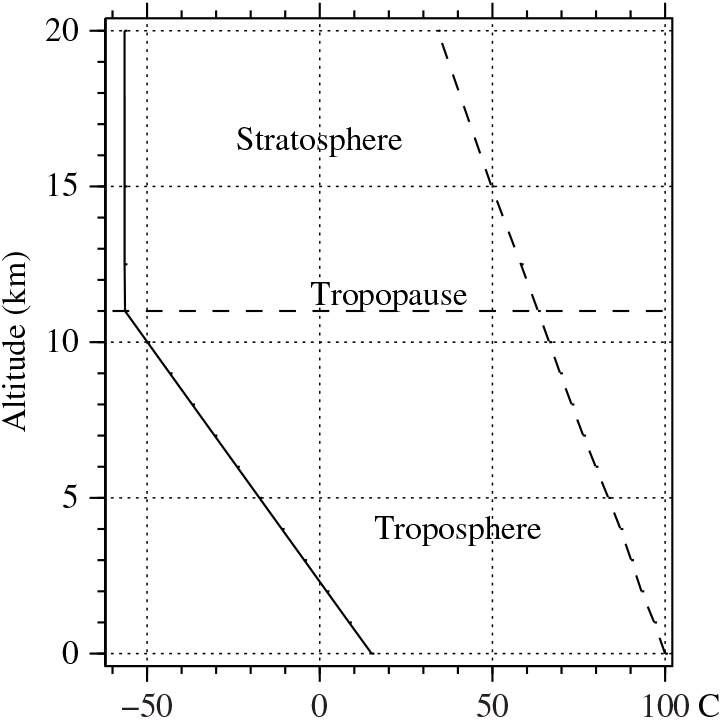
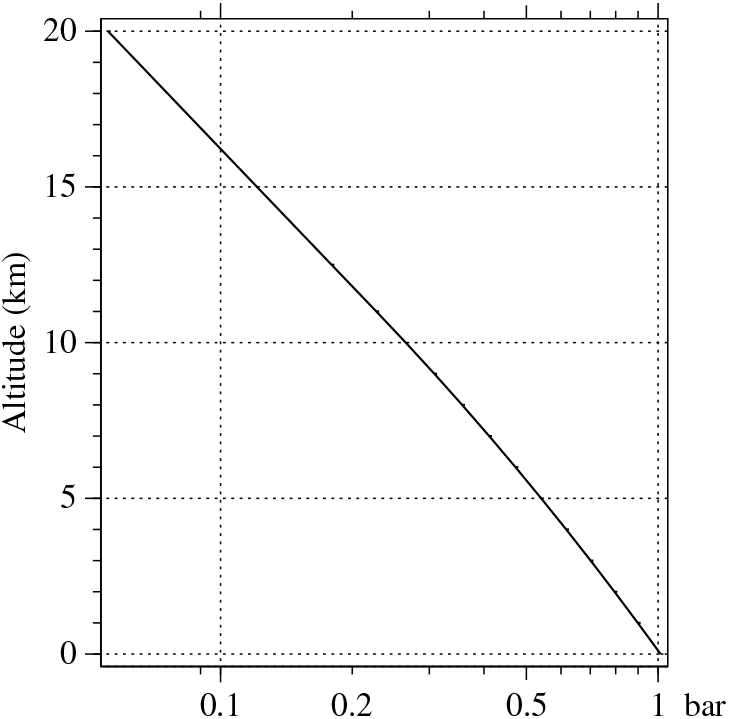
For the vertical temperature profile, we use a simple atmospheric model(14) in which the temperature drops linearly from +20°C until the tropopause at 11 km and is then constant −55 °C in the stratosphere. Dependence of the performance on latitude and the local climate and weather is beyond the scope of this paper. Steam (i.e., 100% water vapour) has a dewpoint temperature that depends on the ambient pressure. The atmospheric temperature and the steam dewpoint temperature are shown in Fig. 1 while the ambient atmospheric pressure is given in Fig. 2.
Model atmosphere temperature (solid) and steam dewpoint temperature (dashed).

Model atmosphere pressure profile.

When the steam balloon rises, the steam expands and cools adiabatically with an adiabatic index of γ = 1.324, following the adiabatic equation of state P ~ n γ, or n ~ P 1/γ . Then, using the ideal gas law P = nk BT, the temperature is proportional to
 $$T \sim {P \over n} \sim {P \over {P^{1/\gamma } }} = P^{1 - \left( {1/\gamma } \right)} $$
However, when the steam cools below the dewpoint (Fig. 1 dashed line) by Equation (1), condensation occurs until the released latent heat is sufficient to keep the temperature at the dewpoint. The steam dewpoint drops more slowly than the ambient atmospheric temperature (Fig. 1). For example, at the 18 km altitude (pressure 75.65 hPa) the dewpoint is still +41°C. Only at 32 km altitude does it drop below the freezing point.
The steam is cooled not only by adiabatic expansion, but also by convective and radiative heat transfer through the balloon skin. Water condensed on the inner surface keeps, by the release of latent heat, the surface near the internal steam temperature.
We simulate the vertical trajectory of the balloon and its payload by modelling the steam thermodynamics, surface cooling due to radiation and convection and the aerodynamic drag that tends to slow down the balloon ascent. To minimise the drag, the balloon has a streamlined droplet-like shape. The faster the balloon rises, the less its performance is affected by surface cooling. As the balloon rises, steam condenses into water both volumetrically as cloud droplets and on the inner surface. In the baseline case we assume, conservatively, that none of the condensed water is rejected from the system. In reality, at least part of the water would rain and trickle down and would exit from the bottom opening. The water does not freeze because the dewpoint of pure steam is continuously much above the freezing point. Moreover, risks of mechanical integrity due to ice formation are unlikely because even if the condensed water would freeze completely, the resulting ice layer would be only 0.25 mm thick.
The balloon is pushed upwards by the lift of the steam. It is pulled downwards by the gravitational weight contributed by the steam mass, the non-rejected condensed water mass, the mass of the balloon itself and the payload. The ascending motion is resisted by the aerodynamic drag,
 $$F_D = {1 \over 2}C_D \rho \upsilon ^2 A,$$
where A = πr 2 is the balloon’s cross-sectional area, and C D is the drag coefficient. The balloon’s radius r is chosen so that the initial steam volume is equal to the volume of the sphere (4/3)πr 3. When the balloon rises, the steam expands, but we keep a constant r because we assume that the expansion goes into lengthening the balloon, i.e., into making it a more elongated droplet. This can be realised, e.g., if the balloon has an elongated shape, but is initially filled only partially so that the lower part hangs like a curtain (i.e., a similar strategy to high-altitude zero-pressure helium balloons(Reference Rainwater and Smith13)). We discuss different design options in section 4.
The drag coefficient of a streamlined, droplet-like shape (at high Reynolds number ~ 107, which is relevant in our case) is about 0.04(Reference Hoerner and Sighard15). The optimal shape has a length of about three times the diameter(Reference Hoerner and Sighard15) so it is not far from typical balloon shape. The optimum is broad, i.e., the drag coefficient is not very sensitive to the exact length to diameter ratio. As a baseline we assume a drag coefficient of C D = 0.08, i.e. twice the theoretical optimum. We do this to account qualitatively for any suboptimality in balloon shape plus the drag of the carried rocket and the ropes from which the rocket hangs. Owing to their small size compared to the balloon, the contribution of the rocket and the ropes to the drag is rather negligible, of the order of a few percent typically. The value C D = 0.08 is only the baseline alternative, and later we simulate a range of potential drag coefficient values.
Skin cooling is estimated by summing the radiative and convective contributions. The radiative cooling rate (power per unit area, W m−2) is given by
 $$u_{{\rm{rad}}} = \varepsilon \sigma _{{\rm{SB}}} \left( {T^4 - 0.5{\kern 1pt} T_{{\rm{Earth}}}^4 } \right),$$
where ∊ is the thermal infrared emissivity and T Earth is Earth’s effective infrared temperature for which we use the value 255 K. The factor 0.5 in front of T Earth comes from the fact that the topside of the balloon radiates to dark space after reaching higher altitudes. This estimate somewhat overestimates the radiative cooling rate, i.e., it is a conservative assumption regarding the lifting performance because at low altitudes the effective Earth radiative temperature is higher, and infrared radiation is received also from above. Overall in this paper, in places where accurate modelling is hard, we prefer approximations that stay on the conservative side, i.e., that do not overestimate the lifting capability of the balloon.
The lifting gas (steam) first tends to fill the top part of the balloon. When the balloon goes up, the steam expands due to the decreasing pressure, progressively filling a greater portion of the balloon volume. If the balloon is already full, steam starts to leak out from the bottom. We approximate the atmosphere facing surface area of the steam volume by a vertical cylinder whose radius is r (radius of a sphere whose volume equals the initial steam volume) and whose volume V equals the expanded volume of the steam. Then the cylinder height (length) is L z = V/A where A = πr 2 is the cross-sectional area of the sphere. Then the cylinder area is given by
 $$A_{{\rm{skin}}} = 2\pi r^2 + 2\pi rL_z $$
The cylinder approximation is used for estimating the skin area in a simple way. The total radiative cooling power is equal to u radA skin.
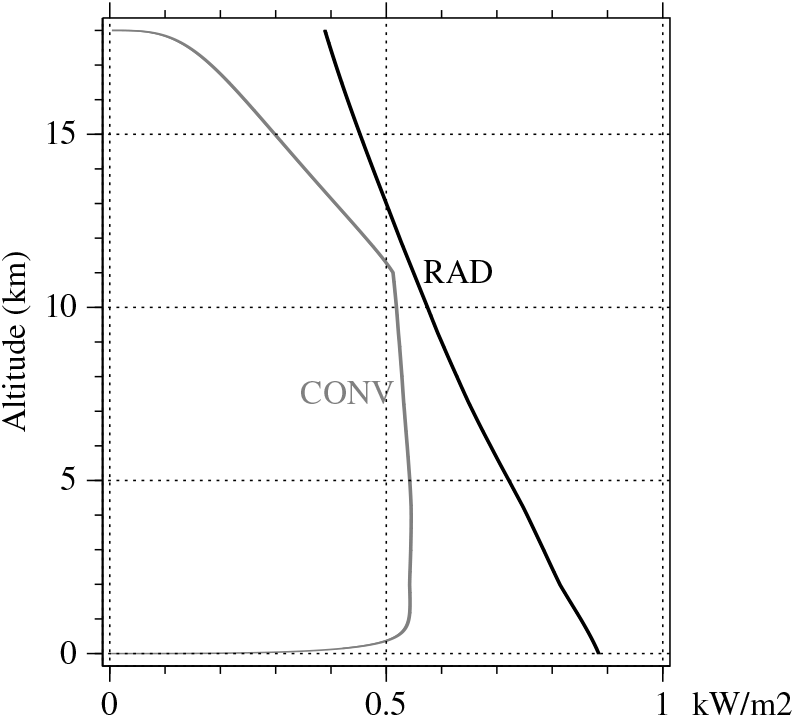
The convective cooling rate is more difficult to estimate. We use an empirical approximation(Reference Whitaker16), which is detailed in the Appendix. The radiative and convective cooling rates as a function of altitude are shown in Fig. 3. According to our approximate calculations, the convective rate is smaller than the radiative one at all altitudes.
The radiative (black) and convective (grey) cooling rates of the balloon skin in the baseline case.

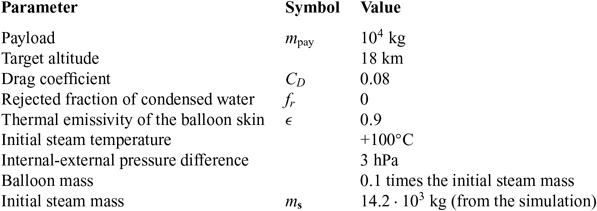
Table 2 lists the main parameters of the balloon device in the baseline simulation.
Device parameters in baseline case

3.0 SIMULATION RESULTS
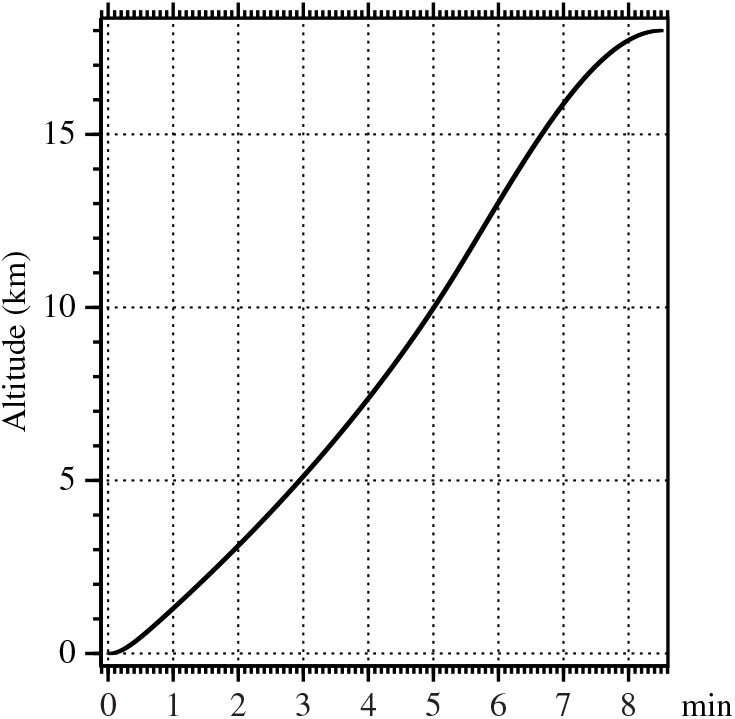
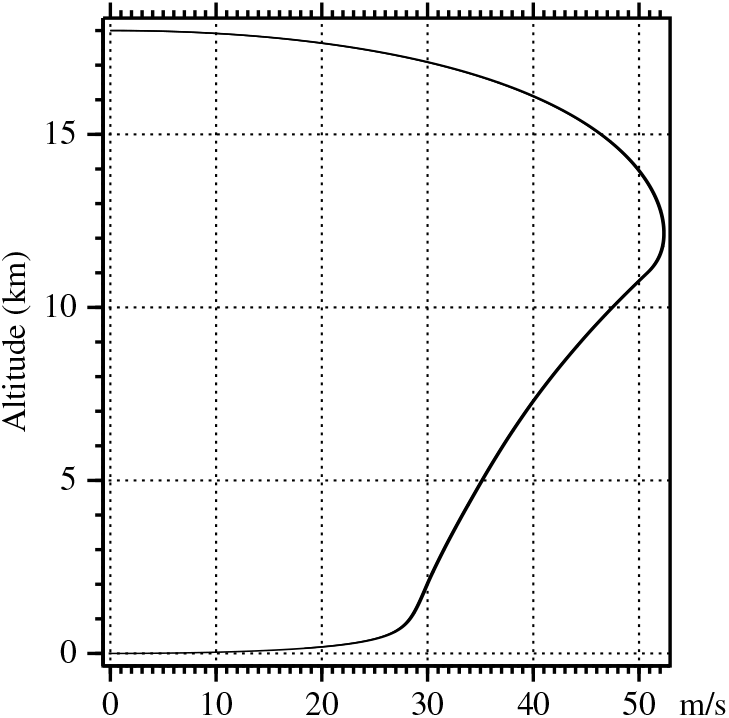
The trajectory and the upward speed of the balloon in the baseline simulation (Table 2) is shown in Figs 4 and 5. The balloon takes off with a maximum acceleration of 0.15 g, and at ~ 1 km altitude the ascending speed becomes drag-limited. The speed continues to increase as the air becomes thinner and the internal minus external temperature difference increases. After passing the tropopause, the speeds starts to decrease because the ambient temperature no longer decreases while the internal temperature continues to do so. The balloon reaches the maximum altitude, which is by design 18 km in this case, and would then start to descend. In the baseline case, the lifting from sea level to 18 km altitude takes 8.5 min. At the maximum altitude, the payload rocket is dropped and launched.
Altitude as function of time in the baseline simulation.

Upward speed of the balloon in the baseline simulation.

The simulated ascent speed of the balloon (up to 50 m/s, Fig. 5) is much higher than, e.g., for weather balloons. In what follows, we show that this is mainly a consequence of the large size of the balloon. Assuming a spherical shape for simplicity, in steady state the net lift is given by(Reference Gallice, Wienhold, Hoyle, Immler and Peter17)
 $$F_{{\rm{lift}}} = \eta \cdot {4 \over 3}\pi r^3 \rho g,$$
where ρ is the density of the ambient air and η is the relative lift parameter, which is a number between 0 and 1, 1 corresponding to an ideal massless balloon filled with weightless lifting medium and 0 to zero net lift. The drag is given by(Reference Gallice, Wienhold, Hoyle, Immler and Peter17)
 $$F_{{\rm{drag}}} = C_D \cdot {1 \over 2}\rho v^2 \pi r^2 $$
Equating F lift and F drag and solving for the equilibrium ascent speed υ yields(Reference Gallice, Wienhold, Hoyle, Immler and Peter17)
 $$v = \sqrt {{8 \over 3}{{\eta rg} \over {C_D }}} $$
Thus the ascent speed is proportional to  $
\sqrt {r/C_D }
$. In our case, r is much larger than the typical radius of weather balloons. Also, because of the large size, the Reynolds number is large, above the drag crises value, which keeps C D small. Additionally, steam cools slower than adiabatically because of the latent heat released by condensation. This effect is peculiar to steam balloons, and it boosts the ascent speed especially during the upper troposphere portion of the climb.
Although the ascent speed is rather high, the overall drag force is necessarily lower than the lift because most of the lift goes to suspending the payload. Hence, if the balloon withstands its own lift when anchored on ground, it also survives the aerodynamic drag force during the ascent. Wake turbulence is a potential concern because it might cause fluttering of the fabric. However, e.g. in parachutes used for air-dropping heavy payloads and for space capsule supersonic re-entries, such issues have been successfully overcome. In any case, quantitative analysis of structural engineering of the balloon is beyond the scope of the present work.
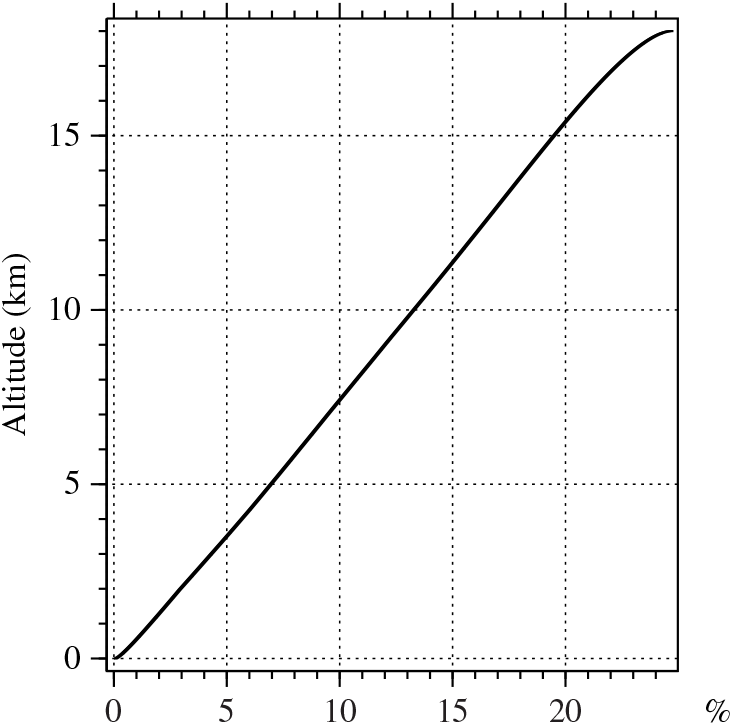
Figure 6 shows the condensed fraction of the steam. The condensed fraction increases rather steadily all the time as a function of altitude.
Condensed fraction of steam in the baseline simulation.

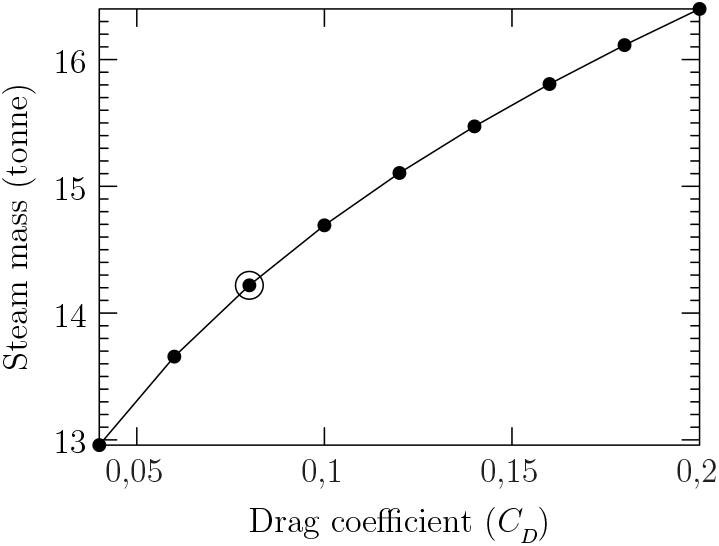
Next, we study the sensitivity of the required initial steam mass to the various parameters and assumptions. The effect of the aerodynamic drag coefficient on the required steam mass is shown in Fig. 7. If the balloon would be a sphere (C D ≈ 0.2 at relevant high Reynolds number) instead of drop-shaped, 2.2 tonnes more steam would be required. The drag coefficient is rather important because the smaller it is, the faster the balloon goes up, which shortens the time available for skin cooling. The effect is somewhat reduced by the fact that a higher velocity increases the convective cooling rate, however. In any case, the overall feasibility of the concept does not hinge on aerodynamics because even if the balloon would be cube-shaped with C D = 1.0, we calculated that the steam mass would still be only 23 tonnes, i.e., a steam to payload mass ratio of 2.3 instead of the baseline value of 1.4.
Dependence of the required steam mass on the assumed drag coefficient. The open circle refers to the baseline simulation.

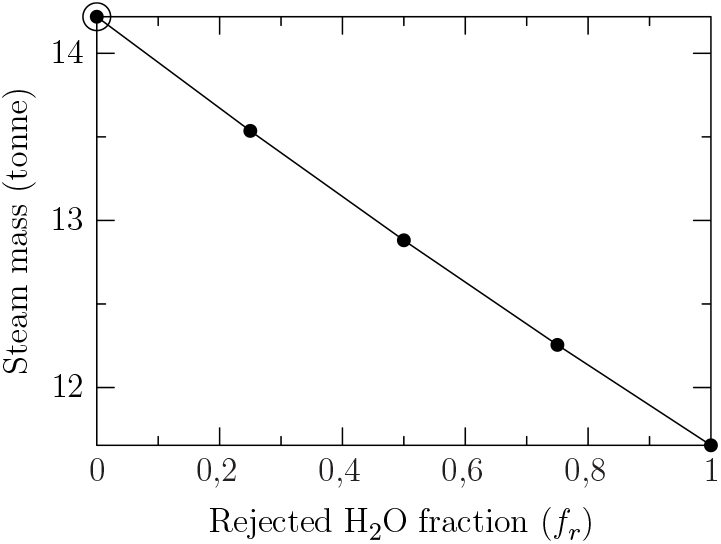
If the condensed water is rejected partially or fully, the performance can be improved further (Fig. 8). The effect is nearly linear in the rejected fraction, and it is of comparable magnitude to the difference between the droplet and spherical shape of the balloon.
Dependence of the required steam mass on the rejected fraction of condensed water.

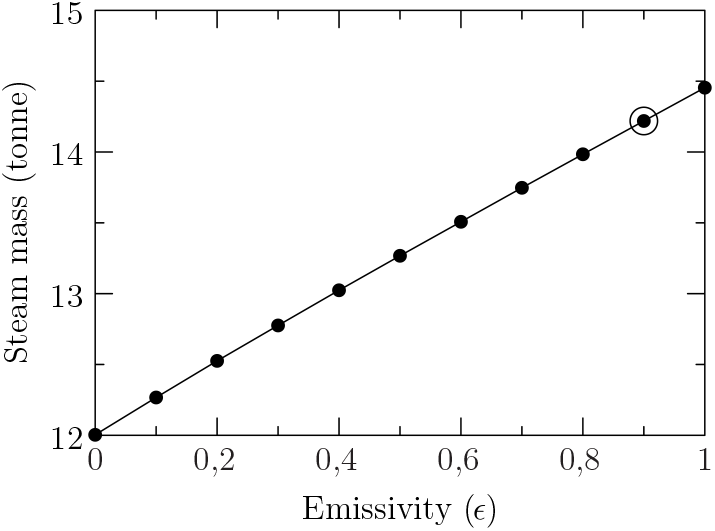
If one coats the balloon by shiny metal, its thermal emissivity becomes nearly zero. The magnitude of the effect is similar to that of rejecting the condensed water (Fig. 9). A coating and other insulation options are discussed in section 5.
Dependence of the required steam mass on the thermal emissivity of the balloon skin.

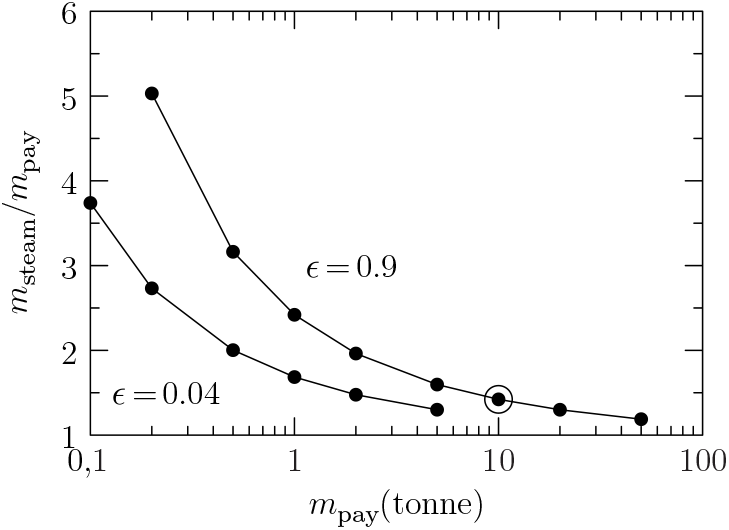
Thus far we have assumed that the payload is 10 tonnes. The effect of the payload mass on the steam to payload ratio (m s/m pay ratio) is shown in Fig. 10. When the payload is smaller, one needs more steam, relatively speaking, because the skin cooling is more important in relative terms. The steam to payload ratio is 1.45 for a 10 tonne payload, but 5.15 for a 200 kg payload. Figure 10 also shows the simulation with a metal-coated balloon where the emissivity is assumed to be ∊ = 0.04. With metal coating, it is possible to go down to a 100 kg payload while keeping a reasonable steam to a payload ratio of less than 4.
Steam per payload mass, as function of the payload. The lower curve shows the metal-coated case.

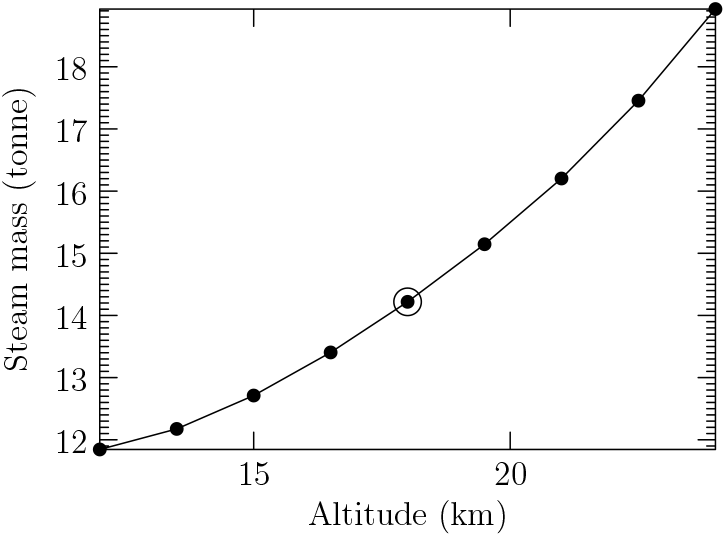
For reference purpose for trade-off studies with rocket vehicle design, in Fig. 11 we show the effect of the target altitude on the required steam mass. Qualitatively, for a given orbital payload mass, a higher launch altitude reduces the rocket’s launch mass, but increases the steam and balloon envelope mass relative to the rocket’s launch mass.
Dependence of the required steam mass on the target altitude.

Finally, in Fig. 12 we show the effect of the initial steam temperature on the required steam mass. The required mass of the steam gets smaller if the initial temperature is increased above the boiling point. The effect is not dramatic, but nevertheless superheating the steam to some extent is a possible approach if the balloon material tolerates such temperatures. For example, nylon 66, which is the material used to make hot-air balloon envelopes, tolerates a few hours of exposure to 180° C, although it weakens mechanically. An additional minor practical motivation for using some superheating may be to reduce the amount of condensed hot water that one has to take care of during filling.
Dependence of the required steam mass on the initial steam temperature.

4.0 THREE DESIGN VARIANTS
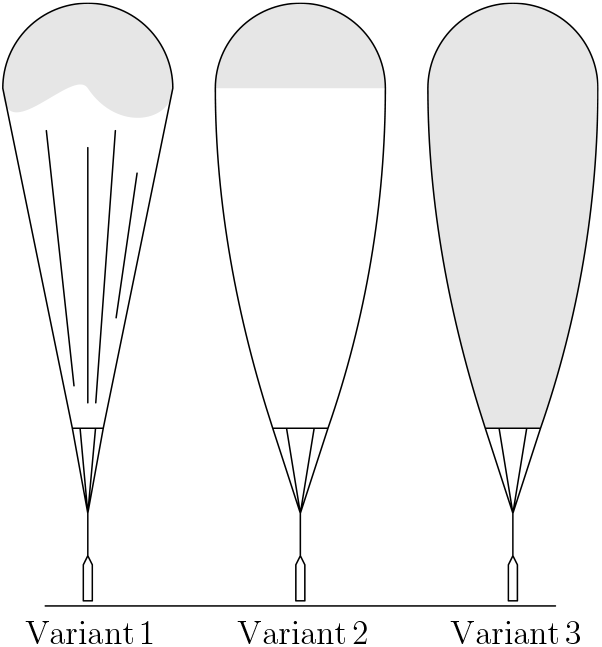
As the balloon rises, the steam expands. We discuss three design variants (Fig. 13), all based on non-elastic balloon fabric, that accommodate the steam expansion in different ways:
The three design variants of the balloon launch-ready on ground. Steam is shown as grey. In variant 2 the lower part of the balloon is filled by warm air.

1. Fill the balloon partially with steam. When the balloon rises, the steam gradually expands and at the target altitude it fills the balloon completely. This corresponds to the so-called zero pressure gas balloon(Reference Rainwater and Smith13).
2. Fill the upper part of the balloon with steam and the lower part with warm air. When the balloon rises, the steam expands and displaces the air, which exits from an opening or openings at the bottom.
3. Fill the balloon completely with steam. When the balloon rises, excess steam continuously exits from opening(s) at the bottom. The exited steam tends to rise faster than the balloon itself because it is not slowed down by the payload. The balloon is surrounded by a large rising steam cloud from all sides.
Variant 1 is the simplest to implement because it requires no excess steam and no warm air. A potential drawback is the somewhat non-aerodynamic shape of the loosely hanging lower part of the balloon. Freezing of the condensed water in the lower part can presumably be avoided by geometric design.
Variant 2 also needs no excess steam, but it needs a source of warm air and filling channels for it. The bulging caused by the warm air guarantees a good aerodynamic shape, and the warm air also contributes to the lift in the tropospheric portion of the climb (Fig. 5). The steam and air layers have a large density difference that evidently keeps them well separated. The warm air cools adiabatically. Therefore, in the troposphere its temperature difference with the ambient stays roughly constant or somewhat decreases. In the stratosphere, the air inside the balloon continues to cool adiabatically. If initially at +100°C, the internal air cools below the freezing point at 8.3 km and below the ambient stratospheric temperature of −55°C at 13.6 km altitude. Accordingly, the internal air should be pushed out by the steam before 13.6 km, because above this altitude the air would contribute a negative lift. Thus, the initial amount of steam should be selected so that the steam fills the balloon completely at 13.6 km. Then, between the 13.6 km and 18 km altitudes, the gas that gets pushed out from the bottom due to adiabatic expansion is no longer air, but steam.Footnote 1
Variant 3 needs several times more steam. Before leaving from the bottom, the extra steam contributes to the lift directly. After going out, the exited steam tends to rise faster than the balloon, so it contributes to the lift by providing an upward tailwind. The exited steam is also warmer than the surrounding air, thus decreasing the convective cooling of the skin. The cloud that forms around the balloon may also decrease the radiative cooling rate. Expectedly, variant 3 should be able to squeeze the maximum lifting performance out of a balloon envelope of a given size. The drawback of variant 3 is that it needs more steam than the other variants. How the exited steam interacts with the balloon would be an interesting topic for experimental research.
Variants 2 and 3 are rather well in line with the aerodynamic assumptions made in the simulation: the balloon has a constant streamlined droplet shape. The contribution to the lift by the warm air of variant 2 and the extra steam of variant 3 were not included in the simulation, however. The simulation therefore represents an intermediate case between variants 1 and 2. Simulating variants 1, 2 and 3 in detail is beyond the scope of this paper.
5.0 THE EFFECTS OF THERMAL INSULATION AND AIR ADDED IN STEAM
Thus far we have assumed that the balloon has no thermal insulation except that the effect of reducing the infrared emissivity of the skin was explored in Fig. 9. We found (Fig. 10) that surface cooling starts to reduce performance when the size of the balloon is such that its natural payload is less than a few tonnes. Thus, for lifting rockets relevant for orbital launches, surface cooling is typically not important, and thermal insulation need not be considered. If one wants to extend applicability towards smaller payloads such as atmospheric science instruments, however, consideration of thermal insulation becomes worthwhile.
A straightforward way to reduce thermal emissivity would be to add a metal coating to one or both sides of the envelope. Such a coating would not add much weight because the aluminium coating that is used, e.g., on Mylar and Kapton plastic membranes used in space technology is typically only 0.1µm thick. However, because the envelope is large, such coating may be costly. Metal coating is typically not used in hot-air balloons, for example.
Both the convective and radiative heat loss could be reduced by a double or multiple wall structure where some gas, possibly together with some thermal insulation material, exists between the inner and outer walls. However, using insulation increases the manufacturing cost and the packaged volume requirement and may make folding of the material tricker.
If the balloon contains pure steam, the gas temperature is uniform and equal to the boiling point of water at the prevailing pressure. If the steam contains some admixture of air, then it is possible that a layer of cooler and drier air forms at the walls because the cool wall condenses out water from the adjacent layer of gas. As a result, the partial pressure of water vapour is lower near the walls although the total pressure is uniform. Then the wall temperature is lower, and the surface energy loss is reduced. Thus, the addition of a small fraction of air in the steam might ideally lead to an automatic formation of an insulating air layer at the walls.
Somewhat unfortunately for this idea, a cooler and drier air layer near the wall is denser than the almost pure steam that fills the bulk of the balloon’s volume. Therefore a convective cell forms where the wall air layer sinks and the steam in the middle of the balloon rises. Such convection tends to reduce the benefits of the insulating air layer. The cool walls condense out water from the gas, and the produced air sinks to the bottom. In variants 2 and 3, the air exits from the bottom because it is pushed out by the adiabatic expansion of the balloon gases.
If the wall temperature drops below the freezing point in this scheme, ice starts to form at the walls, although in the bulk of the balloon, temperature remains well above freezing and nucleation droplets within the steam are in liquid state. Water immobilised as ice contributes to the dead mass, but the associated performance penalty is only moderate because the corresponding penalty was not too significant even if all the condensed water would remain in the system (Fig. 8).
If the wall temperature is successfully reduced by an insulating air layer, the heat loss of the skin is reduced.
The addition of air in the steam reduces its lifting capability, so it is not self-evident that the method can produce a net benefit. However, if an air fraction range exists where a net benefit is produced, applying the method is attractive because the technical implementation is easy.
6.0 DISCUSSION AND CONCLUSIONS
Using steam to fill a balloon seems a promising concept for lifting rockets into the stratosphere for launch. Steam is cheaper than helium or hydrogen, and it is safe. Unlike helium, steam is a long-term sustainable and scalable option. Unlike a hot-air balloon, the ground-filled steam balloon carries no hardware but the payload.
Our baseline mission scenario is that the balloon is launched so that the wind moves it over the sea. The balloon rises swiftly to the launch altitude where the rocket is separated and launched. Then the steam is released by making an opening at the top of the balloon, for example by a pyrotechnic fuse wire that was woven onto the balloon envelope. Alternatively one can keep the balloon intact so that after releasing the payload, it climbs above ~ 30 km where the steam freezes onto the envelope forming a ~ 0.6 mm thin layer of ice. Then the balloon falls into the sea, from where it can be recovered. The balloon may be reused for another flight or the materials can be recycled. Because the lifting phase is relatively fast (typically of order 10 minutes), potential damages like a small hole in the envelope are not harmful and do not prevent reuse. The condensed water that trickles down the envelope is allowed to drop down. The water should be managed so that it does not drop onto the payload.
The main simplifications and approximations made in the present simulation were the following:
1. For calculating the aerodynamic drag, a constant shape of the balloon was assumed (characterised by the equivalent spherical radius r of the initial steam volume and the drag coefficient C D). In reality, the steam expands as the balloon rises.
2. We estimated the cooling surface area from the steam volume V and the balloon radius r by assuming that the balloon is a vertical cylinder. While the balloon’s shape is not cylindrical in reality, the approximation correctly represents the fact that as the steam volume expands, the cooling surface area increases.
For lifting a few tonne of larger payloads into the stratosphere, the effect of surface cooling is rather unimportant. If one wants to extend the applicability to smaller payloads such as atmospheric science instruments, thermal insulation may become relevant. We speculatively discussed the possibility that mixing some air in the steam might improve insulation by creating a cooler air layer adjacent to the walls.
In summary, a steam balloon that is filled on ground looks to be an attractive option for lifting tonne scale and larger payloads such as rockets into the stratosphere. For payloads of such size, a standard plastic balloon skin without any thermal insulation works well. Steam is inexpensive, safe and environmentally friendly, and the steam balloon is comparable to a helium balloon in simplicity and operational safety. Experimental verification of the concept could be performed easily by utilising a standard hot-air balloon envelope and a truck-mounted portable steam generator for the filling operation, and releasing a payload would not be mandatory. On the modelling side, numerical 3D aerodynamic simulations could be performed, including the modelling of different ways of suspending and deploying the payload.
ACKNOWLEDGEMENTS
The authors thank Perttu Yli-Opas and Johan Kütt for fruitful discussions. The results presented have been achieved under the framework of the Finnish Centre of Excellence in Research of Sustainable Space (Academy of Finland grant number 312356).
APPENDIX A: ESTIMATING THE CONVECTIVE COOLING RATE
We estimate the convective cooling rate at the outer surface of the balloon by using a correlation function of heat transfer for forced convection around a sphere(Reference Whitaker16). The convective heat transfer is
 $$u_{{\rm{conv}}} = {{k\Delta T} \over L}{\rm{Nu}}_L ,$$
where k is the thermal conductivity of air, ΔT the temperature difference between the steam and the atmosphere, L = 2r the length scale and NuL the Nusselt number corresponding to the length scale L and given by
 $${\rm{Nu}}_L = 2 + \left( {0.4{\kern 1pt} {\rm{Re}}_L^{1/2} + 0.06{\kern 1pt} {\rm{Re}}_L^{2/3} } \right){\rm{Pr}}^{0.4} \left( {{\mu \over {\mu _s }}} \right)^{1/4} $$
Here ReL = Lυ/ν is the Reynolds number, ν the kinematic viscosity, Pr = ν/α the Prandtl number, α the thermal diffusivity and µ = ρν the dynamic viscosity of ambient air, while µs is the dynamic viscosity of air at the surface temperature of the balloon.
There is some risk in using Equation (A.2) because it was validated only up to ReL = 7.6 · 104 (Reference Whitaker16), while in our case ReL ~ 107. Also, our balloon is not spherical, but has a more streamlined shape. However, we believe that Equation (A.2) gives the correct order of magnitude.