

Introduction
The rate of milk feeding in calves fed from calfeterias may vary due to several factors, including the size of the calf at birth, the speed of learning to drink from teats, the ability to compete within a group and flow rate of milk from the rubber teats used. If left on the dam to be reared naturally, calves are more regulated in milk intake, as the cow will govern their consumption times, and milk is available throughout the day (Albright and Arave, Reference Albright and Arave1997). In commercial rearing situations, calves are fed twice or once a day (Ternouth and Roy, Reference Ternouth and Roy1973; Jasper and Weary, Reference Jasper and Weary2002) depending on age, and typically have to compete with others in their group for adequate intake (Jensen, Reference Jensen2003), especially when they are group housed in large pens and sheds, as is common practice in New Zealand. In certain farming situations, due to lack of labour or time constraints, farmers prefer fast flow teats as this cuts down on the time needed to feed calves around other daily chores on the farm, some even slitting the teat end to speed up flow deliberately.
Clotting of milk in the immature, simple stomach (abomasum) of calves is an important first step in digestion (Frantzen et al., Reference Frantzen, Toullec, Thivend and Mathieu1973; Strudsholm, Reference Strudsholm1988; Longenbach and Heinrichs, Reference Longenbach and Heinrichs1998) although there is a dearth of information on how rate of milk consumption affects this important parameter. Additionally there is no information available specifically on how the speed of teat flow affects milk clotting, despite the fact that various teats are used widely in calf production today. Fast milk consumption can lead to problems in calves, including overfilling the immature stomach (Radostits and Bell, Reference Radostits and Bell1970; Blowey, Reference Blowey, Andrews, Blowey, Boyd and Eddy2008), potentially leading to a flow of undigested milk into the intestines, where it can be utilised by pathogenic bacteria acquired from the environment further down the tract (Porter, Reference Porter1969; Blowey, Reference Blowey, Andrews, Blowey, Boyd and Eddy2008). This can result in digestive disorders, scouring and even higher mortality, especially where calves are kept in environments with high bacterial loads and/or poor farm biosecurity (Wise and Lemaster, Reference Wise and Lemaster1968; Longenbach and Heinrichs, Reference Longenbach and Heinrichs1998; Blowey, Reference Blowey, Andrews, Blowey, Boyd and Eddy2008). In addition, certain behavioural issues can be seen in calves which consume milk at faster speeds (Haley et al., Reference Haley, Rushen, Duncan, Widowski and de Passille1998; Margerison et al., Reference Margerison, Preston, Berry and Phillips2003; Herskin et al, Reference Herskin, Skjoth and Jensen2010). It appears that calves fed via fast flow systems, can become satiated more quickly, and therefore may not consume their daily allowance adequately, due to the large quantity of milk entering the immature stomach (Appleby et al., Reference Appleby, Weary and Chua2001; Jasper and Weary, Reference Jasper and Weary2002). This has been associated with an increase of navel, tail and udder sucking (dePassillé, Reference de Passillé2001; Jung and Lidfors, Reference Jung and Lidfors2001; Jensen, Reference Jensen2003, Jensen and Budde, Reference Jensen and Budde2006). Sucking the immature udder can lead to premature removal of the keratin plug, which protects the individual teats from infection, especially in heifers coming into first milk, as well as navel and skin infections. Both Haley et al., (Reference Haley, Rushen, Duncan, Widowski and de Passille1998) and Herskin et al, (Reference Herskin, Skjoth and Jensen2010) compared the behaviour of calves fed either via different diameter tubes from buckets or large or small teat apertures, leading to slow or fast drinking patterns in calves. In both cases, these authors reported that the slower fed calves had less incidence of non-nutritive (cross) sucking of body parts of other calves.
The aim of the current trial was to determine if regular and slow flow calfeteria teats give true differences in milk intake times, calf growth, digestive characteristics and cross-sucking behaviour under controlled conditions.
Materials and methods
Seventy-two, one day old Friesian heifer calves were used in the experiment. Calves were fed whole milk via either the control teats (regular release) or the treatment teats (slow release), which are regulated via a mesh insert and aperture size, on commercial calfeteria systems (Milkbar, McInnes Manufacturing Limited, Waipu, New Zealand).
Twelve calves were randomly and individually housed in cubicles (1 m x 1.6 m) and fed using single teat calfeterias with either regular or slow teats (n = 6 per treatment). The remaining calves were randomly assigned to groups in six large (4 × 4 m) pens on deep litter wood shaving bedding, to give a minimum of 1.6 m2 per calf (to adhere to New Zealand welfare legal rearing space limits of 1.5 m2 per calf). The latter were milk fed via one large, multi-calfeteria designed to feed this number of calves.
Calves were collected from pasture after 12 hours on the dam following birth, and transferred to the trial site. For four days they received 2 litres of colostrum twice a day. From five to eleven days of age, calves were fed 2.75 litres of half colostrum and half milk twice a day. From day 12 of age, calves were fed 5.5. litres of milk once a day (in morning), to allow an intake of 500 g of milk solids per calf per day at 9% dry matter content of whole milk (as per prior milk analysis). This is equivalent to recommended dry matter milk solids intakes for commercial milk replacers.
Three individually housed calves from each treatment were humanely culled at either seven or fourteen days of age and dissected in order to take digesta samples (approximately 50 ml) from the abomasum (for assessing curding by photograph and sampling), upper ileum and rectum. Animals were culled two hours after feeding to allow milk coagulation and the passage of digesta into the ileum for sampling purposes (Smith and Sissons, Reference Smith and Sissons1975). Samples of colostrum and milk were retained for analysis of lactose and protein. At the end of the 42 day rearing period, all group housed heifer calves were returned to the farmer.
Calves were weighed on entry to the trial site and then weekly, to calculate their average daily gain (ADG). At every feeding, the time for each individually housed calf or group of calves to consume the colostrum, half colostrum or whole milk was measured. Calves that failed to drink from the multi-calfeteria and required individual bottle feeding in the first couple of days of the trial were excluded from the dataset. The trial was conducted to Kaiawhina Animal Ethics Standards, New Zealand (approval code AEC005/14). Full trial biosecurity was afforded by cleaning facilities and equipment and the use of wheel and footbaths with animal-safe, long lasting disinfectant (Credence, Kiotech-Agil Ltd, UK).
Data was analysed using the general linear model procedure of Unistat (UNISTAT 5.5, London, UK), with confidence limits set at 5% (P < 0.05). For average daily gain, body weight at day old was used as a covariate to eliminate its potential influence on subsequent performance. In addition, the dataset for milk intake was analysed for the whole trial period and also split by feeding phase: colostrum only (days 1–5 of age), half colostrum and half whole milk (6–12 days old) and whole milk only (from day 13 to the end of the trial).
Results
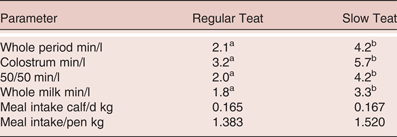
Results for milk intake showed that those fed using regular release teat calfeterias had significantly shorter consumption time compared to those calves on the slow release teats (Table 1), with the regular teat fed calves consuming milk twice as fast as those fed using slow teats (2.1 min/l versus 4.2 min/l; P < 0.0001) for the whole period. When broken down into the three feeding phases, those on the slow teats consumed milk at a rate of 5.7 min/l versus 3.2 min/l during the colostrum phase (which included the calfeteria training period where calves were sometimes slower to consume the milk). For the half colostrum, half milk phase, intake times were 2 min/l for regular teats and 4.2 min/l for slow teats. For the whole milk feeding period (days 13–42) consumption rates were 1.8 min/l for regular and 3.3 min/l for slow teats. Meal intake was not significantly higher between treatments, although those on the slow teat feeders were numerically higher (Table 1).
Milk and meal intake of calves fed using either regular or slow teat delivery systems

a,b Means within a row with different superscripts differ significantly (P < 0.0001)
Body weights and daily gains, when including day old body weight as a covariate, showed no initial significant differences. However, at 42 days of age, calves fed using the slow teats had a strong trend for higher average daily gains (0.738 kg/d slow teats versus 0.665 kg/d regular teats; P = 0.0758). This may reflect the differences in digestibility observed from the digestive tract samples (discussed below).
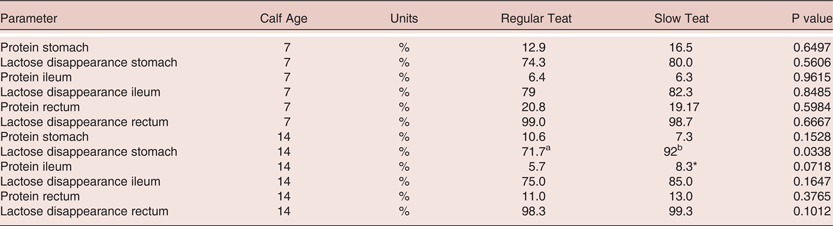
For samples from the cull calves, there were no significant differences seen in digestibility between the calves fed using the slow release and regular release teats at seven days of age (Table 2). However, at 14 days of age, the calves fed using the slow release teats had significantly (P = 0.0338) higher lactose disappearance in the stomach and a trend (P = 0.0718) towards higher ileal available protein compared to the calves fed using the regular teats.
Digestibility in calves at 7 and 14 days of age fed using either regular or slow teat delivery systems
a,b Means within a row with different superscripts differ significantly (P < 0.05)
*Denotes strong trend
Photographic evidence showed consistent differences between those fed using the regular versus the slow release teats (Figures 1 and 2 below). The regular teat fed calves had large clots of curded milk surrounded by watery fluid in the main chamber of the undeveloped, simple stomach. However, in the calves reared using the slow release teats, the ingested milk was curded into much smaller, uniform pieces surrounded by a thicker liquid. These characteristics were consistent for both the seven and 14 days old calves. This indicated that initial digestion in those fed with slow teats resulted in a larger surface area of the consumed milk during the first stage of digestion (i.e. reaction with rennet in the abomasum). This may directly reflect the slower, regular flow of milk into the calf – which reacted with rennet in smaller, more discreet aliquots. Overall, it would be logical to expect that such a larger and more regular surface area may be related to rate of digestion in the upper intestines.
A calf fed using regular flow milk teat at 7 days of age; large clots of coagulated milk in watery fluid.
A calf fed using slow flow milk teat at 7 days of age; smaller clots of coagulated milk in thicker fluid.
During the trial, it was observed that group-housed calves fed the regular flow teats had a much greater incidence of hyperactivity immediately post feeding and were more likely to engage in non-nutritive sucking of each other's body parts (including muzzle, navel and udder). Although this was not the focus of the current trial and hence was not monitored in terms of occurrence or duration, these observations support previously published information.
Discussion
The data showed that feeding a regular or slow release teat had a significant impact on consumption speed, which was related to the age/feeding phase, and in the coagulation characteristics of milk in the abomasum of calves. Other researchers have previously reported such differences in ingestion time – although these were via other suckling systems and varied from the design and control of the teats used in this experiment (Haley et al., Reference Haley, Rushen, Duncan, Widowski and de Passille1998; Herskin et al., Reference Herskin, Skjoth and Jensen2010). The slow feeding teats increased consumption time by double that seen in the regular feeding teats for the whole period. In addition, this appeared to have an effect on initial digestion via coagulation with rennet, whereby calves fed using the regular release teats developed large coagulated clots of milk in watery fluid two hours post feeding, whereas the slow teat fed calves have a more ‘porridge-like’ consistency of small coagulated fragments within a thicker fluid. However, there is little or no published information regarding the relationship between speed of intake and milk coagulation, so it is not possible to compare this against other trials, or to determine an optimal speed for milk coagulation, surface area and digestion. The calves fed using the slow teats had higher lactose disappearance in the stomach and a trend towards higher protein in the ileum which may be related to one another, indicating that feeding speed and curding characteristics had an impact on milk digestibility. These differences may be due to slow feeding eliminating ‘overfill’ in the immature abomasum, as discussed by Radostits and Bell (Reference Radostits and Bell1970) and Blowey (Reference Blowey, Andrews, Blowey, Boyd and Eddy2008), as well as negating the flow of undigested ‘by–pass' milk nutrients into the lower intestines (Porter, Reference Porter1969; Blowey, Reference Blowey, Andrews, Blowey, Boyd and Eddy2008). In addition, the calves fed using the slow teats had higher ADG when calculated from 1–42 days of age, which may be attributed to the higher digestibility of lactose as a primary energy source seen in the calves fed using the slow release teats.
Conclusions
Using slow release teats on milk calfeterias to feed calves from day old to weaning appears to have an important impact on digestive processes in the immature gut. This may be responsible for the strong trend seen in the 42 d ADG. Although meal intake only showed small numerical advantages in the slow teat-fed calves, improvements in digestion and rumen development in young calves may assist in the digestion of other feeds, apart from milk, and may have further impacts on performance at weaning and during maturation. It may be that using this novel, slow release teat system can be expected to reduce scours and other digestive problems in young calves during peak milk intake (up to 15 d of age) when kept in less biosecure environments on farm.
The digestibility results indicated that future studies need to focus on 14 day old calves where important differences were seen despite the fact that this study only had three calves per treatment for these parameters. From this study further research is warranted to determine how milk curding differences occur between the slow and regular teat fed calves in order to understand the consistent differences seen in coagulation particle sizes observed. In addition, future trials should include monitoring the behavioural element of suckling speeds from calfeterias.