Marfan syndrome is an autosomal dominant connective tissueReference Murdoch, Walker, Halpern, Kuzma and McKusick 1 disorder. Aortic root dilation affects up to 80% of Marfan patientsReference van Karnebeek, Naeff, Mulder, Hennekam and Offringa 2 , Reference Roman, Rosen, Kramer-Fox and Devereux 3 and predisposes to aortic dissection and death.Reference Murdoch, Walker, Halpern, Kuzma and McKusick 1 , Reference Aburawi and O'Sullivan 4 Medications such as beta-blockers, angiotensin-converting enzyme inhibitors, and angiotensin II receptor blockers are used to minimise dilation.Reference Mukherjee and Eagle 5 , Reference Williams, Davies, Stuart, Wilson and Fraser 6 There is one systematic review on this topic that has been published to date. Gersony et alReference Gersony, McClaughlin, Jin and Gersony 7 found no conclusive evidence to support the use of beta-blockers; however, this review examined only the use of beta-blockers and not angiotensin-converting enzyme inhibitors or angiotensin II receptor blockers, warranting a more comprehensive review on the topic. Therefore, the purpose of this systematic review was to examine the evidence for beta-blockers, angiotensin-converting enzyme inhibitors, and angiotensin II receptor blockers to treat aortic disease in Marfan Syndrome.
Methods
Study identification and selection
A literature search was conducted independently by two reviewers (V.T. and K.R.) in May, 2010 in four databases – Medline, EMBASE, Web of Science, and The Cochrane Central Register of Controlled Trials – to identify relevant titles and abstracts. Databases were searched with the following terms: “Marfan*” or “Marfan syndrome”; “aortic root dilatation” or “aorta” or “aortic disease” or “aortic dissection” or “aortic aneurysm”; and “adrenergic beta antagonists” or “beta-blockers” or “angiotensin-converting enzyme inhibitors” or “ACE inhibitors” or “angiotensin II receptor blockers” or “ARBs”. No restrictions were placed on patient age, language, or year of study; however, only human studies were included. All comparative study designs were eligible. Trials in progress were searched for on www.clinicaltrials.gov. The search strategy was repeated in April, 2012.
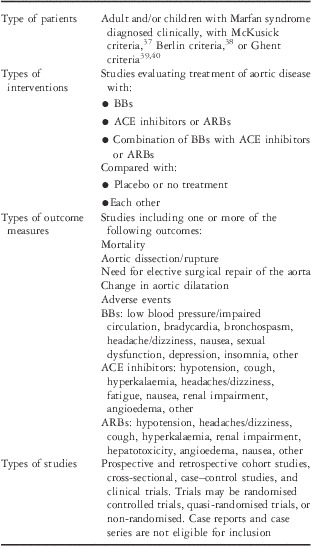
If a title and abstract appeared relevant, full text was retrieved and screened for inclusion using eligibility criteria (Table 1). References of eligible studies and the previous systematic reviewReference Gersony, McClaughlin, Jin and Gersony 7 were hand-searched. We examined conference proceedings of the American Heart Association and the American College of Cardiology from 1990 to 2010.
Eligibility criteria for identification and selection of studies.

ACE = angiotensin-converting enzyme; ARBs = angiotensin receptor blockers; BB = beta-blocker
Risk of bias assessment
Risk of bias of selected studies was rated independently by two reviewers (V.T. and K.R.) using standardised forms. Separate forms were created for observational studies and clinical trials. Clinical trials were assessed for bias as recommended in the Cochrane Handbook.Reference Higgins and Green 8 Observational studies were evaluated using guidelines suggested by the MOOSE statement.Reference Stroup, Berlin and Morton 9 Corresponding authors of eligible studies were contacted to clarify any questions about study methodology. Disagreements between reviewers were resolved through discussion. Risk of bias of each study was discussed and summarised in a table as suggested by the Cochrane Collaboration.Reference Higgins and Green 8 Risk of bias was assessed only for completed studies.
Data abstraction
Characteristics of the study population, details of the medical treatment, and relevant outcomes were retrieved. Data were abstracted on the following outcomes: mortality, aortic dissection/rupture, need for elective surgical repair of the aortic root, change in aortic dilatation, and adverse events. Corresponding authors were contacted to clarify abstracted data to ensure accuracy. Study demographics, such as country in which the study was performed and year of completion, were recorded.
Analysis
The comparison of interest was the use of beta-blockers, angiotensin-converting enzyme inhibitors, or angiotensin II receptor blockers alone or in combination versus placebo or each other in the treatment of aortic root dilatation. The primary outcome was mortality, whereas the other outcomes (Table 1) were secondary. Meta-analysis of observational studies and clinical trials were planned and a priori hypotheses of heterogeneity, such as type of intervention, study design, and patient population, were determined; however, clinical and methodological heterogeneity across studies precluded the use of meta-analyses.Reference Higgins and Green 8
Results
Study identification and selection
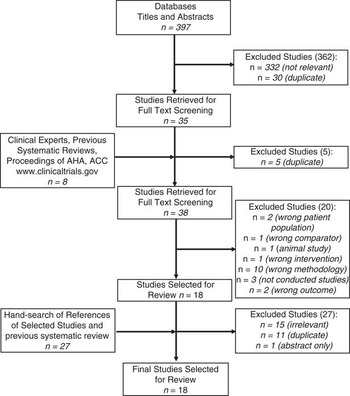
The flow of studies through the screening and selection process is illustrated in Figure 1. A total of 18 articlesReference Ahimastos, Aggarwal and D'Orsa 10 – Reference Yetman, Bornemeier and McCrindle 27 were included. Only one non-English study was retrievedReference Raoux 28 ; this study was published in French and was a duplicate of an English publication.Reference Ladouceur, Fermanian and Lupoglazoff 16 Reviewers had good agreement with study selection (κ = 0.79). Our secondary search did not reveal any additional new studies published between May, 2010 and April, 2012.
Summary of study identification and selection. AHA = The American Heart Association; ACC = The American College of Cardiology.

Risk of bias assessment
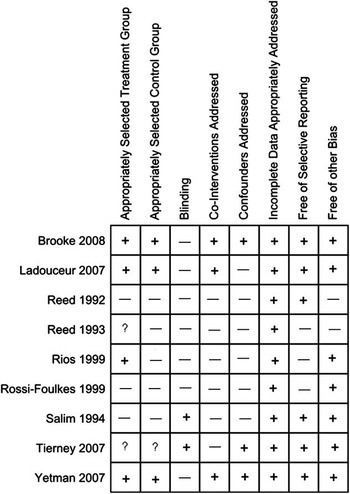
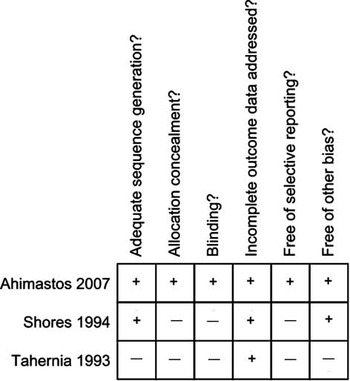
Of the 18 studies,Reference Ahimastos, Aggarwal and D'Orsa 10 – Reference Yetman, Bornemeier and McCrindle 27 there were nine observational studiesReference Brooke, Habashi, Judge, Patel, Loeys and Dietz 11 , Reference Ladouceur, Fermanian and Lupoglazoff 16 , Reference Reed and Alpert 18 – Reference Selamet Tierney, Feingold and Printz 23 , Reference Yetman, Bornemeier and McCrindle 27 and nine randomised controlled trials.Reference Ahimastos, Aggarwal and D'Orsa 10 , Reference De Backer 12 – Reference Lacro, Dietz and Wruck 15 , Reference Radonic, de Witte, Baars, Zwinderman, Mulder and Groenink 17 , Reference Shores, Berger, Murphy and Pyeritz 24 – Reference Wu 26 Of the nine randomised controlled trials, six are in progress.Reference De Backer 12 – Reference Lacro, Dietz and Wruck 15 , Reference Radonic, de Witte, Baars, Zwinderman, Mulder and Groenink 17 , Reference Wu 26 The authors for 13Reference Ahimastos, Aggarwal and D'Orsa 10 – Reference Ladouceur, Fermanian and Lupoglazoff 16 , Reference Reed and Alpert 18 , Reference Reed, Fox and Alpert 19 , Reference Rossi-Foulkes, Roman and Rosen 21 – Reference Shores, Berger, Murphy and Pyeritz 24 of the included studies responded to our team and clarified the study methodology and abstracted data. High risk of bias was demonstrated in two of the trials,Reference Shores, Berger, Murphy and Pyeritz 24 , Reference Tahernia 25 whereas the third showed low risk of bias.Reference Ahimastos, Aggarwal and D'Orsa 10 All observational studiesReference Brooke, Habashi, Judge, Patel, Loeys and Dietz 11 , Reference Ladouceur, Fermanian and Lupoglazoff 16 , Reference Reed and Alpert 18 – Reference Selamet Tierney, Feingold and Printz 23 , Reference Yetman, Bornemeier and McCrindle 27 had at least one important methodological flaw, the most common being lack of blinding. Risk of bias assessment is summarised in Figures 2 and 3.
Methodological quality summary for included observational studies. “+” indicates low risk of bias, “−” indicates a high risk of bias, and “?” indicates an unclear risk of bias.

Methodological quality summary for included randomised controlled trials. “+” indicates low risk of bias and “−” indicates a high risk of bias.

Characteristics of completed studies
Completed studiesReference Ahimastos, Aggarwal and D'Orsa 10 , Reference Brooke, Habashi, Judge, Patel, Loeys and Dietz 11 , Reference Ladouceur, Fermanian and Lupoglazoff 16 , Reference Reed and Alpert 18 – Reference Tahernia 25 , Reference Yetman, Bornemeier and McCrindle 27 were published between 1992 and 2008. Most studies were conducted in North America,Reference Ahimastos, Aggarwal and D'Orsa 10 , Reference Brooke, Habashi, Judge, Patel, Loeys and Dietz 11 , Reference Reed and Alpert 18 – Reference Tahernia 25 , Reference Yetman, Bornemeier and McCrindle 27 and there was one from AustraliaReference Ahimastos, Aggarwal and D'Orsa 10 and another from France.Reference Ladouceur, Fermanian and Lupoglazoff 16 The sample size for the nine observational studies ranged from 22 to 155 patients (median 55), with a total of 579 patients. There was one observational studyReference Rios, Silber and Bavishi 20 conducted exclusively in adult patients, six studiesReference Ladouceur, Fermanian and Lupoglazoff 16 , Reference Reed and Alpert 18 – Reference Salim, Alpert, Ward and Pyeritz 22 were conducted exclusively in children, and two studiesReference Brooke, Habashi, Judge, Patel, Loeys and Dietz 11 , Reference Yetman, Bornemeier and McCrindle 27 included both adults and children.
The sample size for the three completed randomised controlled trialsReference Ahimastos, Aggarwal and D'Orsa 10 , Reference Shores, Berger, Murphy and Pyeritz 24 , Reference Tahernia 25 ranged from 6 to 70 patients (median 17), with a total of 93 patients overall.Reference Ahimastos, Aggarwal and D'Orsa 10 , Reference Shores, Berger, Murphy and Pyeritz 24 , Reference Tahernia 25 All completed randomised controlled trialsReference Ahimastos, Aggarwal and D'Orsa 10 , Reference Shores, Berger, Murphy and Pyeritz 24 , Reference Tahernia 25 were single-centre studies; one was conducted exclusively in children, Reference Tahernia 25 one was conducted exclusively in adults,Reference Tahernia 25 and one included both adults and children.Reference Shores, Berger, Murphy and Pyeritz 24
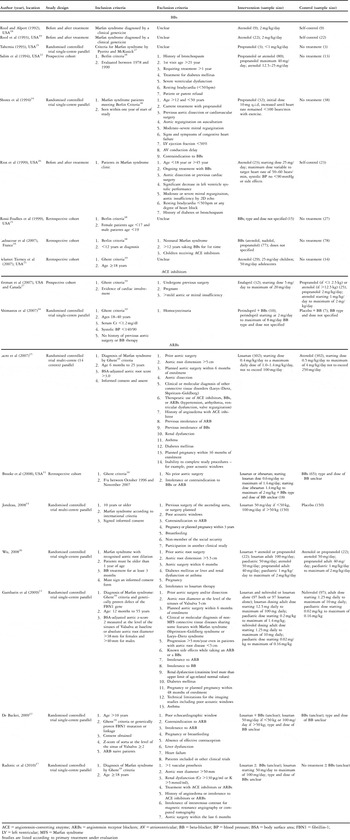
In all, three before-and-after treatment,Reference Reed and Alpert 18 – Reference Rios, Silber and Bavishi 20 one prospective cohort,Reference Salim, Alpert, Ward and Pyeritz 22 three retrospective cohorts,Reference Ladouceur, Fermanian and Lupoglazoff 16 , Reference Rossi-Foulkes, Roman and Rosen 21 , Reference Selamet Tierney, Feingold and Printz 23 and two randomised controlled trialsReference Shores, Berger, Murphy and Pyeritz 24 , Reference Tahernia 25 examined beta-blockers. Of these studies, four examined atenolol,Reference Reed and Alpert 18 – Reference Rios, Silber and Bavishi 20 , Reference Selamet Tierney, Feingold and Printz 23 two studies examined propranolol,Reference Shores, Berger, Murphy and Pyeritz 24 , Reference Tahernia 25 and one study examined both atenolol and propranolol.Reference Salim, Alpert, Ward and Pyeritz 22 The remaining two studiesReference Ladouceur, Fermanian and Lupoglazoff 16 , Reference Rossi-Foulkes, Roman and Rosen 21 examined different types of beta-blockers; however, it is unclear which beta-blocker was used predominantly. Dose ranges for atenolol or propranolol were similar across studies (see Table 2). One non-randomised trialReference Yetman, Bornemeier and McCrindle 27 and one randomised controlled trialReference Ahimastos, Aggarwal and D'Orsa 10 examined angiotensin-converting enzyme inhibitors versus beta-blockers; the non-randomised trial evaluated enalapril, whereas the randomised trial examined perindopril. There was one retrospective cohortReference Brooke, Habashi, Judge, Patel, Loeys and Dietz 11 that examined angiotensin II receptor blockers, specifically losartan in 17 patients and irbesartan in one patient. The details of inclusion and exclusion criteria, study interventions, and baseline characteristics of the included patients are provided in Tables 2 and 3.
Characteristics of the included studies.

ACE = angiotensin-converting enzyme; ARBs = angiotensin receptor blockers; AV = atrioventricular; BB = beta-blocker; BP = blood pressure; BSA = body surface area; FBN1 = fibrillin-1; LV = left ventricular; MFS = Marfan syndrome
Studies are listed according to primary treatment under evaluation
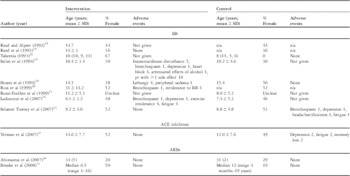
Age and gender of subjects in completed studies and adverse events.

ACE = angiotensin-converting enzyme; ARBs = angiotensin II receptor blockers; BB = beta-blockers
Characteristics of studies in progress
Protocols for studies in progressReference De Backer 12 – Reference Lacro, Dietz and Wruck 15 , Reference Radonic, de Witte, Baars, Zwinderman, Mulder and Groenink 17 , Reference Wu 26 were published between 2007 and 2010. In Europe, four studies in progress are being conducted.Reference De Backer 12 – Reference Lacro, Dietz and Wruck 15 , Reference Radonic, de Witte, Baars, Zwinderman, Mulder and Groenink 17 A large multi-centre study is being conducted in North AmericaReference Lacro, Dietz and Wruck 15 and one study is being conducted in Asia.Reference Wu 26 All studies are randomised controlled trials using a conventional parallel group design, and all include losartan.
Analysis of outcomes
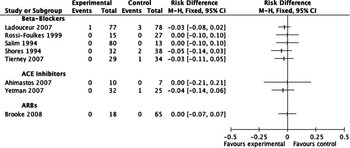
Mortality (Fig 4)
A total of five observational studiesReference Ladouceur, Fermanian and Lupoglazoff 16 , Reference Rios, Silber and Bavishi 20 – Reference Selamet Tierney, Feingold and Printz 23 and one randomised controlled trialReference Shores, Berger, Murphy and Pyeritz 24 evaluated mortality in patients treated with beta-blockers. There were two studies that examined atenolol,Reference Rios, Silber and Bavishi 20 , Reference Selamet Tierney, Feingold and Printz 23 two studies that examined propranolol,Reference Salim, Alpert, Ward and Pyeritz 22 , Reference Shores, Berger, Murphy and Pyeritz 24 and the remaining two studies examined all types of beta-blockers.Reference Ladouceur, Fermanian and Lupoglazoff 16 , Reference Rossi-Foulkes, Roman and Rosen 21 There were two studies examining angiotensin-converting enzyme inhibitors that evaluated mortality. EnalaprilReference Yetman, Bornemeier and McCrindle 27 was examined in one observational study, one randomised controlled trial evaluated perindopril,Reference Ahimastos, Aggarwal and D'Orsa 10 and one observational studyReference Brooke, Habashi, Judge, Patel, Loeys and Dietz 11 examined losartan. None of the studies demonstrated an impact on mortality.
Impact of pharmacological therapy on mortality. Experimental and control interventions varied across studies and are detailed in Table 2. ACE = angiotensin-converting enzyme; ARBs = angiotensin II receptor blockers; M–H = Mantel–Haenszel.

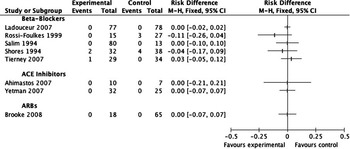
Aortic dissection or rupture (Fig 5)
In all, five observational studiesReference Ladouceur, Fermanian and Lupoglazoff 16 , Reference Rios, Silber and Bavishi 20 – Reference Selamet Tierney, Feingold and Printz 23 and one randomised controlled trialReference Shores, Berger, Murphy and Pyeritz 24 evaluated aortic dissection or rupture in patients treated with beta-blockers. There were two studies that examined atenolol,Reference Rios, Silber and Bavishi 20 , Reference Selamet Tierney, Feingold and Printz 23 two studies that examined propranolol,Reference Salim, Alpert, Ward and Pyeritz 22 , Reference Shores, Berger, Murphy and Pyeritz 24 and the remaining two studies examined all types of beta-blockersReference Ladouceur, Fermanian and Lupoglazoff 16 , Reference Rossi-Foulkes, Roman and Rosen 21 There were two studies examining angiotensin-converting enzyme inhibitors that evaluated dissection or rupture. There was one observational study that evaluated dissection in patients treated with enalapril,Reference Yetman, Bornemeier and McCrindle 27 one randomised controlled trial that evaluated the effect of perindopril.Reference Ahimastos, Aggarwal and D'Orsa 10 One observational study evaluated ARBs, specifically losartan, that reported aortic dissection. In six studies,Reference Ahimastos, Aggarwal and D'Orsa 10 , Reference Brooke, Habashi, Judge, Patel, Loeys and Dietz 11 , Reference Ladouceur, Fermanian and Lupoglazoff 16 , Reference Rios, Silber and Bavishi 20 , Reference Salim, Alpert, Ward and Pyeritz 22 , Reference Yetman, Bornemeier and McCrindle 27 aortic dissection and/or rupture did not occur in any patient. Rossi-Foulkes et alReference Rossi-Foulkes, Roman and Rosen 21 evaluated the use of all types of beta-blockers versus no treatment and reported three patients in the control group with aortic dissection and/or rupture. Selamet Tierney et alReference Selamet Tierney, Feingold and Printz 23 examined the use of atenolol versus no treatment; one patient in the treatment group had a dissection. In the trial by Shores et al,Reference Shores, Berger, Murphy and Pyeritz 24 which examined the use of propranolol versus no treatment, four patients in the control group and two patients in the treatment group had a dissection. The occurrence of aortic dissection was not statistically significant in any of these studies.
Impact of pharmacological therapy on aortic dissection or rupture. Experimental and control interventions varied across studies and are detailed in Table 2. ACE = angiotensin-converting enzyme; ARBs = angiotensin II receptor blockers; M–H = Mantel–Haenszel.

Need for elective surgical repair of the aorta and/or aortic valve because of severe aortic dilatation (Fig 6)
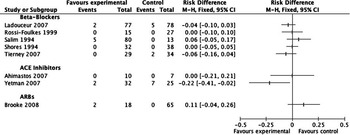
In all, five observational studiesReference Ladouceur, Fermanian and Lupoglazoff 16 , Reference Rios, Silber and Bavishi 20 – Reference Selamet Tierney, Feingold and Printz 23 and one randomised controlled trialReference Shores, Berger, Murphy and Pyeritz 24 evaluated the need for elective surgery in patients treated with beta-blockers. There were two studies that examined atenolol,Reference Rios, Silber and Bavishi 20 , Reference Selamet Tierney, Feingold and Printz 23 two studies that examined propranolol,Reference Salim, Alpert, Ward and Pyeritz 22 , Reference Shores, Berger, Murphy and Pyeritz 24 and the remaining two studies examined all types of beta-blockers.Reference Ladouceur, Fermanian and Lupoglazoff 16 , Reference Rossi-Foulkes, Roman and Rosen 21 There was one observational study that evaluated the need for surgery in patients treated with enalapril,Reference Yetman, Bornemeier and McCrindle 27 one randomised controlled trial that evaluated perindopril,Reference Ahimastos, Aggarwal and D'Orsa 10 and one observational study examining losartanReference Brooke, Habashi, Judge, Patel, Loeys and Dietz 11 that evaluated the need for elective surgery. In four studies,Reference Brooke, Habashi, Judge, Patel, Loeys and Dietz 11 , Reference Ladouceur, Fermanian and Lupoglazoff 16 , Reference Salim, Alpert, Ward and Pyeritz 22 , Reference Yetman, Bornemeier and McCrindle 27 patients required elective surgical repair of the aorta and/or aortic valve. Salim et alReference Salim, Alpert, Ward and Pyeritz 22 examined propranolol versus no treatment and reported that five patients in the treatment group required elective surgery compared with no patients in the control group. In the study by Ladouceur et alReference Ladouceur, Fermanian and Lupoglazoff 16 examining the use of all types of beta-blockers versus no treatment, five patients in the control group required elective surgery versus two patients in the treatment group. Yetman et alReference Yetman, Bornemeier and McCrindle 27 evaluated enalapril versus propranolol and reported that seven patients in the propranolol group versus two patients in the enalapril group required elective surgery. Brooke et alReference Brooke, Habashi, Judge, Patel, Loeys and Dietz 11 evaluated losartan versus beta-blockers and reported that two patients in the losartan group required elective surgery and that no patients in the beta-blockers group required surgery. The need for elective surgery was not statistically significant in any of these studies.
Impact of pharmacological therapy on need for elective repair. Experimental and control interventions varied across studies and are detailed in Table 2. ACE = angiotensin-converting enzyme; ARBs = angiotensin II receptor blockers; M–H = Mantel–Haenszel.

Change in aortic dilatation (Fig 7)
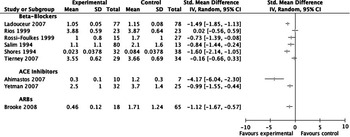
In all, seven observational studiesReference Ladouceur, Fermanian and Lupoglazoff 16 , Reference Reed and Alpert 18 – Reference Selamet Tierney, Feingold and Printz 23 and one randomised controlledReference Shores, Berger, Murphy and Pyeritz 24 trial evaluated aortic dilation in patients treated with beta-blockers. There were four studies that examined atenolol,Reference Reed and Alpert 18 – Reference Rios, Silber and Bavishi 20 , Reference Selamet Tierney, Feingold and Printz 23 two studies that examined propranolol,Reference Salim, Alpert, Ward and Pyeritz 22 , Reference Shores, Berger, Murphy and Pyeritz 24 and the remaining two studies examined all types of beta-blockers.Reference Ladouceur, Fermanian and Lupoglazoff 16 , Reference Rossi-Foulkes, Roman and Rosen 21 There was one observational study that examined aortic dilation in patients treated with enalapril versus beta-blockers,Reference Yetman, Bornemeier and McCrindle 27 one randomised controlled trialReference Ahimastos, Aggarwal and D'Orsa 10 that evaluated perindopril versus beta-blockers, and one observational study that examined aortic dilation in patients treated with losartan versus beta-blockers.Reference Brooke, Habashi, Judge, Patel, Loeys and Dietz 11 In the three before-and-after studies examining atenolol,Reference Reed and Alpert 18 – Reference Rios, Silber and Bavishi 20 there was no significant difference in aortic root size. In the study by Selamet Tierney et alReference Selamet Tierney, Feingold and Printz 23 examining atenolol versus no treatment, there was also no statistically significant difference between treatment and control groups in aortic root diameter (p = 0.52). In the remaining four studies examining beta-blockers, there was a difference in aortic dilation between the treatment and control groups. Salim et alReference Salim, Alpert, Ward and Pyeritz 22 evaluated the use of propranolol or atenolol versus no treatment and reported a slower aortic growth rate in the beta-blockers group (1.1 mm/year ± 1.1) versus the control group (2.1 mm/year ± 1.60, p < 0.006). Rossi-Foulkes et alReference Rossi-Foulkes, Roman and Rosen 21 evaluated the use of all types of beta-blockers versus no treatment and also found a statistically significant difference in aortic root growth rate (mm/year) between the beta-blockers group (1.0 ± 0.8) and the control group (1.7 ± 1.0, p < 0.05). Ladouceur et alReference Ladouceur, Fermanian and Lupoglazoff 16 evaluated the use of all types of beta-blockers versus no treatment and found that the rate of aortic dilation (mm/year) was significantly different in the beta-blockers group, 1.05 ± 0.05 versus 1.15 ± 0.08 for the control group (p = 0.001). Shores et alReference Shores, Berger, Murphy and Pyeritz 24 evaluated propranolol versus no treatment and found a significant difference in the rate of change in the aortic ratio, defined as the measured aortic diameter divided by the diameter predicted by the patient's height, weight, and age, between the beta-blockers (0.023 per year) and control (0.084 per year) groups (p < 0.001). Yetman et alReference Yetman, Bornemeier and McCrindle 27 examined the rate of change in dilation (%/year) and found a significant difference between treatment with enalapril (−2.5 ± 1) and propranolol (1.7 ± 1.2, p < 0.001). Ahimastos et alReference Ahimastos, Aggarwal and D'Orsa 10 examined the aortic root diameter in systole indexed to body surface area (mm/m2); the perindopril group had a significantly smaller indexed root diameter (0.3 ± 0.1 mm/m2) compared with the propranolol group (1.2 ± 0.3 mm/m2, p = 0.01). Brooke et alReference Brooke, Habashi, Judge, Patel, Loeys and Dietz 11 also found a statistically significant difference in aortic root growth rate (mm/year) between losartan (0.46 ± 0.12) and beta-blockers (1.71 ± 1.24, p < 0.001).
Impact of pharmacological therapy on aortic dilatation. Note: Studies varied in how they measured this outcome. Experimental and control interventions varied across studies and are detailed in Table 2. This figure is intended to provide a general graphical display of study findings. ACE = angiotensin-converting enzyme; ARBs = angiotensin II receptor blockers; IV = inverse variance; M–H = Mantel–Haenszel; SD = standard deviation.

Adverse events (Table 3)
In all, four studiesReference Ladouceur, Fermanian and Lupoglazoff 16 , Reference Reed and Alpert 18 , Reference Reed, Fox and Alpert 19 , Reference Salim, Alpert, Ward and Pyeritz 22 did not report adverse events, whereas eight studiesReference Ahimastos, Aggarwal and D'Orsa 10 , Reference Brooke, Habashi, Judge, Patel, Loeys and Dietz 11 , Reference Rios, Silber and Bavishi 20 , Reference Rossi-Foulkes, Roman and Rosen 21 , Reference Selamet Tierney, Feingold and Printz 23 – Reference Tahernia 25 , Reference Yetman, Bornemeier and McCrindle 27 did. Of these eight studies, five studiesReference Rios, Silber and Bavishi 20 , Reference Rossi-Foulkes, Roman and Rosen 21 , Reference Selamet Tierney, Feingold and Printz 23 – Reference Tahernia 25 evaluated various side effects of beta-blockers, two studies evaluated side effects with angiotensin-converting enzyme inhibitors,Reference Ahimastos, Aggarwal and D'Orsa 10 , Reference Yetman, Bornemeier and McCrindle 27 and one study evaluated side effects with angiotensin II receptor blockers.Reference Brooke, Habashi, Judge, Patel, Loeys and Dietz 11 The three observational studies evaluating beta-blockersReference Rios, Silber and Bavishi 20 , Reference Rossi-Foulkes, Roman and Rosen 21 , Reference Selamet Tierney, Feingold and Printz 23 – two evaluating atenololReference Rios, Silber and Bavishi 20 , Reference Selamet Tierney, Feingold and Printz 23 and one evaluating all types of beta-blockersReference Rossi-Foulkes, Roman and Rosen 21 – did not report any significant adverse effects. The randomised controlled trial by TaherniaReference Tahernia 25 did not find any adverse events in the propranolol group. In the randomised controlled trial by Shores et al,Reference Shores, Berger, Murphy and Pyeritz 24 the authors reported heart block as a side effect of propranolol. There were three patients who had a first-degree block and one patient who had a third-degree heart block. Ahimastos et alReference Ahimastos, Aggarwal and D'Orsa 10 did not find any adverse events in the group treated with perindopril versus the control group treated with propranolol. In the study by Brooke et al,Reference Brooke, Habashi, Judge, Patel, Loeys and Dietz 11 examining losartan, there were no adverse events in the treatment or control group.
Discussion
This systematic review examined the use of beta-blockers, angiotensin-converting enzyme inhibitors, and angiotensin II receptor blockers to manage aortic root dilation in Marfan syndrome. These drugs did not reduce mortality, aortic dissection, or the need for elective aortic root or valve surgery; these events were rare, and studies to date have not been powered to detect statistically significant differences in these outcomes. However, beta-blockers, angiotensin-converting enzyme inhibitors, and angiotensin II receptor blockers were associated with a decrease in aortic root dilation. Adverse events among all three drug classes were rare and mild, with the exception of a single patient experiencing a third-degree heart block while on propranolol.
Most studies evaluating beta-blockers examined the use of atenolol.Reference Ladouceur, Fermanian and Lupoglazoff 16 , Reference Reed and Alpert 18 – Reference Rios, Silber and Bavishi 20 , Reference Selamet Tierney, Feingold and Printz 23 Beta-blocker therapy is thought to be beneficial with respect to aortic root dimension by decreasing heart rate and blood pressure and by decreasing change in aortic pressure during left ventricular ejection.Reference Engelfriet and Mulder 29 These changes decrease aortic stretch and reduce aortic stiffness, which prevents or minimises dilatationReference Rios, Silber and Bavishi 20 ; however, the exact mechanism of action remains undefined.Reference Rios, Silber and Bavishi 20 Atenolol is more beta-1 selective than propranolol and may be of more benefit in the treatment of aortic root dilation.Reference Shores, Berger, Murphy and Pyeritz 24 Studies examining angiotensin-converting enzyme inhibitors used enalaprilReference Yetman, Bornemeier and McCrindle 27 and perindopril.Reference Ahimastos, Aggarwal and D'Orsa 10 There is growing evidence that inappropriate activation of the renin–angiotensin system may be involved in aortic dilation.Reference Lu, Rateri, Cassis and Daugherty 30 Angiotensin-converting enzyme inhibitors may stop the abnormal activation of the renin–angiotensin system.Reference Lu, Rateri, Cassis and Daugherty 30 The single completed study examining angiotensin II receptor blockers evaluated losartan.Reference Brooke, Habashi, Judge, Patel, Loeys and Dietz 11 Aortic aneurysm has been found to occur with increased transforming growth factor beta signalling.Reference Habashi, Judge and Holm 31 Angiotensin II receptor blockers inhibit transforming growth factor beta signalling and have reduced aortic dilatation in a mouse model.Reference Habashi, Judge and Holm 31
There were two studiesReference Ahimastos, Aggarwal and D'Orsa 10 , Reference Yetman, Bornemeier and McCrindle 27 that found that angiotensin-converting enzyme inhibitors were associated with a slower rate of change of aortic size compared with beta-blockers, and one studyReference Brooke, Habashi, Judge, Patel, Loeys and Dietz 11 that showed that angiotensin II receptor blockers may be superior to beta-blockers as well. However, studies were small in sample size and firm conclusions about the benefits of angiotensin II receptor blockers or angiotensin-converting enzyme inhibitors over beta-blockers cannot be made from the existing literature. Studies in progress may provide better evidence for one drug class versus another once completed.
Limitations of the existing evidence
In the majority of completed studiesReference Ahimastos, Aggarwal and D'Orsa 10 , Reference Brooke, Habashi, Judge, Patel, Loeys and Dietz 11 , Reference Ladouceur, Fermanian and Lupoglazoff 16 , Reference Rios, Silber and Bavishi 20 – Reference Selamet Tierney, Feingold and Printz 23 , Reference Tahernia 25 , Reference Yetman, Bornemeier and McCrindle 27 a measure of change in the size of the aorta was used as a primary outcome. Change in aortic root dimension is an appropriate surrogate outcome;Reference Gott, Greene and Alejo 32 – Reference Davies, Goldstein and Coady 34 however, clinical events such as mortality, aortic disection, and need for surgical repair need to be evaluated as well. In Marfan syndrome, there is variability in dilatation within and between individuals.Reference Hwa, Richards and Huang 35 Aortic dilatation may be “silent” for variable periods,Reference Gambarin, Favalli and Serio 13 necessitating frequent follow-up. Increased survival of patients with Marfan syndrome is likely attributable to the ability to repair the aorta surgically.Reference Pyeritz 36 Evaluating mortality may be challenging because of the length of follow-up required; a composite outcome including mortality, aortic dissection, and/or need for surgical repair may be more feasible.
Strengths and limitations of the review
Reviewers used multiple data sources to identify eligible studies; as such, the included studies thoroughly represent the existing literature. A protocol for conducting meta-analyses and exploring heterogeneity with a priori hypotheses was planned by reviewers before commencing the review in order to minimise any bias from the reviewers in assessing the data; however, as the data were abstracted, it was clear that there was significant heterogeneity across studies. For this reason, planned meta-analyses were not performed. Randomised controlled trials in progressReference De Backer 12 – Reference Lacro, Dietz and Wruck 15 , Reference Radonic, de Witte, Baars, Zwinderman, Mulder and Groenink 17 , Reference Wu 26 have defined their primary and secondary outcomes clearly and may be more amenable to pooling and performing meta-analyses.
Directions for future research
Currently, the evidence for using beta-blockers, angiotensin-converting enzyme inhibitors, and angiotensin II receptor blockers in the treatment of aortic disease in children and adults with Marfan syndrome is based mostly on observational studies and few completed clinical trials. Clinicians require more rigorous evidence to guide the pharmacological management of Marfan patients. Future studies should examine mortality, need for surgery, aortic dissection, and adverse events. Conducting multi-centre trials may result in sufficient sample size and power to evaluate these clinically meaningful outcomes. There are six randomised controlled trials in progress,Reference De Backer 12 – Reference Lacro, Dietz and Wruck 15 , Reference Radonic, de Witte, Baars, Zwinderman, Mulder and Groenink 17 , Reference Wu 26 of which two are multi-centre.Reference Jondeau 14 , Reference Lacro, Dietz and Wruck 15
Conclusions
Beta-blockers, angiotensin-converting enzyme inhibitors, and angiotensin II receptor blockers all reduce the rate of aortic dilation; however, studies had small sample sizes and were not sufficiently powered to demonstrate an impact on mortality, aortic dissection, need for elective surgical intervention, or adverse events. There are six randomised controlled trials currently in progress.Reference De Backer 12 – Reference Lacro, Dietz and Wruck 15 , Reference Radonic, de Witte, Baars, Zwinderman, Mulder and Groenink 17 , Reference Wu 26 Although each individual study may not be powered for these outcomes, a subsequent systematic review may provide greater insight into the effect of pharmacological therapy on clinical events.
Acknowledgement
Dr Varsha Thakur was awarded a trainee grant from the Department of Pediatrics, University of Alberta.