At the turn of the nineteenth century, married women in the United States faced a legal system that was almost wholly illiberal with regard to their rights, both economic and civic. With limited exceptions, women were denied independent legal and economic status from the moment they spoke their marriage vows. By 1920, this legal environment had been significantly liberalized through the passage of married women's property acts (MWPAs) at the state level. While some illiberal restrictions remained, in almost every state the law acknowledged a separate legal identity for women and allowed them to hold property and make contracts on the same basis as single women. These reforms were passed both in states with active women's organizations and in those that lacked organized women's mobilization, and with few exceptions, they were passed before women had the right to vote. In this article, I examine how reforms developed in this environment, in which straightforward group mobilization was challenging. I argue that married women's economic rights reform is best understood as a piecemeal, iterative process in which multiple state-level institutions interacted over time, including both legislative and judicial bodies. This expansion of women's economic rights often occurred as a by-product of male political actors pursuing issues largely unrelated to gender—such as debt relief and commercial development—combined with paternalistic views of women as needing protection from the state.
Scholars of American political development have written extensively about the role of liberalism in American political culture.Footnote 1 A major piece of this story is the idea that Americans were not, after all, “born liberal”; instead, the process of liberalization and the limits of liberalism are crucial for understanding political development in the United States.Footnote 2 The liberalization of married women's economic rights in the mid-1800s and early 1900s has received less attention in these studies than reforms around labor law and civil rights. This early period of development is particularly important for understanding the processes of liberalization and rights expansions in the United States because these reforms took a different trajectory than these other areas.
Specifically, not all rights revolutions are the product of rights seekers engaging actively with actors and institutions opposed to liberalization. Nor are they necessarily the product of people deliberately seeking political or economic liberty. Rather, especially when rights claimants do not have the ability to organize electorally, rights may arise from the responses of more powerful political actors to changing economic and legal conditions. Male political actors in the mid-1800s and early 1900s saw MWPAs as a way to assist debtors amid economic crises, to protect family wealth, to update and rationalize the legal code in a changing commercial economy, and to compete with neighboring states. They did so in the context of both widespread paternalistic attitudes toward women and a dynamic economic system in which women's roles were actively changing.
In part because these actors were focused on a variety of often-conflicting goals, the reform process was piecemeal and rights reforms developed in a patchwork fashion over time, often in ways that were inconsistent across domains of life. MWPAs were passed in different states at different times without top-down national coordination. And within each state, there were almost always multiple iterations of MWPAs spread out over the course of decades, as political actors balanced varied goals and experimented with different formulations of married women's economic rights.
Further, while many studies of MWPAs have focused largely (although not exclusively) on legislative enactments, I argue that these reforms must be understood in the context of multiple state-level institutions interacting over time. Legislative enactments—especially early legislative enactments—were the beginning of the story rather than the end. As courts began interpreting these laws in specific cases, legislatures had to confront the real-world implications of the sometimes conflicting motivations these laws were based upon—often, a conflict between liberalizing the economic system and protecting women from the harsh realities of the free market.
In this article, I develop a theory of indirect rights reform that involves but is not primarily driven by group mobilization. I argue that the development of married women's property rights was strongly shaped by the ways in which male political actors in a variety of political venues—responding at times to the voices of women activists, but primarily to the demands of male voters—navigated the clashes between feudal common-law definitions of marriage, a dramatically changing economic reality that could not function within these strictures, and popularly held views about the proper role of government in the economic lives of women. Rights often were expanded as a by-product of these conflicts. These contradictions led to a reform process that was piecemeal and required multiple iterations of reforms accomplished through an interactive, multibranch process.
I first discuss the major reforms to married women's economic right that took place in the U.S. states between 1839 and 1920. I then outline how male actors in multiple venues—state legislators, state courts, and state constitutional conventions—cooperated in gradually liberalizing married women's economic rights over time. Finally, I present a case study from Mississippi, a seemingly unlikely place for the liberalization of women's rights. Despite the absence of an organized women's movement well into the late 1800s, Mississippi was an early mover in passing multiple types of MWPAs, and the dynamics there illustrate the broader processes of piecemeal reform in multiple venues that were playing out around the nation.
1. Married Women's Property Acts, 1839–1920
Prior to the 1840s, in most U.S. states, married women's property rights and their legal and economic identities more broadly were governed by a feudal, common-law legal doctrine known as coverture. The doctrine of coverture viewed married women as civically and legally “dead” after marriage—as far as the legal system was concerned, a husband and wife were united into one legal identity, one governed by the husband. This doctrine was transplanted from British common law and was adopted by all of the colonies, and eventually by most states.Footnote 3 Coverture entailed a whole host of legal disabilities, many of which related to married women's economic rights. With limited exceptions, married women could not own property; had no right to their wages; and could not write wills, sign legal contracts, sue in court, or take out mortgages or other loans.Footnote 4
Although the common law was strict in theory, various exceptions existed for women who had the money or legal knowledge to exploit them, often through equity or chancery courts, which allowed wealthy women to petition for individual property arrangements on many states. However, these were not broadly available rights, but were rather attained through legislative or judicial appeal, special legal documents, or clearly defined legal exceptions such as abandonment. Starting in the late 1830s, states began to codify married women's economic rights in ways that both extended some of the exceptions to coverture, making them more widely available to married women from a broader cross section of society, and liberalized married women's economic rights more broadly, for example, by giving them property rights in wages and the ability to sign legal contracts. Although each state dealt with MWPAs in different ways, some broad patterns emerge.
First, despite a lack of federal intervention from Congress or the Supreme Court, these laws were commonplace by the 1870s and near-universal by 1920. To be clear, because these reforms dealt with property arrangements within marriage, they were part of family law and thus outside the bounds of congressional power. Even though the national government lacked the power to direct or mandate coordination, every state passed some form of MWPA by 1920, and all but two passed laws that went beyond token property rights and provided meaningful rights expansions for married women.Footnote 5 Although these laws were certainly not an end to women's struggle for economic equality, they did represent a significant liberalization of their place in the economic world, as compared to coverture, and led to real economic gains for women.Footnote 6 That said, the fact that the process did not include a national “big bang” moment was consequential. The timing and level of liberalization varied. Southern states tended to pass the most expansive versions of MWPAs later than other regions, with one state being an extreme laggard. Florida passed an initial debt relief law protecting married women in 1845, but took almost 100 years to extend more significant management rights to married women (which it eventually did in 1943).
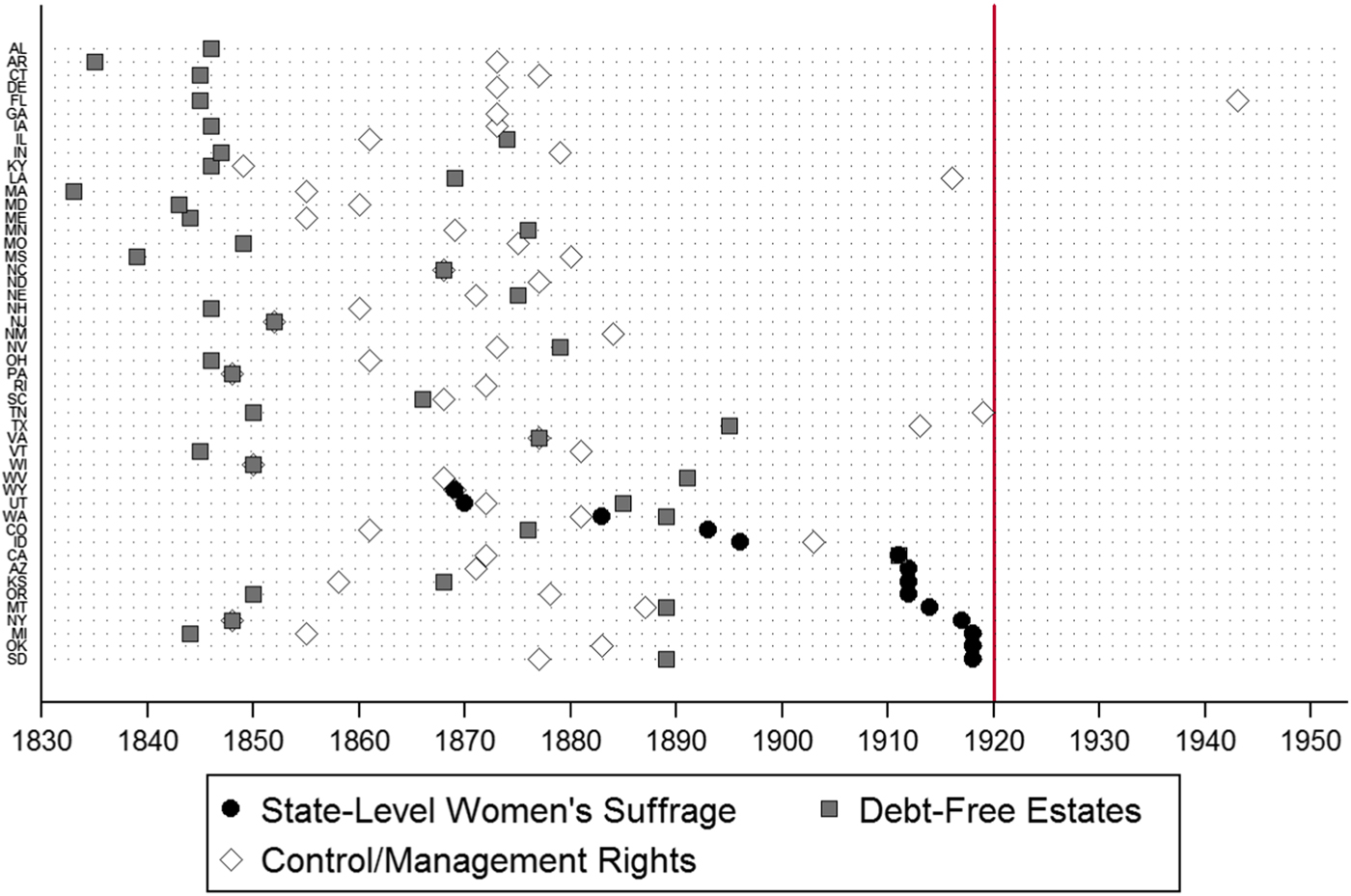
Second, the content of MWPAs varied. Reforms ranged from laws that gave married women the title to land and other property, but nothing more, to laws that granted broad rights to own, sell, and mortgage property, including wages, as well as to sign contracts and appear in court. In any given state, these laws tended to be expanded and liberalized over time. In this article, I distinguish between “debt-free” MWPAs, which allowed married women to hold property in a separate account that would not be subject to the demands of her husband's creditors, and “effective” MWPAs, which provided married women with some measure of meaningful control over that property. As I outline in more detail in the Mississippi case described later, typical “debt-free” laws assigned all property management rights to husbands, whereas later “effective” laws increasingly transferred these rights and powers to wives. Generally, debt-free MWPAs focused more on the protection of married women, while effective MWPAs contained more provisions that empowered them to act independently—but both types of laws often contained a mix of policies that aimed to balance both types of goals. The dates of passage for both types of laws are shown in Figure 1.Footnote 7
Married Women's Property Acts in the States.

Third, while the motivations behind these laws varied, almost all ultimately linked back to the interests of male legislators and constitutional convention delegates, who did not need to respond to the women's vote in a period before women's suffrage. Figure 1 illustrates this point well; in only two states did state-level women's suffrage precede the passage of an MWPA, and the Nineteenth Amendment, granting women's suffrage nationally, came just after this period of reform (indicated with the vertical line at 1920).Footnote 8 While women's groups in some states did petition state legislatures and may have encouraged swifter passage of MWPAs in these states, organized feminist activity was absent in many states where these laws were passed.Footnote 9
In her work on the expansion of woman suffrage in the U.S. states, Corinne McConnaughey asks a similar question: “Why would politicians ever decide to expand the electorate to which they are accountable?”Footnote 10 For McConnaughey, the answer lies in “programmatic enfranchisement,” in which state-level political parties extended suffrage to women in response to “a credible, pro-suffrage coalition to which elected politicians [were] already accountable”—that is, a coalition that included a sizable number of male voters who demanded suffrage extensions.Footnote 11 As such, state-level women's suffrage organizations were most successful when they were able to partner with interest groups or third parties that could provide strong electoral incentives from male voters, including the Populist and Progressive Parties, farmers’ organizations, and labor unions.
In the case of married women's economic rights, obviously these rights did not immediately expand the electorate in the same way as suffrage. Still, the fundamental question remains of why political actors in power would choose to expand rights for a group unable to punish or reward them electorally. Although my account of MWPAs is not primarily focused on parties—both Democratic-majority and Republican-majority legislatures passed both types of MWPAs at different points in time—a key insight from McConnaughey's account is still relevant. That is, even where women did organize around reforms, elected officials were still ultimately accountable to male voters. As such, they prioritized the interests of men over those of women.
These interests included motivations connected to economic self-interest, both narrowly and broadly construed, as well as concerns for the protection of women using state power. These types of arguments tend to appear more often than feminist motivations centered around the empowerment of women in both legislative journals and judicial opinions. As I discuss further here, in periods of economic crisis, MWPAs were often passed to provide debt relief to families, often alongside other non-gender-specific debt relief measures that were unrelated to women's rights. Wealthy and middle-class fathers hoped to protect family money, inherited by or gifted to daughters, from imprudent, lazy, or careless husbands. Business interests pushed for clearer, simpler property rules that would not impede the flow of capital or disincentivize investment, borrowing, and market labor. And finally, men in western states in particular had to compete for female migrants and attempt to attract them to their region.Footnote 12 Although some male politicians and voters undoubtedly did have feminist motivations, paternalistic and economic motives appear to have been the major drivers behind passing MWPAs, and they existed side by side with paternalistic views of women that placed real limits on how far reform would proceed.
2. Explaining Married Women's Economic Rights Reform
Scholars have identified a number of possible explanations for the passage of MWPAs, including women's activism, changes to and disruptions of state economies, and a desire to protect married women and their children from various possible harms. I argue that while women's organizing may have played a role in the passage of some MWPAs in some states, ultimately the motivations of male political actors and voters must be central to understanding the passage of these laws because of the lack of the franchise for women in most states when the bills were passed. Further, I argue that the development of married women's economic rights must be understood as an iterative process that was worked out across multiple state-level political institutions over time, rather than something that was typically achieved with one major legislative push or action. In particular, courts played an understudied role in interpreting MWPAs and spurring the demand for further reforms.
2.1. Social Movements and Feminist Organizing
Accounts of liberalization and rights reform often center around social movements, group mobilization and organization, and interest groups. Although groups are not always successful in fully enacting and implementing all the reforms they seek, this style of reform is characterized by strategic behavior by groups and individuals on multiple sides of an issue, often in multiple types of political venues. For example, the mobilization of labor groups during the late 1800s and early 1900s fits this type of model well. Labor activists and unions were major drivers of reform, mobilizing workers and demanding stronger labor laws in multiple venues.Footnote 13 Labor reformers worked to elect labor-friendly legislators, lobbied for new legislation, and pushed for state constitutional amendments to protect gains from hostile courts.Footnote 14 Meanwhile, business interests clearly saw the potential danger of such reforms and fought back both in legislative settings and in the courts. Judicial review proved to be a powerful tool for those opposed to labor reforms, as federal courts struck down more than sixty labor laws in the 1880s–1890s.Footnote 15 Labor reform during the Gilded Age and Progressive Era is relatively well characterized by an interest group–driven explanation in which interests on both sides of the issue strategically used the political and legal means available to them to advance those interests. Similarly, strategic litigation by the NAACP to gradually change legal precedents related to segregation, as well as more recent efforts by gay rights organizations to overturn same-sex marriage bans through strategic action in both courts and state legislatures, fit well with this type of narrative.
In the case of MWPAs, Holly McCammon et al. argue that “feminist mobilization [was] an important, additional influence in the enactment of married-women's property acts,” complementing broader economic forces.Footnote 16 Although acknowledging that this model is not applicable to all states (especially Southern states), they write that in many states, women's collective activism did play a crucial role. Specifically, by demanding reforms to property rights alongside more radical reforms—such as voting or more comprehensive equal rights—male lawmakers were incentivized to grant more moderate and less disruptive property rights to placate women's organizations. Women also intentionally framed property-related demands in ways that emphasized their connections to values shared by male lawmakers, often directly appealing to a need for state paternalism to protect women from exploitative, lazy, or drunken husbands. Thus, in this account, women were active agents of change who played a pivotal role in the passage of MWPAs across multiple states.
Although McCammon et al. bring to light important examples of states where women's groups were important for the passage of meaningful reforms, I argue that on the whole, women's groups were not necessarily the primary groups agitating for change on the issue of married women's property rights. This was particularly true with the earliest sets of laws, which did not in themselves expand married women's economic rights in major ways, but that I argue were ultimately crucial steps in the overall reform process.Footnote 17
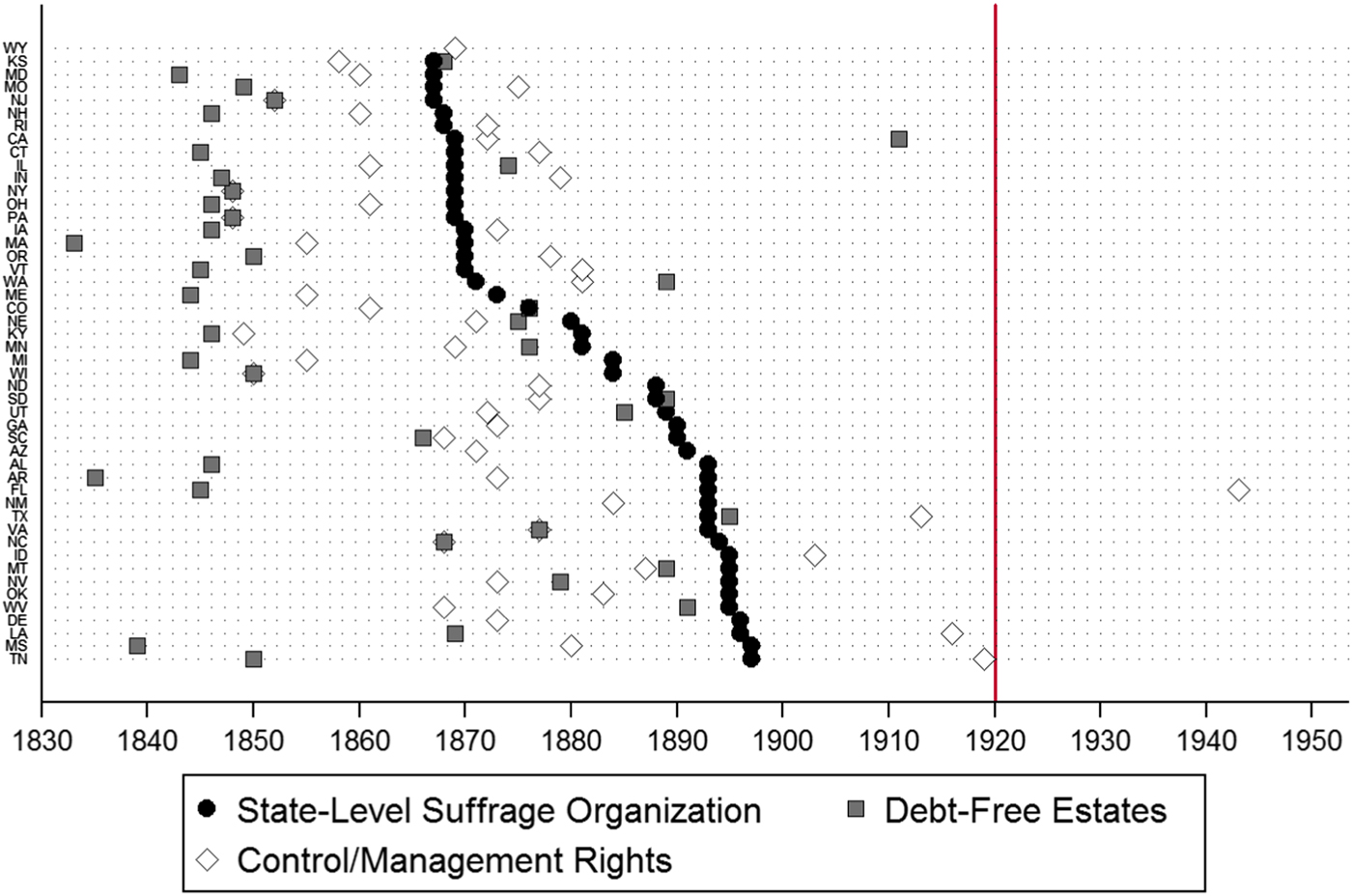
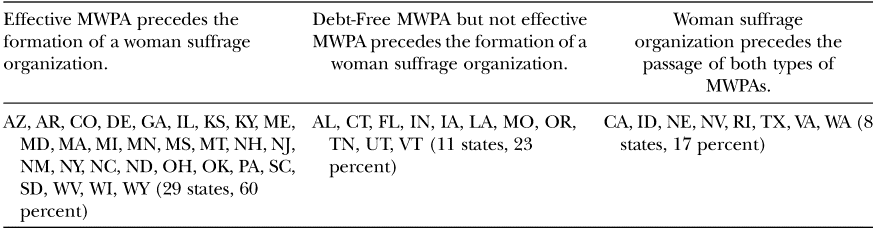
The formation of strong state-level woman suffrage organizations tended to occur after the passage of MWPAs (see Figure 2 and Table 1).Footnote 18 The mean year of passage for debt-free laws was 1861, for effective MWPAs was 1874, and for the formation of woman suffrage organizations was 1880. As indicated in Table 1, in only 17 percent of states did woman suffrage organizations precede the passage of an MWPA. In the majority of states (60 percent), effective MWPAs were passed before woman suffrage organizations were formed, while in a further 23 percent of states, debt-free MWPAs (but not effective MWPAs) preceded the formation of suffrage organizations.Footnote 19
Married Women's Property Acts and State-Level Suffrage Organizations.

Dates of MWPA Passage and the Formation of State-Level Woman Suffrage Organizations

In states where women did petition legislatures or take other actions to advocate for property law liberalization, these efforts were often individual and local rather than coordinated through broad-based women's organizations.Footnote 20 Particularly after the Civil War, women's organizations focused their legislative efforts on suffrage. To the extent property reform was part of the agenda of feminist groups, it was used largely as a recruiting tactic to convince potential members that suffrage was a crucial next step before women could enjoy broader economic rights.Footnote 21 In the legal arena, women's organizations’ strategic efforts were also focused on suffrage; in the late 1860s and early 1870s, the National Woman Suffrage Association launched a legal campaign challenging bans on woman's suffrage. Footnote 22
This is not to say that women's organizations were completely silent on issues of property rights, as McCammon et al. rightly point out.Footnote 23 They could and did petition state legislatures on these issues, but in most states, they lacked a key resource that was available to labor organizers: the vote. It makes sense that women's groups after the Civil War were so focused on this goal, because without the vote, any reforms that passed had to first and foremost satisfy male legislators and male voters. Where women's organizations did agitate on economic rights specifically, they often sought much more radical reforms, such as joint property rights (as opposed to separate property rights) that would compensate wives for household labor—something many MWPAs explicitly excluded.Footnote 24 Although some male politicians and voters undoubtedly did have feminist motivations, paternalistic and economic motivations appear to have been the major drivers behind passing MWPAs: populists advocating for debt relief; commercial interests seeking more rational and predictable commercial transactions; fathers (and other men) hoping to protect women and family assets from reckless husbands; and western settlers trying to attract women to correct gender imbalances in the region.
2.2. Other Motivations for Reform: Economic Upheaval and Paternalism
Despite the hierarchical view of the marriage relationship envisioned by coverture, a rapidly changing economy produced countervailing forces in favor of a new role for legislatures in defining the economic rights and responsibilities of married women. Economic upheaval and growing ranks of debtors from an increasingly broad spectrum of the class structure left legislatures searching for ways to protect family assets, which often meant protecting wives’ assets specifically.Footnote 25 In the first wave of laws, legislators provided for limited new rights for married women. Many of the early MWPAs began as debt relief statutes and were passed amid debate over a variety of debt relief measures, many of which had nothing to do with women. These laws typically guaranteed married women the right to ownership of their property, but not management and control of it. For example, in the case of real estate, Evan Roberts writes that it “could not be sold by the husband, but he could decide what was planted on it, or whether to rent the property, and how much rent would be charged.”Footnote 26 Although technically providing expanded rights and protection for women, these early laws were often anything but progressive, categorizing enslaved people as property in the South and granting few new rights to women.
As the economy became more commercialized and industrialized, giving women more opportunities to take on work outside the home, coverture created incentives against economic growth. Increasingly complicated rules around wives’ separate property made land sales and mortgages difficult to manage. Women who could not claim ownership to wages earned or business profits had less incentive to engage in market labor.Footnote 27 And a growing middle class, which increasingly had access to property and a desire to protect and grow family wealth, demanded more standardized protections for married women. These protections had often historically been available to the wealthiest families through special legal arrangements, and there were increasing demands that these be made available to all.Footnote 28
In addition to these economic motivations, political actors were also motivated by what Rogers Smith calls “ascriptive hierarchies,” or social, cultural, and political systems that “assign people to places in hereditary hierarchical orders … on the basis of such ascribed characteristics as race, gender, and the usually unaltered nationality and religion into which people were born.”Footnote 29 Legislators, delegates, and judges during this period typically did not embrace a feminist ideology that demanded reform on the basis of gender equality, though there were exceptions. A major motivation behind the passage of MWPAs was a paternalistic sense of protection on the part of legislators, often espoused in combination with economic rationales. Debates surrounding this issue are full of language seeking to protect women from husbands who marry only to gain access to women's property and are subsequently lazy, incompetent, or downright criminal in managing that property. Fathers in particular were concerned with protecting family assets that might be inherited by daughters from sons-in-law who could not necessarily be trusted to protect inherited property.Footnote 30 In the History of Woman Suffrage, prominent suffragists wrote in 1881:
The selfishness of man was readily enlisted in securing woman's civil rights, while the same element in his character antagonized her demand for political equality. Fathers who had estates to bequeath to their daughters could see the advantage of securing to woman certain property rights that might limit the legal power of profligate husbands.Footnote 31
The male legislators and delegates writing MWPAs did not usually view women as autonomous individuals, but rather held them to idealized standards that set them apart from the political and economic sphere. Particularly in the South, “a ‘cult of true womanhood’ developed … [holding] that women were more virtuous and more inherently noble than men but that because of such traits, they must be sheltered and protected from the world of men.”Footnote 32 Similarly, throughout the nation, MWPA proponents often espoused a view of women that echoed ideas of republican motherhood, that women were inherently more virtuous than men, so long as they stayed within a domestic sphere and spread republican values to their children through honorable motherhood.Footnote 33 But, to stay in that domestic sphere, mothers needed protection from their less virtuous husbands. For example, at New York's 1846 Constitutional Convention, one delegate gave a speech in support of including an MWPA in New York's new constitution:
[The wife] was not exposed to the same temptations [as the husband]—was not as ambitious of worldly distinction, and would not be likely to hazard her property to as great an extent as he would. Her affection for her offspring was more ardent, and her attachment to, and inducements for remaining at home much stronger than his.… Nineteen out of every twenty cases, when want has found its way in families, it was through the misfortune or the bad character of the husband; and it would seem but just that, in either event, protection should be afforded to the defenceless [sic] mother and children.Footnote 34
These patterns were reflected elsewhere in the country. Suzanne Lebsock analyzes Southern married women's property reforms, with a particular emphasis on reforms passed during Reconstruction, by Radical Republican constitutional conventions from 1867 to 1869.Footnote 35 Nine of ten Southern states included married women's property rights in some fashion in their Reconstruction constitutions. Although obviously this period and region does not reach all the MWPAs passed in the United States, it does give an important window into the motivations behind some MWPAs. Lebsock argues that Southern constitutional reforms—as was the case for many other Southern MWPAs before and after Reconstruction—were enacted for “utterly nonfeminist purposes” including the protection of women from their husbands, the protection of convention delegates’ blood relatives (including widows and grandchildren), and generalized debt relief. Indeed, unlike efforts to advance woman suffrage—which were unsuccessful at Reconstruction conventions—“equality was a by-product and not the intended object of reform.”Footnote 36
Even as legislators sought to protect married women, they also carefully wrote reform laws to ensure that the marriage relationship was unsettled as little as was possible to accomplish their paternalist and economic goals. While married women gained a new foothold vis-à-vis third parties in the market, now able to make contracts and appear in court without being joined by their husbands, this new legal status often did not penetrate the marriage relationship itself. Women's organizations in the antebellum period had sometimes demanded joint property rights that would have given married women an equal stake in family assets, but legislation and court rulings made it clear that husbands would remain in control of the bulk of family assets, with married women gaining control only over property that she alone brought into the marriage and that she specifically elected to keep in a separate account.Footnote 37 Women eventually gained control over wages earned from work done for employers outside the family, but legislators and courts clearly delineated this work from labor performed within the home for the support of the family, which remained under control of the husband.Footnote 38 When MWPAs addressed housework and child care at all, legislators specifically exempted these types of labor from the laws, under the doctrine of marital service, which stated that women owed domestic service to their husbands as part of the marriage contract.Footnote 39
2.3. Iterative, Multibranch Reform Process
I argue that it is important to understand the MWPA reform process as one that took place over time and through the interactions of multiple state-level institutions. Much of the prior research on married women's economic rights reform has pinpointed key acts in each state that extended specific rights to married women. For example, Richard Geddes and Sharon Tennyson identify one date per state for MWPAs that extended meaningful control over property to married women, as well as one date for the first act in each state that granted married women ownership over their wages.Footnote 40 McCammon et al. use a similar dating scheme based on Geddes and Tennyson, revising some dates but overall focusing on the first law in each state granting substantial control and management rights to married women.Footnote 41 Lebsock's research, described above, focuses primarily on MWPAs passed or ratified during Reconstruction regardless of the precise contents of those reforms.Footnote 42
While these approaches can be useful—especially for making cross-state comparisons and understanding specific historical junctures when multiple states passed reforms—I argue that they largely miss the importance of over-time processes within states. Even though the earliest MWPAs in many states granted minimal rights to married women, these laws laid important groundwork for the passage of later, more expansive reforms. This was especially true as these laws were implemented by state courts, a process that often revealed contradictions and complications that were not necessarily apparent when the initial laws were passed.
In her work on post–Civil War Southern MWPAs, Lebsock highlights the dilemma faced by convention delegates and lawmakers: protecting women from their husbands necessarily entailed turning over some powers to wives, but a complete end to coverture would mean that women were left without any special protection under the law, now vulnerable to exploitation not from their husbands but from unrelated business partners. And a mix of powers and protections—which many laws in both Southern and Northern states included—meant confusion and chaos in the market.Footnote 43 This confusion extended beyond the postbellum South. As I discuss below, these contradictions were often made most clear as state courts attempted to resolve disputes between creditors and debtors, and state legislatures eventually responded with further legislation, typically tipping the balance toward empowering (versus protective) reforms. A fuller understanding of the MWPA reform process requires studying individual laws as part of a larger, iterative, and multibranch process, taking place over decades rather than with the passage of one or two key statutes.
2.4. Judicial Cooperation and Deference: A “Much Tangled Issue” Footnote 44
As early laws with a variety of economic and paternalistic motivations proliferated, legal cases interpreting these laws also became common. In thinking about the role of courts in the rights reform process, I emphasize two important points. First, court cases adjudicating MWPAs were most typically conflicts between creditors and debtors as opposed to between husbands and wives. While legislators opposed to MWPAs sometimes expressed concern about how these reforms would disrupt marital relationships, this type of conflict at least did not seem to be the most prevalent in legal venues. Second, judges—while still political actors—have different motivations and decision-making processes than legislators. State courts most often interpreted MWPAs cautiously, avoiding broad interpretations of married women's rights and sticking closely to the text of the acts.Footnote 45 This cooperative, deferential approach among judges tried to balance the conflicting motivations of legislators and interpret exception-filled laws narrowly. This often led to a cycle in which legislative actions were interpreted in ways that increased confusion and decreased predictability, leading to popular pressure for further reforms. Legislators then modified laws, gradually expanding the rights of married women in a piecemeal fashion. This pattern points to an important role for courts in reform processes even when they are not engaged in direct conflict with elected bodies.
Most often, cases brought under MWPAs involved conflict between debtors and creditors, rather than disputes among married couples. Gender-neutral debt relief measures like homestead exemptions, which set aside a specific amount of property for each family that creditors knew would not be available to repay debts, were fairly simple to implement. In contrast, partial rights to separate property for married women created a much more complex legal situation. States quickly learned that providing married women with the ability to, for example, own property but not mortgage that property, impeded the free flow of capital. Worse, many of the early statutes provided for partial control rights that created unpredictable, unclear contracts. For example, a married woman might be able to mortgage her property for some purposes but not for others. Laws granting partial rights to married women created legal disputes in which creditors acting in good faith were unable to collect on debts because the legal situation surrounding married women's economic rights was so uncertain. The legality of a debt could turn on minute details surrounding the exact nature of the woman's separate property and the purpose and type of the debt contracted, with little way for the average creditor to determine in advance whether the debt could be legally collected.
As one example, in Switzer v. Valentine (1854),Footnote 46 the Superior Court of New York City interpreted New York's 1849 MWPA to read that a married woman's separate property was narrowly defined and that the new statute did not confer any general right to contract, merely a specific one with regard to a married woman's separate estate. Caroline Switzer ran a boarding house with her husband's knowledge. She took out a mortgage on the boarding house, and upon failing to pay back the debt, the property was seized. Her husband sued the creditor, arguing that his wife had no legal right to mortgage the property. The court agreed, writing that although the boarding house was run by the wife and much of the business was done in her name, the boarding house was not Switzer's separate property and thus the mortgage was void. The creditor, knowing that Switzer was a married woman, should not have agreed to the mortgage in her name without investigating whether the boarding house was in fact property completely separate from her husband's. This type of legal confusion led to a classic capitalist concern for predictable, clear rules.
Once states began to provide limited rights to married women, pressure from business interests grew to liberalize their place in the market. This pressure led to new reforms that further liberalized married women's economic rights. For instance, at the South Carolina Constitutional Convention in 1895, where a more expansive MWPA was debated and ultimately passed, one delegate argued that “the Acts of the Legislature tinkering with the laws relating to the property of married women had caused more litigation and expense to the people of the State than any other one thing.”Footnote 47
As a point of contrast, consider labor reforms during the Gilded Age, which saw intense conflict between courts and legislatures. The fact that courts largely deferred to state legislatures in the gradual liberalization of married women's economic rights is somewhat surprising given the way courts are often characterized during this period. Robert Bork called Lochner v. New York, the most notorious case of this period, “an abomination,”Footnote 48 and legal scholars have more generally described the Gilded Age as a period in which courts were engaged in extensive conflict with majoritarian bodies. Based on the most well-known court-legislature interactions taking place during this period—serious clashes between business and labor in which courts repeatedly struck down democratically enacted labor reforms—we might expect to see conflict. But, that is largely not the case. The reform of married women's economic rights provides an important foil to the path of labor reform in the United States.
In thinking about the cycle of reform that characterized the development of married women's economic rights, it is important to note the differences between legislatures and courts. Elected bodies can be expected to respond at least in part to the demands of voters, while courts tend to be more, though not completely, insulated from popular pressure. Judges in this era, whether elected or appointed, tended to be selected from the elite, upper classes and to identify themselves with the business community and commercial interests.Footnote 49 In a study of judges in the Midwest during this period, Kermit Hall finds that party leaders, often lawyers themselves, tended to run candidates for judgeships who were at “the upper end of the social spectrum, with emphasis on the prosperous middle class,” and typically had strong kinship connections to other judges and elected officials.Footnote 50 Further, Brian Balogh writes that after Reconstruction, the judicial system was increasingly oriented toward the protection of corporate interests: “As the bar became professional and as prestigious positions were increasingly aligned with law firms that specialized in corporate work, there was no dearth of litigation to protect the interests of large employers and to create and stabilize a predictable national market.”Footnote 51 Judges could also be expected to have an interest in preserving the common law as much as possible, both from self-interest (common law gave them more power over policymaking as compared to legislatures) and because they were socialized in the legal profession and through kinship ties to other judges. Finally, judges interpreting legislative statues were constrained by rules of statutory interpretation to at least some degree—although judges might have multiple options open to them, they were not as unconstrained as legislators in simply selecting a preferred policy outcome.
Meanwhile, elected bodies balanced demands from indebted voters to protect family assets, pressure to rationalize and simplify property law to make commercial transactions more efficient, and a suspicion of woman's suffrage and other demands from feminist organizations. In contrast, courts faced a serious conflict with liberalization in the labor arena, where key business and capitalist interests strongly opposed changes to the common law; essentially each dimension that judges might care about pointed toward opposition to reform. In the case of liberalization of women's property rights, however, judges faced a more nuanced situation, with middle class and business interests often supporting reform and the potential for changes to the common law that loosened coverture's restrictions on property ownership without full liberation of married women. While the new legislation did threaten to change courts’ jurisdiction over family matters in some ways by altering the common law of coverture, these laws did not simultaneously present a major threat to a core constituency of the courts: business and commercial interests. Indeed, these interests often argued for more liberalization of property law, not less, in the interest of a better functioning commercial economy. Ultimately this led to a more cooperative process in which the liberalization of married women's economic rights evolved as a dialogue between state courts and state legislative bodies.
In applying the general rules established in MWPAs to the particular cases brought before them, courts had three options: broad, feminist rulings; conservative conflict; or moderate deference and cooperation. When MWPAs are read in the most progressive, modern light possible, court rulings from this period often do seem to narrow the potential of these acts. Where the provisions even of some early acts could be read broadly to give married women full economic rights to contract, sue, manage their property, and so forth, courts were often slow to come around to these interpretations, and they often came to it only after multiple iterations of increasingly broad legislation. That said, in looking at the legislative and constitutional debates surrounding the passage of these laws, it seems clear that a broad, feminist interpretation was not what was intended by most legislators and delegates, especially in earlier acts. Even by the time acts granting broad rights were passed, motivations still often centered around economic practicality rather than equal rights language. The different types of decision making can mask some of the interbranch cooperation that occurred during this period. While many court cases from this period may appear to narrow the radical potential of MWPAs, this was often just the type of moderate, cautious interpretation that was desired by many legislators and convention delegates. They simply didn't anticipate how many legal problems would be created by partial rights expansion.
When courts did push the envelope and interpret MWPAs to grant broad rights, legislatures at least sometimes fought back and passed narrower laws to clarify their intentions. For instance, in 1881, the South Carolina Supreme Court expansively interpreted South Carolina's 1870 MWPA to allow married women to mortgage their property for the benefit of a third party. In this case, a married woman had gone into debt to support her son's business, and the court ruled this debt was legal and could be collected. Footnote 52 The South Carolina legislature responded quickly, passing a new law in its very next session curtailing married women's general power to contract and limiting it to contracts specifically concerning her separate estate.Footnote 53 Thereafter, South Carolina courts fell into line with a more moderate interpretation of married women's economic rights.
It is also possible to envision courts that engaged in conservative constitutional conflict echoing the conflict over labor legislation. While courts frequently invalidated protective labor legislation and pro-union legislation on constitutional grounds, this pattern was almost nonexistent when it came to MWPAs. Of course, in interpreting MWPAs, state courts were (almost always) engaging in statutory rather than constitution interpretation. That said, courts in the 1800s did have a path available to them if they wanted to strike down MWPAs on constitutional grounds, and a few even did so. For instance, two New York district courts struck down the state's first MWPA on constitutional grounds, finding it beyond the state legislature's power to “destroy vested rights to property” and, in one court, finding it both a violation of the due process clause and the contract clause.Footnote 54 However, this type of interpretation was rare and ultimately had no lasting effect on the path of reform. Still, I argue that courts could have found a path toward constitutional invalidation of MWPAs had they been so inclined; instead, because they were largely cross-pressured by the motivations and interests outlined above, there was little incentive to do so.
By taking a middle path of narrow, cautious interpretations of MWPAs, courts largely deferred to state legislatures in the gradual liberalization of married women's economic rights. The result was that courts could acquiesce to legislative action to liberalize common law elements of marital property law while also maintaining certain aspects of the ascriptive gender hierarchies and state paternalism that remained popular with male voters and legislators. In the case of judicial-legislative conflict over labor legislation, both the influence of common law precedent and the class identifications and ties of judges pointed in the direction of striking down liberalizing labor legislation. In contrast, here these factors ran in opposite directions, with common law doctrine of coverture pointing against the liberalization of married women's economic rights, but business interests positioned either indifferent or—often—in favor of this liberalization. Without a powerful interest aligned with the courts and against the passage of MWPAs, the common law alone was not sufficient to incentivize courts to battle legislatures on this issue.
This iterative process illustrates a more subtle way in which courts are an important part of policy reforms. In the case of married women's economic rights, state courts (as opposed to federal courts) took almost the exclusive lead in interpreting MWPAs, and there is no national “landmark” case that defines our understanding of courts’ posture toward MWPAs.Footnote 55 Further, we don't see evidence of strategic litigants intentionally using the legal process to either direct the course of policy or to bring attention to an important issue. Rather, the most common cases surrounding these issues are small stakes claims of spouses being sued to repay a debt or suing to recover damages after an accident. Still, the court system played an important role in revealing the inherent contradictions in laws that attempted to expand rights just a little bit. Even when courts are not engaged in extensive conflict with legislatures, they can still be an important player in the path of reforms. In handing down cases that deferred to piecemeal legislation, courts revealed a legal environment in which property rights were confused and inconsistent, prompting further reforms from elected bodies.
3. Married Women's Property Rights Reform in Mississippi: From an Early Debt-Free Law to “The Most Radical Legislation”
Although there is not any one typical state in terms of married women's economic rights reform, Mississippi's experience with married women's property rights reforms provides an important case study to examine some of the tensions that played out in this process. Despite a conservative political environment and the absence of an organized woman suffrage movement before 1897, Mississippi was the first state to pass an MWPA of any sort.Footnote 56 Mississippi's early law was born in a time of economic turmoil in the state, and it provided debtor protection by exempting married women's separate property from her husband's debts; management and control of this property, as well as broader rights to contract or sue, were completely lacking. Although this first law was extremely limited and focused primarily on slave ownership, married women incrementally gained additional economic rights over the next forty years, including limited rights to mortgage their property, make contracts, and engage in business.
By 1880, the awkward legal complications stemming from this piecemeal expansion of rights led to a statute that dramatically altered married women's relationship to the economy, described by the Chicago Tribune as “the most radical legislation yet had on the subject.”Footnote 57 While scholars have explored the history and impact of Mississippi's 1839 MWPA, less attention has been paid to the subsequent expansions of married women's rights in that state. The text of all of these statutes and constitutional provisions is available in the online Appendix.
Although there is no one state that is entirely representative of the reform process in each state, the Mississippi case illustrates several important factors that were common to multiple states. These include piecemeal, iterative reforms through which liberalization of marital property law was achieved only through multiple rounds of reform, in which elected bodies and courts operated in a cyclical, interactive process; the absence of a significant social movement from women's organizations or an environment that was generally friendly to women's rights; and competing motivations on the part of male political actors. Next, I discuss the passage of Mississippi's first MWPA as well as its post-1839 statutes, constitutional amendments, constitutional convention debates, and court cases that led to this dramatic shift in Mississippi law. I go into some detail here to illustrate the ways in which competing motivations on the part of political actors—to both protect women and indebted families from various harms and to empower women in ways that were most conducive to a commercial economy—operated in both legislative and judicial arenas to produce change over time. These sources illustrate a tension between the changing reality of married women's involvement in the economy, a need for clear legal rules around this economic activity, and a desire to protect wives from market forces.
3.1. “An Act for the Protection and Preservation of the Rights and Property of Married Women”: Early Laws Feature Debtor Protection and Gradual Rights Expansion
Mississippi's history with expanding married women's property rights began two years before its legislature passed an MWPA, in 1837. In that year, the Supreme Court of Mississippi heard a case in which a Native American woman argued that a slave she owned should be considered her separate property, not liable for her (white) husband's debts, under Chickasaw tribal law.Footnote 58 The Supreme Court agreed, writing that because the couple was married in Chickasaw territory, Chickasaw custom superseded common law in this case.Footnote 59 Megan Benson suggests that the ruling was motivated more by elected judges satisfying anti-creditor demands in the electorate than a desire to expand the rights of married women.Footnote 60 Although there is no specific evidence that legislators considered this case when drafting the 1839 law, it does suggest that these lawmakers may have been primed to consider the possibility of exempting married women's separate property as a way to provide protection for indebted families. The case also offered a common law precedent for exempting a married woman's property from her debts, which may have made legislative innovation in this area appear less extreme than in other states.Footnote 61
Mississippi's 1839 MWPA was introduced to the Mississippi Senate by Senator Hadley, who introduced two related bills during that session. The first bill was for his personal relief, forgiving a debt he owed to the state of Mississippi.Footnote 62 The other was for the protection of married women's separate property.Footnote 63 Hadley was apparently in serious financial trouble and sought both direct debt relief for himself and debt relief more generally through the protection of married women's property.
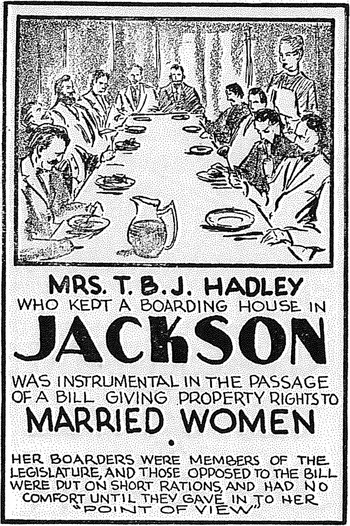
Sources vary on Hadley's marital status at the time he proposed the bill. Some sources claim he was married to a wealthy woman and sought to protect his wife's considerable assets as the owner of a successful boarding house.Footnote 64 In this version of events, Mrs. Hadley's boarding house became a popular meeting place for members of the Mississippi House and Senate during legislative sessions, and she lobbied for the passage of her husband's proposed MWPA to the legislators who came through the boarding house (see a political cartoon to this effect in Figure 3).Footnote 65 Another source claims that Hadley had not yet married, but was romantically involved with a wealthy woman: “[Hadley] was less actuated by admiration for the customs of the Chickasaws, or a sense of justice to women, than by a desire to marry a rich widow and enjoy her property free from liability to his creditors, both of which, it is said, he did soon after his bill became a law.”Footnote 66 In any case, a personal motivation for debt relief, and in particular debt relief through the protection of married women's assets, seems to have played a significant role in the introduction of the bill.
Political Cartoon. Source: Nettie Lockwood, Jackson Jewels and Jackson Today: As Appeared in the Clarion-Ledger and the Jackson Daily News (Jackson, MS: Jackson Printing, 1936).

Opponents of the bill presented a variety of arguments, but many of these centered around debates over debt relief rather than gender. Senator Grayson, for example, argued that if the bill passed, married men would simply transfer the titles of their land over to their wives to fraudulently avoid repaying their debts.Footnote 67 Once an amendment to the bill was offered that addressed this issue, providing that property married women obtained from their husbands would not be exempt, the bill passed handily, by a margin of nineteen to nine.Footnote 68 In writing about the passage of the law, Elizabeth Gaspar Brown notes:
the jurisdiction which adopted this radical innovation was not one of those states where women's higher education later flourished to a noteworthy degree or which became noted for outstanding leaders of women. It was a slave state, deep in the south, and traditionally conservative. Powerful personal forces must have operated to secure the enactment of this law, for it appears highly doubtful that there was the slightest measure of popular demand for it.Footnote 69
Gaspar Brown is correct that there was little popular demand in Mississippi at the time for greater rights for women, but beyond Senator Hadley's personal interest in escaping his own debts, debt relief in many forms was certainly a broader popular concern in the state during this period. Debates from the 1839 statute indicate that while some legislators mentioned concerns related to women's rights, more made arguments relating to debtor protection or the protection of women from irresponsible husbands.Footnote 70 And, indeed, the provisions of the MWPA served primarily to protect property—especially slave property—rather than to empower women as independent economic agents.
The 1839 MWPA, along with other early MWPAs in the South, were passed “during and in the wake of the panics of the late 1830s and the severe depression that followed.”Footnote 71 Sandra Moncrief describes Mississippi in the 1830s as a state of rapid political and economic change. In the early years of the decade, the combination of a flood of immigrants, the opening of Native American lands to settlers, and access to easy, largely unsupervised credit led to an economic boom. The economic fortunes of the state quickly shifted with the passage in Congress of both the Coinage Act and the Distributive Act in 1836, and the resulting Panic of 1837.Footnote 72 Mississippi was among the hardest hit, and “[by] 1839 extensive plantations were thrown out of cultivation and lying waste for want of hands to till them, the slaves having been seized under execution and carried off by the sheriff.”Footnote 73 The Panic of 1837 created a recession that lasted until the mid-1840s, and Mississippi lawmakers did not limit debt relief measures to married women's property protection. In 1841, its legislature passed a homestead exemption act that shielded a debtor's home from creditors up to a certain value.Footnote 74
Further, the focus was on slave property, with four of five sections outlining specific rules regarding married women who owned slaves. This implies that legislators may have been especially concerned with wealthier women who would have been more likely to own slaves, as well as with slave property as a means of production; in contrast, a law protecting women's wages and earnings from employment outside the home would not come until 1871. Importantly, slaves were not specially accounted for under the common law, meaning that a legislative carve-out would be needed if slaves were to be treated differently than personal or real estate property. Looking more broadly than Mississippi, slave states generally were no earlier or later than nonslave states to pass debt-free MWPAs (t test difference-in-means = 7.3 years, two-tailed p value = .28). But, these states did pass effective MWPAs that did more to empower women economically significantly later than nonslave states (t test difference-in-means = 15.7 years, two-tailed p value = .009).
In addition to the nongendered demand for debt relief and protection of slave property, a paternalistic concern for protecting women is also evident. Quoting Jackson's Southern Sun, Moncrief provides an example of this type of argument:
There should certainly be some legislative enactment to prevent some unscrupulous husbands, from wantonly squandering the estate vested in them by marriage and bring virtuous wives and helpless children from want and wretchedness. There are also such people in the world as “fortune hunters”—men without morality—without hearts, who are ever prone to deceive and divest women of wealth, that their prodigal hands may be furnished with the pecuniary means of continuing a life of splendid dissipation and degrading indolence. The licentiousness of such men should be checked. They not only disgrace the name of man—they not only sport with the holiest feelings of a woman's heart—but they prey upon their victim and their children, the countless miseries of poverty.Footnote 75
Concerns for the protection of married women and the property they brought into marriage were especially important for wealthy fathers. Joseph Ranney discusses the importance of MWPAs throughout the South, writing that: “In the South, daughters of the planter class remained a part of their original families after they married and retention of family land holdings was a key to preserving family wealth and power.”Footnote 76 Thus, the passage of Mississippi's 1839 MWPA seems to have been motivated by a combination of both purely economic concerns for protecting indebted families, as well as paternalistic attitudes that aimed to provide governmental protection for married women and the assets that they received via gift or inheritance from family members.
After passing this first MWPA that so heavily emphasized both debt relief and slave property, the Mississippi legislature and post–Civil War Constitutional Convention passed a number of laws that increased married women's rights in a gradual, piecemeal fashion. In 1846 and 1857, the legislature passed MWPAs that kept in place the debtor protections of the 1839 act while limiting husbands’ control over their wives’ separate property and giving married women limited rights to contract. For instance, the 1857 act provided that husbands would no longer be able to “[sell], convey[], mortgage[], transfer[], or in any manner encumber[]” their wives’ property without their permission, and wives gained the right to purchase and sell property under their own name.Footnote 77 Further, married women would now receive the profits and income from their separate property rather than this money going to their husbands as under the 1839 act.Footnote 78 However, married women's right to mortgage separate property or otherwise take out loans remained limited. Married women could only make these types of contracts for specific purposes, outlined in detail in the laws. The 1846 act, for example, allowed wives to mortgage their property for supplies for their slaves and plantation, and the 1857 act enlarged these allowable purposes to include family supplies, clothing, children's education, household furniture, and improvements to their property.Footnote 79 Both acts contained a mixture of protective and empowering elements.
In 1869, in the midst of Reconstruction, delegates met to write a new constitution for Mississippi. In addition to the significant post–Civil War changes to the document, delegates included a brief provision that gave married women's property rights constitutional protection.Footnote 80 The convention's delegates passed this measure as part of the new Bill of Rights by a vote of 39–20.Footnote 81 The convention journal records no debates specific to the married women's provision, likely because it was a brief, generic version of laws that had been in existence for quite a few years, and made no substantial changes to these laws.
However, there were significant debates on issues surrounding debtor protection that are relevant to understanding the context of the MWPA passed during the convention. For instance, one delegate, Mr. S. Johnson, argued that almost all exemptions (here referring largely to homestead exemptions) should be eliminated, with the exception of married women's inheritances.Footnote 82 Although this provision failed, the proposal indicates two important issues. First, women's separate property rights were at least to some extent still seen as an “exemption” allowed to debtors alongside their right to keep exempt some amount of housing, farming implements, and necessities from their creditors’ claims; although some delegates may have seen MWPAs as a proactive extension of women's rights, others classified these alongside other exemptions that were based on family-level protection and unrelated to gender. But, they were also beginning to be seen as more acceptable to the anti-debtor crowd than other forms of debt relief. Second, Johnson's justifications for the proposed provision also give a window into concerns over debtor-creditor politics at the time. He argued that excessive exemptions actually hurt debtors as much as creditors, noting that poor families often could not obtain needed medical treatment on credit because homestead and other exemptions were so generous that it would be too easy to escape repayment.Footnote 83 While Johnson did not extend this discussion to married women's property, married women would have faced similar issues with obtaining needed credit because their right to mortgage and more generally contract was limited in various ways. I discuss several relevant cases that paint a picture of a legal environment in which creditors would have had a difficult time knowing which debts taken on by married women would ultimately be enforceable in court.
Even as some delegates argued for more creditor-friendly exemption laws, others argued for increased debtor protection. This seems to be at least in part in response to the nationwide trend of a growing number of debtors across the class structure and, in particular, debtors whose economic problems were seen as beyond their personal control and responsibility. Rather than being seen as personal moral failings, debts became viewed as an integral part of the commercial economy, for which both creditors and debtors had to take on some level of risk.Footnote 84 For instance, Mr. Railsback, a delegate to the convention, argued that “a large portion of the planters and businessmen of the State of Mississippi are grievously oppressed by unliquidated liabilities,” in large part due to the economic devastation of the Civil War.Footnote 85 Although Railsback's proposed solution, a suspension of all debt collection with in the state, was not adopted, these economic circumstances do help explain why the convention incorporated a variety of provisions that benefited debtors. These included a ban on imprisonment for debt, a provision granting the legislature the power to pass homestead laws as well as “any and every act deemed necessary for the relief of debtors,” and an MWPA.Footnote 86
Throughout the mid-1800s, Mississippi's legislature and Reconstruction Constitutional Convention passed a series of MWPAs that gradually increased the rights of married women. Over time, legislators added empowering elements to the law while still maintaining components that aimed to protect women from their husbands and from risky business ventures and market forces. These dual goals proved challenging to balance in individual cases that pitted creditors against debtors. As these cases worked their way through the court system, they created unpredictability around market interactions that spurred the passage of a more liberal MWPA that essentially eliminated the protective elements of Mississippi's original MWPA. I discuss these court cases and Mississippi's 1880 MWPA in the following sections.
3.2. “Valid Debts”: The Legal Response to MWPAs in Mississippi
In line with the language of Mississippi's first 1839 MWPA, Mississippi's Supreme Court interpreted the law narrowly with little sense that it would empower women economically. In an 1844 case, the court concluded that a right to “separate property” included ownership of slaves only, but not any profits or income from their labor. Sarah Spencer had purchased a carriage with the profits from hiring out the slaves she had received from her father, and her husband's creditors attempted to seize the carriage as repayment for his debts. The court ruled that the carriage was not, in fact, Sarah's separate property and could be seized.
This case indicates that the 1839 act functioned almost entirely as a debtor protection law, exempting a very specific set of property for each family (i.e., a wife's real estate and slaves, brought into the relationship through means outlined in the law), without providing substantial economic empowerment for married women. The Mississippi Supreme Court also found that the 1839 MWPA did not affect married women's broader economic rights, writing in Davis v. Foy that the law “has not the effect to extend [a married woman's] power of contracting, or of binding herself or her property.”Footnote 87
Although Mississippi's first MWPA contained significant illiberal elements—both in terms of its limited reach for women and its focus on slaves as the primary property that was “protected” by the law—later reforms did expand the reach of MWPAs for married women. As Mississippi's elected bodies gradually expanded the rights and powers available to married women under the law, Mississippi's Supreme Court heard a series of cases dealing with loans, contracts, and earnings that indicate a legal environment that would have been opaque and confusing for the average creditor or debtor. Many of the cases resulted in creditors being unable to collect on debts that were seemingly made in good faith, without evidence that the creditors had attempted to fool or take advantage of the women who now appealed to coverture to escape their debts.
For instance, in an 1866 case, Sarah Pelan and her husband signed two promissory notes. Before they came due, her husband passed away, and Sarah claimed in court that she should not be liable to repay the debt because she had been under coverture when she signed the note. The court concluded that because the contract made no mention of Pelan's separate property, she was not liable, despite the fact that she was a single woman at the time of the lawsuit. Justice Ellett wrote: “A married woman generally can make no valid contract, and her promises are prima facie void.”Footnote 88 Though MWPAs had enlarged the ability of married women to make contracts in specific cases, those contracts had to abide by the specific rules and purposes laid out in the statutes.
Whitworth v. Carter (1870) spelled out exactly how those rules might be applied to a specific contract. In this case, Mary Whitworth purchased real estate on credit and failed to repay the loan. In ruling that Whitworth was not liable to repay the loan, the court wrote:
To hold that she can obligate herself to pay for property bought on credit … would overturn the beneficent policy of the law, and break down the barriers with which the corpus of her estate is hedged around. Whilst she can provide for the maintenance, comfort, and education of herself and family and for the improvement of her property, she is not permitted to embark in the hazards of trade or speculations.Footnote 89
The court reasoned that if Whitworth had taken out the loan for an allowable purpose—for example, the education of her children—she would indeed be liable. But a loan for land speculation was a different story; because the justices saw the purpose of the MWPA as protecting married women, they argued that it ought not allow them to take undue risks with their separate property.
Even where married women took out loans with the stated intent to use the funds for allowable purposes, it was incumbent upon the creditor to prove in court that she did, in fact, use the loan for legal purposes. In an 1874 case, Viser v. Scruggs, the court was unsympathetic to a creditor who had a loan document that expressly laid out the way in which the borrower, a married woman, would use the funds:
In making the loan Viser took the risk, that Mrs. Scruggs would use the money for the purposes recited in the note, “of purchasing family supplies and necessaries, and wearing apparel for herself and children.” If the money was not appropriated to exonerate her estate from valid debts, or to improve her property, or to maintain the family, or for some other object for which she could incur liability, there is no obligation resting upon her, or her estate, which can be enforced. The appellant, Viser, has wholly failed to show such use of the money.Footnote 90
This case lays out almost an impossible standard for creditors hoping to collect from married women who sought to escape their debts. Obtaining a signed contract that she would use the loan in compliance with the purposes laid out in the MWPA was not sufficient; the creditor was also required to show that the funds were actually used in that manner.Footnote 91
In cases throughout this period, the Mississippi Supreme Court issued similar rulings that limited the extent to which a married woman's separate property could be seized for her debts, writing that these limitations were “intended [by the legislature] to secure to the wife the enjoyment of her separate estate against any possible contingency of loss through the fraud, force or undue influence of her husband.”Footnote 92 Although these rules limiting married women's liability may indeed have protected individual women who would otherwise have lost their property to bad business deals, it is also likely that many other women would have been unable to obtain credit at all because creditors would have been so uncertain about whether these debts would ever be legally enforceable. Thus there was a constant tension in court decisions between protecting women and empowering them economically, with the highest court tending to rule on the side of protection, even when this created an unpredictable legal environment.
The other major legal issue surrounding married women's property during this period was that of their earnings. Industrial expansion during and after the Civil War led to more women working for wages, most commonly as domestic servants, seamstresses, and factory employees.Footnote 93 As was the case in many states during this period, earnings had traditionally been seen as fundamentally different from other types of property such as real estate or a gift of funds, although this conception was beginning to change.Footnote 94 This distinction often benefited creditors, to the detriment of women who believed they held separate property that was exempt from their husbands’ debts. As with the cases dealing with contracts made by married women, these rulings also sometimes led to outcomes that required extensive record-keeping and high standards of evidence that would seemingly be difficult for many litigants to provide.
As one example, Apple v. Ganong demonstrates how different rules for earnings versus other sorts of property were becoming increasingly problematic.Footnote 95 As in many of these cases, this dispute concerned land that Louisa Ganong claimed as her separate property, but her husband's creditors claimed that they should be able to seize for repayment of his debts. The court determined that Louisa had purchased the land using a combination of funds: money she had in her possession before being married, a gift of cotton from her mother, and income she earned from sewing. Since the first two categories of property could be claimed by married women as separate property, but the last could not, the creditors could claim part, but not all, of Louisa's property.Footnote 96
This type of case helps explain why Mississippi's legislature passed an earnings act in 1871. The new law placed earnings on the same footing as all other types of property, making a thorough investigation into how married women purchased property unnecessary.Footnote 97 The new law also included an important new provision on married women's ability to make contracts, allowing them to make legally enforceable contracts in order to engage in trade or business.Footnote 98 Prominent lawyer Edward Mayes noted that this provision extended the right to contract in the course of business to “more than trade in a commercial sense. It meant any employment which required time, labor and skill.”Footnote 99
Throughout this transitional period, we see the Mississippi legislature and Supreme Court gradually expanding married women's property rights over time, with continued concerns for protecting both indebted families and married women. There was an increasing tension between these protectionist concerns and a desire to prevent fraud and make legal principles clearer in ways that would empower women as economic actors. By 1876, the Mississippi Supreme Court had interpreted the “free trader” provisions of the 1871 MWPA broadly, ruling that married women could engage in trade and business just like men and unmarried women, and they could make legally enforceable contracts in the course of these business transactions. In a sharp shift from the protectionist stances of earlier cases, the court in Netterville v. Barber wrote that “a married woman, like other persons, must take the chances and risks of her business transactions. The law will not intervene and relieve from all consequences of their mistakes, misfortunes, or follies.” Footnote 100
Clearly, this period saw a substantial expansion of rights, both through legislative acts and court rulings that cooperated with these expansionary statutes. But even the justices in Netterville, while announcing a ruling that interpreted married women's right to contract broadly, still insisted: “Freedom from disability is not complete. She is not able to make every sort of contract.”Footnote 101 The cases outlined in this section indicate that married women's property remained a confused area of law with serious consequences for both creditors and married women who hoped to obtain credit.
3.3. “Married Women Are Hereby Fully Emancipated from All Disability on Account of Coverture”: The Married Women's Property Act of 1880 and the Redeemer Constitution of 1890
In 1880, Mississippi's Democratic-dominated legislature passed an MWPA that the Chicago Tribune deemed “the most radical legislation yet had on the subject.”Footnote 102 The new act was sweeping in annulling the common law as it applied to married women's property rights, reading in part:
The common law, as to the disabilities of married women, and its effect on the rights of property of the wife, is totally abrogated, and marriage shall not be held to impose any disability or incapacity on a woman, as to the ownership, acquisition or disposition of property of any sort, or as to her capacity to make contracts, and do all acts in reference to property, which she could lawfully do, if she was not married.Footnote 103
The adoption of this MWPA was part of a broader effort in Mississippi to create a coherent code of laws for the state that would replace major components of judge-made common law. Codification was a process embarked upon in multiple states during this time period, which aimed to rationalize and systematize a state's body of laws as a whole. The creation of new codes was often delegated to experts, and then adopted (or not) as part of an up-or-down vote by the state legislature. As Peggy Rabkin argues in her work on the codification movement and its connection to the reform of married women's property rights in New York state, reformers working on state codes sought to replace feudal, common law rules around a variety of property arrangements with legislative codes intended to be more appropriate for a growing commercial economy. Rationalization of property law meant that in order for creditor-debtor interactions to operate smoothly, married women's participation in these interactions could not be treated according to special rules. Even where wholesale codification efforts failed, as in New York, they often still opened up discussion about and activism for the passage of married women's rights reforms. Footnote 104
In Mississippi, codification was placed in the hands of Josiah A. P. Campbell, a justice of the Mississippi Supreme Court.Footnote 105 He was appointed by the state legislature to write a new code of statutes for the state of Mississippi in 1878, and Dunbar Rowland described this endeavor in a 1935 history of judges and courts in Mississippi: “[The code] was adopted with but little change by the legislature of 1880. The Code of 1880 abounds in reformatory laws which have proved of great value to the people. It contains nearly two hundred sections written solely by Judge Campbell, which were adopted as written.”Footnote 106 Although Campbell's motivations behind including a new MWPA in the 1880 Code are unknown, he was widely known as a reformer, and as a Mississippi Supreme Court justice, he would have been keenly aware of the legal difficulties that piecemeal laws created. In a message to the Mississippi legislature upon delivering the draft code, Campbell did not explicitly mention the married women's provision in the new set of statutes, but did outline his general approach to the task, insisting that he had attempted to leave the code unaltered as much as possible, except as required “to be [easily] understood by those for whom they are designed as rules of action … [and] to meet the suggestions of experience in the practical operation of the statutes.”Footnote 107 Given the legal confusion that the earlier MWPAs had led to, these motivations would seem to apply to Campbell's revision of the law.
In 1890, a convention dominated by Redeemer Democrats wrote a new constitution for Mississippi that gave the 1880 MWPA the weight of constitutional provision. This convention was by no means a progressive one; it introduced literacy tests and poll taxes that would prevent most African Americans from voting. Yet, the MWPA included in the constitution passed with apparently little controversy. One delegate did propose extending the vote to some women (with property and education requirements), but this proposal never made it out of committee.Footnote 108
The context for the passage of the 1880 and 1890 MWPAs had dramatically changed with regard to concern for debtors and debt relief. While the 1890 Constitution did include a prohibition on imprisonment for debt (carried over from its 1868 Constitution), there were no other provisions relating to debt relief and the issue was not a major point of debate at the Constitutional Convention.Footnote 109 By 1880, the debt relief origins of Mississippi's 1839 law had essentially disappeared. The law made no reference to a married woman's husband's debts, and she now had the right to invest her separate property in his business ventures or secure his loans as she pleased. Accordingly, many of the protective aspects of the early MWPAs disappeared. For instance, in Toof v. Brewer, the court ruled that a husband and wife could join together in a business partnership, and the wife would be personally liable for debts so incurred, as would her separate property.Footnote 110 In another example, the court found in 1904 that married women were no longer protected against claims of adverse possession in court—after the 1880 act, they were to be treated exactly like men, with no special protections.Footnote 111 The law had now shifted, both in text and judicial interpretation, to empowering women to make potentially risky economic decisions and away from carving out special protections for them.
However, despite the broad language of the 1880 and 1890 MWPAs, these statutes were limited by the Mississippi courts to property and economic rights only, with an emphasis on women's interactions with third parties outside the marital relationship. For example, in a 1924 case, the Mississippi Supreme Court ruled that a wife could not sue her husband for negligence, writing that “It was not the purpose of the makers of our Constitution nor of the legislature to entirely destroy the unity of man and wife with all the incidents flowing there from.”Footnote 112 Similarly, work done in the home was clearly set outside the bounds of the MWPA and separate from wage labor done in the market, with the 1880 Code outlawing contracts between husband and wife that would compensate household labor.Footnote 113 Thus, the transformation of married women's property law had its limits. Legislators and judges balanced liberalization in the market with a continued desire for gender hierarchy, especially in the home. That said, these laws set the stage for married women to participate more fully in the economy outside the home as businesswomen with equal rights and responsibilities.
4. Conclusion
Mississippi's experience with MWPA reforms illustrates the importance of considering the interaction of multiple venues in understanding the path of married women's economic rights liberalization. Both elected officials and judges struggled with balancing paternalistic justifications for MWPAs with growing demands for debt relief and later economic rationalization. Constitutional conventions, state legislatures, and state courts worked together in a largely cooperative manner to work out the practical details of how expanding economic rights for married women would fit into a growing commercial economy that needed stable, predictable property rights to operate efficiently. The expansion of married women's rights often came as a by-product of this struggle rather than the immediate goal. Male political actors sought to retain a paternalistic stance toward women where possible within a functioning market economy.
Especially in the South, this liberalization of women's rights developed alongside major illiberal restrictions on the rights of African Americans; Redeemer constitutional conventions at the end of Reconstruction frequently either affirmed or even expanded married women's economic rights even as they sharply limited civil rights for African Americans. And around the country, male political actors liberalized married women's economic rights with regard to the market to the extent that they thought it was necessary to allow for the development efficient and workable property rights in a commercial economy. But, they took care not to interfere with the husband-wife relationship more than was needed to accomplish this goal and left women's place in the economy partially but not fully liberalized because of an enduring commitment to gender hierarchy.
Decentralized reforms that lack a major national “victory” can be challenging to study because each state has different actors and dynamics at play. That said, studying these reforms is important for understanding state-level, lower profile rights expansions, such as those identified by Alison Gash in her study of low-visibility activism.Footnote 114 In this case, laws liberalizing married women's economic rights illustrate the importance of gradual, piecemeal change; the interaction of multiple state-level institutions in creating meaningful reform over time; and the ways in in which conflicts over economic issues can create spillover effects that expand group rights.
This study makes it clear that it is important to look beyond highly conflictual battles between the Supreme Court and Congress in understanding the role of the judiciary in reform processes. State courts are important players, even when they largely defer to elected bodies. By making evident the contradictions inherent in vague and inconsistent legal reforms, nineteenth- and early twentieth-century state courts pushed reforms of married women's economic rights forward. They made it explicit in individual cases that the attempt to balance a paternalistic and liberal approach to married women's property ownership could only go so far—at some point, it would create a legal environment full of rules that were difficult, if not impossible, to understand and implement.
Particularly when multiple political values clash with one another in the reform process, change is unlikely to be neat and tidy and present clear before-after moments. In studying MWPAs, most scholars have identified either the earliest laws in each state or the first laws that accomplished some specific legislative target.Footnote 115 Even where these dating schemes identify multiple types of statutes with different dates, they still fail to capture the legislative-judicial dynamic that proved so important to the evolution of married women's economic rights. Legislators at the beginning of this period wrote statutes with limited, modest expectations for how much the new laws would empower women, and often included illiberal elements both for the women who were the intended beneficiaries of the statutes and for slaves who were regarded as property. As specific cases worked their way through the court system, a piecemeal system of women's economic rights proved unworkable, and legislatures gradually expanded and liberalized these rights in an interactive cycle in which judicial and legislative bodies were in dialogue over time.
Supplementary Material
To view the supplementary material for this article, please visit https://doi.org/10.1017/S0898588X18000147.