Languages show variation in terms of not only what aspects of the experience to encode but also the linguistic means with which to encode each of these aspects (Sapir, Reference Sapir1921; Slobin, Reference Slobin, Gumperz and Levinson1996). The distinctions that one language makes may not be available in another language; alternatively, the distinctions may be available in the other language but may not be expressed with the same linguistic forms. For example, to convey a baby's crawling motion into a room, English speakers typically use a prepositional phrase to indicate the direction of motion, along with a main verb that expresses manner information (The baby crawled into the room). In Turkish, one has to encode the direction of motion in the main verb (gir, “enter”) and use a subordinate clause for manner information (Bebek odaya sürünerek girdi, “baby room-to crawling entered”). In Russian, the preferred pattern is to use a manner verb with a directional prefix along with a prepositional phrase to convey the baby's motion (rebyonok vpolz v komnatu, “baby into-crawl into room”). As these examples suggest, languages differ widely in the way they map different semantic components of an event onto syntactic elements, and the mapping preferences are strongly influenced by the typology of the language one speaks (Slobin, Reference Slobin, Strömqvist and Verhoeven2004; Talmy, Reference Talmy1991). In this study, we focus on a specific type of motion event that imposes the tightest linguistic constraints in the expression of motion, namely, motion events that involve the crossing of a spatial boundary (e.g., dashing out of a house, flipping over a beam). We ask how speakers express spatial motion across boundaries under experimental constraints that are at odds with the linguistic constraints of their native language.
EXPRESSION OF MANNER AND PATH IN MOTION DESCRIPTIONS
Talmy (Reference Talmy2000, p. 222), in his analysis of motion events, defines path of motion (i.e., directionality) as the core semantic component of a motion event and divides the world's languages into two types based on the way they map the path component onto syntactic elements: verb-framed languages (V-language; e.g., Turkish) typically express path of motion in the main verb of a clause (in, “descend”), whereas satellite-framed languages (S-language; e.g., English) prefer to express path information in a satellite (particles or prefixes) associated with the main verb, leaving the verb free to encode manner (run down). Because V-language speakers typically use the main verb to express path information, they have to rely on either subordinate manner verbs (koşarak in, “descend running”) or adjunct manner expressions (aceleyle in, “descend in a hurry”) to convey manner of motion. Both of these options involve additional syntactic constituents and thus impose heavier processing demands, which in turn increases V-language speakers’ tendency to leave out manner information altogether from their descriptions (Slobin, Reference Slobin, Gentner and Goldin-Meadow2003).
However, Talmy's typological dichotomy does not apply equally to the lexicalization of all motion events. In V-languages, speakers can use manner verbs as the main verb when expressing activity-type events such as running toward a house or strolling in the park. It is only in describing motion events that involve crossing of a spatial boundary (i.e., motion into/out of/over a bounded region or a threshold) that V-language speakers are required by their language to use a path verb to mark the change of location (enter, exit, or cross; Aske, Reference Aske1989; Slobin & Hoiting, Reference Slobin and Hoiting1994). Thus, the true typological dichotomy is said to be restricted to motion events that highlight the moving figure's traversal of a spatial boundary.
However, there has been very little empirical research that systematically examined the effect of linguistic constraints imposed by language type on speakers’ expression of boundary-crossing events. Nonetheless, the few studies that did focus on such events showed strong evidence for the proposed typological differences: in describing manner-salient motion scenes involving boundary-crossing, S-language speakers (English) predominantly used manner verbs, while V-language speakers (Spanish) relied almost exclusively on path verbs (Gennari, Sloman, Malt, & Fitch, Reference Gennari, Sloman, Malt and Fitch2002; Naigles, Eisenberg, Kako, Highter, & McGraw, Reference Naigles, Eisenberg, Kako, Highter and McGraw1998).
In these earlier studies, the typical form of elicitation was a “free description,” in which case the speakers had the option of not using a manner verb in their descriptions. Spanish speakers followed the lexical restrictions characteristic of their language and used path verbs instead of manner verbs. Nevertheless, Spanish speakers were also able to attend to the manner component of the boundary-crossing events, at least to a certain extent, and occasionally marked it outside the verb by using adjunct manner expressions (e.g., exit rapidly; Naigles et al., Reference Naigles, Eisenberg, Kako, Highter and McGraw1998).
These findings suggest that the linguistic requirement to use a path verb in V-languages in boundary-crossing contexts may force V-language speakers to express path of motion in the verb and leave out manner information altogether from their descriptions. In other words, for V-language speakers, manner may be a linguistically less salient aspect to encode than path when it comes to traversing a spatial boundary. One way to overcome the problem of inequality in the linguistic salience of manner is to observe V-language speakers’ linguistic behavior in a situation where manner is not only perceptually salient but also brought to the speakers’ immediate attention by providing them with manner verbs. Thus, we ask the following question: how will V-language speakers behave if we require them to use manner verbs to describe boundary-crossing events?
In this study, we address this question by explicitly asking English (an S-language) and Turkish (a V-language) speakers to describe boundary-crossing events first in a free description and second by using particular manner verbs (e.g., run, crawl, dash). English and Turkish constitute prototypical exemplars of each language type (Özçalışkan & Slobin, Reference Özçalışkan, Slobin, Greenhill, Littlefield and Tano1999, Reference Özçalışkan, Slobin, Özsoy, Akar, Nakipoglu-Demiralp, Taylan and Aksu-Koç2003), providing a highly relevant language pair to compare the linguistic constraints imposed by boundary-crossing events within a typological framework. We have two predictions, one for the choice of verb types and the other for the extent of the descriptions used to express boundary-crossing events.
For the choice of verb types, we predict that speakers in both languages, but especially Turkish speakers, will express manner at a greater rate when explicitly asked to use manner verbs, primarily because they no longer have the option of leaving out manner information from their descriptions. As such, Turkish speakers may opt to incorporate manner information into their descriptions in several possible ways. One possibility is that Turkish speakers may express manner and path in a relatively compact description, using path verbs with subordinate manner constructions as in (1). This is a strategy that has also been shown to be the preferred choice in describing non-boundary-crossing motion events with salient manner and path components in previous work, accounting for 94% of the motion descriptions produced by adult Turkish speakers (Allen et al., Reference Allen, Özyürek, Kita, Brown, Furman and Ishizuka2007). This also will be a strategy similar in its compactness to the one most likely to be preferred by English speakers, in which manner is expressed in the verb and path in a particle associated with the verb (e.g., he ran into the house). In other words, Turkish speakers have the option to express boundary-crossing events in a compact description, just like English speakers, but by using a different lexicalization pattern (enter running as opposed to run into). Another possibility is that Turkish speakers may rely on path verbs in expressing the actual instance of the boundary crossing itself without any subordinate manner expression but use manner verbs to indicate movement toward and/or away from the boundary itself as in (2); each Turkish example in the original language is followed by a morpheme-by-morpheme gloss and a free translation of the example into English throughout the text (see Appendix A for a list of abbreviations used in the morpheme-by-morpheme glossing).
(1) Eve koşarak/ hızla girdi.
House-DAT run-CVB/ rapid-ADV enter-PST
“He entered the house running/ rapidly.”
(2) Eve dogru süründü, içeri girdi, ve sürünmeye devam etti.
House-DAT towards crawl-PST, inside enter-PST, and crawl-NMLZ continue do-PST
“He crawled toward the house, he entered, and continued crawling.”
For the extent of the descriptions, we expect English speakers to express the manner and path components of a boundary-crossing event in a compact description (e.g., he crawled into the house), typically using a single clausal segment, when describing the scenes with or without the explicit instruction to use manner verbs. In contrast, we expect Turkish speakers to follow one of two possible paths: one possibility is that they would describe each scene in a compact description by using path verbs with subordinate manner expressions (1). This is a strategy similar in its extent to the one likely to be preferred by English speakers. An alternative, however, is that they might express the two components in an extended description, using multiple clausal segments, particularly in the plus-verb condition, where they were explicitly instructed to use manner verbs in their descriptions. In other words, they would express motion toward the boundary with a manner verb, then encode the traversal of the boundary with a path verb, and finally express motion away from the boundary with a manner verb as in (2).
Overall, the study will show how Turkish speakers organize their linguistic resources in conveying boundary-crossing events when the experimental task places competing demands with the lexical constraints in the expression of boundary-crossing events in a V-language and show us whether the boundary-crossing constraint can serve as a true test of the typological split between V- and S-languages.
METHODS
Participants
The participants were 20 adult native speakers of English and 20 adult native speakers of Turkish. The English and the Turkish data were gathered in Berkeley, California, and Istanbul, Turkey, respectively. The participants ranged in age from 18 to 40, with mean ages of 21 for the English and 23 for the Turkish sample. There were 25 females and 15 males, with comparable distribution of males and females in each language. The participants were college students or recent college graduates.
Data collection
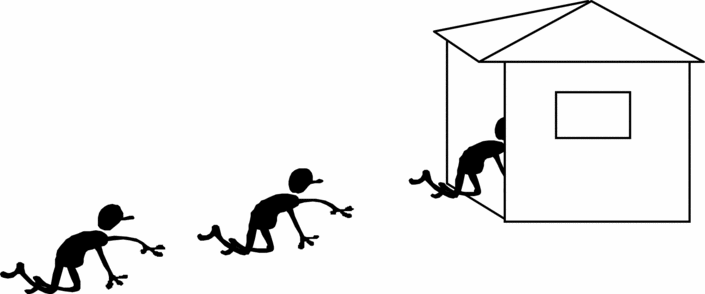
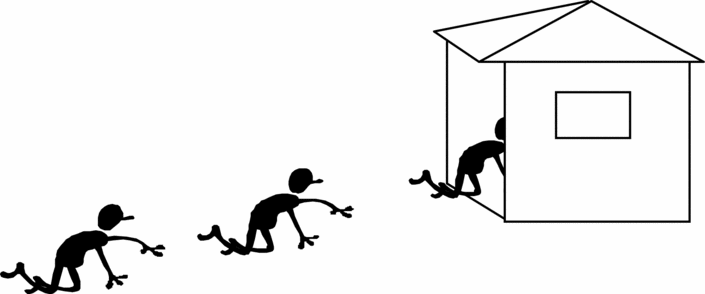
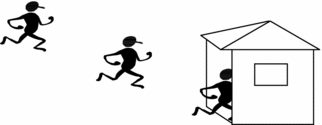
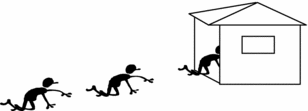
Data were gathered with stimulus pictures depicting boundary-crossing motion events with a salient manner and a salient path component (see Figure 1), using a within-subjects design. The decision to use stimulus pictures instead of video clips was based on the assumption that video stimuli would have emphasized the manner component more, leading to greater expression of manner than is commonly observed in spontaneous descriptions of such events. Following previous work, manner was defined as referring to a broad set of factors, including the motor pattern (e.g., run in the park, crawl into the house), the rate of motion (e.g., pop out of the hole, plunge into the room), or the degree of effort involved in the motion (e.g., clamber up the tree, drag into the room). The manners depicted in the stimulus pictures were chosen based on an earlier classification of manner verbs (Özçalışkan, Reference Özçalışkan2004; Slobin, Reference Slobin, Niemeier and Dirven2000) and included a broad representation of different subtypes of manner, such as rapid motion (e.g., run, dash), leisurely motion (e.g., crawl), smooth motion (e.g., fly), and furtive motion (e.g., creep), along with several others (see also Cifuentes-Férez, Reference Cifuentes-Ferez2010; Ibarretxe-Antuñano, Reference Ibarretxe-Antuñano2006, for similar classifications of verbs into manner subtypes in other V-languages). The different manners depicted in the stimulus pictures were also constructed in such a way that they could be described either with general manner verbs (e.g., run, crawl, fly) or with more specific manner verbs (e.g., creep, sneak, dash), following a distinction originally proposed by Slobin (“two-tiered manner verb lexicon”; Reference Gennari, Sloman, Malt and Fitch1997). Following Aske (Reference Aske1989), we defined boundary crossing as a path expression that predicates a locative end state and included stimuli that captured three types of path with locative end states: entry into a bounded space, exit out of a bounded space, and traversal to the other side of a threshold, which have been shown to impose constraints in the use of manner verbs across a range of V-languages (Slobin, Reference Slobin, Strömqvist and Verhoeven2004; Slobin & Hoiting, Reference Slobin and Hoiting1994). Therefore, there were 12 pictures: 4 depicting motion into a bounded space (e.g., dive into a pool), 4 depicting motion out of a bounded space (e.g., dash out of a house), and 4 depicting motion over a line or a plane (e.g., jump over a hurdle).
A sample boundary-crossing event: crawling into a house.
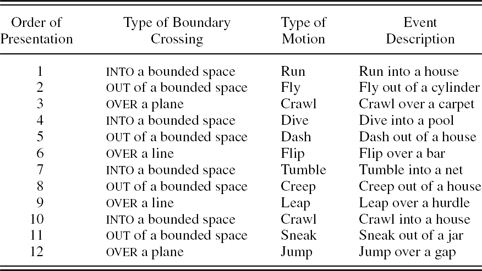
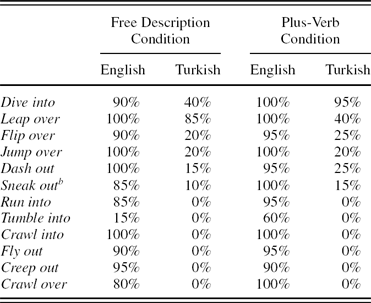
Participants were interviewed individually and were first introduced to the cartoon character named Adam, who performed the motions in the stimulus pictures. They were then shown the stimulus pictures one at a time and asked to respond in two different ways. In the first condition (free description condition), they were asked to describe the pictures in their own words (What is happening in this picture? What is Adam doing?). In the second condition (plus-verb condition), they were asked to describe the pictures using manner verbs provided by the experimenter in a few sentences (I want you tell me what is happening in this picture in one or two sentences, using the verb crawl). The explicit instruction to use only a few sentences was included to elicit more comparable and compact descriptions in both languages, with the goal to force speakers to attend to manner and path components at the same time. Participants described all pictures first in the free description condition and then in the plus-verb condition. If the participants did not make any explicit reference to the landmark that constituted the boundary in the picture, they were asked to redescribe the picture, including the landmark in their description. The free description condition was included to obtain a baseline measure of participants’ responses in expressing motion without any explicit instruction to focus on a particular motion component. Responses were audiotaped and transcribed. The list of boundary-crossing events in the order they were presented to participants is given in Table 1; the stimulus pictures for all 12 events, along with the verbs used in the plus-verb condition, can be found in Appendix B. We kept the order of the individual events constant across participants in both languages to elicit comparable descriptions; however, we presented the three boundary-crossing event types in blocks of four, with each block containing three different boundary-crossing event types (into, out of, and over).
List of boundary crossing event types in order of presentation

Coding and analysis
Participants’ description of each stimulus picture was coded for the type of verb used to describe the boundary-crossing event and the number of clausal segments used to describe the event depicted in the picture. For verb type coding, we only focused on the clausal segment in the description that conveyed the act of crossing the boundary; we classified each verb as a manner verb (e.g., he crawled into the house, he dashed out of the house), a path verb (e.g., he entered the house, he exited the house), or a path verb with either a subordinate manner verb or a manner adjunct (e.g., he entered the house crawling, he exited the house hastily). A fourth category was also added to verb type coding to account for descriptions that either conveyed boundary-crossing implicitly or did not convey boundary crossing. implicit boundary crossing included descriptions in which the figure moves toward a boundary and then is placed inside or outside the bounded region, with no explicit mention of the traversal of the boundary (e.g., he crawls toward the house and now he is inside the house). no boundary crossing included descriptions in which only motion toward, but not across, the boundary is provided (e.g., he crawls toward the house). The number of event descriptions that fell into each of the four categories was computed for each participant; cross-linguistic differences were assessed by independent t test comparisons (English vs. Turkish), separately for each verb type.
For event segmentation coding, we focused on the entire description that the participant provided to each scene to determine whether speakers used one or multiple segments to describe boundary-crossing scenes. We coded each description into one of three categories, as being composed of one segment (he crawls into the house), two segments (he crawls toward the house and he enters), or three or more segments (he crawls toward the house, enters, and keeps crawling). Each segment corresponded to a clause, in the sense that it contained a unified predicate in the form of a verb. Instances of path verbs with subordinated manner verbs (e.g., koşa koşa/koşarak gir, “enter at a run/running”) were also counted as a single segment in both languages, because this was the canonical form of a compact description of motion with manner and path in Turkish. The number of event descriptions with one, two, or three or more segments was computed for each participant; cross-linguistic differences were assessed by independent t test comparisons (English vs. Turkish), separately for each segment type. Additional analyses included two-way analysis of variance (ANOVA) comparisons (Language × Elicitation Condition) of the frequency of manner expression (manner verb or path verb with subordinate manner) and the frequency of descriptions with multiple clausal segments, along with a two-way ANOVA comparison of frequency of manner expression by boundary type (Language × Boundary Type).
RESULTS
English and Turkish speakers use different verb types to describe boundary-crossing events
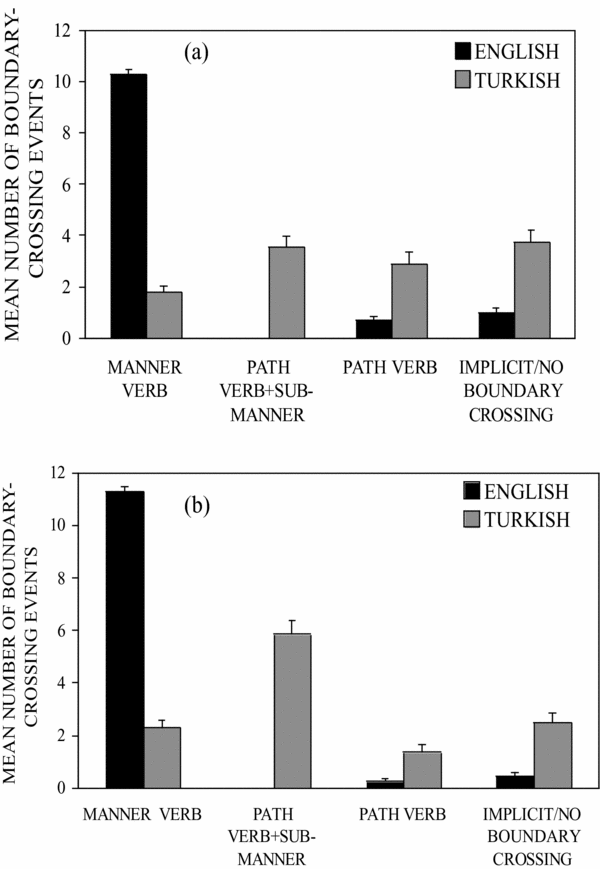
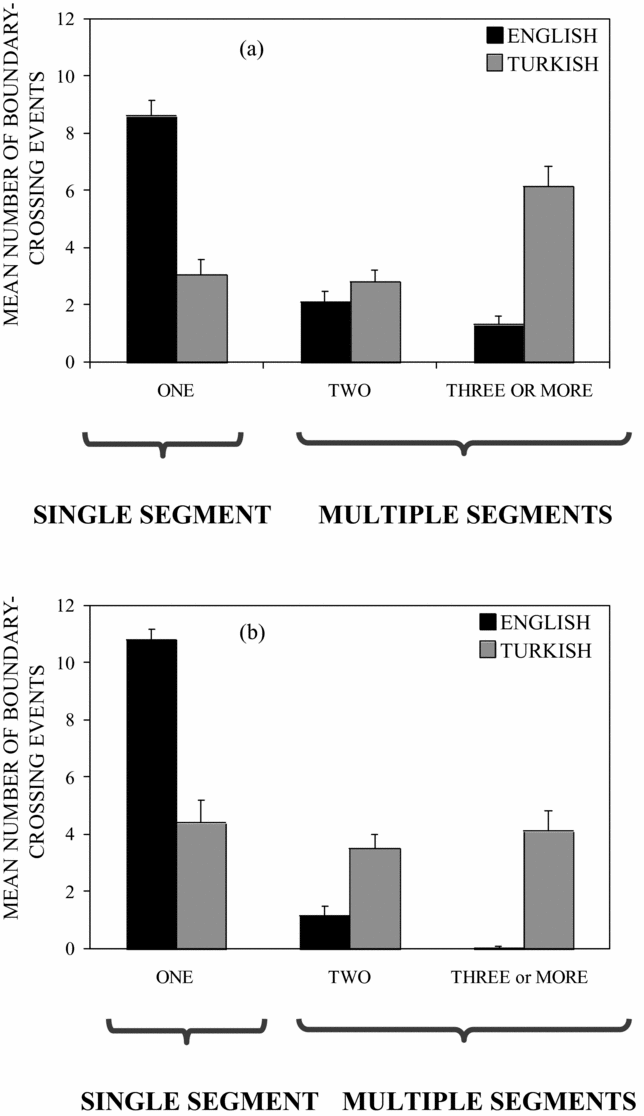
The description of boundary-crossing events showed a strong typological difference in verb choice between the two languages. Beginning with the free description condition, we found significant differences between English and Turkish speakers in their choice of manner verbs, t (38) = 30.56, p < .001; path verbs, t (38) = 4.52, p < .001; and path verbs with subordinate manner, t (38) = 8.59, p < .001. As Figure 2a illustrates, a majority (86%) of the descriptions produced by English speakers involved boundary crossing with manner verbs (M E = 10.30), in contrast to a few in Turkish (15%, M T = 1.8). The pattern was reversed for other verb types: Turkish speakers produced more boundary-crossing descriptions with path verbs (M T = 2.9 vs. M E = 0.7) and path verbs with subordinate manner (M T = 3.55 vs. M E = 0) than did English speakers. The languages also differed in their tendency to convey boundary crossing implicitly, with significantly more descriptions in Turkish involving implicit descriptions or descriptions with no mention of boundary crossing than in English (M T = 3.75 vs. M E = 1), t (38) = 5.60, p < .001.
The mean number of boundary-crossing events by verb type in (a) the free description and (b) the plus-verb condition in (black bars) English and (gray bars) Turkish (maximum possible score = 12).
The patterns remained the same in the plus-verb condition. English and Turkish speakers differed significantly in their choice of manner verbs, t (38) = 28.31, p < .001; path verbs, t (38) = 3.47, p = .001; and path verbs with subordinate manner, t (38) = 11.15, p < .001. As Figure 2b shows, almost all the descriptions (94%) produced by English speakers involved boundary crossing with manner verbs (M E = 11.30) in contrast to only 19% of the descriptions in Turkish (M T = 2.3). The nature of the plus-verb condition, in which the experimenter explicitly asked speakers to use manner verbs, forced speakers of both languages to encode manner more frequently than in the free description condition, leading to a main effect of elicitation condition (two-way ANOVA, Language × Elicitation Condition), F (1, 38) = 35.36, p < .001; a main effect of language, F (1, 38) = 152.2, p < .001; and a significant interaction between elicitation condition and language, F (1, 38) = 7.93, p < .01. Overall, the explicit instruction to use manner verbs led to increased use of manner verbs in English (M free description = 10.3 vs. M plus-verb = 11.3, p < .01, Scheffé) and path verb + subordinate manner constructions in Turkish (M free description = 3.55 vs. M plus-verb = 5.85, p < .001, Scheffé) in the plus-verb condition. The incidence of boundary-crossing descriptions with path verbs was low in both languages (M E = 0.25, M T = 1.35), also likely to be an outcome of the explicit instruction to use manner verbs. The languages also differed in encoding boundary-crossing events implicitly, t (38) = 5.25, p < .0001, with a greater number of descriptions in Turkish involving implicit descriptions or descriptions with no mention of boundary crossing compared to English (M T = 2.50 vs. M E = 0.45).
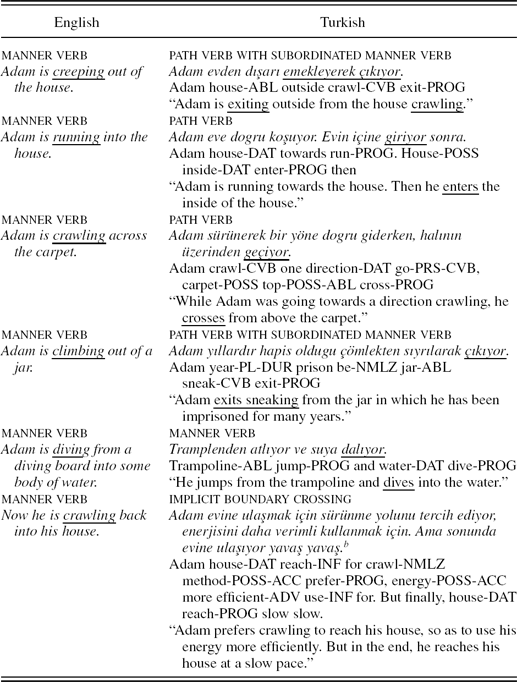
Overall, speakers’ verb choice in both conditions in expressing the boundary crossing showed a strong typological difference. English speakers predominantly used manner verbs, and did so at a much higher frequency than did Turkish speakers. In contrast, Turkish speakers displayed a more varied pattern of verb choices in describing the boundary crossing (see Table 2, for example, boundary-crossing descriptions with different verb types). However, speakers of both languages expressed manner more extensively in the plus-verb condition, where they were explicitly asked to use manner verbs.
Example boundary crossing descriptions with different verb typesa
aThe type of verb used to describe each boundary-crossing event is indicated before each example and the particular verb with which each boundary crossing was conveyed is underlined in each description.
bNo explicit boundary crossing is conveyed in this description; the crossing of the boundary is only implicated via inference.
We next examined whether Turkish speakers’ verb choices showed patterned regularities with respect to different boundary-crossing event types and found this to be true. Table 3 shows the percentage of participants who described each of the 12 boundary-crossing events with a manner verb in the two languages. The majority of the English speakers (80%–100%) described each boundary-crossing event with a manner verb (e.g., he dived into the pool, he dashed out of the house, he crawled over the carpet) in both the free description and the plus-verb condition. In contrast, only certain types of boundary-crossing events led to substantial use of manner verbs in Turkish. These included very rapid or instantaneous boundary-crossing event types, such as diving into a pool of water or leaping over a hurdle; 40%–95% of Turkish speakers described these two events with manner verbs across the two conditions. There were also a few other such rapid event types that led to occasional use of manner verbs by Turkish speakers (e.g., dashing out of a house, flipping over a beam, jumping over a cliff); 15%–25% of Turkish speakers described these events by using manner verbs. In contrast, stimuli that depicted temporally extended types of boundary-crossing events (e.g., crawling/running into a house, flying out of a jar, creeping out of a house, crawling over a carpet) never elicited manner verbs from Turkish speakers in either the free description or the plus-verb condition.
Percentage of participants who described each boundary-crossing event with a manner verba
aPercentages were computed by dividing the number of participants who described each boundary-crossing event with a manner verb by the total number of participants, separately in each language (N = 20).
bThe manner verb that was used as the Turkish equivalent of sneak was sıyrıl. The meaning of the verb sıyrıl is slightly different from the verb sneak in the sense that it involves sneaking out in a rapid manner.
In contrast to Turkish speakers, English speakers relied predominantly on manner verbs (85%–100%) in conveying boundary crossing, showing very little variability in their description of the different scenes. The only exception was the description of the scene involving tumbling of a character into a net; in describing this scene, both in the free description and in the plus-verb condition, participants relied on a more varied pattern of verb choices, with a preference for neutral verbs (e.g., go into the net; 40%) and path verbs (e.g., fall into the net; 30%) in the free description condition and a preference for manner verbs (e.g., tumble into the net; 60%), neutral verbs (20%), and path verbs (15%) in the plus-verb condition (20%). In contrast to other scenes, the unintentional nature of the motion depicted in this scene (i.e., losing balance leading to a fall) might have contributed to the greater variability in English speakers’ verb choices.
In addition to the type of boundary-crossing event (sudden vs. temporally extended), the scenes also differed with respect to the type of the actual boundary itself, with some scenes involving unenclosed two-dimensional boundaries (e.g., carpet, beam) that are crossed OVER and others depicting three-dimensional enclosed boundaries (e.g., a house, a container) that are traversed by going INTO or OUT OF. Speakers of both languages expressed manner at a greater rate in describing boundary-crossing events involving two-dimensional scenes that are crossed OVER than three-dimensional scenes that involved motion INTO or OUT OF, thus showing a main effect of boundary type both in the spontaneous, F (1, 38) = 4.88, p = .03, and in the plus-verb, F (1, 38) = 6.77, p = .01, conditions. Even though both languages followed this pattern, the overall rate of manner expression was higher in English than in Turkish, also leading to a significant main effect of language in describing boundary-crossing events in both the spontaneous, F (1, 38) = 130.72, p < .001, and the plus-verb, F (1, 38) = 39.27, p < .001, conditions, without significant interactions between language and boundary type in either condition.
Taken together, these results show that manner verbs are not simply used very rarely by Turkish speakers in describing boundary-crossing events, but they are also categorically prohibited in the description of activity type events that are temporally extended (e.g., crawling, walking, running). Thus, Turkish speakers are only allowed to violate the path-verb requirement in a boundary-crossing event context if the verb expresses some physically very rapid or relatively instantaneous motion, particularly with two-dimensional unenclosed boundaries (e.g., carpet, beam) that can only be crossed over.
English and Turkish speakers differ in their segmentation of boundary-crossing events
English and Turkish speakers showed a strong typological difference in their segmentation of boundary-crossing events. Beginning with the free description condition, we found that English speakers produced significantly more boundary-crossing descriptions with single segments than did Turkish speakers (M E = 8.6 vs. M T = 3.05), t (38) = 7.23, p < .0001. As Figure 3a shows, the majority (72%) of the event descriptions in English consisted of single clausal segments. In contrast, Turkish speakers produced significantly more boundary-crossing descriptions with three or more segments than did English speakers (M T = 6.15 vs. M E = 1.30), t (38) = 6.42, p < .0001, which accounted for half of the event descriptions in Turkish. Speakers of the two languages showed no reliable difference in their production of boundary-crossing events with two segments (M E = 2.10 vs. M T = 2.80).
The mean number of boundary-crossing events by number of event segments in (a) the free description and (b) the plus-verb condition in (black bars) English and (gray bars) Turkish (maximum possible score = 12).
Turning next to the plus-verb condition, we found significant differences between the number of boundary-crossing descriptions in English and Turkish that consisted of one (M E = 10.8 vs. M T = 4.4), t (38) = 7.3, p < .0001; two (M E = 1.15 vs. M T = 3.5), t (38) = 3.97, p < .001; or three or more (M E = 0.05 vs. M T = 4.1), t (38) = 5.66, p < .0001, segments. As Figure 3b illustrates, English speakers almost exclusively produced boundary-crossing descriptions with single segments (90%), followed by events with two segments (10%). They almost never produced descriptions with more than two segments. In contrast, Turkish speakers produced boundary-crossing descriptions with one, two, or three or more clausal segments at roughly equal rates (30%–36%). A two-way (Language × Elicitation Condition) ANOVA comparison of event descriptions with two or more segments showed a significant effect of elicitation condition, F (1, 38) = 15.26, p < .001, and a significant effect of language, F (1, 38) = 76.03, p < .001, but no interaction, F (1, 38) = 0.88, p = .36, on event segmentation. English, but not Turkish, speakers produced significantly more event descriptions with multiple (i.e., two or more) clausal segments in the free description condition (M E = 3.4) than in the plus-verb condition (M E = 1.2, p < .01, Scheffé), most likely an outcome of the explicit instruction to use a few sentences to describe the events in the plus-verb condition. However, regardless of the explicit instruction to use only a few sentences, Turkish speakers were as likely to produce descriptions with multiple clausal segments (i.e., two or more) in the plus-verb condition as in the free description condition (M free description = 8.95 vs. M plus-verb = 7.60, ns; in Figure 3, see combined average for the columns shown above “multiple segments”).
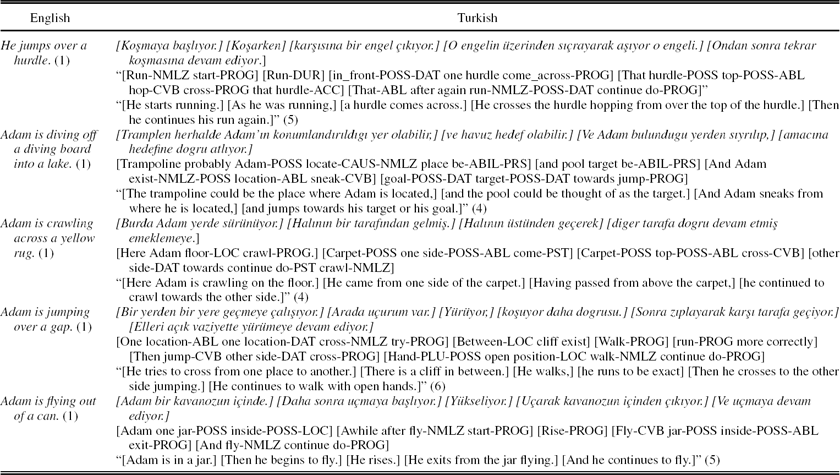
Overall, English and Turkish speakers differed in the number clausal segments they used to describe boundary-crossing events. English speakers predominantly used single clauses to describe such events, while Turkish speakers employed multiple clausal segments to talk about the same set of events (see Table 4 for sample responses with different clausal segments).
Example boundary crossing descriptions with different number of clausal segmentsa
aThe number of clausal segments in each description is indicated in parentheses following the example, and each clausal segment is enclosed in brackets for the Turkish examples.
DISCUSSION
Linguistic description of motion scenes involving the traversal of a spatial boundary imposes the tightest typological constraints in the lexicalization of motion in V-languages: speakers of V-languages are required by their language not to use a manner verb in conveying motion across a spatial boundary (Slobin & Hoiting, Reference Slobin and Hoiting1994). In this paper, we examined how English (S-language) and Turkish (V-language) speakers verbalize boundary-crossing events with a salient manner component. More specifically, we asked how V-language speakers behave in a situation where the restrictions of their language impose competing demands with the requirements of the experimental task (i.e., use of manner verbs). In line with our predictions, speakers showed strong cross-linguistic differences in their choice of verbs to describe boundary-crossing events. English speakers predominantly used manner verbs, while Turkish speakers displayed a varied pattern of verb choices. Speakers also differed in the number of event segments they used to convey boundary-crossing events. Turkish speakers produced more descriptions with multiple clausal segments than did English speakers, who predominantly relied on single clauses to convey the same events. Thus, speakers of each language showed distinct patterns of mapping the manner and path components of boundary-crossing events onto surface structures, and Turkish speakers developed multiple linguistic strategies (e.g., manner verbs, path verbs with subordinate manner, and implicit boundary crossing) to meet the competing demands in conveying both the manner and the path components of a boundary-crossing event.
Earlier cross-linguistic research on motion events in general (e.g., Allen et al., Reference Allen, Özyürek, Kita, Brown, Furman and Ishizuka2007; Hickman, Reference Hickman, Aurnague, Hickmann and Vieu2007; Ibarretxe-Antuñano, Reference Ibarretxe-Antuñano, Strömqvist and Verhoeven2004; Oh, Reference Oh2003; Özçalıskan, Reference Özçalışkan2005, Reference Özçalışkan, Guo, Lieven, Ervin-Tripp, Budwig, Nakamura and Özçalışkan2009; Özçalıskan & Slobin, Reference Özçalışkan, Slobin, Greenhill, Littlefield and Tano1999, Reference Özçalışkan, Slobin, Özsoy, Akar, Nakipoglu-Demiralp, Taylan and Aksu-Koç2003; Papafragou, Massey, & Gleitman, Reference Papafragou, Massey and Gleitman2002; Slobin, Reference Slobin, Strömqvist and Verhoeven2004) and boundary-crossing events in particular (e.g., Naigles et al., Reference Naigles, Eisenberg, Kako, Highter and McGraw1998) showed an overwhelming tendency by V-language speakers to express path of motion in the verb and, in most cases, exclude manner information altogether. In this experiment, we tried to overcome this tendency and made speakers express both manner and path by using manner-salient stimuli and by probing the use of particular manner verbs. The task was an easy one for English speakers, who had the option of using path satellites to encode directionality and the verb to encode manner. In contrast, Turkish speakers faced a challenge. They had no choice but to encode path in the main verb (at least in most cases), because each event involved motion across a spatial boundary. However, they also had to find a way to express manner in the verb, which led to an increase not only in their manner verb use but also in the number of strategies they used to convey such events. They used manner verbs to describe a small set of boundary-crossing event types, only those involving very rapid acts (e.g., diving into a pool, dashing out of a house). However, they never used manner verbs to describe temporally extended motion types (e.g., crawling into a house). Why do Turkish speakers use manner verbs to describe instantaneous acts but not temporally extended events? One likely explanation, as proposed by Slobin (Reference Slobin, Strömqvist and Verhoeven2004), is that crossing of a spatial boundary is construed as a change of state, and V-language speakers most characteristically use verbs to encode change of state. However, most manner verbs are activity verbs that are temporally extended over time. As such, “the only manner verbs that can occur in boundary-crossing situations are those that are not readily conceived of as activities, but, rather, as ‘instantenous acts’” (Slobin, Reference Slobin, Strömqvist and Verhoeven2004, p. 227; see also Kita, Reference Kita1999). The results of our experiment provided strong support for this claim.
Turkish speakers also used other strategies to convey boundary-crossing events. One strategy was to use path verbs with subordinate manner verbs or manner adjuncts, as in (1). This is a linguistic packaging strategy that is also used frequently in describing non-boundary-crossing motion events in Turkish (Allen et al., Reference Allen, Özyürek, Kita, Brown, Furman and Ishizuka2007). This allowed Turkish speakers to express both manner and path together in a compact description. At the same time, this option imposed relatively heavier syntactic packaging, which might have limited Turkish speakers’ use of this construction more extensively. One other common strategy Turkish speakers employed was to convey boundary crossing implicitly. For example, they parsed the event into a series of subevents, described each with a manner verb, and completed their description by placing the character on the other side of the boundary, with no mention of traversing it. This unavoidably led to more segmented descriptions in Turkish, as in (3) and (4).
(3) Emekliyor, halı var, bebek gibi emekliyor halıda, sonra halının öbür tarafında devam ediyor.
Crawl-PROG, carpet exist, baby like crawl-PROG carpet-LOC, then carpet-POSS other side-POSS-LOC continue do-PROG.
“He is crawling, there is a carpet, he is crawling like a baby on the carpet, then he continues on the other side of the carpet.”
(4) Bu resimde adam takla atıyor, Adam kütügün üzerinde amuda kalkıp, tekrar eski haline geri dönüyor öbür tarafta.
This picture-LOC Adam somersault do-PROG, Adam log-POSS over-POSS-LOC do_handstand-CVB, again previous position-POSS-DAT back return-PROG other side-LOC.
“In this picture Adam is doing a somersault, Adam does a handstand on the beam, then he returns to his original position on the other side.”
However, why do Turkish speakers tend to express boundary-crossing events implicitly, when the language easily allows them to express such events using path verbs? One explanation could be the different narrative strategies employed by speakers in the two languages. As shown in previous work, speakers of V-languages, such as Spanish, tend to convey motion trajectory through indirect evocations of the motion components, particularly manner of motion (Slobin, Reference Slobin, Niemeier and Dirven2000). For example, to describe a hiker's climb up a mountain, S-language speakers may describe the scene by using action verbs with manner (e.g., he was clambering up the path to the mountain top), whereas V-language speakers may convey the same movement, particularly the manner component, by describing how slippery the road was, how hot the temperature was, or how shaky the hiker's legs were, and in that way convey manner and/or path implicitly. A similar narrative strategy might be at work here in speakers’ description of boundary-crossing events. In other words, speakers set up the scene that contains the boundary and then mark the location of the figure on one side of the boundary and then on the other side of the boundary, and by inference they convey that a boundary has been crossed through these indirect evocations of motion without any direct mention of the actual crossing itself.
At the same time, however, there were also a few scenes (e.g., diving into lake, leaping over hurdle) that elicited relatively higher frequencies of manner verb use among Turkish speakers. Both diving and leaping involve almost instantaneous motion, thus highlighting duration of motion as a possible factor contributing to the boundary-crossing constraint in V-languages. In addition, the verb diving, along with manner, conveys both path (downward trajectory) and boundary information (fluid boundary), adding the further possibility that fluid boundaries might be more permissible to cross with a manner verb in V-languages. Even more striking was the difference between boundary types that involved crossing OVER an unenclosed two-dimensional boundary and the ones that involved going INTO or OUT OF an enclosed three-dimensional boundary such as a house, with the former allowing greater expression of manner (both manner verbs and path verbs with subordinated manner expressions) in speakers’ descriptions in both languages. These results thus suggest that not only the temporal contour of the motion (temporally extended vs. instantaneous) but also the type of the boundary itself might be an important factor in manner verb use in describing boundary-crossing events in V-languages.
Turkish speakers differed from English speakers not only in their choice of verbs types but also in the extent of their descriptions of the boundary-crossing scenes, producing longer and more segmented descriptions. However, why do Turkish speakers parse boundary-crossing events into more segments than do English speakers? One possible explanation is that Turkish speakers limit their use of manner verbs to activity-type events that are extended temporally. Thus, they produced descriptions in which they first talked about manner as an activity toward a boundary, marked the boundary-crossing with a path verb or with an implicit description, then described manner as an activity away from the boundary, as in (2) and (5)–(7).
(5) Bir tramplen var, bir su var, derinligi olan bir su, derin bir su, adam tramplenden atlıyor, suyun içine giriyor.
One trampoline exist, one water exist, depth-POSS be-NMLZ one water, deep one water, Adam trampoline-ABL jump-PROG, water-POSS interior-POSS-DAT enter-PROG.
“There is a trampoline, there is a body of water, water has depth, it is deep water. Adam jumps from the trampoline, Adam enters the inside of the water.”
(6) Adam yine emeklemeye başlıyor, yürüyor, gidiyor, emekleye emekleye devam ediyor,
sarı bir eve giriyor.
Adam again crawl-NMLZ begin-PROG, walk-PROG, go-PROG, crawl-CVB crawl-CVB continue do-PROG, yellow one house-DAT enter-PROG.
“Adam begins crawling again, he is walking, he is going, he continues crawling, he enters a yellow house.”
(7) Bir adam yerlerde sürünüyor, sonra önünde bir sarı kilim görüyor, sonra sürünerek onun üstünden geçip, diger tarafa geçiyor, ve yine sürünmeye devam ediyor.
One man ground-PL-LOC crawl-PROG, then front-POSS-LOC one yellow rug see-PROG, then crawl-CVB it-POSS top-POSS-ABL cross-CVB, other side-DAT cross-PROG, and again crawl-NMLZ continue do-PROG.
“A man is crawling on the ground, then he sees a yellow rug in front of him, then he crosses above it crawling, he passes to the other side, and he continues to crawl again.”
This strategy allowed Turkish speakers to convey both manner and path in a single description, one at a time, but unavoidably led to longer descriptions with many subevents. Gestures produced by speakers of English and Turkish point to a similar tendency. Earlier research showed that, in describing scenes with both manner and path components (e.g., rolling down a hill), Turkish speakers were more likely to produce separate gestures for manner and path than were English speakers (Kita & Özyürek, Reference Kita and Özyürek2003; Özçalıskan, Reference Özçalışkan2012). Thus, in describing “rolling down a hill,” Turkish speakers were more likely to produce one gesture for rolling (rotating hand in one place) and a separate gesture for the downward path (moving index finger downward) than were English speakers, who typically synthesized the two components of motion into a single gesture (moving finger downward while rotating hand).
The boundary-crossing constraint has the potential to serve as a litmus test that can be applied to languages to show that they are verb-framed, and our analysis of English and Turkish showed a strong dichotomous pattern in the expression of such boundary-crossing events in the two language types. At the same time, Turkish and English, even though they are good exemplars of each language type, constitute only a small subset of the vast array of languages that have been classified as belonging to either the verb-framed (e.g., French, Galician, Moroccan Arabic, Hebrew, American Sign Language) or the satellite-framed (e.g., Dutch, Polish, Finnish, Mandarin Chinese) category (Slobin, Reference Slobin, Strömqvist and Verhoeven2004). We also know from previous work that, in addition to intertypological differences, languages within each type also show some level of intratypological variation (Slobin, Reference Slobin, Strömqvist and Verhoeven2004). For example, the availability of ideophones in some V-languages, such as Japanese or Basque, provides possibilities for greater encoding of manner information in these languages through sound symbolisms compared to other V-languages (Hamano, Reference Hamano1998; Ibarretxe-Antunano, Reference Ibarretxe-Antuñano, Strömqvist and Verhoeven2004; Kita, Reference Kita1997). Similarly, differences in grammatical structure could play a role in the expression of subordinate manner constructions within a typology. For example, in a typical clausal construction in Turkish, the main verb comes at the end of the sentence, and any verb subordinated to the main verb must precede this main verb. Therefore, Turkish speakers have to make a decision to include a subordinated manner verb well in advance before they produce the main verb (e.g., eve koşarak girdi, “house-to running entered”). In contrast, Spanish speakers can add subordinated manner verbs “ad hoc” after they produce the clause in its full form (e.g., El éntro en la casa corriendo, “he entered the house running”), also resulting in a greater use of such subordinated manner verb constructions in Spanish as compared to Turkish (Özçalıskan & Slobin, Reference Özçalışkan, Slobin, Greenhill, Littlefield and Tano1999; see also Ibarretxe-Antunano, Reference Ibarretxe-Antuñano, Guo, Lieven, Ervin-Tripp, Budwig, Nakamura and Özçalışkan2009, for a similar finding on the possible effect of word order on intratypological variation within V-languages). As such, future work examining the extent of the boundary-crossing constraint in the expression of motion between and within typologies is needed to further understand the close coupling between language structure and lexicalization of the typological patterns across a broader set of languages.
Moreover, some of the recent work even suggests a revision of Talmy's typological dichotomy, adding a third type of lexicalization pattern (equipollently framed languages) in which manner and path are expressed by two different verbs that have equal morphosyntactic status in the clause (Slobin, Reference Slobin, Strömqvist and Verhoeven2004). This group includes serial verb languages such as Thai (Zlatev & Yangklang, 2004) and various Niger-Cango languages such as Ewe and Akan (Essegbey & Ameka, 2005). One interesting feature of these languages is that they do not follow the boundary-crossing constraint, allowing descriptions of scenes that involve the traversal of a spatial boundary with both manner and path verbs (Zlatev & Yangklang, 2004). As such, this third category of languages present interesting contrasts that might help further tease apart the importance of the boundary-crossing constraint in differentiating between language types.
CONCLUSIONS
Path and manner may seem perfectly symmetrical, but there is theoretical as well as empirical evidence that they are not. Theory (Talmy, Reference Talmy1991, Reference Talmy2000) says that path is the core feature of a motion event, which means speakers of both S-languages and V-languages will have to express path. However, the opposite is not true. Speakers of V-languages do not have to express manner of motion; it is optional. Empirical evidence provides further support to this distinction; S-language speakers express manner routinely in their motion descriptions, while V-language speakers typically omit manner from their descriptions (for a review, see Slobin, Reference Slobin, Strömqvist and Verhoeven2004). In contrast, they both express path information at roughly equal rates (Özçalışkan, Reference Özçalışkan2004). Our experimental task placed two competing demands on the linguistic resources of Turkish speakers; they were asked to convey both manner and path, while they were simultaneously constrained by their language to focus only on path. In such a scenario, it seems that Turkish speakers produced predominantly more extended descriptions, shifting from the use of manner verbs to path verbs and then back to manner verbs again. This provides the linguistic means to encode both components of motion but within the constraints of the semantic structure of their language. In summary, our results provide empirical evidence for the boundary-crossing constraint in motion descriptions and show how speakers of a verb-framed language adjust to the demands of this constraint when expressing motion events with salient manner and path components. Future work on a wider range of languages from all three typological groups (satellite framed, verb framed, and equipollently framed) will shed further light on the extent of the applicability of this constraint as a defining characteristic of the verb-framed typology.
APPENDIX A
The following list is an adaptation of the Leipzig Glossing Rules (http://www.eva.mpg.de/lingua/resources/glossing-rules.php):
APPENDIX B
Events involving motion into a bounded space
Run into a house (run, koş, “run”)
Dive into a lake (dive, dal, “dive”)
Crawl into a house (crawl, sürün, “crawl”)
Tumble into a net (tumble, yuvarlan, “tumble/roll”)
Events involving motion out of a bounded space
Fly out of a jar (fly, uç, “fly”)
Dash out of a house (dash, fırla, “dash”)
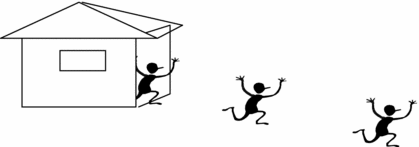
Creep out of a house (creep, emekle, “walk-on-all-fours”)
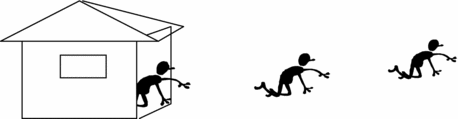
Sneak out of a pot (sneak, sıyrıl, “sneak rapidly”)
Events involving motion over a bounded space (i.e., a line or a plane)
Crawl over a carpet (crawl, sürün, “crawl”)
Flip over a beam (flip, parenda-at, “flip”)
Leap over a hurdle (leap, zıpla, “leap/jump”)
Jump over a cliff (jump, atla, “jump”)