Introduction
Surveys indicate that currently 91% of adults in the United States own a cellular phone (Brenner, Reference Brenner2013). Increasingly, individuals are using mobile smartphones that enable users to talk on the telephone, text message, and access the internet through a single device; recent surveys suggest that 56% of adults in this country own smartphones (Smith, Reference Smith2013). Smartphone users can access content and information through platform-based applications, commonly called ‘apps’. The use of apps on smartphones and tablet devices is increasingly being incorporated in health behaviour change efforts because apps can target a range of change goals and be accessed during people's daily lives (Fox & Duggan, Reference Fox and Duggan2012).
Smoking is a critical public health problem and the leading cause of preventable mortality in the US (Centers for Disease Control and Prevention, 2012) and providing resources to assist smokers in quitting is a national priority (Department of Health and Human Services, 2004). Mobile phone apps targeting smoking cessation are a growing resource as a population with more access to mobile smartphones seeks assistance with smoking cessation. Apps are well-suited to this effort: they are convenient, easy to use, and portable, which means that individuals can access content in real time when they are experiencing urges or cravings to smoke. Moreover, apps can include content that is both tailored to the individual and general to the larger population of smokers.
The Android and iPhone, two of the most popular smartphone devices, can both be used to access apps that target smoking cessation. While the content and utility of iPhone apps have been reviewed (Abroms, Padmanabhan, Thaweethai, & Phillips, Reference Abroms, Padmanabhan, Thaweethai and Phillips2011), apps for Android devices have not been systematically examined. There are several reasons why a review of Android apps for smoking cessation is needed. First, many people own Android devices. The most recent survey on smartphone ownership conducted by the Pew Research Center found that 28% of all cellphone users in the United States reported owning an Android device, while 25% reported owning an iPhone (Smith, Reference Smith2013). This pattern is seen globally; in the growing smartphone market, currently more Android smartphones are sold than iPhones (Global Mobile Statistics, 2013). Thus Android apps have a broad reach. Second, there are differences between Android and iPhone users. While the Pew survey found that persons with higher socioeconomic status were more likely to report owning an iPhone, Android use was distributed across income and education levels (Smith, Reference Smith2013). Some speculate that these differences translate into different rates of smoking between the two smartphone user groups. In their review of iPhone apps for smoking cessation, Abroms and colleagues (Reference Abroms, Padmanabhan, Thaweethai and Phillips2011) suggest that the higher levels of educational attainment and household income among iPhone owners likely signals lower rates of smoking in this group (due to a lower prevalence of smoking in persons with more education and income). Cellphone ownership also differs by ethnicity. While similar percentages of Whites (26–27%) and Latinos (26–27%) reported Android and iPhone use in the Pew survey, African American respondents were much more likely to own an Android (42%) than an iPhone (16%). Third, Android and iPhone apps are not compatible, and there is only limited overlap between the two (Ling, Reference Ling2013). They are written in different operating systems (iOS for iPhone and Android OS for Android) and with different programming languages. Android and iPhone may also differ in the numbers of apps that target health behaviour change domains such as smoking cessation. As part of a review of apps delivering information on HIV, Muessig, Pike, LeGrant, & Hightow-Weidman (Reference Muessig, Pike, LeGrand and Hightow-Weidman2013) searched for apps categorised as ‘health and fitness’ and ‘medical’ and found more apps in these categories for Android (15,891) than for iPhone (13,479). Given these differences, it cannot be assumed that iPhone apps for smoking cessation are the same as those for Android or that what is available on iPhone will be accessible by Android users. Information from such a review is also relevant to medical and mental health professionals who may assist clients with issues related to smoking cessation in their work and thus need to be informed about Android apps (in addition to iPhone apps) as a possible treatment resource.
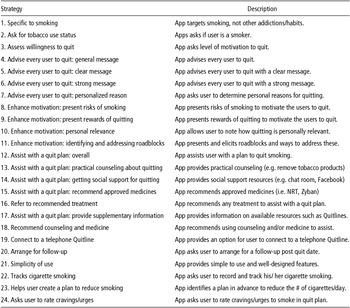
As apps targeting smoking cessation are created and more widely available, it is critically important to determine whether or not they are incorporating best practices that can actually help smokers quit. Motivation to quit smoking waxes and wanes; if a smoker accesses an app for assistance in quitting and finds strategies that are not likely to be helpful, it could present a barrier to quitting. In 2008, the US Public Health Service published Clinical Practice Guidelines for Treating Tobacco Use and Dependence (Clinical Practice Guideline Treating Tobacco Use and Dependence 2008 Update Panel, 2008), a listing of ten recommendations to assist service providers of all types in their work helping people to quit smoking. The recommendations were made by clinical and research experts in the field based on their review of the research literature and included strategies that are evidence-based and have been shown to help smokers quit. Among the recommendations are identifying and documenting whether an individual uses tobacco in all healthcare settings, advising all smokers to quit and offering brief interventions to all smokers, counselling that offers problem solving and support for quitting, and offering use of medication or nicotine replacement therapies. Abroms and colleagues (Reference Abroms, Padmanabhan, Thaweethai and Phillips2011) and Bock and colleagues (Reference Bock, Graham, Sciamanna, Krishnamoorthy, Whiteley, Carmona-Barros, Niaura and Abrams2004) operationalised these recommendations via a list of 24 clinical strategies (see Table 2). Most of these strategies (Strategies 2–7 and 12–20) come directly from the US Public Health Service Guidelines and reflect the practice known as the 5 As – Ask, Advise, Assess, Assist, Arrange – that has been subject to research and is now the evidence-based practice that is recommended as the standard in all health care settings (Goldstein, Whitlock, & DePue, Reference Goldstein, Whitlock and DePue2004; Orleans et al., Reference Orleans, Woolf and Rothemich2006; Schroeder, Reference Schroeder2005; Whitlock et al., Reference Whitlock, Orleans and Pender2002). Others (Strategies 8–11) also come from the US Public Health Service Guidelines and are known as the 5 Rs – discussion of Relevance, Risks, Rewards, Roadblocks, and Repetition – to be implemented with smokers who have expressed an unwillingness to quit as a way to enhance motivation to quit tobacco use. The 5 Rs has also been tested and shown to be beneficial in increasing smokers’ motivation to quit (Carpenter et al., Reference Carpenter, Hughes and Solomon2004; Carpenter, Hughes, & Keely, Reference Carpenter, Hughes and Keely2003). The Clinical Practice Guidelines also recommend use of strategies such as tracking the number of cigarettes one is smoking as a way to make the habit of smoking less automatic and more noticeable, as well as providing advice to quit (Clinical Practice Guideline Treating Tobacco Use and Dependence 2008 Update Panel, 2008). Using these guidelines as a way to gauge the utility of apps for smoking cessation is a convenient way to determine if they offer users strategies that are likely to be useful and effective.
In the present study, currently available free Android apps for smoking cessation were reviewed. A subset of these was evaluated regarding their content and utility in order to identify apps that were most consistent with evidence-based smoking cessation treatment recommendations as part of an effort to identify apps that could be used in conjunction with a multi-faceted smoking cessation intervention. We focused our review on free apps because they are more widely accessible and so would be a better fit with our goal of finding apps that would be suitable for use by a broad range of individuals interested in using an app to help them quit smoking. After reviewing the apps and comparing them to several sets of criteria to ensure that they targeted tobacco smoking and were designed to help users quit, a subset of the apps was rated by three reviewers for the presence of 24 clinical strategies that have been identified as features of good clinical practice for smoking cessation (Abroms et al., Reference Abroms, Padmanabhan, Thaweethai and Phillips2011; Fiore, Jaen, Baker, et al., Reference Fiore, Jaen and Baker2008). We addressed several questions:
-
Research Question 1: Do Android apps include strategies that are consistent with evidence-based smoking cessation treatment recommendations?
-
Research Question 2: What are the most common strategies for smoking cessation found in Android apps?
-
Research Question 3: What can be learned about how Android apps may be improved to better assist individuals who want to use them to quit smoking?
Methods
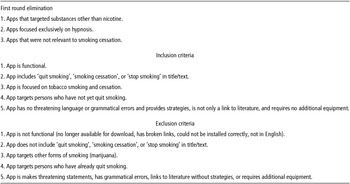
Free android apps for smoking cessation were identified on 21 June 2012 using the ‘Play’ link on Google's USA homepage (www.google.com) and on 1 January 2013 using Amazon's USA homepage (www.amazon.com) and inputting several search terms including: ‘quit smoking’, ‘smoking cessation’, and ‘stop smoking’ in the search bar. Apps for review and evaluation were identified using the following process (Table 1).
Criteria for Identifying Free Apps for Review

First, the apps were reviewed to determine whether they met a set of specifications to ensure they were targeting tobacco smoking cessation. The titles and descriptions of all free apps listed in the search were read and reviewed. Based on this information, apps that targeted substances other than nicotine, focused on hypnosis, or were not relevant to smoking cessation were eliminated from further consideration. Our rationale for eliminating apps focused exclusively on hypnosis was that hypnosis is not an evidence-based strategy for smoking cessation (Barnes, Dong, McRobbie, Walker, Mehta, & Stead, Reference Barnes, Dong, McRobbie, Walker, Mehta and Stead2010). Second, remaining apps were downloaded and their content was reviewed. Following this more detailed inspection, apps that were found to be targeting substances other than nicotine, focused on hypnosis, or were not relevant to smoking cessation were also eliminated.
Third, we used a set of five inclusion/exclusion criteria to further narrow the field based on our goals of ratings apps that include strategies for smoking cessation and that focus on persons trying to quit smoking rather than those who have already quit. To begin with, apps had to be functional. We eliminated apps that were no longer available for download, had broken links, could not be installed on the smartphone correctly, or were not in English. Next, apps had to include the terms ‘quit smoking’, ‘smoking cessation’, or ‘stop smoking’ in their title or text in order to ensure that users would recognise them as focused on smoking cessation. Apps had to target tobacco smoking and cessation and could not be focused on other substances that may be smoked (such as marijuana), because treatment strategies for stopping other substances may be different from those best suited to quitting tobacco smoking. Next, apps had to target persons who have not yet quit smoking; we excluded apps that focused exclusively on staying quit and that did not address actual quitting. While helping people stay smoke-free is also an important goal, our focus was identifying apps that aid users in quitting smoking. Finally, we excluded apps with text or content that was likely to be unhelpful such as apps that made threatening statements (e.g. referring to cigarettes as ‘cancer sticks’), those that had grammatical errors (e.g. ‘Time to Quit Smoke’), those that only linked to books or other literature about quitting but did not provide strategies or supports, and those that needed additional equipment such as specialised headsets. These exclusions were justified by the fact that this study took place within the context of a larger effort to identify apps to be used in a smoking cessation intervention; apps with threatening messages and/or grammar and spelling errors were not suitable for this purpose.
The remaining apps were rated following the methods used by Abroms and colleagues (Abroms et al., Reference Abroms, Padmanabhan, Thaweethai and Phillips2011). Each app was categorised according to its primary approach to smoking cessation: (1) ‘calculator’ that tracks dollars saved and health benefits accrued since quitting, (2) ‘rationing’ that limits the number of cigarettes and/or the time in which cigarettes can be smoked, (3) ‘calendar’ that tracks the days until and after the quit date, and (4) ‘other’ that does not fit into these categories. Each app was rated independently by the three reviewers for the presence of 24 clinical strategies for smoking cessation (Table 2). The first 20 strategies were identified by Abroms and colleagues (Abroms et al., Reference Abroms, Padmanabhan, Thaweethai and Phillips2011) as features of good clinical practice for smoking cessation based on the 2008 Clinical Practice Guidelines for Treating Tobacco Use and Dependence provided by the US Public Health Service (Fiore, Jaen, Baker et al., Reference Fiore, Jaen and Baker2008). Using a modified version of the scale from the Abroms review (Abroms et al., Reference Abroms, Padmanabhan, Thaweethai and Phillips2011), each of these strategies was rated on a 3-point scale: 0 = not present at all, 1 = present a little (present but not on the main screen or in the interactive prompts), 2 = fully present (prominent, on the main screen or in the interactive prompts). We then generated four additional items: (1) simplicity of use, (2) whether or not the app asked users to track their cigarette smoking, (3) whether or not the app helped the user create a plan for how to reduce the number of cigarettes smoked per day in advance of quitting, and (4) whether or not the app asked the user to rate cravings or urges to smoke. Each of these items was rated on a 4-point scale: 0 = poor, 1 = fair, 2 = good, 3 = excellent. A total average rating was calculated for each of the apps reviewed; these ranged from 0–49.
Clinical Strategies for Smoking Cessation Rated for 21 Android Apps1

1 Items 1–20 were rated on a 3-point scale: 0 = not present at all, 1 = present a little (present but not on the main screen or in the interactive prompts), 2 = fully present (prominent, on the main screen or in the interactive prompts). We selected a 3-point scale because we thought we could best discriminate among 3 categories reliably. Items 21–24 were rated on a 4-point scale: 0 = poor, 1 = fair, 2 = good, 3 = excellent.
Results
Identifying and Reviewing Apps
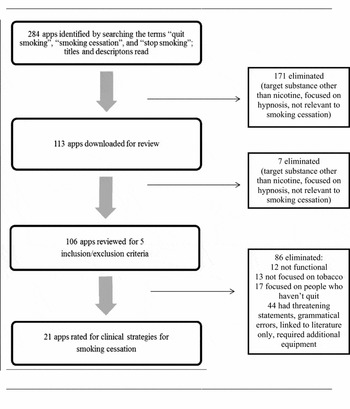
The process of identifying and reviewing apps and the numbers eliminated at each stage are illustrated in Figure 1. The initial search yielded a list of 284 unique apps. Titles and descriptions of all 284 apps were read and reviewed, and 171 (60.2%) were eliminated because they targeted substances other than nicotine (e.g., ‘Addiction Fighter’, ‘Detoxify Bad Habits’), focused on hypnosis (e.g., ‘Smoke Free Hypnosis’, ‘Self Hypnosis Quit Smoking’), or were not relevant to smoking cessation (e.g., apps targeting weight loss, guides to yoga or other wellness practices). The remaining 113 (39.8%) apps were downloaded and their content was reviewed. Of these, another seven were found to be targeting substances other than nicotine, focused on hypnosis, or were not relevant to smoking cessation and so were eliminated from further consideration.
Process of Identifying and Reviewing Apps

The remaining 106 apps were reviewed based on the five inclusion/exclusion criteria described above. Overall, all of the apps had the required terms in the title or text. Twelve apps (11.3%) were not functional, 13 (12.3%) were not focused on tobacco smoking, and 17 (16.0%) were not focused on persons who had not yet quit. Another 44 (41.5%) made threatening statements, had grammatical errors, linked to literature without strategies, or required additional equipment. This yielded 21 apps that were available for further rating and evaluation.
Features and Ratings of the Identified Apps
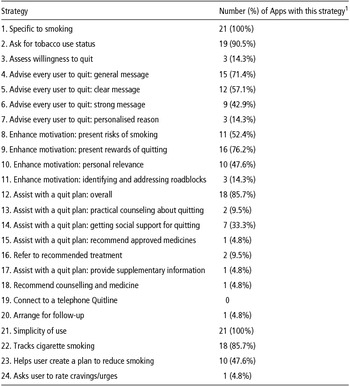
Frequency data on the presence of the clinical strategies across apps is presented in Table 3. Apps most often asked people for their tobacco use status, advised users to quit, presented rewards for quitting, assisted users generally in establishing a quit plan, were simple to use, and offered users a way to track the number of cigarette smoked. Few apps assessed willingness to quit, helped users identify personal reasons for quitting, helped users identify barriers to quitting, identified ways that users could get social support for quitting, recommended approved smoking cessation medications, referred to formal smoking cessation treatment, connected users to a telephone Quitline, or allowed users to rate cravings/urges to smoke.
Frequency of Clinical Strategies for Smoking Cessation in 21 Android Apps

1An app was determined to include a strategy if two of the three reviewers rated the strategy as a (fully present) or 1 (present a little) when reviewing the app (for items 1–20) and 1 (fair), 2 (good), or 3 (excellent) (for items 21–24).
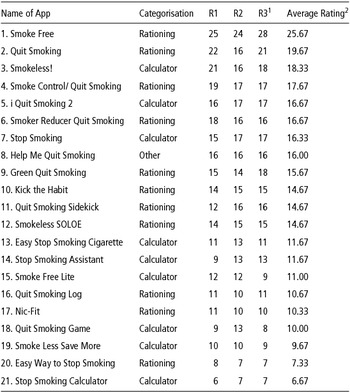
Categorisations and ratings for the 21 apps are listed in Table 4. Most apps used a rationing (12, 54.5%) or a calculator (9, 40.9%) approach. The mean rating for the 21 apps was 14.1 points (sd = 4.5); average ratings ranged from a low of 6.67 to a high of 25.67. Most apps received high ratings for providing advice on quitting and tracking the number of cigarettes smoked. Other strategies, such as identifying and addressing roadblocks and presenting risks of smoking, were included in some apps. Apps uniformly scored low on items 15 through 20, indicating that almost none of the apps included strategies such as recommending approved medications for smoking cessation [e.g. nicotine replacement therapy (NRT)], referring to professionally-delivered smoking cessation treatment, recommending counselling or medication, connecting to a telephone Quitline, or arranging for a follow-up quit date if needed. In addition, few apps asked users to rate their cravings or urge to smoke during the quit plan. Overall, most of the apps used a rationing approach to smoking cessation, and most, even those with the highest rating, received low ratings (0 or 1) on most strategies; the total rating for an individual app by any one rater was a 28 out of 49.
Categorisations and Ratings for 21 Android Apps for Smoking Cessation

1R1 = Rater 1, R2 = Rater 2, R3 = Rater 3
2 Higher rating is better (Min = 0, Max = 49).
Discussion
Use of apps for health related behaviour change is growing: 50% of adults have smartphones with apps and, in 2011, 25% of adults who downloaded an app reported downloading an app related to managing or addressing their health (Purcell, Reference Purcell2011). Most of these adults are young (18–29); as they age and continue to use apps, and are joined by young people who are now growing up using mobile technology and apps from an early age, apps will soon be widely used as part of health, wellness, and behaviour change efforts. Thus it is critically important for healthcare providers to understand what apps can and cannot do in order to make informed recommendations to individuals who are pursuing health behaviour change. To this end, the present study reviewed available free Android apps for smoking cessation. Given the widespread and growing use of Android apps by a diverse group of smartphone owners, a review of these apps, separate from those created for iPhone, is warranted. Moreover, a comparison of our findings with those of Abroms and colleagues found that no apps that were available on both devices. Although apps for both devices have similar features (which we describe below), it was not possibleto identify an app for iPhone and expect to find it for Android. This lack of overlap makes the need for an understanding of Android apps all the more important.
There are several conclusions that we can draw from this review. First, there are few Android apps that target tobacco smoking cessation. An initial pool of 284 Android apps was reduced to a group of 21 that targeted cigarette smoking cessation and were relevant to individuals who are trying to quit. The fact that only 7.4% of the original pool of Android apps was ratable illustrates the large number of apps developed for Android devices that appear to target smoking cessation but are unlikely to be useful for most individuals who want to use an app to help them quit smoking. Thus while apps are being developed for the different mobile smartphone systems, app development is not meeting minimum standards (i.e., focusing on tobacco cessation, being in working order with text that is grammatically correct, etc.). As interest in using apps for smoking cessation grows, it may be difficult for consumers to find an app that is likely to be helpful.
Second, there are several things that Android apps for smoking cessation do well. When we classified the 21 rated apps according to their primary approach, we found that most used either rationing (helping users limit the number of cigarettes and/or the time in which cigarettes can be smoked) or a calculator (allowing users to calculate money saved or health benefits accrued with reductions in the number of cigarettes smoked per day) as their primary approach. The top-rated apps generally used a rationing approach. Rationing is more ‘app-dependent’ in that the app can be used to help in smoking reduction by calculating the target number of cigarettes to be smoked per day on a declining schedule. The calculator is more of a ‘self-awareness approach’ in which the user tracks the number of cigarettes smoked and the app provides feedback about the benefits of cutting down. As a group, the 21 apps were strong in terms of providing advice to quit and in helping users track the number of cigarettes they smoked. Many also included a calculation of the amount of money saved by reducing the number of cigarettes smoked and some included a feature in which the user could record a desired reward to purchase with the amount of money saved. Strategies such as tracking the number of cigarettes (also referred to as self-monitoring) and providing advice to quit are among those identified as important and effective elements in behaviour change efforts in general (Greaves, Sheppard, Abraham, Hardeman, Roden, Evans, Schwarz et al., Reference Greaves, Sheppard, Abraham, Hardeman, Roden, Evans and Schwarz2011; Michie, Whittington, Hamoudi, Zarnani, Tober, & West, Reference Michie, Whittington, Hamoudi, Zarnani, Tober and West2012; van Achterberg, Huisman-de Waal, Ketelaar, Oostendorp, Jacobs, & Wollersheim, Reference van Achterberg, Huisman-de Waal, Ketelaar, Oostendorp, Jacobs and Wollershein2011) and are recommended clinical practices for smoking cessation (Fiore et al., Reference Fiore, Jaen and Baker2008). Overall, it is encouraging that some Android apps include tools that can help smokers set reduction goals and track their progress.
Third, despite these strengths, the Android apps that we reviewed generally had ratings that were well below the maximum possible score, indicating that even the ‘best’ apps did not include many of the recommended strategies for quitting smoking (Fiore et al., Reference Fiore, Jaen and Baker2008). In line with findings by Abroms and colleagues (Abroms et al., Reference Abroms, Padmanabhan, Thaweethai and Phillips2011) with iPhone apps, we found that Android apps generally failed to include education about smoking cessation, provide information on NRT, or refer users to formal smoking cessation treatment if progress towards quitting is not made. As NRT is one of the most beneficial strategies for helping smokers quit (Fiore et al., Reference Fiore, Jaen and Baker2008), this omission is a serious limitation. Similarly, the benefits of social support for many smokers when trying to quit have been noted (Fiore et al., Reference Fiore, Jaen and Baker2008), but few apps offered users connection to a source of support such as a free quitline, suggested that users reach out to friends or family members, or recommended using an online discussion group or other social media sites to communicate with other smokers who are trying to quit. In addition, apps generally received low ratings for their ability to personalise their content to different users. Most apps did not provide a mechanism through which users could provide a personalized reason for quitting, identify and/or address their own roadblocks and barriers to change, or create an individualised plan for cutting down their smoking. Personalised messages and feedback can be extremely useful components of behaviour change (Brug, Oenema, & Campbell, Reference Brug, Oenema and Campbell2003; Larimer & Cronce, Reference Larimer and Cronce2007). Others have noted that web-based interventions for smoking cessation also lack features that allow for personalisation of the content to one's own situation (Lehto & Oinas-Kukkonen, Reference Lehto and Oinas-Kukkonen2011). The omission of these strategies limits the utility of apps to maximally help smokers quit. As more experts become involved in app development and use, these features can be added to apps, making them better able to assist individuals who want to use them to quit smoking.
This study had several limitations. First, we included the most obvious search terms in our effort to identify Android apps for smoking cessation but it is possible that use of other terms that we did not include (e.g., tobacco, nicotine dependence) would have yielded additional apps. Second, clinical practice guidelines focus on persons who are already identified as ‘patients’ or help-seekers, but phone apps may target persons in the population at large. It is possible that some clinical practice guidelines may not translate to an app format. For example, practitioners are encouraged to ask about smoking status (Agency for Healthcare Research and Quality, 2012), but this question is less useful in the case of someone using an smoking cessation app who, it can be assumed, is a smoker who is at least somewhat interested in quitting by virtue of their having downloaded the app. Thus asking the user their smoking status on the app may not be necessary. The design of the apps reviewed here generally focused on self-monitoring and self-awareness of smoking and the apps were not focused on linking smokers with more intensive treatments or social support for quitting. It could be that items 15–20 on our rating scale are not relevant to the current state of apps for smoking cessation. That is, the apps reviewed here may be well-suited as a first level of assistance for smokers who are preparing to quit, providing them with tools and strategies to monitor their smoking and build motivation for quitting. The app market is currently missing apps that provide assistance or recommendations for those who need more intensive strategies. As such, items 15–20 on our rating scale, while not relevant to the current state of apps for smoking cessation, may represent a path for future app development.
We also do not have access to the number of users for the apps that we reviewed or users’ ratings of the apps. Such data would help us to better understand if app users were more frequently identifying and utilising apps that received the highest ratings or whether the lower rated apps were more popular. Relatedly, we do not have much data about the developers of these apps, but it is the developers who determine the content of the apps and their intended user base. While in-depth information about a majority of the app developers is not readily available, we did contact several as part of our intervention development efforts. These app developers were a diverse group including a college student who developed the app as an avocation, an engineer who developed the app as a sideline to his regular job, a PhD student who developed the app as part of his doctoral studies, and a software technology company that developed the app as one of their market products. While anecdotal, this information suggests that app developers are often not healthcare professionals and may benefit in their development efforts from consulting with providers who are knowledgeable regarding the best practices for smoking cessation. Finally, we excluded paid apps. The Abroms review of iPhone apps (Abroms et al., Reference Abroms, Padmanabhan, Thaweethai and Phillips2011) included paid apps, and several of these were rated among their top apps. It could be that some paid apps would have received higher ratings than the free apps that were reviewed here.
There are two main conclusions that can be drawn from this review and which are consistent with that of Abroms and colleagues (Abroms et al., Reference Abroms, Padmanabhan, Thaweethai and Phillips2011). First, many phone apps now address smoking cessation. There are currently at least several apps for each smartphone device that may be useful to help people track how much they smoke and assist with gradual reduction in the number of cigarettes smoked per day. For many smokers, these activities are likely to be helpful as a starting point for learning about and paying attention to their smoking habit, and for self-monitoring their smoking in advance of a quit attempt. Smokers often report that their habit is so automatic that they fail to realise when they reach for a cigarette and therefore, they are surprised to see that they smoke more than they thought (Catley, O'Connell, & Shiffman, Reference Catley, O'Connell and Shiffman2000). Apps that encourage self-monitoring are likely to be helpful as a way for smokers to notice their pattern of smoking throughout the day. As noted above, self-monitoring in and of itself can inspire health behaviour change, and apps provide a convenient way to self-monitor in real time. In addition, self-monitoring using an app does not require paper, pencil, or any materials that could be burdensome. The availability of these phone apps is a positive development as they can be accessed readily by smokers who use their phones for many other tasks throughout the day and so may be willing and maybe eager to use a phone for this purpose.
Second, apps for smoking cessation have significant room for improvement. They would benefit from incorporating more of the recommended clinical strategies, such as education about coping with cravings and urges to smoke, advice to use NRT, and linkage with sources of social support for quitting. Apps would also benefit from incorporating ways to personalise their content so that users can identify and be aware of their own motivations to quit and understand strategies that are best for them. These further adaptations could improve the utility of smartphone apps as a useful and effective resource to help people quit smoking.
Acknowledgements
This work was supported by the VISN 5 Mental Illness Research, Education, and Clinical Center (MIRECC, R. Goldberg, Director).
Financial support
This research received no specific grant from any funding agency, commercial, or not-for-profit sectors.
Conflict of interest
There are no conflicts of interest for any authors.
Ethical standards
This research did not involve human or animal experimentation.