India has been seriously hit by severe acute respiratory syndrome coronavirus 2 (SARS-CoV-2) pandemic with more than 30 million infections reported to date. The infection trends were largely seen in 2 major “waves,” with a second wave reportedly caused by the Delta variant. Due to obvious reasons, health-care personnel (HCPs) were at the forefront of fighting the pandemic and were also at the receiving end of themselves being infected. HCPs are essential workers defined as paid and unpaid persons serving in healthcare settings who have the potential for direct or indirect exposure to patients or infectious materials. 1 HCPs are predisposed to infection during direct or indirect patient care, as well as due to the community spread of the disease during both the waves. The second wave was speedier, fiercer, and infected a higher number of individuals. This wave may be attributed to the mutant virus, and probable disregard of COVID-19-appropriate behavior. It saw manpower challenges as more and more HCPs got infected and were unavailable for work during the quarantine period.
This study aimed to compare clinical presentation and clinical course of SARS-CoV-2 infection in HCPs working in a dedicated COVID-19 care hospital during the first and the second waves. We also studied the residual symptoms of the disease after rejoining the work. Knowing these features can help to address the type of care required by HCPs, manpower challenges, and post-COVID-19 care required in this subset of the population and may help in the management of subsequent waves.
Methods
This observational study was conducted at the COVID-19 care facility of our quaternary care referral institute after approval from the institutional ethics committee. After obtaining written informed consent, observational data were collected during the first and second pandemic wave, which happened to be during May 2020 to November 2020 for the first wave and April 2021 to May 2021 for the second wave. A total of 100 HCPs were enrolled for the first wave and 223 during the second wave. All participants were tested COVID-19-positive by semiquantitative real-time reverse transcriptase-polymerase chain reaction (RT-PCR) or cartridge-based nucleic acid amplification test (CBNAAT)/TrueNAT or rapid antigen test platforms on naso- or oropharyngeal samples. Structured interviews were carried out telephonically or in person for the demographic profile, area of work, presenting complaints, facility used for treatment (home quarantine/hospital care), the average duration of active disease, time to resume duty after COVID-19 infection, and any residual symptoms at the time of joining.
All data were summarized and analyzed using statistical software STATA 14.0. Qualitative data were reported as mean + standard deviation (SD) if normal otherwise median (IQR) was reported. To establish an association between the first and second waves with other variables, the chi-square/Fisher exact test was used. To observe the difference between the first and second waves, a Student t-test was used. A value of P < 0.05 was considered statistically significant.
Results
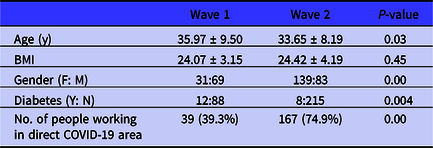
We report clinical presentation and course of SARS-CoV-2 infection in HCPs working in a dedicated COVID-19 hospital. A total of 100 HCPs during the first wave and 223 HCPs from the second wave were enrolled. The demographic variables of HCPs infected during the first wave and second wave are described in Table 1.
Demographics during the first and second SARS-CoV-2 waves

Clinical Presentation
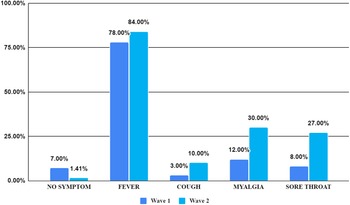
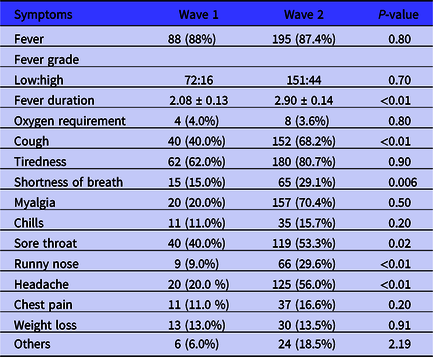
Only a few HCPs, 7 (7%) and 3 (1.4%) were asymptomatic at the time of testing during the first and second wave, respectively, and underwent testing due to a history of high-risk exposure. The most common presenting symptom during both the waves was fever seen in 78 (78.0%) and 188 (80.7%) during the first and second wave, respectively (Figure 1). However, during the second wave, fever was commonly accompanied by other symptoms, such as sore throat, cough, tiredness, running nose, and headache in 165 (74.0%) whereas fever was the only symptom in the majority of HCPs, 58 (58%) during the first wave (P < 0.01). The clinical symptoms, the requirement of oxygen are tabulated (Table 2).
Comparison of presenting symptoms between the 2 COVID-19 waves.

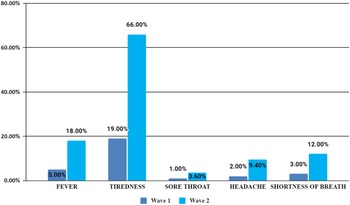
Comparison of persistent symptoms at the time of joining back to work between the 2 COVID-19 waves.

Comparison of clinical symptoms during the first and second SARS-CoV-2 waves

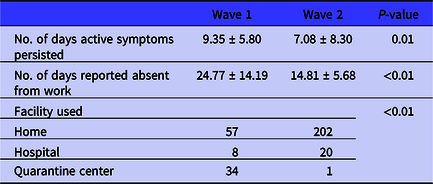
During the first wave, 31 (31%) HCPs had persistent symptoms after joining work, while the number was much higher, 152 (68.1%) in the second wave (P ≤ 0.01). The most common persistent symptoms were generalized body ache, myalgia, or tiredness during the first and second wave and were seen in 19 (19%) and 148 (66.3%) HCPs, respectively. Nearly 40% HCPs had at least 2 or more persistent symptoms during the second wave. The other common residual symptoms during the second wave, included cough 40 (18.0%), difficulty in breathing 19 (9.8%), and fever 14 (7.2%). The other less commonly seen symptoms included insomnia, anxiety, depression, hair fall, weight loss, palpitations, chest congestion. Comparison of duration of disease, the average time of joining work after the onset of symptoms, and facility used for treatment are depicted (Table 3).
Clinical course of the disease during the first and second SARS-CoV-2 waves

Hydroxychloroquine Prophylaxis
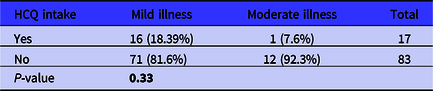
The compliance rate of hydroxychloroquine (HCQ) prophylaxis intake during the first wave was not very high among the HCPs. Of the 100 HCPs, 26 started HCQ prophylaxis. There was no significant difference in the severity of disease among those who took the prophylaxis and those who did not (P-value-0.3). No HCP took HCQ during the second wave (Table 4).
Correlation between intake of HCQ prophylaxis and severity of illness during the first wave

Vaccination
The total number of HCPs who received vaccination at the time of infection during the second wave was 86 (38.7%). Of these, 43 (19.%) had received both the doses and 43 (19.3%) had received only 1 dose. All HCPs received inactivated viral vaccines (Covaxin, Bharat Biotech International Ltd, India) except for 2 who received COVID-19 spike protein vaccine (Covishield, Oxford-AstraZeneca). The facility used for treatment did not differ between those vaccinated and nonvaccinated (P = 0.6). The duration and severity of sickness in the 2 groups were similar, and there was no difference between the pattern and duration of fever and its grade, oxygen requirement, and need for hospitalization (P = 0.5). There was no need for ICU admission in either group and no mortality. The study design, sample size, and statistics used, however, did not permit drawing any conclusions regarding vaccine efficacy.
Reinfections
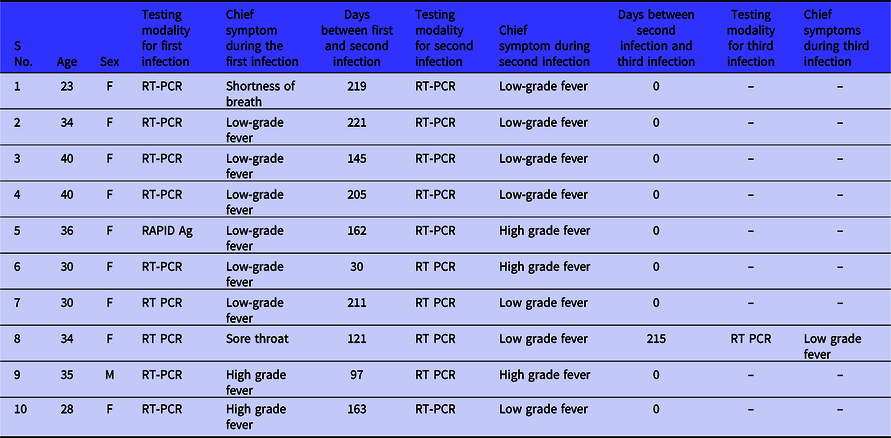
The total number of HCPs who were reinfected was 10 (Table 5). Only 1 was hospitalized (P = 0.9) and required oxygen (P = 0.5), the rest underwent home care. The total duration of sickness between first infection and reinfection was comparable and was 13.3 ± 6.17 and 11.9 ± 5.18 d, respectively (P = 0.38). Nine of 10 HCPs who got reinfected were not vaccinated, 1 received a single dose of vaccination at the time of reinfection.
Disease characteristics during reinfection

Discussion
HCPs may experience an increased risk of SARS-CoV-2 infection not only due to their close contact with highly infectious patients but also due to exposure to undiagnosed or subclinical infectious cases from society. The initial outbreak of the pandemic was difficult for the HCPs considering the poor access to PPE, less experience in handling newly discovered disease, as well as fear of contracting the disease. However, the second wave was no less challenging. Although the healthcare system of low- to middle-income countries (LMICs) was geared up after the first wave, a sudden dramatic rise in the number of cases was enough to create resource scarcity. Reference Jain, Iyengar and Vaishya2 There are limited data on the comparison of clinical presentation and disease course of HCPs during pandemic waves from LMICs. Our study compared the disease course and issues faced after joining back to work among the HCPs during the 2 waves of the pandemic.
Our center was a designated COVID-19 care facility attached to a quaternary care institute. According to our institute policy, PPEs were assigned as per the area of work. Reference Kumar, Killedar and Singh3 Level-1 personal protective equipment (PPE) kits (consisting of surgical gowns, N-95 masks, gloves, and goggles) were used in non-COVID-19 areas, including wards, general labs handling non-COVID-19 patients or their samples. Level-2 PPE kits (coverall/gown’ hood, N-95 masks, goggles, gloves, long shoe covers) were used for screening areas and wards for COVID-19 patients. Level-3 PPE Kits (biosafety coverall, N-95 mask, goggles, gloves, long shoe covers) were used in wards and intensive care units (ICUs) managing COVID-19 patients. The non-clinical areas, such as hospital stores and offices, were provided with N-95 masks as protection from the airborne virus. Reference Sharma, Gupta and Killedar4 The hospital infection control team of the institute issued guidelines for infection control practices, which were uploaded on the institute website from time to time for dissemination across the hospital. These included protocols for disinfection, infection prevention and disposal of biomedical waste by international guidelines, maintenance of donning and doffing areas, monitored donning and doffing, shower areas, etc. Nodal officer was appointed in different working units to ensure adherence to infection control protocols. The HCPs including sanitation workers and security personnel were taught and trained about mask etiquettes, hand hygiene, and social distancing by the hospital infection control team. Almost similar practices were followed during the first and the second wave.
The clinical disease and its course in HCPs need special attention during the pandemic to effectively maintain the functioning of the health-care system. More HCPs were infected in a short span of time during the second wave compared with the first wave, indicating more transmissibility of the new strain leading to manpower challenges. HCPs infected during the second wave were younger than those infected during the first wave and had a female preponderance. Although the incidence of co-morbidities was similar between the 2 groups, diabetics were commonly affected during the first wave.
Most HCPs were symptomatic in either wave, except for a small number who remained asymptomatic and were tested positive as a part of contact tracing or random sampling. This could be because HCPs got themselves tested only when they were symptomatic. Fever was the commonest presenting symptom in both the waves. However, during the second wave, it was more frequently accompanied by other symptoms and incidence of sore throat, running nose, as presenting symptoms was high.
During the second wave, fever duration was longer compared with the first wave but severity of fever (low grade <102 and high grade >102) was similar between the 2 waves. The incidence of sore throat, running nose, shortness of breath, and headache was significantly more during the second wave, indicating a more severe nature of the disease, which are also the reported symptoms of the delta variant. However, the requirement of oxygen was similar in both waves. Data from high-income countries (HICs) show that a less severe disease was seen among patients during the second wave. Reference Soriano, Ganado-Pinilla and Sanchez-Santos5 None of the HCPs enrolled in our study required admission to the intensive care unit. Most of the HCPs were home isolated during both the waves and a small number were admitted to the hospital/quarantine centers. During the second wave, due to a sudden rise in the number of cases and change in availability of resources, more and more HCPs chose to stay in home isolation. Most HCPs relied on friends and colleagues for distress hour needs. Keeping in view the successive pandemic waves, we believe that home isolation supported by teleconsultations may be the best way for managing large numbers of HCPs in limited resource situations. Making home care facilities more robust with regular telephonic follow-ups, access to emergency helpline numbers, and appropriate address of distress calls may be the way forward in delivering effective health care. This can be reassuring and will decrease the number of prophylactic admissions and bed panic in the hospitals.
The average duration to join back duties during the first and second wave was 24.77 ± 14.19 and 14.81 ± 5.68 d, respectively (P < 0.01). This could be because of the manpower shortage during the second wave due to which the HCPs were asked to join on the 11th day of the disease if he/she was asymptomatic/afebrile for 24 h, whereas during the first wave the isolation period was 17 d from symptom onset. More HCPs suffered from persistent symptoms like myalgia, fever, sore throat, and shortness of breath at the time of joining back to work during the second wave, and it was statistically more than the first wave. As most of the HCPs had mild to moderate disease, the recovery rate was good with few HCPs presenting with persistent symptoms at joining during the first wave. Fatigue was the most common residual symptom as observed in other studies as well. Carfì et al. did a study asking about the persistence of symptoms in recovered patients from COVID-19 in Italy Reference Carfì, Bernabei and Landi6 (during the first wave), finding that 87.4% reported persistence of at least 1 symptom and 55% of patients had 3 or more symptoms after recovery, particularly fatigue and dyspnea. In another study, Townsend et al. examined the prevalence of fatigue in individuals who recovered from the acute phase of COVID-19 illness and found that more than half reported persistent fatigue at 10 wk after initial COVID-19 symptoms and that there was no association between COVID-19 severity and fatigue following the infection. Reference Townsend, Dyer and Jones7 This highlights the need for post-COVID-19 care clinics or teleconsultations for HCPs to take care of their physical and mental well-being.
We also did not find any significant difference in the severity of disease among individuals working in direct COVID-19 or non-COVID-19 areas. Our findings are also supported by a study done by Folgueira et al. Reference Folgueira, Munoz-Ruiperez and Alonso-Lopez8 who reported no significant differences in the infection rates between the groups of HCPs working in high, intermediate, and low-exposure risk settings. However, during the second wave, HCPs working in direct COVID-19 care areas were affected more than those working in non-COVID-19 areas. The access to PPEs and infection control policies at both donning and doffing areas were maintained similarly during both waves, manpower was more experienced with working in COVID-19 designated areas but a change in attitude and fatigue among HCPs may have contributed to higher numbers of infections from COVID-19 designated areas.
In March 2020, Indian Council for Medical Research (ICMR), which is the key government body handling India’s COVID response, recommended the use of HCQ by high-risk individuals such as HCP for the prevention of COVID-19, which was later discontinued due to lack of evidence. The compliance rate of HCQ prophylaxis intake was not very high among the HCP. There was no significant difference in the severity of disease among those who took the prophylaxis and those who did not. Several studies have now refuted the role of HCQ as pre-exposure prophylaxis for SARS-CoV-2 in HCPs. The intake of HCQ does not significantly reduce lab confirmed SARS-CoV-2 illness among HCPs, there is no reduction in SARS-CoV-2 with use of HCQ. Reference Rajasingham, Bangdiwala and Nicol9 In light of this literature, HCQ prophylaxis was not used at all during the second wave.
Reinfections
There is rapidly growing evidence toward COVID-19 reinfections questioning the immune response generated by SARS-CoV-2 infection. Few early reports suggested that SARS-CoV-2 reinfection resulted in worse disease than did the first infection, requiring oxygen support and hospitalization. Reference Iwasaki10,Reference Vitale, Mumoli and Clerici11 Cases of reinfection tell us that we cannot rely on immunity acquired by natural infection to confer herd immunity and that not only is this strategy lethal for many but also it is not effective. There were a total of 10 HCPs in our study who tested positive for SARS-CoV-2 more than once. However, all suffered a mild disease. There was no significant difference in need for hospitalization, oxygen use, and duration of disease in the reinfected HCPs from those infected for the first time. Although all HCPs in our study had mild disease, it is important to determine the factors leading to the severity of disease after reinfection. It also needs to be emphasized that reinfections, in general, are being picked up because of symptoms and are biased toward the detection of symptomatic cases. More studies on larger sample size are warranted to determine the impact of reinfections on HCPs and vaccination strategies to stop the SARS-CoV-2 pandemic.
Vaccination
The vaccination drive and availability for HCP started in January 2021, Reference Thiagarajan12 around 3 mo before the second wave, vaccine coverage was still picking up at the time of the second wave. In our study, only 19.8% of infected HCPs received both the doses of the vaccine and nearly 40% received a single dose of vaccine. The reasons for this low coverage were not studied by us. Also, the study did not aim to evaluate the incidence of infections or severe infections among the vaccinated or nonvaccinated HCP population. “Vaccine hesitancy” is defined as a delay in acceptance or refusal of vaccination despite the availability of a vaccine. Reference MacDonald13 Although the severity of disease among vaccinated and nonvaccinated was similar in our study, it is prudent to note that there was no mortality or disease requiring admission to the critical care unit in any HCP. The study design, used statistics, and sample size were insufficient to conclude vaccine efficacy. More and more data are evolving regarding covid vaccination and risk of infection among the general population and HCP from LMICs. Reference Lin, Hu and Zhao14
Ours is a single-center study involving a small number of HCPs, but it gives a fair estimate of manpower, symptoms, and resource requirement to run a 250 bed COVID-19 care facility. We did not do genome sequencing for virus variant responsible reinfections, which would have helped in assessing the role of 1 vaccine in the prevention of infections with all strains of the virus. The study also had a limited follow-up period for persistent symptoms which was only until the time of returning to work. Analysis of vaccine coverage among the participants was not done. Although we tried to keep close track of all HCPs infected by the pandemic, we could have missed a few, especially those who were critical or those who died and did not return to work.
Conclusion
Most of the HCPs had mild to moderate infections during both the waves of the SARS-CoV-2 pandemic, although the second wave infected more young, female HCPs, in a short span of time leading to a serious manpower crisis at our health-care facility. Fever was the most commonly reported symptom in both the waves lasting for a longer duration in the second wave. Cough, shortness of breath, running nose, sore throat, and headache were more commonly seen during the second wave. There were higher numbers of HCPs with persistent symptoms at the time of joining back to work during the second wave. Although reinfections were reported among the HCPs, all of them had mild infections supporting the role of immune response in preventing further severe infections. No vaccinated HCPs in our study had severe infection, suggesting that vaccines do protect against severe SARS-CoV-2 infection. Our study also emphasizes on the need for further upgradation of home-based care and tele consultation facilities for active disease and redressal of residual symptoms, mental health, and addressing questions pertaining to vaccine hesitancy among the HCPs.
Acknowledgments
We acknowledge Ms. Preeti Gupta for helping with data entry.
Author contributions
Ashish Bindra: editing, Concept study design, Interpretation & Compilation and Writing. Sheeba Joseph: editing, Concept study design, Interpretation & Compilation, and Writing. Neha Sharma: editing, Concept study design, Interpretation & Compilation, and Writing. Purva Mathur: editing, Concept study design, Interpretation & Compilation, and Writing. Rajesh Malhotra: editing, Concept study design, Interpretation & Compilation, and Writing. Maroof Ahmad Khan: Concept and Statistics Analysis.
Conflict(s) of interest
The authors declare no conflict of interest.