Introduction
The aims of the paper are to present the findings of a research study which focused specifically on the nature of the collaboration between the visiting instrumental teacher and the class teacher in the Wider Opportunities instrumental programme. It was hypothesised that if collaborative practices were effectively established between these two sets of teachers, they would impact favourably on pupils' learning and progress during the early stages of playing an instrument. The underlying philosophy that drove the study was based on three distinct areas:
• the nature of the collaboration between the two sets of teachers
• the opportunity for teachers to share knowledge and expertise
• the impact of the Wider Opportunities programme on teachers' professional development as a result of collaborative engagement
The research questions related to professional collaboration were:
What is the nature of professional collaboration between the visiting instrumental teacher and the class teacher working in the Wider Opportunities programme?
What learning opportunities does the Wider Opportunities programme provide for instrumental teachers and class teachers?
The background to the Wider Opportunities instrumental programme
In 2001 the Department for Education and Skills published the White Paper Schools Achieving Success. The document stated that ‘over time, all primary pupils who want to will be able to learn a musical instrument’ (2001, p. 12). Pilot studies were undertaken by a small group of local education authorities and a subsequent report was published by Ofsted (2004) where one of the aims of the instrumental programme was seen as giving
as many pupils as possible access to specialist instrumental tuition during Key Stage 2 for a trial period (2004, p. 4).
Guidance for establishing the Wider Opportunities provision (DfES, 2006) was produced which stated that as well as providing instrumental learning for class teachers, visiting instrumental teachers would gain an understanding of
the school context, classroom management and the wider music curriculum . . . a fully integrated learning experience for the child, with CPD [continuing professional development] ‘built in’ (2006: 8).
The above statement stresses that learning should occur not only for the pupils but for the teachers involved.
Previous research studies
Three research studies which focused on the Wider Opportunities programme were carried out (Bamford & Glinkowski, Reference BAMFORD and GLINKOWSKI2010; Fautley, Reference FAUTLEY2011; Lamont, Daubney & Spruce, Reference LAMONT, DAUBNEY and SPRUCE2012), yet they did not specifically highlight the key dimension of collaboration between teachers. The research by Bamford and Glinkowski (Reference BAMFORD and GLINKOWSKI2010) included a large number of participants from eight different local authorities in England. However, although there was no in-depth emphasis on collaboration, it was referred to in relation to partnership. Bamford and Glinkowski recommended that
partnership between the schools and their music service should be strengthened through more collaborative planning and shared delivery (2010, p. 13).
Research by Fautley (Reference FAUTLEY2011) was based on the provision for the Wider Opportunities programme in a large education authority, with Lamont et al. focusing their study on whole class vocal tuition in Key Stage 2. Neither of these studies made detailed reference to collaboration.
A study by Hallam (Reference HALLAM2011) on partnership working in music education concluded that
young people can access a more meaningful and worthwhile music education programme if the strengths of different partners are effectively harnessed and deployed well (2011, abstract).
Current research concerning instrumental teaching in secondary schools is being undertaken by Hallam and Rogers (Reference HALLAM and ROGERS2016), in order to discover the impact of instrumental learning on students' attainment and progress.
In relation to the previously cited research, it appeared that the spotlight placed on professional collaboration in this study was a worthwhile pursuit, in order to contribute to the existing knowledge concerning the Wider Opportunities programme. The underlying assumption to the study was that if high quality collaboration was in place between teachers, high quality musical learning and teaching for pupils would follow.
A review of the literature
Partnership and collaboration
The term ‘partnership’ was referred to in the Bamford and Glinkowski (Reference BAMFORD and GLINKOWSKI2010) study and by Hallam (Reference HALLAM2011) and is a theme that has been evident in several government publications. Working in partnership is emphasised in an Ofsted (2009) report in connection with the whole class teaching programme. The report found that
the very best practice recognised that the programmes were a partnership between the specialist music teacher and the specialist class teacher. Both bring expert skills and knowledge, planning together to ensure that pupils enjoy good progress in their learning (p. 21).
This statement acknowledges the different expertise of each teacher and indicates that both teachers should be involved in planning. Importance was also placed on partnership working between music organisations in the review of music education produced by Henley (Reference HENLEY2011). Henley advocates that
the best model for Music Education includes a combination of classroom teaching, instrumental and vocal music tuition and input from professional musicians. Partnership between organisations is the key to success (p. 13, recommendation 8).
Similar reference is made to effective partnership working in the National Plan for Music Education (DfE, 2011). However, no specific reference is made to professional collaboration between teachers.
It could be contended that collaboration is an important aspect of both teachers’ and pupils’ learning, whereby knowledge is shared, and gains are made through learning from each other. As Pritchard and Woollard (Reference PRITCHARD and WOOLLARD2010) maintain ‘collaboration leads to learning’ (p. 27). Gasper (Reference GASPER2010) considers that partnership brings together people with different skills, perspectives, expertise and experience. Yet Whittington (Reference WHITTINGTON, Weinstein, Whittington and Leiba2003a) states that although the concepts of partnership and collaboration are closely related ‘partnership is a state of relationship; collaboration is the active process, that is, of partnership in action’ (p. 31). Dalkir (Reference DALKIR2011) expresses an opinion which seems relevant to this study. She considers that collaboration involves
two or more individuals with complementary skills interacting to create a shared understanding that none had previously possessed or have come to on their own (p. 463).
In their report on music education and the whole class teaching programme Ofsted (2012) affirm that
where partnerships were strong, the musical skills of the visiting specialist were used to complement the generic classroom management skills of the nonspecialist in team teaching. These collaborations often provided excellent opportunities for colleagues to learn from one another, as ongoing CPD (p. 20).
This statement endorses the value of effective partnerships and the impact they have on learning for all those involved.
Characteristics of collaboration
Hartas (Reference HARTAS2004) identifies communication flow and the exchange of information as important characteristics of collaboration. Hartas suggests that staff require time ‘not only to collaborate but also to negotiate collaborative workings and reach a mutual understanding of what collaboration entails’ (p. 42). Other aspects are highlighted by Fitzgerald & Kay (Reference FITZGERALD and KAY2008) who regard effective collaboration as involving time, effort and clear organisational structures. Zeserson (Reference ZESERSON, Philpott and Spruce2012) believes that a significant aspect in a working partnership is an opportunity to explore and negotiate the roles. These characteristics identified by Zeserson could apply to the Wider Opportunities programme when teachers set out to establish their working relationship.
Huxham & Vangen (Reference HUXHAM and VANGEN2005) contend however that more is involved in a collaborative partnership. They state that ‘you can, in principle, achieve whatever visions you may have by tapping into resources and expertise of others . . . managing to collaborate involves actively managing (in order) to collaborate' (pp. 3–4). Thus collaboration is seen as an active process whereby participants work together and establish and maintain contact with each other. The active process is supported by Meads and Barr (Reference MEADS, BARR, Meads, Ashcroft, Barr, Scott and Wild2005) who state that
learning about collaboration is one thing: learning how to collaborate is quite another. It is active-interactive between the parties who need to collaborate (p. 135).
An active-interactive partnership involves communication, and it was necessary in this study to explore in-depth whether collaboration was an active-interactive process, whether communication between teachers regularly took place and whether both sets of teachers wished for more collaborative involvement.
Another important aspect of collaboration stressed by Skyrme (Reference SKYRME1999) is the opportunity collaboration provides for sharing and exchanging knowledge. Skyrme suggests that before engaging in new collaborations consideration should be given to what knowledge will be exchanged and what knowledge will be jointly developed. A similar opinion is offered by Handscomb (Reference HANDSCOMB, Bubb and Earley2007) when stating that engaging in collaborative practices provides opportunities for new professional knowledge to be established. The emphasis placed on collaboration as a way of sharing knowledge is supported by Leathard (Reference LEATHARD and Leathard2003). She considers that professionals should recognise that what they have in common is more important than their differences, considering that professionals need to ‘acknowledge the value of sharing knowledge and expertise’ (p. 9). Yet Biott and Easen (Reference BIOTT and EASEN1994) warn that collaboration can have its pitfalls as well as its successes in relation to tensions between participants. They consider that although tensions may be beneficial they can cause conflict between people, and this has to be managed or tensions can become negative factors in the relationship.
Collaborative practices
The Continuing Professional Development programme (Trinity Guildhall and The Open University, 2009, 2011) previously available for teachers involved in the Wider Opportunities programme considered that class teachers should be engaged in
planning, supporting the lesson, learning alongside the pupils if appropriate, leading part of the session and running follow up activities between lessons. This collaborative approach allows everyone to pool their own unique expertise and enthusiasm (2011, p. 2).
Again emphasis is placed on the mutual exchange of expertise and on class teachers being actively involved and leading some of the lessons with the instrumental teachers. Palmer, Evans and Spruce (Reference PALMER, EVANS, SPRUCE, Beach, Evans and Spruce2011) consider that as a result of engaging in successful collaborative projects, both the class teacher and the instrumental teacher will gain ‘new musical and pedagogical understandings’ (p. 125). This should be regarded as a key aim of a collaborative partnership in which participants benefit and increase their own level of knowledge and expertise. This seems to be a good blueprint for collaborative practices in the Wider Opportunities programme, as both sets of teachers share expertise and thereby promote and sustain pupils’ musical learning and progress.
Models of collaboration
Models for establishing and implementing collaborative practices are evident in the literature. Bedford, Jackson and Wilson (Reference BEDFORD, JACKSON and WILSON2008) outline a model in which there are four inter-related elements, ‘a supportive organisational culture, effectual systems in place, an appropriate skills set for the teachers and good personal relationships’ (p. 22). With specific reference to the whole class ensemble teaching programme, Evans (Reference EVANS, Beach, Evans and Spruce2011) suggests four models of collaborative teaching which are progressive, with each building on the previous one. She emphasises that in collaborative practices there is a need for shared aims and objectives as well as for shared planning, in order to make sure that ‘the pupils’ musical learning is effective’ (p. 118).
In Whittington's model (Reference WHITTINGTON, Weinstein, Whittington and Leiba2003b) of inter-professional collaboration the following requirements are stated. Participants have to decide
what is common to the professions involved, the distinctive contribution of each profession, what may be complementary between them, what may be in tension or conflict between them, and how to work together (p. 48).
In relation to the Wider Opportunities programme, it is possible to associate Whittington's model with the teachers involved. For example, the common element may be regarded as applying to the pupils. The distinctive contribution of each profession is where the visiting instrumental teacher offers subject knowledge together with technical instrumental skills, and the class teacher offers ‘the tools of the trade’, the pedagogical skills of the classroom. Deciding what is complementary between the professionals could be identified during discussion, but it is possible that both teachers offer a balance of skills which are used for sharing knowledge and expertise. Finally, learning how to work together should be a process in which participants communicate effectively, exchange information, resolve tensions, and develop positive relationships through a process of active participation.
Professional learning
If effective collaboration is in place, then there is an assumption that mutual learning will occur for the teachers involved. As has been shown (Ofsted, 2009, 2012) the Wider Opportunities programme offers opportunities for professional learning when both sets of teachers exchange knowledge and expertise. The concept of a community of practice whereby there is a common interest and where people learn from each other can be linked to the Wider Opportunities programme. Wenger, McDermott and Snyder (Reference WENGER, MCDERMOTT and SNYDER2002) define communities of practice as being
groups of people who share a concern, a set of problems, or a passion about a topic, and who deepen their knowledge and expertise in this area by interacting on an ongoing basis (p. 4).
Maynard (Reference MAYNARD2001) with reference to Lave and Wenger (Reference LAVE and WENGER1991) states that learning is not viewed as an individual process but ‘as a process of participation in communities of practice’ (2001, p. 41). The benefits of the professional learning community which promotes the transfer of good practice are discussed by Fielding et al. (Reference FIELDING, BRAGG, CRAIG, CUNNINGHAM, ERAUT, GILLINSON, HORNE, ROBINSON and THORP2005). They maintain that
teachers sharing their work and collaboratively seeking to develop innovative practice are seen as powerful ways of improving learning experiences for students . . . practice may be learned by the less experienced from the more experienced, and from a process of reflection (p. 96–7).
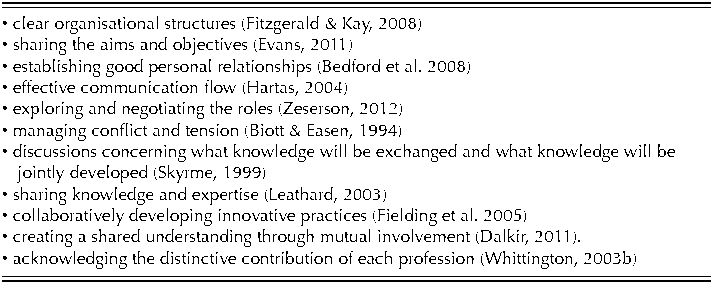
The result of establishing collaborative practices in the Wider Opportunities provision could lead to innovative practices being developed, where teachers explore new ways of teaching which further extend pupils’ musical learning. Bubb and Earley (Reference BUBB and EARLEY2007) consider that building a body of new professional knowledge could promote and benefit the learning of all participants. The sharing of knowledge in the Wider Opportunities programme is related to the concept of master/apprentice (Lave & Wenger, Reference LAVE and WENGER1991), in which the apprentice acquires skills from the master. In the Wider Opportunities programme there is an expectation that the class teacher as a master of pedagogy and the instrumental teacher as a master of music will learn from each other. Pritchard and Woollard (Reference PRITCHARD and WOOLLARD2010) consider that the apprentice looks and learns and ‘is guided in his efforts to master a new skill by the highly skilled master’ (p. 17). It therefore became important in this study to understand how expertise was exchanged between teachers in the Wider Opportunities provision and what opportunities were available for professional learning in the instrumental programme. In order to facilitate professional collaboration between teachers the study identified some of the characteristics of high quality collaboration from the literature which were deemed relevant to the Wider Opportunities programme. These are shown in Table 1.
Characteristics included by high quality collaboration

Methods
The interpretive paradigm was chosen for the study as it is based on using qualitative methods and is considered by Cohen, Manion and Morrison (Reference COHEN, MANION and MORRISON2007) to be more suitable for small-scale research. The approach to the research was based on that of an intrinsic case study. Thomas (Reference THOMAS2011) states that ‘in an intrinsic case study, the subject is being studied not with a secondary purpose in mind but out of interest, pure and simple . . . it is curiosity-driven research’ (p. 98). The nature of the professional collaboration between the instrumental teacher and the class teacher was the curiosity-driven focus of the study as it appeared to be a crucial element in promoting pupils' musical progress.
Before the main research a Pilot Study was carried out in two primary schools to ascertain the best way of collecting the data. Interviews were held with four class teachers and two instrumental teachers and four Wider Opportunities lessons were observed. The Pilot Study showed that there was a need to interview head teachers and pupils in order to provide a more comprehensive picture of what collaborative practices were happening in the schools.
The sample and how it was constructed
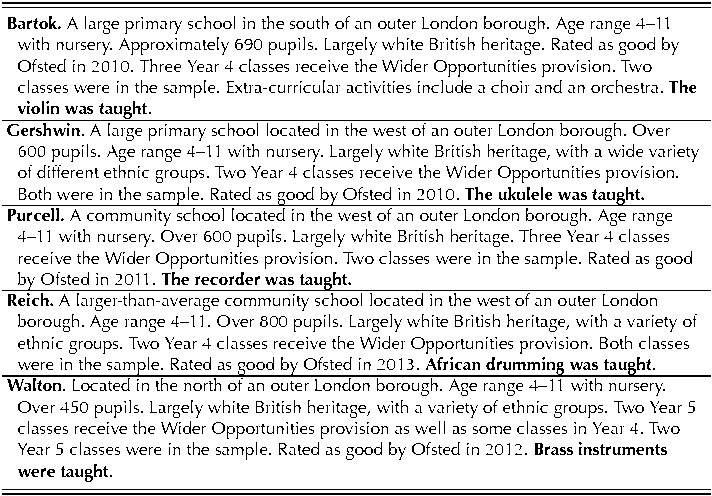
The research was carried out in five primary schools during the year 2013 with the schools being under the auspices of the same local music education hub (see Table 2). Three methods of investigation were used, those of questionnaires, semi-structured interviews and Wider Opportunities lesson observations.
Details of the five primary schools at the time of the research

The participants
The local music education hub was contacted and permission gained to speak to some of their instrumental teachers and the schools receiving the Wider Opportunities programme. Five instrumental teachers were willing to take part and they each suggested five of their schools where two classes followed the instrumental programme. It was considered necessary to use two classes in each of the five schools in order to provide a more in-depth approach to the data gathering. In each school the class teacher was present during the Wider Opportunities lesson taught by the visiting instrumental teacher. In order to gather information about the professional collaboration existing in the five schools ten class teachers, five instrumental teachers and five head teachers were interviewed, with both sets of teachers being interviewed twice. 20 pupils were chosen by the class teachers with four coming from each school. The pupils were selected according to whether they played an instrument out of school, whether they would speak well in an interview, or whether they would benefit from the experience of talking in a group. In addition to the interviews each class teacher and instrumental teacher completed a questionnaire at the beginning of the research. A total of 20 Wider Opportunities lessons were observed.
In the study each school was referred to by the name of a composer in order to protect confidentiality. A different musical instrument was taught in each school.
The data collection process
The questionnaires were used as a means of providing background information about the participants as well as seeking their opinions about collaboration in the Wider Opportunities programme. Some questions related to professional development and the opportunity for shared teaching in the Wider Opportunities lessons.
Semi-structured interviews for class teachers, instrumental teachers and head teachers were designed to identify the collaborative processes taking place, together with the opportunities available for teachers to meet outside the classroom. Some of the questions for class teachers and instrumental teachers were used to follow-up the questionnaire comments, to find out specifically how information was exchanged and to gain an understanding of the way the provision for the Wider Opportunities programme was delivered in the schools. Interviews for pupils were used to discover what musical learning was taking place and if pupils thought that they were helped in the classroom by their class teachers.
In the Wider Opportunities lesson observation a schedule was used to indicate what was occurring in the classroom in relation to professional collaboration and to pupils' musical learning and progress. The headings for each schedule were related to the class teacher, the instrumental teacher and the pupils. It was also noted if the instrumental teacher provided the class teacher with a lesson plan.
The data analysis
Thematic analysis (Braun & Clarke, Reference BRAUN and CLARKE2006, Reference BRAUN, CLARKE and Cooper2012; Howitt & Cramer, Reference HOWITT and CRAMER2011) was used for analysing and interpreting the data. In addition two software programs, the Statistical Package for the Social Sciences (SPSS), and the Computer Assisted Qualitative Data Analysis (CAQDA) program NVivo 9, provided a more detailed structure to the analysis. The questionnaires were analysed using SPSS and the interview transcripts and lesson observation schedules were analysed using NVivo. Selected extracts from Wider Opportunities lessons were formed into vignettes (Miles & Huberman, Reference MILES and HUBERMAN1994).
The analysis of the data identified two main themes and subthemes specifically related to professional collaboration. A main theme of ‘impoverished collaboration' was identified, with subthemes of ‘detached collaboration’ and ‘difficulties in establishing rich collaboration’. The other main theme of ‘underdeveloped provision for professional learning' had a subtheme of ‘missed opportunities’.
Ethical and health and safety issues
Possible ethical issues (BERA, 2011) were highlighted beforehand. These included gaining informed consent for minors from their parents/guardians and interviewing pupils in the presence of a member of staff. The right for participants to withdraw was stressed, as well as ensuring them of the confidentiality of the process. Health and safety issues were particularly relevant when larger instruments were being used in the classroom.
Findings and discussion
The questionnaires showed that of the five instrumental teachers two had completed the Trinity Guildhall and The Open University Continuing Professional Development programme (2009, 2011). Four instrumental teachers had taught whole class lessons previously and one had Qualified Teacher Status. Although in the questionnaire the majority of class teachers expressed a musical interest, only one out of ten played a musical instrument.
The main themes and subthemes from the data analysis
The findings of the analysis presented below include evidence from the questionnaires, interviews and lesson observations.
Theme: Impoverished collaboration
Subtheme: Detached collaboration
Detached collaboration was the term adopted in this study to convey the sense that teachers worked almost independently in the classroom, carrying out their own unspoken roles with no real interaction or mixing of knowledge and skills. Evans (Reference EVANS, Beach, Evans and Spruce2011) considers that class teachers should be ‘fully involved in the learning process, learning alongside pupils. This will ensure that . . . learning is not a “bolt on” but is fully related to the pupils’ curriculum music' (Evans, Reference EVANS, Beach, Evans and Spruce2011, p. 118). In the questionnaire responses ten class teachers (CTs) were asked if they were involved in planning with the instrumental teachers (ITs) or involved in teaching part of the lesson. All CTs responded that they were not involved in planning or teaching. Burt (Reference BURT, Beach, Evans and Spruce2011) recommends that class teachers and instrumental teachers should be involved in collaborative planning and in sharing teaching in the Wider Opportunities programme. In response to a question about their role in lessons CTs agreed that their role should be to support pupils with special educational needs, and nine out of ten CTs consider that they should be involved in class management. The results show a clear demarcation of responsibility, with the instrumental teachers providing the planning and teaching and the class teachers the support. When CTs were asked if they thought they should be involved in teaching with the ITs, four out of ten agreed. Three out of five ITs also agreed with this involvement. Yet in the interviews no mention was made of shared teaching or of a wish for this to happen. The results showed that collaboration was perceived as being based on a division of labour separated by the skills and knowledge of the two professionals. Two domains of professionalism were established and from the questionnaire results it was evident that rarely was there any crossover of expertise or any blending of skills. As will be shown, a lack of time to share expertise helped maintain these positions and consequently the barriers to genuine and fruitful collaboration.
An example of detached collaboration was observed in a Wider Opportunities brass lesson:
The instrumental teacher had prepared the lesson with clear learning objectives which related to the pupils’ previous work. The lesson focused on playing by ear, on identifying and repeating different rhythmic patterns and on improvising a two bar phrase with a backing track. The class teacher was present and it was obvious from her actions that she knew the pupils well. Throughout the lesson the majority of the pupils were engaged, but at one point a few were chatting at the back of the room which caused a slight problem for the instrumental teacher. The class teacher quickly intervened and dealt with the interruption. From then on the class teacher kept a close eye on a few pupils while the instrumental teacher continued teaching.
It was evident in the lesson that the class teacher used her knowledge of the pupils to assist in class management and to maintain the rules of the classroom, and the instrumental teacher provided the teaching. However, there was no mixing of skills or shared teaching, and in addition the class teacher had no indication of what the instrumental teacher was going to teach. Later in interview the class teacher commented
ultimately I am responsible for my class and the curriculum they are being taught and at this point in time I actually have no idea what [the instrumental teacher] is going to come in and deliver to my children and it's really a bit wrong if I'm ultimately responsible for the curriculum (Walton, class teacher).
Other Wider Opportunities lesson observations provided a similar picture of both sets of teachers working almost independently in the classroom, with the class teachers having a limited idea of the goals set for pupils' musical learning or the way that lessons were to progress.
A similar concern relating to a possible issue in communication was expressed by a head teacher saying that
I think if he [instrumental teacher] could tell them about his planning for that particular lesson, the aim of the lesson and what he would be covering, and what he would expect from the children, that would be helpful (Reich, head teacher).
In the questionnaires, CTs were asked about exchanging information and what type of information was shared with the ITs. Seven out of ten CTs claimed that they provided some information about special educational needs pupils and higher attaining pupils, as well as a class list. However, four of the ITs indicated that they had not received any written information. This raised a question about communication and whether the information provided by the class teachers was shared verbally or was documented, and if this information was passed to the relevant instrumental teacher. When head teachers were asked if teachers had time to collaborate out of lessons, one replied, ‘it's incidental, it's not an allocated time’ (Bartok, head teacher). Another head teacher said
there is very little scope for our teachers to meet the instrumental teacher and discuss the programme in detail and the planning, and that is an issue (Purcell, head teacher).
It would appear that data evidence confirmed the detached nature of the professional collaboration, with both sets of teachers carrying out their own roles in lessons, but with limited opportunity for effective and successful communication out of lessons.
Yet as a result of the interviews with pupils, a more encouraging picture emerged concerning the way some class teachers supported pupils in Wider Opportunities lessons. Two pupils said
when you don't do it right she (the class teacher) comes over and does the fingers for you (Bartok, violin).
our class teacher plays with us, but sometimes when children are struggling with rhythms she helps them to learn the rhythm, when we did it in our class my friend was struggling and the teacher helped him and now he knows it (Reich, African drumming).
Subtheme: Difficulties in establishing rich collaboration
Data evidence confirmed that in the schools, rich collaborative practices were not successfully established outside the classroom. This was mainly due to the strictures of time and an overcrowded curriculum which impacted on the availability for closer engagement. Yet the lack of professional discussions between teachers could eventually effect the advancement of pupils' musical learning and their progress in the Wider Opportunities provision. Class teachers indicated that
We just do not have the crossover time. A longer handover time would also be useful so that issues re children could be discussed on an ongoing basis (Bartok, class teacher).
I would like to have longer to discuss what we are doing and how the [instrumental teacher] feels that the children are progressing. We have a snatched moment that's all, so really we don't have a lot of time to collaborate . . . I would like to have worked with the instrumental teacher and discussed exercises to help the lower attainers (Purcell, class teacher).
The phrase ‘snatched moment’, is an effective way of describing what took place in the schools. In this situation lack of time prevented teachers from exchanging information and resulted in instrumental teachers receiving few details about the pupils they taught. Similarly, the time factor impacted on the information class teachers obtain from instrumental teachers about the music provision for lessons. Time for professional dialogue was mentioned in interviews when instrumental teachers spoke of the need to share plans and ideas with class teachers and to gain an understanding of their views in relation to pupils’ progress. Instrumental teachers said:
it would be just good to have the relationship with the teacher and just to sit down and talk about these things, for them to see how they can best help the children to progress (Walton, instrumental teacher).
I think a little bit more time spent with the class teacher, because there was a lot of finding out as the term went on which children had special needs, and I should have known that right at the beginning (Purcell, instrumental teacher).
perhaps meeting before the lessons start and perhaps sharing my ideas for the lessons with the teacher would be good – showing my plans to the teacher to see if that would be suitable and for any children identified with special needs (Bartok, instrumental teacher).
These comments again stressed the lack of opportunity for communication between the teachers. There was little evidence to suggest that any other meeting occurred other than ‘snatched moments’. No mention was made of timetabled provision for teachers to meet in schools to develop collaborative practices. It was evident from the interview data though that both sets of teachers would have liked more collaborative involvement.
Theme: Underdeveloped provision for professional learning
Subtheme: Missed opportunities
One of the key factors impacting on professional learning in this study was a lack of opportunity to engage in professional discussions, whereby each teacher learnt from the talent and skills offered by the other. The different backgrounds and experiences of the visiting instrumental teachers and the class teachers presented an ideal opportunity for enriching and developing professional practice. Palmer et al. (Reference PALMER, EVANS, SPRUCE, Beach, Evans and Spruce2011) in referring to whole class ensemble teaching programmes consider that ‘effective and rich collaborations will provide opportunities for learning by all those involved’ (2011, p. 123). However, in this study there were missed opportunities for further professional learning due to the limited occasions for teachers to share expertise and exchange ideas out of the classroom. As there were problems with establishing rich collaboration, both sets of teachers did not fully benefit from the potential offered by the Wider Opportunities programme.
There was evidence from interviews however that some form of professional learning took place. When a class teacher was asked if the Wider Opportunities lessons provided any professional development for her she responded
it is a learning experience for me as much as it is for the children. I would definitely do some of the things she has introduced [the instrumental teacher] if I were left to my own devices (Gershwin, class teacher).
Similar comments were offered by other class teachers. Instrumental teachers indicated that their change of role to whole class teachers had initially brought some problems. In interviews instrumental teachers mentioned the need to adjust their planning and instrumental teaching to whole class situations, in addition to finding effective ways to communicate with a class of pupils. The instrumental teachers commented
dealing with classroom management and with children of all abilities was very difficult at first, planning as well, longer lessons and having a particular order for lessons (Bartok, instrumental teacher).
it's a different way of teaching . . . I have had to think about the way in which I teach children and the way to teach different skills’. I think it is very easy as an instrumental teacher to get stuck just in routines of teaching an instrument and not thinking of ways to communicate with children (Walton, instrumental teacher).
At the beginning of the study it was assumed that prior to commencing teaching in the Wider Opportunities provision instrumental teachers would have received some form of professional guidance from the local music education hub to aid their work. From the two instrumental teachers’ comments above it appeared that they were learning ‘as they went along’.
Any professional learning opportunities in the schools happened by chance and had not been planned beforehand by the teachers involved. Yet Palmer et al. (Reference PALMER, EVANS, SPRUCE, Beach, Evans and Spruce2011) in relation to collaboration and professional development, consider that there should be aims for professional learning. In the schools teachers’ professional development could be regarded as being in forms of isolation, instead of being part of what Wenger (Reference WENGER1998) described as a community of practice, where each teacher benefitted from sharing learning with the other. The notion of communities of practice could be applied directly to teaching in the Wider Opportunities classes where the pedagogical experience of the class teacher is combined with the musical experience of the instrumental teacher to form a sharing of knowledge and skills which benefits all concerned.
The missed opportunities for teachers to fully engage in professional development through the Wider Opportunities provision, once more added to the view that in the schools, rich collaborative practices were minimal. There was very little exchange of expertise or the blending of skills, and no shared teaching in lessons. The characteristics of high quality collaboration identified in the literature which relate to collaboratively seeking to develop innovative practice (Fielding et al., Reference FIELDING, BRAGG, CRAIG, CUNNINGHAM, ERAUT, GILLINSON, HORNE, ROBINSON and THORP2005), acknowledging the value of sharing knowledge and expertise (Leathard, Reference LEATHARD and Leathard2003) and what knowledge will be exchanged and what knowledge will be jointly developed (Skyrme, Reference SKYRME1999), appeared to be missing. However, there was evidence which suggested that as a result of their involvement in the Wider Opportunities lessons both sets of teachers gained some form of professional development. More could have been possible though if the potential for professional learning offered by the Wider Opportunities programme had been fully explored.
This study provided a broader picture of collaborative practices in the Wider Opportunities programme and supported the previously quoted evidence identified by Bamford and Glinkowski (Reference BAMFORD and GLINKOWSKI2010) that there should be more collaborative planning and shared delivery. It also found that the strengths of the different partners through partnership working (Hallam, Reference HALLAM2011) were not being successfully combined.
There were some limitations to this study mainly because of the difficulty in arranging a second interview with school staff, due to the lack of available time. As a result, head teachers gave permission for four class teachers to provide their responses to some of the interview questions via email.
Conclusion
The overall conclusion to the research study was that there was impoverished collaboration in the five primary schools. This was due to several critical issues which impacted on the opportunities for professional collaboration both inside and outside the classroom. The lack of any meaningful collaboration meant that in the Wider Opportunities provision there was no shared understanding between teachers relating to pupils’ musical learning and progress. There was little evidence to suggest that collaboration was as active-interactive process (Meads & Barr, Reference MEADS, BARR, Meads, Ashcroft, Barr, Scott and Wild2005) or that professional collaboration was regarded as an important part of the Wider Opportunities provision (Evans, Reference EVANS, Beach, Evans and Spruce2011). Furthermore, lesson plans containing aims and objectives had not been shared, and class teachers had little knowledge of the overall scheme of work. The lack of opportunity for shared discussions was highlighted as a weakness in the provision and something which could have been rectified if more time had been available in schools. As both the instrumental teachers and class teachers had other on-going commitments, effective communication between them was severely limited and became even more of a critical issue. Although there was evidence to suggest that both sets of teachers wished for more collaborative involvement the provision for this within the schools did not take place. The full potential that the Wider Opportunities programme offered for promoting pupils' musical learning and teachers' classroom practices through collaborative engagement was not taken up. In conclusion it was judged that in the five primary schools in the study professional collaboration between the teachers was not as good as it could have been.
Implications of the study
The research study highlighted the following:
• The schools need to make timetabled provision for class teachers and visiting instrumental teachers to engage in professional discussions related to pupils' musical learning and progress, and to promote the exchange of teachers' expertise through shared planning and shared teaching.
• There needs to be clearer communication between the local music education hub and the schools. The hub needs to outline its procedures for collaboration and provide guidance for developing rich collaborative practices.