INTRODUCTION
“I don't know how to open it!”, young Nina says as she looks pleadingly at her mother. Nina has been given a new toy, but the plastic box in which it is encased is proving to be hard for her to open. Her mother's reaction was as you might expect: she takes the box and opens it. Business as usual for any parent. However, this short interchange is potentially more interesting than it might seem at first sight, as it suggests that Nina has some understanding of two important areas of communicative competence: the understanding of indirect requests and mental state terms. Nina not only seems to be aware at some level of her own knowledge state (expressed by the mental state term know), but she also appears capable of getting her mother to do something for her without directly asking her to do it (by using an indirect request).
The development of these two areas of communicative competence, indirect requests and mental state terms, is the focus of this paper. From as young as two years old, children produce mental state verbs like know and think (Booth, Hall, Robison & Yeong Kim, Reference Booth, Hall, Robison and Yeong Kim1997; Shatz, Wellman & Silber, Reference Shatz, Wellman and Silber1983) and utter indirect requests like “I hungry” (Ervin-Tripp, Reference Ervin-Tripp1976). However, some caution should be taken in inferring full understanding of indirect requests and mental state terms from their occurrence in children's speech, as it is not necessarily clear that the child understands the full meaning of the mental state verb or the indirect request that she produces. Experimental studies considering children's understanding of indirect requests and mental state terms are thus needed to complement these findings from natural conversations.
But what can an investigation of children's understanding of indirect requests and mental state terms tell us? Both of these aspects of communicative competence are interesting, as they each give an insight into children's understanding of mental states and their linguistic encoding at different levels. Whereas understanding of mental state terms tells us something about children's appreciation of the linguistic encoding of mental states at the lexical level, understanding of indirect requests demonstrates children's ability to take into account the speaker's underlying intention at the discourse level. In this sense then, these two areas of communicative competence can be considered ‘mental language’. They are at the interface of language and mental state understanding, requiring both linguistic skills and an appreciation of the ‘mind behind the speech’ for their development. As both language and an appreciation of mental states are core aspects of cognitive development, without which a child is severely impaired in her ability to take part in social interaction, research looking at this domain of cognition at which they intersect should lead to interesting insights regarding the child's cognitive development.
The development of mental state terms and indirect requests
So what is known about these two domains of mental language: mental state terms and indirect requests? Various studies have looked at children's understanding of terms that relate to mental states. Hirst and Weil (Reference Hirst and Weil1982), for instance, provided early experimental data on the acquisition of epistemic modal auxiliaries. Three- to six-year-old children were told to find a hidden peanut by listening to the advice of two puppets that used the modal terms must, may, and should contrastively (e.g. “the peanut must be under the cup” vs. “the peanut may be under the box”). Hirst and Weil found that only the oldest children (starting at 5;6) could make strength distinctions between the modals, a result that was replicated in a more recent study by Noveck, Ho, and Sera (Reference Noveck, Ho and Sera1996). Byrnes and Duff (Reference Byrnes and Duff1989) found a different result, however, in their study of modal auxiliaries. They considered children's ability to differentiate the strength conveyed by has to be vs. might be (e.g. “It has to be under the red cup” vs. “It might be under the blue cup”) and the difference between the negated terms can't be vs. might not be. Results of this study showed that children improved significantly between the ages of three and four, with ceiling performance at five years old. Moore, Pure, and Furrow (Reference Moore, Pure and Furrow1990) represent a mid way between these two findings in their study of the English modal auxiliaries must, might, and could. This study found significant improvement between the ages of three and four as well, but even the oldest group in their study (consisting of six-year-olds) did not yet demonstrate ceiling performance.
Aside from modal auxiliaries, the development of modal adverbs and mental state verbs has also been considered in various studies. Moore et al. (Reference Moore, Pure and Furrow1990), for instance, investigated children's understanding of the differences in speaker certainty as conveyed by the modal adverbs probably, possibly, and maybe. Similar to the findings for the modal auxiliaries, three-year-olds were not capable of differentiating between any of the modal adverb contrasts, but the older age groups were capable of finding the hidden object on the basis of the modal adverbs. Moore and his colleagues have also conducted various studies on children's understanding of the mental state verbs know, think, and guess. Moore and Davidge (Reference Moore and Davidge1989), for example, demonstrated that by four to five years of age, children understand that know expresses greater speaker certainty than think. Similarly, Moore, Bryant, and Furrow (Reference Moore, Bryant and Furrow1989) showed that four-year-olds are capable of appreciating the fact that know expresses greater speaker certainty than think or guess; by five years old their performance on these contrasts is at ceiling. However, the distinction between think and guess was not understood even by eight-year-olds, the oldest group considered in this study. Overall then, it seems that for English modal auxiliaries, modal adverbs, and mental state verbs, children start to understand the differences in speaker certainty as expressed by these terms at about four years old. How this understanding develops over time is not yet clear, however, as the cross-sectional studies discussed above have different outcomes (in the sense that there is variability in the age of acquisition that is reported for these domains of language) and longitudinal studies employing a similar empirical design have not yet been conducted.
Another question that remains after consulting the existing studies on these mental state terms is to what extent the findings for English generalize to other languages. Children acquiring English may start to appreciate the linguistic encoding of differences in speaker certainty by four years old, but children acquiring other languages may show a different developmental path. Indeed, Bascelli and Barbieri's (Reference Bascelli and Barbieri2002) study on the Italian modal auxiliaries dovere ‘must’ and potere ‘may’ finds considerably later understanding of the differences between the modals. Only at six years old do the Italian children tested in this study demonstrate some understanding of the contrasts between these auxiliaries, whilst the full system is not mastered until they are eight years old. Studies on the development of epistemic modal terms and mental state verbs in languages other than English are thus called for to see to what extent the acquisition of these terms is similar across languages.
Less research has been conducted assessing children's understanding of indirect requests than their understanding of mental state terms. In contrast to direct requests (see (1) for an example), indirect requests refer to a type of request that is not in the imperative form. Indirect requests can differ in how explicit they are. In (2), an example of a relatively explicit indirect request is given. Note that although on the face of it, the utterance in (2) could be interpreted as an information request regarding the child's ability to come and eat dinner, this question is of course intended by the speaker as a request for the child to stop playing with her toys and come to the dinner table. The indirect request in (2) is more explicit than the one in (3), however, as the indirect request in (2) does in fact have the imperative form embedded in it (i.e. “come and eat dinner”). The indirect request in (3), also referred to as ‘hint’ (cf. Ervin-Tripp, Reference Ervin-Tripp1976), represents the most complicated type of indirect request, as the listener is given no explicit cue as to the act that the speaker expects her to carry out. In the case of (3), then, mother is thus not giving a descriptive statement regarding the time of day, rather, she intends the child to stop playing with her toys and come to the dinner table. Only if the child understands the mother's intention can she thus comply with the underlying request.
-
(1) [mother to child playing with toys] Come and eat dinner!
-
(2) [mother to child playing with toys] Can you come and eat dinner?
-
(3) [mother to child playing with toys] It's dinner time.
Although children as young as two years old have been documented to use what would seem to be indirect requests (the “I hungry” example given above, for instance), true understanding of indirect requests has not been found until children are at least three years old, with development continuing until at least eight years old (cf. Bernicot, Laval & Chaminaud, Reference Bernicot, Laval and Chaminaud2007; Bernicot & Legros, Reference Bernicot and Legros1987; Elrod, Reference Elrod1987; Leonard, Wilcox, Fulmer & Davis, Reference Leonard, Wilcox, Fulmer and Davis1978; Spekman & Roth, Reference Spekman and Roth1985). However, the various studies that have investigated indirect request understanding have tended to use quite different measures in their assessments. The most recent of these studies, Bernicot et al. (Reference Bernicot, Laval and Chaminaud2007), considers children's ability to demonstrate understanding of indirect requests by asking them to choose a possible ending for a story containing an indirect request. Children were thus presented with an indirect request in context (e.g. Minnie Mouse utters “cold air is coming from the window” to Mickey Mouse as she lies ill and shivering on the couch below the window) and the child had to choose how the story ends, given the choice between an ending that takes the character's utterance literally (e.g. Mickey Mouse checks the thermostat) or an ending in which one of the story characters recognizes and acts upon the indirect request (e.g. Mickey Mouse closes the window). The youngest children studied in Bernicot et al. (Reference Bernicot, Laval and Chaminaud2007), six year-olds, were not yet at ceiling in their performance on the indirect request trials, but they did show a reasonable level of understanding of this request type. However, the eight-year-olds assessed in this study did show full understanding of indirect requests, suggesting that there is still development in indirect request understanding between the ages of six and eight.
Leonard et al. (Reference Leonard, Wilcox, Fulmer and Davis1987) took a slightly different tack and assessed four- to six-year-old children's ability to appreciate whether a particular action performed by a listener makes sense in the context of an indirect request uttered by a speaker. For instance, given the indirect request “Can you clean the stain?”, the listener would be shown to say “yes” and proceed with either a congruent response (to clean the stain) or an incongruent response (to change a light bulb). Children were required to assess whether the listener's actions made sense or not. This set-up entailed that children could not just assume that any action in response to the indirect request was sufficient. Instead, in order to score well on this task, they had to appreciate specifically which action was implied by the speaker's indirect request. Although in this task four-year-olds did perform better than chance, there was a clear developmental progression with age, as the five-year-olds outperformed the four-year-olds and the six-year-olds outperformed the five-year-olds.
Instead of investigating children's ability to assess another person's response to an indirect request, Spekman and Roth (Reference Spekman and Roth1985) considered children's own behavioural responses to a diverse set of requests (ranging from direct imperatives like “wash the baby” to indirect requests like “some water spilled”). In their study of three- to five-year-olds, they found that direct requests were the easiest for the children to understand, whereas indirect requests were considerably harder for children to follow, although this study did not find significant age differences between the three age groups considered.
Yet other studies (e.g. Bernicot & Legros, Reference Bernicot and Legros1987; Elrod, Reference Elrod1987) require the child to reflect on the indirect request and make clear what intention a speaker might have in uttering the indirect request. For example, in Elrod (Reference Elrod1987) the child was told the following story: “Scott is colouring at the kitchen table. Scott's mom says to Scott, ‘Those cookies are for our guests tonight’” and asked “Why did she [mom] say that?” This set-up thus required the child to be able to reflect on the underlying meaning conveyed by the indirect request and convey this understanding verbally to the experimenter. Although this type of task thus poses higher demands on the child's ability to verbalize their understanding of the indirect requests than the other studies described above, a correct answer on this type of task is more likely to be indicative of true understanding. After all, although a child might be able to appreciate that a particular behavioural response is appropriate following an indirect request, it is not necessarily clear that the child really appreciates the speaker's intention that underlies the indirect request. However, if the child is capable of articulating this intention, then true understanding of the indirect request seems much more likely. This more challenging task proved to be harder for the younger children (three- and four-year-olds) than for the older children (five- and six-year-olds) that were tested in this study.
As was the case with previous research considering mental state term understanding, the understanding of indirect requests thus seems to develop considerably between the ages of four and six years old. However, as was also the case for mental state term understanding, the research has mainly been conducted with English-speaking children (although Bernicot and colleagues work with French-speaking children) and only using cross-sectional designs. The development of indirect request understanding in different languages and in the same child over time thus remains under-studied.
In order to add to existing knowledge of the development of indirect requests and mental state term understanding, the current study thus considers the development of mental language at the lexical and the discourse level from a longitudinal perspective, so that development over time in the same child can be considered. Furthermore, this study considers the development of these domains for Dutch-speaking children. Although there may be differences in the frequency with which mental state terms or indirect requests are uttered to children from different language backgrounds, there is no a priori reason to believe that Dutch children would show fundamental differences in their development of mental state term or indirect request understanding as compared to the English-speaking children that have been studied more intensively. However, the addition of a previously unstudied language is relevant, so that it becomes clearer whether the findings reported in the literature regarding the acquisition pattern of these domains of language result from specific properties of a language or culture or whether these acquisition patterns are down to the maturation of cognitive capacities in a more general sense that allow the child to understand certain domains of language once they have reached a particular level of cognitive maturity. To be more specific: by investigating a language other than English, it becomes possible to assess whether a domain of language like mental state verb understanding generally becomes more adult-like when the child is around four or five years old (because the child needs a certain number of years of cognitive development before she is capable of representing mental state verbs as concepts), or whether this age range is specific to English-speaking children (because of particular properties of the culture or language of English speakers). Adding data from another language thus allows this issue to be considered. Languages other than Dutch would also be informative, but as this study was conducted in the Netherlands, the addition of Dutch made most sense from a practical point of view.
Mental state terms and indirect requests: the role of Theory of Mind and general linguistic ability
Aside from looking at the development of indirect requests and mental state vocabulary in Dutch-speaking children directly, this study also considers the role that the child's general linguistic ability and her understanding of other people's minds (Theory of Mind, ToM) might play in this development. In order to be said to fully understand the meaning of a mental state term or an indirect request, a child needs to have some appreciation of ‘the mind behind the speech’: What does it mean to know or think something? What might someone really mean when they tell you “it's cold in here”? If an understanding of other people's minds forms the basis for the understanding of indirect requests and mental state terms, then the child's ToM ability should predict children's ability to understand these two domains of communicative competence.
Indeed, previous work on mental state term understanding has found a correlation between ToM development and epistemic mental state term understanding (cf. Moore et al., Reference Moore, Pure and Furrow1990, for the relationship between ToM and modal terms, and Ziatas, Durkin & Pratt, Reference Ziatas, Durkin and Pratt1998, for the relationship between ToM and mental state verbs in autistic individuals). Not much work has been done specifically regarding the relationship between ToM and indirect request understanding, but findings from research with autistic individuals (who are known to have ToM deficiencies; cf. Baron-Cohen, Leslie & Frith, Reference Baron-Cohen, Leslie and Frith1985) suggest that they have severe impairments in their pragmatic inference abilities (understanding of indirect requests being a prime domain of cognition in which pragmatic inferences are required), which are presumed to be caused, in part at least, by their deficient ToM development (cf. Loukusa & Moilanen, Reference Loukusa and Moilanen2009, for a review). Aside from this finding in atypically developing individuals, the timing of children's more adult-like production and comprehension of indirect requests (i.e. around four years old) also coincides with children's more adult-like understanding of other people's mental states as assessed by standard ToM tasks. Previous studies thus suggest that there is a relationship between ToM and the understanding of indirect requests and mental state terms, but longitudinal data can show whether children's earlier ToM abilities might in fact be predictive of later indirect request and mental state term understanding.
It should be noted, though, that there is also research that suggests that the relationship between ToM and these ‘mental’ domains of language might go the other way; that is, that the development of mental language might also affect ToM development. Hearing labels for unobservable entities like mental states (e.g. mental state verbs like know and believe) might thus prompt the child to think about what these terms mean and to make the conceptual distinctions that they encode (cf. Booth & Hall, Reference Booth and Hall1995; Hall, Scholnick & Hughes, Reference Hall, Scholnick and Hughes1987). In line with this idea, Cheung, Chen, and Yeung (Reference Cheung, Chen and Yeung2009) demonstrate that Cantonese children's understanding of false beliefs was predicted by their understanding of mental state verbs that entail false thought, like the Cantonese verb /ji5-wai4/ (numbers indicate lexical tones) which translates to ‘falsely think’. These data are correlational, however, so claims about the causal direction between the two domains cannot be made on the basis of these data. More conclusive evidence for a causal role of mental state terms in the development of ToM comes from an intervention study by Gola (Reference Gola2012), as this work demonstrates that exposing three- and four-year-old children to mental state verbs (e.g. know, think, and remember) over a two-week period enhanced their ToM score at post-test. Although to my knowledge no studies have directly considered the effects of indirect request exposure on ToM development, it does not seem implausible that hearing an indirect request, especially an indirect request of the hint form, prompts the child to think about what the speaker might actually mean. In this sense, then, exposure to indirect requests may also enhance ToM. While the main focus of this study is thus to consider how mental language develops and what factors might influence this development, this potential direction of effects will also be considered.
Aside from investigating the role that ToM might play in the development of indirect requests and mental state language, this study also considers the role of the child's general linguistic abilities in this development. Of course, at a basic level, both the understanding of indirect requests and mental state terms requires a certain level of linguistic ability. Children need to learn the mental state terms as lexical items, and for indirect requests children need to be able to parse the syntactic constructions that the indirect requests are framed in. There is reason to believe, however, that the child's general linguistic abilities may be of importance to the development of mental state term and indirect request understanding at a more fundamental level as well. Many researchers have found evidence to suggest that language development is crucial in enabling the child to develop an understanding of other people's mental states; that is, many researchers claim that language is important for ToM development (see Astington & Baird, Reference Astington and Baird2005, for a compilation of studies, and Milligan, Astington & Dack, Reference Milligan, Astington and Dack2007, for a meta-analysis of the relationship between language and ToM). Although some studies suggest a very specific relationship between language and ToM development (i.e. work by de Villiers and colleagues suggesting that children's understanding of sentential complementation constructions is a necessary prerequisite for full ToM development; see for example de Villiers, Reference de Villiers, Astington and Baird2005, Reference de Villiers2007; de Villiers & Pyers, Reference de Villiers and Pyers2002), a considerable number of studies have found a more general relationship between the development of language and ToM (e.g. Astington & Baird, Reference Astington and Baird2005; Astington & Jenkins, Reference Astington and Jenkins1999; Milligan et al., Reference Milligan, Astington and Dack2007). The idea is that only once a child has attained a certain level of linguistic ability is she able to represent other people's mental states properly. Language is thus more than just a code with which mental state terms and indirect requests can be encoded and decoded, it actually provides the child with the conceptual apparatus to represent other people's minds in the first place. To make this a bit more concrete: although it might be possible to represent an idea like ‘John thinks Sally likes Jack, but actually Sally likes John’ non-verbally, language provides us with a complex representational system which we can use to keep all the thoughts in all the minds in this example (i.e. what John thinks, what Sally thinks, what the speaker thinks, etc.) properly ordered in memory. Language is thus taken to provide the scaffolding that allows the child to make sense of the different layers of representation that are necessary for understanding others’ beliefs as distinct from one's own. If this view is correct, then the child's linguistic development in a general sense (comprising both vocabulary knowledge and general syntactic ability) might be an important predictor for the development of ‘mental’ areas of language like indirect requests and mental state terms.
Aims of the study
This paper employs a longitudinal design to address two main questions: How does Dutch children's understanding of indirect requests and mental state terms develop between four and five years old, and what role does ToM and linguistic ability play in the development of these two areas of communicative competence? This research complements previous studies in various ways. By collecting data longitudinally, the development of both mental state term and indirect request understanding can be tracked in the same child over time, thereby providing a clearer picture of developmental changes in these domains than cross-sectional studies. Furthermore, a longitudinal set-up also allows the effects of earlier ToM and general linguistic ability on later mental state term and indirect request understanding to be investigated, thereby considering to what extent ToM and/or linguistic ability is predictive of mental state term and indirect request understanding. Of course, although it is not directly the aim of this study, a longitudinal set-up also makes it possible to assess whether this potential predictive relationship is unidirectional or bi-directional. That is, aside from considering whether ToM predicts mental language development, these data can also be used to consider whether earlier mental language understanding also predicts later ToM ability. Finally, this study also contributes developmental data collected from Dutch-speaking children. This allows a comparison to be made between the English-speaking children who have been the focus of much of previous research on mental state term and indirect request understanding, and children from another linguistic background, so any effects that might be due to factors specific to the English language or the culture of English speakers become clearer.
The hypotheses underlying this study were twofold. In the first place, both indirect request and mental state term understanding were predicted to show significant development between the ages of four and five, paralleling the results of the English-speaking children who have been studied in previous work. Development in these linguistic domains is thus assumed not to rest primarily on specific characteristics of a particular input language, but to be due to more general cognitive development in the domain of ToM and language. Given this line of reasoning, both ToM ability and general linguistic ability were thus hypothesized to be predictive of mental state term and indirect request understanding. In addition, results from previous research also suggest that the predicted relationship between ToM and mental language understanding is likely to be bi-directional. That is, earlier ToM was hypothesized to predict later mental language understanding, but earlier mental language understanding was also hypothesized to predict later ToM.
METHOD
Participants
One hundred and ten Dutch-speaking children (49 boys and 61 girls) who were between the ages of 4;0 and 4;11 (M = 4;6) at the first time of testing participated in the study. The children were recruited from three primary schools in Rotterdam and one primary school in Rosmalen (both are cities in the Netherlands). Most of the children came from lower-middle-class or middle-class families.
Between the first and the second time of testing, eight months later, nine children could not be tested again. All of these children had moved to different towns in the intervening eight months and were thus dropped from the sample, thereby leaving 101 instead of 110 children (47 boys and 54 girls, mean age 4;6, age range 4;0–4;11) for data analysis.
Procedure
Children were tested individually in a separate room in their school building. For all sessions, two adults were present: the author (acting as experimenter) and an assistant. Each child was tested on three occasions separated by at least a day and at most a week between each session. Each session lasted approximately 30 minutes, 20 minutes of which involved the tasks reported on in the current study. Each child received one of twelve possible testing orders, so that test order effects were minimized. Children received stickers in return for their participation. The second time of testing followed the same procedure as the first time of testing. Although all the tests conducted at the first time of testing were essentially the same as those at the second time of testing, two of the ToM subtests had to be modified to some extent (see the description of the various ToM tests below for more information).
Assessing understanding of indirect requests
To assess understanding of indirect requests, the child was invited to listen to stories and look at accompanying pictures together with the experimenter and a puppet. The stories all involved a mother uttering an indirect request to her daughter Karin or her son Jan. These indirect requests were always of the hint form (cf. Ervin-Tripp, Reference Ervin-Tripp1976); the child thus had to take into account the intention of the mother underlying the indirect request (i.e. the direct request) as well as the linguistic encoding of the indirect request in order to understand what was meant by the mother's utterance. Instead of asking the child directly what the indirect request meant, the puppet claimed that he did not understand the story and asked the child to clarify the mother's utterance. An example can be found in (4) (see ‘Appendix’ for a full list of materials):
-
(4) [Karin is standing in the hallway and wants to go outside. Next to her is a hat stand with her coat, her scarf and her gloves. Mummy sees Karin standing in the hallway and says:] It's really cold outside, Karin.
puppet: Why does mummy say that to Karin?
Seven different indirect request stories were given to the child. Understanding of indirect requests was demonstrated if the child's response to the question referred to the mother's intended meaning (e.g. ‘Karin should put on her coat’) or a consequence of the intended meaning (e.g. ‘she'll get ill if she doesn't put her coat on’). Answers of either type were given one point; all other answers were considered incorrect. Seven points in total could thus be received for the indirect requests test.
Assessing mental state term understanding
Three different domains of mental state terms were considered in this study: mental state verbs, modal auxiliaries, and modal adverbs. Children were told that they would play a game in which they could win stickers that were hidden in one of two boxes (a blue box and a red box). In order to win the stickers, the child had to listen to advice given by two puppets who gave hints about the location of the sticker by using the various mental state terms contrastively. Each type of mental state term was presented in a separate session and children could indicate their choice either by pointing at the box or by verbally identifying the box of their choice. In the mental state verb task, the Dutch verbs weten ‘know’, denken ‘think’, and raden ‘guess’ were used (see (5) for examples). Each contrast (i.e. know vs. think, know vs. guess, and think vs. guess) was presented to the child three times for a total of nine trials. In the modal auxiliary task, moet ‘must’ and kan ‘may’ were used (see example (6)) and in the modal adverbs task, zeker ‘definitely’ and misschien ‘maybe’ were used (see (7)). The contrasts in both modal tasks were presented four times. In order to be successful on this task, children had to choose the box denoted by the mental state term that conveyed greater speaker certainty over the term that conveyed lesser speaker certainty.
-
(5) Ik weet/denk/raad dat de sticker in de rode
doos ligt
I know/think/guess that the sticker in the red
box lies
‘I know/think/guess the sticker is in the red box’
-
(6) De sticker moet/kan in de blauwe doos liggen
The sticker must/might in the blue box lie
‘The sticker must/might be in the blue box’
-
(7) De sticker ligt zeker/misschien in de rode
doos
The sticker lies definitely/maybe in the red box
‘The sticker is definitely in the red box/Maybe the sticker is in the red box’
Children were not allowed to look inside the boxes; after the last trial they received a number of stickers irrespective of their performance on the task. Prior to the test trials, two practice trials were included in which one puppet stated simply where the sticker was (de sticker ligt in de rode doos ‘the sticker is in the red box’) and the other puppet stated where the sticker was not (de sticker ligt niet in de blauwe doos ‘the sticker is not in the blue box’). In the practice trials, both puppets thus demonstrated that they could help the child find the sticker by stating in plain terms where the sticker was located (in the first practice trial, one puppet gave the affirmative statement; in the second trial, the other puppet gave the affirmative statement). Furthermore, care was taken that the intonation and voice used for the two puppets was the same across items and trials; there were thus no paralinguistic cues on which the subjects could base their choice. The child received a sticker for each of the practice trials and was promised more stickers if she played the game and paid attention.
For the modal auxiliary task, the child received a point each time she preferred moet ‘must’ over kan ‘might’, allowing a total of four points for this task. Four points in total could also be gained for the modal adverb task if the children preferred the modal adverb zeker ‘definitely’ over misschien ‘maybe’. Nine points could be gained for the mental state verb task if the child consistently preferred weten ‘know’ over denken ‘think’ and raden ‘guess’, and denken ‘think’ over raden ‘guess’. A total of seventeen points could thus be scored by the child in the mental state term understanding task.
Assessing Theory of Mind
Three different types of false belief task were presented to the children: two appearance–reality tasks (Flavell, Flavell & Green, Reference Flavell, Flavell and Green1983; Gopnik & Astington, Reference Gopnik and Astington1988), two location change tasks (Wimmer & Perner, Reference Wimmer and Perner1983), and two unexpected contents tasks (Perner, Leekam & Wimmer, Reference Perner, Leekam and Wimmer1987). In the appearance–reality tasks, children briefly talked to a puppet, but then were told that he had to leave and would come back to play a game with them later. After the puppet had disappeared, the child was shown a deceptive object (e.g. a candle that looked like a cake) and asked what it was. Once the child had volunteered the expected answer (a cake), she was shown the true identity of the object. The child was then asked two false belief questions, one referring to the child's initial belief regarding the identity of the object (self-question) and one referring to the puppet's belief (other-question). In order to make sure that children truly understood the nature of the object, after the test questions they were asked two control questions, one referring to the real identity of the object (reality-question) and one referring to its appearance (appearance-question). In a separate session at the first time of testing, the children were shown another deceptive object (a pencil sharpener that looked like a car) and asked the same questions as described above. If children did not answer the questions initially, they were given a forced choice of the two possible answers. At the second time of testing (eight months after the first time of testing), children had to be given different deceptive objects for the task to legitimately assess false belief understanding (otherwise children may simply remember the true nature of the object). The second time of testing involved a pen that looked like a car and a purse that looked like a glove.
In the location change tasks, children witnessed one protagonist, Laura, place a marble in a basket, which a second protagonist, Paul, moved to a box in Laura's absence. On Laura's return, the child was asked where Laura would look for her marble (prediction-question) and why she would look there (explanation-question). Two control questions were also included to ensure that the child had understood the story and remembered the key events. These questions were asked after the false belief questions and pertained to the first location of the marble and the final location of the marble. In the second version of this task, administered in a separate session, two different locations were used and Laura displaced the marble in Paul's absence. For all prediction and control questions, children were asked to choose between the two possible options, if they did not answer the questions initially.
In the unexpected contents tasks, children conversed briefly with a puppet, but were told he had to leave. The children were then shown a familiar container (e.g. a pencil box) and asked what was in the container. Once the child had given the expected answer, they were shown the true contents of the box (a piece of string). The box was then closed again and the child was asked about her previous belief regarding the contents of the box (self-question), about the puppet's belief regarding the contents (other-question), and she was asked to explain the puppet's belief (explanation-question). A control question regarding the true contents of the box was included to ensure children had remembered the relevant aspects of the story. In a separate session at the first time of testing, the children were shown an egg box that contained a toy car and asked the same questions. Just as in the appearance–reality trials, the unexpected contents tasks at the second time of testing involved different familiar containers than the first time of testing (a milk carton containing a band-aid and a lunch box containing a lamb puppet). For the self-, other-, and control-questions, children were asked to choose between the two possible options, if they did not answer the questions initially.
It should be noted that none of the ToM test questions included mental state terms, as this would have entailed that the results of the mental state term understanding task and the ToM task might be confounded. Instead, all ToM questions either referred to concrete behaviour (e.g. “Where will she look for her ball?” in the location change task) or used the communication verb say instead of the mental state verb think (e.g. “What did you say this was when you first saw it?” in the appearance–reality task). Performance on the ToM task did thus not hinge on understanding of mental state terms as such.
Each appearance–reality test yielded two points: one for the self-question and one for the other-question. Children were only awarded points for the questions if they answered both control questions (the appearance question and the reality question) correctly. Each false belief location change task also yielded a maximum of two points: one point for the prediction-question and one for the explanation-question. For the explanation-question, answers were scored as correct if they referred to the original location of the object or the character's belief regarding the location of the object. Again, the child was only awarded the points if she correctly answered both of the control questions (the first location and the final location questions). Children could receive a maximum of three points for the unexpected contents task: one for the self-belief question, one for the other-belief question, and one for the explanation-question. Answers to the explanation-question were scored correct if they referred to the box’ misleading appearance or the character's mistaken belief regarding the contents of the box. Children only received the points if they answered the control question (the true contents question) correctly. Across all ToM tests, children could thus receive a maximum of fourteen points, which, in comparison to many other studies, is a relatively broad range. High scores on the ToM measure thus demonstrate children's capacity to predict and explain false beliefs across three types of task each presented in two different scenarios.
Assessing linguistic ability
Initially, the test battery was considered to consist of two different linguistic measures testing children's receptive vocabulary and their general language comprehension. The receptive vocabulary test was the Dutch version of the Peabody Picture Vocabulary Test III (PPVT) created by Schlichting (Reference Schlichting2005). This is a standardized test of receptive vocabulary, which is suitable for both adults and children aged 2;3 and older. The test involves the participant listening to a word and pointing to one picture out of an array of four that goes with that word.
General comprehension of syntax was tested by giving children an abbreviated version of the Reynell test for language comprehension (Van Eldik, Schlichting, Lutje Spelberg, van der Meulen & van der Meulen, Reference Van Eldik, Schlichting, Lutje Spelberg, van der Meulen and van der Meulen1995). The Reynell test is a standardized test, suitable for children from 1;3 to 6;3. All test items involved the child manipulating certain objects out of an array of multiple objects, following a verbal instruction by the experimenter. Given the long duration of the whole test (approximately 45 minutes per child), only parts 8, 9, and 11 of the test were conducted, consisting of thirty-four items in total. These parts were chosen as they best tested four- and five-year-old children's understanding of language comprehension at the sentential level. No specific names are given to these parts, but the test manual states that part 8 assesses non-standard couplings of two objects through a preposition and the understanding of passive forms, part 9 assess children's recognition of properties of objects and assesses understanding of number, question words, and prepositions, and part 11 tests children's understanding of two or more concepts (e.g. question words, colour, superlative forms, pronouns, prepositions, and double negatives) in a concrete situation.
Initially then, the child's performance on this task was taken as a measure of her general language comprehension ability. However, on closer examination of the assessment material, it became apparent that a considerable number of the test items involved children's understanding of spatial language, in particular their understanding of locative prepositions (e.g. in, on, next to). Across all three parts of the task, many items required the child to appreciate the relationship between two objects as expressed by a locative preposition. As locative prepositions encode perspective (the locative preposition denotes the nature of the spatial relationship between two objects from the perspective of the speaker), and perspective relates to children's developing ToM (which hinges on children's understanding of the notion that differing perspectives on events can lead to different beliefs regarding those events), the decision was made to not only consider the child's total score on the Reynell test in the further results, but also to look at whether the spatial items in the Reynell test were of greater importance in explaining the development of indirect requests and mental state terms than the non-spatial items. In dividing the Reynell items in parts 8, 9, and 11 into spatial and non-spatial items, spatial items were defined as items that contained locative prepositions and non-spatial items were those that did not contain a locative preposition. In this division of the Reynell test, items with negative elements in combination with locative prepositions (e.g. “Which pig is not in the field?”) were discarded from analysis. The reason for this was twofold. In the first place, the negative element adds an extra level of processing difficulty to the item that comes on top of the computation required by the locative preposition. Second, it is not clear to what extent the perspective element is still present when the locative is denied (of course, not in means the same as outside in the example, but in order to understand this, the child has to understand the nature of negation more than the perspectival relationship encoded by the locative preposition).
The child's performance on the Reynell test was thus considered in two ways: the score that the child received on all three parts of the test that were administered (34 being the maximum) was taken as a general measure of the child's language comprehension, but aside from that, the children's score on the spatial items (with 21 as the maximum) and the non-spatial items (with 9 as the maximum) was also considered in a separate analysis. Note that the remaining four items all contained locative prepositions in combination with a negative element and thus were discarded from analysis.
RESULTS
Descriptive statistics
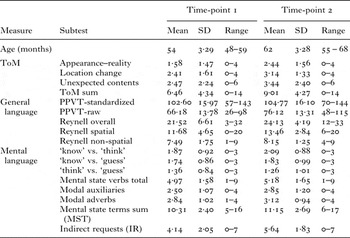
Table 1 shows the means, standard deviations, and ranges of the various tasks and the participants' ages at the first and second time of testing.
Means, standard deviations, and ranges of all the tests at the first and second time-point

notes: Maximum scores: appearance–reality and location change = 4; unexpected contents = 6; ToM sum = 14; no PPVT maximum; Reynell overall = 34; Reynell spatial = 21; Reynell non-spatial = 9; mental state verbs total = 9; ‘know’ vs. ‘think’, ‘know’ vs. ‘guess’, and ‘think’ vs. ‘know’ = 3; modal adverbs and modal auxiliaries = 4; mental state terms sum = 17; indirect requests = 7.
In the data analyses reported in the following sections, all the individual ToM tasks are summed in order to create a total ToM sum-score. For the vocabulary measure both the raw scores and the standardized scores are reported in Table 1. The standardized scores demonstrate that on average the group of children assessed in this study had a slightly above average receptive vocabulary (with a score of 102·60 where average is 100). In the further analyses, the raw scores are used, as otherwise the effect of age is considered twice in the analyses (in order to determine the standard scores, the subject's age is already taken into account, if in further analyses age is entered as a separate variable, then the effect of age would thus be doubly accounted for in the model). Each of the mental state term domains is considered separately in the analyses that look at the development of mental state terms, but a sum score of the various mental state term domains was taken in the analyses that considered the role of ToM and language on mental state term development.
The development of indirect requests and mental state terms
All individual general language and ToM measures increased significantly between the first and the second time of testing (all paired-sample t-tests, p < ·001). Regarding the dependent variables in this study, children's understanding of indirect requests and mental state terms, significant development was also observed across the two time-points (separated by eight months). Children's understanding of indirect requests increased significantly between the first and the second time of testing (t (100) = −6·97; p < ·001), indicating their developing ability to make sense of indirect requests. Children's overall understanding of mental state terms also increased significantly across time-points (t (100) = −2·83; p = ·006). In order to consider the development of mental state terms more closely, the performance on the various mental state terms was considered separately. Paired-sample t-tests demonstrated that children's performance increased significantly for their understanding of modal auxiliaries (t (100) = −2·84; p = ·005) and modal adverbs (t (100) = −2·35; p = ·02). The mental state verbs showed a slightly different pattern, however. Although the sum score for the performance on the mental state verbs did not increase significantly over time (t (100) = −1·00; p = ·32), children's understanding of the differences in speaker certainty as conveyed by weten ‘know’ vs. denken ‘think’ (t (100) = −2·01; p = ·05) did improve. Children's understanding of the difference between weten ‘know’ vs. raden ‘guess’, and denken ‘think’ vs. raden ‘guess’ did not improve significantly, however (t (100) = −0·77; p = ·44, and t (100) = 0·77; p = ·44, respectively).
In order to consider whether children were displaying above chance performance in their understanding of the various mental state terms, one-sample t-tests were run. Although overall performance on the mental state verb sum score may not have improved, one-sample t-tests did demonstrate that performance was above chance at both time-points (mean score = 5; t (100) = 3·00; p = ·003 for time one, and mean score = 5·2; t (100) = 4·14; p < ·001 for time two). A maximum score of 9 could be gained for this task with two possible answer options; above chance performance thus entails a score higher than 4·5. At both time-points then, the children scored significantly higher than would be predicted by chance, indicating that they did have some understanding of the differences between the mental state verbs, even though this did not develop significantly in the intervening eight months. Considering the three contrasts employed in the mental state verbs task separately, one-sample t-tests show that at both time-points children were performing significantly above chance (i.e. scored significantly above 1·5) on the weten ‘know’–denken ‘think’ contrast (time-point 1: mean score = 1·87; t (100) = 4·04; p < ·001; time-point 2: mean score = 2·09; t (100) = 6·70; p < ·001), and on the weten ‘know’–raden ‘guess’ contrast (mean score = 1·74; t (100) = 2·85; p = ·005 for the first time-point, and mean score = 1·83; t (100) = 3·37; p = ·001 for the second time-point). This was not the case for the denken ‘think’–raden ‘guess’ contrast at either time-point, however. At the first time-point, children's scores did not differ from chance (mean score = 1·36; t (100) = −1·71; p = ·09). However, at the second time-point, children's scores were significantly below chance (mean score = 1·26; t (100) = −2·42; p = ·02). Although children thus already displayed an understanding of the difference between weten ‘know’ and denken ‘think’, and between weten ‘know’ and raden ‘guess’ at the first time-point (which, in the case of know vs. think had developed further by the second time-point), children did not show any understanding of the difference between denken ‘think’ and raden ‘guess’ at either time-point. On both the epistemic modal auxiliary and adverb task children displayed significantly above chance performance (i.e. out of a maximum score of 4 children scored significantly higher than 2) with p < ·001 at both time-points (modal auxiliaries time 1: mean score = 2·50; t (100) = 4·63; modal auxiliaries time 2: mean score = 2·85; t (100) = 7·26; modal adverbs time 1: mean score = 2·84; t (100) = 8·32; modal adverbs time 2: mean score = 3·12; t (100) = 11·95).
At the first time-point, children thus demonstrated some understanding of indirect requests, both areas of epistemic modal terms and the contrasts between the strongest mental state verb (weten ‘know’) and the two weaker ones (denken ‘think’ and raden ‘guess’). Understanding of indirect requests, the modal terms, and the difference between weten ‘know’ vs. denken ‘think’ developed further in the course of the intervening eight months, but no significant development of the understanding of the contrast between raden ‘guess’ and the other two verbs was observed in this time period.
Regression analyses
In order to consider the role of ToM and language in the development of mental state term and indirect request understanding, hierarchical regression analyses were conducted. Children's performance at a later age will depend partly on their age (as a proxy for general maturation) and their earlier performance on the tasks, so these two factors (age and earlier mental state term and indirect request understanding) were accounted for first in the models. In order to consider the contributions of ToM and language, the following two models added earlier ToM performance and earlier linguistic performance in the various domains to the initial model. Children's understanding of mental state terms and indirect requests was considered separately in these analyses.
Predicting mental state terms from ToM and language
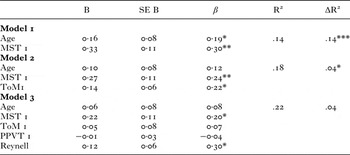
First, the role of ToM and language in the child's understanding of mental state terms was considered. Table 2 demonstrates the outcome of the hierarchical regression analyses assessing the contributions of ToM and language to mental state term understanding.
Predicting mental state term understanding at time 2 from ToM and language at time 1

notes: MST = mental state terms; ToM = Theory of Mind; PPVT = Peabody Picture Vocabulary Test; * p ⩽ ·05; ** p ⩽ ·01; *** p ⩽ ·001.
The first model in the analysis describes 13·5% of the variance in mental state term understanding (R 2 adj = 11·8%) with an overall significant relationship (F (2,98) = 7·68; p = ·001). This first model shows that both age (t (98) = 2·00; p = ·05) and earlier mental state term understanding (t (98) = 3·12; p = ·002) significantly predict the child's later understanding of mental state terms. The second model in the analysis (see Table 2) considers whether earlier ToM is a significant predictor of later mental state term understanding, controlling for age and earlier mental state term understanding. This second model describes 17·6% of the variance (R 2 adj = 15·1%), thereby significantly improving the percentage of explained variance in the initial model by 4% (with an overall significant relationship, F (3,97) = 6·91; p < ·001). Furthermore, both earlier understanding of mental state terms and ToM predict later understanding of mental state terms (t (97) = 2·53; p = ·01, and t (97) = 2·19; p = ·03, respectively).
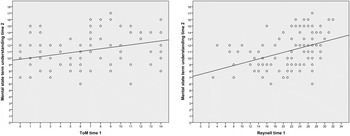
The third and final model considers whether any of the language measures contribute significantly to the child's understanding of mental state terms and whether the influence of ToM remains significant once the language measures are added to the model. This final model describes 21·6% of the variance (R 2 adj = 17·5%), again with an overall significant relationship (F (5,95) = 5·23; p < ·001). The regression analysis demonstrates that, aside from the child's earlier understanding of mental state terms (t (95) = 2·02; p = ·05), only one other predictor in the model significantly predicted later understanding of mental state terms: performance on the Reynell test for language comprehension (t (95) = 2·08; p = ·04). This model did not explain a significantly larger amount of the variance in later mental state term understanding than model 2, however (the extra 4% of explained variance was not a significant improvement). Vocabulary was not a significant predictor of mental state term understanding once the other variables in the model were controlled for. The child's earlier receptive vocabulary thus did not significantly explain additional variance in the child's understanding of mental state terms. The relationship between ToM and mental state term understanding also changed once the language measures were taken into account: whereas ToM was a significant predictor of mental state term understanding in model 2, this effect disappeared in model 3. The relationship between mental state term understanding and ToM and the Reynell language comprehension measure is visualized in the scatterplot in Figure 1.
Scatterplot: ToM (time1), Reynell (time1), and mental state term understanding (MST) (time2).

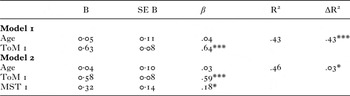
The above analysis thus demonstrates that both ToM and general linguistic ability predict later mental state term understanding. However, as discussed in the ‘Introduction’, previous research suggests that this relationship might in fact be bi-directional (that is, that mental state term understanding at an earlier time-point is also a predictor of ToM). In order to consider this possibility, regression analyses were thus conducted to investigate whether earlier mental state term understanding also predicted later ToM (see Table 3).
Predicting ToM at time 2 from mental state term understanding at time 1

notes: ToM = Theory of Mind; MST = mental state terms; * p ⩽ ·05; ** p ⩽ ·01; p ⩽ ·001.
The first model in this analysis considered the effects of age and earlier ToM performance. This first model described 42·7% of the variance in ToM performance at time two (R 2 adj = 41·5%) with an overall significant relationship (F (2,98) = 36·52; p < ·001). Although age was not a significant predictor of ToM performance at time 2, earlier ToM performance was a significant predictor (t (98) = 7·87; p < ·001). The second model in the analysis included earlier mental state term understanding as a predictor. This model described 45·7% of the variance in ToM performance at time two (R 2 adj = 44·0%) with an overall significant relationship (F (3,97) = 27·19; p < ·001), thereby significantly improving the percentage of explained variance in the initial model by 3·0%. Earlier understanding of mental state terms was found to be a significant predictor of later ToM performance (t (97) = 7·21; p = ·02). These results thus suggest that there is a bi-directional relationship between the development of ToM and mental state term understanding (it should be noted that earlier mental state term understanding did not predict later general linguistic ability; this relationship was not predicted on the basis of previous research, but data from this study thus also suggest that the relationship between general linguistic ability and mental state term understanding is unidirectional).
Predicting indirect requests from ToM and language
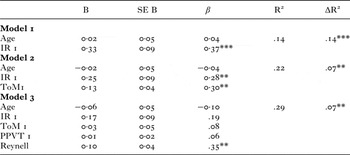
After considering the role of ToM and language in the development of mental state term understanding, the following set of hierarchical regression analyses considered their role in the child's understanding of indirect requests. Again, later understanding of indirect requests was expected to depend on age and on earlier understanding of indirect requests, so these factors were introduced first in the model, after which the effects of ToM and the various language measures were considered. Table 4 shows the results of these analyses.
Predicting indirect requests at time 2 from ToM and language at time 1

notes: IR = indirect requests; ToM = Theory of Mind; PPVT = Peabody Picture Vocabulary Test; * p ⩽ ·05; ** p ⩽ ·01; *** p ⩽ ·001.
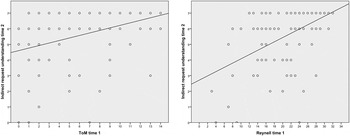
This first model described 14·3% of the variance in the understanding of indirect requests at time two (R 2 adj = 12·6%) with an overall significant relationship (F (2,98) = 8·19; p = ·001). Against expectation, this model demonstrated that although earlier understanding of indirect requests was a significant predictor of later understanding of mental states (t (98) = 3·81; p < ·001), age was not, when earlier understanding of indirect requests was controlled for. In the second model ToM was added as a predictor. This addition allowed the model to describe 21·5% of the variance (R 2 adj = 19%) with an overall significant relationship (F (3,97) = 8·84; p < ·001). The additional 7% of explained variance was significant. This model demonstrates that ToM does significantly predict later understanding of indirect requests even controlling for age and earlier understanding of indirect requests (t (97) = 2·97; p = ·004). The third and final model demonstrated that adding the language measures led the model to describe 28·7% of the variance (R 2 adj = 24·9%), again with an overall significant relationship (F (5,95) = 7·64; p < ·001). The added 7% of explained variance was a significant improvement in comparison with the second model. In the final model, only the child's earlier performance on the Reynell test for language comprehension proved to be a significant predictor of her later understanding of indirect requests (t (95) = 2·55; p = ·01). None of the other predictors in the model significantly predicted the dependent variable. The relationship between indirect request understanding and ToM and the Reynell language comprehension measure is visualized in the scatterplot in Figure 2.
Scatterplot: ToM (time1), Reynell (time1), and indirect request understanding (IR) (time2).

It should be noted that in the case of indirect requests no evidence was found for the opposite direction of causality. That is, regression analyses demonstrated that earlier indirect request understanding did not predict later ToM understanding or later general linguistic ability. For indirect request understanding, there is thus a unidirectional relationship with earlier ToM and general linguistic ability predicting later indirect request understanding.
The Reynell test: a closer inspection
For both mental state term and indirect request understanding it was found that although ToM was a significant predictor in a model with age and earlier performance, this effect disappeared once the language measures were added to the model. However, it should be noted that it was only the child's earlier performance on the Reynell test for language comprehension that proved to be a significant predictor of the child's later understanding of mental state terms and indirect requests. As detailed in the ‘Method’ section, practical considerations dictated that only certain parts of the Reynell test were given, namely those that best assessed the four- and five-year-old child's understanding of language comprehension at the sentential level. On closer examination, however, it became apparent that about two-thirds of the items in these sets involved an understanding of locative prepositions (e.g. in, behind, next to) that indicate the spatial relationship between two objects (e.g. “Put one of the pigs behind the man”). As locative prepositions encode perspective and perspective relates to children's developing ToM, potentially, then, it is this aspect of the Reynell test that was of primary importance in explaining the significance of the Reynell test as a predictor of mental state term and indirect request understanding. In the following analyses, the spatial and the non-spatial parts of the Reynell test were thus considered separately.
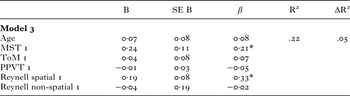
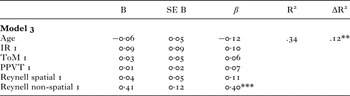
Table 5 demonstrates what effect this division has on the outcome regarding the child's understanding of mental state terms (as the first two models are the same as in Table 2, only the final model is given) and Table 6 shows the results for understanding of indirect requests.
Predicting mental state terms at time 2 from ToM, spatial, and non-spatial language at time 1

notes: MST = mental state terms; ToM = Theory of Mind; PPVT = Peabody Picture Vocabulary Test; * p ⩽ ·05; ** p ⩽ ·01; *** p ⩽ ·001.
Predicting indirect requests at time 2 from ToM, spatial, and non-spatial language at time 1

notes: IR = indirect requests; ToM = Theory of Mind; PPVT = Peabody Picture Vocabulary Test; * p ⩽ ·05; ** p ⩽ ·01; *** p ⩽ ·001.
For mental state term understanding then, the final model explains 22·3% (R 2 adj = 17·4%) of the variance with an overall significant relationship (F (6,94) = 4·51; p = ·001). As can be seen in Table 5, aside from earlier understanding of mental state terms (t (94) = 2·15; p = ·03), only the spatial subset of the Reynell test significantly predicted children's later understanding of mental state terms (t (94) = 2·26; p = ·03). None of the other measures in model 3 was a significant predictor. For the final model regarding the child's understanding of indirect requests, this finding was somewhat different. This model explains 33·8% of the variance (R 2 adj = 29·5%), again with an overall significant relationship (F (6,94) = 7·99; p < ·001). In the final step of this model, however, it was only the non-spatial subset of the Reynell test that significantly predicted understanding of indirect requests (t (94) = 3·33; p = ·001). None of the other measures predicted performance significantly in this final model. It should be noted that no evidence was found to support the reverse direction of causality. That is, earlier mental state term understanding was not found to predict later performance on the spatial subset, and earlier indirect request understanding similarly did not predict later performance on the non-spatial subset. There thus seems to be a unidirectional relationship from performance on spatial language to mental state term understanding, and from non-spatial language to indirect request understanding.
To summarize, then, both the development of mental state term and indirect request understanding is predicted by the child's earlier ToM performance, even if age and earlier performance on mental state terms and indirect requests are taken into account. This relationship was bi-directional in nature for ToM and mental state term understanding, but unidirectional for ToM and indirect request understanding. Once the child's linguistic ability is added to the model, however, only the child's performance on the Reynell test for language comprehension proved to be a significant predictor. On closer examination, however, it was found that the spatial items of the Reynell test significantly predicted the child's understanding of mental state terms, whereas the non-spatial items were not a significant predictor in this instance. On the other hand, if the child's understanding of indirect requests is considered, the opposite finding appears as the non-spatial items of the Reynell test prove to be the only significant predictor of performance in this domain.
DISCUSSION
This paper considered the development of two areas of communicative competence, the understanding of indirect requests and mental state terms, in a longitudinal study of Dutch-speaking four- and five-year-old children. Two questions were at the heart of this paper: How does understanding of indirect requests and mental state terms develop between four and five years old, and what role does the child's linguistic ability and her understanding of other people's mental states play in this development?
Regarding the first question, the results demonstrate that Dutch-speaking children do have some understanding of indirect requests and mental state terms by the age of four, but that this understanding increases significantly between four and five years old. Ceiling performance is not yet reached at this age, however, indicating that children continue to develop their understanding of these domains after five years old. These findings for the understanding of indirect requests are in line with the findings for English and French (Bernicot et al., Reference Bernicot, Laval and Chaminaud2007; Bernicot & Legros, Reference Bernicot and Legros1987; Elrod, Reference Elrod1987; Leonard et al., Reference Leonard, Wilcox, Fulmer and Davis1978; Spekman & Roth, Reference Spekman and Roth1985) that state that children start to appreciate indirect requests by the age of three and continue their development until they are at least eight years old. Of course, this study only considered four- and five-year-olds, so claims about Dutch-speaking children younger or older than these ages cannot be made. However, four-year-olds already demonstrated some understanding of a relatively opaque form of indirect requests, the hint, which developed across time within the same individual, but did not yet peak at five years old. Given the fact that the findings for English, French, and Dutch converge, it seems plausible that children undergo a significant improvement in their understanding of indirect requests between four and five years old, independent of the specific language that they are exposed to (although English-, French-, and Dutch-speaking children are exposed to relatively similar cultures, so it may be the case that children exposed to non-Western cultures show somewhat different patterns of development).
Regarding Dutch children's understanding of mental state terms, the finding was that only the difference in speaker certainty as conveyed by the terms denken ‘think’ vs. raden ‘guess’ was not appreciated at any of the tested ages. Four-year-olds did not perform any better than chance on this difference and, eight months later, children's performance had actually even deteriorated, suggesting a continued lack of awareness of the distinction between the two terms. These results are very similar to the findings described by the cross-sectional studies on English-speaking children (Byrnes & Duff, Reference Byrnes and Duff1989; Hirst & Weil, Reference Hirst and Weil1982; Moore & Davidge, Reference Moore and Davidge1989; Moore et al., Reference Moore, Bryant and Furrow1989, 1990; Noveck et al., Reference Noveck, Ho and Sera1996), which broadly indicate some understanding of mental state terms at four years old, with continuing development until at least five years old. Like children who speak English, Dutch-speaking children thus begin to appreciate the differences between mental state verbs, modal auxiliaries, and modal adverbs at least by four years old. Already at this point in time, they understand at a basic level that weten ‘know’ expresses greater speaker certainty than denken ‘think’ and raden ‘guess’, that moet ‘must’ expresses greater speaker certainty than kan ‘might’, and that zeker ‘definitely’ is more certain than misschien ‘maybe’. However, full understanding of these contrasts is still developing even at five years old, as children do not yet demonstrate ceiling performance at this age. The distinction between denken ‘think’ and raden ‘guess’ remains problematic for Dutch-speaking children at these ages, as they do not demonstrate above chance performance for this contrast at either time-point. This result is in line with Moore et al.,'s (1989) finding that English-speaking children also have difficulties with the difference between think and guess until they are at least eight years old. Evidently then, it seems that four- and five-year-olds understand that some terms (like weten ‘know’) express high speaker certainty and that other terms (like denken ‘think’) express some level of speaker uncertainty, but they are not yet capable of making the distinction between different levels of uncertainty (that is, between denken ‘think’ and raden ‘guess’ that both convey uncertainty to a different extent).
However, this finding for mental state terms is in contrast with Bascelli and Barbieri's (Reference Bascelli and Barbieri2002) study on Italian modal auxiliaries that did not find any understanding of these terms until at least six years old. Potentially then, the particular language that the child is learning does have an effect on the age at which at least modal auxiliaries (the only area of mental state vocabulary tested in Bascelli and Barbieri, Reference Bascelli and Barbieri2002) are learned. However, given that the findings for English do seem to suggest that significant development occurs between four and five years old (with Byrnes & Duff, Reference Byrnes and Duff1989, at the low end of this continuum with their finding that three-year-olds already understand modals, and Hirst & Weil, Reference Hirst and Weil1982, at the high end with their finding that only children aged 5;6 understand modals), and this study on Dutch confirms that, it is possible that more studies on Italian will eventually converge around the ages of four and five as well. For the moment then, it can be said that, at least for children acquiring Dutch and English, significant steps are taken in the understanding of mental state terms between four and five years old.
In order to address the second question underlying this paper (What role does the child's linguistic and ToM ability play in the development of mental state terms and indirect requests?), hierarchical regression analyses were conducted. These analyses suggest that ToM does play a role in the child's developing understanding of mental state terms and indirect requests. Even controlling for age and earlier performance in mental state term and indirect request understanding, earlier ToM proved to be a significant predictor of later mental state term and indirect request understanding. Children's ability to appreciate other people's mental states is thus a relevant factor in their coming to understand the nature of mental state terms and indirect requests.
In line with findings from previous research, the relationship between ToM and mental state term understanding was found to be bi-directional, as earlier understanding of mental state terms also predicted later ToM development. Development in the domains of mental state terms and ToM thus seems to influence each other. Potentially then, mental state terms serve to give the child an explicit clue to the existence of unobservable entities like mental states and, in turn, the child's dawning understanding of mental states allows the child to ground this new terminology in a conceptual framework. The child thus uses mental state terms to guide the process of concept formation and her sensitivity to other people's mental states is recruited in assigning meaning to mental state terms. In this way, then, mental state term understanding and ToM might bootstrap each other, furthering the child's development in both areas of cognition.
Although the current study only demonstrates this predictive relationship between ToM and mental state terms for Dutch-speaking children, it seems likely that a similar relationship will also be observed for children learning other languages. After all, previous work has suggested a similar link between ToM and mental state terms not only for English (a language that is similar to Dutch in its mental state terminology), but also for Chinese (a language that has a more enriched terminology for mental states, as ‘falsely think’ is encoded as one single lexical item; cf. Cheung et al., Reference Cheung, Chen and Yeung2009). Presumably then, as long as a language provides linguistic labels for mental states, similar effects as those reported in the current study should be observed in the child's cognitive development. Some support for this notion comes from a study by Vinden (Reference Vinden1996), which reports that children acquiring Junín Quechua (a language that reportedly does not have the linguistic means to refer to mental states directly) are delayed in their development of ToM.
Although mental state term understanding and ToM were thus found to be bi-directionally related, a different relationship was found for ToM and indirect request understanding. ToM unidirectionally predicted indirect request understanding, suggesting that an understanding of other people's mental states in a general sense precedes the more specific ability to understand and articulate the intention underlying an indirect request. There is thus a relationship between the development of ToM, indirect request understanding, and mental state term understanding, but it should be noted that the effect of ToM on mental state term and indirect request understanding disappeared once the language measures were added to the model. Controlling for the child's linguistic abilities, then, earlier ToM no longer proved to be a significant predictor of later mental state term and indirect request understanding. Although children's receptive vocabulary was not a significant predictor of mental state term and indirect request understanding, the other language measure, the Reynell test for language comprehension, was. This finding is in line with the view that the child needs a particular level of general linguistic ability in order to be able to represent other people's mental states in a coherent way (cf. Astington & Baird, Reference Astington and Baird2005; Astington & Jenkins, Reference Astington and Jenkins1999; Milligan et al., Reference Milligan, Astington and Dack2007). Language thus provides the child with the scaffolding to make sense not only of other people's mental states, but also of language that relates directly to mental states (i.e. mental state terms and indirect requests). In this sense, then, language does a dual job in mental state term and indirect request development: it provides the child with the representational apparatus to make sense of other people's mental states and it provides the child with a system for decoding the linguistic format in which they are encoded.
However, considering the data from the Reynell test more closely, it might be possible to identify more specific domains of language that may be important in the development of mental state term and indirect request understanding. About two-thirds of the items in the Reynell test required the child to understand the nature of locative prepositions like on, next to, and behind. This class of words is potentially interesting in that some understanding of perspective is required in order to fully understand their meaning: although from the point of view of one speaker, the house might be next to the tree, from the point of view of another speaker, the house might be in front of the tree. Understanding of differences of perspective at this relatively concrete, spatial level is thus crucial for the child to understand these terms. The function of a locative preposition is thus to denote the concrete spatial relationship of two objects in space from the point of view of the speaker. Perspective, albeit in a more abstract sense, is also crucial in the child's development of ToM. Only if the child appreciates that differing perspectives on events can lead to different representations of those events (and hence potentially to false representations of those events) can the child develop a more advanced understanding of other people's mental states and their linguistic encoding. Indeed, although in previous literature a specific relationship between the understanding of locative prepositions and mental state term understanding has not been investigated, Creem-Regehr, Gagnon, Geuss, and Stefanucci (Reference Creem-Regehr, Gagnon, Geuss and Stefanucci2013) do suggest that there are relevant parallels between visual perspective taking and the understanding of other people's mental states. In their paper, these authors claim that the ability to take another's visual perspective is crucial in order to be able to determine what their goals might be, as if you are capable of taking another's line of sight, you can see what they are looking at and hence determine their intentions. Indeed, in line with this suggestion, children with a visual impairment perform significantly worse on tasks assessing the understanding of other people's mental states than typically developing children (cf. McAlpine & Moore, Reference McAlpine and Moore1995; Minter, Hobson & Bishop, Reference Minter, Hobson and Bishop1998). In a broader sense, there is thus prior research linking visual perspective taking to mental state understanding. Potentially then, what unites the child's understanding of mental states, their performance on the Reynell test, mental state term and indirect request understanding is that all these domains rely on the child's appreciation of differences in perspective. Given the more concrete nature of the spatial relation described by the locative preposition (it is in principle verifiable in the context whether or not, from the point of view of a certain speaker, the house can be considered to be next to or in front of the tree), the child might be using the more concrete perspectival nature of the locative preposition to bootstrap understanding of the more abstract perspectival nature expressed in mental language. It should be noted that although initial work on the understanding of spatial perspective taking has suggested that children do not develop this ability until eight or nine years old (e.g. Piaget & Inhelder, Reference Piaget and Inhelder1956), more recent studies in this domain have since demonstrated that even two- and three-year-olds are capable of appreciating differences in spatial perspective (e.g. Moll & Meltzoff, Reference Moll and Meltzoff2011; Moll & Tomasello, Reference Moll and Tomasello2006). It is thus not the case that an understanding of differences in spatial perspective necessarily develops later than mental state term understanding (and, indeed, the current study also only found evidence for a unidirectional relationship between earlier performance on the spatial subset of the Reynell test and later mental state term understanding).
If we consider the spatial and the non-spatial items of the Reynell test separately, we see that there is partial support for the idea that an understanding of spatial perspective might bootstrap the child's understanding of mental perspective. Although the spatial items do not significantly predict indirect request understanding (only the non-spatial subset of the Reynell items predicts this ability), the spatial items are the only significant predictor of performance for mental state term understanding. Earlier understanding of locative prepositions thus predicts later mental state term understanding. To understand how this might work, consider what a locative preposition does: a locative preposition denotes the concrete relationship of two objects in space from the point of view of the speaker. In the statement “the house is next to the tree”, the locative preposition classifies the nature of the relationship between object A (the house) and object B (the tree) as ‘next to’ from the point of view of the speaker. Importantly, this can be verified in an actual situation: is the house indeed next to the tree from the point of view of the speaker? A mental state term can be considered to have very similar characteristics to a locative preposition in this sense, although the relationship holds at a more abstract level. A mental state term gives a more abstract denotation of the triadic relationship between a mind and a proposition from the point of view of the speaker. In the statement “Laura thinks that the ball is in the basket”, the mental state term classifies the nature of the relationship between mind A (Laura's mind) to proposition B (the ball is in the basket) as ‘thinks’ from the point of view of the speaker. This relationship cannot be verified in the concrete environment, though, as there is no overt evidence for the thinking relationship. If the child can use the analogy from locative prepositions, however, then perhaps she can use the more concrete nature of this similar perspectival relationship to get to grips with the more abstract perspectival relationship denoted by the mental state term. In this way, then, the understanding of locative prepositions may precede and indeed bootstrap the child's understanding of mental state terms.
Again, although the current study has only considered the relationship between spatial prepositions and mental state term understanding for Dutch-speaking children, if the above reasoning is correct, a similar development would also be expected for children learning other languages that have perspective denoting spatial prepositions. The relationship between spatial language and mental state term understanding would thus not be expected for children acquiring languages that use absolute frames of reference (in which cardinal directions are the basis for reference, instead of features of a particular object or angles derived from the viewer's bodily orientation as is the case in intrinsic and relative frames of reference, respectively; cf. Levinson, Reference Levinson1996), as these reference frames do not rely on an understanding of the speaker's perspective for their interpretation. However, future research (for instance with children acquiring an absolute reference frame language like Tzeltal) will have to determine if this is indeed the case.
Assuming that the above analysis regarding the relationship between spatial prepositions and mental state terms is correct, this raises the question why a predictive relationship was not found for the spatial items of the Reynell test and the child's understanding of indirect requests. This discrepancy between mental state term and indirect request understanding might lie in the different demands that the indirect request and the mental state term tasks place on the child's linguistic abilities. The task that was used to assess indirect request understanding requires more advanced verbal skills than the mental state term task. In the mental state term task, the child has to understand the differences in speaker certainty as conveyed by various mental state terms (and thus the task requires the child to have some appreciation of the differences in perspective that these terms convey), but the response required in the task itself is non-verbal (the child can simply point to one of the two boxes). In contrast, in the indirect requests task, the child cannot give a non-verbal answer. The child not only has to understand the intention of the speaker that underlies the indirect request (and thus the speaker's perspective in the exchange), but she also has to parse the story and the speaker's utterance and come up with a coherent verbal response. The indirect request task may thus require more of the child's general linguistic skills than just her understanding of the speaker's perspective on the situation. It could be, then, that a measure that takes into account children's language comprehension at a more general level (i.e. the non-spatial items of the Reynell test that comprise an understanding of passives, negation, question words, etc.) is a better predictor of this ability than a language measure that looks at a more narrowly defined area of language (i.e. the spatial items that primarily look at the child's understanding of locative prepositions).This explanation suggests that if the verbal load of the indirect request task is decreased (for instance by creating a variant of the task that allows the child to respond non-verbally), a relationship between spatial language and indirect request understanding might be found.
However, it might also be the case that this discrepancy in the findings for mental state term and indirect request understanding is more principled in nature. The parallels between locative prepositions and mental state terms as described above may entail that there is an analogy between the understanding of locative prepositions and mental state terms that is absent for indirect request understanding. Instead, the fact that the non-spatial items of the Reynell test predict later indirect request understanding may point to the fact that the child needs to have a certain level of general linguistic ability before the structure of the indirect request can be successfully parsed and interpreted. For indirect request understanding, linguistic ability may provide the child with the mental machinery that allows her to keep apart the different layers of meaning that the indirect request entails (i.e. What does the sentence mean? What does the speaker mean in using the sentence? What am I supposed to do given the speaker's intended meaning?). In this sense, then, it would not only be the indirect request task that entails that children need a certain level of linguistic ability in order to perform well, but it would be the nature of the indirect request itself that entails that a certain level of general linguistic ability is a prerequisite for full understanding. This relationship between language and indirect request understanding would thus be different from the relationship between language and mental state term understanding, as mental state term understanding may be bootstrapped by more specific domains of language (i.e. locative prepositions).
Of course, the suggestion regarding the relationship between locative prepositions and mental state terms is speculative and requires confirmation from future research (the current research was not set up with this outcome in mind), but it may be one aspect of language that is relevant in the child's coming to understand the nature of the mind. However, whether or not the relationship between spatial language and mental state terms is confirmed, this study does demonstrate that the child's linguistic ability plays a crucial role in her understanding of mental state terms and indirect requests. Although the child's understanding of other people's mental states (as assessed by tests of ToM) is not an irrelevant factor in this development (ToM was a significant predictor in the model without the language measures), this effect was eclipsed once the child's linguistic abilities were taken into account. At least for the development of the areas of communicative competence considered in this study, then, it would appear that the child's linguistic abilities are of key importance in allowing the child to develop more adult-like ways of social interaction.
APPENDIX: indirect requests task materials (English translations of Dutch originals)
[Story 1]
experimenter: Here's the first story. It's about Jan. Jan is sitting at the kitchen table and sees a bowl of cookies on the table. Jan really likes cookies, so he has taken one. Then mum comes in and says: “Those cookies are for tonight's guests.”
puppet: I don't get it. Why does mum say that to Jan?
[Story 2]
experimenter: This story is about Karin. Look, Karin is standing in the hallway and she wants to play outside. Next to Karin is a hat stand with her coat, her scarf and her gloves [points to these]. When Karin wants to go outside, mum sees her. And mum says: “It's really cold outside.”
puppet: Huh, why does mum say that to Karin?
[Story 3]
experimenter: The next story is about Karin again. Karin is playing with her toys. She has just emptied a box of Lego on the floor. Karin is playing with the Lego. Mum comes in and says: “It's dinner time, Karin.”
puppet: Wait a minute, why does mum say that to Karin?
[Story 4]
experimenter: This story is about Jan. Jan is standing in the hallway and wants to go to the kitchen. When mum sees that, she says: “I just mopped the kitchen floor, Jan.”
puppet: I don't get it, why does mum say that to Jan?
[Story 5]
experimenter: The next story is about Karin. Karin is drawing at the kitchen table. And mum has opened the refrigerator and is standing next to the drinks. Then mum says: “You really haven't had enough to drink today, Karin.”
puppet: Huh, why does mum say that to Karin?
[Story 6]
experimenter: The next story is about Jan again. Jan has just returned from playing outside and he wants to come back into the house again. His boots are all muddy and dirty. He is standing on the mat. When mum sees that, she says: “Take a look at your muddy boots!”
puppet: Can you explain it to me? Why does mum say that to Jan?
[Story 7]
experimenter: This is the last story and it's also about Jan. But now Jan is a bit poorly, because he is ill. Look, he's lying on the couch with a thermometer in his mouth [points at thermometer], you know, one of those things that measures how ill you are. There is a blanket next to Jan, but it's not on him, do you see [points at blanket]? Then mum comes in and says: “You'll get really cold without a blanket!”
puppet: Just a minute, why did mum say that to Jan?