Introduction
In Sweden, a political decision has been taken to increase the acreage of certified organic agricultural production from 6%, in 2006, to 20% of the total production area by the year 20101. The consumption of certified organic food within the public sector (state institutions covering healthcare, law, education, defence, etc.) should reach 25% of the expenditure for the food consumed2. These goals have been decided as a means of fulfilling national environmental objectives such as a nontoxic environment, a varied agricultural landscape, good quality ground water and a rich diversity of plant and animal life. Within the horticulture sector, organically grown vegetable production accounted for 9.4% of the total horticultural field production in 20053. It is seen as a challenge to increase production to the levels set in the above goals. Competition from imported vegetables is severe, keeping domestic prices to growers low, and there is a need for both increased profitability and cropping reliability to secure expansion in the areaReference Nilsson4. Problems such as weeds, long working hours, lack of capital for investments and complex management situations are considerable but there are also problems of pathogens and nutrient managementReference Hanson5, Reference Rölin and Larsson6.
In 2005, in Sweden, there were 470 certified organic horticultural field producers, with an average acreage of 1 hectare7. The main crops grown are onions, beetroots, carrots and cabbage—the last two often being financially the most important for growers. Supplies of Swedish produce have been limited during the past few yearsReference Nilsson4. Organic vegetable production that is able to meet growers' expectations and national policy goals requires skilled growers who can plan and vary their crop rotations and are good soil managers. It is demanding and strenuous work and there is a need for solutions that will both improve production levels and reduce working hours.
In order for research to contribute to transitions improving ecological agriculture (agriculture striving for improved sustainability and accordance with the ecosystem principles, going beyond statues set for organic agriculture) there was an experienced need to improve the relevance to practical farming of research results. In 2002, a research project to study green manure as a multifunctional ‘tool’ within Swedish organic vegetable production was started at the Swedish University of Agricultural Sciences (SLU) to support the strive toward more ‘ecological’ agriculture. Green manure is frequently used for augmenting on-farm nutrient supply in Swedish agriculture. On farms without animals it is used by almost all organic producers today and on farms with animals the same effect is given through ley production (i.e., production of a mix of grass and leguminous plants), for grazing, hay and ensilage. A work package (WP) was added to the project to allow farmers, researchers, an extensionist and a facilitator to evaluate the output of the conventional research trials through Participatory Learning and Action Research (PLAR). The experience of implementing this WP, as an add-on within a conventionally designed research study, raises the questions addressed in this paper: is researching in the conventional way fit for the purpose of supporting ecological horticulture? Is a PLAR ‘add-on’ sufficient to overcome any shortfalls in the conventional approach?
The Research Study
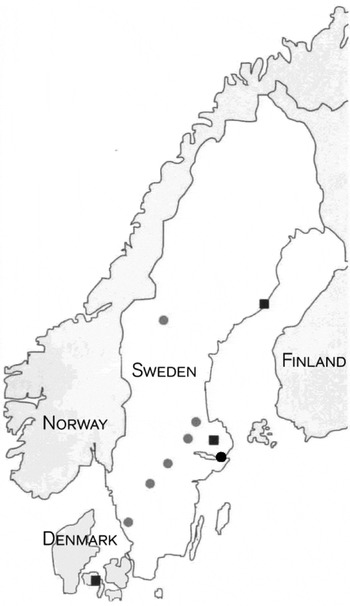
The research project ‘Green manure as a multifunctional tool in vegetable production’ was implemented from 2002 through 2005. The study sites were spread throughout the country (Fig. 1), and also included one location in Denmark.
Location of study farms and research stations.

The overall aim was to gain a holistic understanding of what green manure, as a multifunctional tool for integrated vegetable production management, could add to locally adapted vegetable production systems. The investigation of different systems of green manure focused especially on its contribution in terms of nutrients, protection against pests and product quality. Four green manuring systems were included: ploughing-in of a growing ley crop, intercropping, digested sludge and composting.
The research was divided into three work packages (WPs 1–3). Each was based on disciplinary trials at three different research stations. In addition, it was planned that WP 1 (on nutrients) would be connected to a series of on-farm trials. The linkage would be implemented by constituting a collegial levelReference Johnson, Lilja, Ashby and Garcia8 PLAR group (WP 4).
The study was directed by a steering committee, consisting of the study coordinator (SC), a senior responsible researcher for WPs 1–3, respectively, and the advisor responsible for WP 4. WPs 1–3 consisted in each case of senior researchers (R1:X–R3:Z) and a PhD student (PhD1–PhD3). The participatory WP (WP 4) team was made up of an organic farming advisor, a researcher on plant nutrients (R4:1) and one on composting (R4:2) (both were also part of the plant nutrient WP), and the farmers (6 men/1 woman) from the six participating farms (F1–6), and a facilitator.
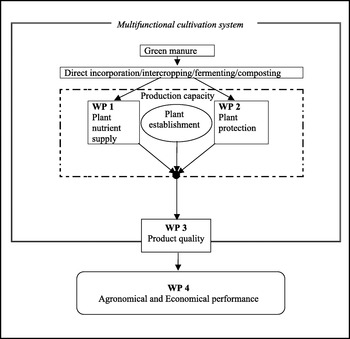
The design of the overall research study was informed by a system awareness, illustrated by the picture (Fig. 2) used by the study coordinator to explain the planning of the study at the first meeting (Sunnersta Herrgård, 4–5 March 2002). The imagined correlation between the productions systems and the relevance of the WPs are illustrated. At the time, despite the system awareness, it was not thought necessary to change the organization of the research as a conventional disciplinary research project. The underlying presumption was that knowledge would be produced through objective study of defined variables with reduced statistical variance and maximum expression of the treatment variablesReference Hildebrand and Russel9. In the course of implementation, the disciplinary studies continued to be based on a series of objective trials and laboratory experiments of particular parts of the system of interest, separated in time and space. The research plan required that, following the completion of the project, the project steering committee would combine the outputs of the separate WPs into a total system analysis. The analysis was planned to allow a qualitative and quantitative evaluation through use of multivariate methods.
Systems picture modified from the application, used to explain the study at the first meeting of the overall study (Sunnersta Herrgård, 4–5 March 2002).

During the initial planning of the study, the PLAR WP was conceived as a discrete activity that would focus on the agronomic and economic evaluation of the green manure options studied by the other WPs, as illustrated in Figure 2.
Sufficient inter-linkage between the WPs to support a systems approach was to be achieved through periodic steering committee meetings, twice a year, reports from each WP every 6 months, and by organizing two large seminars for all members of the study. The purpose of the seminars was to provide opportunities for the members of the WPs to present their work to each other. Two field trips to selected farmers, and to the research stations where the trials were conducted, also took place.
The group work
The participating farms were selected based on the farmers' degree of knowledge of organic farming, using length of time in organic farming as an indirect indicator (number of years in organic ranging between 7 and 27 at project start), cabbage production and geographic location. The advisor presented the study to the farmers from six farms that meet these criteria. Financial compensation was offered to cover the farmers' costs associated with meetings and trial work. When invited to participate, all accepted. The advisor became responsible for reporting to and liaising with the steering committee; the facilitator for guiding the process in the PLAR group; and the two researchers for guiding the on-farm trials.
Because of the large distances between the farms – approx 800 km from north to south – the WP 4 participants met mostly in an available conference room in Stockholm.
The first seminar for all study members (4–5 March 2002) was planned by the steering committee as an occasion for each WP team to present their plan of work. At this occasion the participatory group for WP 4 met together for the first time. The facilitator gave a short introduction to PLAR and PLAR tools, briefly explaining the approach for trans-disciplinary and systemic research and learning for enabling transitions that yield situational improvements. Then the advisor invited discussion of the on-farm trials that were designed to complement the on-station trials. At this point, the farmers added mulching to the manuring strategies to be studied. This suggestion was adopted and implemented in WPs 1–3. It was accepted that conventional quantitative designs would be used for the planned on-farm trials of the manuring options, in order for farmers to carry out their own qualitative evaluation of these trials, and for the results derived from the on-farm studies to be related to the on-station nutrient trials.
At the second PLAR meeting, a group contract was negotiated, using key words to indicate how the group wanted their collaboration to be characterized. The facilitator also took the group members through a series of exercises designed to build the group dynamics and to illustrate differences in the learning and thinking styles of the participants. Each participant presented the individual goals that they hoped would be secured by the group.
The third meeting took place at one of the farms. The participants created together a large matrix table, mapping what the participants had interest in knowing more about within the overall study theme, if the group could deal with it and how, and what to do if the item mentioned was not within the capability of the group or the study. Some questions were noted for forwarding on to researchers in other WPs.
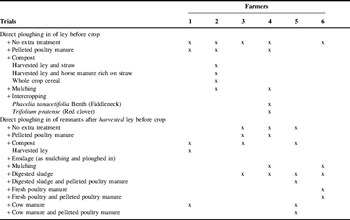
During the first three PLAR meetings, time and effort were given to adjusting the design of the research trials to the local conditions on the farms and to the farmers' resources, and for the farmers' questions to be answered; these questions continued to be discussed throughout the trial period. The final suite of on-farm trials from which farmers could choose were as follows: manuring with different kinds of compost, digested sludge, mulching and inter-cropping, complete ploughing-in of ley pasture or ploughing-in of the remnants after harvested ley pasture. Each farmer chose a different combination of trials (Table 1).
Trials chosen by the participating farmers compiled.

Source: Group documentation 2002–2004.
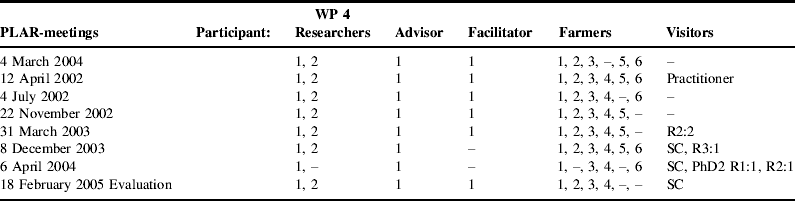
All the group meetings experienced time pressure and especially in the first three meetings, the focus was kept firmly on questions related to the design, establishment and management of the trials. Attendance in this crucial phase was high (Table 2). A small number of the researchers from WPs 1–3, visited members of WP 4 at a later stage, to present their ideas and discuss experiences.
Attendance at the PLAR meetings.
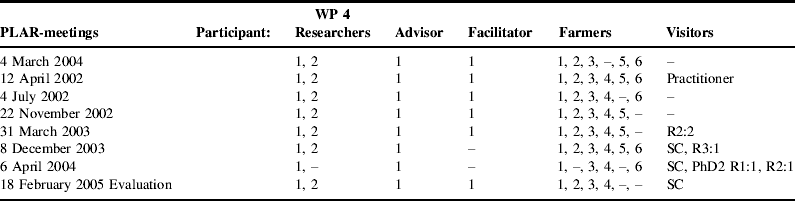
Source: Group documentation 2002–2005.
During 2002–2004 (three growing seasons) the farmers implemented their chosen manuring trials, with adjustments and changes between seasons. In the trial fields, the soils were mapped; and for the ley, tests of dry matter content, measurements of ash and total carbon, nitrogen and potassium were taken. The measurements were to be used in the development of nutrient budgets. The farmers took diary notes on their research activities and photos were taken ‘for the record’ at the time of spreading the mulching and compost material.
The final meeting (Sunnersta Herrgård, 17 February 2005), was planned by the steering committee as the synthesis and conclusion of the whole study. Each WP team presented their results to the others. The farmers presented their own results and their experiences of working with the different ‘sub-systems’ in the on-farm trials. The day after, the participatory group held its own evaluation. The evaluation process was planned by the facilitator according to the interest expressed by the members of the group. The topics included outputs and outcomes, as well as the process—the different activities and ways of working. Four farmers, the researchers, the advisor, the facilitator and the program coordinator took part.
Methodology
Primary data were recorded through participant observation, written notes taken at group work meetings, study seminars, the group evaluation day, the facilitators' diary, records taken during farm and study visits. Secondary information was drawn from projects proposal and reports. All researchers responsible for work packages and a farmer not present at the group evaluation day were interviewed individually. The information has been processed manually and written up as a case studyReference Eksvärd10.
Results
This section is divided into two parts. The first reports the findings from a participatory evaluation of the PLAR activities. It focuses on the practical issues that arose as a result of trying to implement conventional trials on-farm in a participatory process. The second focuses on issues of cooperation and understanding.
Evaluating the group work
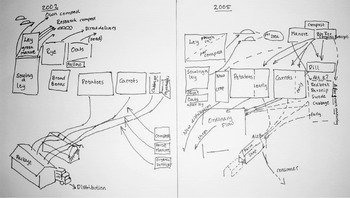
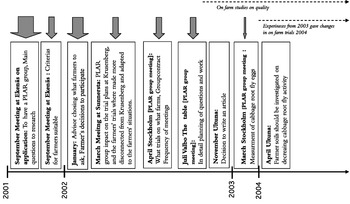
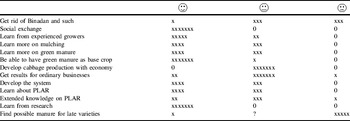
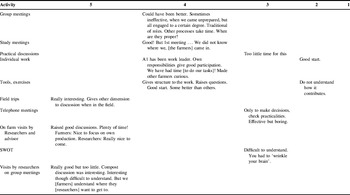
The PLAR group engaged in several different activities, principally: eight group meetings including an evaluation day, two conference telephone meetings, two research study seminars (start and end), field trips, practical discussions, individual work, introductions to and reviews of the tools and exercises used, on-farm study visits by researchers and the advisor and visits to the PLAR group meetings by one or more of the researchers from the other work packages. The evaluation was carried out using participatory tools. Figures 3a and b show two diagrams comparing a farm system before the study and after. Figure 4 shows a timeline of when the decisions important for the development of the research process in WP 4 were taken. Tables 3 and 4 present the outcomes of tools for evaluation and/or grading, used to facilitate discussion on how the group had met its goals and how the different activities had contributed.
(a, b) Example of a flow diagram drawn by evaluation participant to discuss changes within the farm systems resulting from the participatory group work and the research program (F2, Sunnersta Herrgård 18 February 2005) (Copied and translated by the author).

Illustration of decisions affecting the process, and their weighted importance illustrated through the added arrows (SC, R4:1, R4:2, A1, Sunnersta Herrgård 18 February 2005. Translated and modified for publication).

Base for discussing how the group thought their goals had been met. Scores were given by some with respect to the whole study and by some with respect to the work of WP 4 (modified for publication).

Source: F1–4, R4:1, R4:2, Advisor, Sunnersta Herrgård 18 February 2005.
Group grading and comments on contribution of different activities (modified for publication).

Source: F1–4, R4:1, R4:2, A1, Sunnersta Herrgård 18 February 2005.
In the timeline in Figure 4, the researchers of WP 4, the advisor and the study coordinator have illustrated their assessment of the importance of the key decisions taken, in terms of how the process developed, when made and by whom.
Cooperation and understanding
This section presents findings of a different kind: the relations that arose within the research team and between the researchers and farmers as a result of incorporating the participatory activities. The role of the facilitator's contribution to the research and collaboration was questioned as she tried to understand and facilitate the development of these relations, something not often done in natural science projects.
At the start of WP 4 it was stressed that the focus in PLAR is not on ‘solving’ well-bounded problems, but on improving ‘messy’ management situations that require farmers to adapt ‘best bet options’ to the particularities of their own enterprise, growing conditions, market opportunities, etc. It was pointed out that the effects are achieved through collaboration between actors with different experiences and knowledge related to a shared area, theme or topic of interest, aiming for practical change as well as new knowledgeReference Pretty, Guijt, Thompson and Scoones11, Reference Ison, Reason and Bradbury12. The participants either agreed or did not contradict the proposition that the quality of the collaboration would be important to achieving the desired outcomes and that care would have to be taken to adjust the process as it unfolded ‘in real time’. It was recognized that this would demand a commitment to consistency in attendance at key events and that time should be set aside at key moments throughout the process for joint reflection and re-planning.
The information in Figure 4 indicates that the participants considered the most important decisions influencing the whole process were those taken at the time of planning the study and writing the application. It was at this early point before the participants had met each other that the main research questions were set and the criteria were set concerning which farmers to invite. It was noted that the facilitator had joined the process at a later stage and had no influence on the process aspects of the study design.
Relations within research team
The responsible researchers for each of the other three WPs were interviewed by the facilitator on their experiences of having a participatory group included in the research design. They expressed a range of views:
One was generally positive and stressed how nice it was to get to discuss subjects with farmers who ‘are not within your own sphere, but know the subject’ (R2:1, 24 May 2005).
Another expressed criticism: ‘They [the participatory group] have missed a chance by not doing repeated trials, this is not usable scientifically’ (R1:1, May 05). This researcher would have liked to see identical trials carried out at every farm. But the researcher also stressed the importance of the PhD students (who had a biology background) involved in her WP, having a chance to meet farmers.
The third had developed an active relationship with the farmers through discussions initiated at a visit to a participatory group meeting and when taking samples from the farmer trials. The idea of using the farmers' own produce as samples came from this researcher who saw increased possibilities for the researchers' disciplinary research through the participatory group. The researcher had had earlier contacts with another participatory farmer research group and was very positive towards the idea from the start. The researcher said: ‘I have learned that reality is really important for the research, to really get a dialogue with farmers that is providing. It is a really important question, very exiting’ (R3:1, 17 August 2005).
The study coordinator and two of the interviewed researchers pointed also to the importance for researchers of experiencing the interest and request of their knowledge from the research receivers. The researcher said: ‘It is fun to get to hear that some people enjoy what you are doing, that happens extremely seldom’ (R1:1, May 05).
Two of the three interviewed researchers stated or implied that the participatory group's inclusion in the program had not had any effects on their research.
Relations between research team and farmers
The researchers participating in the group collaboration gave only general answers when asked about what they had learned from the collaboration that might be of use for their personal future research. They expressed enjoyment of the new experience of working with farmers and said they had gained increased insight into the farmers' situationReference Eksvärd10. The advisor pointed to the importance of the experiences generated under WP 4 relating to other contexts when explaining farmer practices to decision makers and other actors. The advisor also commented on the difficulties of doing PLAR while positioned in a pre-determined and time-bound project.
Researcher 4:1 and the advisor claimed to have learned ‘quite a lot’ about mulching (Sunnersta Herrgård, 18 February 2005), both from the research station trials but especially from two of the farmers' trials. The farmers both had a long experience of mulching and had developed their own systems and equipment to make the practice work. One of these farmers, F4, had expected to learn from his participation in the study detailed quantitative facts on the rate of degradation of the material, microbial life, effects on quality and such. He was disappointed that these questions remained unanswered at the end of the collaboration.
The presence of researchers from other WPs at the group meetings was experienced as: ‘really thrilling’ and ‘very good’. The farmers would have liked there to be more such visits yet mentioned a constant lack of time for meetings as a deterring factor. The contact with the different researchers was described as ‘the bonus of this project’ (Sunnersta Herrgård, 18 February 2005). Farmer 2 describes what a ‘kick’ it was to discuss things with researchers and sort out sticky problems together and thought all farmers ought to get the chance to have that experience. This farmer's openness to learning can be exemplified from a field trip to a research station (Krusenberg, 04.08.21) where he got inspiration from the researchers' trials on incorporating mulching in the soil. During the group's visit to his farm on the very next day he had tried already to incorporate a small part of what he had learned into his own system.
All farmers present at the evaluation concluded that the researcher contact was something they would like to have continued access to, although they found it difficult to understand the researcher presentations at the common large meeting. One farmer commented on this, saying ‘Sometimes they go into things so deeply; it is difficult to understand what they are looking for.’(F6, March 05). When the farmers wanted to know whether their participation had contributed to the researchers' work, the coordinator expressed the importance of having the possibility to relate one's research knowledge and other information to the practical context.
Discussions during the two common field trips were mutually enriching, as illustrated below (Krusenberg, 04.08.21, facilitator notes).
Farmer 4 pointed to the effects of non-experimental variables in the trials by questioning whether the good growth observed in the plot was because the ploughed-in ley gave relatively high levels of nitrogen. He said: ‘We always see that [the effects of good soil structure] and it is always forgotten’. A discussion on the need for measuring root length started. It ended with the conclusion that such measurements would have been nice to do but that there is no funding for such a time-consuming task. At the next plot, to which digested sludge had been applied and growth was poor, farmer 3 said: ‘Well this doesn't work.’ meaning that it would be of no use in practice. Researcher 1:3 standing nearby answered the farmer with a neutral prompting question: ‘no?’. The farmer continued: ‘You should give digested sludge to the plough-in now’. A discussion began on the possibilities of how the different treatments could be combined. Later that night the researcher 4:1, who was also responsible for the research station trials, concluded that the real purpose of the trials was to develop knowledge on the basics of the research variables, and that the issue of combined treatments is something that could be done subsequently (in a some other project).
The farmers several times brought up questions related to environmental issues. They wanted to know, for instance, more about the factors causing nutrient leakage, and the energy consumption involved in each manuring option. The study team repeatedly responded with statements of regret that it was not possible to include such questions, as the funding agency had not accepted the WP related to the environmental aspects.
The role of the facilitator: a problematic position
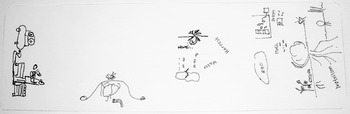
At the first meeting, the facilitator introduced a tool for situation analysis: drawing a ‘rich picture’ (Sunnersta Herrgård, 4 March 2002) of what was thought to have impact on the farmers' cabbage production, as a prompt for discussion of different viewpoints and priorities. A few farmers drew something on the paper, not really listening to instructions and without much enthusiasm. The resulting picture (Fig. 5) shows a few unconnected illustrations; the farmers may have realized that the participatory determination of the focus area of the study was redundant since the boundaries already had been decided in the original research application. The facilitator considered the exercise a failure, the picture was not much discussed and the tool was not used again during the study.
The ‘rich picture’ from the first meeting (F1, 2, 5, 6 Sunnersta Herrgård 4 March 2002) (Copied and translated by author).

The participants' stated goals all stayed within the limits set by the aims of the research study. So did all the questions expressed in the matrix table produced at the third meeting. The facilitator's own self-reflection on the process at that time included:
Is there a need for working with group dynamics, in order to broaden the context and expand the area of interest? (Given that the tasks of the group were already set by the study design). How to deal with the conventional pattern of interaction, with the researchers giving suggestions on what to do, and farmers asking for suggestions? (Facilitator's diary, April–July 2002)
The research application had claimed that the study would be ‘participatory driven research’. The farmers had been introduced to this phrase when invited to participate. When the facilitator was invited to join the project, the written application described PLAR as an evaluation method. The study coordinator pushed for improving the ‘qualitative experiences’ in the project. The advisor responsible for the WP had, together with the facilitator, worked in a PLAR group before. Discussions between the facilitator and the study coordinator and advisor resulted in a decision to work for as ‘high a level of participation as possible under the circumstances’; the meaning of this phrase was not further discussed. For the facilitator, it implied a process of ‘striving for’ this goal, i.e., collegial decision making on what situation was to be improved, what questions were to be asked and how they should be explored, analyzed, concluded and presented. The participants agreed to the general aim during the second meeting of the group, influenced by the fact that the farmers had clearly stated in the negotiated group contract that each member should take an interest in each farmer's trials and research questions.
The facilitator had been requested by the program coordinator to prepare a written article on the process and trial results. The initial intention was that this should be co-authored together with the advisor and researchers (R4:1, R4:2, SC), and published under all WP 4 participants' names as a way of acknowledging the essentially collective nature of the enterprise. The writing turned out to be problematic: roles, process and content all proved contentious. The status of the article was ‘down graded’ to a reportReference Eksvärd10. In the end no one had anything to add and the facilitator remained the sole author.
Analysis and Discussion
These findings lead into discussion of two challenges that surfaced during the project. The first has to do with the robustness of the data generated. Questions were raised about the role of the PLAR WP as a disruptor of conventional research trials, leading to impure data that could not be analyzed using conventional methods: in brief, the loss of methodological rigor led to a ‘failed’ research outcome. The second had to do with the ‘stability of the research object’. The PLAR process stimulated the participants to observe, measure, analyze and learn, leading to changes in both understanding and directly to changes in the on farm practices. These two challenges prompted the team to query the whole enterprise: was the ‘bastard’ design, mixing conventional and participatory elements, fit for purpose? I address each of these challenges in turn.
The outputs of the overall study were reported at a Nordic Association of Agricultural Scientists seminar (posters 6–1013), focusing on forms of green manure, changes in soil bacterial community, soil content, intercropping issues related to insect pests and options for handling competition with the main crop. Other results publishedReference Elfstrand, Båth and Mårtensson14, Reference Elfstrand, Lagerlöf, Hedlund and Mårtensson15 focus on the impact of fresh green manuring material compared to digested, and on the difficulties in quantifying carbon flows because of the higher heterogeneity in farm fields compared to controlled laboratory experiments.
In the end report to the funding agency, the only quantitative result presented from WP 4, though not statistically proven, was that plough-in of mature ley gave a production increase to the next cabbage crop compared to plough-in of harvested ley. At the evaluation day, all participants agreed on R 4:1's comment on this finding ‘We already knew before, that green manuring [in this case plough in of ley] was great … and we still know that’. And farmer 1 added ‘You could not participate if you didn't know that!’ – which the advisor agreed was correct (Sunnersta Herrgård, 18 February 2005). So, quantitative results from WP 4 can be said to be nil.
However, we argue that this failure does not amount to a claim that reliable knowledge was not generated. All farmers at the start of the project shared a concern about their reliance on an imported pelleted poultry manure product. By studying Table 1, we can see that the most positive farmer, F2, only carried out trials on the basis of ploughing in of the full ley crop. F3 based almost all his trials on harvested ley; F4 also based his trials on harvested ley; the ones he based on full ley were the trials on mulching and intercropping. These proved problematic and did not yield the learning he had expected. From the facilitator's perspective, it was clear that these two farmers had tried alternatives that did not, or could not, fit their existing system. The farmers concluded that the project appeared for them simply to have proven the necessity of using the imported pelleted manure product. F5 had undertaken only the trials based on harvested ley, but he did not come to the evaluation and did not respond to request for a follow-up interview. F6 said he had learnt about mulching but did not mention his own trials during the evaluation. F3, 4, 5 tried harvested ley with no extra treatment which, especially for F4 with light soils, caused financial losses. From a researcher perspective, these manuring trials were judged by R 4:1 to be equivalent to treatments that yielded reliable results (Sätrabrunn, 21 August 2004). Although this assessment must be modified by the fact that no measurements were taken of the material added, it could be argued that the varying judgements on what results the on-farm trials produced are essentially differences in claims about what is effective knowledge in relation to a purpose.
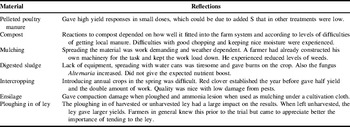
The experience further indicates the different weight scientists and facilitators give to knowledge as an end product and learning as a process of knowledge generation. An examination of the information in Table 5 shows that though learning has been going on, there are not many results that the participants together could not have foreseen. The farmers commented that actually they did not know if any of the results were relevant because the results were presented independently of information on the environmental context. They especially asked for future studies to take account of energy consumption of alternative practices (Sunnersta Herrgård, 18 February 2005). These comments link to the literature on innovation systemsReference Barnett16, Reference Hall, Rasheed Sulaiman, Clark and Yoganand17 that emphasizes ‘working with and reworking the stock of knowledge is the dominant activity in innovation’Reference Arnold and Bell18. It also links to workReference Cook and Brown19 that distinguishes an epistemology of possession (knowledge that can be built, owned, circulated and used for innovation) and an epistemology of action (knowledge that is produced during the process of acting).
Participants' reflections following the use of the different manuring strategies.

Source: End report to funding agency, The Swedish Resource Council Formas, n.d., and Sunnersta Herrgård 18 February 2005.
Analysis of the findings further highlights a number of organizational issues. The implications of having a PLAR WP added to the project were initially not clear to the participants in the planning group. While, for instance, the advisor envisaged that farmers would play a driving role in the overall execution of the WP, the researchers, who were unfamiliar with PLAR theory and processes, envisaged a more conventional division of responsibilities that left scientists in control. PLAR in early study descriptions was called both a ‘method’ and an ‘evaluation model’. The WP 4 advisor, and later the facilitator, brought into the planning process additional information, experience and theoretical knowledge related to trans-disciplinary, symmetrical, systemic research. In some instances, the initial reaction from scientific colleagues to these contributions tended to be dismissive or explicitly negative. Right from the start, connecting the PLAR activity to a conventionally framed scientific study turned out to be rather difficult and controversial.
As the work progressed the issue of ‘knowledge possession’ was revealed in the way the work was organized. For instance, the farmers' trials and fields were used by researchers in WPs 1–3 for collecting soil samples, checking pathogen frequency and measuring quality parameters in the cash crop (cabbage). The farmers were also asked to suggest the levels of manuring that should be used in the research station trials, about how to develop appropriate machinery, cash crop varieties for the research station trials as well as to identify the crops that could be of interest in the intercropping trials. Thus, the researchers drew extensively on farmers' knowledge as an input into their own work.
In the on-farm trials, we do not see a simple symmetrical reversal, with farmers using inputs from researchers to drive their own experimental work. The plans for the on-farm work were drawn up by the researchers. When the plans were presented to the farmers, they had plenty of questions and comments. Their ideas and viewpoints were aggregated into 20 sub-paragraphs in the meeting memos. The items listed and the general discussion can be clustered into different categories: (1) those that accepted the framing as a given but raised questions of implementation, like lack of necessary equipment and varieties of crops that would fit their systems; (2) those that sought to extend the boundary of the innovation space by raising questions like ‘Could not the intercrop be cut in the middle of the season and be used for mulching?’; and (3) questions that challenged the researchers' assumptions about the purpose of the trials in relation to the farmers' own systems, such as how to organize the flow of nutrients among farmers who had access to horse, poultry and cattle manure, compost from fungi production, or discarded ensilage and those who did not. The organization of the work in this project meant that, whatever the claims and intentions, the third category simply could not be included in the overall study. Farmer 2 actually did try composting horse manure, a main reason for his contentment with the project, but this was not reported among the trials in the end report to the funding agency.
In addition, it is clear with hindsight that there was insufficient attention paid to farmers’ decision making and management roles. The farms were not simply a site for a particular kind of activity, namely on-farm trials, but dynamic contexts purposively managed through time and space to capture market opportunities. ‘Reading the context’ from different perspectives proved a challenge. Although the advisor and researchers visited the individual farms on numerous occasions, several of the on-farm trials proved quite problematic from their point of view. The problems from the researchers' perspective included missing and broken equipment, late planting, ammonia damage on leaves, bird damage, time-consuming new procedures, heavy work, etc. From the farmers' perspective the challenge was more a question of how to manage the trials in a context of their ongoing decision-making and systems management processes. Eventually the farmers concluded that they could not evaluate the economic performance of the trials. There were too many first time problems and farmers had not had time to learn how to manage the options and adjust their management and working practices to accommodate them.
Catalyzing changes in the farm enterprise
In a discussion of changes and developments on the farms during the trials, one farmer said the following;
We have all done that, you catch a bit here and a bit there and mix them according to your own circumstances and views, and then you do not need to make all the mistakes (F3, Sunnersta Herrgård 18 February 2005)
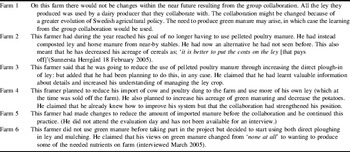
His meaning was, this is the normal way we learn how to improve our practice, i.e., knowing in action. In order to clarify more exactly what changes on farm had been catalyzed by the project, a discussion tool was used, pictured in Figure 3a and b. This was complemented by an in-depth interview with one farmer. The farmers' perceptions of the main changes are presented in Table 6. The farmer on farm 2 said that he had come much closer to developing a farm system that runs on the available local and regional nutrient resources. This farmer expressed clearly that he wanted to develop his ‘farm system’; a system that is fun to manage, profitable and does not demand the performance of many unpaid chores, i.e., he was seeking systemic improvement rather than problem-solving knowledge.
Changes on farm arising from the group collaboration.

Source: Sunnersta Herrgård 18 February 2005.
We can see clearly reflected here that it is not enough for scientists who seek to support ecological agriculture to understand learning as ‘situated in practice’, and ‘on-farm trials’ as a sufficient practice to provoke transitions in understanding and system management. If a farmer tries something that is not of interest to his system, the only thing that will be learnt is that it was not of use to his system, and there will not be any catalyzing effect from a project intervention. For example, farm 1 had selected composting ley from the suite of on-farm trial options, a practice the husband and wife on farm 1 themselves judged as follows ‘composting ley is absolutely mad on our farm’ (Sunnersta Herrgård 17 February 2005). Their own idea of composting spoiled ensilage (for them, an easily accessible resource) was not included in the trial options. This in turn raises an issue of increasing importance, not only in organic horticulture but also in wider societal debate, on how to assist agricultural sectors to move toward agro-ecological sustainability. What is at stake for the scientific community is researchers' preparedness to place their knowledge and practice in society in ways that catalyze the transitions that seem to be needed.
The methods and approach: were they fit for purpose?
In this section, we discuss briefly a response to the key questions for this article. At the time of planning and initiating the study, when the most important decisions for the development of the process of the PLAR group were taken, a disciplinary-based natural science research approach was taken as the standard. There did exist an understanding of the need to find solutions to practical problems on a broader base than purely disciplinary or single-factor studies, and that the research process needed to come into more contact with production practices in order to deliver results relevant for farmers. This was the basic motivation for inviting farmers into the study. Yet from the start the project contained a hidden controversy. The questions to be studied were focused on well-defined variables, bounded by the researchers' understanding, planned as discrete activities and constructed around quantitative researcher-designed and -managed trials. Thus, in WP 4, quantitative trials were planned for qualitative goals. It is revealing that at the end of project the participants of WP 4 were talking about quantitative ‘trials and research’ and contrasting them to qualitative ‘work’.
Although there was an awareness of the importance of developing a fuller picture through a more systemic approach, it was assumed that this could be achieved by connecting the parts once the study had been accomplished. The project claimed to be ‘working with systems’, but there was no formal description of what ‘the systems’ were, how they could be conceptualized or how they should be analyzed. The systems to be studied were ‘bounded down’, i.e., restricted to a selection of manuring strategies that were claimed to be multifunctional ‘tools’. But there was no explanation of, for instance, how digested sludge could be a tool against weeds and pests. The effort to build a systems model from the results of the component parts of the project was never formally completed by the end of the project.
Within a ‘participant driven’ PLAR approach, the farmers would have been invited to explore a wider area of interest, like organic vegetable production or nutrient management in organic vegetable production. The focus would have been developed thereafter on the basis of shared interests between the participating farmers as well as the researchers. However, in this case, the relevance to farmers was assumed to be secured through the possibility of choosing one more additional treatment to those already planned. In striving for relevance, the farmers had additional opportunities to carry out adaptations on their farms, involving changes, subtractions and additions to the design of the trials. During this process, the trials gained in systemicity as they were adapted to real farm systems, but they lost systematic rigor and as a result of the increasing diversity and by management decisions that departed from conventional scientific standards. It proved impossible to implement well-functioning trials when, without reflection, there was pressure to merge the intentions of two approaches, i.e., when objective, single-factor trials that could yield data for augmenting research knowledge, were conflated with trials progressively adapted toward systemic research aiming at situation improvement. To deliver the first would require negating the second aim; to deliver the second would re-position the first aim as a by-product of action-based learning.
The differences between the research approaches and between the methods used for implementation became clear in writing up the work of WP 4. For instance, distinctions were drawn between presenting the process of researching in order to understand farmers' agronomic practices, reporting scientific trial results and relating the experience of trying to facilitate and carry out PLAR. The writing brought many of the contradictions presented in this article to the surface. It became evident that allowing the ‘failures’ in the scientific aspects of the on-farm trials had been necessary for researching and learning in the participatory research process, and were needed to generate outcomes relevant for the aims and goals of organic farming.
Another way of considering the ‘fit for purpose’ question is to reflect on the new relationships that were constructed through the project. These undoubtedly produced moments of high connectivity, such as the meeting on 6 April 2004 when each participant had an opportunity to present and discuss his or her own experience of what they had learned from the project. Yet, the project also served to disconnect, as the evaluation process demonstrated, the different ways of acting, learning and knowing.
Farmers' knowledge and skills were meant to be used to evaluate the research questions already decided on, not contribute to the process of defining the research or the criteria by which outputs and outcomes were evaluated (contrast this to Bonny et al.Reference Bonny, Prasad, Narayan and Varughese20). Thus, the project clearly signalled an asymmetry in the way in which different kinds of knowledge, and of knowledge-generating methods, was valued. These differences in valuation of different knowledge, also described in Eshuis and StuvierReference Eshuis and Stuvier21 were instanced in many small events. For example, the steering committee scheduling trial planning on the very day WP 4 was initiated, and the WP 4 evaluation day was scheduled after the formal ‘sharing of results’.
Within WP 4, farmers' skills and knowledge were well used in a symmetrical process of learning, and appreciated. But at times, both within WP 4 and in the overall study, a very hierarchical relationship prevailed. To put it bluntly, the advisor gave plenty of approving feedback to the farmers for their contributions and work, the farmers expressed how much they valued the discussions with, and visits by, the advisor and researchers, while the researchers, both in the WP and the study, commented on how much they appreciated feedback from the research receivers on how interesting their research was. Researchers 4:1 and 4:2 when asked what they had learned from the study mentioned mulching, i.e., the manuring strategy that the farmers added, but at the same time, they did not mention that they had learned anything of importance for their own research (Sunnersta Herrgård, 18 February 2005). Interviews with the researchers who had asked for farmers' opinions and listened to farmers' reasons for making a particular combination of treatments or the problems of adapting trials for their own systems, failed to elicit any reference to systemic understanding or to shared learning even though the study drew on the farmers' knowledge to decide the treatments and the crops selected for the research station trials.
Conclusion
Scholz et al.Reference Scholz, Mieg and Oswald22 discuss how trans-disciplinarity sets science on ‘its head’ because its practice demands researchers move from the screening of a problem within a narrow theoretical perspective to identifying where in a messy situation their competence might contribute. It is concluded that this is not an easy change and it takes time to relate the contextual knowledge of farmers to the abstract knowledge of scientists. The conventional assumption of a hierarchy of knowledge in which truth, natural law and empirical tests of an objectively knowable universe stand at the apex, places lived and felt experience and contextual knowledge grounded in practice at the un-regarded base of the hierarchy. PLAR seeks to introduce greater symmetry in knowledge claims and the rigor of knowledge-generating processes, by means of procedural and relational changes. Yet, as this article evidences, PLAR as an add-on WP cannot hope to catalyze such transitions or instil lasting change. At best—which this article also evidences—it may catalyze temporary changes in procedure and relationships that open up spaces for shared learning. Research needs to be adapted to the systemic characteristics of the sustainability problems. This is needed to ensure that outputs and outcomes will contribute to improving agricultural sustainability.
It is a real pity that the strong competition for funding and need to do ‘good research’ to qualify in the research community makes it difficult to share such problems and ‘failures’. Without a conscious knowledge, awareness and trust of the each others' capabilities, and a collaborative environment where failures can be shared without fear of being judged, such collaboration will continue to be disappointing. This will affect the aims of gaining holistic understanding to facilitate transitions to reach the goals of improved sustainability.
Acknowledgements
A sincere gratitude to all the participants in the WP and the study, whose different contributions are the base for the learning presented in this article, and to all the people who in different ways have supported the writing process.