Introduction
In an ageing society, the wellbeing of older people is an important area for research and at the top of the public policy agenda (Wilhelmson et al. Reference Wilhelmson, Andersson, Waern and Allebeck2005). Considering steadily increasing life expectancy, very low birth rates and the high proportion of people over the age of 65 in Western societies, it is easy to understand the growing interest of both policy makers and social researchers in the conditions of older people, and the increasing attention paid in the last decades to the issue of their wellbeing.
As regards subjective wellbeing, many authors have recognised the different ways it can be measured and distinguished (Dolan and Metcalfe Reference Dolan and Metcalfe2012; Kahneman and Deaton Reference Kahneman and Deaton2010). Among them, a common measure is life evaluation, referring to a person's thoughts about his/her life and usually investigated considering life satisfaction. In gerontology, life satisfaction is a concept frequently used to assess subjective wellbeing (Pinquart and Sörensen Reference Pinquart and Sörensen2000; Silverman et al. Reference Silverman, Hecht, McMillin and Chang2008). A substantial body of research has, indeed, considered life satisfaction as subjective evaluation of the quality of life in general (Fagerström, Holst and Hallberg Reference Fagerström, Holst and Hallberg2007), an important factor in successful ageing (Berg et al. Reference Berg, Hassing, McClearn and Johansson2006; Daatland Reference Daatland and Johnson2005; Jan Reference Jan2004; Tate, Lah and Cuddy Reference Tate, Lah and Cuddy2003) and an indicator of efficacy in old age (Freund and Baltes Reference Freund and Baltes1998). Thus, it is important for policy makers to know how conditions of older people are linked with life satisfaction.
Good health, sound finances and social integration have all been demonstrated to influence positively the quality of life of older persons (Gaymu and Springer Reference Gaymu and Springer2010; George Reference George, Binstock and George2006; Pinquart and Sörensen Reference Pinquart and Sörensen2000); however, the picture is still far from clear (Meléndez et al. Reference Meléndez, Tomás, Oliver and Navarro2009). One problem, for instance, is connected with the fact that, since socio-demographic resources are strongly interrelated, their actual effect on life satisfaction needs to be clarified (Bourque et al. Reference Bourque, Pushkar, Bonneville and Béland2005; Fernández-Ballesteros, Zamarrón and Ruíz Reference Fernández-Ballesteros, Zamarrón and Ruíz2001). For example, the effect of physical health problems could be over-estimated if social integration is not controlled for, since physical limitations may inhibit people from interacting with friends and other individuals. Another problem which is underlined by the literature refers to the fact that the determinants of life satisfaction may differ by age, gender, living arrangements and cultural context (Bourque et al. Reference Bourque, Pushkar, Bonneville and Béland2005; Pinquart and Sörensen Reference Pinquart and Sörensen2000; Walker Reference Walker2005). Indeed, subjective wellbeing is influenced by the individual's aspirations, and these in turn depend on personal preferences and values, which are adjusted according to objective changes in the environment. Thus, the literature has proposed that the role of the determinants of older adults' wellbeing may change according to the environmental (cultural and institutional) climate and the individual circumstances in which people find themselves (Easterlin Reference Easterlin2008; Gagliardi et al. Reference Gagliardi, Marcellini, Papa, Giuli and Mollenkopf2010; Gaymu and Springer Reference Gaymu and Springer2010; Oshio Reference Oshio2012; Silverman, Hecht and McMillin Reference Silverman, Hecht and McMillin2000).
With respect to gender, some researchers have argued that wellbeing models do not apply to older men and women in the same way (Bourque et al. Reference Bourque, Pushkar, Bonneville and Béland2005; Gaymu and Springer Reference Gaymu and Springer2010; Pinquart and Sörensen Reference Pinquart and Sörensen2000), because differences in socialisation may lead to gender differences in goals and values and, thus, in sources of life satisfaction. Existing literature suggests a stronger relationship between socio-economic status and life satisfaction for men than for women, and a higher importance of social integration and functional ability for women's life satisfaction than for men (Bourque et al. Reference Bourque, Pushkar, Bonneville and Béland2005).
However, gender differences in the predictors of subjective wellbeing may be also influenced by living arrangements. For example, Gaymu and Springer (Reference Gaymu and Springer2010) suggested (and partially found) that gender differences in the determinants of life satisfaction do not hold in the same way if the older person lives alone. This may be due to the fact that, on the one hand, men do not or no longer have a partner to take care of the social aspects of their life, and, on the other hand, women do not or no longer have the financial support of a partner.
In fact, the issue of gender differences in the predictors of subjective wellbeing among older people is even more complex since it may be mediated by the environment. Many authors have indeed shown the importance of welfare regimes and cultural norms, for various aspects connected with wellbeing (Horstmann et al. Reference Horstmann, Haak, Tomsone, Iwarsson and Gräsbeck2012; Stevens and Westerhof Reference Stevens and Westerhof2006). Since most gender patterns in life satisfaction observed in the literature are explained through differential socialisation between men and women (see e.g. Oshio Reference Oshio2012), and socialisation likely depends on social and cultural context, one should be careful in generalising findings from one country to another.
In this paper, we consider the Italian case to shed further light on these points. Given the availability of a large sample of older adults with detailed individual and contextual data that overcomes the limits often reported in previous studies, we aim to analyse the factors associated with the life satisfaction of Italian older men and women, and whether these factors differ among those living alone. We examine whether the same conditions predict life satisfaction similarly (Cheng and Chan Reference Cheng and Chan2006), in a European country with a still relatively unbalanced gender system as Italy (Anxo et al. Reference Anxo, Mencarini, Pailhè, Solaz, Tanturri and Flood2011; De Rose, Racioppi and Zanatta Reference De Rose, Racioppi and Zanatta2008). In addition, we aim to verify whether in such a context the possible gender differences in determinants of life satisfaction persist or, as reported by Gaymu and Springer (Reference Gaymu and Springer2010), decrease among older people living alone.
The data are from two rounds of the survey ‘Aspects of Daily Life’, undertaken in Italy by the National Statistical Institute (Istituto Nazionale di Statistica (ISTAT)) in 2010 and 2011. They provide a nationally representative sample of almost 18,000 individuals aged 65 or older living in private households.
Background and hypotheses
Several studies that have examined the determinants of wellbeing of older people have emphasised the importance of gender (Berg et al. Reference Berg, Hassing, McClearn and Johansson2006; Cheng and Chan Reference Cheng and Chan2006; Mroczek and Kolarz Reference Mroczek and Kolarz1998; Pinquart and Sörensen Reference Pinquart and Sörensen2000, Reference Pinquart and Sörensen2001). More specifically, the empirical literature has suggested that older women are more sensitive than men to functional ability and to family and social relations (Bourque et al. Reference Bourque, Pushkar, Bonneville and Béland2005; Cheng and Chan Reference Cheng and Chan2006; Oshio Reference Oshio2012; Pinquart and Sörensen Reference Pinquart and Sörensen2000; Wilhelmson et al. Reference Wilhelmson, Andersson, Waern and Allebeck2005), whereas older men are more sensitive than women to economic security (Bourque et al. Reference Bourque, Pushkar, Bonneville and Béland2005; Pinquart and Sörensen Reference Pinquart and Sörensen2000). For example, in a meta-analysis of studies on life satisfaction, Pinquart and Sörensen (Reference Pinquart and Sörensen2000) found that social network integration was more closely related to life satisfaction for women, and socio-economic status was more important for life satisfaction and happiness for men. Other studies have found that older women mention functional ability and social relations as important determinants of quality of life more often than older men (Bowling Reference Bowling1995; Gurung, Taylor and Seeman Reference Gurung, Taylor and Seeman2003; Wilhelmson et al. Reference Wilhelmson, Andersson, Waern and Allebeck2005). Again, regarding the family, marriage is found to provide emotional connectedness to older people, but differently for men and women: the literature shows that men rely more on their partners for emotional support, whereas women also report support from their children (Stevens and Westerhof Reference Stevens and Westerhof2006).
Higher sensitivity to functional ability for women's life satisfaction is part of the common suggestion that they are more negatively affected by impairment than men, who are, instead, more likely to develop responses to negative moods (Nolen-Hoeksema Reference Nolen-Hoeksema2001). Further gender differences in wellbeing determinants have been explained by socialisation (see e.g. Cheng and Chan Reference Cheng and Chan2006; Oshio Reference Oshio2012). Current cohorts of Italian older men tend to have been socialised toward economic success and to developing their occupational careers, while Italian women grew up and spent most of their young and adult years in a context characterised by limited work opportunities. In addition, older women invested in family care, focusing on roles involving marriage, child-rearing, home-making and care-giving. Thus, socio-economic status is likely to be important in the evaluation of self and in the determination of subjective wellbeing for men, whereas family and social relations are likely to be important for the subjective wellbeing of women.
However, it is also worth asking whether these differences are confirmed for older adults living alone, since their proportion has become non-negligible (United Nations Department of Economic and Social Affairs/Population Division 2009) and is expected to further increase in the next few years (Keilman and Christiansen Reference Keilman and Christiansen2013). Gaymu and Springer (Reference Gaymu and Springer2010) suggest that the answer is probably negative. Women living alone do not or no longer have the economic support of a partner, and men do not or no longer have a partner to take care of the social and practical aspects of their life. These considerations have led the same authors to suggest that living arrangements may interact with determinants of the wellbeing of older men and women: social resources (traditionally considered important mostly by women) may increasingly influence the wellbeing of older men living alone and financial factors become an important source of wellbeing for older women living alone. Thus, gender differences in the factors influencing the life satisfaction of older people are expected to decrease among older people living alone.
However, Gaymu and Springer (Reference Gaymu and Springer2010) found only partial support for this hypothesis and there is no comprehensive evidence of gender differences in the correlates of older people's wellbeing. Previous studies have mostly concerned non-European countries (Bourque et al. Reference Bourque, Pushkar, Bonneville and Béland2005; Cheng and Chan Reference Cheng and Chan2006; Oshio Reference Oshio2012). In addition, some analyses suffer from data limitations: some researchers have considered only a limited number of factors as life satisfaction determinants (Berg et al. Reference Berg, Hassing, McClearn and Johansson2006; Wilhelmson et al. Reference Wilhelmson, Andersson, Waern and Allebeck2005), while other studies have focused on selected groups of older people (see e.g. Stevens and Westerhof Reference Stevens and Westerhof2006).
In addition, several studies have suggested the importance of factors associated with wellbeing in later life across institutional and cultural boundaries. According to this perspective, determinants are contextually bound and related to the political framework of a country (Horstmann et al. Reference Horstmann, Haak, Tomsone, Iwarsson and Gräsbeck2012; Silverman, Hecht and McMillin Reference Silverman, Hecht and McMillin2000), and the values and social norms prevailing in different sets of societies (Gagliardi et al. Reference Gagliardi, Marcellini, Papa, Giuli and Mollenkopf2010; Westerhof and Barrett Reference Westerhof and Barrett2005). Many authors have confirmed the importance of welfare regimes, cultural norms and gender-based expectations for various aspects connected with wellbeing (Horstmann et al. Reference Horstmann, Haak, Tomsone, Iwarsson and Gräsbeck2012; Stevens and Westerhof Reference Stevens and Westerhof2006). The importance of socio-cultural contexts is particularly strong in the current study, due to our hypothesis of gender differences in the determinants of life satisfaction among Italian older people. Most gender patterns observed by the literature described above are, indeed, explained through differential socialisation between men and women which depends on context. As a consequence, wellbeing in old age is not only an individual matter, but it also relates to the various constraints and opportunities available in different societies (Walker Reference Walker2005).
In this paper, we analyse gender differences in the correlates of wellbeing among older people in the Italian context, which retains important gender differences in many public and private aspects of the life course (Anxo et al. Reference Anxo, Mencarini, Pailhè, Solaz, Tanturri and Flood2011; De Rose, Racioppi and Zanatta Reference De Rose, Racioppi and Zanatta2008; Organisation for Economic Co-operation and Development (OECD) 2010) such as employment rates and wages, and allocation of household labour. Since these differences were more marked among older cohorts, we hypothesise that Italy is a suitable country to test gender differences in life satisfaction in old age. Our hypotheses follow two perspectives. We, first, predict that life satisfaction among older men is influenced by a good economic status (measured by education and economic security) more than among women, whereas the family network (represented by household composition and marital status) and social relations (friends, leisure and consumer activities), as well as physical functionality, are more important for women. Then, we investigate whether these differences disappear among older adults living alone, as a result of the life satisfaction of men becoming more sensitive to physical autonomy, family and social relationships, and that of women to economic status.
In fact, it could be that in Italy, even considering all elderly (and not only those living alone), gender differences as regards family resources are less marked than those found in previous literature. Italy belongs to those familialistic societies typical of southern (and eastern) Europe, where in contrast to more individualistic societies (de Jong Gierveld, Dykstra and Schenk Reference de Jong Gierveld, Dykstra and Schenk2012; Glaser and Tomassini Reference Glaser and Tomassini2000; Walker Reference Walker2005), intergenerational support is the norm and parents have strong expectations to receive support from adult children. In this context, family relationships are the most important source of life satisfaction among older people (Polverini and Lamura Reference Polverini, Lamura and Walker2005), and physical closeness (in the form of co-residence or frequent contact) with adult children may have a beneficial effect on a parent's wellbeing. Thus, it is possible that men could be as sensitive to physical closeness with children as women and no gender differences may be found of its effect on life satisfaction.
Data and methods
We use data from two rounds (2010 and 2011) of the cross-sectional survey ‘Aspects of Daily Life’, undertaken in Italy by ISTAT. Each round was based on nationally representative samples of approximately 20,000 households, with a total of more than 50,000 individuals. In our study, we focused on 17,249 individuals aged 65 and above, obtained pooling together older people of both rounds of the survey.Footnote 1 Thus, the study comprises older people living in private households, and excludes those living in nursing homes, hospitals or residential care.
The survey collected information on several dimensions of life. Besides basic demographic characteristics (age, sex), several items on health, lifestyle, religious practices and social integration for each household member were recorded. In addition, information on the socio-economic status of the family and on the family structure was gathered.
Life satisfaction, the focus of our study, was assessed with the question: ‘How satisfied are you with your life on the whole at present?’ Answers range from 0 (not satisfied at all) to 10 (very satisfied). This is our dependent variable in the regression models. Since this variable, as others considered in the analyses, are subjective measures, a potential limitation is that some results might reflect differences in reporting styles rather than true differences (see e.g. Angelini et al. Reference Angelini, Cavapozzi, Corazzini and Paccagnella2012, Reference Angelini, Cavapozzi, Corazzini and Paccagnella2013). Methods suggested by literature to overcome this problem cannot be applied in this context due to data unavailability. In fact, it is also true that some literature (see e.g. Berg et al. Reference Berg, Hassing, McClearn and Johansson2006) suggests that subjective wellbeing might be particularly important among older people, since it combines the effects of psycho-social and health-related variables.
The explanatory variables of interest for the study are grouped into three main domains: socio-economic conditions, health status, family and social relations. Two variables were used to describe the socio-economic background of individuals. Education has four categories: low (no schooling), middle-low (primary school), middle (junior high school) and high (secondary school or above). Economic situation is determined through a subjectiveFootnote 2 evaluation of the family's economic resourcesFootnote 3: a dichotomous variable was built distinguishing whether the family had poor or insufficient resources (as opposed to very good or good).
Health was described by three covariates. The first refers to a subjective perception of health. Individuals were asked how their health is, in general. We grouped the five available categories into three categories: good health (excellent or good), fair and poor health (poor and very poor). A second variable referring to the self-reported presence of limitations in usual activities distinguishes three categories: severe limitations, only mild limitations, no limitations. Lastly, the presence of at least one chronic illness (from a list of 15 common chronic diseases) was taken into account.
Family resources were investigated considering a combination of living arrangements and marital status. Living arrangements were separated into four groups: (a) living alone, (b) living only with partners, (c) living with a partner and with other persons, (d) living without a partner but with other persons (henceforth identified as ‘alone with others’). In fact, most of these ‘other persons’ living in groups (c) and (d) are adult children; 89% of older people of group (c) live with at least one child, and 78% among group (d). Unfortunately, the survey does not provide data on the presence of non co-resident children, or on the frequency of contact between parents and these children. Thus, there is no information about the family network of older people living in a one-person household. In order to attenuate this problem, the marital status of older people living alone (never married, separated or divorced, and widowed) was specified. This categorisation may be considered a still imprecise proxy of family network since a strong association between marital status and intergenerational support and contact has been found using other empirical data.Footnote 4
Two other domains were examined to describe social relations: social network integration and active lifestyles. Social integration was measured as participation in the year prior to the interview in different social activitiesFootnote 5; those who participated in at least one activity were distinguished from those with no participation. In addition, how often individuals met their friends was taken into account (every day, at least once a week, less often than once a week, never or without friends). Active lifestyles were measured considering physical activity, going on holiday and attendance at cultural activities. Physical activity distinguished individuals who played sports regularly or occasionally or engaged in physical activity at least once a week, those who were rarely physically active and those without any physical activity. Holiday and cultural activities considered whether individuals had gone on holiday and to some cultural or entertainment venues,Footnote 6 respectively, in the last year before the interview.
Several other characteristics representing possible individual differences were included in the analyses as controls. First, age (five-year age classes) and religiosity (attendance at religious services: at least once a week, sometimes in a month, sometimes in a year, never) were included. Furthermore, we considered the characteristics of the place of residence. Besides the geographical area of residence (northern versus central-southern Italy), this aspect was measured by the type of municipality (metropolitan area, suburbs, town with more than 10,000 inhabitants and small town with less than 10,000 inhabitants), and by two other covariates describing the characteristics of the neighbourhood (presence of problems and availability of servicesFootnote 7). Finally, the year of the interview was considered.
Multivariate analyses were applied to study the association between older people's life satisfaction and their living circumstances; since our dependent variable is continuous, linear regression models were used. In using linear regression analyses, we tested for violations of assumptions, and none were found. Normal P-P plots of regression standardised residuals showed no deviation or minor deviation from the expected cumulative probability. Separate analyses were developed for both men and women as a whole and for men and women living in one-person households. From a statistical viewpoint, the most efficient strategy to compare the effects between men and women consists of pooling the data and including all interactions between gender and covariates. This procedure has the disadvantage that the presentation and the interpretation of the results can be burdensome. As a consequence, the alternative method used here, consisting of the estimation of separate models, is preferred. In this perspective, we can formally test whether the differences between covariates are statistically significant, following the approach used by Liefbroer and Corjin (Reference Liefbroer and Corjin1999) and by Hango and Le Bourdais (Reference Hango and Le Bourdais2007). They considered the formula:
 $$z = \displaystyle{{b_{\rm m} - b_{\rm f}} \over {\sqrt {s^2 (b_{\rm m} ) + s^2 (b_{\rm f} )}}} $$
where b m is the estimate for men and b f for women, s 2(b m) is the variance of b m and s 2(b f) of b f. In this way, we use a conservative approximation of the standard error of the difference between the parameter estimates for men and women, since in this formula the covariance is lacking (due to missing data). However, the approximation will usually be quite good, since the covariance between the estimates of men and women will be relatively small in most instances (Liefbroer and Corjin Reference Liefbroer and Corjin1999).
Describing the sample characteristics in a gender perspective
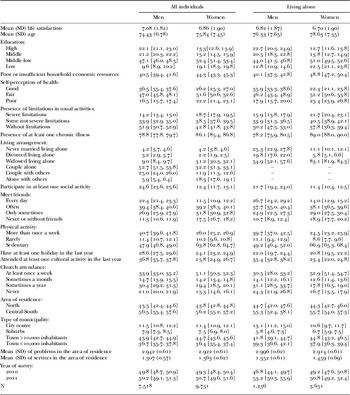
At first glance (Table 1), women 65 or over are, on average, significantly (p<0.01) less satisfied with life than men of the same age. This is in line with the literature (Easterlin Reference Easterlin, Sirgy, Rahtz and Samli2003; Inglehart Reference Inglehart2002; Pinquart and Sörensen Reference Pinquart and Sörensen2001). However, men's and women's living circumstances differ in several respects. First, women are on average older than men, and this clearly influences other conditions, such as living arrangements: women are found to be more likely to live alone as widows (31.2% versus 9%) or with others (18.3% versus 5.9%), and less likely to live with a partner (44.1% versus 77.7%). In addition, as found in other studies (Eurostat 2002; and studies cited by Ross, Masters and Hummer Reference Ross, Masters and Hummer2012), women are generally more disadvantaged than men, having poor or insufficient household economic resources in higher proportions (44.3% versus 40.5%), lower educational levels (19.1% of women have low education, in comparison with 9.6% of men), higher proportions with disabilities (57.2% versus 48.1%) and poorer perceived health (22.2% versus 16.5%). Men present higher social integration than their female counterparts, since they have more contact with friends, and participate more in physical, social and cultural activities (22.4% of men meet friends every day, compared to 11.5% of women). As regards background characteristics, women are more involved in religious practices than men (51.1% attend church at least once a week, for men, this decreases to 33.9%). However, no differences are found between men and women with respect to the context of residence, in that there are no distinctions in the quality and services within the neighbourhoods or the type of municipality.
Percentage distribution of variables for all men and women of the sample and for those living alone

Notes: Values in square brackets are confidence intervals at the 95 per cent level. SD: standard deviation.
Similar remarks hold for older people living alone (differences in the life satisfaction of men and women are significant at 0.02 level). As Table 1 illustrates, they may be a selected group of individuals since, although on average are older than those living with other individuals, they have, for example, similar self-perceived health and social integration.
Results
Tables 2 and 3 present the coefficients of the linear regression models used to estimate the determinants of life satisfaction for respondents aged 65 and over as a whole and living alone. Model 1 considers the effect of family resources and the socio-economic background of individuals together with the controls of age and religiosity; model 2 adds the health conditions variables; model 3 takes into account also social relations and the final model 4 considers also the residential environment and geographical area of residence. For both the final models (for respondents aged 65 and over as a whole and for those living alone), the statistical significance of the difference of parameters for men and women is tested following the approach described in the Data and Methods section.
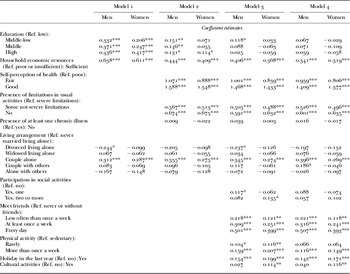
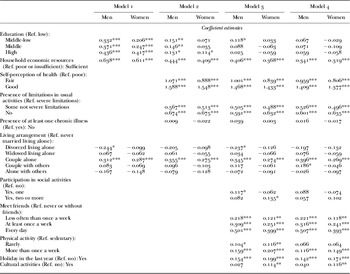
Determinants of life satisfaction of men and women aged 65 and over
Notes: Model 1 controls also for age and religiosity; besides age and religiosity, model 2 takes into account health conditions; model 3 controls also for social relations; model 4 adds area of residence, type of municipality, problems and services in the area of residence, and survey year. Ref.: reference category.
Significance levels: * p<0.1, ** p<0.05, *** p<0.01.
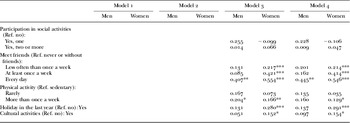
Determinants of life satisfaction of men and women aged 65 and over living alone
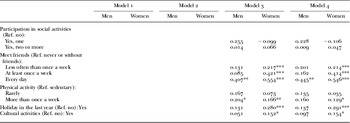
Notes: Model 1 controls also for age and religiosity; besides age and religiosity, model 2 takes into account health conditions; model 3 controls also for social relations; model 4 adds area of residence, type of municipality, problems and services in the area of residence, and survey year. Ref.: reference category.
Significance levels: * p<0.1, ** p<0.05, *** p<0.01.
Results of separate analyses for men and women considering the whole sample suggest only slight gender differences in the determinants of life satisfaction (Table 2). We found that economic conditions are relevant in the same ways for life satisfaction for both men and women. The subjective evaluation of household economic resources has, indeed, a significant effect in both populations; education does not show any significant effects in the final models (the eighth and ninth columns of Table 2), their initial effect (the second and third columns of Table 2) being absorbed mainly by health conditions for women, and also by lifestyles for men. The greater importance of functional ability on life satisfaction for women than for men found by some previous studies was not confirmed. For both men and women, either subjective perception of health or limitations in usual activities are associated with life satisfaction with no statistically significant differences. With respect to social and family relationships, the results show a rather complex picture. On the one hand, men's satisfaction seems to be slightly more sensitive to family resources than that of women. For both men and women without significant gender differences (z=0.97, p>0.10), living as a couple has a significant and positive impact on their life satisfaction. Living only with a partner increases the score of satisfaction of 0.396 points for men and of 0.269 points for women with respect to the condition of living alone; however, only among men, living with a partner and other persons is a source of life satisfaction, even if the effect and the gender difference is weakly significant (z=1.68, p<0.10). On the other hand, women's satisfaction seems to be only slightly more sensitive than men to benefits of social integration. Having contacts outside the family (meeting friends often and being physically active) has a significant and positive effect on life satisfaction of older people, independent of gender. For example, meeting friends every day increases the score of life satisfaction of 0.507 points for older men and of 0.393 points for older women compared to respondents who never meet friends. However, there are some hints suggesting that life satisfaction for women is more sensitive to cultural activities than that of men, even if gender differences are not significant (z=−1.15, p>0.10).
The results of our multivariate analyses are not consistent with our hypotheses, even with respect to men and women living in one-person households (Table 3). In particular, the hypothesis of a convergence in the determinants of life satisfaction for men and women is not completely confirmed. Instead, some differences between men and women in aspects connected with life satisfaction are found. Whereas for both men and women economic conditions and self-rated health are important for life satisfaction, some other characteristics seem to be gender-specific. In particular, a high educational level is positively associated with life satisfaction only for men, even if the gender differences are only slightly significant (z=1.70, p<0.10). Physical limitations decrease life satisfaction mainly for women: the effects of this variable are relevant also for men, but to a lesser extent (z=−1.68, p<0.10). In addition, women seem to be more sensitive than men to active lifestyles (cultural activities, holidays and physical activity), even if gender differences are not significant. Finally, after controlling for environmental characteristics, marital status does not seem to be relevant for the life satisfaction of both men and women (z=−0.49, p>0.10 for divorced living alone; z=0.89, p>0.10 for widowed living alone).
Unexpected results are found even with respect to the effect of family resources on life satisfaction. Living as a couple without other persons in the household is positively associated with wellbeing for both men and women without significant gender differences (as seen above), but living with persons other than the partner is not always predictive of greater satisfaction in comparison with respondents living alone. Only in the case of men, living with a partner and others has a significant (even if weak) positive effect on life satisfaction; in fact, as seen above, the gender difference is only slightly significant (z=1.68, p<0.10). Women living with others (mainly adult children), with or without a partner, and men living only with other persons (mainly adult children) are not significantly more satisfied than their counterparts living alone. Moreover, potential frequent contact with children defined by marital status has no significant positive effect, even on older people living alone.
Discussion and future research
This paper analyses the determinants of life satisfaction of older people living in private households in order to verify whether some hypotheses suggested by the literature (e.g. Cheng and Chan Reference Cheng and Chan2006; Gaymu and Springer Reference Gaymu and Springer2010; Oshio Reference Oshio2012) hold for Italian older people at the end of the first decade of the twenty-first century. The availability of both a large sample of individuals representative at the national level and detailed data on individual and contextual characteristics of older people allowed us to examine whether: (a) women's satisfaction is more sensitive to health conditions and to family and social relations, and that of men is more sensitive to socio-economic situations; (b) older people living in one-person households present determinants of life satisfaction which are less gender differentiated.
The findings are not consistent with these assumptions. In a country with a still unbalanced public and private gender system, we did not find clear gender differences in the determinants of life satisfaction among the older adults considered as a whole. With few exceptions, economic security, functional ability and social integration are all conditions that, in the same way, significantly contribute to the life satisfaction of older men and women. Thus, we find neither evident and significant gender differences in the determinants of life satisfaction of older adults as a whole, nor differences which clearly move in the direction suggested by the literature: that older women's life satisfaction is shaped much more by social and health aspects than men, and that men are more sensitive than women to economic factors. Instead, only some slight gender differences are found among older people living alone in the direction suggested by the literature for the older adults as a whole.
How can we explain these results? We cannot exclude the fact that, even in a Mediterranean context such as Italy (not considered by previous studies), the differences in socialisation of the men and the women of these cohorts are not strong enough to clearly influence the determinants of their life satisfaction when they reach older ages. Alternatively, it could be that, at this age, health, social and family relations, and financial status become relevant for life satisfaction, independently of the gender preferences at previous ages. Another (more likely) explanation could be that life satisfaction is influenced by the behaviours and by the preferences of co-resident individuals and, thus, the differences may be less clear if we consider the population as a whole. Instead, since this contamination effect does not operate among those living alone, some (weak) differences are found in the determinants of life satisfaction.
This study is also the opportunity to explore how family resources influence the life satisfaction of older adults in a southern European country characterised by strong family ties (Dalla Zuanna and Micheli Reference Dalla Zuanna and Micheli2004). The results are rather unexpected. While living in a couple is beneficial for the life satisfaction of older adults (e.g. as found by Lowenstein, Katz and Gur-Yaish Reference Lowenstein, Katz and Gur-Yaish2007), we do not find evidence to support the hypothesis that in a familialistic country, such as Italy, physical closeness with adult children is beneficial for the life satisfaction of older adults. Moreover, among those living alone, life satisfaction is not differentiated by marital status even if we can demonstrate that marital status is highly associated with the frequency of contact with adult children.
The results for older people living alone could depend on the fact that physical closeness with adult children is not measured in a completely precise way. Thus, further information is needed to better control for the possible heterogeneity of this group. In particular, information is needed on the relative network (especially, adult children and grandchildren), which literature has shown to be important for life satisfaction among older people (Gabriel and Bowling Reference Gabriel and Bowling2004; Gaymu and Springer Reference Gaymu and Springer2010), and on the health of close relatives.
However, the data deficiency cannot explain why co-residence with adult children does not significantly increase the life satisfaction of older people. This result could be the effect of a process of individualisation of older adults who in more recent cohorts are increasingly engaged in active lifestyles (ISTAT 2000, 2009). In this perspective, co-residence with adult children might no longer be considered a choice, but rather a constraint (and a possible source of intergenerational conflict). An in-depth analysis on households (whose results cannot be accommodated into the models) does not exclude this hypothesis. When older people live with their adult children, indeed, these are mainly never married (78% of older individuals with co-resident children live with at least one never married child); thus, in this case, intergenerational co-residence is principally a matter of the child's late transition to adulthood, and this can be negatively associated with life satisfaction (as found, for example, by Oshio Reference Oshio2012). Moreover, a relevant portion of children co-residing with older people (41%) are not employed; in these cases, co-residence is likely to be a financial necessity, particularly in the years of the surveys when the financial crisis hit Italian households quite severely (OECD 2013; European Commission 2013). In this context, we could speculate that living with their partner and other persons is less satisfying for women than for men due to the additional unpaid domestic work.
In summary, this study suggests that the effect of family resources on the life satisfaction of older adults should be examined taking into account also the quality of their relations. More generally, some caution should be used on either (a) generalising differences in the gender system on the determinants of life satisfaction among older people, or (b) considering all southern European countries as an undifferentiated familialistic environment.