Introduction
The Diagnostic and Statistical Manual of Mental Disorders (DSM-5) defines post-traumatic stress disorder (PTSD) as a trauma and stressor-related condition precipitated by a traumatic event. PTSD is characterized by symptoms of re-experiencing, avoidance, negative cognitions and mood, and hyperarousal which cause significant distress and functional impairment. The diagnosis of PTSD requires at least one month of continuous symptoms following exposure to a traumatic event (American Psychiatric Association, 2013).
PTSD may be considered a disease of both mind and body. In addition to the debilitating post-traumatic symptoms, PTSD is associated with high rates of Axis I psychiatric comorbidities, including mood, anxiety, and substance use disorders (Pietrzak, Goldstein, Southwick, & Grant, Reference Pietrzak, Goldstein, Southwick and Grant2011). PTSD has also long been implicated in the etiology of various somatic diseases, such as gastrointestinal disorders and cancer. In recent years, literature support has emerged for an association with cardiovascular diseases (CVD) (Gradus, Reference Gradus2017), including unstable angina, myocardial infarction, transient ischemic attack, stroke, and deep vein thrombosis and pulmonary embolism (Edmondson & von Kanel, Reference Edmondson and von Kanel2017; Gradus et al., Reference Gradus, Farkas, Svensson, Ehrenstein, Lash, Milstein and Sorensen2015).
Hypertension is a known major modifiable risk factor for CVD (Protogerou et al., Reference Protogerou, Panagiotakos, Zampeli, Argyris, Arida, Konstantonis and Sfikakis2013) and may serve as a critical mediator in the pathway by which PTSD increases CVD risk. However, only a few longitudinal studies across a limited number of settings have investigated the association between PTSD and incident hypertension. Most of them assessed populations that had been exposed to combat- or war-related traumatic events: cohorts of war veterans (Burg et al., Reference Burg, Brandt, Buta, Schwartz, Bathulapalli, Dziura and Haskell2017; Schnurr, Spiro, & Paris, Reference Schnurr, Spiro and Paris2000) and of service members severely injured in combat (Howard et al., Reference Howard, Sosnov, Janak, Gundlapalli, Pettey, Walker and Stewart2018), Bosnian war refugees (Vukovic, Jovanovic, Kolaric, Vidovic, & Mollica, Reference Vukovic, Jovanovic, Kolaric, Vidovic and Mollica2014), and relatives of soldiers killed during the 1992–1995 war in Bosnia and Herzegovina (Santic, Lukic, Sesar, Milicevic, & Ilakovac, Reference Santic, Lukic, Sesar, Milicevic and Ilakovac2006). Civilian samples included a cohort of female nurses (Sumner et al., Reference Sumner, Kubzansky, Roberts, Gilsanz, Chen, Winning and Koenen2016), World Trade Center Health Registry enrollees (Li, Zweig, Brackbill, Farfel, & Cone, Reference Li, Zweig, Brackbill, Farfel and Cone2018), a representative sample of patients from Taiwan's National Health Insurance program (Lin et al., Reference Lin, Chung, Chen, You, Chien and Chou2019), and participants in an international household survey (Stein et al., Reference Stein, Aguilar-Gaxiola, Alonso, Bruffaerts, de Jonge, Liu and Scott2014).
Among several potential confounders of this association, higher body mass index (BMI), antidepressant use (Lin et al., Reference Lin, Chung, Chen, You, Chien and Chou2019; Sumner et al., Reference Sumner, Kubzansky, Roberts, Gilsanz, Chen, Winning and Koenen2016), untreated PTSD status (Burg et al., Reference Burg, Brandt, Buta, Schwartz, Bathulapalli, Dziura and Haskell2017), chronicity of PTSD diagnoses, and injury severity (Howard et al., Reference Howard, Sosnov, Janak, Gundlapalli, Pettey, Walker and Stewart2018) were shown to be independent risk factors for incident hypertension. Edmondson and von Kanel (Reference Edmondson and von Kanel2017) have concluded that further studies are needed, particularly with non-American, non-veteran populations, and should include a rigorous adjustment for depression and lifestyle as well as for established CVD risk factors.
Most extant research on PTSD has focused on people who have experienced combat- and war-related traumatic events. There is, however, marked heterogeneity in the populations at risk for PTSD, which include victims of sexual assault, domestic violence, torture, armed robbery, and motor vehicles accidents, child abuse survivors, refugees, patients with cancer and other serious diseases, firefighters, police officers and other high-risk professions, and populations exposed to natural disasters, such as tornadoes, wildfires, and landslides (Luz et al., Reference Luz, Mendlowicz, Marques-Portella, Gleiser, Berger, Neylan and Figueira2011). Efforts should also be made to foster research on these and other population groups at increased risk for traumatic stress.
The mental health of people dwelling in urban slums is a significant problem demanding urgent consideration and action (Ezeh et al., Reference Ezeh, Oyebode, Satterthwaite, Chen, Ndugwa, Sartori and Lilford2017). According to the United Nations (2003), a slum is a ‘contiguous settlement where the inhabitants are characterized as having inadequate housing and basic services; a slum is often not recognized and addressed by public authorities as an integral part of the city’ (p. 10). In the last 50 years, a massive growth of the population living in slums took place mainly in the low- and middle-income countries (Ezeh et al., Reference Ezeh, Oyebode, Satterthwaite, Chen, Ndugwa, Sartori and Lilford2017). People residing in slums are exposed to multiple traumatic events, such as turf wars between drug-dealing gangs (Rodgers, Reference Rodgers2009), landslides (Smyth & Royle, Reference Smyth and Royle2000), fires (Wong et al., Reference Wong, Nyachieo, Benzekri, Cosmas, Ondari, Yekta and Breiman2014), floods (Rashid & Halder, Reference Rashid and Halder1998), and domestic violence (Peerzada & De Sousa, Reference Peerzada and De Sousa2016). There is also limited access to health services, in general (Unger & Riley, Reference Unger and Riley2007), and to mental health care, in particular (Ezeh et al., Reference Ezeh, Oyebode, Satterthwaite, Chen, Ndugwa, Sartori and Lilford2017). Given that currently more than a billion people live in slums worldwide (Davis, Reference Davis2006), their mental health problems are issues of great concern.
The present study's goal was to investigate the association between PTSD and the subsequent onset of hypertension in previously normotensive individuals in a population living in the stressful environment of the urban slums while controlling for socio-demographic, lifestyle, and clinical and psychiatric risk factors for CVD. We hypothesized that, compared to participants without PTSD, those with PTSD would be at increased risk of developing hypertension after accounting for a range of potential confounders. Considering the importance of hypertension as a major modifiable risk factor for CVD, the ascertainment of a relation between PTSD and hypertension in specific populations might yield novel prevention and intervention approaches for the number one leading cause of death globally (Lozano et al., Reference Lozano, Naghavi, Foreman, Lim, Shibuya, Aboyans and Memish2012).
Methods
Participants and procedures
This retrospective cohort study was part of the CAMELIA (Cardio-Metabolic-Renal Family) Project conducted by the Universidade Federal Fluminense (UFF) that investigated the health status of people living in slums in the city of Niterói, a 450 000 inhabitants-strong town in the metropolitan area of Rio de Janeiro, Brazil. Although Niterói is considered a middle-class town, about 10% of its population lives in favelas, a typically Brazilian type of slum. Unlike the inner-city ghettos of the USA or the French banlieues, the favelas are racially and ethnically mixed since segregation in Brazil is determined mainly by economic inequalities rather than by entrenched skin color prejudices (Oliveira, Reference Oliveira1996).
Most favelas were precariously built into steep hillsides, and there is a significant risk of landslides during the wet seasons (Fernandes et al., Reference Fernandes, Guimarães, Gomes, Vieira, Montgomery and Greenberg2004). Moreover, favelas are now usually controlled by drug lords, turf wars, and armed confrontation between drug dealers and the police are frequent, and the murder rates far exceed those in other parts of the city (Zaluar, Reference Zaluar2000). Since most people living in favelas lack health care coverage (Lilford et al., Reference Lilford, Oyebode, Satterthwaite, Melendez-Torres, Chen, Mberu and Ezeh2017), the first Brazilian Family Doctor Health Care Program was established in 1992 in the city of Niterói to provide health services to this economically and socially deprived population.
One of the CAMELIA project's primary research goals was to investigate the familial aggregation of the metabolic syndrome and its components and determine their association to potential risk factors. Details of the CAMELIA project design and methods have been previously published (de Souza et al., Reference De Souza, Rosa, Lugon, Yokoo, Mesquita, Rodrigues and Cagy2011). In brief, the CAMELIA study has sequentially recruited and assessed 1098 volunteer participants from 362 families who were assisted in the city of Niteroi's Family Doctor Health Care Program ambulatory care units between July 2006 and December 2007. To be accepted in the study, the volunteers had to have a partner and at least one biological child between 12 and 30 years old, both of whom were also willing to participate in the study. Exclusion criteria were pregnancy, immune deficiencies, and the use of immunosuppressive agents (steroids or cytostatic drugs). Participants were divided into four groups based on the presence of hypertension and diabetes mellitus: (1) patients with hypertension only; (2) patients with diabetes and hypertension; (3) patients with diabetes only; and (4) patients with neither disease.
Only individuals who were older than 18 years at recruitment, had filled out the Posttraumatic Stress Disorder Checklist – Civilian Version (PCL-C), were not diagnosed with hypertension (defined as a systolic blood pressure of 140 mm Hg or higher or a diastolic blood pressure of 90 mm Hg or higher) (US Preventive Services Task Force, 2007) at baseline (groups 3 and 4), and did not meet the exclusion criteria were recruited for the study (n = 458). The volunteers whose medical records were not available for checking for incident hypertension at follow-up were excluded from the statistical analyses, leaving a total of 320 participants.
The study was carried out in accordance with the 1975 Declaration of Helsinki (World Medical Association, Reference World Medical Association2001). The Institutional Review Board of the Hospital Universitário Antônio Pedro approved the CAMELIA project (project number CEP CMM/HUAP in 220/05) and reviewed it annually. All participants signed a written informed consent form acknowledging their willingness to participate in the study and their understanding of its potential risks and benefits.
Measures
Socio-demographic questionnaire for global health status
The volunteers were asked to complete a general questionnaire including questions regarding their socio-demographic background [e.g. age, gender, income, educational status, clinical and functional condition (e.g. primary psychiatric diagnosis, comorbidities, use of medications), and life habits (e.g. alcohol consumption, smoking, dietary habits, and level of physical activity)] (Trindade Fortes et al., Reference Trindade Fortes, Giordani Cano, Alcoforado Miranda, Chung Kang, Fontenelle, Mendlowicz and Garcia-Rosa2020). Self-reported race/ethnicity was categorized as Caucasian, African-Brazilian, and mixed-race. Monthly income was defined as follows: less than US$100, US$100–200, and more than US$200. Participants were grouped into three categories according to the educational attainment: 0–4 years (low), 5–9 years (intermediate), and ⩾10 years (high).
Alcohol intake was divided into three groups: never drank, used to drink but stopped, and drinks at least once a week. A screening question was asked to assess smoking status: Have you smoked at least 100 cigarettes during your whole life? BMI was classified as less than 25 kg/m2 (normal), 25–29 kg/m2 (overweight), and equal or more than 30 kg/m2 (obese) (Keys, Fidanza, Karvonen, Kimura, & Taylor, Reference Keys, Fidanza, Karvonen, Kimura and Taylor1972). Physical activity was dichotomized as less than 150 min/week and equal or more than 150 min/week (US Department of Health and Human Services, 2008).
Post-traumatic stress disorder checklist – civilian version
The participants were instructed to fill out the PCL-C (Berger, Mendlowicz, Souza, & Figueira, Reference Berger, Mendlowicz, Souza and Figueira2004; Weathers, Litz, Herman, Huska, & Keane, Reference Weathers, Litz, Herman, Huska and Keane1993), a DSM-IV-TR criteria-based, 17-item questionnaire that is one of the most commonly used self-report measures of post-traumatic stress symptoms (Brewin, Reference Brewin2005; Elhai, Gray, Kashdan, & Franklin, Reference Elhai, Gray, Kashdan and Franklin2005). The Brazilian-Portuguese version of the PCL-C has a three-factor structure (Lima, Barreto, & Assunção, Reference Lima, Barreto and Assunção2012) and demonstrated adequate internal consistency (Cronbach's α = 0.89) and test-retest reliability (r = 0.83) (Berger et al., Reference Berger, Figueira, Maurat, Bucassio, Vieira, Jardim and Mendlowicz2007).
Participants are asked to rate the severity of the post-traumatic symptoms during the last 30 days by scoring them from (1) ‘not at all’ to (5) ‘very much’. Total scores for the PCL-C vary from 17 to 85, with higher values indicating more severe post-traumatic symptoms. The PCL-C was employed to establish the diagnosis of PTSD according to the DSM-IV-TR criteria, as follows: scores equal to or higher than three on at least one symptom of re-experiencing (Cluster B), on at least three symptoms of avoidance/numbing (Cluster C), and on at least two symptoms of hyperarousal (Cluster D). Criteria E (symptoms must persist for at least one month) and F (result in significant distress or impairment in social, occupational, or other important domains of functioning) (American Psychiatric Association, 2000) were not directly assessed. In the present study sample, the Cronbach's α for the PCL-C full scale and for the subscales were 0.90 (total score), 0.84 (re-experiencing), 0.76 (avoidance), and 0.78 (hyperarousal).
Beck Depression Inventory
The Brazilian-Portuguese version of Beck Depression Inventory (BDI) (Beck, Ward, Mendelson, Mock, & Erbaugh, Reference Beck, Ward, Mendelson, Mock and Erbaugh1961; Gorenstein, Andrade, Vieira Filho, Tung, & Artes, Reference Gorenstein, Andrade, Vieira Filho, Tung and Artes1999; Richter, Werner, Heerlein, Kraus, & Sauer, Reference Richter, Werner, Heerlein, Kraus and Sauer1998) was used to measure the severity of the comorbid depressive symptoms. The BDI consists of 21 items covering different types of depressive symptoms. Scores for each individual item vary from zero to three, and the total BDI score, which ranges from zero to 63, is calculated by adding up all the 21 items' scores. A cut point of 19 was recommended as a threshold for diagnosing moderate to severe depression (Beck et al., Reference Beck, Ward, Mendelson, Mock and Erbaugh1961) and was endorsed by a recent study (von Glischinski, von Brachel, & Hirschfeld, Reference von Glischinski, von Brachel and Hirschfeld2019) for diagnosing depression in psychiatric settings. The Brazilian-Portuguese version of the BDI demonstrated good psychometric properties (Gorenstein et al., Reference Gorenstein, Andrade, Vieira Filho, Tung and Artes1999). The Cronbach's α for the BDI total score in the present study sample was 0.85.
Blood pressure measurement and the diagnosis of incident hypertension
Arterial blood pressure was measured at the baseline assessment using an automated electronic sphygmomanometer (model HEM-705CP, Omron Healthcare Inc., Lake Forest, IL, USA) and an appropriately sized arm cuff. Participants were seated for half an hour before any measurements were made. Three readings, one minute apart, were done, and the mean of these measurements was defined as the participant's baseline BP. Hypertension was defined as a systolic blood pressure of 140 mm Hg or higher or a diastolic blood pressure of 90 mm Hg or higher (US Preventive Services Task Force, 2007).
Five years after the baseline assessment, the participants' medical records were reviewed by the research team. The blood pressure readings, the eventual prescription of an antihypertensive medication, and any new hypertension diagnosis were recorded. Incident hypertension was defined as the first occurrence at the follow-up review of the medical records of (1) systolic blood pressure of 140 mm Hg or higher or diastolic blood pressure of 90 mm Hg or higher or (2) the participant started taking antihypertensive medication or (3) a new diagnosis of hypertension made by a physician (Burg et al., Reference Burg, Brandt, Buta, Schwartz, Bathulapalli, Dziura and Haskell2017).
Data analysis
The Statistical Package for the Social Sciences (SPSS), version 21.0, was employed for data analysis. The main predictor of interest was hypertensive status at follow-up (0 = absent, 1 = present). Descriptive statistics were used to summarize the characteristics of the sample. The differences between individuals with and without incident hypertension in terms of sex, age at baseline, race/ethnicity, income, educational achievement, family history of hypertension (any parent or sibling), depression, PTSD status, current antidepressants/anxiolytics use, BMI, baseline diagnosis of diabetes (yes/no), alcohol consumption, smoking status, physical activity habits, and duration of follow up period until a diagnosis of hypertension was established were compared with the t test (for continuous variables) and the χ2 test (for the categorical ones).
We examined whether PTSD status was associated with incident hypertension using multivariate Cox proportional hazards models to calculate hazard ratios (HRs) and 95% confidence intervals (CIs). We included in the model only the variables whose associations with the hypertensive status had a p value ⩽0.20. For the Cox regression model, the significance level was set as ⩽0.05. The proportion of missing data was low for all variables, reflecting all precautions taken in data collection, and ranged from 0.6% (BDI item #10) to 3.87% (PCL-C item #9). All missing data were imputed using the missing values analysis function in SPSS by the mean of series.
Results
The analysis included 320 individuals. The socio-demographic and lifestyle characteristics, the follow-up period until incident hypertension was diagnosed, and the PCL-C and BDI-based diagnoses of PTSD and depression, respectively, of the full sample and of hypertensive and non-hypertensive participants are shown below (see Table 1). As Table 1 indicates, six variables showed a statistically significant (p ⩽ 0.20) univariate association with the hypertensive status: age, educational level, body mass, smoking, diabetes, and PTSD diagnosis.
Socio-demographic, clinical, and lifestyle characteristics of individuals with and without incident hypertension

PCL-C, Posttraumatic Stress Disorder Checklist, Civilian Version; PTSD, post-traumatic stress disorder; BDI, Beck Depression Inventory; df, degrees of freedom.
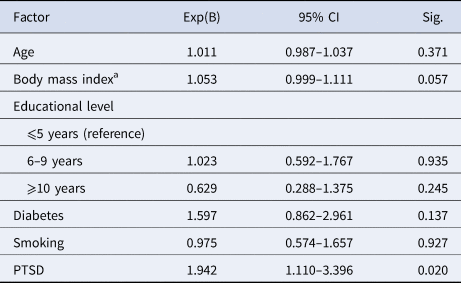
In the multivariate Cox regression, only PTSD diagnosis was significantly associated with incident hypertension (multivariate HR 1.942; 95% CI 1.11–3.396) (Table 2).
Results of Cox's proportional hazards regression analysis

a Continuous variable.
Discussion
Hypertension is considered the most common chronic disease and the primary cause of morbidity – including congestive heart failure, stroke, and chronic kidney disease – and mortality in the Western world (Solak et al., Reference Solak, Afsar, Vaziri, Aslan, Yalcin, Covic and Kanbay2016). In the last few decades, the association between hypertension and post-traumatic stress has been consistently confirmed by clinical and epidemiological studies. However, the reporting of incident hypertension in individuals with PTSD remained relatively scarce. Most studies in which a multivariate survival analysis was used to demonstrate a PTSD-incident hypertension association were conducted with US military personnel (Andersen, Wade, Possemato, & Ouimette, Reference Andersen, Wade, Possemato and Ouimette2010; Burg et al., Reference Burg, Brandt, Buta, Schwartz, Bathulapalli, Dziura and Haskell2017; Howard et al., Reference Howard, Sosnov, Janak, Gundlapalli, Pettey, Walker and Stewart2018). In contrast, investigations carried out with civilian samples yielded contradictory results. Some studies reported significant associations (Li et al., Reference Li, Zweig, Brackbill, Farfel and Cone2018; Lin et al., Reference Lin, Chung, Chen, You, Chien and Chou2019), while others found no relation whatsoever (Stein et al., Reference Stein, Aguilar-Gaxiola, Alonso, Bruffaerts, de Jonge, Liu and Scott2014; Sumner et al., Reference Sumner, Kubzansky, Roberts, Gilsanz, Chen, Winning and Koenen2016).
The present study was the first to demonstrate PTSD and incident hypertension's association while controlling for the most critical confounders in a demographically diverse, urban civilian adult population living in a stressful environment. While previous studies assessed mostly male veterans (Andersen et al., Reference Andersen, Wade, Possemato and Ouimette2010; Burg et al., Reference Burg, Brandt, Buta, Schwartz, Bathulapalli, Dziura and Haskell2017; Howard et al., Reference Howard, Sosnov, Janak, Gundlapalli, Pettey, Walker and Stewart2018; Schnurr et al., Reference Schnurr, Spiro and Paris2000) and one included only females (Sumner et al., Reference Sumner, Kubzansky, Roberts, Gilsanz, Chen, Winning and Koenen2016), our sample population had a balanced distribution in terms of sex, age, race, and education. Prevalence of current PTSD at baseline, as measured with PCL-C, was 10.7%, considerably greater than that of the general population in the same metropolitan area – a 1-year prevalence of 3.3% (95% CI 2.2–4.4%) (Ribeiro et al., Reference Ribeiro, Mari, Quintana, Dewey, Evans-Lacko, Vilete and Andreoli2013) – suggesting high levels of exposure to traumatic events. After an average period of 42.8 (s.d. = 12.5) months, 44.7% of the participants with PTSD were diagnosed with incident hypertension; in contrast, only 20.9% of the volunteers without PTSD also did so. A diagnosis of PTSD was thus associated with a 94% increased risk of hypertension incidence (HR 1.942; 95% CI 1.11–3.396). A higher HR was reported only in service members with chronic PTSD who sustained severe combat injury as to have required critical care (HR 2.29, 95% CI 1.851−2.84) (Howard et al., Reference Howard, Sosnov, Janak, Gundlapalli, Pettey, Walker and Stewart2018).
We measured several potentially relevant confounders and adjusted for them in the analysis. Some, such as higher BMI and antidepressant use, were reported in the PTSD literature (Sumner et al., Reference Sumner, Kubzansky, Roberts, Gilsanz, Chen, Winning and Koenen2016). Age, ethnicity, physical activity level, smoking status, alcohol consumption, diabetes mellitus, and positive family history are all well-known risk factors for hypertension (Booth et al., Reference Booth, Li, Zhang, Chen, Muntner and Egan2017). Depression was selected because of its frequent comorbidity with post-traumatic stress, which impacts powerfully on the physical and mental health of individuals with PTSD (Araujo et al., Reference Araujo, Berger, Coutinho, Marques-Portella, Luz, Cabizuca and Mendlowicz2014; Pagotto et al., Reference Pagotto, Mendlowicz, Coutinho, Figueira, Luz, Araujo and Berger2015), and has been consistently identified as an independent risk factor for hypertension (Kibler, Joshi, & Ma, Reference Kibler, Joshi and Ma2009; Meng, Chen, Yang, Zheng, & Hui, Reference Meng, Chen, Yang, Zheng and Hui2012). Nevertheless, none of these risk factors contributed significantly to hypertension incidence in the multivariate analysis. Perhaps, our sample's community-based recruitment may have generated a ‘healthy volunteer effect’ (Gordon, Moore, Shurtleff, & Dawber, Reference Gordon, Moore, Shurtleff and Dawber1959) and minimized the impact of lifestyle options and medical and psychiatric comorbidities.
Several pathophysiological mechanisms are common to PTSD and hypertension and might explain why the former predicts the latter's occurrence. First, PTSD may be linked to hypertension through established unhealthy lifestyles, such as smoking (Fu et al., Reference Fu, McFall, Saxon, Beckham, Carmody, Baker and Joseph2007), alcohol misuse (Debell et al., Reference Debell, Fear, Head, Batt-Rawden, Greenberg, Wessely and Goodwin2014), physical inactivity and poor eating behaviors (Hall, Hoerster, & Yancy, Reference Hall, Hoerster and Yancy2015), and comorbidity with obesity (Bartoli et al., Reference Bartoli, Crocamo, Alamia, Amidani, Paggi, Pini and Carra2015) and metabolic syndrome (Rosenbaum et al., Reference Rosenbaum, Stubbs, Ward, Steel, Lederman and Vancampfort2015), all well-known risk factors for hypertension (Booth et al., Reference Booth, Li, Zhang, Chen, Muntner and Egan2017). All these risk factors were accounted for in the present study.
Secondly, chronic PTSD, the prototypical stress-related disorder, may be associated with impairments in the hypothalamic-pituitary-adrenal axis activity and reactivity. The resulting altered secretion patterns of corticotrophin-releasing factor, stimulating adrenocorticotropic hormone, and glucocorticoids (Dunlop & Wong, Reference Dunlop and Wong2019) may predispose to the eventual development of endocrine, metabolic, and immunological disorders (Silverman & Sternberg, Reference Silverman and Sternberg2012).
Thirdly, PTSD is associated with various measures of autonomic nervous system dysfunction: higher resting heart rate (HR) (Buckley & Kaloupek, Reference Buckley and Kaloupek2001; Pole, Reference Pole2007); larger HR responses to startling sounds, to standardized trauma cues, and to idiographic trauma cues (Pole, Reference Pole2007); and elevations in resting systolic and diastolic (DBP) blood pressure (Buckley, Blanchard, & Hickling, Reference Buckley, Blanchard and Hickling1998; Pole, Reference Pole2007) and in DBP responses to idiographic trauma cues (Pole, Reference Pole2007).
Fourthly, there is increasing evidence supporting that PTSD is associated with the presence of a systemic low-grade inflammatory state. It has been hypothesized that this state of ‘sterile inflammation’ could be the key mechanism leading to the development of somatic illnesses in individuals with PTSD (Speer, Upton, Semple, & McKune, Reference Speer, Upton, Semple and McKune2018). The most consistent pieces of evidence for a dysregulated immune state in patients with PTSD are increased blood levels of pro-inflammatory cytokines, such as interleukin-1 (IL-1), interleukin-6 (IL-6), and tumor necrosis factor-α, and the skewing of peripheral blood cells populations with increased numbers of pro-inflammatory Th1 and Th17 cells. Reduced anti-inflammatory mediators, such as cytokines IL-4 and TGF-β, and lower numbers of anti-inflammatory cells, such as regulatory T cells and negative regulator PD-L1 on CD4+ cells, have also been reported, though less consistently (Wang & Young, Reference Wang and Young2016).
Finally, functional neuroimaging research supports the hypothesis that PTSD is associated with a hyper-responsive amygdala (Hughes & Shin, Reference Hughes and Shin2011), which accounts for several of this disorder's clinical features, including intrusive memories, nightmares, insomnia, and hypervigilance (Diamond & Zoladz, Reference Diamond and Zoladz2016). A recent prospective study (Tawakol et al., Reference Tawakol, Ishai, Takx, Figueroa, Ali, Kaiser and Pitman2017) found that amygdalar activity (measured with ¹⁸F-fluorodeoxyglucose PET/CT) was associated with an increased bone-marrow activity, arterial inflammation, and risk of CVD events. Further, in 13 individuals with a history of post-traumatic stress disorder, perceived stress (measured with the Perceived Stress Scale) was associated with resting amygdalar metabolic activity, arterial inflammation, and inflammatory biomarkers. Based on these findings, the authors identified the amygdala, the main component of the brain's salience network, as a ‘key neural structure associated with future cardiovascular disease events’ (p. 841).
The current study has several limitations that must be addressed. First, PTSD was assessed using the PCL-IV-TR, a self-rating instrument, and not a clinical interview. Although semi-structured diagnostic interviews are considered the diagnostic gold standard, the PCL-C, when used thoughtfully, can be a time-efficient and reliable screening tool (McDonald & Calhoun, Reference McDonald and Calhoun2010). There is apparently a trade-off between practicality and depth of investigation in this area since only one study probing the association of PTSD and incident depression has employed a semi-structured interview to diagnose the former (Stein et al., Reference Stein, Aguilar-Gaxiola, Alonso, Bruffaerts, de Jonge, Liu and Scott2014). Further, considering the lack of consensus regarding the optimal cut score for the PCL-C, we opted for the symptom cluster method. This algorithm method replicates the DSM-IV-TR criteria for PTSD to derive a categorical diagnosis of PTSD. The symptom cluster method was initially proposed by Weathers et al. (Reference Weathers, Litz, Herman, Huska and Keane1993) and was endorsed by later studies (Manne, Du Hamel, Gallelli, Sorgen, & Redd, Reference Manne, Du Hamel, Gallelli, Sorgen and Redd1998; Widows, Jacobsen, & Fields, Reference Widows, Jacobsen and Fields2000).
A second limitation is that by having employed the PCL-C, the current study is still based on the earlier DSM-IV-TR criteria for PTSD, not on the updated DSM-5 ones. However, DSM-5 criteria for PTSD remain controversial in some quarters, and there have been recurring questions about whether their formulation is indeed optimal (Brewin et al., Reference Brewin, Cloitre, Hyland, Shevlin, Maercker, Bryant and Reed2017). Meanwhile, an influential group of researchers has argued that the continued use of the DSM-IV-TR formulation and corresponding diagnostic instruments is necessary and recommended that research proposals enrolling PTSD patients should be strictly scrutinized if their design does not include the DSM-IV-TR criteria (Hoge et al., Reference Hoge, Yehuda, Castro, McFarlane, Vermetten, Jetly and Rothbaum2016).
A third issue is the lack of an instrument to assess exposure to the traumatic experiences, like the Trauma History Questionnaire (THQ) (Hooper, Stockton, Krupnick, & Green, Reference Hooper, Stockton, Krupnick and Green2011) or the Life Events Checklist for DSM-5 (LEC-5) (Weathers et al., Reference Weathers, Litz, Keane, Palmieri, Marx and Schnurr2013). For practical purposes, we assumed that living in a slum increased the odds of exposure to multiple potentially traumatic events.
Despite these study limitations, the data demonstrated an association between PTSD and incident hypertension in a civilian, demographically diverse population. These findings are of particular clinical importance since they show that reducing the long-term global health impact of PTSD and its associated costs requires early surveillance and active treatment. Conversely, they highlight the importance of considering a diagnostic hypothesis of PTSD in the prevention and treatment of CVD. Future studies should further investigate this link, while clinicians and health planners must acknowledge its implications and work to minimize them.
Conflict of interest
None.