1. INTRODUCTION
Understanding the behavior of matter in electric and magnetic fields remains a central point of interest in science. Extreme electric fields up to the 1016 V/cm exist in the vicinity of multiple ionized heavy nuclei, but in tiny volumes, less than cubic Angstrom (Winters & Stoehlker, Reference Winters and Stoehlker2009). Complementary, strong fields at the micrometer scale can be produced using lasers. Since 1960s, the laser produced fields strength registered an exponential increase, based on three directions of development, namely, the reduction of the pulse duration, of the focal spot area, and the increase of the pulse energy.
Following energy up-scaling path, several multi-PW facilities are proposed (e.g., Hays et al. (Reference Hays, Gaul, Martinez and Ditmire2007)), or under construction (extreme light infrastructure, Apollon laser in France, Vulcan-10 PW system in United Kingdom (Mourou et al., Reference Mourou, Korn, Sandner and Collier2011), exawatt center for extreme light studies in Russia (http://www.xcels.iapras.ru)) to investigate new physics effects down to the attosecond and possibly zeptosecond (1021 s) time scales and to promote new technologies based on ultra-short pulses of high energy photons, electrons, protons, neutrons, positrons, muons and neutrinos, on demand (Mourou et al., Reference Mourou, Tajima and Bulanov2006).
Complementary, many experiments involve high focal intensities with less pulse energy, which also allows a high repetition rate operation (Hou et al., Reference Hou, Nees, Mordovanakis, Wilcox, Mourou, Chen, Kieffer, Chamberlain and Krol2006). In recent years, the relativistic intensity was produced in the kilohertz regime with short pulses of less than 10 fs composed of only a few electro-magnetic field cycles (Naumova et al., Reference Naumova, Nees, Hou, Mourou and Sokolov2004a). By focusing few cycles' laser pulses to diffraction limited spot, relativistic intensities can be achieved with milijoule energies (Naumova et al., Reference Naumova, Nees, Sokolov, Hou and Mourou2004b). While in this case both temporal and spatial extensions of the pulse are comparable with the wavelength of the pulse, the experiments using such pulses are also labeled as performed in the lambda cubed regime (λ3) or wavelength cubed regime. Combining the spatial and temporal approaches, the planned extreme light infrastructure facility (Mourou et al., Reference Mourou, Korn, Sandner and Collier2011) will break into the ultra-relativistic regime and beyond, in generation of particles from the vacuum (polarization and boiling of the vacuum experiments). For such experiments, huge electric fields have to be created using tightly focused ultra-short laser pulses (TFP), i.e., in λ3 regime. The effects expected in such experiments depend on the spatial and temporal extension of the huge electric fields generated by TFPs. Our paper provides here an analysis of the extension of the electromagnetic field in tightly focused ultrashort laser pulses used for experiments in the wavelength-cubed regime, relevant for experiments proposed at the ELI facility (Habs et al., Reference Habs, Gross, Marginean, Negoita, Thirolf and Zepf2010).
In special relativity theory, the temporal τ and spatial σ coordinates are linked through the speed of light c.
 $${\rm \sigma}=c \times {\rm \tau}.$$
For laser pulses, their spatial extent along the propagation path and their duration are linked through a similar relation, in most cases. However, in this paper, it is shown that the relation mentioned above does not hold for linking spatial extent and temporal duration of tightly focused beams. Also, the evaluation of the spatial extension of the pulse in the focus is provided. It is also shown that a λ3 regime can be achieved with significantly longer duration pulses. This effect is explained in connection with the associated Rayleigh range. As a consequence, it is shown that the Rayleigh length can limit drastically the presence of the high fields in TFP.
The obtained results find their use in the planning of experiments that combine ultra-short laser pulses and relativistic particle beams or other types of radiation. Such experiments include photon-photon interactions (Marklund & Shukla, Reference Marklund and Shukla2006), probing the pair creation from the vacuum in the focus of strong electrical fields with γ- or electron beams, studies concerning the real part of the index of refraction of the vacuum in high fields (vacuum birefringence), production of cascades of e + e pairs and γ-rays triggered by a single slow electron in strong fields, Compton scattering and radiation reaction of a single electron at high intensities (Habs et al., Reference Habs, Gross, Marginean, Negoita, Thirolf and Zepf2010), and entirely light based quantum double-slit experiments (King et al., Reference King, Piazza and Keitel2010). A direct result to be addressed here is related to the generation of few femtoseconds long gamma bursts in Thomson backscattering experiments based on TFPs and laser driven electron bunches. The sketch of such an experimental set-up at forthcoming ELI-NP facility (Habs et al., Reference Habs, Gross, Marginean, Negoita, Thirolf and Zepf2010) is provided.
2. HOW TIGHT SHOULD ONE FOCUS?
The starting point of our analysis is the peak intensity to be reached in the focus of the TFP at existing or planned facilities. The highest intensity reported to date is 2 × 10²² W/cm2 using a paraboloid with f-number f# = 1.0 at the HERCULES 300 TW laser facility (Yanovsky et al., Reference Yanovsky, Chvykov, Kalinchenko, Rousseau, Planchon, Matsuoka, Maksimchuk, Nees, Cheriaux, Mourou and Krushelnick2008), but planned facilities aim to reach above 1023 W/cm2. Such intensities will be achieved with laser pulses in the near infrared with pulse duration in the range of 10 fs to 200 fs and pulse energies in the range of 50–2000 J, corresponding to powers from 10 PW to 100 PW. From these parameters, one can roughly evaluate the focal f-number of the focusing optics needed in order to reach such intensities. Following (Siegman, Reference Siegman and Aidan1986), the formula for the peak intensity in the focus of a Gaussian beam is:
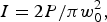 $$I=2P/ {\rm \pi} w^{2}_{0}\comma \;$$
where I is the peak intensity, P is the peak power and w 0 is the waist of the Gaussian beam. To connect this relation to the focusing element, we have to use the f-number relation:
 $$w_0=f \# {\rm \lambda} \comma \;$$
where λ is the laser wavelength. Combining the relations of Eqs. (2) and (3), one can extract the dependence of the f# from the peak intensity of the laser pulses:
 $$\,f \#=1/ {\rm \lambda} \lpar 2P/ {\rm \pi} I\rpar ^{1/2}.$$
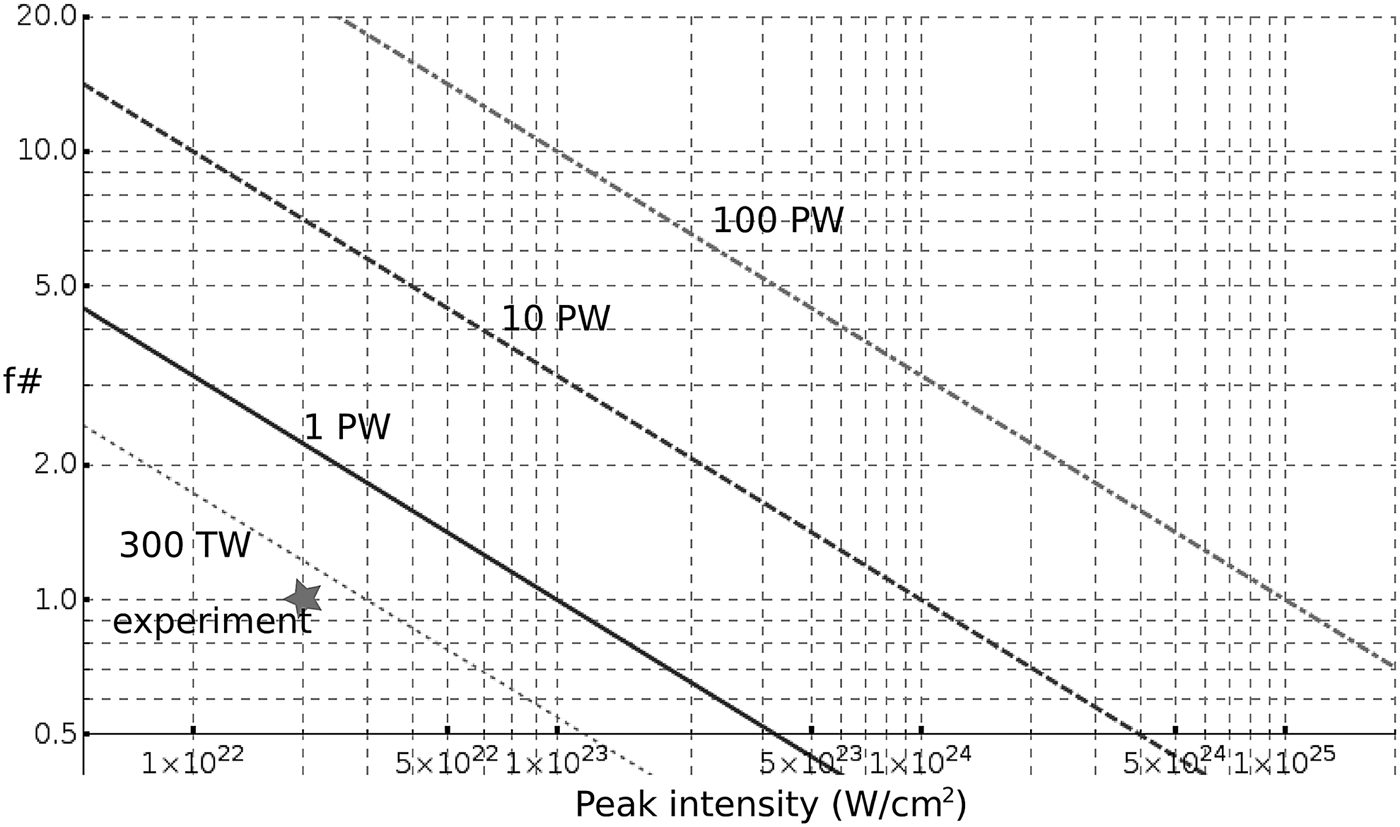
Figure 1 shows the f-number parameter for the focusing system needed to obtain a given beam intensity for ideal Gaussian pulses at the 800 nm wavelength, for 300 TW, 1 PW, 10 PW, and 100 PW peak power pulses. The highest intensity measured (Yanovsky et al., Reference Yanovsky, Chvykov, Kalinchenko, Rousseau, Planchon, Matsuoka, Maksimchuk, Nees, Cheriaux, Mourou and Krushelnick2008), obtained with a 300 TW laser system and a system with f# = 1, is also represented with the star symbol. The horizontal (thick full) axis indicates focusing systems with f# = 0.5, corresponding to cases where the beam radius equals the focal distance of the system. At lower f# values, the focus of the system is no more separated by the incoming beam path, even at 90° deflection. The essential conclusion that comes out from the Figure 1 is that reaching intensities above 1023 W/cm2 needs not only high power systems but also focusing systems with the f-number as low as possible, corresponding to TFP. From the same plot one can estimate the beam waist w 0 with the help of Eq. (3), assuming a wavelength of 800 nm. The beam diameter remains of the order of the micrometer in the TFP configurations, making difficult the overlap of such pulses.
f-number values for the focusing optics to obtain peak intensities in the ultra-relativistic regime.

3. SPATIO-TEMPORAL EXTENSION IN TIGHTLY FOCUSED BEAMS
Analytical solutions for the electromagnetic field distribution of focused Gaussian laser beams are studied in the recent years in relation with charged particle acceleration mechanisms in vacuum. Solutions for monochromatic laser pulses are used most of the time, corresponding to infinite pulse durations. The solutions are infinite power series in the small parameter ε = 1/(k w) used in the computations is usually limited to small values below ε = 0.032, corresponding to about 7° beam divergence and f-number of 5 (Quesnel & Mora, Reference Quesnel and Mora1998). Even in this case, the use of fifth order terms is necessary for the accurate evaluation of the fields with waist dimensions down to 5 µm (Salamin & Keitel, Reference Salamin and Keitel2002). For the ultra-short pulses, an analytical solution is presented in Quesnel and Mora (Reference Quesnel and Mora1998); the analytical solution is truncated and the validity of the solution is related to the condition that the laser pulse contains a large number of periods (at least 60 fs pulses).
As shown in the previous section, to reach the highest fields for experiments planned at multi-PW facilities such as ELI, one needs tighter focusing of the pulses, beyond the approximation in the analytical solutions from (Quesnel & Mora, Reference Quesnel and Mora1998). So, in the evaluation below, we complement and extend the results concerning the electromagnetic field structure for ultrashort pulses below the spatial and temporal limits mentioned above, using a numerical approach.
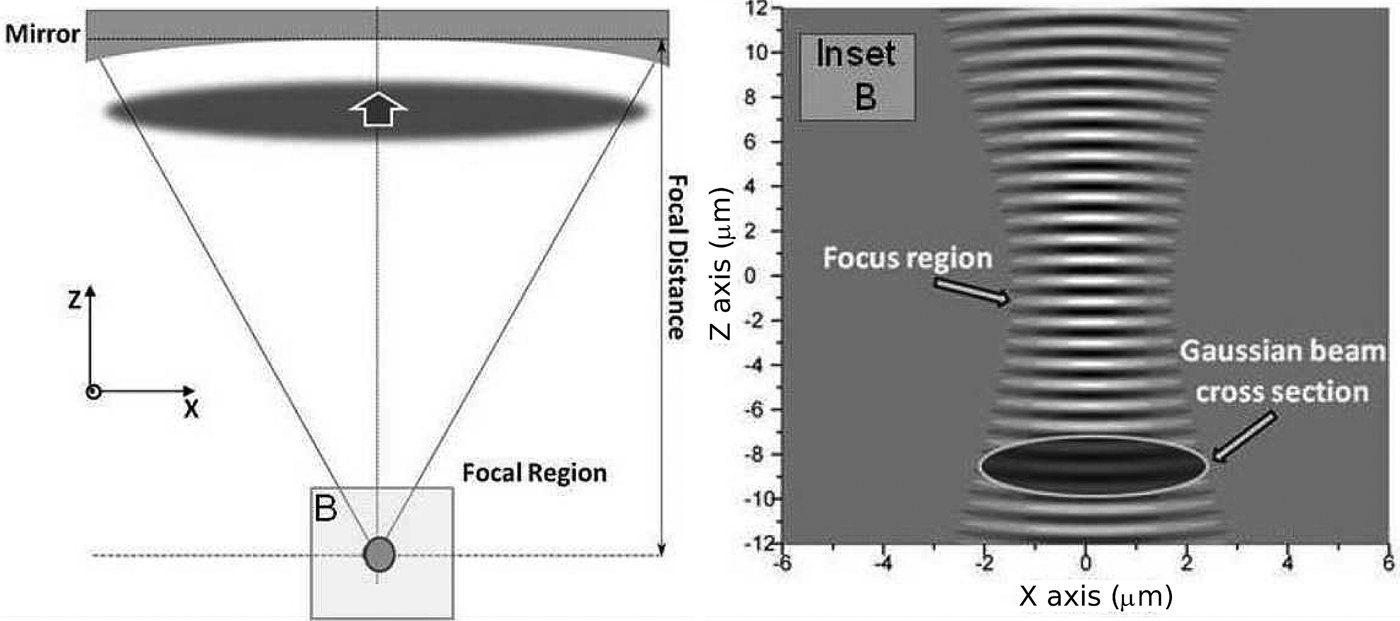
Numerical computation of the ultra-short pulses propagation was performed in order to investigate the electromagnetic field distribution in the vicinity of the focus. We used FullWAVE, a package of the commercial software RSoft (http://www.rsoftdesign.com) which solves the Maxwell equations using the finite difference time domain (FDTD) method. The geometry of the problem is depicted in Figure 2. The study implies a laser source (central wavelength λ of 800 nm, variable diameter source in the interval of 30 µm and 150 µm, pulse duration varying between 5 and 120 fs, vertical polarization, symmetrical position to the x axis) which propagates initially along the z axis. The laser pulse is focused by a spherical mirror which has the focal distance of 75 µm and the diameter of 160 µm. The pulse duration will be denoted τ, while the period of the pulse is denoted T. Due to symmetry considerations, the point P where the electric field is most intense for the entire temporal range simulated is placed along the propagation axis z. The position of the point P was identified, monitoring the electromagnetic field along the propagation axis z in several points, with a quarter of a wavelength accuracy. This allowed finding out also the moment t 0 when the maximum electric field EP (t 0) is produced in the specified point P. The envelope full width at half maximum of the electric field E(t) was found to be the same in any point of the xz plane including P (except for the vicinity of the mirror where the pulse and its reflection interfere), within 6% precision. This indicates that the pulse duration is a good parameter for the pulse description.
Analyzed geometry and the fine structure of the field in the focal region. (Left) optical set up of the pulses focusing. (Right) Electromagnetic field distribution in focus in case of an extended source illustrating the Gaussian beam Ey distribution in the (xz) plane.
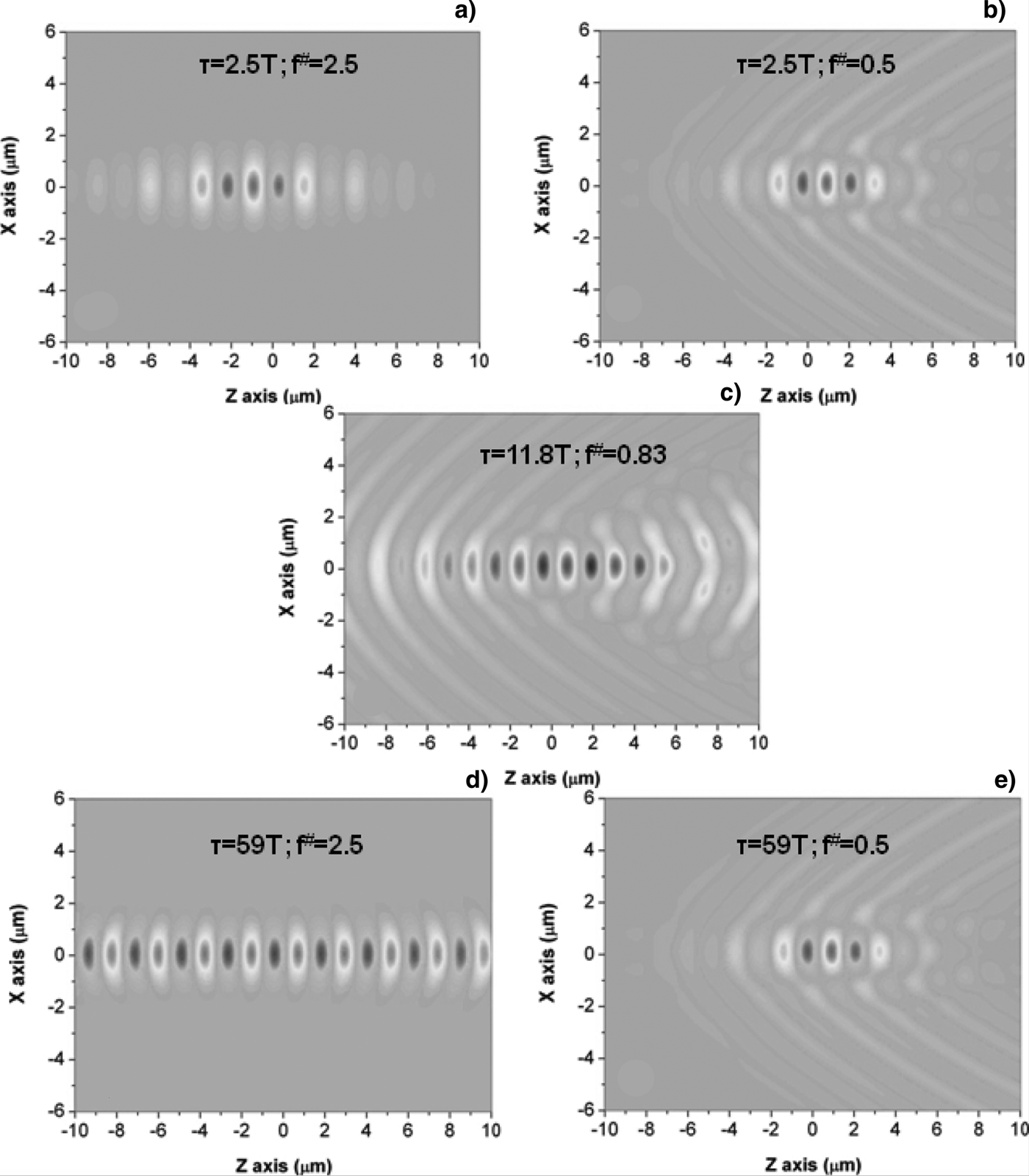
The structure of the electric field E(x,z) was computed in the vicinity of the focal point. In Figure 3 we illustrate the electric field distribution in the focal point P, using false color coded plots, where blue shows the negative values, green represents the zero field, while the red shows the positive parts of the field. All the plots preserve the same spatial ranges, centered on the P point. In the upper part of Figure 3, which illustrated the following cases: pulse duration of two cycles τ = 2.5 T at f# = 2.5 in the upper left figure and at f# = 0.5 in the upper right figure. In the last case, the field is slightly narrower but has a similar extension along the propagation axis. This does not hold any more in the lower part of the Figure 3, where pulse duration of 59 cycles τ = 59 T at f# = 2.5 in the lower left figure and at f# = 0.5 in the lower right figure, while the structure of the electric field along the propagation axis z for f# = 2.5 is significantly longer than the one with the f# = 0.5. However, the electric field E(x,z) for f# = 0.5 at τ = 2.5 T and τ = 59 T is looking almost identical. This indicates that the spatial electric field structure E(x, z), for tightly focused pulses is not always sensitive to the duration of the pulse. In the central plot of the Figure 3, the electric field for the intermediate case τ = 11.8 T and f# = 0.83 was represented for comparison.
The electromagnetic field distribution in the focal region for different pulse durations (τ) and for different diameters of the laser source (D): (a) τ = 2.5 T, laser D = 30 µm; (b) τ = 2.5 T, D = 150 µm; (c) τ = 11.8T, D =9 0 µm; (d) τ = 59 T, D = 30 µm; (e) τ = 59 T, D = 150 µm.
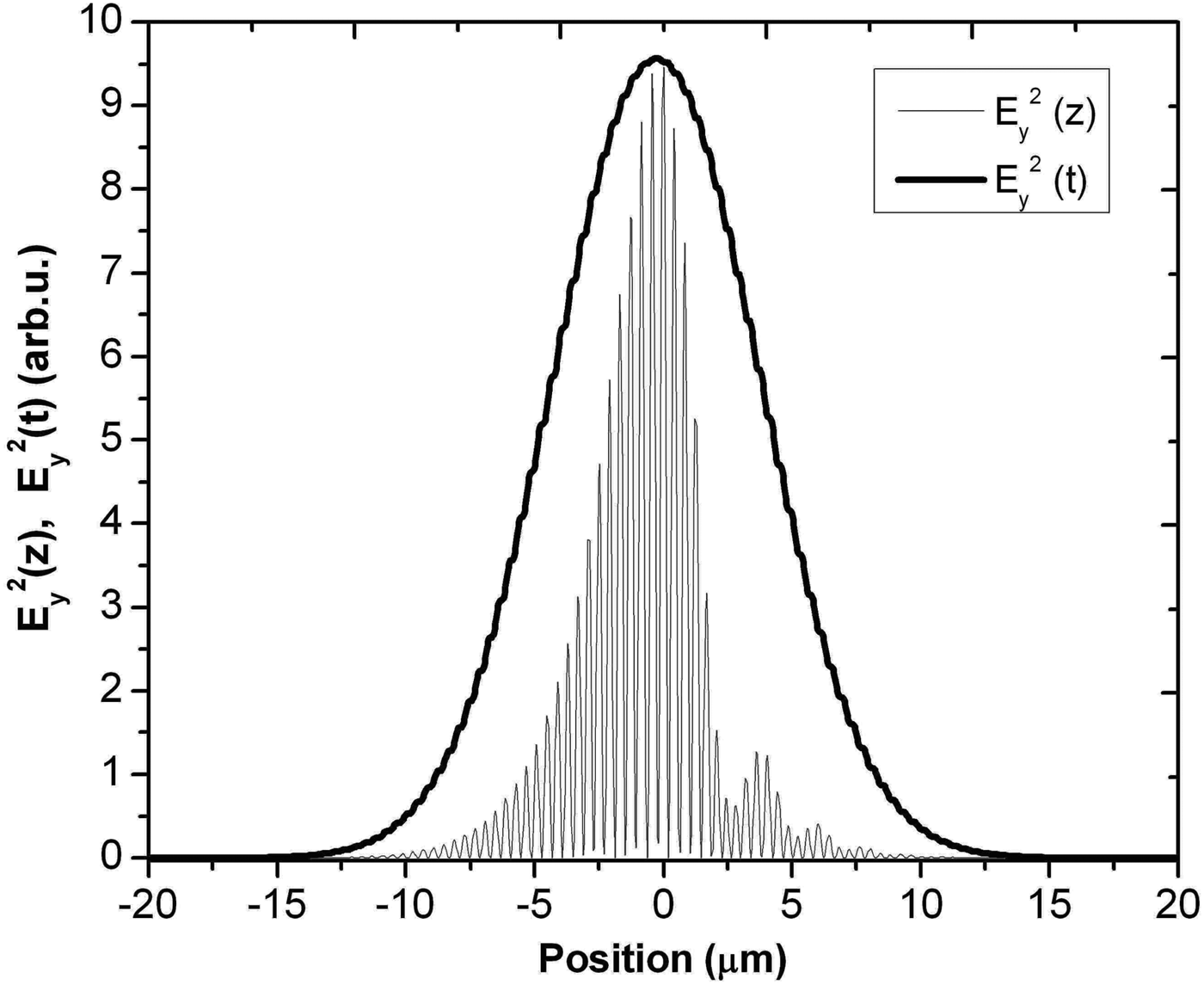
Further, in Figure 4, it is illustrated for this particular case (τ = 11.8 T and f# = 0.83), the difference between the temporal evolution of the envelope of the electric field EP (t) and the spatial extent of the field along the propagation axis E(x = 0; z). For the representation of the spatial extent of the electric field along the z axis, the detailed field structure is represented at the time when the pulse reaches the focus.
Comparison of the temporal envelope with the spatial envelope for the square of the electric field from a TFP with an f-number of 0.83. The full width at half maximum of the spatial envelope is 3.78 µm while the temporal envelope has 9.35 µm/c duration, where c is the speed of light.
For the temporal structure, we transformed the temporal axis into a spatial one using the Minkowski space relation from Eq. (1), and we represented the envelope of the temporal evolution for the electric field E P(t); in this case, 0 is the moment where the field reaches its maximum. The temporal envelope is a factor of 2.5 larger than the spatial one. One can also observe the signature of the spherical aberration in the soft modulation at the end of the spatial field structure.
In order to understand the effect, one can analyze the extension of the confocal region for TFP. The confocal parameter b equals two times the Rayleigh range of a Gaussian beam. Starting from the definition, the confocal parameter is described here as a function of the f#, making use of Eq. (3):
 $$b=2 {\rm \pi} w^{2}_{0}/ {\rm \lambda} =2 {\rm \pi} f \# ^{2} {\rm \lambda}$$
It can reach the same order of magnitude as the wavelength of the beam, as long as f# is of the order of unity. In this way, we obtain a confined spatial distribution of the electromagnetic field in a region of few cubic wavelengths, in the λ3 regime. In order to characterize the discrepancy between the spatial and temporal extent of the TFP, we introduce a factor, denoted u that quantifies the relative spatial extension (RSE) of the TFP:
 $$u =L_{FWHM} /\lpar c {\rm \tau}_{FWHM}\rpar \comma \;$$
where L FWHM and τ FWHM are the full width at half maximum of the spatial extent of the pulses and temporal duration measured for Gaussian pulses in the focal plane.
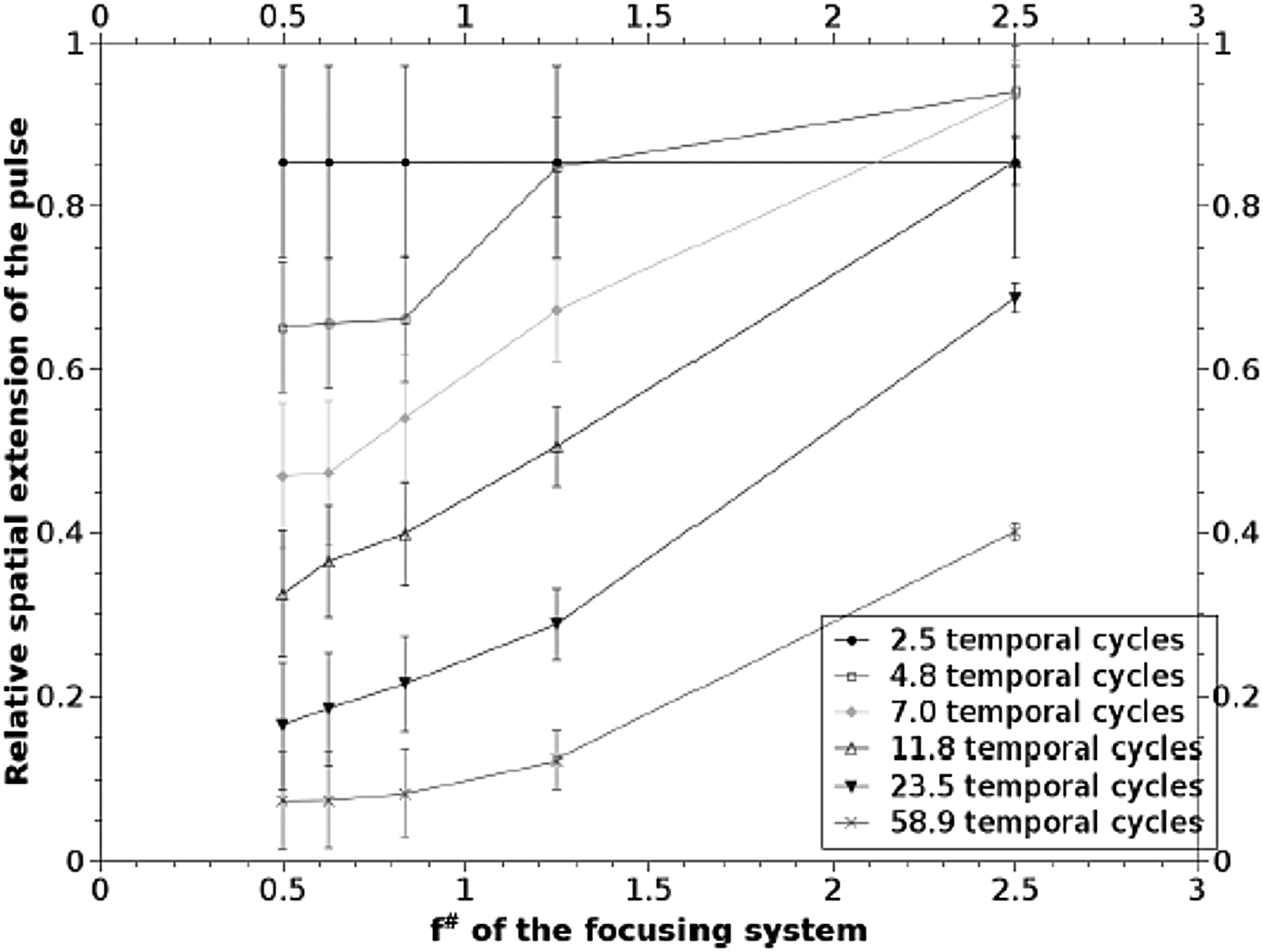
We further performed a parametric study of the RSE as a function of τFWHM and f# of the assumed focusing system. The results are represented in Figure 5. For very short pulses, of few cycles, RSE is close to unity and is almost insensitive to f#. For longer pulses, the RSE decreases strongly, showing that spatial extension of the pulses can be up to a factor of 10 and smaller than the temporal one, in the case of 60 cycle's pulses and longer. Thus, even though the laser pulse might be longer, the high intensity region of the TFP remains similar in its spatial extension with the one provided with shorter pulses. Consequently, the pulses generated with high f# optics but somewhat longer pulses can be understood as belonging to an extended lambda cubed regime.
Pulse length in focus, normalized with the number of cycles at the wavelength of 800nm as a function of the f-number.
4. ULTRA-INTENSE LASER FIELDS EXPERIMENTS IN THE EXTENDED LAMBDA CUBED REGIME
Eq. (6) for TFPs provided here can be used for the planning of the experiments performed in the lambda cube regime, namely, where the lasers can provide an energy encompassed in a focal volume of a few cubic wavelengths (λ3). As shown in Section 2, this regime will be automatically achieved with existing or planned laser systems, once intensities of the order of 1023 W/cm2 are targeted. Laser-gamma experiments and boiling of the vacuum experiments involving ultra-intense laser fields as proposed in Habs et al. (Reference Habs, Gross, Marginean, Negoita, Thirolf and Zepf2010), Marklund and Shukla (Reference Marklund and Shukla2006), King et al. (Reference King, Piazza and Keitel2010) can be presently realized only using such TFPs.
Further in this section we limit ourselves to the analysis of experiments involving slow and fast electrons in TFPs, as a case study. This is motivated by the fact that experiments related to non-linear Thomson backscattering, Compton backscattering, laser driven electron acceleration in vacuum (Hora et al., Reference Hora, Hoelss, Scheid, Wang, Ho, Osman and Castillo2000; Gupta & Suk, Reference Gupta and Suk2007) and radiation reaction effects (Mao et al., Reference Mao, Kong, Ho, Che, Ban, Gu and Kawata2010) can be systematically performed at the ELI-NP facility to come online in 2017, and possibly other facilities. An exhaustive review of the processes can be found in (DiPiazza et al., Reference Piazza, Müller, Hatsagortsyan and Keitel2012)
The amplitude of the wiggling motion of an electron a ω is given by:
 $$a_{{\rm \omega}} = eE/\lpar m {\rm \omega}^{2}\rpar$$
where e is the absolute value of the electron charge, E represents the amplitude of the electric field, m is the electron mass, and ω is the angular frequency of the electromagnetic field (Brabec & Krausz, Reference Brabec and Krausz2000; Pukhov, Reference Pukhov2003) seen by the electron. The laser field amplitude formula is, following (Eliezer, Reference Eliezer and Navas2002):
 $$E=2.75 \times 10^{9}\lpar I_{L}/10^{16} W/cm^{2}\rpar ^{1/2}.$$
Two cases can be identified, depending on the Doppler shift of the radiation as seen by the electron. In a first case, the wavelength seen by the electron is not Doppler shifted, as the electron is non-relativistic in the lab frame. In a second case, if the electron is relativistic, the Doppler shift can change the wavelength seen by the electron proportional with the relativistic Lorentz factor one or more orders of magnitude.
4.1. Non-Relativistic Electron in TFPs
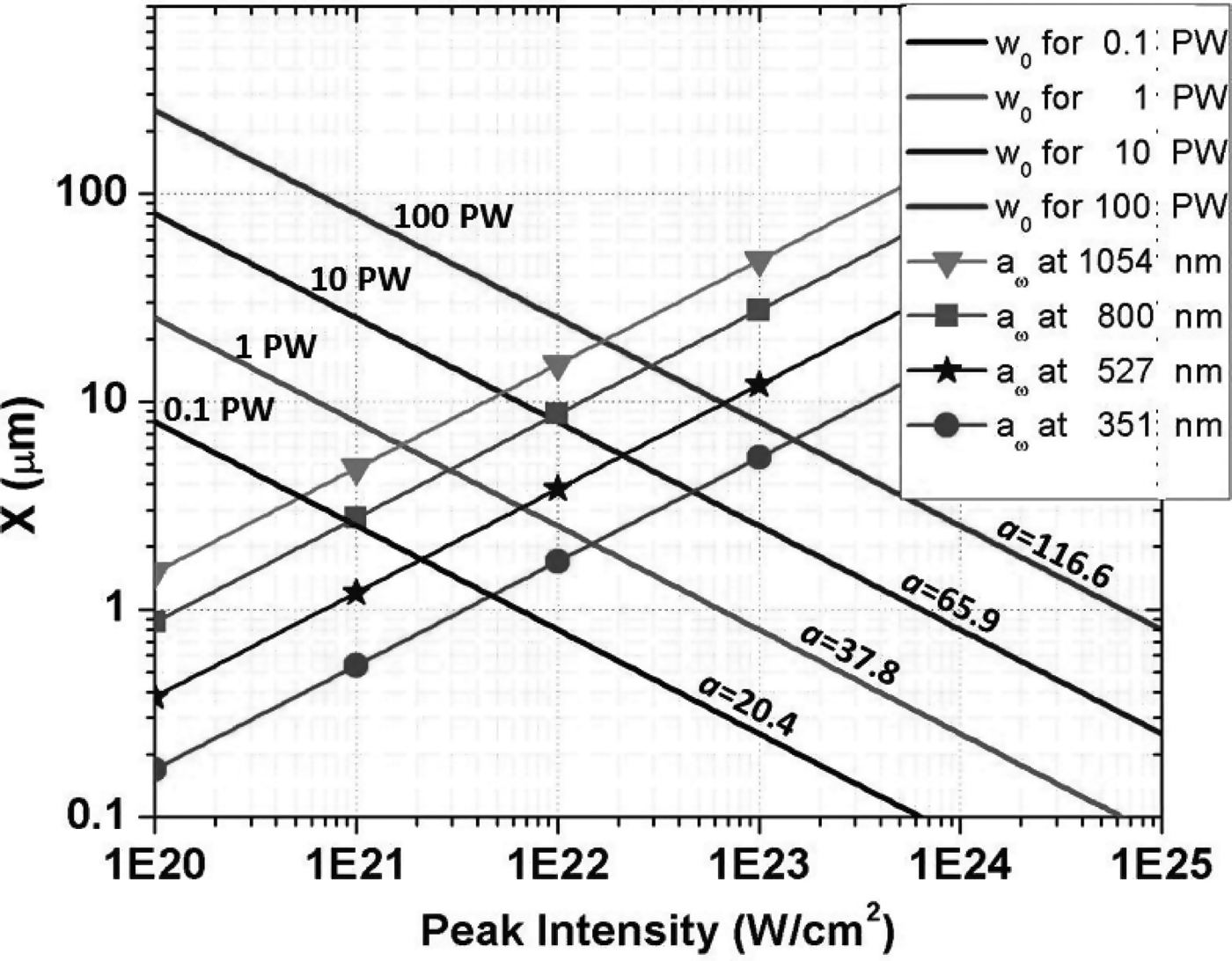
Assuming linear polarized laser pulses within reach using existing technologies, the wiggling amplitude of the non-relativistic electron can reach values comparable or larger than the waist of the TFP, as illustrated in Figure 6. In such a case, the particles are violently accelerated and might easily escape in the transverse direction relative to the TFP direction of propagation. As a consequence, detecting such particles (as signature of the boiling of the vacuum, for example) has to be realized in the transverse plane. To find the onset of this process, Figure 6 illustrates the oscillation amplitude for a free and initially slow electron in TFP and the associated beam waist for the TFP.
The dependence of the Gaussian beam waist (w0) and of the electron excursion amplitude (a w) at a given intensity.
When the amplitude of the oscillation becomes comparable with the waist, the infinite plane wave approximation is no longer valid. For example, at peak pulse power of 10 PW, at 800 nm wavelength, this takes place at intensities of 9 × 10²¹ W/cm2, when the waist is about 9 µm. To achieve this intensity with ideal Gaussian beam, one needs to use optics with the f# of 10. If the pulse is short enough, below 20 cycles, the RSE factor is 1. For a 10 PW system at 351 nm, the corresponding waist is 10 µm, and the intensity reaches 5 × 10²² W/cm2, achievable with f# of 4.6. In this case, the RSE factor is 0.8 for a 60 cycles pulse and smaller for longer pulses.
Conversely, for a system with f#1, the RSE factor is 0.4 in a 12 cycles pulse at 800 nm. The reached intensity is 1023 W/cm2 and we are in a regime where the amplitude of the electron excursion during a single cycle in infinite plane wave approximation is about 30 µm while the waist is only 0.8 µm. Hence, the huge field in the focus will expunge the electrons from the intense field region in less than a half cycle in the transverse direction to the light propagation direction.
4.2. Relativistic Electron in TFPs
In the relativistic electron case counter-propagating a laser pulse, the Doppler shift changes the wavelength of the incoming radiation and, following Eq. (7), the amplitude of the oscillation is reduced proportional with the square of the Lorentz factor. In this case, the electron does not necessarily escape from the laser field in the transverse direction to laser propagation as in the case described in Section 4.1. As a consequence, harmonics generation experiments in the non-linear Thomson scattering can be realized in ultra-intense laser fields, as reported to recent studies (Popa, Reference Popa2008; Reference Popa2009; Reference Popa2011; Reference Popa2012). The model described in Popa (Reference Popa2008) was used to perform computations using the plane wave approximation, so it can be used when the values of the relativistic parameter a (a = eE/mcω) are in the ultra-relativistic regime which correspond to beam intensities of the orders 1023 Wcm−2 and the waist is large enough in comparison with the wavelength of the laser field in the electron rest framework reference. According to the numerical model presented in (Popa, Reference Popa2008; Reference Popa2009; Reference Popa2011) we evaluated the spectral intensity of the scattered radiation in case of 10 PW output power with the correspondent value of the relativistic parameter a = 65.9.
At the E7 experimental area of ELI-NP facility, two synchronous beams of 10 PW each and pulse duration below 25 fs are planned to be delivered at a repetition rate of one shot per minute. In addition, laser-synchronous electron bunches with energies up to 700 MeV and pulse durations in few picosecond ranges will be provided by a linear accelerator that drives a Thomson backscattering gamma beam source (GBS). The GBS follows the development of Thomson backscattering sources recently reported (Hartemann et al., Reference Hartemann, Tremaine, Anderson, Barty, Betts, Booth, Brown, Crane, Cross, Gibson, Fittinghoff, Kuba, Le Sage, Slaughter, Wootton, Hartouni, Springer, Rosenzweig and Kerman2004; Chouffani et al., Reference Chouffani, Harmon, Wells, Jones and Lancaster2006; Priebe et al., Reference Priebe, Laundy, Macdonald, Diakun, Jamison, Jones, Holder, Smith, Phillips, Fell, Sheehy, Naumova, Sokolov, Ter-Avetisyan, Spohr, Krafft, Rosenzweig, Schramm, Gruner, Hirst, Collier, Chattopadhyay and Seddon2008).
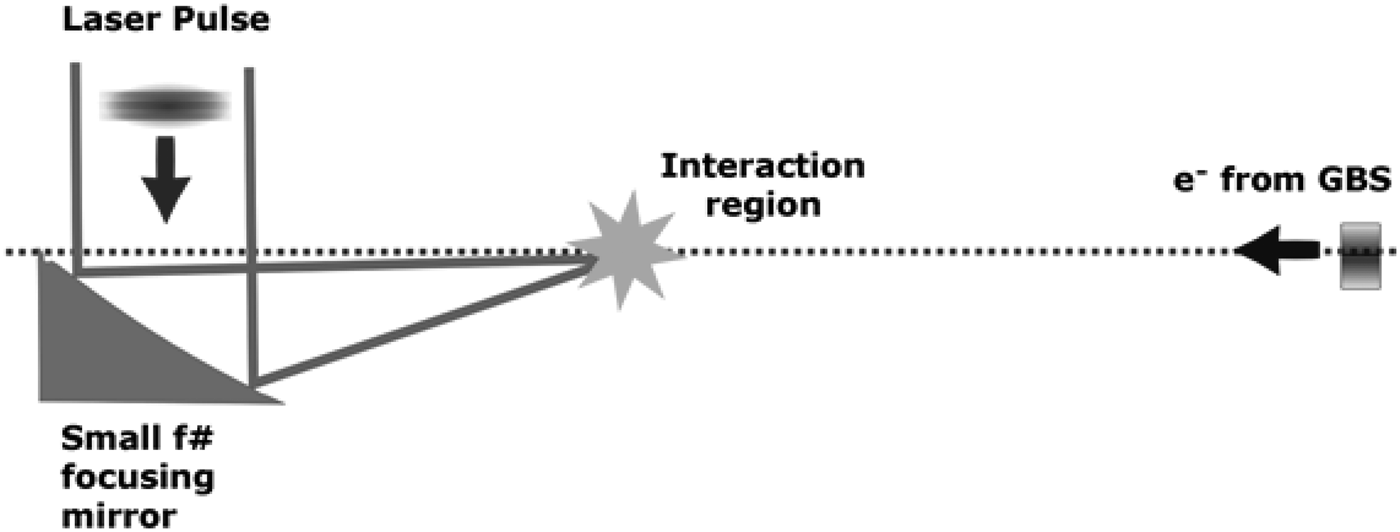
Following previous considerations, we analyzed the interaction between relativistic electrons (700 MeV) and a Ti-Sapphire laser beam (λ = 800 nm), in a configuration shown in Figure 7, planned to be available at E7 experimental area at ELI-NP. For this, we considered the equation of the energy of the quanta of the fundamental X radiation, described by:
 $$W_{\,j}=j \times W_{x}=j\lpar W_{L} \times {\rm \gamma}_{0}^{2} \times \lpar 1+\vert {\rm \beta}_{0} \vert\rpar ^{2}\rpar \comma \;$$
where
 $${\rm \gamma}_{0}=We/mc^{2}\comma \;$$
 $${\rm \beta}_{0}=\lpar 1-1/ {\rm \gamma}_{0}^{2}\rpar ^{1/2}\comma \;$$
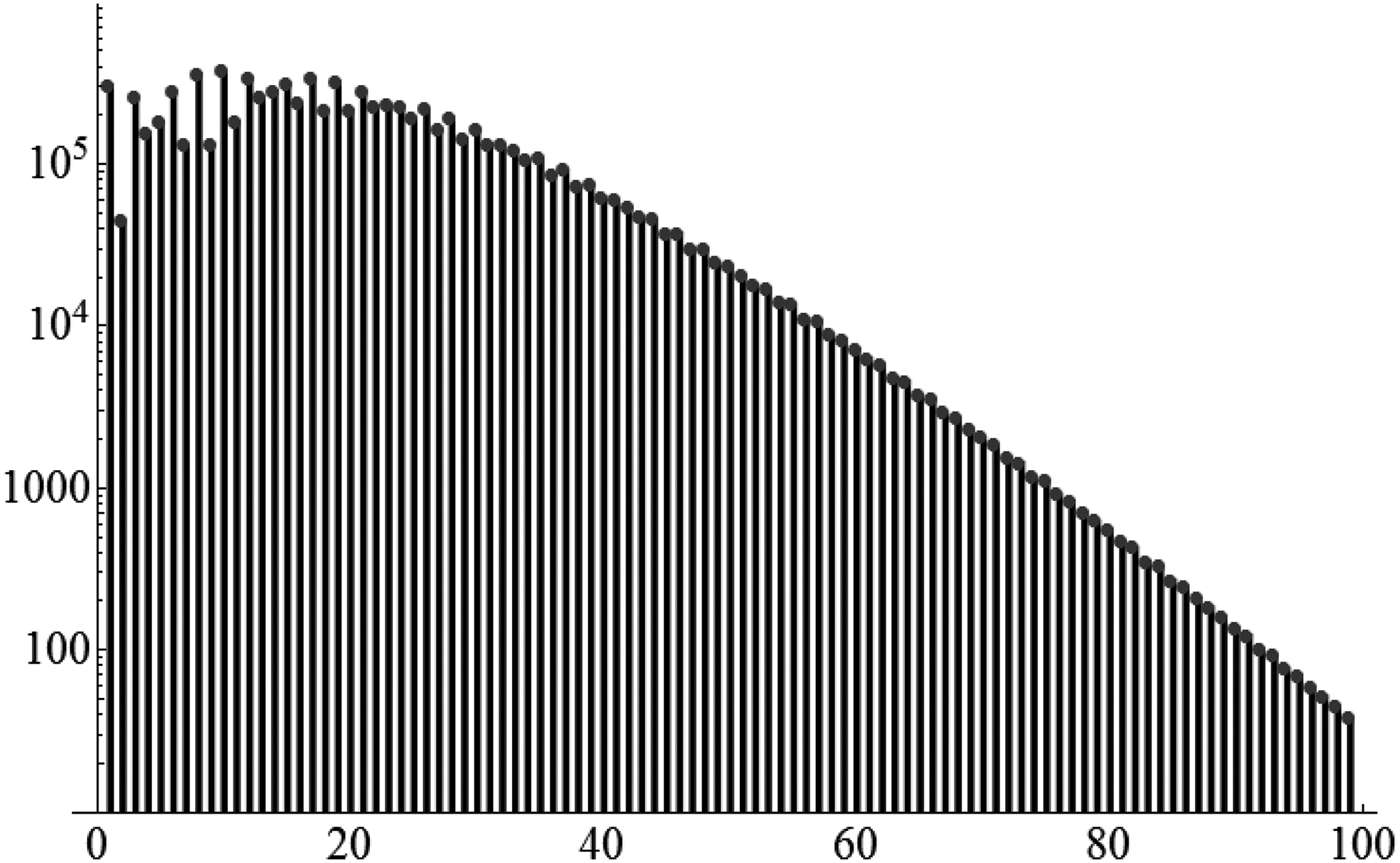
and W Lis the laser energy, multiplied by the number of generated harmonics denoted by j. The study is performed close to 180o geometry, where the laser beam and the electron beam collide head-on with each other. As it can be seen in Figure 8, the maximum intensity is obtained by the 10th harmonic. Thus the energy of the quanta of the fundamental radiation can achieve up to 121, 5 MeV, with significant harmonics production also above 40th harmonic, in the 500 MeV range, neglecting the electron recoil. The generation of such quanta presents a great interest for many recent approaches in terms of high-intense laser fields, such as gamma ray assisted laser boiling of the vacuum (Habs et al., Reference Habs, Gross, Marginean, Negoita, Thirolf and Zepf2010).
Laser-GBS nonlinear Compton scattering set-up at E7 experimental area of ELI-NP.
The spectrum of the normalized total scattered radiation for a = 65.9 by computing the values of Ij as a function of j.
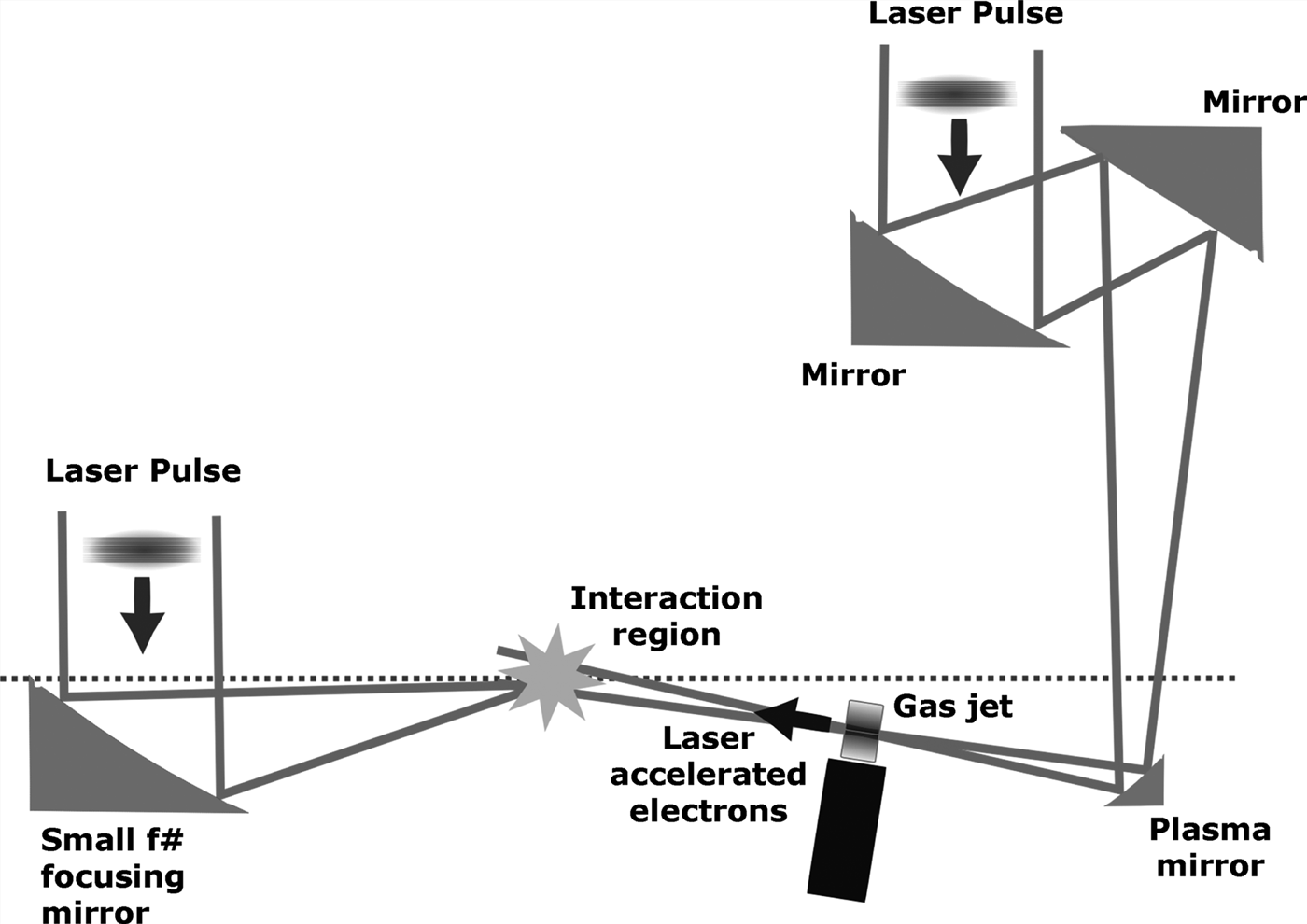
The use of the up to 700 MeV electron beam available at the ELI-NP facility has the drawback of low electron density in the bunch, as the planned electron bunch duration is of the order of 2 ps, and total charge in the range of 100 pC, similar to values reported in (Hartemann et al., Reference Hartemann, Tremaine, Anderson, Barty, Betts, Booth, Brown, Crane, Cross, Gibson, Fittinghoff, Kuba, Le Sage, Slaughter, Wootton, Hartouni, Springer, Rosenzweig and Kerman2004). In order to increase the electron bunch charge density and to decrease the bunch length, laser driven electron bunches can be produced with energies from 100 MeV (Glinec et al., Reference Glinec, Faure, Pukhov, Kiselev, Gordienko, Mercier and Malka2005) up to 2 GeV (Wang et al., Reference Wang, Zgadzaj, Fazel, Li, Yi, Zhang, Henderson, Chang, Korzekwa, Tsai, Pai, Quevedo, Dyer, Gaul, Martinez, Bernstein, Borger, Spinks, Donovan, Khudik, Shvets, Ditmire and Downer2013). The behavior of dense and short electron bunches compared to the wavelength of the intense laser field was modeled in (Smorenburg et al., Reference Smorenburg, Kamp, Geloni and Luiten2010). Such a set-up, also proposed earlier in (Kulagin et al., Reference Kulagin, Cherepenin, Hur, Lee and Suk2008), using two synchronous 10 PW laser pulses, one to generate dense bunch of electrons in a gas jet and one for Compton is described in Figure 9.
Laser-only Compton backscattering set-up at E7 experimental area of ELI-NP.
Attosecond pulses generation through Thomson scattering was proposed earlier (Lee & Cha, Reference Lee and Cha2003; Zhang et al., Reference Zhang, Song and Zhang2008; Liu et al., Reference Liu, Xia, Liu, Wang, Cai, Wang, Li and Xu2010). As the pulse duration of the produced gamma radiation is determined by the convolution of the electron bunch duration with the TFP spatial extension. If the electron bunch is significantly shorter than the duration of the TFP, then the Compton backscattered harmonics pulse duration will be determined by the electron bunch duration. This can be the case in experiments using laser accelerated electron bunches where the bunch length can reach durations of the order of 2 fs (Buck et al., Reference Buck, Nicolai, Schmid, Sears, Sävert, Mikhailova, Krausz, Kaluza and Veisz2011; Lundh et al., Reference Lundh, Lim, Rechatin, Ammoura, Ben-Ismaïl, Davoine, Gallot, Goddet, Lefebvre, Malka and Faure2011). In such a case, covered by the set-up described in Figure 9, even using hundreds of femtosecond long pulse duration will provide Compton backscattered pulses with duration in the few femtosecond range.
5. CONCLUSIONS
As pointed out in the first part of this article, TFPs are needed in order to perform experiments in the ultra-relativistic regime with the existing or planned laser facilities. Spatial s and temporal t extensions of TFPs were investigated. Analytical solutions for the electric and magnetic fields are computational intensive, so FDTD numerical computation was used instead. The results show that the spatial extent of the EM field in focus of ultra-short pulses depends on Rayleigh range and it is shorter than the temporal duration of the pulse c × T. A factor that quantifies the relative spatial extension (RSE) of the electromagnetic field of the laser pulse in the focal region was introduced and the extended lambda-cubed regime was thus described.
This impacts on the realization of experiments in strong laser fields. This study is important for future ultra-short pulse laser experiments at laser facilities such as Extreme Light Infrastructure. The results show that, in a restricted sense, the λ3 regime can be reached with significantly longer pulses.
We have shown that depending on the type of the electron, non-relativistic or relativistic, the transverse extension of the TFP or the longitudinal extension of the TFP can play a major role. In the first case, the electrons are expunged from the focal region perpendicular to the direction of propagation, while in the second case, Compton scattering on relativistic electron bunches, gamma radiation can be produced with very short pulse duration even when employing relatively long laser pulses.
ACKNOWLEDGEMENT
The authors acknowledge discussions with Dietrich Habs, Dino Jaroszynski, Olimpia Budriga, Madalina Boca, Viorica Florescu, and Alexandru Popa. Work performed with the financial support of LAPLAS 3 program from ANCS, Romania and of the UEFISCDI project PN2-Parteneriate-1/2012. This work is supported by Extreme Light Infrastructure – Nuclear Physics (ELI-NP) — Phase I, a project co-financed by the Romanian Gouvernment and European Union through the European Regional Development Fund.