Introduction
Around the world, aggressive competition exists among countries, regions, and cities for inward foreign direct investment (FDI). Policy makers know that its effects can be considerable, supporting, for example, productivity improvements,Footnote 1 the infusion of new technology,Footnote 2 and jobs.Footnote 3 For firms, outward FDI helps overcome political tension and regulatory barriers,Footnote 4 increases production and distribution efficiencies,Footnote 5 allows for the exploitation of ownership advantages,Footnote 6 and safeguards access to assets like natural resources and specialized expertise.Footnote 7
In recent years, the focus of economic development has broadened and evolved. The stated goals of modern economic development have shifted away from headline-grabbing, smokestack-chasing, external sources of industrial development.Footnote 8 One current priority is internal, organic forms of development, cultivated through enhanced innovation, diversification, entrepreneurship, and competitiveness.Footnote 9 Another is the pursuit of qualitatively different forms of external FDI, including for example technology-oriented undertakings from industries like information and communication technology, biotechnology and green tech. Attention has also shifted to attracting functions traditionally housed at headquarters, including activities like research and development.Footnote 10
Despite the apparent repositioning of priorities, the practice of big-game hunting endures. In 2017, for example, electronics manufacturer Foxconn announced a $10 billion plant in Wisconsin, facilitated by government support valued at $4 billion.Footnote 11 That same year, 238 locations submitted bids for Amazon’s second North American headquartersFootnote 12 supported by incentive packages valued in the billions of dollars. Tesla’s 2014 decision to build a battery factory in Nevada was accompanied with $1.3 billion in tax breaks and other incentives.Footnote 13 Thus, even though economic development plans are now aimed at qualitatively different forms of investment, the promise of big-game, external sources of inward FDI continues to stir attention.
How do FDI decisions of such magnitude get made? While considerable evidence exists about the motivations of both foreign investors and its recipients, less research has been done about how conditions converge and how the process unfolds. Notwithstanding the gaps, some attempts have been made and models and frameworks have been devised.Footnote 14 However, for many, inward FDI attraction is best explained in an incremental manner: by considering the presence or deficiency of individual factors. Such investigation includes analysis of horizontal policies: widely accessible programs and plans available across regions and industries (e.g., tax concessions or subsidies to support innovation, research, or the adoption of advanced technologies).Footnote 15 It also includes vertical programs: policies targeted at specific regions, industries, or firms.Footnote 16 Beyond that, the effect of broad philosophical underpinnings has also been considered, including for example, adherence (or not) to a neoliberalism approach and/or the principles contained in the Washington Consensus.Footnote 17
This article contributes to this literature by exploring the process of FDI attraction and decision making through the lens of business history. It extends and supports ongoing discussions about the integration of historical approaches into contemporary business and management, aligning with a push by business historians to deploy the practices of their discipline to build theories in management and business fieldsFootnote 18 as well as a pull by those disciplines to consider a historical approach.Footnote 19 It does this by examining the Canadian automobile manufacturing industry in the 1980s. When that decade started, four American-owned original equipment manufacturers (OEMs) dominated automobile manufacturing in Canada. By the close of the decade, five new manufacturers (Honda, Toyota, Suzuki, Renault, and Hyundai) had entered Canada with new assembly plants: large industrial operations, employing thousands of people on several hundred acres. By telling the story of their entry—how the appetite for new sources of investment evolved and how the tools to bring the new entrants to Canada were conceived—several contributions are possible. First, rich perspective is gained about the interplay and development of motivations, messages, and tactics of investors, policy makers, and others in FDI attraction. Second, because the period following the U.S. presidential election in 2016 coincided with a reversion by some to tactics reminiscent of those employed in Canada in the 1980s, this article provides timely perspective on present-day issues and debates. Third, another item may now be added to the catalog of factors that are said to affect decisions surrounding FDI. That item is the role of policy entrepreneurs in shaping public opinion, setting goals, building tools, taking risks, and energizing the process.Footnote 20 Finally, an addition is made to the history of one of Canada’s most important industries. By explaining the political and economic pressures confronting policy makers during the earliest stages of the new entrants’ foray, it augments Jacobs’s and Anastakis’s descriptions of the historical path of automakers entering Canada during the 1980s.Footnote 21 Additionally, the article increases understanding of the development and use of several forms of industrial policy, many of which have been subsequently proscribed. For example, considerable research exists surrounding the 1980s-era introduction of restraints on Japanese automobile exports to the United States and Europe.Footnote 22 However, examination of how such trade-related distortions were deployed in Canada or why the Canadian situation compelled an approach that differed from those adopted in the United States or Europe does not exist.
This article contributes to understanding of these matters through an in-depth case study, an approach that is appropriate for several reasons. First, by closing a gap in the business history of the Canadian automobile manufacturing industry, the information this case reveals is intrinsic and valuable in itself.Footnote 23 Second, it assesses the validity of previously established concepts and theories.Footnote 24 Third, it opens an avenue for new streams of inquiry.Footnote 25 Caution has been taken to avoid a tendency that exists in case study research to extend findings or circumstances unique to the case under study as the basis for broader generalizations.Footnote 26
Quantitative data is drawn from multiple sources, including Statistics Canada’s CANSIM database, which is Canada’s key source of socioeconomic data. Several private sector sources of data are also consulted. Qualitative perspective is obtained from archival sources as well as from interviews with key actors. Interview subjects include those engaged in the decisions and events that unfolded during the period under study.
Going forward, the article is organized as follows. In the next section, context is provided through a review of key features of the Canadian auto industry from 1965 to 1980. After that, Japan’s transition from status of threat to be managed to potential source of new inward FDI is explained. Then, drawing on Kingdon’s Multiple Streams Theory,Footnote 27 an account is provided of how one person—a policy entrepreneur—recognized the convergence of a problem, the availability of policy options, and favorable political dynamics to exploit an opportunity to bring new sources of inward FDI to Canada. The article concludes with key observations, including comments about the value of bringing historical perspective to contemporary issues.
The Post-Auto Pact Era: Mounting Pressures for North American Automakers
Policy makers in both developed and developing nations have long recognized the unique benefits that FDI from automobile manufacturers provides. While the direct employment effects are substantial,Footnote 28 vehicle manufacturing also generates high economic multiplier and upstream and downstream spin-off benefits.Footnote 29 In Canada, the enduring importance of automobile manufacturing is also reflected in the nature and volume of research it has generated, both prior to and after the period this case considers.
The foundation for a large volume of research concerning Canada’s auto industry is the Canada-U.S. Auto Pact of 1965. The auto pact had the effect of merging vehicle manufacturing in Canada and the United States. Under the pact, companies could import vehicles duty-free into Canada provided they met two provisions: make one vehicle in Canada for every vehicle sold in Canada and generate Canadian Value Added (CVA) equal to 60 percent of company sales. Auto pact companies’ Canadian factories also gained unencumbered access to the U.S. market, allowing them to reach scale economies previously unattainable. In the years following the pact’s coming into force, its effect was assessed from a variety of perspectives, including productivity, trade, employment, wages, and GDP.Footnote 30 For Canadians, the pact became a symbol of national pride,Footnote 31 “monitored closely, scrutinized regularly, interpreted widely and defended vigorously.”Footnote 32
When it came into force in 1965, the auto pact represented a major alteration to the conditions by which auto manufacturers in Canada conducted their affairs. While the tariff-avoiding benefits of holding auto pact status were considerable, the penalties for violating its production volume and/or CVA requirements were severe—the imposition of duties on all imported vehicles and parts; costs that could reach hundreds of millions of dollars per year. Although there were several occasions when incumbent automakers failed to meet performance floors, Canada never chose to impose tariffs. Instead, a series of incremental investment commitments were extracted from the offending parties, mostly in the form of new final assembly plants. For example, Chrysler Canada failed to meet the production to sales ratio for trucks in 1973, 1974, and 1975. However, rather than pay duties the federal government estimated at $17 million, Chrysler agreed to invest $40 million to construct a new van plant.Footnote 33 American Motors of Canada (AMC) failed to meet auto pact standards in 1980 and 1981, creating a $30 million liability, which was absolved when the company invested $764 million in a new assembly plant in Bramalea, Ontario, later that decade.Footnote 34
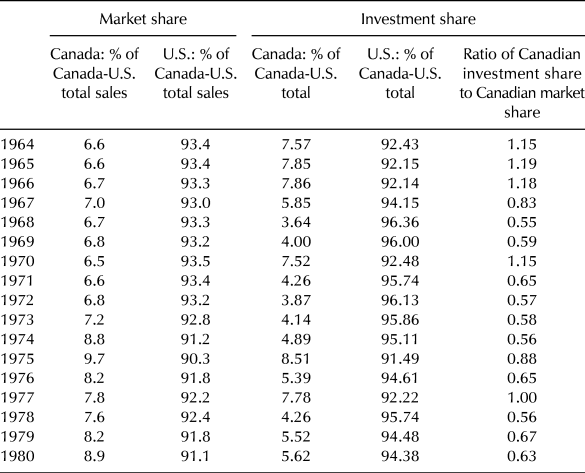
Initially, the auto pact opened a flourishing phase in the Canadian automotive industry. However, following an early-stage flurry of spending by automakers to seal their pact requirements, investment stalled. By the time it was approaching its fifteenth anniversary, pressure for something different had started to grow. Anxiety converged around the notion of “fair share”; specifically, that Canada was not getting its share of investment and jobs. For example, data from Table 1 shows that between 1967 and 1980, Canadian sales represented an average of 7.7 percent of the total Canada-U.S. market. However, Canada’s share of capital investment was just 5.3 percent. Table 1 also shows that between 1967 and 1980 there were only two years when Canada received investment share commensurate with the size of its market. In a letter to U.S. President Carter in May 1978, Prime Minister Trudeau described his hope that the Big 3 American-owned manufacturers would “see their way clear to place a fair and equitable share of their proposed new investment in Canada so as to contribute to the revamping and upgrading of automotive development and production in Canada and to re-dressing in some reasonable measure Canada’s persistent bilateral trade deficit.”Footnote 35 In the province of Ontario, where most of Canada’s auto industry was located, similar consternation arose. In 1978, the province observed: “The Canadian automotive market has been growing more rapidly than the level of industry activity. As a result, Canada’s share of investment, employment and other industrial benefits has not been commensurate with its contributions to overall North American sales.”Footnote 36
Market share and investment by motor vehicle manufacturers in Canada: 1964–1980

Sources: Market share data derived from DesRosiers, DesRosiers Automotive Yearbook.
Investment figures from 1964 to 1974 from United States International Trade Commission, United States-Canadian Automotive Agreement.
Investment figures from 1975 to 1980 from Lavelle and White, An Automotive Strategy for Canada, 168.
Investment figures standardized using exchange rate data from Antweiler, Foreign Currency Units.
In addition to concerns about levels of investment and employment, anxiety was also rising about the profile of the industry. The concern was that the Canadian industry had become truncated, which Campbell Stuart, who served as chairman of a Government of Canada automotive task force in the early 1980s described as “the tendency for Canadian subsidiary firms to rely very heavily on their U.S. parent companies for research and development, engineering and design, management functions and investment and sourcing decisions.”Footnote 37 In his report for the Science Council of Canada, MacDonald listed a series of functions that were performed in Canada before the signing of the auto pact, but which subsequently disappeared. These included flexible manufacturing lines capable of producing low volumes with a much wider production mix, unique-to-Canada purchasing and logistics functions, and standalone marketing and product planning.Footnote 38 By 1978, pressures had grown to the extent that the pact’s original architect, Simon Reisman, was appointed to conduct a Royal Commission study into the industry. He concluded: “Under the Auto Pact, the Canadian industry lost none of its satellite characteristics. If anything, this condition became more pronounced as the U.S. side took advantage of the free trade arrangements to rationalize its overall activities, including those in management, professional and scientific areas of its operations.”Footnote 39
Therefore, by the close of the 1970s, a consensus had developed in Canada that its auto industry had stagnated, that Canada was not getting its fair share of investment, and that it had been consigned to the status of low-skilled backwater. Agitation was growing in key quarters, including the federal government and Ontario.
As the 1980s began, anxiety continued to mount. A second energy crisis occurred in 1979, and the economy was beset by high inflation, low growth, and high interest rates. In 1980, inflation was 10.1 percent,Footnote 40 economic growth was dropping,Footnote 41 and consumer loan rates had jumped to 16.6 percent.Footnote 42 Between 1978 and 1980, automobile production dropped by 25 percent in Canada, and by 38 percent in the United States. In Canada, the assembly sector shed more than 8,400 jobs between 1978 and 1980, a decline of 16 percent. Meanwhile, parts makers released 11,100 people, which was 21.3 percent of their workforce.Footnote 43 The Canadian operations of the four major assemblers registered losses of $217 million (1980), $168 million (1981), and $184 million (1982).Footnote 44
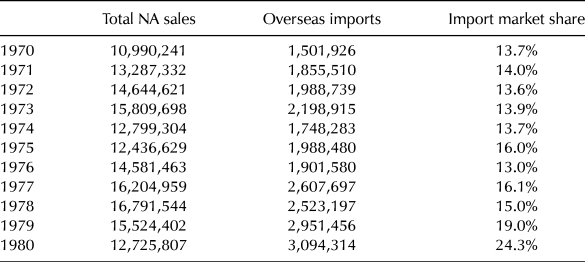
Over a very few years, the structure of the North American auto industry had undergone a dramatic shift. As Table 2 shows, as recently as 1970, the industry was smaller, but American-owned firms still dominated. Combined Canada-U.S. vehicle sales in 1970 were just 11 million, but 9.5 million vehicles were made in North America. By 1980, the market had grown to 12.7 million, but Canada-U.S. production was stalled at 9.6 million, and the share of the market claimed by imports had reached almost 25 percent. More critically, data from Table 2 shows that between 1978 and 1980, the North American market had dropped by 24.2 percent at the same time imported vehicle sales had risen by 22.6 percent.
North American vehicle sales and import market share
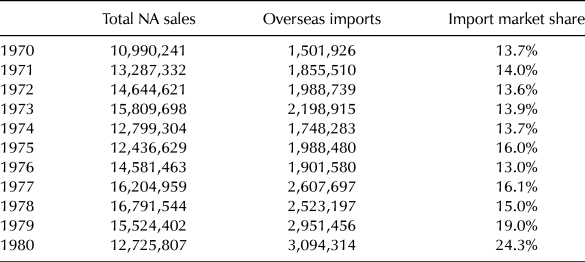
Source: Author calculations from Canada, Department of Industry, Science and Technology. Report on the Canadian Automotive Industry in 1986, 6.
As the challenges confronting North American-based automakers grew, Japanese-owned automakers were enjoying increasing success. In Japan, for example, vehicle production climbed from 5.3 million units in 1970 to 11 million in 1980,Footnote 45 rivaling the United States for leadership. Over the same period, Japanese manufacturers reduced the number of hours required to build a vehicle from 254 to 139. By comparison, over the same ten-year timeframe, the number of hours needed to make a car in U.S. factories jumped from 189 to 202.Footnote 46 Further, by 1980, hourly labor costs in the United States were $12.67 as compared to just $7.40 in Japan.Footnote 47 As a result, by 1981 it was estimated that Japanese automakers could manufacture a small car for $1,500 to $2,000 less than their U.S. counterparts.Footnote 48 The difficulties besetting the North American automakers in Canada during this phase were reflected in comments by William Pickett, AMC Canada president and chairman of the Motor Vehicle Manufacturers Association of Canada: “We cannot go on losing money the way we are or we are not going to have an industry left … and if we are going to continue as an industry we will need some protection. Otherwise it means a loss of production, a loss of employment and a loss of revenues.”Footnote 49
Japan and Its Automakers Become the Target
As this section will show, the stresses bearing down on both the U.S.-owned automakers in Canada as well as the policy makers in that country eventually manifested in unprecedented pressure on Japanese-owned automakers to invest in Canada. In time, the Japanese did warm to the idea, but as will also be demonstrated, this was not anyone’s original intent: not Canadian policy makers, certainly not the incumbent automakers, and not the Japanese. In fact, the move to affirmative FDI decisions by the Japanese was never straightforward. In this section, it will be shown that at the start of the 1980s no elaborate strategy existed and the tools that eventually proved to be effective were not originally conceived for the purpose of attracting FDI. Ultimately, though, Canadian policy makers did throw a lifeline to U.S.-owned automakers. However, rather than support them via direct measures, their attempt to help the incumbents was based on destabilizing the upstart Japanese. In the end, instead of prompting a Japanese retreat from the North American market, which this research will demonstrate was the primary intent of the incumbents and many policy makers, the actions had the effect of causing the Japanese to reconsider their strategies. In due course, policy makers in Canada came to adjust their goals and reorient their approach to such an extent that, rather than viewing the Japanese firms as threats that had to be managed and curtailed, some policy makers started to think of them as potential new sources of inward FDI.
This section explains how that transition occurred. First, a description is provided of how Japan and its automakers became a target of policy makers in the United States and Canada in the early 1980s. After that, an explanation is offered for how Japanese automakers transitioned from being the object of Canadian policy makers’ antagonism to being the target of its investment attraction efforts.
There are several reasons why Japan became a target in the early 1980s. Ultimately, events played out in Canada in a manner similar to that of the United States. However, as will be demonstrated, conditions in the two countries were not uniform. In the United States, the situation with respect to the auto industry’s employment, production, and sales was more acute. Also, for the Japanese, including its automakers and government, the United States was a bigger and more important market. Additionally, it is shown that less ambiguity existed in the United States about the perceived need for a response. As a result, in dealing with the U.S. situation, the reaction of key actors tended to be more rapid and emphatic. Actions in that country also tended to presage subsequent events in Canada.
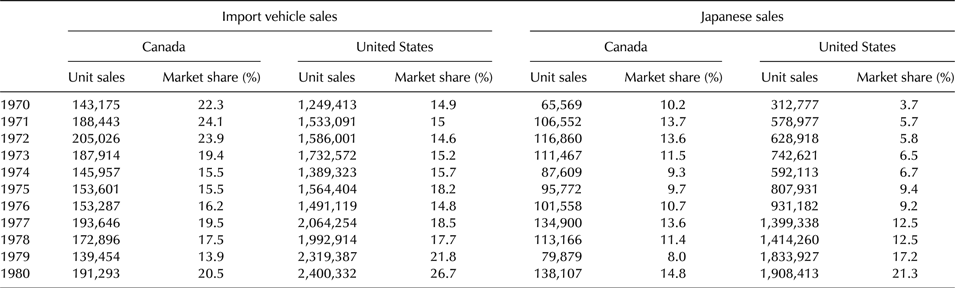
Table 3 shows that in the United States, vehicle imports from Japan climbed from 313,000 units, just one-quarter of total vehicle imports and less than 4 percent of the American market in 1970, to 1.9 million units in 1980, which was 21.3 percent of the market and 80 percent of all imported vehicles. Moreover, by 1980, the ascendancy of the Japanese in the U.S. market was about to peak. It being an election year in the United States, politicians of all hues were prepared to pledge support. Two major U.S. government reports that were issued that year give evidence to the considerable attention the issue was generating. In May 1980, U.S. president Carter established a task force on the American auto industry, led by Transportation Secretary Neil Goldschmidt. When the task force presented an interim report to the president in July, just prior to a trip he was making to Japan, it included a recommendation to impose restraints on Japanese imports. In September 1980, the Trade subcommittee of Congress also released a report. It urged “the Japanese to understand the critical mass dangers created by the current auto trade imbalance and unemployment in the United States and to show voluntary restraint during this period of domestic restructuring.”Footnote 50 Then, shortly after taking office, President Ronald Reagan appointed Transportation Secretary Drew Lewis to head another task force. Its membership was deeply divided over the issue of restraining trade, but it eventually recommended a voluntary formula to be administered by Japan.Footnote 51
North American sales of imported passenger vehicles: 1970–1980
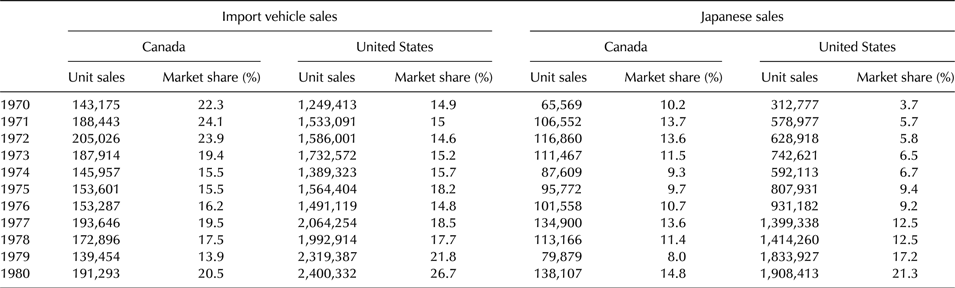
Source: Total import market share and Japanese market share in Canada and United States from Canada, Department of Industry, Science and Technology, Report on the Canadian Automotive Industry in 1985, 57, 58.
The convergence of these condition—a fragile economy, deteriorating automotive employment and sales, and sustained attention of policy makers—made conditions ripe for an aggressive U.S. response. Recognizing the fragility of their situation, Japan acted first by adopting the Lewis task force’s blueprint of a voluntary formula to be administered by Japan. Japan’s Voluntary Restraint Agreement (VRA) cut exports to the United States to 1.68 million units in the twelve-month period commencing April 1, 1981, a 7.7 percent reduction from the previous year.
With a ceiling on U.S. exports in place, Canada and its industry became isolated. However, conditions in Canada did not neatly parallel those of the United States. For example, Table 3 shows that Japanese vehicle imports to Canada had grown, but by a more modest extent than what had occurred in the United States. As well, while the U.S. trade deficit with Japan was large and growing, Canada enjoyed a surplus with Japan, due largely to commodities. The delicacy of the situation is described in a letter from Herb Gray, then Canadian Minister of Industry, Trade, and Commerce, to one of his constituents: “Japan is one of Canada’s largest trading partners and we do about $5 billion in trade annually. In 1979, we had a surplus in our balance of trade with that country of $1.8 billion and in 1980 to the end of July we exported $2.7 billion to Japan and imported only $1.5 billion.”Footnote 52 Therefore, Canada could not simply impose a formula similar to the one Japan had voluntarily placed on itself with the United States. The delicacy of Canadian policy-makers’ situation notwithstanding, they recognized that they could not sit idly by. For example, a letter to Prime Minister Trudeau from Ontario Premier Davis warned: “Lower imports into the United States could mean increased imports to Canada.”Footnote 53 The federal government eventually agreed, raising the issue in a meeting with Deputy U.S. Trade Representative Robert Hormats in November 1980, expressing frustration that there was “no indications from the Japanese that they are prepared to treat auto exports to Canada with the same degree of quote prudence unquote as exports to the USA.”Footnote 54 This meant Canada had little choice but to press for its own form of VRA. On June 5, 1981—two months after the Japan–U.S. VRA deal commenced—the Japanese Ministry of International Trade and Industry (MITI) announced its intention to impose voluntary restraints on passenger car exports to Canada at a level of 174,000 units for the twelve-month period, retroactive to April 1, 1981, a cut of 6 percent from the year before.Footnote 55
In time, the system proved to be beneficial as a tool to generate inward FDI to Canada from Japanese automakers. However, Paul Lau, who was then at the Canadian Department of Regional and Industrial Expansion, explains that the original purpose was not investment attraction: “They had nothing to do with getting them to invest as such. They were used to address the downturn of the industry at that time because of the oil shock.”Footnote 56 Even so, in 1986, five years after the system was enacted, Suzuki and GM were contemplating a joint venture automotive assembly investment in Ontario. However, to round out the Suzuki sales line-up and to make the business plan viable, imports of Suzuki products from Japan were necessary. The problem was that, under the restraint program, exports were allocated to manufacturers on the basis of market shares held in Canada in 1980. Because Suzuki sales in Canada were negligible in the base year, it was limited to just 3,000 exports, not enough to make the business feasible. Suzuki sought an export allocation of 25,000 units, but other Japanese automakers refused to relinquish any of their shares.Footnote 57 Until the situation was resolved, General Motors and Suzuki were unwilling to commit to the new plant. Only after the Canadian government intervened in 1986 did the Japanese government agree to increase the overall quota by 36,000 to 240,000 for the year ended March 31, 1987, augmenting allocations to all companies, including the provision of 14,000 additional units to Suzuki.Footnote 58 Shortly thereafter, GM and Suzuki announced their intention to build a new $500 million facility in Canada.
Beyond the existence of export restraints, the process of Japan and its automakers transitioning from the status of imminent threat to new foundation for growth also required the accumulation and convergence of additional factors. That process unfolded slowly. In fact, even as Japanese automakers were announcing investments in the United States, Canadian policy makers doubted that Canada would receive similar attention. For example, after visiting Washington, DC, in 1983, an Ontario official reported that Japanese automakers appeared poised to invest in North America. However, he also commented, “If they do, they are less likely to invest in Canada.”Footnote 59 Robert White, who led the Canadian arm of the United Autoworkers (UAW) lamented: “We do not have the same political persuasion with Japan as the United States does and all you have to do is look. Nissan, Honda, Toyota and literally dozens of parts plants are already in the United States.”Footnote 60 Importantly, the Ontario official’s and the union leader’s comments were made in 1983, two years after Japan imposed its ceiling on exports to Canada. However, as their statements suggest, even though there was pessimism about their prospects, Canadian actors had started to countenance the idea of Japanese investment.
The imposition of a Voluntary Export Restraint program in Canada in 1981 represented a significant achievement for those seeking to limit the threat that Japanese automakers were seen to represent. However, the presence of a ceiling did not mean the absence of a risk, a fact that caused Canada’s incumbent automakers to continue efforts to reinforce their position with policy makers and consumers. In doing so, they employed a message designed to simultaneously remind audiences of their commitments to Canada and establish a foundation for protecting their market. The message suggested that any manufacturer selling vehicles in Canada should make investments commensurate with its sales. All incumbent automakers in Canada, as well as the leadership of the Canadian arm of the UAW deployed the message in speeches and media interviews. In 1983, for example, the president of GM Canada reminded an audience: “Now that Japan has achieved the rank of an industrialized nation, one of the world’s most advanced and powerful, it no longer can conduct itself as if it were still a developing nation. It must be more sensitive to the needs of others in world trade.”Footnote 61 In in an interview, the UAW’s Robert White declared, “The government sits on the sidelines and watches these multinational corporations, who really do not care where they make their money, make more and more investment decisions outside of the country. We have to put a policy in place that says, we don’t care what you’re called; if you’re going to sell in this market, you have to make a commitment here.”Footnote 62 In his 1982 address at the Ford of Canada Annual Shareholders Meeting Ford’s Canadian president Ken Harrigan stated: “The philosophy of investing in plants and jobs where we sell our products is an historic one with Ford—worldwide. And it is the same philosophy that we believe should be applied to the Japanese manufacturers who are currently enjoying windfall sales in Canada.”Footnote 63 Harrigan’s message to shareholders in the company’s 1983 annual report further explained:
Favourable exchange rate differentials and lower labour costs provide those importers with a competitive advantage over domestic producers and this situation requires appropriate government responses. The obvious solution is to invite importers who sell a large number of vehicles in Canada, to establish production and supply facilities here, which would result in Canadian investment and employment, as well as allow competition on an equitable basis.Footnote 64
For the American-owned OEMs and their unionized workers, the “build here-sell here” theme was considered a safe form of defensive maneuvering. Former Chrysler Canada executive Mike Walker describes the logic: “Even if they did invest, they were going to incur the same labour costs, they were going to incur all the rules and regulations with regards to doing business within this country and the same level of taxation and so on and so forth. They could fail and struggle on the same basis as everyone else.”Footnote 65
In due course, the automakers’ and Labour’s message had an effect, but not the one they anticipated. Even though the messages from the actors remained aligned, motivations started to diverge. Private sector actors continued to press for inward Japanese FDI, even though they believed none would be forthcoming. Even so, their posturing was having an influence. First, they were creating a form of consent for policy makers to pursue new entrants. Second, policy makers started to act, eventually building confidence that a positive result might be possible.
Ultimately, the Canadian policy-makers’ toolkit to attract automotive FDI expanded to include multiple offerings. Some were straightforward, such as interest-free loans, training support, purchases of land, and direct grants. Several were less transparent, such as auto pact liability waivers; tiered duty remission plans; and manipulations of Canada’s Foreign Investment Review Agency (FIRA), which stipulated the conditions under which foreign companies were allowed to conduct business in Canada. Others were more threatening, including blocking access to the market and issuing warnings about elevated local content. The next section explores the processes employed and the contributions of one of the key actors in effecting the transition.
The Entry of a Policy Entrepreneur
So far, a description has been provided for how multiple factors accreted and evolved to support an appetite for new sources of FDI: a prolonged economic downturn, acute challenges confronting incumbent automakers, and efforts to isolate Japan. In this section, an additional layer is inserted: the actions of Canadian Cabinet Minister Ed Lumley. During his tenure in the Cabinet of the Government of Canada, Lumley was deeply involved in FDI attraction, elevating the position of automotive FDI among political and policy elites, taking provocative actions, and deploying consistent and often unconventional forms of communication.
A suitable lens for capturing Lumley’s tactics, methods, and contributions resides in Kingdon’s Multiple Streams Theory (MST), which submits that the alignment of three streams are necessary for a policy change to occur.Footnote 66 Those streams are recognition that a problem exists, the availability of policy responses, and suitable political dynamics. These have been detailed in the sections above. Beyond the three streams, MST also contemplates the role of policy entrepreneurs: those who recognize that the streams are aligning and that a window is opening. It is the policy entrepreneurs who have the enterprise and ambition to exploit opportunity and effect change. Subsequent contributions have added definitional precision to Kingdon’s notion of the policy entrepreneurFootnote 67 and established some separation between the function of policy entrepreneur and policy broker.Footnote 68 Nevertheless, Kingdon’s description of such persons as demonstrating a “willingness to invest their resources—time, energy, reputation, and sometimes money—in the hope of a future return”Footnote 69 is both instructive and fitting for assessing the role of Ed Lumley in the changes that ensued.
Lumley was born and raised in Windsor, Ontario, which is located on the Canada-U.S. border directly across the Detroit River from Detroit, Michigan. For generations, Windsor has served as the de facto home of the Canadian auto industry. In 1904, for example, the first Ford automobiles built outside of the United States were made in Walkerville, Ontario; then, just beyond Windsor’s borders. In the 1980s, the city was the location of Chrysler Canada’s head office and two of that company’s final assembly plants, as well as the site of key parts and components operations, including those of General Motors and Ford. Even today, Windsor has the highest auto industry concentration in Canada.Footnote 70 Although Lumley’s political career was forged in Cornwall, Ontario,Footnote 71 800 kilometers east of Windsor, he maintained a strong connection to Windsor and the industry that dominated its economy. He attended Assumption University, the predecessor of the University of Windsor, and graduated in 1961. From 2006 to 2018 he served as chancellor of the university. Additionally, he has sat on the boards of directors of several automotive-related manufacturers, including Magna and American Motors Corporation.
When Lumley joined the Cabinet of Liberal Prime Minister Pierre Trudeau in 1980, as the Minister of State for Trade, conditions were converging for an aggressive pro-auto industry approach. As previously described, economic malaise coupled with a range of challenges besetting the auto industry’s traditional North American entrants was causing significant stress. Political dynamics were also aligning. First, beyond Lumley, three other politicians from constituencies in or adjacent to the city of Windsor were appointed to Trudeau’s Cabinet: Eugene Whelan (Essex-Windsor), Agriculture; Herbert Gray (Windsor West), Industry, Trade, and Commerce; and Mark MacGuigan (Windsor-Walkerville), Secretary of State for External Affairs. That meant that Windsor, with a population of 200,000, less than 1 percent of Canada’s population, comprised almost 10 percent of the new Cabinet, 12 percent including Lumley. Therefore, the home of Canada’s auto industry had influence disproportionate to its size.
Second, Gray’s 1980 appointment solidified and portended the new government’s approach to economic intervention. During the 1980 election campaign, the Liberal Party and its leader, Pierre Trudeau, had taken a strong nationalistic stance, promising intercession with respect to energy and foreign investment. The party’s disposition was a reflection of a lingering preoccupation with economic nationalism that had persisted within the Liberal Party and Canada’s political left since the 1960s. Oxygen for the movement had been added in 1968 with the release of the commissioned report of the Liberal government, “Task Force on Foreign Ownership and the Structure of Canadian Investment,” which had been led by economist Mel Watkins. Then, in 1972, Gray, then serving as Revenue minister, tabled another report with the same nationalistic theme, this time titled “Task Force Report on Foreign Ownership.” The content of the 1972 report gave rise to the creation of Canada’s FIRA in 1974 (mentioned earlier), its mandate being to screen foreign acquisitions in Canada to ensure, as the act declared, that those investments provided a “significant benefit to Canada.” Through FIRA, Canadian policy makers gained considerable latitude in imposing the terms by which foreign corporations were allowed do business in Canada—powers the Government of Canada subsequently exercised in the 1980s to extract automotive FDI from new entrants.
The preponderance of literature is either sharply critical of FIRAFootnote 72 or of the opinion it had minimal effect.Footnote 73 However, successive ministers consistently used the legislation to exact requirements from potential investors.Footnote 74 Before a case was disallowed, an applicant had a number of options. One was to withdraw. Alternatively, applicants were able to suggest or accept undertakings to satisfy government aspirations. In so far as the attraction of new sources of automotive FDI in Canada in the 1980s is concerned, the powers vested to the minister of Industry to extract concessions and investments by auto companies seeking to do business in Canada were substantial. For example, FIRA undertakings were important ingredients in the 1984 decision by AMC-Renault to build an assembly plant in Brampton, Ontario. The seeds of this started in 1980 when Renault increased its stake in AMC to 46.4 percent, giving them effective control. Over the next four years, company officials negotiated with federal officials in an effort to gain FIRA approval, suggesting a series of undertakings to demonstrate “significant benefit to Canada.” For example, by April 1981 they had pledged to continue production at its assembly plant in Brampton, maintain operations at its auto parts subsidiaries in Canada, hire more Canadian executives, appoint Canadians to its board, and provide guarantees about new capital investments.Footnote 75 In the midst of the FIRA process, AMC also fell short on its auto pact commitments and the two items became entangled.Footnote 76 It was not until AMC-Renault saw the need for additional vehicle production capacity that the two parties were reconciled. By then, Lumley was the Industry minister. Recognizing that an opportunity existed for Canada to secure the new investment, he approached AMC-Renault officials directly.Footnote 77 In 1984 AMC-Renault announced a new $764 million, 150,000-unit capacity plant for Brampton. The government package was announced as $121 million, split equally between the federal and provincial governments. Additionally (and not announced) the company also received a waiver for its auto pact liabilities as well as approval from FIRA.Footnote 78
FIRA undertakings were also important ingredients in the decision by Hyundai to build a plant in Bromont, Quebec, in 1985. When Hyundai announced a 100,000-unit, $300 million plant for Bromont, it was disclosed that the company would receive $200 million interest-freeFootnote 79 as well as land, reduced electricity rates, and a training grant of $7.3 million.Footnote 80 It was not revealed until later that Hyundai also gained exemption from FIRA undertakings they had pledged in 1983 when they first started selling vehicles in Canada. As part of the 1983 deal, Hyundai pledged to purchase and export Canadian products valued at 50 percent of the company’s imports, at least 20 percent of which were agreed to be manufactured goods.Footnote 81 In 1983 Hyundai anticipated that its sales would be approximately 5,000 units per year.Footnote 82 Problems arose, however, when sales exploded. In 1985 and 1986, Hyundai imported 138,000 vehicles into Canada, which at an average cost of approximately $6,500 amounted to sales of $897 million. Under the FIRA agreement, Hyundai should have exported $225 million worth of goods annually, including manufactured goods valued at $45 million. Hyundai’s Canadian vice president, Norm Gibbons, stated that his company had purchased just $39 million worth of parts and accessories in 1985.Footnote 83
Gray’s posting to the Industry, Trade and Commerce portfolio set a tone for subsequent intervention by the Canadian government in Canada’s automotive industry. Within months of his appointment, he coordinated Canada’s involvement in a rescue package for Chrysler, a turn of events that was triggered by Chrysler witnessing its North American production decline from 1.6 million vehicles in 1976 to just 700,000 in 1980.Footnote 84 This article will not delve into the detailed negotiations that saved Chrysler as that has been well documented elsewhere.Footnote 85 What ultimately emerged was a complex multijurisdictional package involving the federal governments of the United States and Canada as well as the provincial government of Ontario, providing the wherewithal for Chrysler to survive.
The combination of the Liberal Party’s longstanding nationalist sentiments, the composition of the 1980 Cabinet, and the exigencies of the Chrysler situation ultimately manifested in conditions that allowed Gray and the Government of Canada to affect an agenda that proved itself to be strongly interventionist insofar as Canada’s automotive industry was concerned. After the bailout, Canadian governments were not inhibited about inserting themselves into negotiations if their involvement might bolster investment and employment. In time, rather than limit their attention to the protection and support of traditional American-owned sources of automotive capital, Canada expanded its aspirations. That transition occurred throughout the 1980–1984 tenure of the Trudeau government, and accelerated with the appointment of a new Industry minister in 1982.
Lumley’s 1980–1984 tenure in Cabinet, and particularly his period in the Industry portfolio after 1982, coincides with an important period in the business history of Canada’s automotive manufacturing industry. It was then that many of the most significant investments associated with the newly evolving automotive manufacturing industry in Canada emerged. Thus, the period and Lumley’s role provides a valuable lens for considering the role of policy entrepreneurs in the attraction of FDI.
In the opinion of several former Canadian officials, Lumley’s contributions were indispensable. For example, Barry Steers was the Canadian ambassador to Japan from 1981 to 1989. According to Steers, Lumley “not only had a deep interest in Canada’s trade, but its continued innovation and industrialization.”Footnote 86 Former Trade official Paul Lau says, “Mr. Lumley was the hero for everyone: for the industry, for the bureaucrats and across all the provinces.”Footnote 87 When asked to consider if there was a single overriding factor for Canada achieving a disproportionate share of investment during the 1980s, former Tokyo embassy official Larry Duffield’s answer is short: “Lumley.”Footnote 88
While the former government officials are emphatic, their observations are inadequate for conceptualizing the potential role of individuals in FDI attraction. Indeed, independent of the range of additional factors previously described, they could be interpreted as analogous to Carlyle’s “Great Man Theory,” in which “the history of the world is but the biography of great men.”Footnote 89 Instead, this article suggests that Lumley’s contributions are more appropriately assessed through the lens of Kingdon’s policy entrepreneur. There, policy changes and the role of individuals in effecting such outcomes are explained in a wider and subtler context. Policy entrepreneur’s skills, passion, and connections both affect and are affected by the problems, policy options, and political dynamics that exist.
The priorities and methods that defined Lumley’s approach as Industry minister were informed by his experiences in Trade. He recalls that after taking up his posting as Trade minister in 1980, he learned that Canada was a low priority for inward investment. For example, at a G7 Trade Ministers’ meeting in 1981, he found himself at a dinner seated next to Toyota Motor Corporation official Dr. Shoichiro Toyoda. Lumley explained, “We were talking about Japanese investment in Canada and I realized very quickly that we weren’t even on the radar screen for any type of investment.”Footnote 90 Shortly thereafter, Lumley started traveling extensively, spending two weeks each month out of the country promoting Canadian trade and making Japan a priority. Bruce Rankin, who was then Canada’s ambassador to Japan, warned the minister that his focus on Japan could not be fleeting. Lumley summarizes Rankin’s caution: “If you really want to do business in Japan, you have got to come here on a regular basis.... He said, you will have to come here ten times before you do your first deal.… Until they recognize you in the airport, until they can recognize your face, you are just a number that comes in from country X.”Footnote 91 Rankin’s advice stayed with Lumley throughout the time he was Trade minister and subsequently minister of Industry, Trade, and Commerce (or its derivatives). According to Lumley, during his tenure in Cabinet, he was in Japan at least once per quarter.Footnote 92
Lumley never approached the role with subtlety and deference. Rather, his method was consistent and blunt. For example, he recalls a speech he made to a group of businessmen in Japan:
I reminded them that now that Japan was an economic powerhouse, they had to assume the responsibility that came with it. I reminded them that they weren’t a developing country any more.... I basically told them that if they invested in Canada they would be welcomed … that we would treat them the same as the Americans.… But I also told them they wouldn’t be selling here, if they didn’t invest.”Footnote 93
Lumley’s warnings became tangible action in 1982. The first year of Japan’s export restraint program had expired, and he had been trying for months to get it renewed. He was also under considerable pressure because key actors were advocating for defined local content levels, including the Canadian UAW, the parts-makers association, the North American assemblers, and the large Canadian steel companies. He was also under pressure to impose a surcharge on Japanese cars and trucks, at the suggestion by New Democratic Party trade critic Derek Blackburn. By that point, he had also made several trips to Japan but had achieved little success. He was reluctant to identify a specific local content level or impose a surcharge on Japanese cars and trucks, but he knew he was obliged to match his talk with action. In May 1982 he made his move: he instructed Canadian Customs to conduct vehicle-by-vehicle inspections of all Japanese vehicles entering Canada by way of the Vancouver port. It was a dramatic gesture, gaining national and international exposure. John Tennant, who had been stationed at the Canadian Embassy in Tokyo, describes Lumley’s measure as “a very calculated move … to actually throw down a very evident marker to say Canada needs to be treated relatively equivalently to the U.S. We need your attention in terms of investment in Canada. This kind of going along and trailing the Americans, getting by with as little as you can … at a certain point slid away and Ed Lumley really felt he had to lay down a marker.”Footnote 94
Lumley recalls that his idea generated significant opposition and unease. This arose externally from groups like the pulp and paper industry, and internally from his own deputy minister and his party. For example, former Liberal Cabinet minister and future Prime Minister John Turner was advising Japanese clients that Lumley was going to be fired. In the end, Trudeau backed his minister, and the port action continued. By conducting vehicle-by-vehicle inspections of shipments from Japan, only about 10,000 cars and trucks were being landed per month instead of 20,000. By the end of June 1982, 13,000 vehicles were sitting in the bonded area; and by July, Japanese vehicle sales had dropped by 16.3 percent.Footnote 95 The logjam started to clear in August when Japan yielded, restricting exports to 63,000 units in the second half of 1982, which, along with the 90,000 vehicles shipped in the first half of the year, meant sales of Japanese-made vehicles in Canada were forecast to drop to 153,000 from 204,000 the year before. However, because overall sales were so depressed, Japanese market share was forecast to drop by just over 1 per cent, to 21.7 percent from 22.9 per cent in 1981.Footnote 96
Through this, not only did Lumley avoid being fired, in September 1982 Trudeau gave him a promotion when he replaced Gray as Industry minister (when Gray moved to Treasury Board). As Industry minister, the auto industry remained his priority, and he continued his now-established practice of issuing blunt communications and taking provocative measures. His December 1982 appointment of a task force on the Canadian vehicle and parts industry is an example. Its outward objective was to provide the minister with an automotive strategy for Canada, but for Lumley the task force was set up for an additional and more immediate purpose. Through its composition, it was designed to send a strong and deliberate message to Japan. Lumley explains that he had wanted the group to be co-chaired by one representative from an auto company and one representative from Labour. However, when he contacted the companies, they all agreed to participate but no one was prepared to serve as co-chair. From that, Patrick Lavelle, from the Automotive Parts Manufacturers Association (APMA), defaulted into the role.Footnote 97 When Lumley reached out to Canadian UAW Director Robert White to request his participation, Lumley recalls White telling him that he would not compromise himself by sitting down with management. Lumley recalls his counter to White: “You can co-chair this thing or not, but I’m telling you, there will be no coming in the back door and criticizing later if you don’t help out now.”Footnote 98 Lumley remembers that exchange as being the trigger to gain White’s participation.
The focus of the task force quickly shifted away from broad measures and toward something simpler: a Canadian content target for Japanese imports. Lavelle acknowledges: “The focus was very much Japanese-oriented. It wasn’t racist, but it was verging on getting to that level. It was all very negative in a sense that something had to be done that was dramatic.”Footnote 99 The task force released its report in May 1983, and it dealt with local content by recommending a phased implementation of an auto pact-like content requirement (i.e., 60 percent CVA) by 1987 for manufacturers selling in significant numbers, defined as greater than 28,000 vehicles annually.Footnote 100 Both White and Lavelle had been on record as advocating for CVA of between 85 percent and 100 percent, but they backed off, a consequence of the fact that the task force members themselves, who were American-owned automakers, would have been hard-pressed to meet the higher threshold. On only four occasions since 1966 had the industry actually reached 85 percent CVA.Footnote 101 Also, members came to understand that the 60 percent threshold was sufficient to achieve their ultimate goal: keep Japanese vehicles out of Canada. Dennis DesRosiers, Lavelle’s director of Research at the APMA at the time explains: “It was to force the government to put content measures in place that would lock the Japanese out.… They can’t meet it so we can kick them out of the marketplace. It wasn’t really worked through. It was kind of thrown out as a broad parameter. The reality of it behind the scenes was that it was a pure protectionist measure to stop the Japanese.”Footnote 102
Lumley never acted on the recommendation, but critically the task force achieved Lumley’s primary objective of sending a strong message to Japan. By stacking it with protectionist-oriented co-chairs, the thrust of whose recommendations could have been anticipated from the outset, a signal was sent to the Japanese that they could not take access to the Canadian market for granted. Indeed, the Nihon Keizai Shinbun speculated on April 24, 1983—before the release of the report—that Canada was expected to introduce legislation by fall 1983 requiring specific content levels in vehicles sold. The inference was drawn that unless Japanese automakers invested in Canada, they must withdraw from the market.Footnote 103
Another tactic Lumley used was to bypass the Japanese government and speak directly to vehicle manufacturers. Moreover, his approach was to do so in less formal settings. To that end, Canada’s ambassador to Japan, Barry Steers, suggested to Lumley that he engage the chairman of the Japan Automobile Manufacturers’ Association (JAMA), Takashi Ishihara, who was also chairman of Nissan.Footnote 104 Rather than meet him in Ottawa or Tokyo, Lumley invited Ishihara to his home on the St. Lawrence River, straddling the Canada-U.S. border. Lumley recalls: “We were going to go fishing in the St. Lawrence and I was trying to show him we don’t have any borders. When we fish, we fish in U.S. water.”Footnote 105 The former executive director of JAMA, Shigehira Yoshioka, reflects: “To those of us in the automobile industry … this was a rather startling development that was extremely unusual if not unprecedented.”Footnote 106 Despite the unconventionalities, according to Lumley, Ishihara thought the approach was completely fitting. Lumley had just finished protracted negotiations with MITI and had been consistently rebuffed. Lumley recalls Ishihara telling him, “You didn’t come to us; you should have come to the companies.”Footnote 107
Yoshioka explains that following his return to Japan, Ishihara brought the leaders of the Japanese industry together to explain the need to cooperate.Footnote 108 In response, the Pacific Automotive Cooperation (PAC) was established as a liaison body to promote automotive investment in Canada and to support joint ventures and other undertakings with Canadian parts producers. Consisting of the 11 JAMA members and 21 Japanese auto parts companies, it came into being in 1984. Lumley recalls that his impression was that it was more gesture than substance. He remembers thinking, “This is the vehicle you want to use?… If this is just another con job, another stalling tactic, it’s not going to work.”Footnote 109 While he may not have been convinced that PAC would lead to significant investment, Lumley had no choice but to rally behind it. Lumley’s says his position led to a tense discussion about PAC with APMA President Lavelle. During that exchange, he recalls warning Lavelle: “Patrick, you are going to support PAC or you are not going to get in the door of the C. D. Howe building in Ottawa.Footnote 110… You are going to get up and you are going to support the damn thing.” Lumley recalls Lavelle telling him: “They’re just either fooling you or stalling you.” Lumley says he replied, “Pat, I have Mr. Ishihara’s word, which I will take.”Footnote 111
Before Lumley’s government was defeated in the September 1984 federal election, Toyota had built a parts plant in British Columbia, Honda and AMC-Renault had announced their intention to build assembly plants in Canada, and other assembly plants were under discussion. By then, Trudeau had resigned and John Turner was back as prime minister and leader of the Liberal Party. Lumley recalls that during the campaign he came under pressure to announce that he was in discussions with other investors. He explains, “Turner’s people wanted us to announce we were in negotiations with Toyota and I refused. That would kill it. They will go someplace else I told them, and Turner said, ‘You’re right.’”Footnote 112
Eventually, the negotiations initiated by Lumley with Honda, Toyota, AMC-Renault, Hyundai, and Suzuki came to fruition. Just a few years earlier, no one thought that positive outcomes were possible. However, through his energy and his methods, Lumley was able to draw attention to the unique and urgent expectations of Canada. He served as a policy entrepreneur by recognizing that a window was opening and by drawing on the various streams identified by Kingdon to effect change. The investment Lumley was prepared to make of his own personal capital is testament to the contribution that policy entrepreneurs can play in the attraction of FDI.
Conclusion
Prior to the early 1980s, the idea that Canada could expand its automotive manufacturing base via the attraction of full-scale assembly plants from offshore manufacturers was considered remote. Lavelle, the former auto parts association head, summarizes the Canadian mindset: “I don’t think, at that time, that we ever countenanced the fact that the Japanese would actually assemble cars in Canada. I mean our goals were much smaller than that.”Footnote 113 This article explains how conditions subsequently converged and aligned, and how one policy entrepreneur influenced and exploited those conditions to expand the goals that the Canadian government had for its auto industry.
By explaining how that transition occurred, this article makes several contributions. First, despite enduring interest in the development and organization of the Canadian automotive industry, one period has lacked scrutiny proportional to its effect: the 1980s. It was then that the Canadian automotive manufacturing industry shifted from one that looked to U.S.-headquartered companies for growth to one with more global aspirations. During the decade, five new international companies started building vehicles in Canada. Had non-American-owned companies not established new automotive assembly facilities in Canada during that period, the profile of the Canadian industry would be markedly different today. For example, by 2017 the companies that entered Canada during the 1980s and subsequently stayed and grew, or the factories that those companies constructed before departing, built 1,497,000 vehicles, which is 71.9 percent of the total number of vehicles made in Canada that year. This article documents the origins of that process, including the complex interplay that unfolded between actors and events.
Second, MST has been applied to build understanding of the process of inward FDI attraction. Consistent with MST, the article includes a description of how problems, policy options, and political dynamics accumulated and aligned during the period under study. Critical to this discussion, MST also encompasses policy entrepreneurs. For that, attention is drawn to the role of Ed Lumley. When he entered Cabinet in 1980, the right climate for significant inflows of capital had yet to be established. However, by exploiting opportunities both inside Canada and beyond, Lumley shifted perceptions, ultimately altering and elevating the profile of Canada’s automotive manufacturing industry.
Third, the article has demonstrated that the opportunities that were created and exploited in the 1980s were supported by a combination of policy tools. Capturing the dynamics of the situation, and considering the tools employed, provides context for improved understanding and assessment of contemporary conditions. The tools and tactics employed by the Canadian government in the 1980s encompassed a series of pressures and threats, including, for example, the possibility of restricting access to the market, increasing tariff rates, and mandating local content levels. Several forms of incentive were also devised. These included duty remission schemes, financial grants, and the promise of eventual access to benefits paralleling those conferred on companies meeting conditions of the 1965 Canada-U.S. Auto Pact. However, subsequent to the period this case explores, the rules of global governance shifted and the many tools that Canada and Ed Lumley wielded were proscribed. For example, Canada agreed to eliminate its duty remission program as part of the Canada-U.S. Free Trade Agreement of 1988. That agreement also specified that auto pact status would be limited to General Motors, Ford, Chrysler, Volvo, and CAMI (the General Motors–Suzuki joint venture). Subsequently, the World Trade Organization (WTO) struck down the auto pact in 1999. Additionally, FIRA’s “significant benefit to Canada” was diluted to “net benefit to Canada.” Local content requirements were deemed inconsistent with national treatment obligations of WTO. More recently, though, another shift has been noted: a reversion to methods similar to those that Canada employed in the 1980s. The current U.S. administration, for example, has threatened to limit access to its market, has increased tariffs on several products, and threatened higher tariffs on vehicles.
Studying the environment, the companies, and the actors provides a basis for understanding the ingredients, processes, and nuances associated with FDI attraction and decision making. Moreover, doing so through the lens of history is particularly beneficial. For example, by applying MST to the process of FDI attraction in Canada in the 1980s, an existing theory has been extended to a new area of inquiry. Additionally, this case has shown how historical perspective can provide the basis for consideration of an issue previously unexplored; in this instance, the role of policy entrepreneurs in FDI attraction. Finally, in light of the reemergence of a trend to diverge from the conventions of investment attraction and trade policy, the case from Canada in the 1980s demonstrates the continuing relevance of integrating historical perspective with contemporary issues in business, management, and public policy.