Introduction
The basic foods of each honeybee colony are nectar and pollen (Crane, Reference Crane1999; Weidenmüller and Tautz, Reference Weidenmüller and Tautz2002; Jha and Vandermeer, Reference Jha and Vandermeer2009). Nectar is transformed into honey. Pollen and honey are stored in the hive for future use. These substances have been exploited by humans for thousands of years (Crane, Reference Crane1999). Honey and pollen production mainly depend on the abundance of some plant species and their attractiveness to honeybees (Williams and Carreck, Reference Williams, Carreck and Matheson1994; Leven et al., Reference Leven, Boot, Mutsaers, Segeren and Velthuis2005; Afik et al., Reference Afik, Dag and Shafir2006). Thus sustainable beekeeping in a given region requires a detailed knowledge of the suitable plants that grow in the environment of the hives (Morton, Reference Morton1964; Riedacker, Reference Riedacker1996; Bakenga et al., Reference Bakenga, Bahati and Balagizi2000; Leven et al., Reference Leven, Boot, Mutsaers, Segeren and Velthuis2005; Paterson, Reference Paterson2006).
Before this study, there was a dearth of literature on the relationship between the honeybees and many plant species in Cameroon. Nevertheless, due to increasing demand for hive products such as honey and pollen, beekeeping needs to be developed in the country. The highest quantities of honey consumed or marketed in Cameroon come from the Adamawa region, which has a climate particularly favourable for the proliferation of bees (INADES, 2000a), though production in this region is generally considered to be very low (INADES, 2000b) as in the whole of Africa in general (Dietemann et al., Reference Dietemann, Pirk and Crewe2009).
The main objective of this work was to contribute to the knowledge of the relationships between the honeybee Apis mellifera adansonii Latreille and Combretum nigricans Lepr. ex Guill. & Perr. (Combretaceae), Erythrina sigmoidea Hua (Fabaceae), Lannea kerstingii Engl. & K. Krause (Anacardiaceae) and Vernonia amygdalina Delile (Asteraceae). These plant species are among the most common woody species of the Adamawa region of Cameroon. For each plant species, we recorded the activity of A. m. adansonii on flowers, estimated the apicultural value and evaluated the efficiency of A. m. adansonii as a pollinator.
Materials and methods
Study site and biological materials
The studies were carried out from December 2001 to May 2002 and from December 2002 to May 2003 at Dang, which is a village located north of the city of Ngaoundéré in the Adamawa region of central-northern Cameroon. This region belongs to the high-altitude Guinea savannah ecological zone. The climate is tropical and is characterized by two seasons: a rainy season (April–October) and a dry season (November–March). The annual rainfall is about 1500 mm. The mean annual temperature is 22 °C and the mean annual relative humidity is 70%.
Plants chosen for observations were located in an area 3 km in diameter, centred on a Kenyan top-bar hive inhabited by an A. m. adansonii colony. The hive is located at a latitude of 7°24.949′N and at a longitude of 13°32.870′E (the altitude is 1093 m above sea level). The number of honeybee colonies located in this area varied from 32 in December 2001 to 67 in January 2002. The vegetation was represented by crops, ornamental plants, hedge plants and native plants of the savannah and gallery forests. Table 1 describes plant species studied. Table 2 shows the relative abundance of opened flowers per month for each of these plant species during the two studied periods.
Scientific name, botanic family, biotope, some characteristics and strength (in the observation station) of different plants studied

++, spontaneous plant; +, cultivated plant; sh, shrub; FP, flowering period; DCOF, dominant colour of opened flower.
† Number of individuals in bloom.
Relative abundance of opened flowers according to plant species and time

D, December; J, January; F, February; M, March; A, April; Ma, May; 1, ≤ 100 flowers = rare; 2, >100 and ≤ 500 flowers = common; 3, >500 and ≤ 1000 flowers = abundant; 4, >1000 flowers = very abundant.
Study of the foraging activity of A. m. adansonii on flowers
From 1 December 2001 to 31 May 2002 and later from 2 December 2001 to 31 May 2003, flowers of different plant species were observed, and the foraging behaviour of A. m. adansonii workers was recorded. Data were taken on at least 4 days per month between 07.00 and 18.00 h, with three time periods per day (07.00–11.00, 11.00–15.00 and 15.00–18.00 h). Table 3 provides information on the number of observation days for each plant. For each plant species visited by the bees and for each observation date, the following parameters were recorded for each time period and, whenever possible, in at least ten individual plants: floral product (nectar or pollen) harvested during each floral visit, abundance of foragers (highest number of individual bees foraging simultaneously on a flower or an individual plant), duration of individual flower visit (measured using a stopwatch), influence of the fauna (disruption of the forager's activity by competitors and/or predators) and impact of the other surrounding floras (i.e. attractiveness of other plant species to A. m. adansonii workers). The influence of this ‘competitive’ flora was assessed by two methods: (a) direct observation of the nectar and/or pollen collection behaviour of the bees on a given plant species and other flowering plant species near the plants under observation and (b) study of the pollen loads carried by A. m. adansonii workers caught on L. kestingii and V. amygdalina flowers. During each of the 3 days of full flowering, two pollen foragers were caught on the flowers of each plant species. Pollen loads of each worker were then removed from pollen baskets and submitted to microscopic analysis for determination of the pollen profile.
Food harvested by Apis mellifera adansonii from the flowers of various plant species according to time, harvesting intensity and frequency of each food

D, December; J, January; F, February; M, March; A, April; Ma, May; TD, total number of observation days; nDN, number of days where collection of nectar was observed; pDN, percentage of days where collection of nectar was observed; nDP, number of days where collection of pollen was observed; pDP, percentage of days where collection of pollen was observed; N, nectar; P, pollen; 1, 2, 3 and 4 given as superscripts indicate very low, low, high and very high collections, respectively.
Evaluation of the apicultural value of different plant species
The apicultural value of each plant studied was evaluated using data on the flowering intensity and the degree of attraction of A. m. adansonii workers to its nectar and pollen (Guerriat, Reference Guerriat1996; Tchuenguem Fohouo et al., Reference Tchuenguem Fohouo, Messi, Brückner, Bouba, Mbofung and Hentchoya Hemo2004, Reference Tchuenguem Fohouo, Djonwangwe, Messi and Brückner2007, Reference Tchuenguem Fohouo, Djonwangwe and Brückner2008a, Reference Tchuenguem Fohouo, Djonwangwe, Messi and Brücknerb, Reference Tchuenguem Fohouo, Djonwangwe, Messi and Brückner2009a, Reference Tchuenguem Fohouo, Ngakou and Kegnib).
Evaluation of the influence of A. m. adansonii on pollination
To measure the ability of A. m. adansonii to act as pollinator of each plant species, visits during which it came into contact with the stigma were counted (Jacob-Remacle, Reference Jacob-Remacle1989; Freitas, Reference Freitas1997) together with the registration of the duration of the flower visits.
Data analysis
Data were subjected to descriptive statistics, Student's t-test and correlation analysis using Microsoft Excel software.
Results
A. m. adansonii foraging activity on flowers
Floral products harvested, intensity and frequency of collection of different products
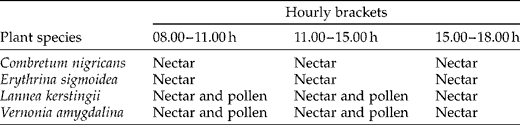
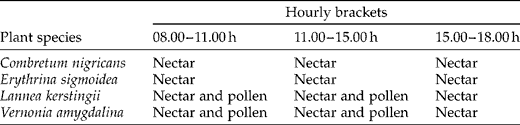
The identity of the food harvested by A. m. adansonii workers from the flowers of each investigated plant species and the intensity and frequency of the collection of different foods are presented in Tables 3 and 4. The main results are as follows: (a) A. m. adansonii workers collected nectar from the flowers of each plant species; (b) L. kerstingii and V. amygdalina were additionally visited for pollen; (c) in general, the intensity (very low, low, high and very high) of nectar or pollen collection varied with plant species and time; (d) in the plant species where honeybees harvested nectar, the harvesting frequency (percentage of the number of days where collection of nectar was observed, compared with the number of investigation days) varied from 99.4% in E. sigmoidea to 100% for each of the other plant species; (e) in the plant species where honeybees harvested pollen, the harvesting frequency varied from 72.5% in V. amygdalina to 93.7% in L. kerstingii (Table 3). The type of substance harvested from flowers (i.e. nectar or pollen) by A. m. adansonii in a given plant species varied with hourly brackets (Table 4).
Products harvested by Apis mellifera adansonii from the flowers of the four plant species according to daily time brackets
Density of foragers
The highest number of A. m. adansonii workers foraging simultaneously was one per flower for each of the studied plant species. The abundance of A. m. adansonii workers per plant varied from 26 in E. sigmoidea (March 2002) to 4200 in V. amygdalina (January 2003; Table 5).
Abundance of Apis mellifera adansonii workers per plant (maximum of individuals simultaneously in activity on open flowers for three observations) according to plant species and months

D, December; J, January; F, February; M, March; A, April; Ma, May.
Duration of visits per flower
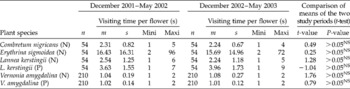
In general, (a) the mean duration of a flower visit varied with plant species, and for a given plant species, it varied with the type of floral product collected and (b) the mean duration of a visit per flower did not vary significantly from year to year (Table 6).
Visiting time of Apis mellifera adansonii on the flowers of the four plant species according to the study periods and harvested products

n, number of visits studied; m, mean; s, estimated standard deviation; Mini, minimum; Maxi, maximum; N, nectar collection visits; P, pollen collection visits; NS, non-significant difference.
The difference between the mean duration of a flower visit for nectar collection and that for pollen collection was highly significant in L. kerstingii (2001/2002: t = 4.02, P < 0.001; 2002/2003: t = 6.04, P < 0.001) and in V. amygdalina (2002/2003: t = 3.43, P < 0.001). Thus on a L. kerstingii flower, A. m. adansonii spent more time for pollen collection than for nectar collection. On a V. amygdalina flower, this bee spent more time for nectar collection than for pollen collection.
The duration of visits was partially influenced by disruptions by other anthophilous insects. Thus of the 108 honeybee visits registered on L. kerstingii flowers in 2001/2002, 39 were disrupted by other A. m. adansonii workers (21 visits), Meliponula ferruginea Lepeletier (Hymenoptera: Apidae; 7 visits), Ceratina sp. (Hymenoptera: Apidae; 5 visits), Camponotus flavomarginatus Mayr (Hymenoptera: Formicidae; 3 visits) and Paratrechina longicornis Latreille (Hymenoptera: Formicidae; 3 visits). Of the 420 visits registered on V. amygdalina flowers in 2002/2003, 92 were disrupted by other A. m. adansonii workers (67 visits), Lasioglossum spp. (Hymenoptera: Halictidae; 12 visits), Xylocopa sp. (Apidae; 4 visits), Ceratina sp. (4 visits), Megachile sp. (Hymenoptera: Megachilidae; 3 visits), Chalicodoma sp. (Hymenoptera: Megachilidae; 1 visit) and Precis oenone (L.) (Lepidoptera: Pieridae; 1 visit).
Influence of neighbouring floras
During the observation periods of each of the plant species under investigation, flowers of many other plant species growing in the study area were also visited by A. m. adansonii workers for nectar or pollen.
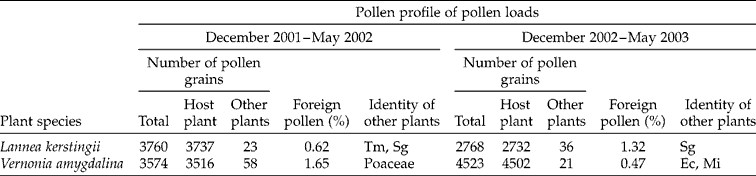
During one foraging trip, an individual bee foraging on a given plant species scarcely visited another plant species, and for each plant species studied, not more than three observations of such behaviour were recorded during the entire study period. In addition, the analysis of the pollen loads collected from the pollen baskets of worker bees showed that the percentage of foreign pollen varied from 0.5% in V. amygdalina to 1.6% in the same Asteraceae (Table 7).
Pollen profile of pollen loads collected in the corbiculae of sampled Apis mellifera adansonii workers foraging on the flowers of the four plant species according to the investigation periods
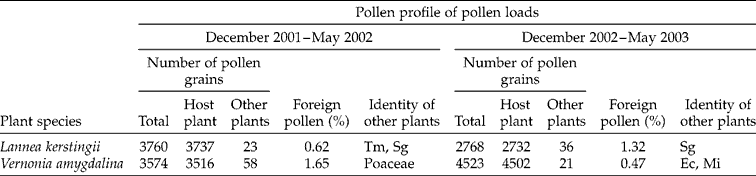
Tm, Terminalia macroptera Guill. & Perr. (Combretaceae); Sg, Syzygium guineense (Willd.) DC. (Myrtaceae); Ec, Eucalyptus camaldulensis Dehnh (Myrtaceae); Mi, Mimosa invisa Mart. ex Colla (Fabaceae).
Apicultural value of the plant species
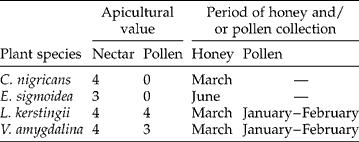
During the observation period, we recorded distinct levels of activity of A. m. adansonii workers on the flowers of the four investigated plant species. In particular, there was a high density of workers per tree, good nectar collection on all plant species, high pollen collection on L. kerstingii and V. amygdalina and continuous flowering in all the four studied plant species. Moreover, in the dry season, which is the main period of honey flow, individual trees of each of the four investigated plant species could produce more than 20,000 flowers. Based on these data, the plant species studied can be classified vis-à-vis their apicultural value as follows: (a) very highly nectariferous: C. nigricans, L. kerstingii and V. amygdalina; (b) highly nectariferous: E. sigmoidea; (c) very highly polliniferous: L. kerstingii and (d) highly polliniferous: V. amygdalina.
Table 8 summarizes the appropriate period to harvest honey or pollen from hives installed in an area of at least 3 km in diameter where flora in bloom is made up of a strong population of each of the studied plant species with a high or very high apicultural value according to the investigations done in the period 2001–2003. Thus in the Adamawa region of Cameroon: (a) honey can be harvested in March and June, if the environment of the apiary is dominated by strong populations of L. kerstingii and E. sigmoidea, respectively; and (b) pollen can be harvested from the hives from January to February, if the surrounding environment of the apiary is characterized by many L. kerstingii or V. amygdalina plants.
Apicultural value of various plant species and the most favourable period to harvest honey and/or pollen from Apis mellifera adansonii hives installed in environments where the flowering vegetation is predominantly characterized by a large population of corresponding plant species in a delimited area of at least 3 km in diameter following the 2001–2003 investigation period
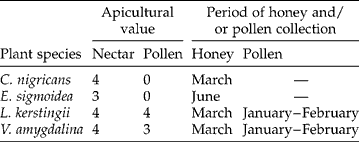
Second column: 3, high nectariferous value; 4, very high nectariferous value; third column: 0, null polliniferous value; 3, high polliniferous value; 4, very high polliniferous value.
Impact of A. m. adansonii activity on pollination of the plant species
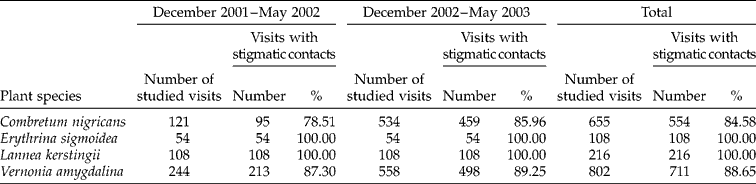
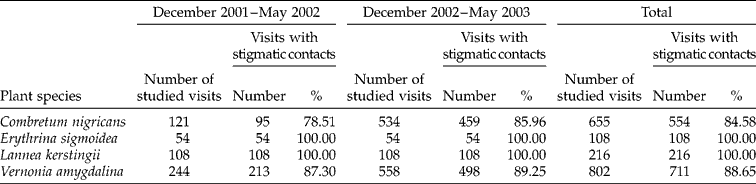
During the collection of pollen or nectar from the flowers of the four studied plant species, foragers regularly contacted anthers and carried pollen. They flew frequently from flower to flower with this pollen. The percentage of the total number of visits during which worker bees came into contact with the stigma of the visited flower was 100% in L. kerstingii, 100% in E. sigmoidea, 84.6% in C. nigricans and 88.6% in V. amygdalina during the 2001–2003 investigation period (Table 9).
Number and frequency of contacts between Apis mellifera adansonii and the stigma during the floral visits to two plant species
Discussion
The collection of nectar of E. sigmoidea and the harvesting of nectar and pollen of L. kerstingii by A. m. adansonii have also been observed during previous investigations in the same area of the Adamawa region (Tchuenguem Fohouo et al., Reference Tchuenguem Fohouo, Nyomo Mapongmetsem and Messi1997). The collection of pollen and nectar of V. amygdalina by A. m. adansonii has also been recorded in Ethiopia (Fichtl and Adi, Reference Fichtl and Adi1994). In West Cameroon, only the collection of nectar has been observed in this Asteraceae (Dongock Nguemo et al., Reference Dongock Nguemo, Foko, Pinta, Tchoumboué and Zango2004).
Thus the type of floral products harvested by A. m. adansonii from a given plant species can vary with the region and year. The observed variations in this study could be mainly explained by the availability of pollen or nectar at the level of flowers, and by the needs of the colonies of the foraging bees.
The observed high densities of foragers per tree recorded in this study can be attributed to the ability of honeybees to recruit a great number of workers for the exploitation of high-yield food sources (Frisch, Reference von Frisch and Michel1969; Louveaux, Reference Louveaux, Pesson and Louveaux1984; Schneider and Hall, Reference Schneider and Hall1997; Goodman, Reference Goodman2003; Kajobe, Reference Kajobe2006). Honeybees' attractiveness for nectar of each plant can be partially explained by its properties. The nectar volume and sugar concentration of the studied plant species will be looked at in future work.
In L. kerstingii and V. amygdalina, the fact that A. m. adansonii spent significantly different times on a flower for nectar harvest and for pollen collection can be explained by the abundance and/or accessibility of each of these floral products.
The disruptions of visits by other insects reduced the duration of certain A. m. adansonii visits. This obliged some workers to visit more flowers during a foraging trip in order to maximize their pollen or nectar loads. Similar observations have been made in A. m. adansonii workers foraging on the flowers of Callistemon rigidus R. Br. (Myrtaceae) (Tchuenguem Fohouo et al., Reference Tchuenguem Fohouo, Messi, Brückner, Bouba, Mbofung and Hentchoya Hemo2004), Entada africana Guill. et Perr. (Fabaceae) and Psidium guajava L. (Myrtaceae) (Tchuenguem Fohouo et al., Reference Tchuenguem Fohouo, Djonwangwe, Messi and Brückner2007); Croton macrostachyus Hochst. ex Del. (Euphorbiaceae) and Syzygium guineense (Will.) DC var. guineense (Myrtaceae) (Tchuenguem Fohouo et al., Reference Tchuenguem Fohouo, Djonwangwe and Brückner2008a); Persea americana Mill. (Lauraceae) and Vitellaria paradoxa Gaertn. F. (Sapotaceae) (Tchuenguem Fohouo et al., Reference Tchuenguem Fohouo, Djonwangwe, Messi and Brückner2008b); and Vigna unguiculata (L.) Walp. (Fabaceae) (Tchuenguem Fohouo et al., Reference Tchuenguem Fohouo, Ngakou and Kegni2009b); and in Meliponula erythra (Schletterer) (Hymenoptera: Apidae) foraging on the flowers of Dacryodes edulis (G. Don) H. J. Lam (Burseraceae) (Kengue et al., Reference Kengue, Tchuenguem Fohouo and Adewusi2002). The disruption of A. mellifera visits by Trigona spp. (Hymenoptera: Apidae) has been observed at feeders (Roubik, Reference Roubik1980).
The present study shows that during one foraging trip, an individual bee foraging on a given plant species scarcely visited another plant species. This result indicates that A. m. adansonii shows flower constancy (Louveaux, Reference Louveaux, Pesson and Louveaux1984; Basualdo et al., Reference Basualdo, Bedascarrasbure and De Jong2000; Montgomery, Reference Montgomery2009) for the flowers of each of the four plant species studied. This floral constancy in honeybees exists because an individual forager is generally capable of memorizing and recognizing the shape, colour and odour of the flowers visited during previous foraging trips (Hill et al., Reference Hill, Wells and Wells1997; Wright et al., Reference Wright, Skinner and Smith2002).
Since C. nigricans, E. sigmoidea, L. kerstingii and V. amygdalina are highly nectariferous bee plants, they should be planted and protected to increase honey production. Besides, V. amygdalina pollen has been identified in one of the seven honey samples collected in the study area in 1999 (Mbofung et al., Reference Mbofung, Tchuenguem Fohouo, Boukar, Hentchoya Hemo and Brückner2000). Lannea kerstingii pollen has been identified in honey samples collected in the same study area in 2001 (two of the three samples analysed) and in 2002 (one of the eight samples analysed; Tchuenguem Fohouo, Reference Tchuenguem Fohouo2005).
As highly polliniferous bee plants, L. kerstingii and V. amygdalina can permit the increase of pollen production as a hive product.
All the plant species studied contributed to the food supply and therefore to strengthening of the honeybee colonies. Consequently, these plant species should be planted and protected in the environments surrounding the apiaries.
During the collection of pollen or nectar from the flowers of each plant species, A. m. adansonii foragers regularly contacted anthers and carried pollen with which they flew frequently from flower to flower. As a result, A. m. adansonii workers could induce self-pollination by applying the pollen of a flower on the stigma of the same flower. Foragers carried pollen from a flower of one tree to the stigma of another flower of the same tree (geitonogamy) or to that of another tree (xenogamy). Consequently, A. m. adansonii workers increase the pollination possibilities of C. nigricans, E. sigmoidea, L. kerstingii and V. amygdalina.
Conclusion
Based on our results, we recommend: (i) the installation of A. m. adansonii colonies in environments where one or more of the studied plant species occur abundantly and (ii) the cultivation and/or protection of each plant species in the surroundings of A. m. adansonii apiaries.
Acknowledgements
This study was funded by the International Foundation for Science (Stockholm, Sweden) and the United Nations University (Tokyo, Japan) via a research grant to F.-N. T. F. (3181-1). We thank A. Pauly for his contribution to the identification of flowering insects and P. M. Mapongmetsem for the identification of plant species. The DAAD (German Academic Exchange Programme) awarded a research grant to F.-N. T. F. (A/08/15 704).