On October 29th, 2012, Hurricane Sandy devastated private and public infrastructures and forced evacuations from several New York City hospitals.Reference Powell, Hanfling and Gostin 1 Due to the damage, several hospitals could not provide inpatient services for months after the storm. When hospitals are affected by disasters, one of the questions asked is if critical services such as the emergency department (ED) should reopen, even if inpatient services remain unavailable. We describe herein the restoration of emergency services at Bellevue Hospital Center (Bellevue) as a freestanding, 911-receiving ED.
Damage Caused by the Storm
Although New York Downtown Hospital reopened 2 weeks after Hurricane Sandy, flooding caused such devastation at 3 lower Manhattan hospitals that inpatient care remained closed for months (Supplemental Figure). New York University Hospitals Center (NYUHC) of NYU Langone Medical Center reopened on December 27, 2012, but without an ED. Inpatient services at Bellevue did not resume until February 7, 2013, and those at the Manhattan campus of the Veterans Administration New York Harbor Healthcare System (VAMC) were not restored until May 21, 2013. Before the storm, the permanent closure of 3 hospitals in lower Manhattan within 6 years had increased average occupancy in Manhattan hospitals to 86% (Pre- and Post-Sandy New York City and Long Island Occupancy and Bed Availability; Greater New York Hospital Association internal report for the New York State Department of Health; November 2012).
With evacuations from the storm causing strain at nearby hospitals,Reference Teperman 2 the inability to reopen Bellevue, NYUHC, and VAMC further increased the burden on neighboring hospitals to provide acute care. Lower Manhattan lost its regional trauma and safety-net hospital at Bellevue, a transplant center at NYUHC, and also dialysis centers, hospital-based pharmacies, specialty services, psychiatric services, and over 1900 inpatient beds, which included intensive care capacity. As for emergency care, EDs at Bellevue, NYUHC, and VAMC together provided more than 500 daily visits, including more than 150 emergency medical service (EMS) transports a day.
A public, safety-net hospital, Bellevue provides more than 80% of its ED care to patients with Medicaid and the uninsured. 3 A non-profit, private institution, NYUHC serves mainly privately insured and Medicare patients, which represent more than 80% of its ED patients. 3 VAMC provides comprehensive health care services to veterans throughout Manhattan and other parts of New York City. These hospital closures also meant the temporary loss of hospital-based outpatient care for these patients, which compounded the need for emergency care.
Effect on Nearby Hospitals
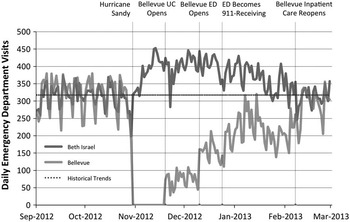
In spite of the best efforts of nearby hospitals, the need for emergency care exceeded available capacity. The closest hospital, Beth Israel Medical Center (Beth Israel), experienced exceptionally high patient volumes. After a week, ED visits increased by 30% (Figure 1). This demand was driven primarily by patients needing lower intensity care, as reflected by reduced admission rates. Increased strain led to walkout rates of 15%. In comparison, the average walkout rate for a high-volume ED is approximately 4%.Reference Welch, Augustine, Dong, Savitz, Snow and James 4
Emergency Department Census at Bellevue Hospital Center and Beth Israel Medical Center. Abbreviations: ED, emergency department; UC, urgent care. Data were obtained from Bellevue Hospital Center and Beth Israel Medical Center. Historical trends (dotted line) were similar at both hospitals before Hurricane Sandy.

Other nearby EDs in lower Manhattan also recorded unusually high volumes. The only hospital on the west side of lower Manhattan, Roosevelt Hospital of St. Luke's-Roosevelt Hospital Center, experienced an 8% increase in ED visits between October and November 2012. 5 Metropolitan Hospital Center, the nearest public hospital, had a 13% increase in ED volume. 5 Emergency trauma cases were diverted to Weill-Cornell Medical Center, the closest trauma center. Otherwise, ED volume did not significantly increase at other Manhattan hospitals located farther away. 5
Restoring Emergency Care at Bellevue
In view of the need to rebuild emergency care capacity in lower Manhattan, leadership at the Health and Hospitals Corporation (HHC), Bellevue, and its ED, in collaboration with the New York State Department of Health (NYS DOH) and other partners, established a freestanding, 911-receiving ED at Bellevue since on-site inpatient services were unable to reopen.
Although the ED was not directly damaged, essential electrical, water, and medical systems such as gases and suction had to be repaired before it could reopen. The freestanding ED at Bellevue was staffed by a full complement of credentialed ED attending physicians, residents, nurses, and ancillary staff. It was equipped to provide all standard emergency services, and had full laboratory and radiological services except for magnetic resonance imaging. After site surveys by the NYS DOH, emergency services at Bellevue were restored in stages: first as a 24-hour urgent care facility, then as a freestanding ED, and later as a 911-receving facility.
Discussion
Freestanding Emergency Departments
Freestanding EDs are not a new concept and account for 1.6% of all EDs in the United States.Reference Sullivan, Bachireddy, Steptoe, Oldfield, Wilson and Camargo 6 More than 90% are located in urban regions, but most see fewer than 100 patients per day.Reference Sullivan, Bachireddy, Steptoe, Oldfield, Wilson and Camargo 6 In areas with sufficient inpatient capacity, freestanding EDs have emerged as an alternative to traditional hospital-based EDs. Initial data show that they may reduce ED crowding in neighboring hospitals while increasing the volume of emergency care delivered in a region.Reference Simon, Griffin and Jouriles 7
Although questions remain on how best to implement freestanding EDs on a permanent basis,Reference Sullivan, Bachireddy, Steptoe, Oldfield, Wilson and Camargo 6 such facilities may serve a unique, transitional role when inpatient care is compromised in disasters. Permanent freestanding EDs are constructed following a period of market analysis with established provider agreements, referral networks, and transfer arrangements. However, successfully implementing a freestanding ED in the midst of a disaster requires coordinated efforts among hospitals, EMS, and public health institutions to maximize the use of existing infrastructure to ensure that affected communities can gain access to the care they need.
However, several preconditions must exist. First, the need to increase emergency care capacity after a disaster must be clearly evident. Monitoring activity at EDs that remain open can offer useful indicators of systemic stress.Reference Welch, Augustine, Dong, Savitz, Snow and James 4 Second, an absolute commitment to patient safety must be sustained. Lowering standards of care during a disaster risks ethical and legal scrutiny and jeopardizes public confidence.Reference Schultz and Annas 8
Key Partnerships and Essential Elements
After Hurricane Sandy, successful implementation of a freestanding, 911-receiving ED required strong partnerships and several essential elements. These essentials included coordination with EMS, emphasis on follow-up for patients discharged, establishment of an emergency critical care ward for critically ill patients, streamlining transfer protocols for patients requiring admission, and monitoring ED utilization at affected hospitals.
The close coordination established with the Fire Department City of New York EMS determined which ambulance patients Bellevue would receive. Exclusions included patients with trauma, cardiac arrest, third trimester pregnancy, ST-segment elevation myocardial infarction, stroke, obvious surgical disease, emotional disturbance, and those in police custody. These exclusions meant that ambulances brought patients who were more likely to be treated and discharged home, leading to fewer transfers for admission.
Continuity of care was ensured by providing appropriate outpatient follow-up with primary or specialty care. Because many hospital-based and office-based outpatient providers were affected by the disaster, coordinating care for patients discharged from the ED was critical to providing safe patient care. Reopening Bellevue's outpatient clinics made this follow-up possible. After putting these first two measures in place, only 8% of patients seen at Bellevue's freestanding ED required transfer for inpatient care.
However, in spite of the explicit exclusion criteria that had been established, a few patients were found to be critically ill on further evaluation. Thus, a third essential element was to reopen an emergency critical care ward that had been restored before receiving patients by ambulance. In usual hospital operations, this multiservice unit, which is located next to Bellevue's ED, is used to stabilize critically ill ED patients. Approximately 14% of patients requiring admission from the freestanding ED (or about 1% of all ED visits) were treated in this unit after Hurricane Sandy. It provided an essential safety net for critically ill patients waiting for safe transfer to beds at nearby hospitals.Reference Warren, Fromm, Orr, Rotello and Horst 9
The fourth essential element was streamlining transfer protocols implemented for patients requiring admission. It was important to have clear communication regarding patient care with private and public receiving hospitals that participated in this effort. In addition, efficient transfers not only allowed patients requiring admission to receive the ongoing care they needed, but they made space available for those needing follow-up after visiting the freestanding ED.
Finally, monitoring of ED utilization at hospitals affected by the disaster was ongoing. Metrics analyzed included overall ED volume, ambulance volume, wait-times, and walkout rates. The impact of reopening Bellevue's ED on nearby hospitals was continually evaluated to determine the level of care that Bellevue's ED should provide. This aspect makes implementing a freestanding ED after a disaster unique, because it allows capacity building to dynamically meet the demand for emergency care. The need for emergency services can vary based on the circumstances of a given disaster, which may evolve over time. Rebuilding emergency capacity in stages provides a dynamic responsiveness that is critical in disaster recovery efforts.
Expanding Emergency Care Capacity
By first resuming 24-hour urgent care services on November 19th, then evolving to a freestanding, non-ambulance receiving, ED on December 10th, Bellevue provided care for nearly half of its usual ED volume. Concurrently, outpatient primary care and some subspecialty services at Bellevue also reopened. Restoring ambulatory care capacity improved access for patients with ambulatory-sensitive conditions and those needing follow-up visits to the freestanding ED. However, nearby EDs continued to undergo persistent strain, especially due to high ambulance volume.
On December 24th, Bellevue's freestanding ED was designated as a 911-receiving center to mitigate the high ambulance volume at other hospitals. In January, Bellevue's ED volume reached 77% of pre-hurricane levels. On average, 18 patients a day were transferred for inpatient care, and 80% to 85% of patients delivered by ambulance were discharged home. ED volumes at nearby hospitals continued to normalize as Bellevue's freestanding ED delivered increasingly higher levels of emergency care.
Conclusions
Ensuring adequate access to emergency care is critical in disaster recovery efforts. Previous research on the use of a freestanding ED by the military after a disaster has been described,Reference D'Amore and Hardin 10 and we report a similar effort organized by hospitals and public health institutions. Key partnerships and essential elements allowed for successful implementation of a freestanding, 911-receiving ED after Hurricane Sandy. Reopening Bellevue's ED in New York City was an important step in the recovery period and could serve as a model for future disaster operations.
Acknowledgments
David J. Prezant, MD, was a key collaborator on this project. Other partners in this project included personnel in the emergency medical services and in the public and private hospitals that received transfers from Bellevue Hospital Center and all of the staff, physicians, residents, nurses, and other clinical and administrative personnel who worked diligently to provide patient care in the months after Hurricane Sandy.
Disclaimer
The content in this article is the responsibility of the authors and does not represent the official views of the State of New York, New York State Department of Health, New York University School of Medicine, Health and Hospitals Corporation, or any named institution.