Introduction
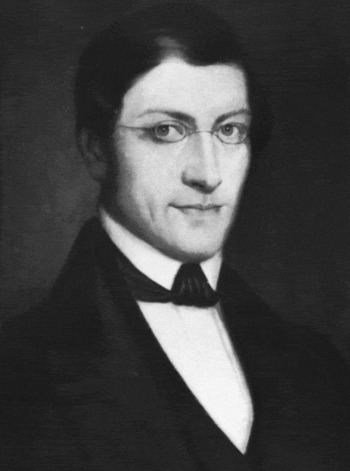
The name of Matthias Alexander [Mathias Aleksanteri Castrén (1813–1852) (Fig. 1) appears in the list of the most prominent Finns, according to the collection of biographies published by the Finnish Literature Society (Salminen Reference Salminen2003: 156–160). During his lifetime he received a reputation as a ‘restless’ traveller, and as a scholar who breached political, ideological and linguistic boundaries. Castrén's friend and editor of his work in the German language, Anton Schiefner, started the introduction to his first volume by pointing out that ‘the year of 1852 deprived the small land of Finns of two scientists, whose names both in homeland as well as abroad are of a particular distinction’ (Schiefner 1969: V). Schiefner refers here to the explorer and orientalist Georg August Wallin (1811–1852), who became famous through his seven years travelling in the middle east and the ‘indefatigable’ researcher Matthias Alexander Castrén.
Matias Aleksanteri Castrén. Painted by G. Budkowskin (1845) (Castrén Reference Castrén and Joki1953).

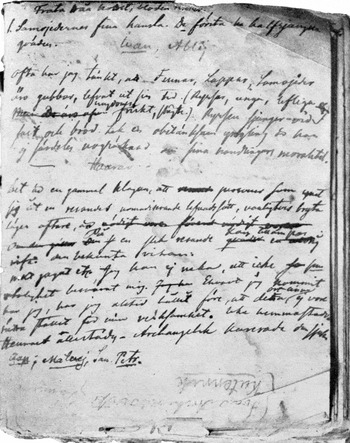
A brilliant researcher and fieldworker, the first professor of the Finnish language and prominent founder of the Ural-Altaic hypothesis, Castrén undertook a vast range of studies from linguistics to ethnology. He spent more than ten years on expeditions, which covered a huge area stretching from Lapland and the European Russian north to Siberia, the Altai and Sayan regions, and reaching into China. His correspondence, diaries (Fig. 2) and travel reports reveal his particular interest in the origin of the Finns and the relationship between the Finno-Ugrian and Samoyed, Turkic and Mongolian languages. At the same time Castrén's duties included studies far beyond research in the humanities, being multidisciplinary by any standards for scientific expeditions of the 18th and 19th centuries. Less known is the fact that Castrén was also the first translator of the full text of the first version of Kalevala, the so called Old Kalevala, into Swedish and contributed in its establishment as a national symbol as well as an object of international interest.
A page from Castrén's diary (Estlander Reference Estlander1929: 80).

Despite this, his fame has remained mostly among a select group of scholars. Among the wider Finnish public, outside the scholarly community, his name is less well known than are the names of his prominent friends. It is for historical reasons that Castrén's work is published mainly in German, Swedish and Russian and least in Finnish. Until the middle of the 19th century, most of the texts of writers and researchers from Finland were written not in Finnish, but in Swedish or Latin. The most comprehensive publication of his materials is presented in twelve volumes in German entitled Nordische Reisen und Forschungen [Northern travels and research]. Anton Schiefner edited them between 1853 and 1862 on the order of the Russian Academy of Sciences. Seven of the twelve volumes include grammars of 20 different languages and dialects, most of them not previously studied. Castrén's materials, excluding his research on Finno-Ugrian and other languages, were published also in Swedish in six volumes under the same title as Nordiska resor och forskningar (1852–1870) and were edited by Berndt Otto Schauman and Carl Gustav Borg. Five volumes of this edition correspond basically with Schiefner's, whereas the sixth volume includes translations of Castrén's docent and professorial theses. These were theses that had to be completed before he could attain the relevant rank in the university. His travel notes were published in 1860 in Russian as Puteshestvie po Laplandii, Severnoi Rossii i Sibiri (1838–1844, 1845–1849) [Travels in Lapland, Northern Russia and Siberia]. A Finnish edition of Castrén's materials was not published until 1953, when Aulis J. Joki presented two volumes translated from Swedish as Tutkimusmatkoilla Pohjolassa [Northern research travels]. Some materials of Castrén's linguistic research edited in Finland by Toivo Lehtisalo appeared in the German language (Castrén Reference Castrén1960).
All of Castrén's materials that are available to the author of this article, mostly in their German edition, are clearly related to the general events of Finnish history and the scientific scene of this time. This article analyses the research activities of Castrén in the context of the period, which is often regarded as a turning point in Finnish history and as a key period in the formation of the Finnish nation. However, the reception of Castrén's work seems rather limited, as the author of this article is only aware of a few special accounts of Castrén's work, for example, on his travelling in Lapland and Russia (Estlander Reference Estlander1929; Murav'ev Reference Murav'ev1961). Other entries on Castrén relate to his contribution to different disciplines (Sjögren Reference Sjögren1853; Setälä Reference Setälä1901; Bogoraz Reference Bogoraz1927; Sternberg Reference Sternberg1931). In the literature in English, no work on Castrén specifically appears to exist, except as part of studies on the history of Finnish science of the 19th century (Aalto Reference Aalto1971; Vuorela Reference Vuorela1977; Korhonen Reference Korhonen1986; Räsänen Reference Räsänen1992). The Finnish linguist Korhonen mentioned in his work entitled Finno-Ugrian language studies in Finland 1828–1918 published in 1986 that ‘the most important sources [on] Castrén are his own writings’ (Korhonen Reference Korhonen1986: 66), meaning that there is more written by him than on him. The author is not be fully familiar with the publications about Castrén that have appeared only in Finnish, but has attempted to compensate for this deficit through a careful reading of Castrén's work available in German in a reprint of the original edition published in 1969 in the GDR (Castrén Reference Castrén and Schiefner1969a, Reference Castrén and Schiefner1969b, Reference Castrén and Schiefner1969c, Reference Castrén and Schiefner1969d, Reference Castrén and Schiefner1969e).
In the spirit of the time
Castrén was t born on 2 December 1813 in Tervola in northern Finland in a family of Lutheran clergymen. His father, Kristian Castrén, at that time pastor's assistant, later became parish minister in Rovaniemi (1821–1825), where his grand father on his mother's side, Esaias Fellman, was the first parish minister (1785–1819) (Pulkamo Reference Pulkamo1982: 33–34). At the age of 16, he matriculated at the university of Helsinki and studied classical (Greek and Hebrew) and oriental languages (Turkic), and philosophy. These were also the main subjects of his master's degree, taken in 1836 (Aalto Reference Aalto1971: 83). In keeping with the family tradition, he appeared to be preparing for a career in the church (Korhonen Reference Korhonen1986: 50), but his interest was soon attracted by other subjects.
His undergraduate years were spent among friends who were profoundly influenced by the spirit of national romanticism. Those who became famous names in the Finnish history of this period were among his friends, such as Elias Lönnrot (1802–1844), and Johan Wilhelm Snellman (1806–1881). Castrén also lived for two years as an undergraduate with Zachris Topelius (1818–1898) in the home of Johan Ludvig Runeberg (1804–1877) (Korhonen Reference Korhonen1986: 50). Both became national authors in Finland. The publication of the first version of Lönnrot's great compilation from 1835, traditionally called the Old Kalevala, marked an important turning point for Castrén's interests towards Finnish language and related languages. ‘It was Kalevala's beautiful songs, which became the first subject of my scientific studies when I decided to spend the power of my life for science’, Castrén wrote in 1851 (Castrén Reference Castrén and Schiefner1969e: 315). In 1836, Helsingfors Morgonblad published Castrén's article Några ord om Kalevala [Some words about the Kalevala], which impressively reflected the spirit of the time: ‘if one were to predict a future for Finland, where its sons are inspired by real love to their country instead of worshipping a foreign culture, where they would accept only that [love for country] as true, . . .one would find support for such hopes in the Kalevala’ (Castrén Reference Castrén and Schiefner1969e: 2). These emotional ties to Finland's past and future in the context of rising national awareness followed the mainstream ideas among Finnish intellectuals.
During the more than six centuries of Swedish rule, from the middle ages until 1809, when it became an autonomous grand duchy of the Russian empire, Finland was merely a group of provinces, governed from Stockholm like the rest of Sweden, rather than a national entity. Swedish remained the only official language until 1863. The language decree issued in 1863 by the Russian Tsar Alexander II marked the beginning of the process through which Finnish became an official administrative language. In practice Swedish retained its dominant position until the beginning of the 20th century. The 1919 constitution declared that both Finnish and Swedish were national languages of the republic of Finland.
Under remarkably benign Russian rule the process of change started in 1809, as the Finns began to seek a new national identity within their autonomous grand duchy. According to Lavery (Lavery Reference Lavery2006: chapter 4), Finnish autonomy and Russian power worked harmoniously together from 1809 to 1890, and Finland enjoyed its special privileges inside the Russian empire almost to the end of the century. The country kept its Swedish legal code and its social and political system (Laitinen 1998: 50). Tsarist Russia promoted Finland's cultural life in a way that was unseen elsewhere in the north (Schoolfield Reference Schoolfield1998: XX). Jacob Grimm (1785–1863), the German linguist and famous co-author of classical collections of folk songs and tales, Grimm's Fairy Tales, quoted Finland's break with Sweden as a decisive historical event reinforcing the Finns' national self-awareness and compared it to the break up between Holland and Belgium (Grimm Reference Grimm1865).
The political process of change had far reaching cultural effects. After a massive fire in 1827 in Turku the central government in Finland moved finally to Helsinki and the new capital took over as a centre of intellectual heritage. This decision was influenced by the view that Turku was too close to Sweden and the atmosphere in Turku was seen as too pro-Swedish (Korhonen Reference Korhonen1986: 34). The transfer of the university from Turku to Helsinki became an important turning point in the study and development of Finnish, the basis of which was created during the time of Turku romanticism. The new University statutes from 1829 introduced a position of lecturer in Finnish. Suomalaisen Kirjallisuuden Seura [Finnish Literature Society] was established in 1831. Castrén played a crucial role in establishing the activities of the society with its focus on collecting Finnish mythology (Schiefner 1969: 3: VII).
At this time Finnish was a language of the countryside largely neglected by intellectuals. Educated Finns were Swedish speaking. This prejudice was at that time according to Castrén ‘still deeply rooted’, so that ‘many parents still forbid their children contacts with Finns, in order to increase their motivation to learn Swedish’ (Castrén Reference Castrén and Schiefner1969e: 263). From the time of Mikael Agricola (ca.1510–1557) until the early 19th century, written Finnish consisted mostly of translations of religious texts (Schellbach-Kopra Reference Schellbach-Kopra and Okuka2002: 649). The first novel in the Finnish language, Seitsemän veljestä [The seven brothers] by Aleksis Kivi (1834–1872), was published only in 1870. While the novel became a national symbol proving that Finnish was also acceptable as a language of intellectuals and artists (Schellbach-Kopra Reference Schellbach-Kopra and Okuka2002: 660), Kalevala, had appeared more than three decades before this, and became a national symbol as a first authentic Finnish folk epic and as a desired national epic.
Schoolfield, defining Kalevala as an instrument of Finnish identity, pointed out that ‘the missionary zeal of proponents of the Finnish language and of a correspondingly large political entity was impressive, to say the least’ (Schoolfield Reference Schoolfield1999: 89). The enthusiasm for Kalevala, motivated by nationalist movements and influenced by international interest in heroic epics was the basis for Castrén's commitment to the Finnish language. Castrén (1969, 5: 266) saw the ‘greatness and power of the Finnish nation’ in Kalevala, which he described as a ‘flower unspoiled by any worm’. In the spirit of this time, Castrén devoted his first academic efforts to the ‘explanation of the wonderful songs of Kalevala’ (Castrén Reference Castrén and Schiefner1969e: 315–316).
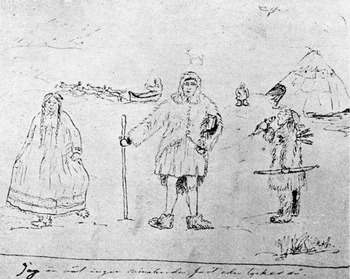
One of the dominant thoughts of this time was the idea of unity of language, literature, national spirit and state: language was given a significant role in the formation of the nation. In his docent thesis (1839) ‘De affinitate declinationum in lingua Fennica, Esthonica et Lapponica, Castrén started with the words of the German linguist Franz Bopp (1791–1867) known for his extensive comparative work in Indo-European languages: ‘[t]he grammar in its higher scientific sense should be a history and description of nature’ (Castrén Reference Castrén and Schiefner1969e: supplement: 22). During his studies at the university he started with deeper investigations in the Finnish language, and ‘ethnographically’ related issues as well as on the Sami and Estonian languages. When Castrén was offered the chance to participate in an expedition to Lapland in 1838 by his friend, a physician from Tornio, who was interested in folk culture and archaeology, Carl Robert Ehrstöm, he accepted it gladly (Fig. 3). During his first expedition focusing on Sami language, mythology and folklore, Castrén deepened his interest in ties between Finnish and related peoples. In the materials of this first expedition he mentioned that he had been thinking for a long time about the necessity of field research in Europe and Asia towards Finnish and related languages ‘for more richer and reliable data supply than (is) available’ (Castrén Reference Castrén and Schiefner1969a: 3).
Castren's self-caricature during his travels in Lapland (Estlander Reference Estlander1929: 40).

On the search for Finnish national identity ‘in between’
The call of this period can be expressed with a statement attributed to Adolf Ivar Arwidsson (1791–1858), a central figure of the national romantic movement in Turku: ‘Swedes we are not, Russians we can't become, let us then be Finns’ (Pentikainen 1999: 17). The major point of Arwidsson's perhaps apocryphal remark was that Finland no longer shared Sweden's fate but must find its own way; certainly, it could not identify with Russia, which was linguistically and religiously alien, and backward compared to Sweden in social, political, and legal aspects (Laitinen 1998: 50). The Achilles' heel of Finnishness was considered to be its lack of history (Apo Reference Apo2003: 5) and the marginal status of the Finnish language. The Finnish national writers such as Runeberg and Topelius were regarded as essential parts of Finnish language literature thanks to early and excellent translation. In fact, they wrote entirely in Swedish (Schoolfield Reference Schoolfield1998: XVII; Schellbach-Kopra Reference Schellbach-Kopra and Okuka2002: 659). It seems a paradox that Aarne Antilla pointed out in 1931 that a ‘genuine Finnish poetry’ had to be written in Swedish (Voigt Reference Voigt and Honko1990: 254). Castrén himself did not write or lecture in Finnish and described his efforts in the study of Finnish as an ‘isolated aspiration’ in a letter to Snellman in 1846 (Castrén Reference Castrén and Schiefner1969b: 164). In 1844 Castrén stated with sadness in a lecture at the university that in spite of the growing ‘warmness for the fatherland, [. . .] much work [was needed] to bring it to life’ (Castrén Reference Castrén and Schiefner1969e: 308).
Castrén saw in the word ‘Finnishness’ a synonym of ‘rawness’, when ‘the Finnish element is condemned not only by Swedish people and foreigners but even among national intellectuals themselves’ (Castrén Reference Castrén and Schiefner1969e: 263). Castrén linked the lack of a common national identity to ‘Swedish education, which was inoculated to the Finns, . . .and separated the intellectuals from the folk’ (Castrén Reference Castrén and Schiefner1969e: 271–272). The prejudices of the middle ages of ‘abominable pagan folk’ had exterminated all national feelings (Castrén Reference Castrén and Schiefner1969e: 271), but at the same time Castrén saw in this historical fact that ‘Finnishness’ remained in its deep authentic purity, truth and power (Castrén Reference Castrén and Schiefner1969e: 272). In the introduction to his lectures about Kalevala he referred to the text of the Icelandic epic Edda, which warns of disrespect for the ‘memories of one's own fathers’: ‘the peoples who neglect it are already endangered to condemn their own fatherland’ (Castrén Reference Castrén and Schiefner1969e: 272–273). The search for national identity affected Castrén ‘deeply and powerfully’. In a letter to Snellman in 1844 he revealed this quite strikingly: ‘I can live only for that, everything else is subsidiary. I have decided to show the Finnish people that we have not been torn apart from the world and world history. . .’ (Korhonen Reference Korhonen1986: 66).
Forged into a single epic by Lönnrot, compiler and editor, Kalevala has become, first and foremost, a symbol for the nationhood of the Finnish people. For the Finns, striving to establish their cultural and political independence, Kalevala offered poetry in a language they could call their own, a pantheon of gods, demigods, or heroes that represented the antiquity of their own nation and actions that were evocative of the dawn of it (Pentikäinen Reference Pentikäinen1999: 17). Castrén expressed his enthusiasm for the ‘poetry of the people’ in a lecture in 1841: ‘[t]he runes talk to us through the power of centuries with the deep words of truth, wisdom and the power of our fathers. With this we have a treasure that cannot be shaded by Homer, Ossian and Edda’ (Castrén Reference Castrén and Schiefner1969e: 272). Later, Snellman, the most important ideologist of the national movement, who initially reacted to Kalevala disparagingly, said: ‘[t]he fact that the Finns have a national epic, a “third” true epic on the earth, alongside the Iliad and the Nibelungenlied, gives reason to assume knowledge not possessed by all peoples’ (Pentikäinen Reference Pentikäinen1999: 23). The epic became a milestone both in Finnish culture as a whole and in linguistics. At one stoke Finnish threw off its reputation as being a language fit only for peasants and became accepted as a fully fledged language of poetry in the true Romanic spirit (Alboniemi Reference Alboniemi and Honko1990: 232).
Strong ideological meaning in nationalistic discussions was attributed to concepts such as the heroic age and the heroic epic. In spite of his national inspirations Castrén kept at a distance from all the practical activities of the Finnish nationalists. Referring to his experience, he expressed in lectures in 1844 his conviction and fear for any enthusiasm and predicted its end if patriotism would not develop beyond mere enthusiasm without tangible evidence (Castrén Reference Castrén and Schiefner1969e: 312). For Castrén the idea of making the symbolic power of Kalevala ‘tangible’ and ‘real’ became a mission of his research: ‘[i]n order to promote national awareness, the nations have to have something real, what they can identify as their own creation’ (Castrén Reference Castrén and Schiefner1969e: 312). Striving for ‘something objective’, ‘real’, ‘reliable’ is a leitmotif in Castrén's research materials from the early and later travel notes to his correspondence and lectures. He admitted that the feeling of fatherland was still in its infancy and, if at all, it remained a ‘dream without reality (Castrén Reference Castrén and Schiefner1969e: 310)
Castrén started to work on this ‘something real’ with intensive research about Finnish mythology, intending to write a book on the subject (Korhonen Reference Korhonen1986: 51). In his early publications such as the already mentioned article on Kalevala (1836) and on the art of magic of the Finns (1837), he arrived at considerations about historical connections in Finnish mythology in general and in Kalevala in particular. He analysed the thoughts and materials collected in this period in his docent thesis, mentioned above, on the Finnish, Estonian and Sami languages (1839). Korhonen sees this work as the first piece of research at the university of Helsinki that was completed in the spirit of the new comparative method (Korhonen Reference Korhonen1986: 52). In 1839 Castrén spent four months in Karelia with a grant from the Finnish Literature Society, to become more familiar with the poems that could deepen his studies on Kalevala and its background. In 1840 Castrén was appointed docent in Finnish and old Scandinavian languages and started his lectures on Kalevala, which he had just translated into Swedish, in the spring term 1841.
In November 1841 he set out on a research expedition with Lönnrot and travelled with him in Lapland and as far as Arkhangelsk at the mouth of the Dvina River. The aim of the expedition was the study of languages related to Finnish. The initial plan of the expedition was amended when Castrén received, in January 1842, in the Sami village of Inari a letter from Anders Johan Sjögren (1794–1855), prominent Finnish scholar, who at this time was an academician at the imperial academy of science in St. Petersburg. He informed Castrén of the final decision of the academy to establish an expedition to Siberia and to appoint him as linguist and ethnographer. Sjögren suggested continuing to travel from Arkhangelsk to the area occupied by European Samoyeds and crossing the northern Urals to Siberia, where Castrén's task on behalf of the academy would start (Castrén Reference Castrén and Schiefner1969a: 105). Castrén set out to investigate the relations between the Finns and kindred peoples and to find the ancestral land of the Finno-Ugrian peoples. His aim was also the ‘intensive study of language of European Samoyeds and ethnographic relations’ in preparation to the Siberian expedition. He continued his travel from Arkhangelsk alone, deeper into the Samoyed tundra, crossed the Pechora, travelled south and east along the Pechora and crossed the Urals, then following the Ob downstream to Obdorsk (now Salekhard). As a result of this expedition he collected extensive material on the language and culture of the Yurak Samoyeds (Nentsy) and of the Zyryans (Komi).
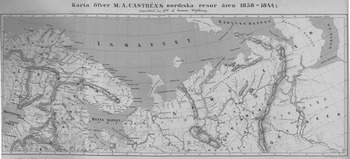
He completed during the expedition a manuscript on the Zyryan grammar. This was published in 1844 and he was awarded the Demidov prize by the Russian Academy. According to Korhonen it was the best in its field at the time (Korhonen Reference Korhonen1986: 54). Already, whilst visiting the Ter Lapps on the east coast of Kola Peninsula in summer 1842, Castrén had symptoms of illness. His friends in Arkhangelsk advised him not to undertake this travel to the Samoyed tundra in view of its difficulty, which could pose a risk to his unstable health. But health problems could not stop his desire ‘to explore for science’ with the ‘enthusiasm of the young researcher’ (Castrén Reference Castrén and Schiefner1969a: 177). Later during his expedition and under extremely difficult conditions on the tundra, Castrén fell sick and a haemorrhage of the lungs soon showed that he had tuberculosis (Aalto Reference Aalto1971: 83). This expedition lasted until May 1844, but in spite of the diagnosis, he left Finland the following year for a further Siberian expedition. His striving for ‘truth’ in research and his readiness to ‘sacrifice life for an idea’ remained the guiding theme for this indefatigable man (Fig. 4).
Map of Castrén's travels between 1838–1844. Original map by M.Wijkberg, dated 1870 (Castrén Reference Castrén and Schauman1870: appendix).

The following several years of expeditions only permitted him to resume full time university lecturing in 1849. But during a break between the expeditions, in 1844, he lectured in the university on Finnish grammar. He made a tremendous impression on his audience explaining in a forceful, distinct and calm manner the significance of Finnish for the life of the whole nation (Korhonen Reference Korhonen1986: 55). After his return to Helsinki in 1849 he restarted his lectures based on the conceptual considerations arrived at during his field work and research activities. His lecture at a literary soiree in November 1849 Hvar låg det Finska folkets vagga? [Where was the cradle of the Finnish people?] had far reaching consequences. He surprised the audience with facts that clearly pointed out the relation of Samoyed languages to Finnish. Through this relation the original homeland is thought to be in the Sayan mountains and the western Altai chain in the area of the Ob, Irtysh and Yenisei rivers, ‘where Finns, Turkic people and Samoyeds still lived in brotherly unity’ (Castrén Reference Castrén and Schiefner1969e: 116). This new hypotheses starkly differed from previous ones relating Finnish to Hebrew and Greek, and seeing the Finns as descendants of the Israelites (Fig. 5).
Geographical distribution of Uralic languages (Korhonen Reference Korhonen1986).

The establishment of a chair in the Finnish language at the university of Helsinki became an important event not only in academic circles but also for a wider acceptance of the status of Finnish. This idea had been discussed for many years during the first half of the 19th century, and was finally realised in 1851. On 14 March, Castrén was appointed first professor of Finnish language and literature. The crown prince and later emperor Alexander II personally handed over the letter of appointment to him (Schiefner Reference Schiefner and Castrén1969a: VIII). Lönnrot had been another candidate for this position. However, when the post was advertised in May 1850, Lönnrot refused to apply since in his opinion the professorship should by rights go to Castrén (Korhonen Reference Korhonen1986: 63). Castrén introduced two courses with lectures on the ethnology of Altaic people and on Finnish mythology.
It is remarkable that after a long time away from Finland, in his lectures on Kalevala in 1851 Castrén reinforced the enthusiasm of his youth which remained stable in spite of changed thoughts, views and interests: ‘[a]fter such a long breakup I feel a desire for returning to this wonderful song which was a first flame that brought me to the language and literature of my fatherland’ (Castrén Reference Castrén and Schiefner1969e: 316). His belief of youth in the necessity of comparative research ‘in order that this object does not become a minor matter’, let Castrén decide to make this topic a particular focus of his lectures. He called it ‘ethnography or presentation of old culture of Finns’. This subject he handled from comparative perspective, as ‘religion, customs and other cultural relations of our fathers and related peoples’ (Castrén Reference Castrén and Schiefner1969e: 317–318). The last chapter of a planned lecture on heroes of mythology in Finnish and related songs, he wrote lying on sickbed a few weeks before his death (Schiefner Reference Schiefner and Castrén1969b: IX).
Castrén's role in the Kalevala process
When it was published in 1835 by Lönnrot, Kalevala was the materialisation of hopes that had been evident for several years. At the same time for more educated people in the country only the Swedish translation enabled them to become familiar with Kalevala (Alboniemi Reference Alboniemi and Honko1990; Vento Reference Vento1992). It was Castrén who translated the first edition of Kalewala taikka Wanhoja Karjalan Runoja Suomen kansan muinosista ajosta [Old Karelian poems about the ancient times of the Finnish people], the so called Old Kalevala, into Swedish in 1841: ‘[t]o introduce this splendid epic to my fellow countrymen I undertook its translation into the language that our fathers were forced to accept in exchange for their own mother tongue during hard times’ (Castrén Reference Castrén and Schiefner1969e: 315).
The first and most important readers of Kalevala were Finnish intellectuals, who were at this point Swedish speaking. According to Schoolfield the Old Kalevala found disappointingly few readers who could understand its language (Schoolfield Reference Schoolfield1999). Other scholars underline the fact that readers had difficulty in understanding Lönnrot's poetic text in Finnish and even more difficulty in following the historical and heroic plot (Alboniemi Reference Alboniemi and Honko1990: 233; Vento Reference Vento1992: 84; Apo Reference Apo2003: 5). A memoirist of that time, August Schauman (1826–1896), recalled: ‘[t]he Kalevala was naturally not read in wide circles; the language was impossible to understand, it was said, even by those who thought they knew Finnish. Translation and summaries provided some idea, however, of the contents of the epics’ (Alboniemi Reference Alboniemi and Honko1990: 232). Castrén was the first to cross linguistic borders. With his translation of the full text of the Old Kalevala into Swedish, Kalevala runes became familiar to Finnish society and were established as a national symbol.
Castrén's translation can also be regarded as a starting point of the international recognition of the Finnish epic. A new Finnish edition of Kalevala by Lönnrot appeared in 1849, but Castrén's Swedish translation of 1841 generated wide attention for Kalevala abroad. The real international breakthrough for the Finnish epic came in 1845. On 13 March, Jacob Grimm, who was introduced to Kalevala through Castrén's Swedish translation, gave a famous lecture at the Berlin Academy ‘Ueber das finnische Epos’ [About the Finnish epic]. In his lecture and in the accompanying article, published under the same title in year 1846, Grimm praised the great richness of the Finnish language, which in ‘this epic at once unfolds its whole wealth to an extent unknown from previous works by Juslen and Renvall. This wealth deserves our more than superficial admiration’ (Grimm Reference Grimm1865: 79). He mentioned Castrén's translation as well as his other publications as the most thorough work in Finnish and related language studies (Grimm Reference Grimm1865: 79). The Fosterländskt Album immediately published a Swedish translation of Grimm's lecture that same year and this, along with Robert Tengström's analysis of Kalevala, helped to establish the position of the epic in Finland's Swedish speaking circles (Alboniemi Reference Alboniemi and Honko1990: 234).
The famous German Sanskrit scholar and orientalist, Hermann Brockhaus was so inspired by Kalevala that he planned to prepare a translation into German. He invited another Sanskrit scholar, Hermann Kellgren, to come and lecture on the Finnish language. During the academic year 1846–1847 two other professors also lectured on the Finnish language and on Kalevala in Berlin (Alboniemi Reference Alboniemi and Honko1990: 235). Schiefner, the first translator of Kalevala into German in 1852, noted that the way for understanding the runes was paved by Castrén, who also inspired him to a translation of the second edition into German (Schiefner Reference Schiefner and Castrén1969b: VII.). Castrén's Swedish translation was also the basis of French prose document presenting an abbreviated Kalevala, in 1854 (Schoolfield Reference Schoolfield1999). The history of several translations of Kalevala is only vaguely known, although it could be seen as an integrative part of the Kalevala ‘process’. Schoolfield argues that the outside world is indebted to the many translators of Kalevala for their work. (Schoolfield Reference Schoolfield1999).
Translations of epic poetry permanently navigate close to the limit of truth with regards to the original text, and are often exposed to sharp criticism (Fromm Reference Fromm and Fromm2005: 6). Likewise, in his translation of Old Kalevala and his lecturing on Kalevala poetry, Castrén had the chance to interpret and reinforce the concept of the national epic. Schiefner described the Swedish translation by Castrén as giving an impression of consistence that allows Kalevala to appear to be a much more autonomous poetic creation (Schiefner Reference Schiefner and Castrén1969a: VI). In the introduction to his translation of Kalevala, Castrén points out that he tried ‘to stay as much as possible true to the text as well as free’ (Castrén Reference Castrén and Schiefner1969e: 47).
Castrén's translation contributed greatly to the national and international reputation of Kalevala. The prestigious international feedback on Kalevala was of no little significance for Finland as a country in the search for its national identity. While honoured in his time, Castrén's translation work in this process and popularisation of Kalevala, is only a footnote in the contemporary analysis on Kalevala and related historical events. Even less known and barely noticed is his contribution to the whole process of Kalevala, which we can consider as a process of collection, composition, revision and establishment. Some contemporary scholars indicate that this processual perspective on Kalevala, which began with the collecting and editing of folk poetry still remains obscure (see Honko Reference Honko and Honko1990: 211; Gay Reference Gay1997: 63).
Fromm, the translator of Kalevala into German in 1967, states that many of his contemporaries understood Lönnrot as a speaker on behalf of a group, and so did he himself (Fromm Reference Fromm and Fromm2005: 344). Both the Old Kalevala from the year 1835 as well as its new version from 1849 have Lönnrot's name not on the title page, but only after the introduction. This fact could lie in Lönnrot's modest character and according to unwritten conventions concerning the anonymity of heroic epics, for example Nibelungenlied. Although Kalevala gained Lönnrot international attention among academic circles in Europe, the descendents perceive the epic as an anonymous witness of tradition. In the introduction to the Swedish translation of Kalevala, Castrén considered the epic as a process, in which Lönnrot's main contribution was ‘the bringing of mythical relicts into the daylight’ (Castrén Reference Castrén and Schiefner1969e: 17). He credited Henrik Gabriel Porthan (1739–1804) for having ‘rescued for the country the historical memorials’. Starting with Porthan's contribution, Castrén analyses also the merits of others, for example he mentioned Topelius, who had published a collection of ancient and younger runes, as an important person for generating interest in folk poetry (Castrén Reference Castrén and Schiefner1969e: 19).
Lönnrot himself credited his friend Castrén with the historical conception of the background of Kalevala (Fromm Reference Fromm and Fromm2005: 10). At that time, when society was not overly disposed to appreciate the aesthetic particularities of epic, the historical events of Kalevala in their allegoric form made it a symbol of our ‘own great past’. In his interpretation and analysis of the epic in articles and lectures on Kalevala, Castrén kept the ‘national’ in his mind. The explanation of historical events, the inner world of the ‘old Finns’ and the language of the songs represented a unified consciousness of belonging to a great past with all its national particularities, which are the basic ingredients for a national future. Castrén's Kalevala translation and efforts of ‘national romantic’ were a part of the creative Kalevala process from its symbolic significance to its linguistic dimensions. Lönnrot was appointed successor to Castrén in 1853 in the position of lecturer in Finnish language and literature at the university. A few years later he started for the first time to teach in Finnish, thus fulfilling one of Castrén's dreams to which he had contributed significantly.
Exploring the Altaic origin of Finns
The research interests of Castrén from the beginning were influenced not only by the spirit of the time but also by certain new tendencies in scientific work. One of the strongest tendencies was the multi-disciplinary perspective in research. During his first travels in Lapland, Castrén's research had already covered many areas of study beyond linguistics. He paid much attention to cairns (ancient graves), Sami graves, customs, dwelling and toponymics. This approach of involving language, folklore and myths in the nation's historical process, was one of the humanistic research trends as they were repeatedly manifested in German scholarship in the 19th century. The Finnish historian and folklore researcher Porthan, who had a great influence on the following generation of researchers, was very familiar with neohumanist theories (Siikala Reference Siikala2003: 12–13). He set out to examine the history of Finns by studying the neighbouring peoples to the east using linguistic, ethnographic and folklore material. However, for age and health reasons, Porthan, who was in his 60s had to decline to fulfil his desire in conducting an expedition among Finno-Ugrian peoples in Russia (Siikala Reference Siikala2003: 13).
For Castrén, comparative research gave the linguist a chance to secure a ‘possibly great universality’ (Castrén Reference Castrén and Schiefner1969d: 4). In his lecture on Altaic people in 1851 he criticised the priorities of craniological research in classification of racial and ethnic affinity and belonging, on the base of his own experience with the Karagass group in Siberia. An earlier investigation of the cranium had attributed the Karagass as belonging to the Samoyed and Mongolian groups. However, Castrén's research among the Karagass revealed them to be a ‘pure Turkic’ group (Castrén 1969: 11–12). He described the contemporary research of this time on the classification of Finns as Turkic people of Caucasian and Indo-European race as a mistake of physiological analysis (Castrén 1969: 13). He ascribed the decisive role in ongoing discussions on comparative ethnographical research together with linguistic analysis.
Castrén's idea of the necessity of comparison as a more reliable research tool was strengthened through the central question of Finnish human science at this time that is concerning the origin of the Finns. The lack of knowledge and evidence of origin, language and history of the Finnish people and the wish to fill hypotheses and the national enthusiasm with ‘real things’ became a powerful desire of the young Castrén. He considered ‘the comparison of the religion, customs and other cultural relations of our fathers with other kindred people’ as a more ‘reliable base for our research than results based only on domestic sources’ (Castrén Reference Castrén and Schiefner1969e: 317–318). In a letter to Snellman from Tomsk (west Siberia) in 1846 he wrote that ‘until now we do not know not even the character and the laws of Finnish language roots.’ Emphasising the ‘necessary requirements to Finns to investigate all the languages which are closely or further kindred to Finnish’, he pointed out that ‘the importance of this research is already accepted in the whole world, except probably Finland.’ According to Castrén ‘even in Germany more or less worthy works on Finnish language and Finnish origin were published, . . . the Academy of Science in St. Petersburg is already so far that it is established a special position in Finnish and related languages studies’ (Castrén Reference Castrén and Schiefner1969b: 163). For him only comparing Finnish with other kindred people makes it possible to distinguish ‘what in our own sources is original and what was added later’ (Castrén Reference Castrén and Schiefner1969e: 318).
Another source of ideas and motivations for Castrén was certainly a growing general interest in field work determined by international practice. Tsarist Russia took its place as a fully fledged participant in the endeavours of the intellectual and academic world of the day. The Russian academy of science had conducted several expeditions for studying indigenous peoples of the Russian empire. Expeditions had been carried out since 1827, on behalf of the academy, by Sjögren, who counts as a pioneer among Finnish travellers. These expeditions were followed with interest in scholarly circles (Korhonen Reference Korhonen1986: 48). Largely due to Sjögren, the interest in Finno-Ugrian groups increased at that time in Russia (Sokolova Reference Sokolova and Räsänen1992: 10). St. Petersburg was to remain the northern centre for Finno-Ugrian studies until 1883 when as a result of founding of the Finno-Ugrian Society the main centre became Helsinki (Korhonen Reference Korhonen1986: 49). For the broad audience in general, travel reports such as Giuseppe Acerbi's Travels through Sweden, Finland and Lapland to the North Cape in the Years 1798 and 1799 were fashionable reading in Finland in the 19th century (Acerbi Reference Acerbi1802; Siikala Reference Siikala2003: 14).
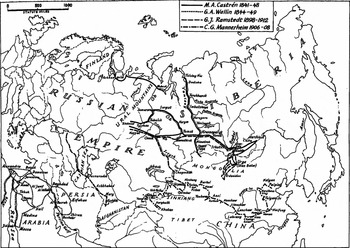
Castrén's scholarly career and intellectual development was directly guided by Sjögren, who intensively applied a historical-comparative method in his research among Finnish peoples in the European part of Russia. In 1844 he was appointed to the post of permanent academician for Finno-Ugrian and Caucasian languages and ethnography at the academy in St. Petersburg. After Castrén's return from the expedition to Lapland in 1838, he heard that Sjögren had been in Helsinki looking for a suitable candidate for an expedition to Siberia. The young researcher was already concerned with his ‘favourite plans’ of fieldwork in different parts of Europe and Asia (Castrén Reference Castrén and Schiefner1969a: 3). Wallin also expressed his interest in participating in the planned expedition. As was mentioned above, Sjögren recommended Castrén to the academy, and he subsequently spent the time from 1845 to 1849 on his Siberian expedition. The principal objectives of this expedition were the Samoyeds and an assessment of their distribution in Siberia, from the Ob to the Yenisei, from the tundra of the coast of the Arctic Ocean as far as Lake Baikal (Fig. 6).
Map of Castrén's expeditions 1841–1848 (Aalto Reference Aalto1971: appendix).

As was common in other scientific expeditions of this period, Castrén's duties combined the collecting of linguistic material, folklore, place-names, statistical and geographical, archaeological and ethnographical data, with the study of climate, hydrology and vegetation. The main instructions of the academy written by Sjögren, himself, is impressive in the detail and extensiveness of the programme formulated for Castrén (Sjögren Reference Sjögren and Castrén1969: 505–514). Among Castrén's major tasks were delivering a classification of all Samoyed groups, the verification of available data, which was thought to be contradictory, and clarifying the relationships between different neighbouring ethnic groups. In the southern part of the Yenisei region Castrén was to check the controversial information about the extinction and existence of some hardly known tribes. Besides such tasks it was expected that the collected data should not just briefly touch upon topics in a way ‘how it was done before’ (which) ‘brought only vague hypotheses.’ Sjögren by himself accepted that three years for this kind of research in a vast territory was rather too short, but at the same time he prescribed an exhaustive summary of the matter (Sjögren Reference Sjögren and Castrén1969: 511).
In addition to Sjögren's instruction there was another supplementary instruction from Peter von Köppen (1793–1864) academician, whose research fields covered geography, ethnography, history, statistics and cartography. Köppen charged Castrén with a special task, related to the political administrative interests of Russia. He referred to the statute of administration of Siberian inorodtsy [aliens] from 1822, also known as Speranskii Code, which for the first time integrated the non-Russian population into the empire's legal structure. The category inorodtsy classified the remote ethnic groups of the north, of Siberia and of the steppes. Inorodtsy, literally translated means ‘of different kin’ or ‘clan’, some kind of ‘otherness’, and included three groups: settled [osedlye], that is, those who lived in towns and settlements; nomadic [kochevye], those who occupied definite places depending upon the season; and wandering or foraging [brodiachie ili lovtsy], those who moved from one place to another. The purpose of the categorisation of inorodtsy according to their way of life was based on the fiscal needs of the empire. Each of the above mentioned categories of inorodtsy had also a different set of responsibilities and rights within the empire. According to Köppen's instructions, Castrén should attempt to classify precisely these categories, according to their way of life, their own self-designation, and their own determination of the land borders within which they moved (Köppen Reference Köppen and Castrén1969: 515–517).
However, the multidisciplinary profile of the expedition created problems for Castrén. In his report on the hydrology of the Russian north dating from 1845 he wrote: ‘[t]he main object of my travel is the study of man. Thus, it is difficult to combine it with nature study.’ As a particular problem Castrén explained that for his own research purposes he was to travel in areas distant from waterways, because the Samoyeds did not migrate along rivers. Nonetheless, he agreed to take on this extra research and ensured that he did his best in searching for relevant information (Castrén Reference Castrén and Schiefner1969e: 327). Personally, Castrén's thoughts were focused on finding evidence for his thesis about the affinity of Finns with related Siberian groups and their possible common origin. The kinship between Finns and Samoyeds was clear for Castrén anyway, and he planned to provide further evidence from the expedition. What he really was interested in finding was further Finnish ancestral roots through investigating more deeply the relations of Samoyeds to other groups. He was also very interested in obtaining material on Turkic and Mongolian languages in order to be able to compare them to Finno-Ugrian languages. He was completely convinced that the research question could not be answered satisfactorily before the bonds would be found that connect the ‘Finnish tribe with the bigger or smaller part of the world’ (Castrén Reference Castrén and Schiefner1969b: 75).
This idea brought him to China through the Sayan Mountain even though it was not in the academy's instructions and was explicitly forbidden by the Chinese border regulations. From Narym in west Siberia in 1845 he wrote to his friend, assessor France Johan Rabbe about his ‘intangible longing’ to go to the Baikal area and China in the search for Finnish ancestors (Castrén Reference Castrén and Schiefner1969b: 144). The desire to clarify the question of whether the Soyot group of Samoeyeds originated on the Chinese side of the border was for him stronger than the fear of Chinese prisons, as he reported in 1847 to Sjögren after the expedition (Castrén Reference Castrén and Schiefner1969b: 355).
In spite of his illness, that caught him again during the severe Siberian winter, he was able to do much more work than he had envisaged. During the four years from 1845 to 1849 he travelled all through west and south Siberia, reaching the borderlands of Mongolia and China. His northernmost research area was between Turukhansk and Tolstoy Nos. The easternmost point of his expedition was Nerchinsk. The contribution that Castrén made to Uralic linguistics on this expedition was impressive. He examined around twenty languages and dialects, of which some had not been totally studied before. He investigated all the Samoyed languages and demonstrated their affinity with the Finno-Ugrian languages. He wrote in 1845 from Narym, ‘every day I am delighted to discover more and more analogy between Finnish and Siberian languages’ (Castrén Reference Castrén and Schiefner1969b: 145).
As was shown above the discussion concerning Finnish origin and culture was not isolated from the process of searching for the national identity. One of the important questions related to where the outside influences came from. Castrén's lecture in 1851 referred sceptically to the views on Finnish origin that accredited Finnish ancestry to Scandinavians, Germans, and English people and believed that they discovered Finnish traces even in France and Spain. On the same occasion he pointed that ‘nowhere are these traces so easy to find as in Russia’ (Castrén 1968d: 90–92). During his stay in Surgut, in 1845, Castrén also noted that the Samoyeds formed the crucial ‘bridge’ of affinity between the Altaic and the Finnish peoples. Thus, it was through the Samoyeds that the Finns could be seen as related to the Altaic people (Castrén Reference Castrén and Schiefner1969b: 75). Therefore he answered the question ‘where was the cradle of the Finnish people?’ in his famous lecture as follows:
We have to abandon the idea of any relatedness [of the Finns] with the Greeks, the Israeli tribes, and with the great privileged nations. However, for our own comfort we can say that everybody is the son of his own actions, and in the end we earn any noble traits by ourselves (Castrén Reference Castrén and Schiefner1969e: 122).
Castrén put forward the idea of the relationship between the Finno-Ugrian, Turkic and Mongolian languages. Under the common name ‘Altaic’ he classified five big language families: Tungus, Mongol, Turkic, Samoyed (Uralic) and Finno-Ugrian (Castrén Reference Castrén and Schiefner1969e: 318). This concept is known as the Ural-Altaic theory. In his lecture at the university of Helsinki in 1851 he definitely located the origin of Finns in their relation to this common group, however near or distant. He considered Kalevala as a general expression of genuine culture, which was generated not only by Finns but by all Altaic peoples. The fruitful ground of Asia is for Castrén the root of the great ideas of Kalevala, in which ‘Finns, Turk, Mongol, Tungus and other people worked together on development of their culture’ (Castrén Reference Castrén and Schiefner1969e: 321)
After his return Castrén worked more than was really permitted because of his wretched health. In the late winter of 1852 his condition worsened rapidly, but he was still feverishly preparing his grammar of Samoyed. On 16 April Sjögren announced, during a meeting at the academy in St.Petersburg, a new article by Castrén but on 7 May the news of his death was received. The almost simultaneous loss of both Wallin and Castrén was felt very deeply by their compatriots. Because the field of the latter was of special national interest, his work and personality were nearer to the interests of the general public than were those of Wallin (Aalto Reference Aalto1971: 88). Castrén's life and magnificent achievements inspired many students of the following generations to devote themselves to Finno-Ugrian studies and to travel to those remote peoples.
Perception and legacy
Castrén had already during his lifetime considerable international respect and was celebrated as a hero in Finnish nationalist circles. At the same time, he was busily engaged in his principal work and his activities were focused on academic research. During the peak decade of growing national awareness he was away from his homeland for years conducting research expeditions in Russia. Castrén kept a certain distance from nationalist enthusiasts, for him not everybody had a right to call ‘long live the fatherland!’ only those who were really ready to stand up for it with their actions (Castrén Reference Castrén and Schiefner1969e: 311). His popularity has remained mostly among closely connected circles, in spite of the far reaching cultural and ideological implications of his work.
The international respect for Castrén's academic contribution is based on the collection and analysis of his enormous field material from northern European Russia and central Siberia and on the theories deriving therefrom. His groundbreaking work remains the standard reference material to this day for all research on most central Siberian languages (Anderson Reference Anderson and Vajda2004: 16). Castrén's contribution in linguistics is especially impressive and unique. His docent thesis dating from 1839, was the first piece of research at the university of Helsinki completed in the spirit of the new comparative method (Korhonen Reference Korhonen1986: 52) on the analysis of Finnish, Sami and Estonian languages. The thesis that Castrén produced for the chair in Finnish language and literature in 1850 De affixis personalibus linguarum Altaicarum proved the affinity between the Finno-Ugrian, Samoyed, Turkic, Mongol and Tungus languages. Among his contemporaries he was uniquely familiar with the subject. All together he distinguished fourteen grammars of languages, belonging to different language families. He himself regarded, according to Schiefner, the Samoyed grammar as his main scientific work in his life (Schiefner Reference Schiefner and Castrén1969a: VIII).
Contemporary Finnish scholars emphasise his importance for establishing Finno-Ugrian studies as a discipline (Setälä Reference Setälä1901: 4–5; Korhonen Reference Korhonen1986: 59–61; Nordman Reference Norman1968: 16), for laying the foundations of modern comparative Uralic linguistics (Korhonen Reference Korhonen1986, 65) and the theory of the Ural-Altaic family of languages (Aalto Reference Aalto1971: 85; Holmio Reference Holmio2001: 18–19; Stipa 1999: 312). As Korhonen points out, for many decades it was the basis of understanding of the prehistory of the Finns. It influenced the spread of the concept of ‘Altaic languages and peoples’ and contributed to the construction of the concept of origin for the Finns. These ideas soon became familiar in scholarly circles, not only in Helsinki and St. Petersburg, but elsewhere in Europe where Castrén's work was followed (Korhonen Reference Korhonen1986: 60) and provided poets and writers with exceptional subject matter (Holmio Reference Holmio2001: 18–19). Sakari Yrjö-Koskinen, author of the first history of Finland in Finnish, incorporated Castrén's theory of Asiatic origin of the Finns into his Finnish national history, published in 1869–1872. There he classified Ural-Altaic nations among the nations that ‘had performed on the stage of history’ (Holmio Reference Holmio2001: 19). Castrén was the first to analyse, in his interpretation Kalevala, songs in relation to the kindred people of Finns. He was among the first men to take a scientific position on Kalevala and to strive towards its verification.
According to Aalto, Castrén's studies, together with Böhtlink's grammar on Yakut language (Turkic), started a new era in Turkology (Aalto Reference Aalto1971: 87). Referring to Castrén's linguistic field work, Salminen considers him as a founder of ethno-linguistics (Salminen Reference Salminen2004). In Niiranen's analysis of the history of Finnish ethnology, his name is among the candidates for the title of ‘father’ of the subject (Niiranen Reference Niiranen and Räsänen1992: 21–24). Aalto and Vuorela credited him as ‘the first professor of ethnology in the world’ (Aalto Reference Aalto1971: 87; Vuorela Reference Vuorela1977: 21). Castrén's archaeological investigations in Finland, northern Russia and Siberia are regarded as very significant (Nordman Reference Norman1968, 16; Salminen Reference Salminen and Lehtinen2002: 48). During his short life, he managed to collect enormous and unique material, which is contained in 32 volumes of his manuscripts. In spite of great efforts in editing of Castrén's materials, much of it remains unpublished. Additional translations into Finnish would be appreciated, since so far only a minor part is available in the language that he so wished to promote.
Castrén's name is also of particular importance for the Russian research community. The materials, collected by Castrén during the expeditions in Russia on behalf of the Russian academy of science, and his theoretical hypothesis made on this base, still attract the attention of Russian scholars in linguistics, ethnography, history and folklore (Omeltschuk Reference Omeltschuk1984: 237–239; Sokolova Reference Sokolova and Räsänen1992: 9–20). On the website of the famous Peter the Great museum of anthropology and ethnography [Kunstkamera] in St. Petersburg he is even represented as a Finnish and Russian linguist with his ‘Russian’ name that was used in official documents of the 19th century, Matvey Khristianovich Kastrén. With this name he is registered also in the Encyclopaedia of Russian writers and researchers, who died in 18th–19th centuries published in 1880 in Berlin in Russian (Gennadi Reference Gennadi1880: 121–122). Some of his works, expedition materials, travel notes, correspondence, and reports to the Russian academy are translated and published, and are thus well represented in the Russian language.
In 1927 the academy of science of the USSR devoted one commemorative volume in the series on history of science to Castrén. The volume started by praising him as one researcher among very few with an outstanding position in the history of the academy (Oldenburg Reference Oldenburg and Bogoraz1927: 1). In his contribution to the volume, Bogoraz called Castrén and his work unique for the ‘great and complicated science of humans’. He thought Castrén's work marked the starting point for many different trajectories in this science, all of which he followed himself more thoroughly than many of his successors even a century later (Bogoraz Reference Bogoraz and Bogoraz1927: 35). The scientific legacy of Castrén, evaluated by Bogoraz, is so great that only the description of his manuscripts and main ideas would require much work and many volumes (Bogoraz Reference Bogoraz1927: 20).
In Finland a M.A. Castrén society was established in 1990, and this is in charge of a programme for supporting language and cultural activities of Finno-Ugrian ethnic groups in the Russian federation. Among such activities are teaching the native languages and literature, teaching Finnish at the universities in the Finno-Ugrian republics of Russia, cooperation in museum and library activities as well as broadcasting, TV and other mass media. Along similar lines, the Komi national library in Syktyvkar published, in 2004, a CD-Rom containing Castrén's licenciate thesis and articles on the Zyryan language (Castrén Reference Castrén2004a, Reference Castrén2004b).
The question of the assessment of Castrén's scientific contribution is related to the discussion among Finnish scholars concerning criteria for a scientific discipline to be regarded as independent and about placing it as part of the research of the 19th century (Korhonen Reference Korhonen1986; Niiranen Reference Niiranen and Räsänen1992; Lehtinen 1992; Siikala Reference Siikala2006). Castrén himself, defining his field of study, referred to Grimm's thought that pure linguistics was not enough for him to connect ‘words’ and ‘things’. It was ‘to live in the houses and not only build them.’ At the same time he characterised himself first and foremost as a linguist and therefore felt most comfortable in this field. On the other hand, his endeavour from the beginning was aside from language studies. It was to study the linking of ‘songs, myths, history, ethnography’ to issues related to national belonging (Castrén Reference Castrén and Schiefner1969e: 316–317). However, by any definition, Castrén's studies reflected a strong interdisciplinary tradition in research. They cover an extremely wide area in geographic, historical and methodological terms. Such studies should be regarded as the outcome of locally based research tendencies within the process of nation building and of close interaction with the surrounding world.
Summary
It is in the contexts of the Finnish history of nation building and of the importance of the Finnish language, in which we can capture the versatility of Castrén's contribution to the history of Finnish science in the 19th century and to national history in general. An attempt has been made in this article to understand his position as a researcher from several perspectives: from integrating his studies into the process of national awakening and from the crucial importance of science in the changing Finnish society of that period. Influenced by romanticism and national awakening but guided by rational judgement, Castrén's work and life is an impressive example of putting into effect his idea of ‘fatherland’ in the interpretation of 19th century Finland. The emotional ties between the ‘fatherland’ and science can be seen through all Castrén's material. At the same time Castrén's research and teaching activities contributed to the early institutionalisation of a major role for linguistics and ethnography in the strengthening of Finnish identity. Taking the question of relationships in his Finno-Ugrian and Uralic language studies as a central driving force, Castrén's research activities in the first half of the 19th century were part of a broader human science that took the question of human diversity and unity as one of the central problems.
Trying to place Castrén's contribution in the context of historical events and developments in academic life, one could call his position as a position ‘in between’. Like the Finland of this period, in search for a national identity between Sweden and Russia, Castrén was acting ‘in between’ as a Finn writing in Swedish, participating in the creative Kalevala process, and trying to discern Finnish origin between different disciplines. His research took place between the ‘beloved fatherland’ and outside it. In contemporary research on the history of science he is placed between the romantic and the classical researchers. On the other hand his tremendous capacity for work, his desire for deep learning, the dimensions and far reaching implementation of his scientific results and the blazing love for his country has brought him into the top ranks of the Finnish ‘Who is Who’ for ever. However, the history of Castrén's national and international reception also shows that his role for world science and northern studies in general is worth revisiting. While few scholars might credit him with the title ‘first professor of ethnology in the world’, a deficit of current and past English language scholarship using Castrén's work suggests that there is much potential in analysing his works in the future.
Undoubtedly due to Castrén's research achievements, it can be assessed that he did not only distinguish and classify many small ethnic groups, but that he did so by doing it thorough ethnographic and linguistic research on them, including on groups which were thought to be extinct such as the Kotts. The importance of Castrén's contribution for preserving the linguistic heritage of indigenous groups became evident for the present author during recent fieldwork among the malozemel'skie Nentsy (Samoyeds) who almost lost their language. They are just adjacent to the area in which Castrén did intensive fieldwork (nowadays the Nenets Autonomous District) in Arctic Russia. Castrén's focus on language as an identity marker may not be the only approach to categorise ethnic belonging and relatedness, but beyond doubt, language preservation is to date among the top priorities of cultural heritage politics. In this respect, Castrén's work sets an agenda in a direction that continues to be timely.
Acknowledgements
The author wishes to thank Arto Kiurujoki of the Arctic Centre Library of the University of Lapland in Rovaniemi, who assisted in finding the literature available in English and helped to clarify some details of Castrén's biography from Finnish sources and who also organised an exhibition on Castrén at the Arctic Centre. Many thanks are also due to Kari Jantunen from the Arctic Centre for his assistance with various documents. The author is also most indebted to two anonymous referees for their valuable comments on an earlier draft of this paper.