Throughout the cold war the west was concerned that Soviet submarines could enter the Atlantic from their bases in the White Sea area using the seaways on each side of Iceland. Of these, the Denmark Strait between Iceland and Greenland was the most significant. Continous monitoring to detect the passage of such vessels was done by the US Navy's Anti-Submarine Warfare Unit based in Jacksonville, Florida, through its aircraft stationed at the NATO base at Keflavik in Iceland.
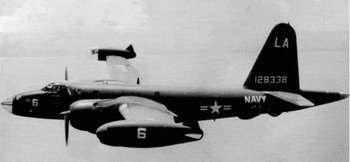
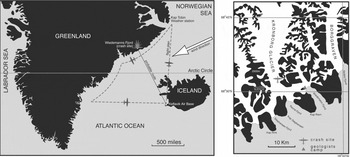
Just before 0800Z (GMT) on 12 January 1962, a P2V5 Neptune (Fig. 1), designated LA-9 and with 12 personnel on board, took off on a routine patrol mission. The flight plan anticipated a triangle north from Iceland, then southwest about 60 km (40 miles) off the coast of Greenland, then returning to Keflavik after an estimated time of 8.5 hours (Fig. 2). They were to fly low, under 660m (2000 feet), and records show that the weather was very bad with strong winds, snow and heavy cloud cover. In fact, visibility was probably close to zero. A message from Kap Tobin (70° 24′ 52″N 21° 58′ 35″W) in Greenland confirmed gale force winds (60 knots) from east northeast, obscured ceiling and heavy snow for the whole day. LA-9 reported its position after one hour, according to procedure, but this was thought to be in error as it was to the west of the intended route. (It would later transpire that this was on line to the ultimate crash site). Between 1000 and 1100Z, base communications heard weak and unreadable signals from the aircraft, which ceased at 10.53Z. At 11.25Z the base issued an alert and at 13.05Z a second Neptune was launched with orders to try to establish radio contact with LA-9. A further two aircraft took up the search without result and just after 2000Z a distress signal was released. LA-9's fuel was expected to be exhausted by about 2200Z and the last of the search planes returned to Keflavik at five minutes past midnight.
P2V Neptune, similar to LA9, in the air.

Planned route of LA9 from Keflavik to Scoresby Sund (Kap Tobin), returning along the Greenland coast and then directly across the Denmark Strait.The probable route, the wind direction at the time and the crash site are also shown. Fig. 2b (right). Location of the crash site on the Kronborg Glacier.

The following day eight search aircraft were launched, but again their efforts were hampered by bad weather with poor visibility and low ceilings, and their efforts were fruitless.
On 14 January, 10 search aircraft, including some from other NATO countries, were sent out and, although weather conditions were much improved, there was still no result. These operations were continued until 19 January, when they were called off. In retrospect, it seems that only one aircraft, a C130 (Hercules), searched the area of the crash site and that was not until about one week after the crash, when the wreck may have become snow covered.
As one member of the search crews pointed out, there was only about four hours of daylight at these latitudes at that time of year. Another, R. Franklin recalls waving to the crew of LA-9 as his plane lined up with them for take off. Later, he first realised that they would not return when he saw the duty officer and two enlisted men making an inventory of the personal effects of the missing men. The aircraft had only recently come to Iceland from Rota in Spain; this was its first flight out of Keflavik. Cdr N. Kozak, a veteran of World War II, the Berlin airlift, and the Korean conflict, had just taken command. Some of his crew, including the navigator, B.C. Smith, were new, and the flight surgeon, J.A. Brown, had just gone along to keep up his required flying hours.
In the summer of 1966, a group of four young geologists, of whom one was the author, on an expedition from Oxford University were proceeding slowly up the Kronborg Glacier (which discharges into the sea at about 68° 30′N on the east Greenland coast), dragging sledges loaded with their equipment. They observed a collection of black rocks on the ice, silhouetted by the brilliant sunshine in their faces. Later, on looking back, they were surprised to see a US insignia on one of the rocks and realised they were not rocks at all, but aircraft wreckage. Even greater was their surprise when they discovered many, largely preserved, bodies amongst the wreckage. The scene consisted of twisted metal, tangles of electrical wiring, personal effects, cans and jars from the pantry and the aircraft's huge engines lying on the ice where they had rolled after being torn off by the impact.
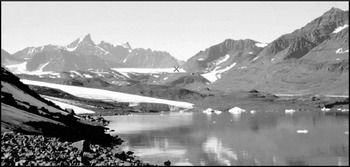
The plane had crashed at the side of the Kronborg glacier (Fig. 3) on an area of relatively uncrevassed ice and at sufficiently low altitude that now, in the middle of summer, the snow had melted from the glacier surface leaving bare ice. The geologists were not in a position to do anything, not being in touch with the outside world. They collected a few articles, such as wallets with names, and carried on with their work. At the end of their expedition, the geologists returned via Iceland and delivered these items at the US Embassy.
The crash site (marked with a cross) viewed from Wiedemann Fjord. The mountains of the Lilloise range are in the background with an altitude of around 2500 m.

It was now well into September and the geologists recommended that a recovery mission was inadvisable that year. It was therefore with surprise that they received a letter from the commander of the U.S. Naval Forces in Iceland thanking them for their assistance and describing a rescue operation mounted from the icebreaker USS Atka between 20 and 22 September 1966. They also received letters from Mrs W.J. Madey of New York, sister of Cdr. Kozak, expressing her thanks and relief that the mystery of the disappearance had now been cleared up. They were also informed that some of the crew had been laid to rest at the Arlington National Cemetery and others buried privately.
In 1995, almost exactly 30 years after the original discovery of the wreck, the author was flying in the neighbourhood in a helicopter. He happened to mention to the Swedish pilot that there had once been an aircraft crash in the area but probably nothing now remained. Immediately the pilot went into a steep turn and headed for the site. Indeed there were still remains. Aircraft parts, now much smaller (the recovery team had blown up wreckage) than before were soon spotted. The helicopter was hovering a few feet off the ground when suddenly the pilot said that there were human remains down there. This was a real surprise. It had been understood, apparently by all involved, that all remains had been returned to the United States for burial.
The author reported the existence of human remains to the police authorities in Nuuk, Greenland, as is required. He was later informed that nothing would be done due to lack of resources.
Some time in 1997, Mrs. Y. Nelski of Coloma, Michigan, received a phone call from D. Latimer of San Diego, a former airman who had been transfered from the crew of LA-9 just prior to the fateful flight. He asked if she was a relative of Joseph Renneberg, one of the crew members who had perished. When she said she was, he was her nephew, she was informed that more remains had been found on the ice (it is unclear to the author how this news had been disseminated). She did not know if the casket at the funeral she had attended with her now-deceased mother and daughter had in fact contained his remains. The only way to be certain was to return the remains and compare them with a DNA sample from Mrs. Nelski.
In 2001, news of this discovery reached R. Pettway of Chattanooga, Tennessee, who had been in the same squadron in Rota, Spain and knew many of the lost crew personally. He was naturally disturbed and puzzled as to who had been returned and who not. He wondered why the original recovery operation was apparently mounted in such haste and the plane blown up if bodies were still on board. Would a new recovery operation be organised?
Pettway learned of the United States Army Central Identification Laboratory, Hawaii (USACILHI) the task of which is to recover the bodies of US servicemen lost in combat, but not ‘Non-hostile unaccounted-for casualty cases.’ The crew of LA-9 had fallen under this latter category. It is difficult to escape from the view, then, that the dead airmen were not the primary motivation of the recovery mission, but rather the destruction of the plane, with whatever instruments and documents it contained.
Pettway's mobilised the relatives of the lost men, lobbied politicians, set up and ran a web site and wrote numerous letters to the navy and the press. When, in 2004, a television report, supported by this author's pictures, brought the story to the public, the U.S. Navy announced a new recovery mission. A 16 member recovery team under Naval Air Force, U.S. Atlantic Fleet (CNAL), departed Norfolk, Virginia, on 2 August 2004 and returned with the rest of the crew remains on 17 August. The recovery mission, which used cadaver dogs to find all human material, was organised by Tangent Expeditions of Cumbria, UK.
The remains then were moved to the Joint POW/MIA Accounting Command (JPAC), Hawaii, and were then turned over to the Armed Forces DNA Identification Laboratory (AFDIL) for identification before being returned to their families for burial. However, since some of the remains had been buried in the Arlington National Ceremony it was desired that the latest recovered body parts should go into the same graves. This was to be a problem since the army, which had jurisdiction over the cemetery, claimed that opening of graves was not permitted and it again took some years to sort out this problem.
Finally, on 6 November 2009, about 200 people, with families and former crew mates, assembled at the Naval Air Station in Jacksonville, Florida, for the unveiling of a refurbished sister plane to the LA-9 and to hear tributes to the lost aviators. At the same time, Pettway received a special recognition medal and plaque for his tireless efforts. After almost 50 years, the saga was almost at an end, pending the final burial of the remains.
All twelve crew members now have identified remains recovered. The army refuses to disinter the remains from 1966, but each family can now have a separate grave site in the Arlington National Cemetery or else in their home state. In Arlington, there is a ‘common casket’ grave site and memorial for the crew members who were only partly recovered. Unidentified remains will be buried with the unidentified remains from 1966, under a gravestone with all twelve names. The Kozak family elected to have the newly recovered remains buried in a small box in the grave of their father in Arlington.
The reason for the crash has never been discovered. It is possible that the aircraft was blown off course by gale force winds or there may have been a navigational error. The radar would have been inoperative in heavy snow (and would not reflect from glacier ice; there are many testimonies as to the inadequacy of the model of radar carried by the aircraft). The aircraft flew straight into the glacier at an altitude of just over 660m (2000 feet) when they thought they were over the sea where the maximum height of icebergs was reported as much less than this. Also, two essential pieces of equipment, the radar and radio-altimeter were allegedly repaired the night before the fateful flight although these may not have functioned under the prevailing conditions anyway. What seems certain is that all the crew died on impact as established at the original discovery by the geologists.
Acknowledgements
I wish to thank Mr. Robert Pettway for keeping me up to date on his campaign and for hospitality in the USA. Cdr. Kozak's daughter, Mrs. Patricia Moscantioni of Orange County, Florida, six at the time of the event, provided memories. The information in this article comes from personal knowledge and the voluminous information on the US Navy website on which Pettway collected media stories: http://www.vpnavy.com/vp5mem_newsletter.html. I wish to thank the anonymous reviewers, especially the one who suggested many significant improvements.