A relatively small group of protesters gathers in city streets or squares, demanding something of the government. The authorities try to break up the protests by sending in the police, who use “less-lethal” weapons—water cannons, tear gas, pepper spray, sound bombs, batons, rubber bullets. But rather than breaking up the protests, the police actions incite more people to join. Backlash movements of these kinds have been documented by journalists and scholars in settings as diverse as the United States during the Civil Rights movement, Footnote 1 the Eastern bloc countries and Soviet regions in the 1990s, Footnote 2 and the advanced democracies facing anti-globalization movements. Footnote 3 A recent example is the 2014 pro-democracy movement in Hong Kong. The appearance there of police with tear gas and long-barrel rifles, in the autumn of 2014, galvanized the movement, bringing many more people into the streets. Footnote 4 The events in Ferguson, Missouri, in the United States in August 2014 had some of this feel: the appearance of tanks and heavily armed and protected police officers, facing off against protesters, seemed to stoke the flames rather than quelling them.
How do elected governments facing backlash uprisings exit these crises? The strategic choices open to them are limited and carry risks. In democracies, governments typically exert limited control over the flow of information and therefore lack some of the “diffusion-proofing” and control strategies that authoritarian governments have at their disposal. Footnote 5 And the authorities have just learned that repression can fail to quell movements and indeed make them grow, and they may be worried about the consequences in public opinion and at the next election should they continue, or even increase, the repression. Yet calling off the police and making concessions to protesters is also risky and entails costly policy reversals. Which of these two paths governments adopt can make the difference between extreme violence and human rights abuses, versus sharp policy change but perhaps a peaceful resolution to the crisis. Especially in new democracies with pre-transition histories of abuses, the dilemmas are sharp and the choices consequential.
We study here important recent backlash uprisings in three new democracies in which the governments chose divergent paths out of the crisis. The background to the uprisings was remarkably similar across the three: modest-sized groups of protesters pressing for policy (but not regime) change were attacked by police; the attacks were widely publicized, in large part through the social media; and major national uprisings ensued. At this point in the scenarios, the paths diverged. One government chose to end the uprising by increasing the level of repression to the point that the movement finally subsided, leaving a grim toll in deaths and injuries. The other two governments instructed their police forces to put away rubber bullets and avoid using their batons, and offered concessions to the protesters.
Our explanation for strategic divergence draws on original interviews with police and civilian authorities, as well as original surveys and analyses of third-party surveys, carried out in Turkey, Brazil, and Ukraine. In all three countries, national uprisings took place in 2013: the Gezi Park demonstrations began in Istanbul in late May, the Brazilian protests began in São Paulo in early June, and the EuroMaidan protests began in Kiev in late November and lasted until February 2014. Which road toward extrication each government took depended, we argue, on the security of the government’s hold on office and, behind this, the linkages between the party system and societal cleavages. By exploring governments’ electoral incentives when they deal with backlash movements, we heed McAdam and Tarrow’s call for a rapprochement between electoral and social-movement studies. Footnote 6
In addition to providing general insights into protests and state coercion, each of the recent movements we study was important, nationally and internationally. The international press can scarcely mention Turkey’s Justice and Development Party (Adalet ve Kalkınma Partisi, AKP) government and Prime Minister (now President) Recep Tayyip Erdoğan, without also mentioning the brutality they deployed against the Gezi Park protesters. Footnote 7 A year after the Brazilian protests, the authorities were on tenterhooks during the soccer World Cup, fearing a replay of June 2013. The EuroMaidan protests set off a sequence of events from the fall of the Yanukovych government, to Russia’s annexation of Crimea, to rebellion and civil war in Eastern Ukraine.
Mass movements, such as in Tiananmen Square or Communist Eastern Europe in the late 1980s, led to a spate of theoretical and empirical work by social scientists, as did the 2011 Arab Spring uprisings. Footnote 8 But protests and repression in democratic settings, where office-holders operate under the shadow of future elections, are also of political and policy importance. In the United States, just as in Brazil and Turkey, in the era of hand-held cameras and social media, it is important to understand why governments repress, with what consequences, and how they can exit situations that seem ready to spiral out of control.
Rather than a large-N test for our explanation, we offer in-depth case studies that contribute to theory building. They do so by illustrating how electoral security shapes governments’ responses to protest in democratic settings. Footnote 9 Our plausibility probe gains strength from the fact that the observed variation in extrication strategies does not, as we shall show, conform to predictions of rival explanations, ones that focus on differences in degrees of political centralization, democratic consolidation, civilian control over the police or the governments’ ideologies, the costliness of protesters’ demands, the social class composition of demonstrators, or their network structures.
In the next section we discuss theories of protests and repression. We then present evidence about why governments repressed, why protests grew, and, in particular, why governments adopted such varying paths toward self-extrication from the crises. In the penultimate section we evaluate our explanation for varying extrication strategies against rival accounts. We end by exploring the implications of our study for broader questions of democracy, accountability, and party and cleavage structures.
Theoretical Considerations and Preview of the Findings
Why people protest, why governments sometimes repress them when they do, and why small movements sometimes explode into mass uprisings have all been the subject of scholarly investigations. In each of the cases studied here, governments used harsh measures against “early risers.” Footnote 10 Since harsh measures can elicit moral indignation and heightened protest, Footnote 11 especially in democracies, Footnote 12 states that turn to these measures presumably know that they are taking a calculated risk. But what happens when governments have just been vividly reminded that, in deploying repression, they can exacerbate the protests, rather than tamping them down? In each of these cases, the backlash uprising constituted a major crisis for the government, even though a transition to armed insurrection was not a major concern. Footnote 13
The cases we study show that governments have at least two basic routes out of the backlash crisis: they can back down, calling off the police and even offering concessions; or they can intensify the repression still further. The strategies recall the distinction between “negotiated management” and “escalated force” approaches to policing protests in advanced democracies. Footnote 14 Scholars have described an evolution from the first to the second strategy, and have debated whether that evolution was linear and irreversible, in light of anti-globalization movements and the rise of global terrorism. But they have done less to offer explanations for why democratic governments would resort to one or the other set of tactics. Scholarly research into regime type and levels of democratic consolidation do offer explanations for why levels of repression vary. Though much research lumps democracies together and compares their actions with those of authoritarian regimes, some studies disaggregate among democracies. Hence Christian Davenport and his co-authors explore the components of democracy that influence governments’ choice of level of repression. Footnote 15 One conclusion is that transitional regimes, ones that are neither fully authoritarian nor consolidated democracies, are especially prone to violence against their populations. Footnote 16
But our study holds constant both regime type and level of democratic consolidation, and still identifies variation in repressive strategies—variation that is analytically meaningful and politically consequential. Though Brazil’s democracy is more consolidated than either Turkey or Ukraine, there is little appreciable difference between the two latter countries on this dimension. Nevertheless, their paths toward extrication from the backlash uprisings was very different. In 2012, the year before the protests, Turkey and Ukraine received identical Freedom House scores of (3.5 on a scale of one as most free to seven as least free), both of them higher (less free) that Brazil’s (two). In the Polity IV Project, Turkey received a better score than Ukraine on measures of competitiveness of executive recruitment and political participation. If democratic consolidation per se were the predictive factor, we would predict harsh repressive measures in Ukraine as well, which we do not observe. Footnote 17
A hint at the explanation for the variation we observe comes from another component of Davenport’s work, in which he explains why democracies in general are less repressive—why there is a “domestic democratic peace.” Footnote 18 “Democratic institutions,” he explains, “are believed to increase the costs of using repressive behavior because, if state actions are deemed inappropriate, authorities can be voted out of office.” Footnote 19 Building on this insight, we argue that the decision of an elected government often boils down to its assessment of the degree to which it will be held accountable for high levels of repression. Secure governments, ones that maintain a stable electoral support base that maps closely onto an overlapping social cleavage, are relatively free to inflict harm at high levels. Footnote 20 By contrast, less secure governments, those with volatile electoral support, are more sensitive to electoral sanctioning and have incentives to refrain from repression. A factor contributing importantly to electoral insecurity in the countries we study is a loose mapping of the party system onto social cleavages, either because social cleavages are multiple and cross-cutting (Brazil), or because the party system has not developed into a stable expression of major cleavages (Ukraine).
By stressing the prospect of future elections as a force shaping governments’ strategic decisions, our answer homes in on accountability. That accountability can vary from democracy to democracy as a function of institutional arrangements is well known. Footnote 21 But we underscore that accountability for certain policies and acts, such as harsh repression of a protest movement, can also vary simply as a function of societal cleavages and their connection to party competition. When elections have the feel of an ethnic or racial “census,” Footnote 22 their accountability effect is muted. Even when societies are divided not on sharp racial or ethnic but on softer religious or ideological lines, a government that rests on a firm majority on one side of the divide, a secure government, is less constrained to preserve the rights of, or cater to the preferences of, people on the other side. Viewed in this way, insecure governments, those that foresee being held to account more readily for their actions, are more constrained and may be less abusive of the integrity of the person than are secure ones. Footnote 23
In the following sections we provide evidence about protests, repression, uprisings and extrication from our research into recent events in Turkey, Brazil, and Ukraine. As a preview to our key findings, the three cases have in common that governments repressed early risers and this repression was followed by mass mobilization and a crisis for the state. But at that point their paths diverge. The Turkish government refused to commit to concessions and ended the protests by upping the level of repression to very high levels, resulting in several deaths and dozens of injuries. In Brazil, the elected authorities pulled back the police and made key concessions to the protesters. The Ukrainian government also pulled back the police and (eventually) offered concessions.
The key relevant feature distinguishing Turkey, on the one side, from Brazil and Ukraine, on the other, was the security of the government’s hold on office and its projection that this security would not be disturbed, even by an Armageddon against the protesters. The Turkish government rested securely on a base of conservative and devout constituents. The public’s reactions to the Gezi Park protests and to the government’s handling of them were sharply structured by polarized socio-religious and party affinities; as we will show with polling data, virtually no government supporters joined the Gezi Park protests in Istanbul. Few government supporters were likely to turn against the government or ruling party in the wake of the harsh crackdown that ended the protests. We suggest in the concluding discussion that this dynamic is not unique to Turkey. Venezuela is a country in which a powerful class cleavage has for about 15 years found fairly direct expression in party competition. When backlash movements broke out in that country, with near-exclusive participation among people from one side of the (class) divide, the government unleashed lethal repression.
By contrast with Turkey (and Venezuela), in Brazil social cleavages are cross-cutting and map only loosely onto the party system. Party identities remain weak, as Samuels and Zucco note, because of the “shallowness of sociocultural cleavages...class, ethnicity, religion, or region have historically never provided the basis for party competition in Brazil.” Footnote 24 The weakness of partisan affinities meant that partisanship did not strongly structure people’s attitudes toward the protests or toward the government’s handling of them. Elected officials, from different political parties in office at distinct levels of Brazil’s federalized system, worried about the potential loss of support even from their own constituents, should the repression not end.
The Ukrainian government under Viktor Yanukovych attempted to extricate itself from the backlash crisis in a way that resembled Brazil’s path more than Turkey’s. Though the pro-Russian and pro-Western cleavage is powerful, the party system has been inchoate and has not consistently expressed this cleavage. Footnote 25 Hence Yanukovych did not sit atop a silent majority, like Erdoğan’s, that would give him the freedom to end the uprising with a ferocious crackdown. And there was no chance of governing the country in the midst of a mass upheaval in Kiev and other Western cities. The day after the initial bout of repression and in the midst of the immediate backlash, the government fired Kiev’s chief of police and directed the Ministry of Internal Affairs’ force to restrain from further irritating actions. But the “Brazilian strategy” was more clumsily implemented in Ukraine and, within three months of the initial backlash, the government fell.
In our penultimate section we entertain several rival explanations for variation in elected governments’ strategies vis-à-vis backlash movements. We systematically assess evidence that bears on whether the observed differences might correspond to differing degrees of consolidation of democracy or to differences in the nature of the protesters’ demands or in the movements’ class compositions, among others. Another possibility worth mentioning from the outset is that differences in network structures of the movements shaped government strategies. Siegel has explained how “small world” networks, located in urban or suburban settings and through which information flows quickly, can produce greater resistance to repression. Footnote 26 Perhaps the governments anticipated the levels of movement resilience and were encouraged to use more repressive tactics to end the backlash when they thought resilience would be weak. Yet there is little evidence of marked differences in the networks sustaining the movements that we study. All resemble “small world” networks: they were urban, comprised of middle-class individuals, and were capable of rapidly spreading information to socially distant people through the social media. This common social outlook also helps rule out more general arguments based on movement weakness. Footnote 27
In turn, Pierskalla points out that violence may escalate between the government and protesters in situations in which a hard-liner faction within the government, such as the military, threatens to step in. Footnote 28 This third party is dissatisfied with the government but wants to take action only if the government is weak. Under such circumstances, the government might ratchet up repression to maintain the appearance that it had a strong hold on power. This dynamic might appear to fit the Turkish case and potentially explain why only there, among the three countries we study, the government deployed more repression to quell the backlash. It is true that, traditionally, the Turkish military has played the role of watchdog in politics. But in fact, by 2013 the AKP government had significantly curbed the power of the military in politics. Footnote 29 During the Gezi protests the military police entered the cities to join the regular police forces; thus this hypothesis also fails to explain why the extrication strategy of the Turkish government diverged from the other two.
Repression, Uprisings, and Extrication in Three New Democracies
In this section we use information from interviews with political elites and protest participants, together with original and third-party surveys, to construct case studies of the recent backlash movements that took place in Turkey, Brazil, and Ukraine. Our case studies highlight that electoral security was the key factor influencing governments’ decisions about whether to escalate or reduce repression, once backlash uprisings were under way. Electoral security trumped factors implied by rival explanations of government extrication strategies.
Turkey’s Gezi Park Protests: Secure Power and Escalating Repression
Overview.
In Istanbul, in May-June, 2013, harsh police repression of a small group of activists was followed by massive national protests. Within four days of the initial repression, hundreds of thousands of people had gone to the streets. Faced with the uprising, Prime Minister Erdoğan ratcheted up the level of repression to a point where the protests finally subsided. The prime minister’s implacable leadership style, as well as his desire not to repeat past experiences of protests, contributed to this strategy of extrication-through-increased-repression. But what allowed him to pursue this course was the confidence that his conservative and devout voting base would not punish him at subsequent elections for the harsh police tactics. Since the Gezi Park uprising the government, now well aware of the risk that mid-level repression will instigate a backlash, has dealt extremely harshly with protesters. The AKP was victorious in subsequent municipal (March 2014), presidential (August 2014), and legislative (June and November 2015) elections. Footnote 30
Phase 1 (May 28–30): Early repression.
In the early morning of May 28, 2013, a force from the municipal police (Zabıta) used pepper spray, tear gas, and water cannons to try to dislodge members of the Taksim Solidarity Coordination Committee from Gezi Park. Located at the center of Taksim Square, the park had been occupied by activists trying to block its conversion into a shopping mall. The scene that morning was the source of a Reuters photograph that would come to be known as the “Woman in Red”—a young woman, garbed in a red dress, standing still while a police officer about four feet away aimed a stream of pepper spray at her face. The image, circulated widely on the Internet, was among the most notorious of the protests, and seemed to draw many people to the park.
Phase 2 (May 31–June 2): Uprising and police retreat from Taksim.
A second phase is marked by a sharp increase in the number of protesters and ends with the police beating a tactical retreat from Taksim Square. In the early morning of Friday, May 31, the police again raided the park, and again used tear gas, pepper spray, and water cannons against the protesters.
This was the moment when the protests began to swell to massive proportions. Estimates put the number of demonstrators on Istiklal Caddesi, a pedestrian avenue that ends at Taksim, at around ten thousand by Friday afternoon, May 31. The protests grew as word of police actions spread through social media. The number of tweets per day that included the word eylem (“protest”) surged to around 50,000 on May 31, to around 90,000 on June 1, and remained above 30,000 until June 8. Footnote 31 On June 6–8, a survey research team asked more than 4,000 people in the park, “What was the most important reason for you to join the protests?” The most frequent answer, offered by nearly half of respondents, was “seeing the repressive acts of the police.” Footnote 32
The intensity of the police actions rained down international condemnation on the Turkish authorities and created some tensions within the government and between the government and the business community. Yet Erdoğan remained intransigent. In a June 1 speech, he threatened to meet popular force with popular force: “where they gather 20, I will get up and gather 200,000 people. Where they gather 100,000, I will bring together one million from my party.” Footnote 33 This confrontational rhetoric was indicative of Erdoğan’s confidence in garnering popular support.
Having failed to contain the protests or stop their spread, the police retreated from Gezi Park on orders of the interior minister on Saturday, June 2.
Phase 3 (June 11–15): Negotiations and heightened repression.
The Gezi Park protests came to an end with batons, torrents from water cannons and enough tear gas to keep the air around Taksim toxic and discolored for most of the day. On the morning of June 11, police entered Taksim, took down protesters’ barricades, and forced them from the square; most demonstrators dispersed or retreated into the park. The police returned, on June 15, with a massive deployment and show of force that cleared the park and ended the protests.
In between, on June 13-14, the prime minister held talks with Taksim Solidarity leaders. These discussions seemed unlikely to stave off what would be the final, massive assault on the park. In contrast to Brazil, where—as we shall see—the government made unilateral concessions, the Turkish government offered to soften its stance if the movement first dispersed. The Taksim Solidarity leaders were not in a position to end the protests. They could have encouraged a retreat, but there was no guarantee that the demonstrators would have complied. And the offers made by the prime minister were not credible, since they relied on future decisions of judges or on referendums. Footnote 34
On June 15, the police entered the park with a massive show of force. Ahmet Şık, a prominent Turkish journalist, told us that he had covered several war zones in his career but had never faced a scene as frightening as the one he encountered on June 15 in Gezi. Şık took refuge in a building nearby and dared not venture out for many hours. Footnote 35 A medical doctor who helped organize the care of injured protesters noted that not until the renewed attacks of June 11 and 15 did they see widespread evidence of the use of batons and of beatings by police. Footnote 36 In the end, the police response to the protests left a grim toll. According to the Turkish Medical Association, by mid-July, 8,000 people had been injured at the scenes of demonstrations, 61 of them seriously. Eleven people lost eyes after being hit by tear gas canisters. Four civilians and one police officer were killed at the site of demonstrations. Footnote 37 Two more demonstrators died later of injuries sustained at the protests. Exposure to chemical toxins also caused numerous asthma attacks, was believed to be linked to several heart attacks, and may have induced chronic reactive airwave conditions in protesters after repeated exposure. Footnote 38 Medical personnel reported treating numerous cases of burns, apparently from chemical irritants added to the water shot from cannons.
Aftermath in Turkey.
The park remained closed to the public until early July 2013. Since then, the police have maintained a constant presence in Taksim Square, with the now-defunct Atatürk Cultural Center next to it serving as a de facto police station. Political organizations have been vigilantly kept out of the park. In March 2014, upon the death of Berkin Elvan, a 15-year-old boy who was injured during the protests and had been in a coma for nine months, the police used tear gas and water cannons to keep the crowds attending his funeral out of Taksim.
Understanding the Government’s Actions
The initial repression.
The Gezi Park protests were a major crisis for the Erdoğan government, provoking internal divisions in the AKP, criticisms from some wealthy and influential actors who normally side with it, and inviting lasting derision from the international press and foreign governments. The government appeared to be taken by surprise by the magnitude of the movement. But as of May 2013, nothing in recent experience would have warned it that repression of a small group of environmental protesters would lead to an uprising on a once-in-a-generation scale—as one activist put it, “Gezi was our ’68.” Footnote 39
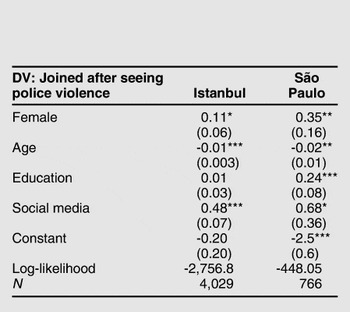
The key role of digital-age media in sparking the uprising helps explain the government’s surprise that its everyday level of repression ended up mobilizing so many erstwhile bystanders. As mentioned earlier, in an on-site poll of protesters, the most common answer to the question, “Why did you join the Gezi protests?” was “seeing the repressive acts of the police.” Our research shows that social-media consumers were significantly more likely to offer this response. Indeed, this was true both in Turkey and in Brazil, as table 1 shows. The survey research firm, Konda, supplied us with the individual-level data from their survey of more than 4,000 demonstrators, conducted in Gezi Park. We obtained equivalent data from Datafolha, a Brazilian survey research firm which also carried out an on-site survey of protesters in São Paulo. The two surveys were carried out at equivalent moments in the cycle, after the repression of early risers and at the peak of the subsequent uprisings. The São Paulo protesters were also asked their reasons for joining the protests. Footnote 40 Multivariate analyses show that, in both countries, social media consumers were more likely than others to report that they were drawn to the protests because of learning of repression against earlier protesters. Footnote 41
Individual-level correlates of mobilization by repression in Istanbul and São Paulo

Notes: Education = ordinal variable from 1 (illiterate) to 7 (graduate degree).
Social media=1 if the respondent stated that he or she first heard about the protests from social media.
Logistic regressions. Standard errors are in parentheses.
Source: Konda survey (Istanbul) and Datafolha Protester Survey (São Paulo). * p < .1, ** p < .05, *** p < .01
The rise of social media and cell-phone cameras capturing police attacks does not explain why the Gezi Park protests turned into a national uprising whereas others, close in time and place, did not. But it does suggest that governments have been caught off guard by a mobilizational capacity which these digital-revolution changes allowed.
Extrication.
A common perception is that the harsh measures and uncompromising language with which the protests were met reflected the personality and leadership style of Prime Minister Erdoğan. Indeed, Erdoğan’s default tactic in many situations is to inflame the passions of his base by insisting on the illegitimacy of his opponents. This tactic has yielded much success, and Erdoğan has stayed on top of Turkish politics longer than any leader since Atatürk. Others attribute the ferocity of the June 11 and 15 crackdowns to an earlier episode of prolonged protests which Erdoğan perceived as having been a challenge to his authority and policies. Footnote 42
Still, many political leaders would prefer to deal harshly with opponents and to bend reality to suit their ambitions and policy goals. What gave Erdoğan the freedom to respond to the Gezi Park protesters so harshly was the near-certainty that repression would have no serious electoral repercussions. This was a level of security of office that the other governments we consider lacked. Where Erdoğan could be confident that his constituents’ support would not waver when their government dealt harshly with protesters, others whose actions we consider had to worry about an electoral backlash.
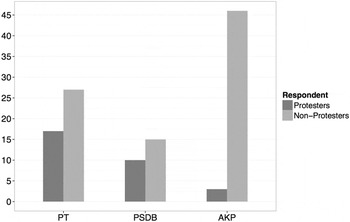
One indication of Erdoğan’s greater insulation from this backlash can be seen in the contrasting partisan compositions of the Turkish and Brazilian protests, revealed in our original sample surveys. Footnote 43 Almost none of the many thousands of protesters who flooded the Taksim Square area (or who protested elsewhere in Turkey) were supporters of the ruling party, the AKP. In Brazil, protesters included a sizeable minority of supporters of the ruling parties: the Workers Party—Partido dos Trabalhadores, PT—nationally and in the city of São Paulo, and the Brazilian Social Democratic Party—Partido da Social Democracia Brasileira, PSDB—in the State of São Paulo. These contrasts in the partisan orientation of protesters are displayed in Figure 1. Multivariate analyses on the individual-level correlates of protest participation confirm partisanship as a strong predictor of protest participation in Turkey but not in Brazil. Footnote 44
Percent of protesters and non-protesters who said they would vote for the ruling parties, São Paulo and Istanbul
Note: At the time when the survey was conducted in Brazil (November 20–December 23, 2013) the PT was in power nationally and in the city of São Paulo; the PSDB was in power in the state government of São Paulo. At the time the survey was conducted in Turkey (November 20–December 15, 2013), the AKP was in power nationally and in the city of Istanbul.
Source: Authors’ surveys, N=2,000 (São Paulo) and N=1,214 (Istanbul).

The electoral security of the Erdoğan government was also reflected in polls conducted around the time of the Gezi protests. A national poll conducted by Konda Research in July 2013, right after the protests, revealed that about 52 percent of the Turkish voters reported an intention-to-vote for the AKP if an election were held that day. Our original survey of a probability sample of Istanbul residents, fielded in November and December of the same year, gave a similar picture, with 49 percent of respondents reporting that they would vote for the AKP. The vote share of AKP in the latest general election (June 2011) before the Gezi protests was 49.8 percent, indicating that the AKP had gone through the protests without any weakening in their electoral standing.
In sum, facing a large backlash movement, sparked by everyday levels of police repression against a small group of “early risers,” the Erdoğan government escalated the level of repression significantly and suppressed the movement. Its insulation from future electoral risk should it resolve the crisis through more force allowed it to do just that.
Brazil’s June of Fury : Insecure Power, Reduced Repression, and Concessions
Overview.
The largest street demonstrations that Brazil had experienced in two decades began in June 2013, after a small organization took to the streets to oppose increases in public transportation fares. Protesters also opposed lavish spending in preparation for the Soccer World Cup, scheduled to take place in Brazil a year later, in July 2014. Footnote 45 The perception of scholars who have studied the protests is that they went from small to massive after the public became aware of excessive use of force by the police. Alonso and Mische write that the Brazilian scenario was like others in which a “disproportionate police response … captured on social as well as mainstream media sources, provokes indignation and anger among a broader swath of the population and generates a ‘scale shift’ [in] the movement.” Footnote 46
The parallels with Turkey (and Ukraine), where state violence also encouraged a transition from small protests to massive demonstrations, are striking. But the Brazilian authorities’ extrication strategy was remarkably different from the one pursued in Turkey. Rather than upping the level of repression, the Brazilian authorities stopped using rubber bullets, sent shock troops back to their barracks, and made a key policy concession.
These divergent strategies have their roots in differing cleavage structures and their fit with the party systems. We have seen that the public’s reaction to the Gezi protests was sharply structured around the central fault line in Turkish society, an overlapping cleavage that separates the religiously devout from the secular, the rural and less-educated parts of the population from the city dwellers with high school and college educations, and the AKP supporters from the supporters of opposition parties. Intense partisanship and overlapping cleavages induced a sense of electoral security in the ruling authorities in Turkey when they turned up the heat on protesters in late June 2013. By contrast, Brazil is a society with myriad cleavages—ideological, regional, class, racial—that overlap imperfectly with the structure of party competition. And, not unrelatedly, it is a society of relatively weak partisan identities. Footnote 47 The reaction to the protests and to the early repression did not leave the elected authorities with a sense of insularity from public opinion—quite the contrary. They felt pressure to back off, in part with an eye on future electoral consequences.
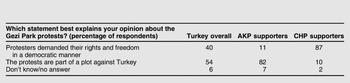
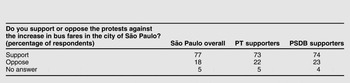
The contrasting ways in which partisanship structured popular responses in the two countries can be seen in tables 2 and 3. Table 2, from a representative sample of the Turkish population carried out by Konda, indicates that partisanship powerfully shaped reactions to the Gezi protests in the Turkish population. When asked whether the protesters were making legitimate demands or represented a foreign plot against Turkey (a claim often repeated by Prime Minister Erdoğan), the overall response tracks the pro-/anti-government split in the country. Among supporters of the ruling AKP, those who believed in the foreign plot outnumber non-believers by about eight to one. The proportions are reversed among supporters of the main opposition party, the Republican People’s Party (CHP). By contrast, in Brazil partisanship played a small role in shaping responses to the protests or the government’s handling of them. Table 3, from a Datafolha survey, shows basically identical opinions of the Brazilian protests among supporters of the leftist PT (in power nationally and locally) and of the center-right Brazilian PSDB (in power in the São Paulo state government).
Public opinion about the Gezi protests in Turkey

Source: Konda July 2013 Barometer (N=2,629). Konda Research & Consultancy, July 6–7, 2013. The AKP is the party of the then Prime Minister (now President) Erdoğan. The CHP is the main opposition party.
Public opinion about the protests in São Paulo

Source: Violencia in São Paulo, Aumento da Tarifa do Transporte Público, Emprego II (N=805). Datafolha, June 18, 2013. The PT is the leftist party that, at the time of the protests, headed the municipal government of São Paulo as well as the national government. The PSDB is a conservative party that headed the government of the State of São Paulo.
Phase 1 (June 3–12): Early protests and initial repression.
In São Paulo, a small protest took place on June 3, 2013, in opposition to recently announced public transportation fare increases. The protests were part of the regular strategy of the Free Fare Movement (Movimento Passe Livre, MPL), a small organization comprised mainly of graduate students from the University of São Paulo, a leading public university.
At the outset of the protests, São Paulo’s elected civilian leadership was univocal in its support of a tough police response. On June 8, Mayor Haddad, from the leftist PT, declared that the protesters “rejected the democratic rule of law.” Footnote 48 The day before, June 7, the governor of the state of São Paulo from the center-right PSDB, Geraldo Alckmin, had called the protests “absurd;” on June 12, he called the protesters “hooligans” and “vandals.” Footnote 49 The federal Minister of Justice, José Eduardo Cardozo (PT), also condemned the protests on June 12, saying, “Unfortunately, we have seen this taking place in São Paulo. I think it’s absurd, this is not the way that a demand will be met.” Footnote 50
The traditional paulista press also called for strong police action. On June 8, an editorial in the newspaper Estadão lamented that “the authorities in the area in charge of public security should have demanded more rigorous police action from the beginning of the protests.” Footnote 51 Referring to a major downtown artery, the editorial “Retake the Avenida Paulista” demanded that “it is time to put a full stop to this. The municipality and the Military Police have to enforce the restrictions on protests in the Avenida Paulista.” Footnote 52
Phase 2 (June 13): The crackdown.
Heeding the calls from left and right for strong measures, the Minister of Public Security of São Paulo State, Fernando Grella Vieira, authorized the use of Military Police Shock Troops (Tropas de Choque), a specialized force that deals with protests and crowd control. Footnote 53 The key moment of repression came on June 13, 2013. That day was for São Paulo what May 31 was for Istanbul and November 30, 2013 would be for Kiev.
As in these other cities, police actions in São Paulo would be self-defeating. Images of masses of Shock Troops aiming tear gas canisters and rubber bullets at unarmed civilians took the public aback. Photos and videoclips of injured and frightened protesters sailed through the Internet and social media, and shifted opinion strongly in sympathy with the protesters. A survey conducted on June 13 by Datafolha, just before the demonstration and the news of police violence, reported 55 percent support for protests. A second Datafolha survey, conducted on June 18, found support had risen to 77 percent. Footnote 54
If the authorities were surprised by the dimensions and national scale of the demonstrations that followed, so were protest organizers. A Brazilian activist, a veteran of many smaller protests, responded this way to our question about why Brazil’s June 2013 protests grew to be so large: “In general, at least in Brazil, the police arrive, beat people up, and everyone leaves. This wasn’t the case” [in the June protests.] When we asked why this time was different, she threw the question back to us: “There are some things that are hard to explain. Perhaps researchers can explain it.” Footnote 55
Having the day before called for stronger police actions, the newspaper Estadão decried the actions of the police: “Bombs and rubber bullets were shot without restraint. Policemen shot even when they were caught on camera by newspapers and TV. Journalists were injured, in addition to more than one hundred demonstrators. The cowardice and excesses by the police, shown time and again in the Internet and TV, changed the game.” Footnote 56
The media’s attitude toward the demonstrations shifted after June 13, not least because several journalists were injured and arrested. A much-viewed image from that day was of a 26-year-old TV Folha reporter, Giuliana Vallone, sitting on a curb, her face bloody and her right eye swollen shut, having been hit in the face with a rubber bullet.
The civilian authorities also began to sound a new note. Justice Minister Cardozo, having called the protests “absurd” on June 12, declared on June 14: “Beginning yesterday, we had a situation that we cannot, evidently, accept… . [T]here were situations of police violence that I consider unacceptable. I don’t think it’s correct for the police to treat people as the images showed yesterday.” Footnote 57
In the aftermath of the crackdown, there followed a war of narratives and images between the police and protesters, a war that the police were still fighting one year later. When two of the authors arrived at the headquarters of the Central Area Command of the Military Police on May 26, 2014, they were greeted by a lieutenant colonel who immediately pulled up a photo on his iPhone that showed him in the June 2013 protests, bleeding above his lip. He then showed the interviewers the scar that the wound had left. His superior, Colonel Celso Luiz (who moved into his position after the protests), started our interview by playing video clips on his desktop computer of acts of vandalism during the protests—people smashing ATM machines and store windows, a car on fire.
But the police had difficulty winning the war of images and narratives. The asymmetry in the level of weaponry worked against them. So did their long-standing reputation for excessive force. Footnote 58 One military police colonel whom we interviewed offered an historical explanation for distrust of the Brazilian police: “We supported the Getulio regime, it was a dictatorship; we gave support to the [1964–1989] military dictatorship. They remember because they are historians, they are social scientists, they are sociologists, law students. We want to turn the page but they remember the page.” Footnote 59
Phase 3 (June 14–20): Concessions and reduced repression.
The June 13 actions were followed by a change in strategy of the civilian authorities, who now reined in the police. Governor Alckmin announced that rubber bullets would no longer be used. At a press conference on June 16, Grella, the Minister of Public Security, ruled out further deployment of shock troops.
The police recognized that civilian authorities were bending to popular sentiment. But despite misgivings, police officers at the protests mainly complied with the mandated shift to a more passive policing of the demonstrations. Soon after, the elected authorities made a key concession on bus fares. On June 18, less than a week after the crackdown, Mayor Haddad announced that transit fares would revert to their earlier level. The protests peaked two days later and then subsided.
Rather than persisting, as Erdoğan did, in questioning the legitimacy of the protesters and threatening to meet popular force with popular force, the Brazilian authorities abandoned the language of protesters-as-lawless-hooligans and shifted to one that exalted free speech and collective action as essential for democracy. President Dilma Rousseff (PT) made favorable statements, if belated ones, about the protests. In a speech on June 18, she said “today Brazil woke up stronger. The greatness of yesterday’s demonstrations proves the energy of our democracy, the strength of the voice from the street, the civility of our population.” Footnote 60
Aftermath in Brazil.
Once the crisis had passed, there were signs that the government feared repression leading to larger protests, and tried to adjust strategies. No individual police officers were prosecuted for excessive use of force. But after the protests, some military police leaders were shifted out of central urban districts and moved to locations where protesters would be less likely to gather. And in some instances, new leadership was brought in to places that had been protest hot spots (such as Colonel Celso Luiz referred to earlier).
Some changes in police procedures suggested that lessons had been learned and attempts were being made to institutionalize them. Hence the crisis instigated an expansion of the “repertoire of policing strategies” used by the Brazilian police. Footnote 61 Police officials whom we interviewed credited Celso Luiz with introducing non-repressive crowd-control methods. A new tactic deployed before the 2014 World Cup was to try in advance to stop protests from happening. The Civil Police of São Paulo undertook sweeps of anarchist organizations. Protests did take place, in all host cities, though they were generally small. The police were heavily armed and on occasion used force. Footnote 62
Explaining the Brazilian Government’s Actions
Early repression.
There can be little doubt that the civilian authorities ordered strong police measures in Brazil, not anticipating that the result would be a mass uprising. A case can be made that civilian authorities in Brazil, more than their counterparts in Turkey or Ukraine, failed to anticipate not just the effect of police brutality on the public, but the nature and extremity of that brutality. Yet often the real surprise was not that the police were so brutal but that their brutality was so public. The Estadão editorialists’ dismay was that “policemen shot even when they were caught on camera by newspapers and TV.” Footnote 63 In the new world of omnipresent cameras and immediate production and diffusion of images, there was little chance that extreme police actions would not come to light.
Extrication in a federal system.
Once the police had acted and the public had reacted, the authorities chose to reduce the level of repression, as we have seen, and to make a key—and painful—policy concession. Our contention is that electoral sensitivities—concerns about the impact of persistent movements and police repression on incumbents’ future electoral prospects—encouraged the Brazilian authorities to pull back the police; whereas the depth and overlapping nature of Turkey’s political cleavages insulated the Turkish authorities from these pressures. Anticipating the aftermath of the protests, one official told us, “The [2014] World Cup generates political interest. What happens after the World Cup? Elections. For the state government, for the Brazilian presidency. Everyone is worried. If the police act, [the civilians] can lose votes; if the police don’t act, they can also lose votes. That’s the dilemma.” Footnote 64
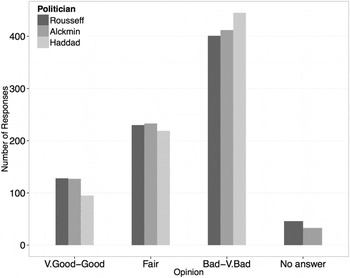
Another salient difference between these two new democracies is that Brazil is decentralized whereas Turkey is highly centralized. Does this greater decentralization explain Brazil’s more conciliatory extrication strategy? For instance, was the Brazilian strategy the result of bargaining among key political actors at different levels of government? We find little evidence that this was the case. What is striking, instead, is the shared sense of crisis that the uprising instilled. Mayor Haddad, his counterparts in other cities (such as Rio de Janeiro mayor Eduardo Paes from the Brazilian Democratic Movement Party, Partido do Movimento Democr´atico Brasileiro—PDMB), governors and public security ministers from São Paulo and other states, and the federal authorities; all were sent scrambling post-June 13 to reverse course on the demonstrations. And, as figure 2 suggests, as of June 18 in São Paulo, public opinion perceived all relevant political leaders’ handling of the protests in a negative light. Footnote 65
Responses to the question “What is your opinion of [President Rousseff’s / Governor Alckmin’s / Mayor Haddad’s] handling of the recent protests?”
Source: Datafolha survey, June 18, 2013, N=805.

Political authorities were not wrong to fear a public-opinion backlash. Where Erdoğan and the AKP’s support held steady through the Gezi Park uprising, support for key officeholders in Brazil eroded during the protests. Alckmin had won 50.6 percent of votes cast in the São Paulo governor’s election in 2010. In June 2013, before the protests, 52 percent of adult sampled declared that they would vote for him if an election were held then. Two weeks after the protests peaked, his vote intention had fallen to 40 percent. Footnote 66 President Rousseff’s support also tumbled, from 51 percent in the first week of June to 30 percent on June 30. Footnote 67
In sum, the Brazilian authorities in June 2013 underestimated the mobilizing effects of tough police measures against protesters. Once this effect was revealed to them, given incumbents’ fears of public-opinion and electoral consequences, they reduced the level of repression and conceded to the protest organizers’ key demand.
Ukraine’s EuroMaidan Protests: Insecure Power, Mixed Signals, and Concessions
Overview.
In 2010, Viktor Yanukovych became the fourth president of independent Ukraine, five years after the Orange Revolution had forced a new election and kept him from acceding to the presidency. Yanukovych and his entourage had come up through the Soviet system in Eastern Ukraine; he had served in the early 1990s as governor of the Donetsk oblast. As a political leader in independent Ukraine, Yanukovych maintained strong ties to Russia. But in 2012, dissatisfied with the terms Vladimir Putin was offering for Ukraine’s entry into a Eurasian customs union, Yanukovych entered into talks about a possible Association Agreement with the European Union. This possibility was greeted with enthusiasm in Western Ukraine.
Yet negotiations with the EU were also difficult and on Friday, November 29, 2013, Yanukovych left an Eastern Partnership summit in Vilnius without signing an Association Agreement, and protests broke out in central Kiev that day. The brutal repression of a small, lingering crowd in the Maidan, early the next morning, November 30, set in motion a series of events that ended three months later in the fall of Yanukovych’s government. As in Turkey and Brazil, early repression was followed by a major multi-city uprising. In the midst of the crisis, the government ordered the Berkut, a special police force under the direction of the Ministry for Internal Affairs, not to target protesters and offered to bring opposition leaders from the protests into the cabinet.
Thus the Ukrainian government tried to end the crisis through a strategy parallel to Brazil’s, and quite different than Turkey’s. It reduced repression and offered concessions to the opposition. These efforts were in some ways clumsily executed and undertaken against the backdrop of a less stable political regime than in either of the two other countries. There was political violence during the EuroMaidan protests, with thugs kidnapping several protest leaders; and the government tried to dampen the protests with a series of legal measures. Yet through many difficult weeks of confrontation, the Yanukovych government signaled that it would not again send in the police to repress demonstrators and did not resort to the kind of solution through escalated state violence that the Erdoğan government had deployed in Gezi.
Phase 1 (November 21–December 1, 2013): Initial repression.
Early Saturday morning, November 30, about 1,000 people remained from the previous day’s protests in the Maidan. The sound equipment that organizers had used was being taken down and workers had arrived to put up the square’s traditional Christmas tree. At 4:30 a.m., the Berkut spilled into the square. With batons and boots they beat everyone they could find—student protesters, municipal workers, visitors, and journalists—and pursued those who fled down nearby streets. Thirty-five people required medical attention, among them a cameraman and a photographer, both from Reuters; thirty-six people were arrested. Footnote 68
If the aim of the attack was to clear the square and end the protests, the result was the opposite. Estimates for the size of the crowds who choked the Maidan the following day—Sunday, December 1—ran as high as 800,000. Footnote 69 Certainly the crowds dwarfed those that had appeared in support of the Association Agreement the previous weekend. People close to the government and in the parliament (Rada) agreed that the turnout was massive and that the government was surprised. Footnote 70
Public opinion polls confirm that most of the protesters came to the Maidan because they were angered by the Berkut’s actions. On December 7–8, 2013, the Kiev International Institute of Sociology (KIIS) conducted a poll of a convenience sample of about 1,000 protesters on the Maidan. They asked, “Why are you here?” The modal response was “because of the brutal beating of demonstrators at the Maidan on the night of November 30.” This was the response of 66 percent of the more than one thousand respondents. Footnote 71
Phase 2 (December 2–25, 2013): Reduced repression and concessions.
In the days following the November 30 Berkut attacks in the Maidan and the huge December 1 rallies, the Yanukovych government, newly sensitive to the possibility of a backlash against police repression, gave signs that it would back down: lessons had been learned. On December 2, the chief of the Kiev police, Valeriy Koryak, resigned. The Minister of Internal Affairs, Vitaly Zakharchenko, declared publicly that “riot police abused their power,” and promised an investigation. Footnote 72
On December 11, the Interior Ministry again sent the Berkut into the area around the Maidan, with orders to remove barricades but not to touch the demonstrators. In public statements, Interior Affairs Minister Zakharchenko made clear that this was not a return to the repression of November 30: “I want everyone to calm down. There will be no storming of the square. No one will violate your rights to protest peacefully, but do not ignore the rights … of other citizens.” Footnote 73 The security forces mainly complied with the government’s orders for restraint. Tetiana Chornovol, a journalist, activist, and harsh critic of the Yanukovych government, explained in an interview that the “police were given orders not to hurt people. And [the opposition] exaggerated … they said people were being killed. No one was killed, some people were beaten, but [in general] the police acted very peacefully at that moment.” Footnote 74
Yet the wound left from the November 30 attack was too raw. As Chornovol’s words suggest, it was easy for protest organizers to send texts and tweets saying that the Berkut had again set upon the demonstrators. Along with the messages came images of phalanxes of officers, holding three-quarter-length body shields, their faces hidden behind protective visors. As activist and radio broadcaster Vitali Pornikov explained, “all this looked horrible when people saw the picture. The Berkut did not beat, but they looked ominous.” Footnote 75
Encouraged by movement organizers to interpret the new police measures as a repetition of the November 30 attacks, people streamed back into the square and barricades were quickly re-erected. The Guardian reported that “with the return of the Berkut, the protests were reenergized.” Footnote 76 The government also attempted to make concessions. On January 25, 2014, the president, now seeming desperate, offered cabinet posts to opposition leaders. The post of prime minister was offered to Arseniy Yatseniuk, the leader of the Batkivshchyna or Fatherland opposition bloc in the Rada; that of Deputy Prime Minister for Humanitarian Affairs to UDAR’s Vitali Klitschko. The opposition leaders turned the offers down.
The movement ebbed and flowed for two more months, until Yanukovych fled to Russia on February 21, 2014, denouncing the “coup” that ousted him from power.
Aftermath in Ukraine.
Within a week of Yanukovych’s departure, the interim interior minister announced that the Berkut would be disbanded. A small contingent of protesters remained encamped in the Maidan through early May, 2014, at which point a combination of face-to-face persuasion by erstwhile activist, now mayor Klitschko, and gentle police actions finally cleared the square.
Explaining Government Actions in Ukraine
The initial repression and failed extrication.
The decision to send the Berkut into Maidan Square in the early morning hours of November 30, 2013, with instructions to use harsh measures and break up the protest, led to a major backlash uprising, as similar actions had sparked uprisings in Turkey and Brazil. The almost universal view among people we interviewed, who included former police officials and insiders from Yanukovych’s Party of Regions, is that the attacks were approved by Yanukovych. Our interviews also indicate that the government was sensitive to public opinion. Inna Bogoslovskaya was a deputy in the Rada and a member of the Party of Regions. She described the ways in which the president and his inner circle tried to anticipate public opinion. Footnote 77 She recalled a November 18 meeting, before the protests, between Andriy Klyuyev, the secretary of the National Council for Security and Defense, Volodymyr Rybak, the Speaker of the Rada, and five other prominent Party of Regions deputies. Klyuyev told those present that Yanukovych and his advisors were looking at public opinion polls that indicated that if he refused to sign the Association Agreement with the EU, he would not provoke much of a reaction; the people are “dormant” and will “take anything,” Bogoslovskaya recalled Klyuyev asserting. Though this turned out to be a misreading of the public’s mood, it is indicative of the government’s concerns about shaping policies and actions to cater to public opinion.
The Ukrainian strategy version of extraction-through-reduced repression was not unlike Brazil’s and was also taken in the context of weakening public support. Like their Brazilian counterparts, Ukrainian authorities had reasons to believe that repression had become an electoral liability. Yanukovych was in a fragile situation even before the protests had started. Polls conducted in October indicated that he would lose a presidential runoff against any of the opposition’s potential candidates. Footnote 78 But where the Brazilian authorities basically got things right in the second phase, the Ukrainian authorities allowed themselves to appear to be undertaking another round of repression, as we have seen, by sending the Berkut back into the Maidan on December 11, though their intention was to avoid violence against demonstrators.
Rival Explanations for Divergent Extrication Strategies
The crucial factor shaping extrication strategies, we have argued, is the security of the government’s hold on office, specifically, its ability to maintain its popular support base even if it undertakes very high levels of repression. For these governments, varying degrees of security of office in turn reflected the nature of social cleavages and public opinion about the government and the protesters. We have already discussed why explanations that stress the social networks underlying the movements or the presence of a third-party hardliner cannot account for the variation we observe. We now briefly consider several additional rival accounts.
-
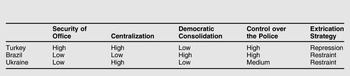
Decentralization. Brazil stands out among our cases for its decentralized structure of government. And we saw that office-holders at several levels of government—sometimes from competing parties—played a role in the extrication process there. Yet we found no evidence that federalism was related to their choice of concessions and restraint. Furthermore, the Ukrainian system was centralized and yet the strategic instincts of the Yanukovych government, in the extrication phase, were more like the Brazilians’ than the Turks.’
-
Democratic consolidation. We suggested in the introduction that the degree of democratic consolidation is not an apt explanation for the patterns we observe. Though Brazil is a more consolidated democracy than Turkey, Ukraine is not, and yet the Yanukovych government attempted to draw back the police and offer concessions—an extrication strategy much closer to Brazil’s than to Turkey’s.
-
Incomplete civilian control over the police. Police characteristics could also influence repressive strategy. Footnote 79 Perhaps civilian leaders uniformly preferred peaceful extrication strategies but were thwarted by police forces, over which they lacked full control. If so, it would have to be the case that the Turkish authorities exercised less control than the Brazilians or Ukrainians. Our research turned up little evidence of lack of civilian control over the police in Turkey. Certainly the Turkish police complied with their civilian leaders’ demands that they suppress the uprising. In interviews, we found the views of Turkish police officials to be almost perfectly aligned with the statements of the government.
In Brazil as well, we found little evidence of insubordination in the military police and shock troop actions against protesters, before, during, or after the June 13 crackdown. Police officials whom we interviewed insisted that they acted on orders of the civilian authorities: “The government said, ‘Don’t allow people to stay in the streets.’ We obeyed.” In the beginning, Mayor Haddad said, ‘I can’t accept [the blockage of the Avenida Paulista].’ One week later he reversed his decision.” Footnote 80
The case in which repressive agents were arguably not acting on the commands of, or in accord with the strategy of, the government in its efforts to end the crisis was Ukraine, and in this case it was not the Berkut that failed to act on the government’s commands but shadowy actors who kidnapped and beat protesters. But this possible insufficient control of the forces of repression helps explain the failure of the Yanukovych’s extrication strategy, not the choice of that strategy.
-
Ideological orientation of the government. Perhaps leftist governments are less likely to crack down on protests, and right-wing or conservative ones more likely. It is no easy matter to characterize the ideological orientation of the governments in question on a left-right, conservative-liberal, or any single dimension; we opt in table 4 for a “leftist-conservative” dimension. But these orientations do not account for different extrication strategies. The best evidence is from within-case variation in Brazil. Conservative and leftist governments alike favored mid-level repression of the early risers, and both ideological types shifted to a non-repression, conciliatory stance after the failed crackdown.
-
The nature of the threat. The threat posed by protesters is another prominent explanation for government responses in the literature on social movements. Footnote 81 Perhaps differences in the costs that governments would have to bear should they make policy concessions explain the different strategies of extrication they pursued. If this were the key explanatory variable for the cases we have studied, it would have to be the case that the most exigent demands were those of protesters in Turkey, with those in Brazil and Ukraine making demands that were easier for their respective governments to meet. In any objective sense, the opposite is true: the demand that the Ukrainian government rejoin talks with the EU must be considered more substantial than that bus fares be reduced or that an urban development project be set aside. Neither does the size of the protests or the tactics used by demonstrators exhibit significant differences to account for the varied governmental responses. Footnote 82
-
Social class of protesters. The allusion, earlier, to the class composition of protesters suggests another possible explanation. Footnote 83 Perhaps governments are wary of wielding batons against highly-educated, middle-class protesters, less so when the protests are composed of the ill-educated and the poor. Though this proposition might be true in general, it does not explain variation among the countries we studied. Gezi Park protesters skewed high in income and education, as did those on the streets of São Paulo and Kiev. Footnote 84
Extrication strategies: Where the cases fall on favored and rival explanations


Table 4 summarizes our cases in terms of our key explanatory factor, factors related to the six rival explanations just discussed, and the outcome—the extrication method that each government attempted. What emerges is the similarity of the Turkish and Ukrainian cases on most of the rival explanatory variables. What made Ukraine look more like Brazil and less like Turkey was the lack of security of office that the leaders of this tumultuous and revolution-prone country faced.
Conclusions: Repression, Accountability, and the Political Construction of Cleavages
When authoritarian governments hold popular elections, there is usually little uncertainty about who will win. Not so in democracies. A key distinguishing feature of democracies is that elections “institutionalize uncertainty” Footnote 85 and expose incumbents to electoral risk. This insecurity of office is what undergirds accountability: politicians who may or may not prevail in the next election have incentives to govern well and to represent the interests of constituents.
But the degree of insecurity of office is not invariant across democracies. Political circumstances and societal structures can increase or reduce office-holders’ electoral security. Footnote 86 Of course, politicians can increase or reduce their chances of reelection by performing well or badly; this is democratic accountability. But sociological or identity-based connections between constituents and parties can reduce the formers’ sensitivity to government performance and hence weaken accountability. In societies sharply divided along racial or ethnic lines and in which one dominant party captures the lion’s share of support from the majority group, its leaders will have more latitude to abuse their office or simply underperform and yet avoid being thrown out of office. Thus the “ethnic census” quality of elections in post-apartheid South Africa, as Ferree explains, shields the ANC from electoral accountability. Footnote 87
The phenomenon of ruling parties that have a lock on power, even when they face repeated free and fair elections, has worried students of democracy. One concern is that the opposition may give up on elections and turn to violence. Footnote 88 Another is that parties that enjoy high levels of electoral security are less accountable, for the reasons just explained, and more prone to misbehavior. This last concern finds support in our study.
Our study shows that security of office can arise in democracies that are not ethnically divided but divided along other powerful cleavage lines. And it underscores the threats to the integrity of the person that can arise when governments enjoy high levels of electoral security. The government of Turkey was relatively secure: it enjoyed nearly undisputed “ownership” of the electorate on the majority side of a deep socio-religious divide. The Turkish AKP consistently gets the overwhelming electoral support of the devout, conservative majority. Footnote 89
The combination of a powerful party achieving undisputed support from voters on one side of a highly salient divide and a consequent lack of restraint on that party from using harsh tactics against citizens is not unique to Turkey. Venezuela is another instance. The prevailing, highly salient divide in that country is a class cleavage; regional, racial, and even religious bases of division tend to be overshadowed or subsumed by the class divide. Since 1999, the class cleavage has found direct expression in a political system dividing supporters and opponents of Hugo Chávez and his Bolivarian Revolution. This political divide persisted after 2013, when President Chávez died and was succeeded by Nicolás Maduro. Protests rocked Venezuela, beginning in early 2014. They began with small groups and grew into a mass movement after a heavy-handed police response against university students. As in Turkey, the setting was highly polarized, the population of protesters was drawn nearly exclusively from among the government’s opponents, and the ruling party did not fear a loss of support among its own constituents if it increased the level of repression, which it did. Footnote 90
The less-electorally-secure governments we studied presided over societies with complex and cross-cutting cleavages. The ruling parties lacked firm “ownership” of important segments of the populace. Though the core constituency of the PSDB—the incumbent party in the state of São Paulo during the protests—comes from middle- and upper-middle class voters, the party represents a broader cross-class coalition anchored around multiple issues. The same can be said about the nationally incumbent PT. In spite of its primarily working class appeal, it also commands substantial middle-class support. Not unrelatedly, party identification is weak in Brazil, so that masses of stalwart supporters, the counterparts of AKP voters in Turkey, make up a small part of the electorate. Footnote 91
Ukraine is a country of shifting and complex social cleavages. Yekelchyk notes that in the regions of Ukraine which historically were part of the Russian Empire (and then the Soviet Union), the majority of the population is ethnically Ukrainian. The eastern parts of the country do not vote as a bloc, but are influenced by “ethnic composition, age profile industrial development, trade patterns, and tourist routes.” Footnote 92 The Communist Party was an important force in the 1990s but later declined; central Ukraine’s voting patterns followed those of the east in the 1990s, but later came more in line with those of the western part of the country.
Yanukovych had aspirations to build the Party of Regions into the undisputed representative of the southeastern regions and Russophile segments of the electorate. But the party’s leader managed to spark two popular revolts—the Orange Revolution and the EuroMaidan movement; the party basically disbanded after Yanukoych’s 2014 exit to Russia. Nor have Western-oriented politicians forged a strong party capable of voicing and unifying its electorate. The history of the opposition in the 1990s and 2000s is littered with political alliances that crumbled as erstwhile partners became opponents. Footnote 93
The contrast with Turkey is stark. Scholars of Turkish politics highlight the existence of a historical, politicized cleavage that has pitted the nationalist and secular elites of the “center” against the ethnically diverse, conservative, and religious non-elites of the “periphery.” Footnote 94 Despite several interruptions of democratic rule, major parties have continued to position themselves on one side of this central cleavage since the first competitive elections of 1950. The latest incarnation of this interaction of party system and societal cleavage is the competition between AKP, a relatively new party that claims to be a continuation of the political tradition representing the “periphery,” and CHP, currently the largest opposition party that advocates “centrist” values and is considered to be the founding party of the Republic. The success of AKP lies in its ability to dominate the “peripheral” electoral scene, and to draw overwhelming support from the religious and conservative majority of the society.
Future cross-national research could test our claim that insecurity of office in new democracies encourages restraint in dealing with protests. A measure of insecurity of office is electoral volatility—the degree to which the electoral bases of political parties changes over time. Volatility is well known to be higher in new democracies than in established ones. Footnote 95 A measure of repression attuned to democratic political systems demands focusing on state restrictions on collective action rather than ostensible forms of state violence. Footnote 96 Following prior work, this kind of “less-lethal” form of repression can be operationalized through aggregate civil liberties scores as those produced by Freedom House. Footnote 97 However, in contrast to existing work focusing on repression levels, our argument implies that changes in electoral volatility should trigger concomitant changes in civil liberty scores. Footnote 98 Studying change rather than levels is appropriate given our emphasis on electoral concerns triggering discrete changes in repressive strategy.
Another question for comparative research is the relative importance of cleavage structures (overlapping or cross-cutting) versus party system-cleavage structure mapping (loose or tight) in shaping electoral security. The cases studied here suggest an interactive effect, so that an overlapping and highly salient cleavage and a party that captures the votes of people on the majority side of the cleavage are the joint underpinnings of electoral security.
Yet any research in this area needs to be cognizant of relations of mutual causation between party systems and cleavage structures. Political scientists have shown that, in equilibrium, the number of cleavages in a society influences the number of effective parties that the political system is likely to sustain. Footnote 99 The number of parties competing is likely to influence the capacity of any one to capture the majority identity group’s vote.
Indeed, mutual causation of party systems and cleavage structures goes even deeper. A strong message emerging from our research is that “social” cleavages are politically constructed, or at least politically reinforced. The message resonates with research into social cleavages and party competition in other democracies, old and new. In Europe, political parties’ rhetoric, manifestos, and policy choices shape the relative importance of class and religious cleavages. Footnote 100 In South Africa, the continued reputation of the major opposition party, the Democratic Alliance (DA), as a party of whites owes as much to savvy ANC strategy as it does to inevitable dynamics of ethnic competition. Footnote 101
Rhetorical stratagems, deployed against the backdrop of cleavage structures, were just as crucial in the outcomes we considered in our paper. The Turkish government did not passively rely on their supporters to reject the protesters; it led its followers to interpret the uprising as a conspiracy against the nation, instigated from abroad, thus splitting responses to the protests and repression along predictable party-cleavage lines. In the more fragmented settings of Ukraine and Brazil, responses to the repression were more multi-partisan. The harsh actions of the police elicited a widespread (though far from universal), visceral rejection of violations of the individual by the state. Symptomatic of the breadth of this response was that the post-crackdown protests in Brazil and Ukraine attracted some people who identified with the ruling parties, as we have seen. They, too, found something shocking in images of police brutality against unarmed citizens. Though Erdoğan encountered some discontent about his treatment of the protesters in the upper reaches of the AKP and in the pro-government part of the business community, the real nightmare for him would have been had his followers not embraced the idea that the protesters deserved the abuse to which the police exposed them.
Thus politicians in democracies who find themselves relatively insulated from electoral risk because they sit atop a party system deeply rooted in social cleavages are not merely fortunate but also savvy and strategic. Their success, unfortunately, can often be measured in the ruthlessness of their tactics and in the injuries inflicted on their citizens.