


Introduction
Research evidence suggests that Cognitive Behaviour Therapy (CBT) is an effective treatment for depression and is now included in the National Treatment Guidelines in the UK and the USA (NICE, 2004). The majority of this evidence originates from western based research. However, emerging evidence suggests that CBT might also be effective in treating mental health problems in the developing countries (Araya et al., Reference Araya, Rojas, Fritsch, Gaete, Rojas, Simon and Peters2003; Rahman, Malik, Sikander, Roberts and Creed, Reference Rahman, Malik, Sikander, Roberts and Creed2008; Sumathipala et al., Reference Sumathipala, Siribaddana, De Silva, Dewey, Prince and Mann2008). CBT involves exploration and attempts to modify automatic thoughts, underlying assumptions and core beliefs and these can be expected to vary across cultures (Wong, Reference Wong2008, Padesky and Greenberger, Reference Padesky and Greenberger1995). It is because of these variations that CBT needs modification before it can be used in non-western cultures (Wen-Shing, Reference Wen-Shing2004; Hall, Reference Hall2001; Barrera and Castro, Reference Barrera and Castro2006) and so it is perhaps because of these challenges that a literature search found only a few trials for CBT in depression for non-western populations (Wong, Reference Wong2008; Agnes, Mei-chun, Wilson, Sophia and Dejian, Reference Agnes, Mei-chun, Wilson, Sophia and Dejian2009; Rossello, Bernal and Rivera-Medina, Reference Rossello, Bernal and Rivera-Medina2008).
There is high prevalence of depression in developing countries, particularly in Pakistan (Mirza and Jenkins, Reference Mirza and Jenkins2004). The population of Pakistan is nearly 160 million. Psychiatric services however are small in number, poorly resourced, and located mainly in urban centres. Currently there are 4 large mental hospitals and 30 mental health units spread throughout the country. There are nearly 3570 psychiatric beds, with around 400 psychiatrists. Within the national health system there is no referral system and sub specialities (psychotherapy) are nonexistent. Psychiatry units have very few qualified psychologists. This is in spite of the fact that the number of psychologists graduating from universities has increased in recent years (Naeem, Reference Naeem2005).
There are no evidence based psychological therapies for depression available in Pakistan. The aim of this study therefore was to evaluate the effectiveness of a culturally adapted manual-based CBT for Pakistan program that was based on our earlier qualitative work.
Method
Study settings and population
The trial was conducted in Rahim Yar Khan, a large town in Southern Punjab, Pakistan. At the onset we arranged meetings with the local primary care physicians and explained our project to them. A consecutively referred sample of primary care attenders from three participating primary care clinics were invited to participate.
Inclusion/exclusion criteria
Patients with an ICD-10 (International Classification of Diseases) RDC (Research Diagnostic Criteria) diagnosis of depression (F32, F33) and living locally within an hour's walking distance from the family practices were included. Those with severe physical illness, intellectual disability, dysthymia or severe mental illnesses were excluded from the trial.
Interventions
The pilot trial was undertaken in Pakistan as part of our “Developing Culturally-Sensitive CBT Project”. The aim is to develop methods and processes to modify CBT to make it accessible, effective and acceptable for use in non-western cultures. In the preparatory first stage of this two-stage mixed method project, we aimed to develop and refine a CBT manual to treat depression.
Preparatory stages in development of culturally adapted CBT
In the first qualitative study six clinical psychologists were interviewed about their experiences of providing therapy, especially CBT, to depressed patients. In particular, issues around barriers in therapy, helpful and unhelpful techniques, and factors that influence outcome of therapy were explored (Naeem et al., Reference Naeem, Gobbi, Ayub and Kingdon2010). In the second study, nine depressed patients were interviewed, focusing on presenting symptoms, referral behaviour, attribution styles, acceptability of talking therapies, and obstacles in its delivery (Naeem et al., submitted). In both studies, subjects were interviewed until saturation was achieved and new themes stopped emerging. Two authors (FN and MG) analyzed the data using content analysis.
In the third study, 34 university students from social sciences departments were organized into focus groups. The aim was to find out the extent to which CBT was consistent with their personal, religious, family, social and cultural values (Naeem, Gobbi et al., Reference Naeem, Gobbi, Ayub and Kingdon2009). We further utilized their help in the selection of culturally equivalent terminology used in CBT. We employed a technique called “name the title”, which involved students being given a description of a term (e.g. black and white thinking) and being asked to find an equivalent idiomatic phrase, rather than simply translating it into Urdu for them.
Information gathered from these preparatory qualitative studies, as well as our own field observations and experience of therapy and clinical practice, were collated to develop an adaptation framework that guided the CBT adaptation process (Naeem, Ayub et al., Reference Naeem, Ayub, Gobbi and Kingdon2009).
The adaptation framework consists of three main themes, each further divided into seven minor areas. The first main theme, Culture and related issues, encompasses: culture, religion and spirituality, family, communication and language, rules of engagement, symptoms and expression of distress, focus of therapy, traditional healing practices. The second main theme, Capacity and circumstances, covers: gender, educational status, coping strategies, capacity of the health system, availability of mental health professionals, pathways to care and help seeking behaviour. The third theme, Cognitions and beliefs, looked into beliefs about health and illness, causes of illness, treatment, health systems, healing and the healer, psychotherapy, and cognitive errors and dysfunctional beliefs).
Format and content of adapted CBT
A CBT manual was developed as a result of the preparatory qualitative phase. Out of the planned 9 sessions, initially 6 sessions could be delivered on a twice-weekly basis and subsequently once a week. We originally wanted to have 12 sessions but, based on our preparatory qualitative feedback, we decided to have only 9 so as to reduce the burden and travel costs to the patients.
Some of the cultural adaptations that we incorporated in the CBT manual were:
- Therapists initially focused on physical symptoms. We included physical symptoms in the fourth column in our first thought diary to highlight the importance of the physical symptoms and their association with thoughts and mood.
- Urdu equivalents of CBT jargon were used in therapy.
- Culturally appropriate home work assignments were selected and patients were encouraged to attend even if they were unable to complete their homework.
- During the therapy sessions a member of the family accompanied all patients and helped the patient with homework when required.
- Folk stories and examples from the life of the Prophet Muhammad and Quran were used to clarify issues.
Therapist background and training
CBT was provided by a psychiatrist (FN) and two psychology graduates who received extensive training and ongoing supervision by FN in the use of this CBT manual. During the duration of the trial an expert in CBT (DK) provided supervision over the phone and in face to face meetings.
Facilitating compliance
Learning the lessons from the preparatory qualitative studies, we planned a priori to overcome barriers to recruitment and attendance for the subjects. We asked referring primary care physicians to talk to the subjects and emphasize the importance of regular attendance. The day before the sessions, all patients were prompted by the therapists to attend.
Prescription of antidepressants
Participating primary care physicians trained in the management of depression prescribed 20mg of either Paroxetine or Fluoxetine to every patient in both arms of the trial and followed up the patient every 4 weeks.
Objectives
The primary aim of the study was to evaluate the efficacy of the culturally adapted CBT in Pakistan and second, to ascertain our ability to train therapists, deliver the intervention, and collect outcome data to calculate sample size for a later definitive trial.
Our hypothesis was that culturally adapted CBT with combined antidepressants (SSRI) would be superior to antidepressants alone in depressed Pakistani primary care attenders.
Outcomes and assessments
Assessments were carried out at baseline and outcomes at 3-months by raters blind to the type of intervention. Depression was rated by previously validated Urdu versions of Hospital Anxiety and Depression Scale (HADS) and Bradford Somatic Inventory (BSI). HADS consists of 7-item subscales each for depression and anxiety. Scores of 11 or more on either subscale are considered to be a case (Mumford, Tareen et al., Reference Mumford, Tareen, Bajwa, Bhatti and Karim1991). BSI consists of 45 items, with scores above 21 indicative of depression (Mumford, Bavington et al., Reference Mumford, Bavington, Bhatnagar, Hussain, Mirza and Naraghi1991). Considering the low literacy levels of the subjects and in order to standardize the rating process, these self-rated questionnaires were read to all subjects in a standardized procedure.
Recruitment
Between January and May 2008 consecutive referrals from three primary care clinics were assessed for ICD-10 depression, and those meeting the inclusion criteria and giving written consent were included in the trial. The randomization to the treatment and control arm was done remotely in the University of Southampton by using www.randomization.com. We generated 8 blocks of 4 and one block of 2 for this purpose. The treatment arm received CBT combined with antidepressants, and the control arm received antidepressants alone.
Statistical analysis
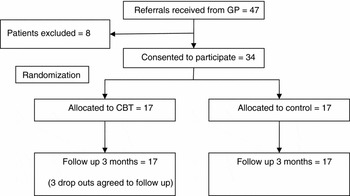
We followed the CONSORT guidelines for randomized controlled trials (Moher, Schulz and Altman, Reference Moher, Schulz and Altman2001) (see Figure 1). The analysis was carried out on intention to treat basis using SPSS version 16.0. Initial analyses to compare the two groups were carried out using t test andχ2 test. A linear regression analysis was used, with end of therapy as the dependent variable and group allocation, financial status and baseline differences scores as independent variables. We report η2 as effect size calculated from t scores. We used the formula effect size = √ t2/t2+ df. This is an appropriate method for effect size calculation for groups of equal sample size.
CONSORT flow diagram of CBT pilot trial

Ethics approval
Ethics approval was received from the Ethics committee of Sheikh Zayed Medical College, Rahim Yar Khan.
Results
Seventeen patients were assigned to each arm of the trial. There were no statistical differences between the two groups at baseline; age [therapy = 32.35 (SD 8.9), control = 33.64 (SD 1.0), p = .965], gender (female) [therapy 14(82%), control 11(65%), χ2 = 0.244], education (5 to 10 years of education) [therapy 8(47%), control 9(52%), χ2 = 0.732], family system (nuclear family living) [therapy 8 (47%), control 8 (47%), χ2 = 0.607],employment status (unemployment) [therapy 10(59%) control 9(53%) χ2 = 0.399] marital status (married) [therapy 13(76%) control 13(76%) χ2 = 1.0], except for financial status: more people were in the lower monthly income group in the CBT group compared to control (i.e. those earning up to Rs10000) [therapy 10(59%), control 16(94%), χ2 = 0.015].
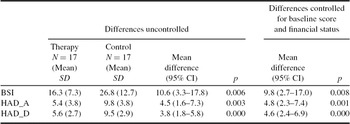
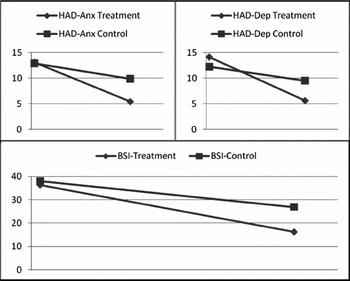
Table 1 shows the differences between the therapy and control group at the end of the therapy, controlled for the baseline differences in HADS score. Final outcome assessment at 3 months showed a statistically significant reduction in BSI and HADS scores in the therapy group as compared to the control group. Since baseline differences were observed in financial status between the two groups, further analyses were carried out with these differences included in linear regression as an independent variable along with the group and baseline differences. However, the differences remained statistically significant as shown in Table 1 (see also Figure 2).
Differences between the treatment and control groups, both uncontrolled and controlled for intial differences as well as financial status. Analyses were carried out using a linear regression

Scores on Hospital Anxiety And Depression Scale (HADS) subscales and Bradford Somatic Inventory (BSI) at baseline and at 3 months Notes: HAD-Anx = Hospital Anxiety and Depression Scale Anxiety Subscale; HAD-Dep = Hospital Anxiety and Depression Scale Depression Subscale; and BSI = Bradford Somatic Inventory Scores

The effect size (eta square) for HADS Depression score was found to be 0.60.
Fourteen (82%) patients attended at least 6 or more CBT sessions. The remaining three patients attended 1, 3 and 4 sessions respectively.
When comparisons were made of therapy and control group at the end of 3 months for compliance with antidepressants, subjects in the therapy group were more compliant (65%) compared with those in control (35%), χ2 = 10.7, p = .001.
Discussion
Increasing awareness and improving recognition of depression in poor countries like Pakistan will not be beneficial unless it is also accompanied by specific treatments that overcome the socio-cultural and health system barriers faced by such populations. Our culturally sensitive intervention is based on CBT as used in western society but we successfully undertook necessary conceptual, format and delivery modifications that improved compliance with therapy and thus symptom reduction. A high rate of dropouts from the treatment was cited as a major barrier in our preliminary qualitative studies. More subjects in our therapy group were still taking antidepressants at the end of the therapy compared to the control group. It is certainly possible that this disparity in medication use has contributed to better outcomes in the therapy group.
Appropriate intervention began with a priori understanding of socio-cultural nuances, discussion and exploration of therapy with indigenous therapists and patients; this was followed by development of informal networks within primary care, which helps to bring together the subjects and health providers. During our qualitative work for the adaptation of therapy, interviews with the psychologists revealed that patients lived far away and probably this is the biggest hurdle in providing therapy. They present mainly with somatic symptoms and drop out of therapy as soon as they start to feel slightly better. Patients also like a directive style and probably don't feel comfortable when a collaborative style is used. They also felt family involvement can be a hurdle if not dealt with carefully. Patients like medicines and are not even aware of the role of a psychologist or psychotherapy. Seeing faith healers and the lack of an explanation by the psychiatrists at the time of referral were seen to be other major problems. Interviews with the patients confirmed some of these themes (for example, they were not familiar with psychotherapy and they presented mainly with somatic symptoms and believed that only doctors can treat their illnesses). Patients had very limited knowledge of the illness; however, they believed that, in general, mental illnesses were due to social or psychological causes. They said they could not stop performing their duties and wanted to get better as soon as possible. Interestingly, almost all the patients in our study referred themselves to the psychiatry departments.
In the study with the students it was revealed that although concepts underpinning CBT were not in conflict with their personal, family and social values, they might be in conflict with their religious values. Field observations and experience of therapy were also very helpful in developing insights into cultural issues. For example, one patient with anxiety said “I have a ball of gas in my stomach which rises to my head and then I start feeling dizzy”. Another patient when asked, “What is wrong with you and how can we help you”, replied, “You are the doctor, you tell me what is wrong with me”. Some traditional healers can diagnose patients by just looking at them, and patients' expectations can be determined by their experience with these healers. Discussions with colleagues in Pakistan revealed that patients think mental illnesses are due to religious causes (for example sins) or even material deprivation. Magic spells, evil eye and bad luck can be described as the cause of an event or even an illness. The therapist needs to be careful when working with dysfunctional beliefs; for example, dependence on others, seeking the approval of others, especially parents, or sacrificing in favour of a family member might be seen as positive values in Pakistani culture. Patients might not feel comfortable with commonly used therapy techniques like “Socratic dialogue”. Similarly, assertiveness can be considered as rudeness and so some modifications were made to deal with this issue.
In this preliminary trial, depression and somatic symptoms only were measured. Future research needs to assess cost-effectiveness, quality of life, disability, and changes in cognitive errors and beliefs.
In conclusion, therapists, trainee psychologists and psychiatrists, trained in the use of a culturally adapted CBT manual, were successful in reducing anxiety and depression along with somatic symptoms in patients referred from primary care in Pakistan.
Limitations
This is only a pilot project and many aspects, including the variables that could potentially influence therapy, were not studied; detailed analyses were also not carried out due to the small sample size. For example, close contact with therapists and increased compliance with medication in the therapy group might have led to this improved compliance. We are now planning a larger trial to address these issues.



Comments
No Comments have been published for this article.